|
Civil Defence Emergency Management Group Meeting Wednesday 4 September 2019 at 11.00am
|
|
|
|
|

|
Civil Defence Emergency Management Group Meeting Wednesday 4 September 2019 at 11.00am
|
|
|
|
|
Civil Defence Emergency Management Group Meeting
4 September 2019
Civil Defence Emergency Management Group Meeting Agenda
Meeting to be held in the Council Chamber
36 Water Street, Whangārei
on Wednesday 4 September 2019, commencing at 11.00am
Recommendations contained in the agenda are NOT decisions of the meeting. Please refer to minutes for resolutions.
MEMBERSHIP OF THE Civil Defence Emergency Management Group Meeting
Chairman, FNDC Councillor Colin Kitchen
|
KDC Councillor Anna Curnow |
NZ Police Representative Superintendent Tony Hill |
WDC Mayor Sheryl Mai |
|
FENZ Representative Mr Commander Brad Mosby |
NRC Councillor Rick Stolwerk |
MCDEM Representative, Ms John Titmus (Observer Status) |
Item Page
1.0 apologies
2.0 declarations of conflicts of interest
3.0 Presentation - The Emerging Strategic Communications Role 4
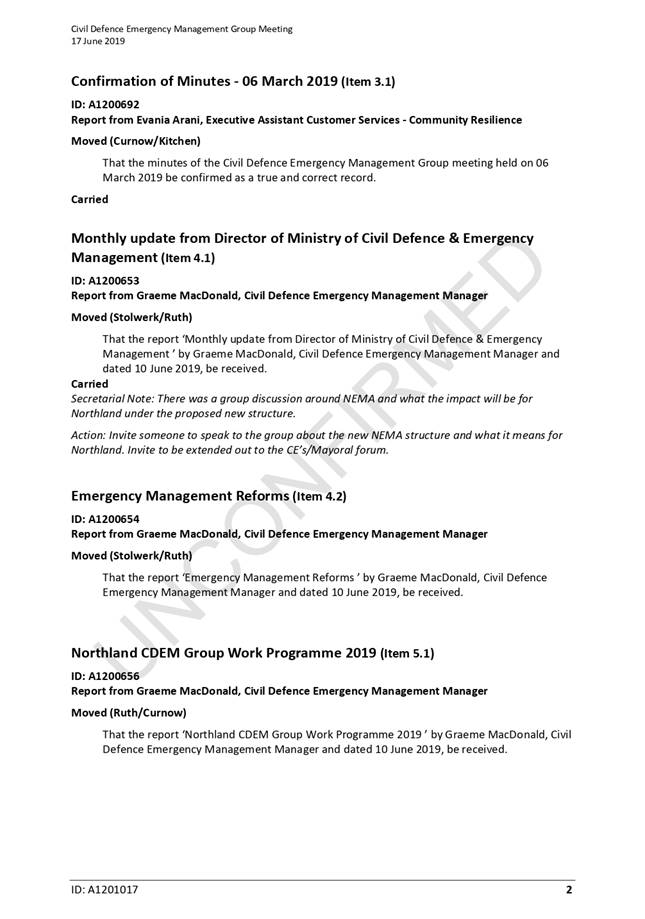
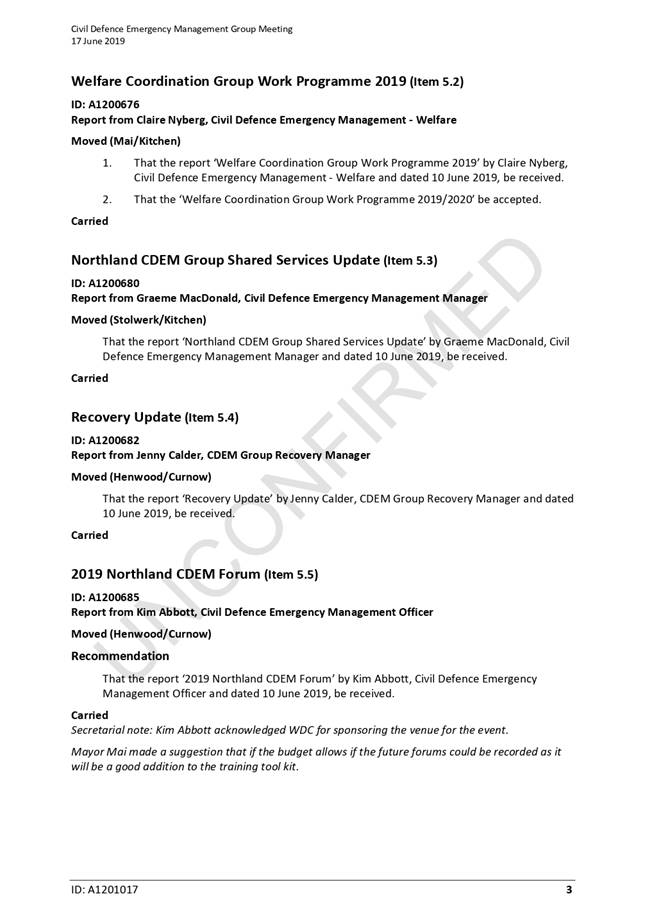
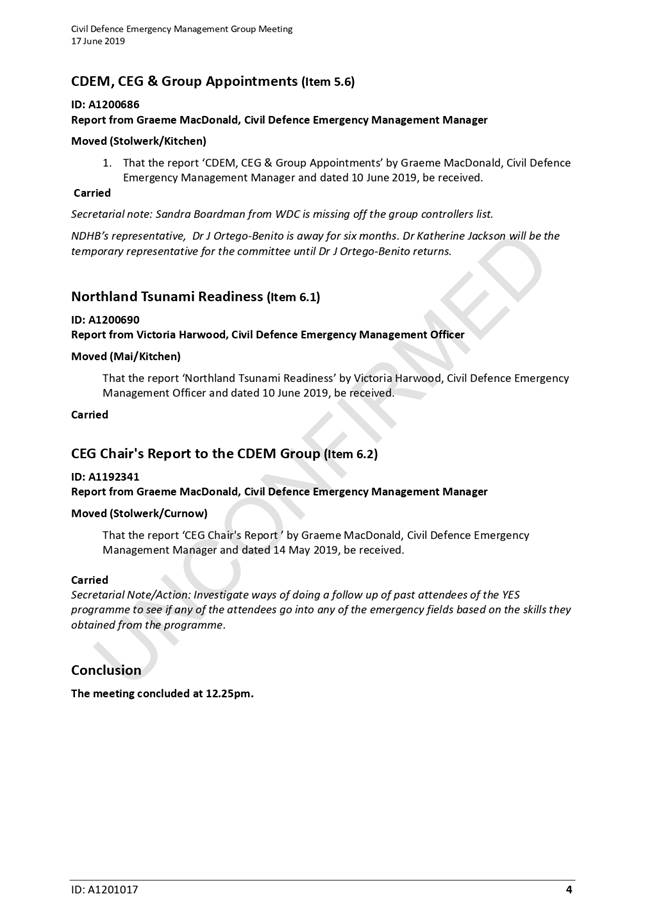
4.1 Confirmation of Minutes - 17 June 2019 5
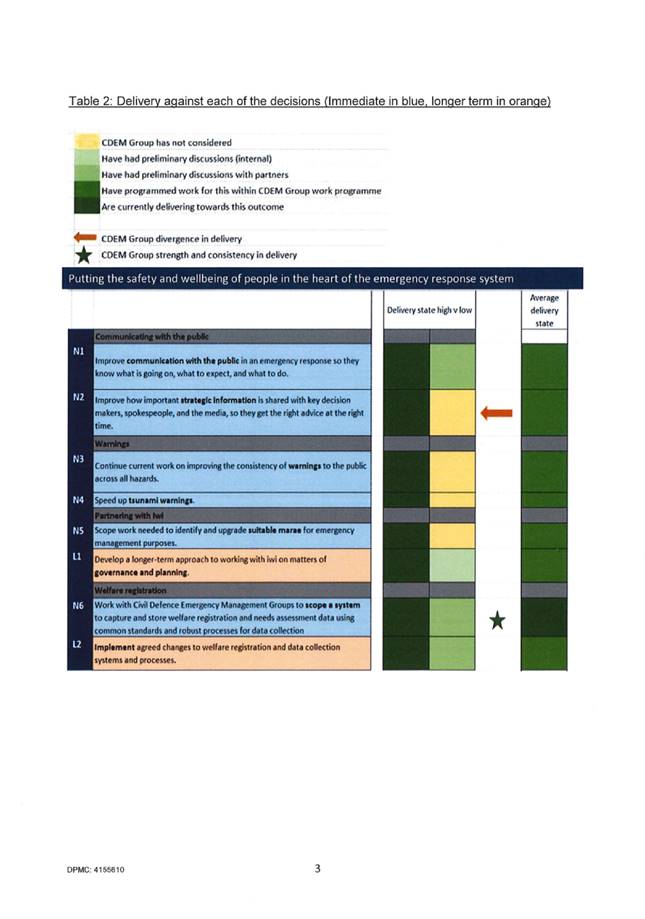
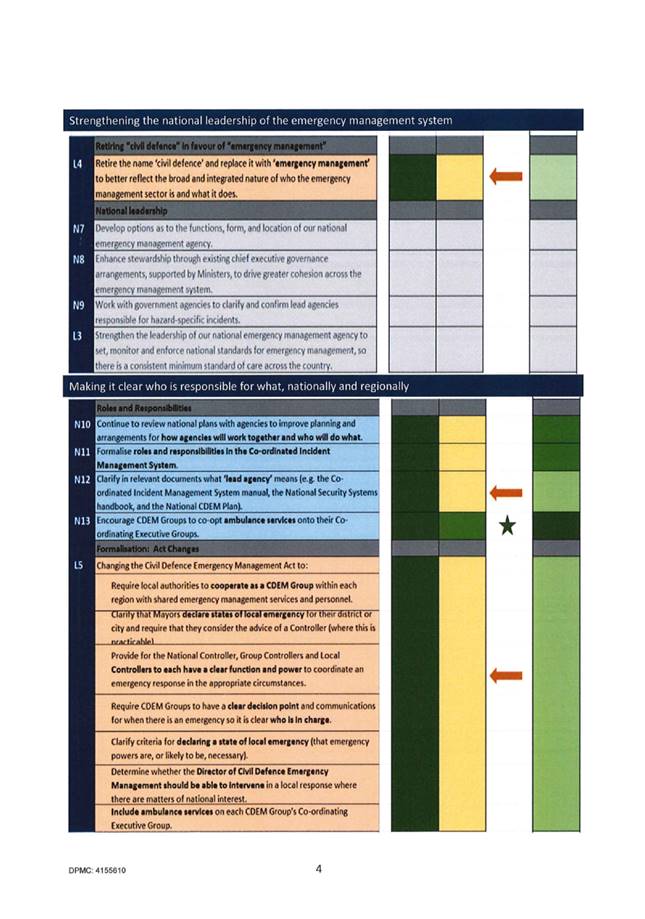
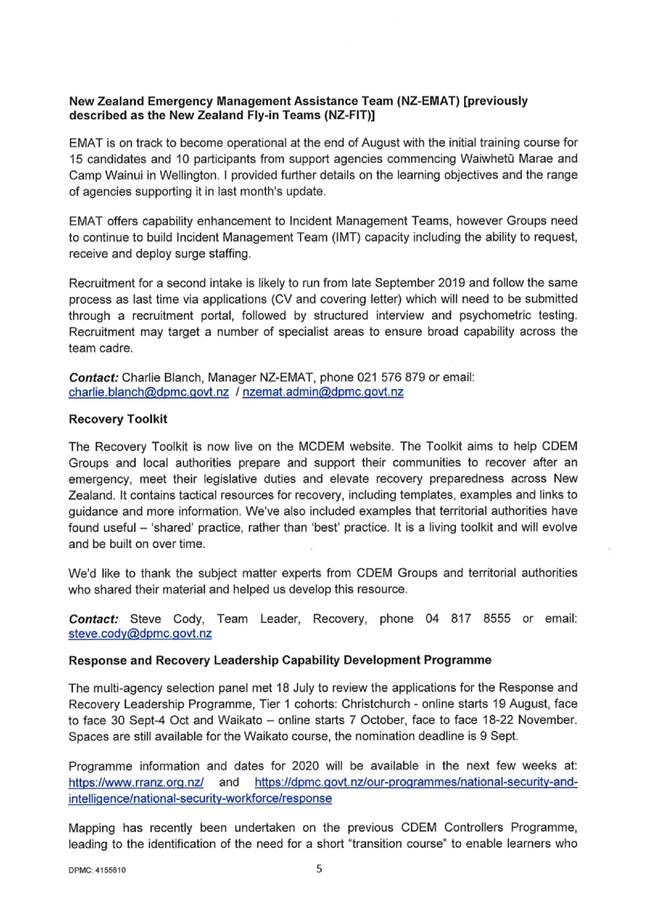
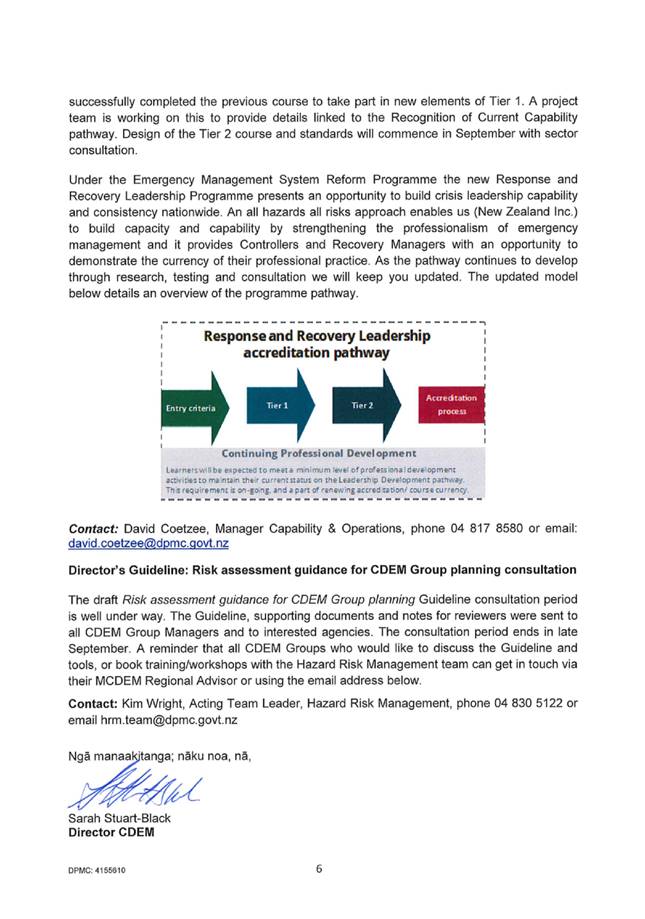
5.1 Monthly update from Director, Ministry of Civil Defence & Emergency Management 10
6.1 CEG, CDEM and Group appointments 17
6.2 CEG Chair's Report 19
6.3 Report on Welfare Coordination Group work programme 26
6.4 Proposal to establish a multi agency Emergency Coordination Centre for Northland 29
6.5 Northland CDEM Group Work Programme 2019/20 32
6.6 NZ Emergency Management Assistance Team (EMAT) 39
7.1 Coordinated Incident Management Systems (CIMS) 3rd Edition 41
7.2 Northland CDEM Group Shared Services Update 44
7.3 Northland Tsunami Readiness 47
Civil Defence Emergency Management Group Meeting item: 3.0
4 September 2019
|
TITLE: |
Presentation - The Emerging Strategic Communications Role |
|
ID: |
A1233472 |
Executive summary/Whakarāpopototanga
Murray Soljak – Public Information Manager will be providing the group with a presentation on the Emerging Strategic Communications role.
1. That the presentation, The Emerging Strategic Communications Role, be received.
Attachments/Ngā tapirihanga
Nil
Authorised by Group Manager
|
Name: |
Tony Phipps |
|
Title: |
Group Manager - Customer Services - Community Resilience |
|
Date: |
28 August 2019 |
Civil Defence Emergency Management Group Meeting item: 4.1
4 September 2019
|
TITLE: |
Confirmation of Minutes - 17 June 2019 |
|
ID: |
A1230016 |
|
From: |
Evania Arani, Executive Assistant Customer Services - Community Resilience |
1. That the minutes of the Civil Defence Emergency Management Group Meeting held on 17 June 2019 be confirmed as a true and correct record.
Attachments/Ngā tapirihanga
Attachment 1: Unconfirmed CDEM Group
Meeting Minutes - 17 June 2019 ⇩ 
Authorised by Group Manager
|
Name: |
Tony Phipps |
|
Title: |
Group Manager - Customer Services - Community Resilience |
|
Date: |
28 August 2019 |
Civil Defence Emergency Management Group Meeting item: 5.1
4 September 2019
|
TITLE: |
Monthly update from Director, Ministry of Civil Defence & Emergency Management |
|
ID: |
A1233474 |
|
From: |
Graeme MacDonald, Civil Defence Emergency Management Manager |
Executive summary/Whakarāpopototanga
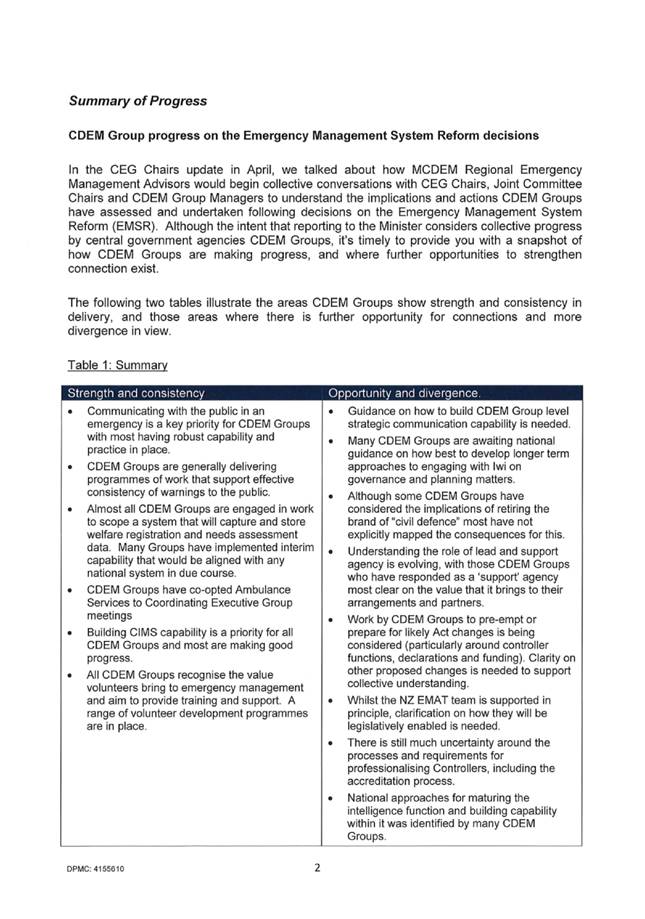
Attached for the information of the group are monthly updates from the Director, Ministry of Civil Defence & Emergency Management.
1. That the report ‘Monthly update from Director, Ministry of Civil Defence & Emergency Management ’ by Graeme MacDonald, Civil Defence Emergency Management Manager and dated 28 August 2019, be received.
Attachments/Ngā tapirihanga
Attachment 1: Director MCDEM July 2019
update ⇩ 
Authorised by Group Manager
|
Name: |
Tony Phipps |
|
Title: |
Group Manager - Customer Services - Community Resilience |
|
Date: |
28 August 2019 |
Civil Defence Emergency Management Group Meeting item: 6.1
4 September 2019
|
TITLE: |
CEG, CDEM and Group appointments |
|
ID: |
A1233478 |
|
From: |
Graeme MacDonald, Civil Defence Emergency Management Manager |
Executive summary/Whakarāpopototanga
This report shows an up to date list of members and key appointments for the Northland CDEM Group. The list of key appointments is also available on the same webpage as the Northland CDEM Group plan. The list has also been referenced in the group plan.
1. That the report ‘CEG, CDEM and Group appointments ’ by Graeme MacDonald, Civil Defence Emergency Management Manager and dated 28 August 2019, be received.
Background/Tuhinga
Membership of the Northland Civil Defence Emergency Management Group:
· Cr Colin Kitchen, Chairperson (FNDC) - alternate Cr John Vujcich
· Cr Rick Stolwerk (NRC) alternate Cr Paul Dimery
· Mayor Sheryl Mai (WDC) alternate Cr Sue Glen
· Cr Anna Curnow (KDC) - alternate Cr Andrew Wade
· Commander Brad Mosby (Fire and Emergency NZ)
· District Commander, Superintendent Tony Hill (NZ Police)
· Mr John Titmus (MCDEM) in observer role
Membership of the Coordinating Executive Group:
· Mr Tony Phipps, Chairperson (NRC)
· Mr Andy Finch (FNDC)
· Ms Sandra Boardman (WDC)
· Mr John Burt (KDC)
· Inspector Martyn Ruth (NZ Police)
· Asssitant Area Commander Graeme Quensell (Fire and Emergency NZ)
· Ms Sarah Hoyle (Northland Health)
· Mr Andy Gummer (St John Ambulance)
· Mr John Titmus (MCDEM) in observer role
· Dr J Ortega-Benito (Northland District Health Board)
· Mr Russell Watson (Northland Lifelines Group)
· Mrs Claire Nyberg (Northland Welfare Coordination Group)
· Ms Jo Field (Department of Conservation)
Group Controllers:
· Graeme MacDonald
· Tony Phipps
· Claire Nyberg
· Simon Weston
· Sandra Boardman
· Victoria Harwood
· John Burt
· Alistair Wells
· Shona Morgan
Local Controllers for the Whangarei District:
· Simon Weston
· Sandra Boardman
Local Controller for the Kaipara District:
· John Burt
· Dean Nuralli
Local Controllers for the Far North District:
· Alistair Wells
Group Welfare Managers:
· Claire Nyberg
· Shona Morgan
Local Welfare Managers:
· Raewyn Smythe (FNDC)
· Aya Morris (FNDC)
· Paula Urlich (WDC)
· Darlene Lang (KDC)
· Michelle Nepia (KDC)
Group Recovery Manager:
· Jenny Calder
· Graeme MacDonald
Local Recovery Managers
· Janice Smith (FNDC)
· John Burt (KDC)
· Vacant (WDC)
Attachments/Ngā tapirihanga
Nil
Authorised by Group Manager
|
Name: |
Tony Phipps |
|
Title: |
Group Manager - Customer Services - Community Resilience |
|
Date: |
28 August 2019 |
Civil Defence Emergency Management Group Meeting item: 6.2
4 September 2019
|
TITLE: |
CEG Chair's Report |
|
ID: |
A1233479 |
|
From: |
Tony Phipps, Group Manager - Customer Services - Community Resilience |
Executive summary/Whakarāpopototanga
This report provides an overview of matters relevant to the CEG Chairs functions.
1. That the report ‘CEG Chair's Report ’ by Tony Phipps, Group Manager - Customer Services - Community Resilience and dated 28 August 2019, be received.
Background/Tuhinga
Communications – Murray Soljak
The recent EMPA (Emergency Media and Public Affairs) conference in Wellington featured multiple perspectives on two recent major events- the Pigeon Valley Fires and the Christchurch mosque shootings.
It also included detailed information on the newly-introduced Strategic Communications role, which is incorporated in both CIMS 3rd edition and the EMAT team structure. A presentation on this role will be given at the meeting.
Public alerting – Emergency Mobile Alerts and Hazard app
A third national test of Emergency Mobile Alerts is expected to be confirmed for late November – although these tests are initiated nationally, they are supported locally with leadup publicity and social media engagement.
Recent research carried out in Wellington indicates that the public view towards smartphone alerts has shifted over time and the public appetite is now higher than the usage to date.
Work at a national level continues on integrating EMAs with the Hazard app, as well as separate enhancements to the Hazard app, notably better reflecting MetService terminology and the colours that are now being used for weather watches and warnings.
MetService is now deservedly a leader in New Zealand in using the Common Alerting Protocol (CAP) to distribute weather warnings across a range of platforms.
Media/social media
The key requirement for social media engagement since the previous meeting has been around the self-activation of one of the tsunami sirens at Te Hapua, which is covered elsewhere in this agenda.
The tsunami evacuation maps have also been embedded into the Group Facebook page (emulating their existing location on the NRC website), which is a significant step forward in that they are now directly accessible via social media.
Warnings and activations
Several weather related warnings and watches have been issued over past months. All have been monitored with no further action required from the on-call duty personnel.
Interagency relationships
Communications support has been provided to Fire and Emergency for the Pataua North Road (Whangarei District) sawdust pile fire, which has provided a useful test of local arrangements operating under national oversight.
The ongoing PIM catch-ups with Whangarei District Council communications staff are likely to be joined by the Department of Conservation and – for the upcoming WDC annual exercise – a Kaipara District Council team member.
Technology and GIS – Shona Morgan and Tegan Capp
GIS
Northland CDEM is continuing to work closely with GIS to further develop and enhance the use of the Northland CDEM Operational Viewer. As part of this process, two digital projects have been lodged with the NRC GIS team:
Project 1 - Address Data
Northland
CDEM has recognised the need to be able to identify properties for immediate
evacuation. Currently there is no digital method to access addresses, the
number of dwellings, access to and from those dwellings and ownership details
of properties if they have been identified for immediate evacuation.
The information/layers to be included in the operational viewer are:
· building footprint layer
· dwelling ownership and occupier details
· Installation Control Points (ICP’s) from Northpower and Top Energy (subject to availability)
· address points
· RAPID #'s if applicable
Project 2 – Table-top Exercise
A table-top exercise is being organised to enhance the Northland CDEM teams understanding and use of the Operational Viewer. Assistance from the NRC GIS team is requested as, although the CDEM team has had training in using the viewer, the CDEM team are not experts in GIS. CDEM needs ongoing support from GIS staff at the exercise to assist with the technical aspects of the architecture, and to help identify the capabilities and limitations of the technology.
The EMIS replacement project led by MCDEM is making progress and Northland CDEM Group operational staff will have an opportunity to view the new system on 5 September at a roadshow hosted by MCDEM.
The System build has been developed and implement in to the newly provisioned Office 365 Emergency management environment. MCDEM will host an Exercise on 3 September, with Taranaki, Canterbury, MCDEM, and Fire and Emergency NZ to test the system. As outlined at the last meeting training and roll out will occur in Northland in early 2020.
Contacts App
The Contacts App is in the final stages of development. User testing identified several minor bugs which have been remedied by the application developer; and an updated version was released to the iOS store last week. Key stakeholders can expect to receive an invitation to download and login to the App very soon.
Community Resilience – Shona Morgan
Youth in Emergency Services
The debrief for the YES Whangarei programme was held in July. The agencies in attendance provided valuable feedback for future programmes as well as their positive experiences from being involved with the programme. As with previous programmes, the agencies were really keen to have the programme back in their area, however in true Northland style, the programme will be held in a different location in 2020.
Vulnerable Groups
A workshop was held at Age Concern in August at their annual forum. Topics discussed were around hazards in Northland, personal preparedness and alerting methods. CDEM Officers Shona Morgan and Claire Nyberg will also be attending the Positive Aging Advisory Group meeting in Whangarei in September to discuss how the older communities can be better prepared for disasters.
National Exercise Programme (NEP)
CDEM Officer Shona Morgan attended the NEP meeting in Wellington in August. The national exercise AF8 was a huge focus of the meeting with many national agencies starting to prepare for the exercise to be held in September 2020. Northland’s focus is likely to be in a support role to other South Island CDEM groups likely to be directly impacted by the earthquake scenario.
Recovery – Jenny Calder
Temporary Accommodation
Earlier this year we started work with the Temporary Accommodation Services (TAS) staff from the Ministry of Business, Innovation and Employment (MBIE). On 29 July we hosted the first of two workshops with MBIE. The aim of this work is to develop a plan for the provision of Temporary Accommodation Services (TAS). This plan will be specific to Northland and will ensure we are prepared should MBIE need to establish temporary accommodation services following a major event.
We had good representation and positive input from Whangarei District Council staff at the workshop, however we need engagement from all three districts if we are to have a well-documented, regional plan. The second workshop will be held once MBIE have a draft plan to bring back to the group.
Strengthening recovery across the region
Development in strengthening recovery across the region has extended to building capability for recovery with our neighbouring groups, with a meeting held in Auckland 29 August. Staff present were from our immediate neighbouring group Auckland, as well as Waikato and the Bay of Plenty. Discussion also included a review of the recently released draft version of Directors Guidelines for Recovery.
Work at a national level has included attending a workshop in Wellington looking at the Recovery Manager Role Profile and identifying the key actions that a recovery manager undertakes, especially in relation to the roles within the Coordinated Incident Management System (CIMS) structure.
Business Continuity Planning – Kim Abbott
Kim Abbott has been working in partnership with the Northland DHB emergency planner, Sarah Hoyle and Whangarei pharmacist, Shane Heswell to deliver BCP workshops to the Northland community pharmacy sector.
Following on from the success of the Whangarei workshop earlier this year, a second workshop took place in Kerikeri on August 13 with pharmacy representatives from the mid north. The feedback was positive, and a far north meeting is planned for September.
Pharmacists are a critical resource within a response both in terms of dispensing medications, ensuring continuity of medication and an easy access point for information and non-urgent medical information. They are respected members who are usually engrained within their communities and as such in an ideal position to encourage forward planning with individuals around medicines and health needs.
Nationally the Ministry of Health has shown interest in the success of the Northland BCP program and the possibility of replicating this in other areas of New Zealand. The MOH National pharmacist came to Whangarei on August 21 for an overview of the project and also to discuss some of the challenges and legislative barriers that have been raised during the workshops.
Professional Development – Kim Abbott
The Northland CDEM training pathway is currently being reviewed and updated. Coordinated Incident Management Systems (CIMS4) and Emergency Operation Centre (EOC) training will continue to underpin the training program with extension courses currently being looked into around dedicated CIMS functional training. In addition, in 2020, we will need to include training on the new Microsoft 365 emergency platform and the CIMS 3rd edition changes. MCDEM is currently undertaking feedback around the most effective way to assist the groups to deliver this.
Kim Abbott travelled to Otago in July to evaluate the delivery and content of CIMS functional training delivery across: Planning, Intelligence, Logistics and Operations. These were delivered by our current trainer, Gerard Moore. Each course is delivered in a one-day format and will need to be modified slightly to incorporate Northland CDEM’s existing systems and operations. Initial dates have been identified for delivery in June 2020.
There has been a high demand for CIMS4 training from partner organisations and agencies as well as council staff. The scheduled September and November courses were fully subscribed with a large waiting list. We have been able to negotiate 2 additional courses which will result in 8 courses for 2019 and approx. 176 students accredited.
Exercises
Refining NZ held an interagency exercise on 15 August. The scenario was an on-site explosion, fire and smoke plume affecting the Refinery site and the community at Reotahi, Whangarei Heads. Representatives from Fire and Emergency, NZ Police, St John, Refining NZ and CDEM staff took part in the exercise. CDEM roles included Public Information Management and Welfare. A unified control was established as part of the exercise between Refining NZ and Fire and Emergency. Murray Soljak worked alongside refinery public information managers and Claire Nyberg and Victoria Harwood worked alongside the Refining NZ Special Assistance Team (SAT) with internal staff and external community welfare. Multiagency exercises are an invaluable part of the readiness programme.
Controllers Development Programme – Claire Nyberg
Invites have been sent to controllers and on call staff to observe the NZ Urban Search and Rescue exercise which is being held in Auckland on the 21 & 22 October. The controller’s development session is scheduled for the following week, and topics include international assistance, USAR and civil military engagement.
The first national cohort for the Response and Recovery Leadership programme attended the residential component of the initial course in July. The new Leadership course comprise The first cohort of 18 participants completed Tier 1 of the new Response and Recovery Leadership Programme. Tier 1 incorporates theory and research with practical experience opportunities. It begins with 6 weeks of part-time study (2-3 hours/week) of on-line activities, discussion forums and real-time video tutorials, followed by a full week of active face-to-face learning.
After reviewing the nominations received for the next Tier 1 course planned for Auckland, it was determined that there were not have enough applicants to proceed and the course was cancelled.
The next Tier 1 course started on 19 August with the face-to-face component in Christchurch from 30 September to 4 October. Jenny Calder the Northland Recovery Manager has been accepted onto this course.
We have now established that the course cost can be funded through the national CDEM Training fund. (Northlands allocation for this year is approx. $70k)
As discussed at the last CEG, Response and Recovery Aotearoa New Zealand (RRANZ), are still working to develop a programme that will enable those that completed the earlier CDEM Controllers Development Programme to be approved under the new programme.
Northland has 10 controllers who completed the CDEM Controllers Development programme.
Lifelines – Kim Abbott
The Northland Lifelines Utilities Group (NLG) meeting was held on July 1. The meeting was well attended with 32 participants representing the Northland utilities sector.
Key updates from members included:
· NZTA presented an update of their Regional Road Resilience projects currently being undertaken or planned for Northland. These include major state highway projects, capital works, extensive sealing, and future resilience risk analysis.
· FirstGas, which owns and operates more than 2500kms of high pressure gas lines throughout the Nth Island as well as gas retailing, presented an overview of their Northland operations including: organisational structure, assets, resilience planning and challenges.
· MCDEM reported that the National Fuel plan has been updated but is on hold pending the release of the fuel enquiry on the pipe line outage in 2017. The findings of the enquiry were expected to be released in August.
· NRC presented on outline of the GIS Portal. Discussion was undertaken around how NLG members could populate key data around their assets prior and during an event and also access situational data for interdependent network.
· The NLG group is engaged, and an exercise is being planned to test communication and current plans in November.
· The National Lifelines conference is scheduled for 15 -16 October in Christchurch.
National Emergency Management Development Group
The National Emergency Management Development Group made up of representatives from MCDEM and group managers from each of the 16 CDEM Groups meet in Wellington on 15 & 16 August.
The NEMDG recently reviewed its Terms of reference and has established a structure that will enable greater visibility across a number of groups and sub groups that have been created or exist within the sector. Four sub-groups have been established to provide visibility across each work stream – the groups are Operational Systems, Hazards and Risks, Response and Recovery and Capability Development.
The meeting focused on the Emergency Management System reforms and a presentation was made by Carolyn Schwalger, NEMA Transition Programme Director, who has been in place for a month. Carolyn’s responsible for putting in place the structure of the programme, developing the governance around the programme and starting to build a programme team.
The NEMA transition programme work streams are:
· Programme planning and governance
· Machinery of Government (NEMA establishment as a departmental agency)
· MCDEM to NEMA transition (the mechanics)
· Designing for the Future
· Stakeholder Engagement and Communications
The Programme Sponsor, Brook Barrington (CE Department of Prime Minister and Cabinet), will chair the chief executives-level NEMA Transition Steering Committee. Carolyn is working on the composition of the intra-agency Senior Officials Group which will have an important role in supporting the CE’s Group in situating NEMA in the broader emergency management and national security systems.
Although no definite time frame was given, establishment of the NEMA is likely to occur within this financial year.
The group also discussed and workshop with representatives from Te Puni Kokiri marae preparedness and the Oranga Marae programme that it administers. Oranga marae provides funding to marae for development. Discussion was held around the use of the national resilience fund to supplement the TPK programme.
Discussion was also head on a National Deployment SOP which has been in draft for several years.
Sub groups have been established to review tsunami warning and alerting information particularly around beach and marine threats and a second group to review the Resilience Fund policy.
United Nations Disaster and Assessment Coordination
New Zealand has been a member of the UNDAC Programme since the first members were trained in 2001. UNDAC is a part of the international emergency response system for sudden onset emergencies and was established in 1993. MCDEM and MFAT have oversight of the UNDAC arrangements and agreements. Notification has been received that New Zealand’s involvement in the UNDAC programme will end when agreements end in September 2019. New Zealand has 5 UNDAC members, including Graeme MacDonald who has been a member since 2008.
Attachments/Ngā tapirihanga
Nil
Authorised by Group Manager
|
Name: |
Tony Phipps |
|
Title: |
Group Manager - Customer Services - Community Resilience |
|
Date: |
28 August 2019 |
Civil Defence Emergency Management Group Meeting item: 6.3
4 September 2019
|
TITLE: |
Report on Welfare Coordination Group work programme |
|
ID: |
A1233481 |
|
From: |
Claire Nyberg, Civil Defence Emergency Management - Welfare |
Executive summary/Whakarāpopototanga
This report outlines the delivery of the Welfare Coordination Group (WCG) work programme.
1. That the report ‘Report on Welfare Coordination Group work programme’ by Claire Nyberg, Civil Defence Emergency Management - Welfare and dated 28 August 2019, be received.
Report
The third WCG meeting of the year was held on 9 August. The following agencies attended:
· Northland Civil Defence Emergency Management (CDEM) Group
o (Responsible for registration, needs assessment, household goods and services and emergency shelter and accommodation)
· NZ Police
o (responsible for inquiry)
· Oranga Tamariki
o (responsible for care and protection services for children and young persons)
· Northland District Health Board (NDHB)
o (responsible for psychosocial support)
· Ministry of Primary Industries (MPI)
o (Animal welfare)
Representatives from the Ministry of Civil Defence and Emergency Management (MCDEM) and MPI were unable to attend due to flight cancellations, although a local MPI representative was at the meeting.
The Ministry of Business, Innovation and Employment (MBIE) representative did not attend but submitted an update. They facilitated a temporary accommodation workshop in Whangarei the week before the WCG meeting (see the recovery agenda item for more detail).
Ministry of Social Development (MSD) were not present at the WCG meeting and no update was given.
Supporting welfare agencies who were not present at the WCG meeting included; Housing NZ, Inland Revenue, Accident Compensation Corporation (ACC) and the Public Health Unit (PHU).
Members of the Tzu Chi foundation (https://www.tzuchi.org.nz/) gave a representation to the WCG on what the foundation does and how they support people in an event, both nationally and internationally.
The Tzu Chi foundation has been active during emergencies in NZ such as in the Christchurch earthquakes in 2011, the Kaikoura earthquake 2016, Edgecumbe 2017 and the Nelson/Tasman Fires 2019.
The Tzu Chi foundation provides support in emergencies in the form of financial assistance where they hand, directly to those affected, cash cards which can be used as the affected person wishes.
They also work with Police, community groups, NGO’s and local store owners to discourage the money being spent on non-essential items.
First quarter update on the 2020/2019 work programme
· A CDC course was delivered to 20 participants from Oranga Tamariki, Inland Revenue, NZ Red Cross, Far North District Council, NDHB, Salvation Army and the volunteers.
· A health and safety module was created along with processes, forms, documentation and teaching material and delivered as a pilot to CDC volunteers. Feedback from participants overall was good however the session time needs to be longer to allow the practical part of the session to be completed.
· Work is nearly complete on the CDC forms which will replace exiting forms.
· The shelter and accommodation sub-function met and finalised the Northland Emergency Shelter and Accommodation Plan. A work programme has been developed for this sub-function to be implemented over the next 3 years.
· A meeting was held with i-Site management in Whangarei to discuss the possibility of utilising them during an emergency to book accommodation if the logistics function becomes overwhelmed. The outcome was positive we are meeting with staff to provide a brief overview of the Shelter and Accommodation sub-function and the considerations for booking accommodation during an emergency.
· A draft Professional Development Plan for Welfare has been developed but is now currently on hold as training is reviewed at a national level.
· A meeting was held with the Ministry of Education (MOE) representative from the National Welfare Coordination Group (NWCG) in Wellington to work on how to strengthen the involvement and relationship between CDEM and MOE in Northland.
Coordinated Incident Management System (CIMS) review
The CIMS review has been completed (as reported in a separate agenda item) with the changes for welfare being that the 9 sub-functions have been removed and replaced with two new sub-functions; needs assessment and welfare delivery coordination. The 9 sub-functions remain in the National CDEM Plan (2015) and therefore the responsibilities still lay with the responsible and supporting agencies to deliver on them. The level of welfare response will continue to be dictated by the scale complexity and consequence of an incident. For example:
· At an incident level, these services relate to meeting the immediate needs of the affected people and animals (e.g. providing shelter in safe place and information about available services).
· In a response where delivery of welfare services required a more significant coordination (e.g. a flood event), the welfare service arrangements in the National CDEM Plan (2015) may need to be activated in coordination with CDEM Groups. (pg 62, CIMS 3rd edition, Aug 2019).
Attachments/Ngā tapirihanga
Nil
Authorised by Group Manager
|
Name: |
Tony Phipps |
|
Title: |
Group Manager - Customer Services - Community Resilience |
|
Date: |
28 August 2019 |
Civil Defence Emergency Management Group Meeting item: 6.4
4 September 2019
|
TITLE: |
Proposal to establish a multi agency Emergency Coordination Centre for Northland |
|
ID: |
A1233482 |
|
From: |
Graeme MacDonald, Civil Defence Emergency Management Manager |
Executive summary/Whakarāpopototanga
A multi-agency response usually involves police, fire, ambulance, health, emergency management, lifelines, welfare agencies and support agencies, government officials (elected and others); all collaborating at various levels to work together to provide a coordinated response to communities. This proposal relates to the establishment of a multi-agency Emergency Coordination Centre.
1. That the report ‘Proposal to establish a multi agency Emergency Coordination Centre for Northland’ by Graeme MacDonald, Civil Defence Emergency Management Manager and dated 28 August 2019, be received and noted.
Background/Tuhinga
Recent emergency events in New Zealand have necessitated the establishment of joint agency response structures to support emergency responses to affected communities. There is now an expectation that Civil Defence Emergency Management Groups and response agencies have the capability and capacity to prepare for, respond and recover from emergency events from dedicated purpose-built coordination centres. Canterbury, Hawkes Bay, Wellington, Manawatu, Southland, Nelson-Tasman, Waikato and Bay of Plenty have established and dedicated ECC’s.
Northland has had numerous emergency events over recent years that have necessitated coordinated across agency response and recovery activities. In all recent emergencies, the Northland response have been coordinated by agencies from their own facilities. No dedicated facility exists in Northland that enables a truly integrated across agency response.
During the large-scale flooding events in 2007 and 2014 the responses were coordinated across agency from temporary facilities established within in existing business as usual facilities. Relying upon councils establishing “pop up EOC’s” in council chambers is no longer operationally practicable.
Emergency Management
On 10 April 2019, the Government released the National Disaster Resilience Strategy. The strategy sets out government expectations for emergency management in New Zealand and puts in place a number of goals to be achieved over the next decade. The Strategy sets three key priorities to improve New Zealand’s resilience to events – managing risks, effective response and recovery, and enabling community resilience.
The strategy also outlines the government’s aim to “modernise the discipline of emergency management and ensure that, locally, regionally, and nationally we are ‘fit for purpose’. This includes mechanisms to have in place command, control, and leadership that are required to ensure rapid, effective, inclusive, and compassionate response and recovery.”
In November 2017, the government released a Ministerial Review (Better Responses to Natural Disasters and Other Emergencies in New Zealand, Technical Advisory Report, 2017) that made 43 specific recommendations. The priority recommendations included the requirement that CDEM Groups take regional approach with the intent of the CDEM Act: and provide adequate funding and resourcing for effective CDEM activities.
Recently the value of dedicated ECC’s facilities was evident during the Rural Fire / FENZ response to the Tasman Fires in Nelson and the response to the March terrorist attack in Christchurch. Multi-agency shared facilities enabled the establishment of effective coordination and management of both responses.
Dealing with the expectations and demands of communicating with communities, partners and stakeholders in emergencies is rapidly developing. Demands for immediate up to date information now dominate emergency responses. Enabling a single joint agency facility for the Northland region will act to enhance and strengthen strategic and media communications, providing a knowledge hub.
Concept of operations - Northland
A multiagency response usually involves police, fire, ambulance, health, emergency management, lifelines, welfare agencies and support agencies, government officials (elected and others), all collaborating at various levels to work together to provide a coordinated response to communities. Historically in Northland agencies have not come together in a single collocated facility or ECC to manage and coordinate emergency responses.
The primary role of the Northland ECC during an emergency response would be to develop and share a common operating picture (COP). To achieve a COP information collection, analysis and distribution as part of the collaborative coordination will ensure that a common operating picture, and a collaborative coordinated response occurs. Communicating information in a timely manner within the response and externally to communities and those impacted would be a priority for an ECC facility.
The ECC would also operate as a day to day business as usual facility for stakeholder personnel that provide funding or in-kind contribution to the facilities construction and establishment.
The ECC would also serve as a dedicated multi-agency training and exercising facility. Shared technology and information management platforms would also be a feature. Integral to the design would be future proofing technology, layout and ensuring capacity for the future is considered or factored into the final concept and design.
Stakeholders and Partners
Initial discussions with representatives from FENZ, NZ Police and NRC has meet with a high level of approval and commitment for a joint-agency Northland Emergency Coordination Centre. Discussions have also been held with WDC. WDC has budget and is progressing the rebuild of its entire Whangarei council office facilities and initially staff expressed support for the proposal. These partners are potentially those that may fund or provide assets for a joint facility.
There is a wider group of stakeholders who may support a combined facility.
Attachments/Ngā tapirihanga
Nil
Authorised by Group Manager
|
Name: |
Tony Phipps |
|
Title: |
Group Manager - Customer Services - Community Resilience |
|
Date: |
28 August 2019 |
Civil Defence Emergency Management Group Meeting item: 6.5
4 September 2019
|
TITLE: |
Northland CDEM Group Work Programme 2019/20 |
|
ID: |
A1233483 |
|
From: |
Graeme MacDonald, Civil Defence Emergency Management Manager |
Executive summary/Whakarāpopototanga
Attached for the information for the group is the Northland CDEM Group Work Programme and an outline of the Portfolios and areas of responsibility.
1. That the report ‘Northland CDEM Group Work Programme 2019/20’ by Graeme MacDonald, Civil Defence Emergency Management Manager and dated 28 August 2019, be received.
Attachments/Ngā tapirihanga
Attachment 1: Northland CDEM Group Work
Programme ⇩
Authorised by Group Manager
|
Name: |
Tony Phipps |
|
Title: |
Group Manager - Customer Services - Community Resilience |
|
Date: |
28 August 2019 |
Civil Defence Emergency Management Group Meeting
4 September
2019
|
|
Comment |
|
|
1. CDEM Group |
|
|
|
· Negotiate, agree, deliver and report upon the Northland CDEM shared services work programmes for the Whangarei, Far North and Kaipara District Councils. |
|
FNDC, WDC, KDC, full agreements in place. |
|
· Review and report on the key recommendations, and outcomes of the Ministerial review and where necessary implement the appropriate findings at the Northland level. |
|
Updates in agenda on EMSR underway and NEMA implementation process. |
|
· Engage with, provide feedback and submissions to MCDEM and other national agencies on strategies, guidelines and documents that may have a bearing on the Northland region, the Ministerial review recommendations and actions |
|
EMSR, EMA, NEMDG ToR, NWCG representation. |
|
· Monitor and provide input and/or submit where appropriate on district council activities relevant to resilience/hazard management. |
|
No progress |
|
· Develop, promote and implement a collaborative across region approach to CDEM. |
|
On going |
|
· Review the past year’s work programmes with a view to establishing those activities that should be maintained, those that could be reduced and those that could be omitted from future programmes. |
|
December workshop
|
|
· Review the 2016 – 21 CDEM Group Plan, including review of objectives and targets |
|
|
|
· Develop a project plan and business case to deliver a share across agency Emergency Coordination Centre for the region. |
|
|
|
2. Readiness and Response |
|
|
|
· Develop and implement an across region Exercise Programme. |
|
Underway |
|
· Develop a strategy outlining how Northland CDEM engages with communities |
|
Workshops held / underway |
|
· Review and maintain e CRP’s across the region. |
|
Ongoing |
|
· Enhance the knowledge, understanding and preparedness of Northland’s vulnerable communities. |
|
|
|
· Provide capability to deliver business continuity courses. |
|
No courses planned |
|
· Implement and coordinate the region on call arrangement for Controllers and Duty Officers. |
|
Underway and ongoing |
|
· Provide ongoing controller’s development programme. |
|
Underway |
|
3. Recovery framework, capacity and capability |
|
|
|
· Incorporate recovery as a key CDEM component. |
|
Underway |
|
4. Recovery framework, capacity and capability continued |
|
|
|
· Review existing recovery arrangements and where necessary act to strengthen or enhance the recovery structures in the region. |
|
New DG/L out for review and feedback. |
|
· Develop, promote and integrate recovery arrangements internally and externally |
|
Ongoing engagement with partners underway. |
|
5. Welfare Co-ordination |
|
|
|
· Implement the agreed Northland CDEM strategy for delivery of Welfare arrangements across the region. |
|
Strategy approved by CEG. |
|
· Deliver Northland Welfare Coordination Group work plan. |
|
Updated work programme agreed |
|
· Engage with and contribute to the National Welfare arrangements, including planning and delivery. |
|
To be completed |
|
· Review Welfare work programme and arrangements to identify priority actions. |
|
To commence |
|
6. EOC and ECC readiness |
|
|
|
· Enhance the readiness and response capability of the Group ECC. |
|
Underway (Priority High) |
|
Develop and implement a consistent and harmonised across region template or format for EOC’s |
|
Forms completed. |
|
7. Lifeline Utilities |
|
|
|
· Provide support to the Lifelines Utility Group projects and meetings |
|
Quarterly meetings annually |
|
· Support and collaborate with the Northland Lifelines Group members to ensure ongoing engagement and commitment. |
|
|
|
8. Communications |
|
|
|
· Maintain and enhance Northland’s alerting capability |
|
Underway and ongoing |
|
· Train staff and ensure learnings/changes at a national level are conveyed within the Northland CDEM Group (including governance) and the reach if/when required is understood and available to other agencies. |
|
Underway and ongoing |
|
· Consolidate and improve delivery of important strategic information with spokespeople and the media so that they get the right information at the right time key decision makers, |
|
Underway and ongoing |
|
· Maintain and develop social media platforms to engage with community and across agencies. |
|
Underway and ongoing |
|
· Develop, maintain and strengthen Public Information arrangements.
|
|
Underway and ongoing |
|
9. Operational Systems |
|
|
|
· Consider, evaluate and implement technology to support readiness and response arrangements i.e. Contacts app. CDEM GIS Portal. |
|
Partly complete and ongoing
|
|
· Where necessary for larger scale technology projects develop a project outline or strategy. |
|
To be completed |
|
· Extending the reach of alerts into other platforms (websites, social media) as technology becomes available. |
|
Underway |
|
· Create and maintain SOP’s and other plans to support operational capability. |
|
On-going |
|
10. Tsunami Risk Management and preparedness |
|
|
|
· Develop a single region asset management plan for tsunami sirens and tsunami public information boards. |
|
Completed |
|
· Engage with and provide the Ministry of Education, school boards and principals with the high-level tsunami risk management tools to enable them to disseminate the information through schools |
|
Partly complete (High Priority) Commenced |
|
· Review and implement any necessary changes in tsunami risk assessments. |
|
Ongoing |
|
· Complete an across region installation of tsunami public information boards. |
|
Underway and partially completed |
|
· Carry out bi-annual tsunami siren testing and reporting |
|
Underway |
|
11. Relationships and engagement |
|
|
|
· Build upon existing relationships; and leverage and enhance new relationships with partner agencies, communities, including with iwi and Maori communities. |
|
Iwi engagement on CEG to be clarified. |
|
· Engage with national, regional and local level working groups, meetings and programmes where appropriate. |
|
Ongoing needs review |
|
· Consider and report on the mechanisms available to have Iwi representation at the CEG level taking into consideration the national review findings and any national recommendations or findings. |
|
As above |
|
· Work with PIM staff from other agencies (including those outside the region) to better understand strengths and reinforce logical separation of responsibilities, particularly during events. |
|
Ongoing |
|
· Deliver the YES programme. |
|
Complete 2019. Funds approved for ongoing programme |
|
12. Professional development |
|
|
|
· Review and provide professional development and training opportunities including CIMS, EOC, Welfare, Governance and Mayors as priorities. |
|
Ongoing and further development required. |
|
· Review and report upon the national level ITF courses. |
|
National review. |
|
12. Professional development continued |
|
|
|
· Provide professional development programme and opportunities for all Controllers, Recovery Managers and Welfare Managers. |
|
Programme implemented |
|
13. Human resources |
|
|
|
· Provide input and assistance into the development of the national deployment policy. |
|
National draft circulated for comments. |
|
Portfolio’s & Areas of responsibility |
|
|
1. Lifelines Utility Group Coordination of the Northland Lifelines Utility Group activities including assisting the Project Manager to deliver the Lifelines Utility Group work programme. Acts as the focal point for LUG. |
Kim Abbott |
|
2. Welfare Coordination Group and Work Programme Coordinates Welfare Coordinating Group activities and delivery of the work programme. Acts as the focal point for all Welfare related matters. Chairs the WCG. Supported by the Alternate Group Welfare Manager. |
Claire Nyberg
Shona Morgan |
|
3. Shared services agreements. The focal points act as the key points of contact. Focal points are appointed to act for each of the three councils operating shared services arrangements. Delivery of the agreed services is through the CDEM Group office personnel and not exclusively by the single point of contact. |
Sharon Douglas Victoria Harwood Bill Hutchinson |
|
4. Professional development Acts to coordinate the professional development programme including CIMS, ECC and other professionally delivered external provider courses. (Acts as the Groups representative on the CDAG). |
Kim Abbott |
|
5. Controllers development and training of staff Provides guidance, training and direction to ensure Controllers and the on-call staff are equipped with the appropriate tools to implement the on-call roster arrangements. |
Claire Nyberg |
|
6. Projects Delivers specific projects as the Project Manager. (Project Manager acts as the focal point including but not limited to project oversight, responsibility for decisions, coordination and delivery and its implementation. |
|
|
Marae Preparedness |
Claire Nyberg |
|
Business Continuity |
Kim Abbott |
|
Vulnerable Communities |
Shona Morgan |
|
Tsunami Sirens and Tsunami signboards
|
Victoria Harwood, Bill Hutchinson, Sharon Douglas |
|
Youth and Emergency Services |
Shona Morgan |
|
Projects continued |
|
|
Contacts Management |
Tegan Capp |
|
Exercise Programme |
Shona Morgan |
|
Community Engagement strategy |
Shona Morgan |
|
GIS Portal |
Shona Morgan |
|
Community response plans and planning |
Shona Morgan |
|
7. Recovery Coordinates and leads the regional recovery programme. |
Jenny Calder |
|
8. Emergency Coordination Centre Develops the Group Emergency Coordination Centre operational capability and capacity |
Claire Nyberg and Shona Morgan |
|
9. Communications Engagement Acts as a focal point to engage with and provide guidance and support to communications specialists across agency. Provides specialist knowledge and oversees the apps/communications mechanisms. |
Murray Soljak |
4 September 2019
|
TITLE: |
NZ Emergency Management Assistance Team (EMAT) |
|
ID: |
A1233485 |
|
From: |
Shona Morgan, Civil Defence Emergency Management Officer - Community Resilience |
Executive summary/Whakarāpopototanga
This report summarises the purpose and development of the NZ EMAT, the selection course and the subsequent selection of Northland CDEM Officer Shona Morgan to the team.
1. That the report ‘NZ Emergency Management Assistance Team (EMAT)’ by Shona Morgan, Civil Defence Emergency Management Officer - Community Resilience and dated 28 August 2019, be received.
Background/Tuhinga
The New Zealand Emergency Management Assistance Team (NZ-EMAT or EMAT) is a new capability in the emergency management system, and its establishment is the Government’s response to the recommendations to establish a ‘fly-in team’ in the Technical Advisory Group’s report on better responses to natural disasters and other emergencies.
The name reflects the purpose and structure of the team which is to provide specialist capability enhancement to assist and support the affected incident controller and their incident management team manage an emergency
Northland CDEM Officer Shona Morgan has been selected as a member of the NZ EMAT team.
The selection process began in March this year with the submission of a CV, covering letter and application form. This progressed to a panel interview in April, followed by psychometric testing, personality profiling, a Leadership Versatility Index 360 review, and a two week selection course in August at Camp Wainui in the Wellington Region. Thirteen candidates attended the course, from the following agencies:
· CDEM
· Department of Conservation
· St John
· Ministry of Social Development
· Te Puni Kokiri
The programme was supported by ten participants from MCDEM, NZ Army, Urban Search and Rescue and the NZ Medical Assistance Team.
The process was hugely beneficial with the learnings from the selection course being transferrable to working in a high pressure situation during an emergency response, as well as in the day to day work environment. The topics covered on the selection course include:
· A Powhiri and learning session at Waiwhetu Marae in Lower Hutt including an overnight stay and workshop with Te Puni Kokiri.
· Establishing coordination in an austere environment including satellite communications, deployable multi-purpose habitation and personal equipment.
· High ropes activity focusing on coaching and establishing immediate trust in a high-risk environment
· Performance Under Pressure – full day workshop with Dr Ceri Evans, forensic psychiatrist and All Blacks psychologist
· Guest Speaker - MCDEM Director Sarah Stuart-Black
· Strategic Self Awareness – analysis of the Hogan personality assessments and LVI 360 review, what it means for me and others I work with
· Understanding the drivers of Collective Culture
· Horse activity including how influence, ambiguous communication and emotions can impact others
· Teachable Point of View – 5 minute talk to syndicate about personal leadership style
· Communication skills for coaching and leading from the side
· Building a team in the EMAT environment
· De-escalating situations
· Visit and lunch with Minister of Civil Defence Peeni Henare
· Guest Speaker – Sarah Holland, National Security System
· Public Information and Strategic Communications
· Guest Speaker – Stefan Weir, Private Secretary Civil Defence
· Delegations, SOP’s, Health and Safety and Code of Conduct for NZ EMAT members
· 36 hour exercise to complete the course
MCDEM will announce successful NZ EMAT candidates in due course, with more training (of a much shorter duration, 1-2 days) likely to occur in September or October this year. A second cohort selection course will be held in February and at the completion of this course it is anticipated that all members will meet for further interaction and training.
More information about NZ EMAT can be found at https://www.civildefence.govt.nz/cdem-sector/new-zealand-emergency-management-assistance-team/
Attachments/Ngā tapirihanga
Nil
Authorised by Group Manager
|
Name: |
Tony Phipps |
|
Title: |
Group Manager - Customer Services - Community Resilience |
|
Date: |
28 August 2019 |
Civil Defence Emergency Management Group Meeting item: 7.1
4 September 2019
|
TITLE: |
Coordinated Incident Management Systems (CIMS) 3rd Edition |
|
ID: |
A1233488 |
|
From: |
Graeme MacDonald, Civil Defence Emergency Management Manager |
Executive summary/Whakarāpopototanga
The expectation of the Government is that government agencies and emergency services use the latest version of CIMS as a common operating model to ensure that responses are managed and coordinated consistently. The CIMS 3rd edition has now been released. This report provides an overview of the changes and highlights actions the Northland CDEM Group should take to embed the new arrangements.
1. That the report ‘Coordinated Incident Management Systems (CIMS) 3rd Edition’ by Graeme MacDonald, Civil Defence Emergency Management Manager and dated 28 August 2019, be received.
Background/Tuhinga
The New Zealand Coordinated Incident Management System (CIMS) was established in 1998 with the publication of the 1st edition (also known as the “Blue Book”). Building on the experience gained since 1998, especially several large scale and complex emergencies in the period 2010-2012 as well as taking into account the recommendations of subsequent formal reviews, the 2nd edition was published in 2014. With the publication of the 2nd edition, it was decided that CIMS should be reviewed every five years going forward.
In April 2018 the Chief Executive of the Department of the Prime Minister and Cabinet (DPMC) and Chair of the Officials’ Committee for Domestic and External Security Coordination (ODESC) requested the Ministry of Civil Defence & Emergency Management (MCDEM) to commence and lead the next review, and sent a letter to the CIMS subscriber agencies inviting them to nominate representatives to a re-convened CIMS Steering Group.
In August 2018 the Government announced its decisions on the review of Better Responses to Natural Disasters and Other Emergencies, among others that CIMS will be reviewed by August 2019 to give effect to the CIMS-related recommendations.
The Steering Group (consisting of eighteen CIMS user agencies) re-convened in May 2018 and has since met monthly to conduct the review. In June 2019 a draft of the CIMS 3rd edition was consulted with targeted agencies and organisations that are not represented in the Steering Group.
The resulting feedback was subsequently considered by the Steering Group and where appropriate, incorporated into the new edition. The Steering Group confirmed the final version of CIMS 3rd edition on 16 July 2019.
Changes
The CIMS 3rd edition builds on the previous editions and therefore does not introduce wholesale doctrinal change; however it does introduce a number of enhancements and new concepts that will require adjustment, notably:
· Revising the CIMS Foundations through reducing the previous ten CIMS principles to three core principles, and presenting the remaining (previous) principles as ‘CIMS Characteristics’
· Emphasising the importance of inclusion of/engaging with iwi/Māori.
· Introducing a more holistic consideration of all the consequences in Response, and subsequently also better integration between Response and Recovery.
· Expanding on the CIMS supporting protocols and systems through the introduction of the concept of ‘Incident Classifications’; an enhanced description of ‘Governance’, and introducing a ‘Strategic Communications’ role.
· Introducing a section on the application of CIMS, to demonstrate how CIMS can be applied across the range of response levels - from Incident through to National level.
· More fulsome descriptions of the CIMS Functions, and the addition of Recovery (in response).
· Some new appendices and templates.
About change
· Eighteen agencies are represented on the CIMS Steering Group that have overseen the development of the new (3rd) edition. A draft of the 3rd edition was also consulted with a wide range of other agencies and organisations, including training providers.
· The Hazard Risk Board (HRB) of ODESC endorsed the 3rd edition on 1 August 2019.
· The expectation is that agencies and CIMS training providers familiarise themselves and work on aligning towards CIMS 3rd Edition between August and December 2019. Between January and June 2020, agencies and training providers should actively transition relevant document content towards CIMS 3rd edition.
· From 1 July 2020 all training and multi-agency responses must reflect CIMS 3rd edition.
· The CIMS Steering Group will continue to meet, in order to consider implementation matters (including the development of central guidelines).
Implications for Northland
The Northland CDEM Group has delivered CIMS 4 training since 2004, predominately each course has been made up of representatives from across a variety of agencies and until recently was delivered over a 3 day period. Recently the course has been revised and has been delivered over two days with an EOC specific day added. Usually 4 courses per annum were conducted with on average 20 personnel attending. A refresher course was offered for a short period of time between 2015-17.
With the changes and updates to the CIMS 3rd addition the following actions will be required -
1. Update the Northland training programme to include CIMS 4
2. Update and rewrite where necessary EOC/ECC SOP’s
3. Facilitate where necessary the ongoing embedding of the changes to CIMS.
4. Consider a revision course to update to the new CIMS version.
Attachments/Ngā tapirihanga
Nil
Authorised by Group Manager
|
Name: |
Tony Phipps |
|
Title: |
Group Manager - Customer Services - Community Resilience |
|
Date: |
28 August 2019 |
Civil Defence Emergency Management Group Meeting item: 7.2
4 September 2019
|
TITLE: |
Northland CDEM Group Shared Services Update |
|
ID: |
A1233489 |
|
From: |
Victoria Harwood, Civil Defence Emergency Management Officer |
Executive summary/Whakarāpopototanga
This report provides an update of the Civil Defence Emergency Management activities within the three district council areas over the past three months.
1. That the report ‘Northland CDEM Group Shared Services Update’ by Victoria Harwood, Civil Defence Emergency Management Officer and dated 28 August 2019, be received.
Background/Tuhinga
District Council Work Programmes
The three district councils continue to carry out their CDEM responsibilities and activities.
Representatives from across the four Northland councils attended several presentations including from the Earthquake Commission (EQC) and Ministry of Business Innovation and Employment. The Northland Welfare Coordination Group meeting and local welfare managers meeting in August were also well supported.
Far North
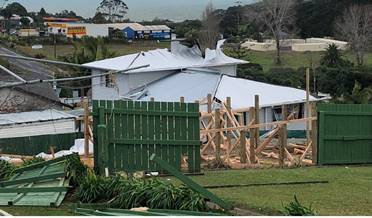
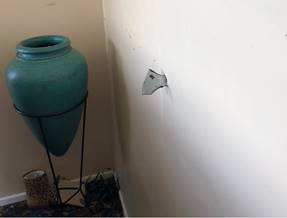
The Far North district experienced a Tornado impacting Doubtless Bay on 5 June. Civil Defence staff worked with the on-scene emergency services and provided liaison between agency groups and the affected occupiers of the properties. Approximately 20 properties were recorded as damaged.
|
|
|
|
Typical damage sustained to structures and fencing |
Glass imbedded in internal wall linings |
In line with the Northland CDEM Group relationship and strategy activities, Civil Defence staff are assisting to coordinate a water safety initiative with Operation Flotation. Operation Flotation is a Charitable Trust established for the purposes of:
o lowering the number of drowning deaths by providing flotation devices at beaches
o providing other water safety equipment at these locations, as necessary
o promoting the teaching of water safety
o working with, or affiliating to, other organisations with similar objectives
As part of the ongoing Kaitaia flood protection programme lead by the Northland Regional Council, CDEM staff have been collaboratively working with representatives from councils, landowners, iwi, archaeologists, and other stakeholder groups to move forward with proposed upgrades to the Awanui flood scheme to further reduce the risk of flooding in Kaitaia.
Whangarei
The Whangarei District Council (WDC) work plan has been focused on welfare arrangements. The Civil Defence Centre (CDC) volunteers attended an Integrated Training Framework Civil Defence Centre training day and a Health and Safety in a CDC Introduction training, held by CDEM staff. The Council Welfare Kits have been checked and updated as required.
CDEM Emergency Coordination Centre (ECC) and Emergency Operations Centre (EOC) forms and documents have been reviewed and standardised across the region. A OneDrive shared space has been developed to enable access to these documents from all Northland ECC / EOC locations as required. Investigations into electronic tools and software to enable information management more effective are still underway. The use of the new national CDEM Microsoft Teams software will also be incorporated into this process.
The WDC annual CDEM exercise took place on 30 August. The exercise was to carry out the physical set up of the EOC in Council Chambers and EOC functions to run through their responsibilities. The exercise was well attended with support from Northland CDEM Group office staff.
The annual Northland Airports exercise was held at the Onerahi Fire Station in July. CDEM supported the exercise, the theme was Security, including an active shooter scenario.
The WDC CDEM web pages are being reviewed to further align and redirect to the comprehensive information available on the NRC Civil Defence web pages.
A meeting with the State Highway 15 group at the Parahaki Marae at Nukutawhiti was attended to discuss the CDEM arrangements in the area. A presentation and workshop for the intermediate children of Mangakahia Area School was also delivered and the Northland Disability Expo supported.
The WDC Public Information Managers collaborated with the Northland CDEM Group PIM at their bi-monthly meeting and discussed learning from the latest Emergency Media and Public Affairs (EMPA) conference.
Kaipara
The Kaipara District Council (KDC) continues to have staff engaging in training and workshops. Another CDEM induction workshop is required in the months ahead due to a number of new staff commencing at KDC.
Community engagement has focused on tsunami preparedness in the Mangawhai area. Local campground managers assisted in reviewing siren locations and signage placement. The Mangawhai Community Response group is in a rebuilding phase. Meetings with key stakeholders continues, and a public meeting is planned for late September. Local representatives from the emergency services will assist in driving this group forward.
Attachments/Ngā tapirihanga
Nil
Authorised by Group Manager
|
Name: |
Tony Phipps |
|
Title: |
Group Manager - Customer Services - Community Resilience |
|
Date: |
28 August 2019 |
Civil Defence Emergency Management Group Meeting item: 7.3
4 September 2019
|
TITLE: |
Northland Tsunami Readiness |
|
ID: |
A1233491 |
|
From: |
Victoria Harwood, Civil Defence Emergency Management Officer |
Executive summary/Whakarāpopototanga
This report provides an update on the regional Tsunami Readiness activities from the last three months.
1. That the report ‘Northland Tsunami Readiness’ by Victoria Harwood, Civil Defence Emergency Management Officer and dated 28 August 2019, be received.
Background/Tuhinga
Northland Outdoor Tsunami Siren Network Future - Update
Investigations into the options available for the future development of the Northland outdoor tsunami siren network have progressed.
Five options for the future of the siren network were presented at the June CEG meeting. An investigation into option five, “To replace the current siren network over a staged timeframe with verbal electronic sirens” is underway.
Northland CDEM office staff have engaged with James Sturzenegger, Business Development Manager, USA and Oceania, HSS Engineering and Warning Solutions, based in Lystrup Denmark. The siren products supplied and installed by HSS meet all the NZ National Technical Standard best practice guidance set for outdoor alerting systems.
The HSS all hazard siren system covers the gaps identified in the current Northland outdoor tsunami siren network. The current tsunami siren decibel range is 108dBc to 118dBc and its audibility beyond 400m and inside buildings is compromised with its lack of lower tone frequency.
Advantages and extra features of the All Hazard Siren are:
· Full range of recommended frequencies (70dBc to 119dBc) available
· Voice alerting
· Fully electronic
· Remote control
· Built in battery power up to 30 minutes with no other power source
· 360ᵒ directional speakers
· Sound propagation reach is further
· Option to add a top-mounted strobe light
· Option for solar power
An initial assessment by HSS of the Tutukaka Coast has been completed, identifying the placement and coverage of all hazard sirens in this area. The Tutukaka Coast currently has 20 outdoor tsunami sirens. The HSS siren can achieve wider sound propagation with eight sirens.
The appearance of the siren can be seen in Figure 1. Mapping of the possible locations and estimated sound propagation of the eight HSS sirens along the Tutukaka Coast are included.
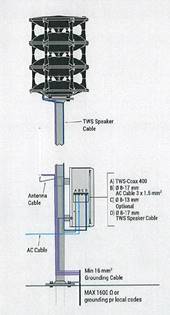
Figure 1. HSS All Hazard High Powered Siren System
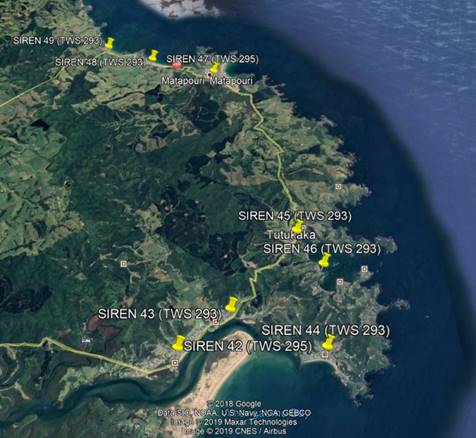
Map of the possible locations for the HSS All Hazard Siren along the Tutukaka Coast
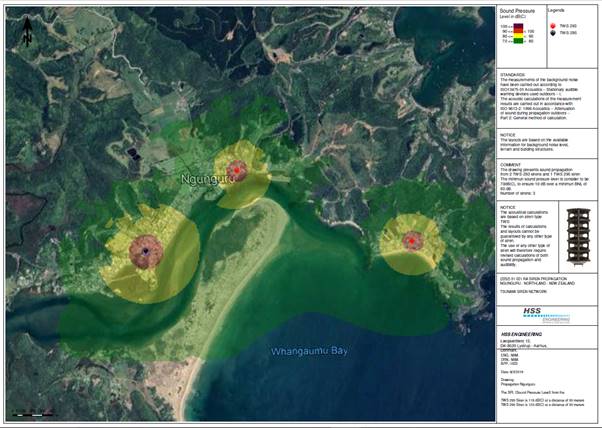
Estimated Sound Propagation – Ngunguru
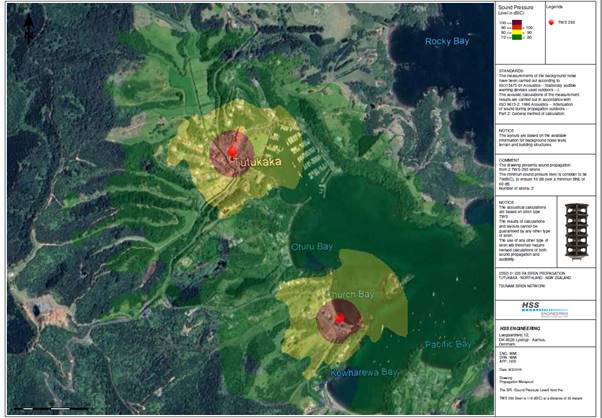
Estimated Sound Propagation – Tutukaka
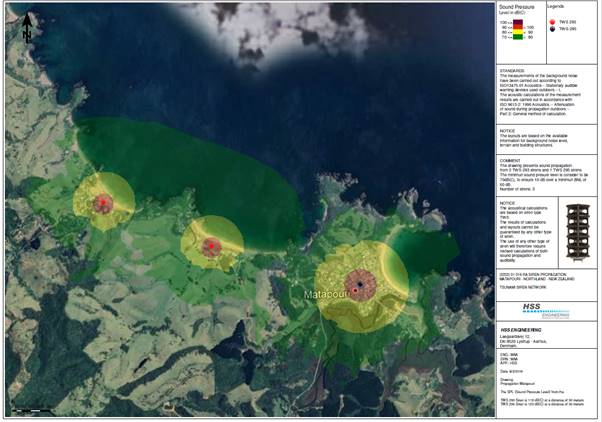
Estimated Sound Propagation – Matapouri / North
An assessment of the entire Northland coastline has been completed, with estimated sound propagation mapping for all populated locations. An estimated 98 all hazard siren would replace the 202 current sirens in the network, halving the infrastructure. A meeting with James Sturzenegger from HSS with council CEG representatives and CDEM staff was held on 3 September. A verbal update from this meeting can be provided.
Mitigation of Tsunami Hazards at Maritime Facilities in Northland
On 28 June, Jose C. Borrero Ph.D. Coastal Scientist and Engineer, Tsunami Hazards Specialist and Director of eCoast Ltd, presented the background and outcomes of the project ‘Development of Products and Procedures for the Mitigation Tsunami Hazards at Maritime Facilities in Northland’.
Staff attending included Northlands’ Harbourmaster, Maritime and CDEM staff. The project was funded by the national CDEM resilience fund and provides electronic decision making ‘playbooks’ for the rapid assessment of tsunami hazards from near source tsunami.
Harbours included in the programme are Marsden Point, Doves Bay, Opua, Tutukaka, entrance to the Whangaroa harbour, the inner portion of the Whangaroa harbour and Waitangi.
The electronic programme is based on detailed hydrodynamic modelling of tsunami heights and currents from 72 individual tsunami source locations around the Pacific and three earthquake magnitudes of 8.7M, 9.0M and 9.3M.
By plotting the magnitude and location of a Pacific Ocean earthquake into the programme, the closest model is matched and the potential effects of the earthquake in harbour areas can be viewed. This enables staff to respond appropriately and in a timely manner to a tsunami event. The hazard maps include predicted tsunami heights, water current speeds and estimates of the duration of hazardous currents. It is anticipated that this work will be a template for the development of Port and marina-specific tsunami response plans throughout New Zealand. An example of the programme dashboard can be seen below.
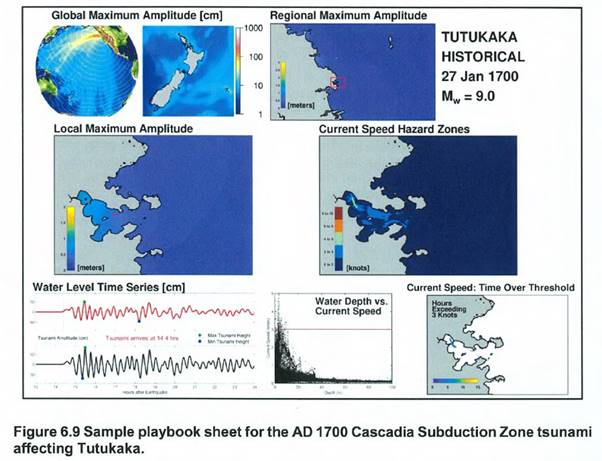
Northland Tsunami Response
Since the June Coordinating Executive Group and CDEM Group meetings, there have been no national tsunami alerts.
Northland Tsunami Information Boards
In line with the Northland CDEM Work Programme, Tsunami Information Boards are now being rolled out in Far North coastal communities. The sites chosen for the information boards are in areas to ensure the opportunity to educate the public to the risk of tsunami is maximised and that the reach includes transitory public.
The 10 tsunami information boards for the Kaipara district, Mangawhai and Mangawhai Heads are installed and complete.
Whangarei district Community response groups are assessing their community coastal areas for gaps where a tsunami information board would be valuable and not currently in place. A small number of additional boards may be installed during the next 12 months as areas are identified and assessed.
Northland Outdoor Tsunami Siren Network update
Northland bi-annual tsunami siren testing will take place on Sunday 29 September 2019 at 10.00hrs for 10 minutes and 10.30 am for 30 seconds. The usual process will be carried out, including comprehensive public information.
The use of ARCGIS software Survey 123 technology to collect the assessment results of all 202 tsunami sirens is being investigated and may be available for the community volunteers to use during their monitoring on 29 September. This will reduce paper usage and administration tasks during testing and provide instant overall results and immediately indicate any issues.
The Far North District Council has received approval from Meridian Energy to allow further tsunami sirens to connect to their network at no charge for administration or power usage. They are now able to proceed with the installation of three sirens on the Karikari Peninsula that have been on hold for the past three years until permission was granted. It should be noted that further funding will be required from council to be able to add to or extend sirens in other coastal communities should requests be received.
During a planned move of a siren in Mangawhai, it was discovered that the Northpower and Vector boundaries overlap and are not consistent with council boundaries. The indoor and outdoor sirens will not work on the Vector network, therefore pockets of southern Mangawhai may not be covered.
Attachments/Ngā tapirihanga
Nil
Authorised by Group Manager
|
Name: |
Tony Phipps |
|
Title: |
Group Manager - Customer Services - Community Resilience |
|
Date: |
28 August 2019 |