|
Joint Climate Change Adaptation Committee Friday 4 August 2023 at 1.00pm
|
|
|
|
|

|
Joint Climate Change Adaptation Committee Friday 4 August 2023 at 1.00pm
|
|
|
|
|
Meeting to be held in the Northland Regional Council
Council Chamber
36 Water Street, Whangārei
on Friday 4 August 2023, commencing at 1.00pm
Recommendations contained in the agenda are NOT decisions of the meeting. Please refer to minutes for resolutions.
MEMBERSHIP OF THE Joint Climate Change Adaptation Committee
Chairperson, Te Uri o Hau and Te Roroa Representative Fiona Kemp
|
Deputy Chairperson Amy Macdonald |
KDC Mayor Craig Jepson |
FNDC iwi/hapu representative Antony Thompson |
|
WDC Councillor Scott McKenzie |
FNDC Councillor Tamati Rakena |
WDC Iwi/hapu representative Deb Harding |
RĪMITI (Item) Page
1.0 Ngā Mahi Whakapai/Housekeeping
2.0 Ngā Whakapahā/apologies
3.0 Ngā Whakapuakanga/declarations of conflicts of interest
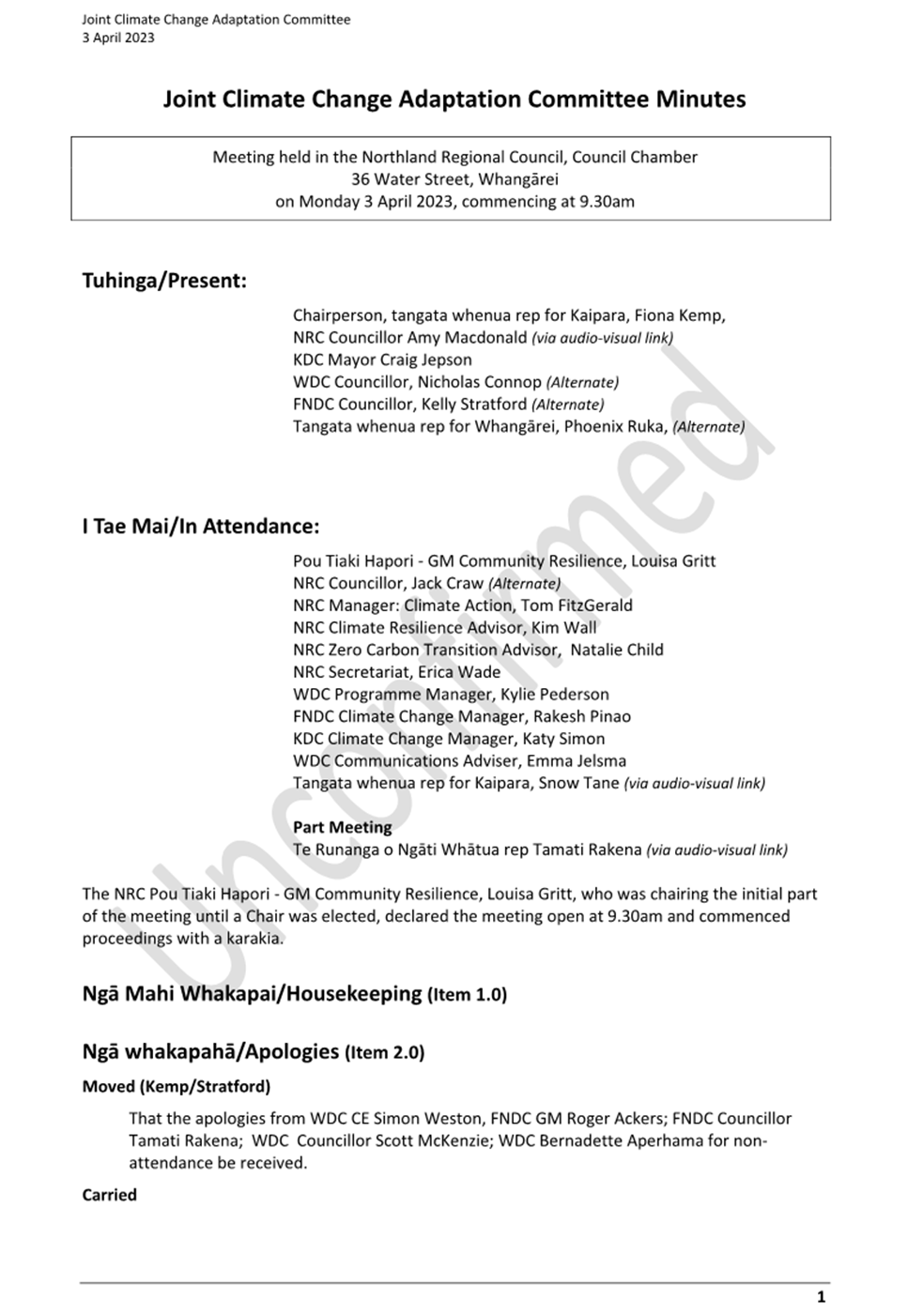
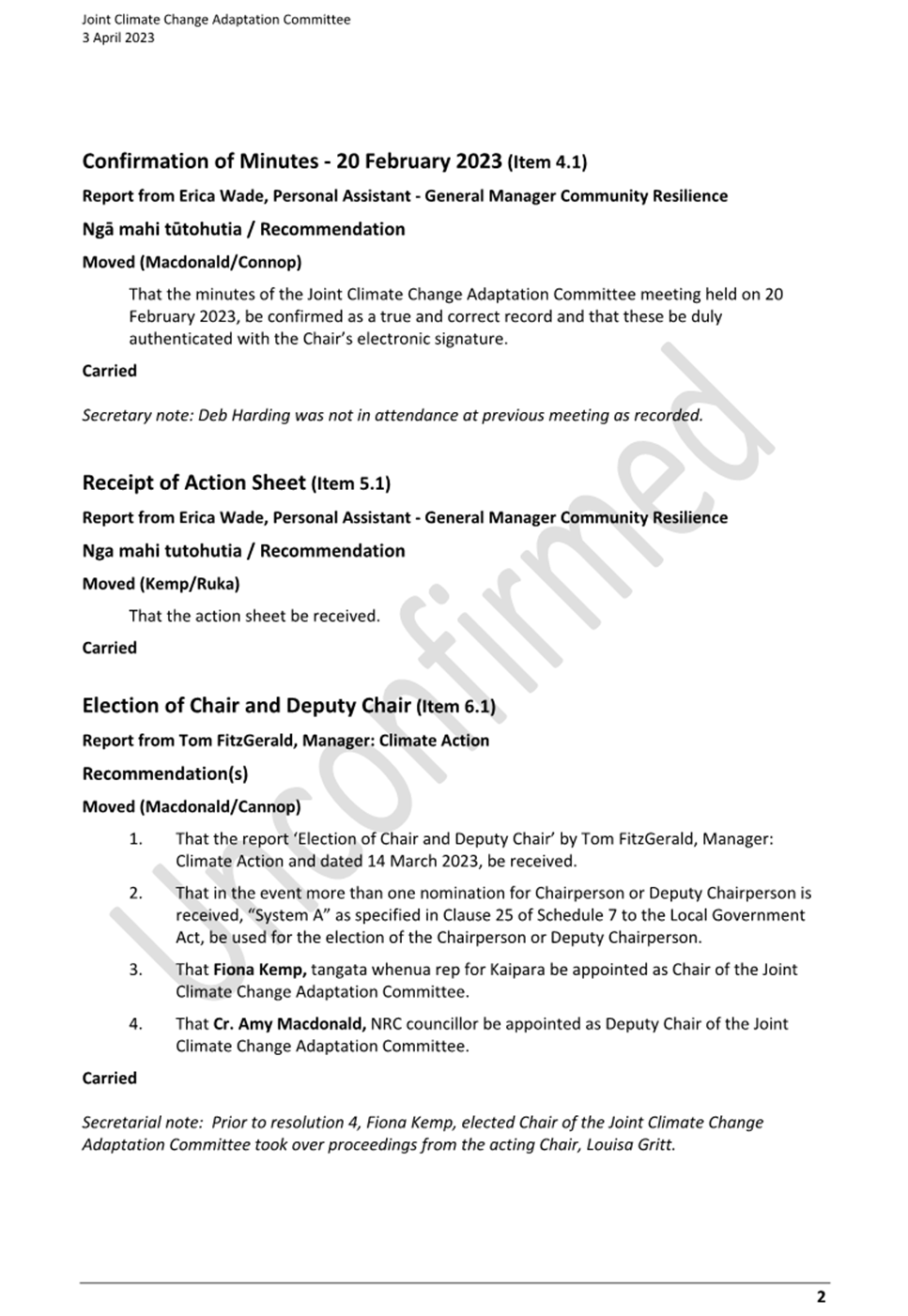
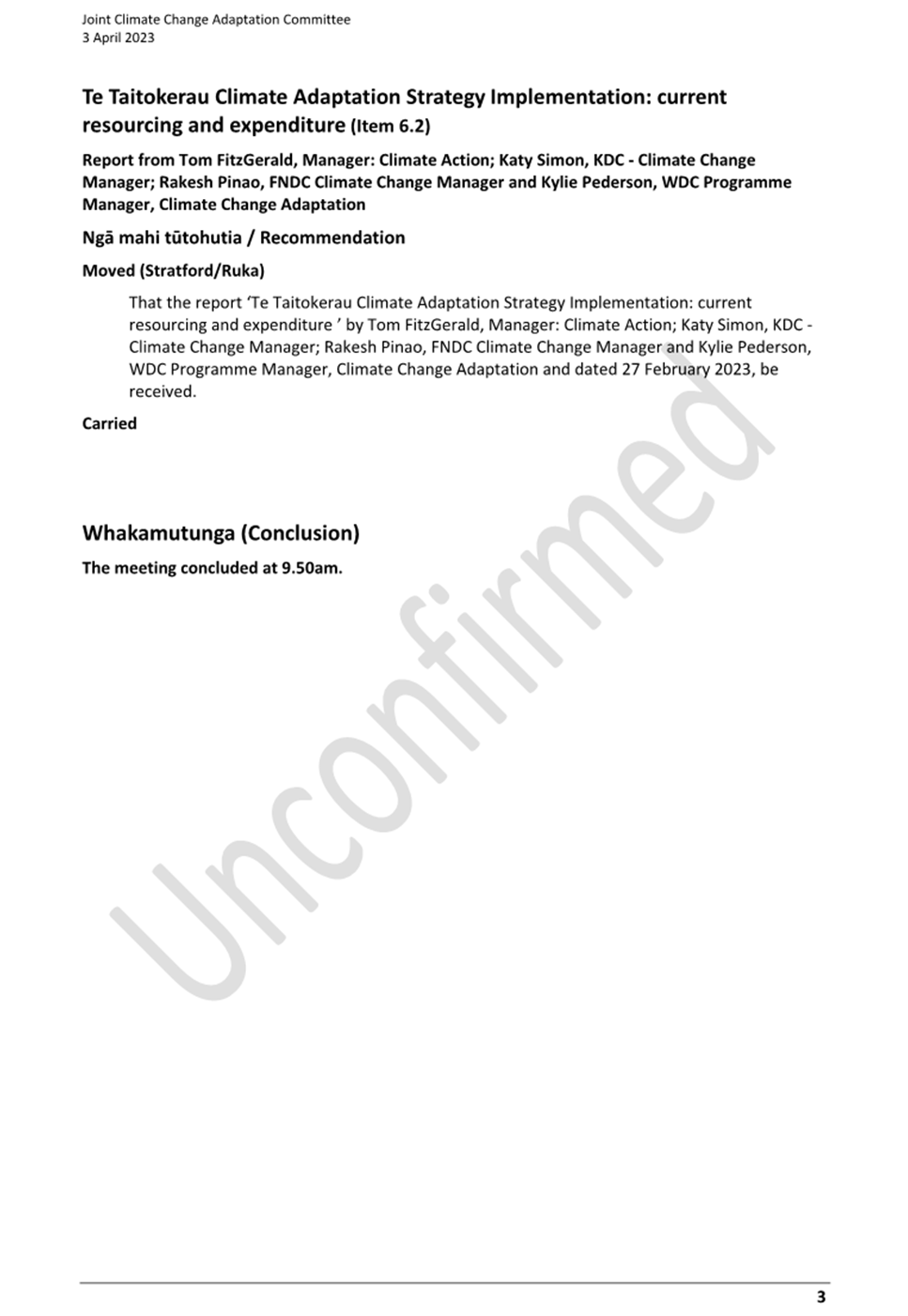
4.0 Ngā Whakaae Miniti / Confirmation of Minutes
4.1 Confirmation of Minutes - 3 April 2023 3
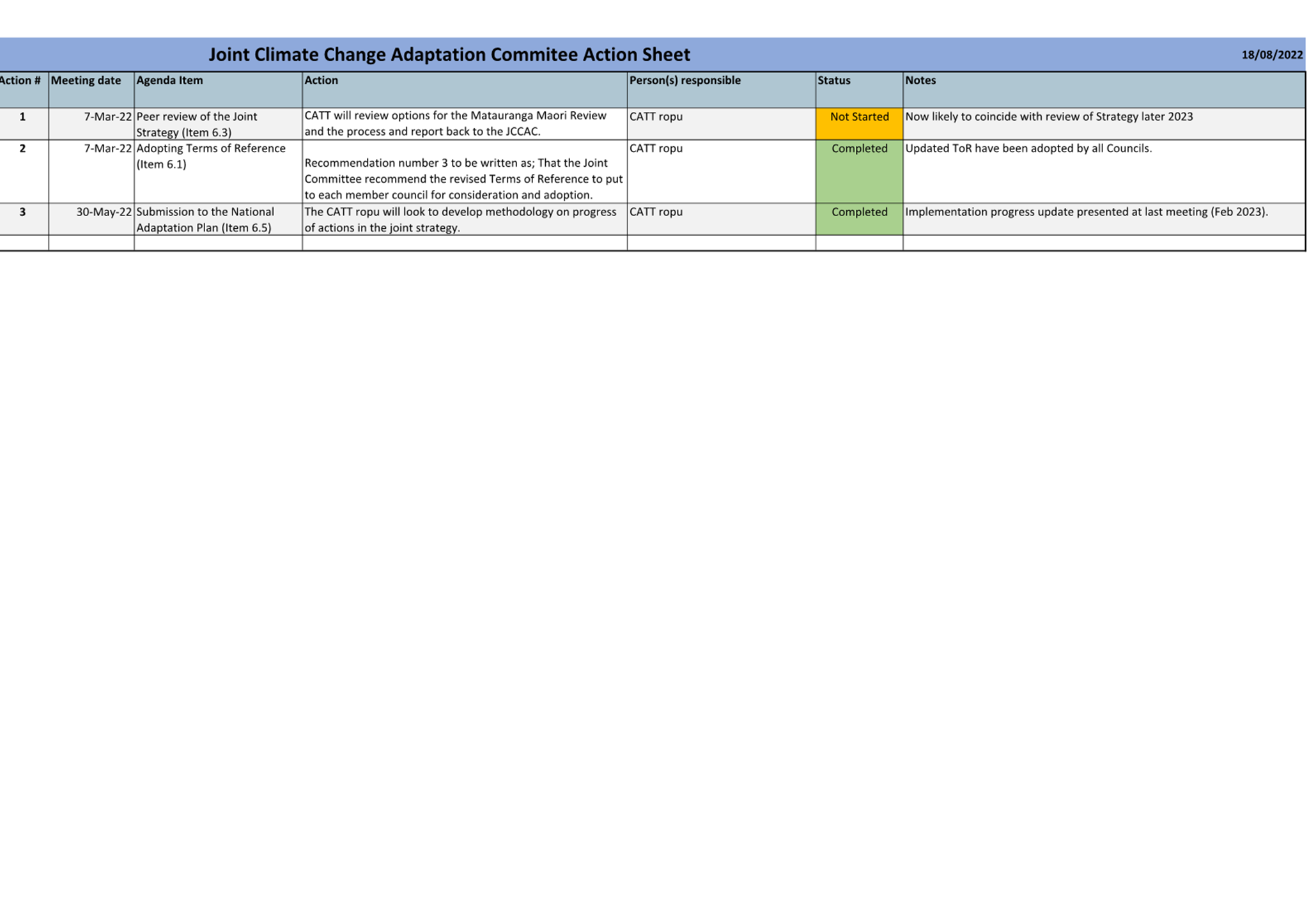
5.1 Receipt of Action Sheet 7
6.1 Policy updates 9
6.2 Update from Aotearoa Climate Adaptation Network (ACAN) 18
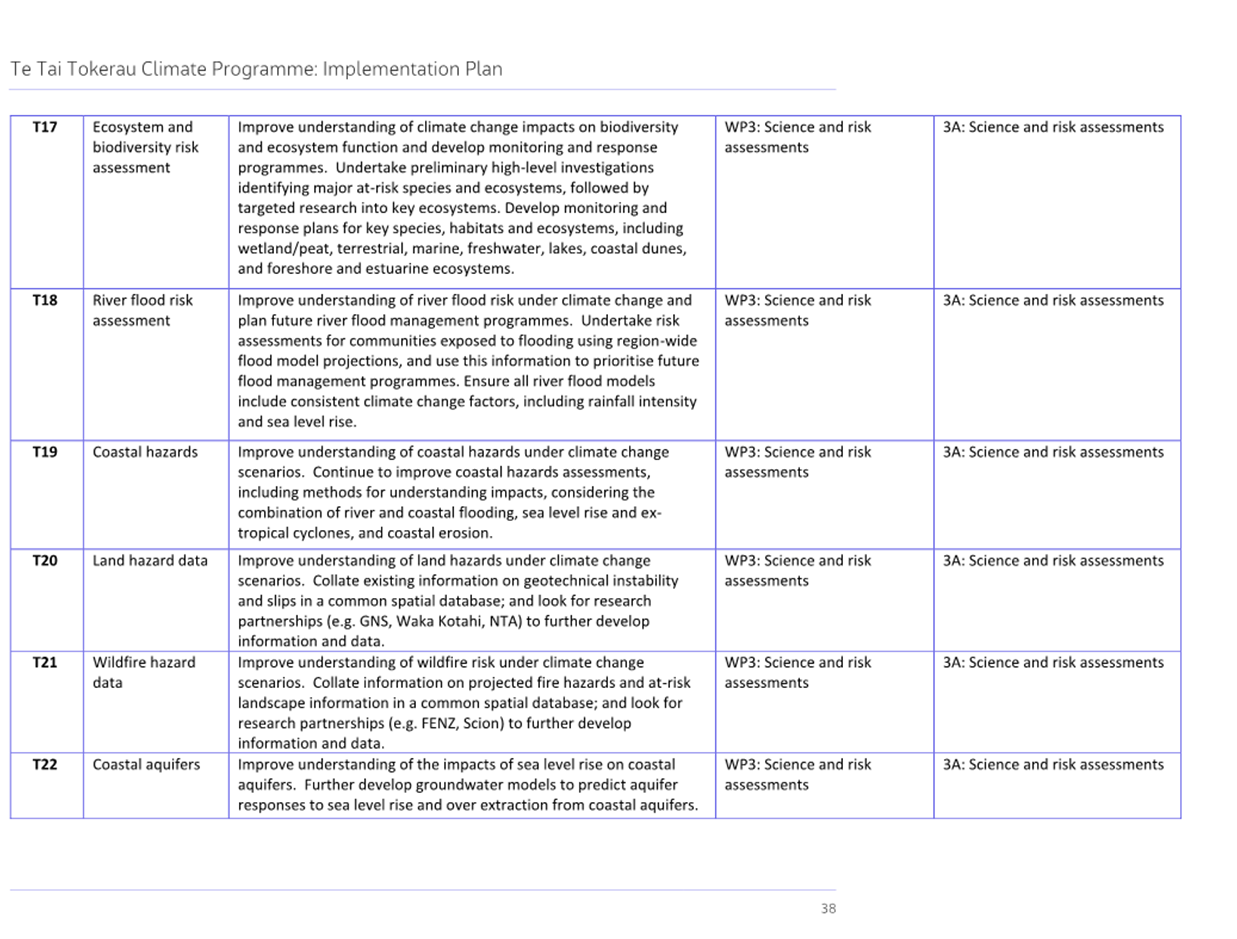
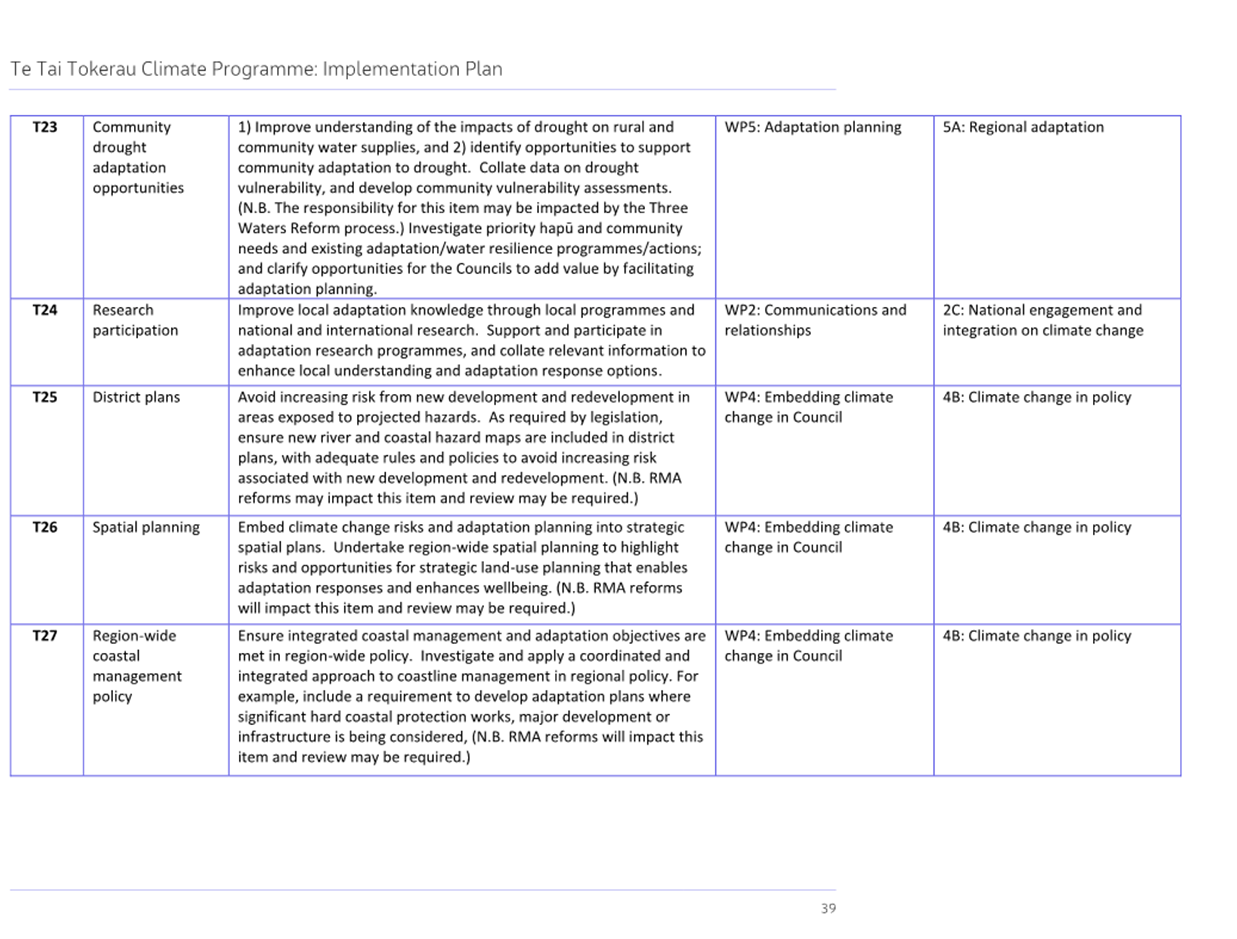
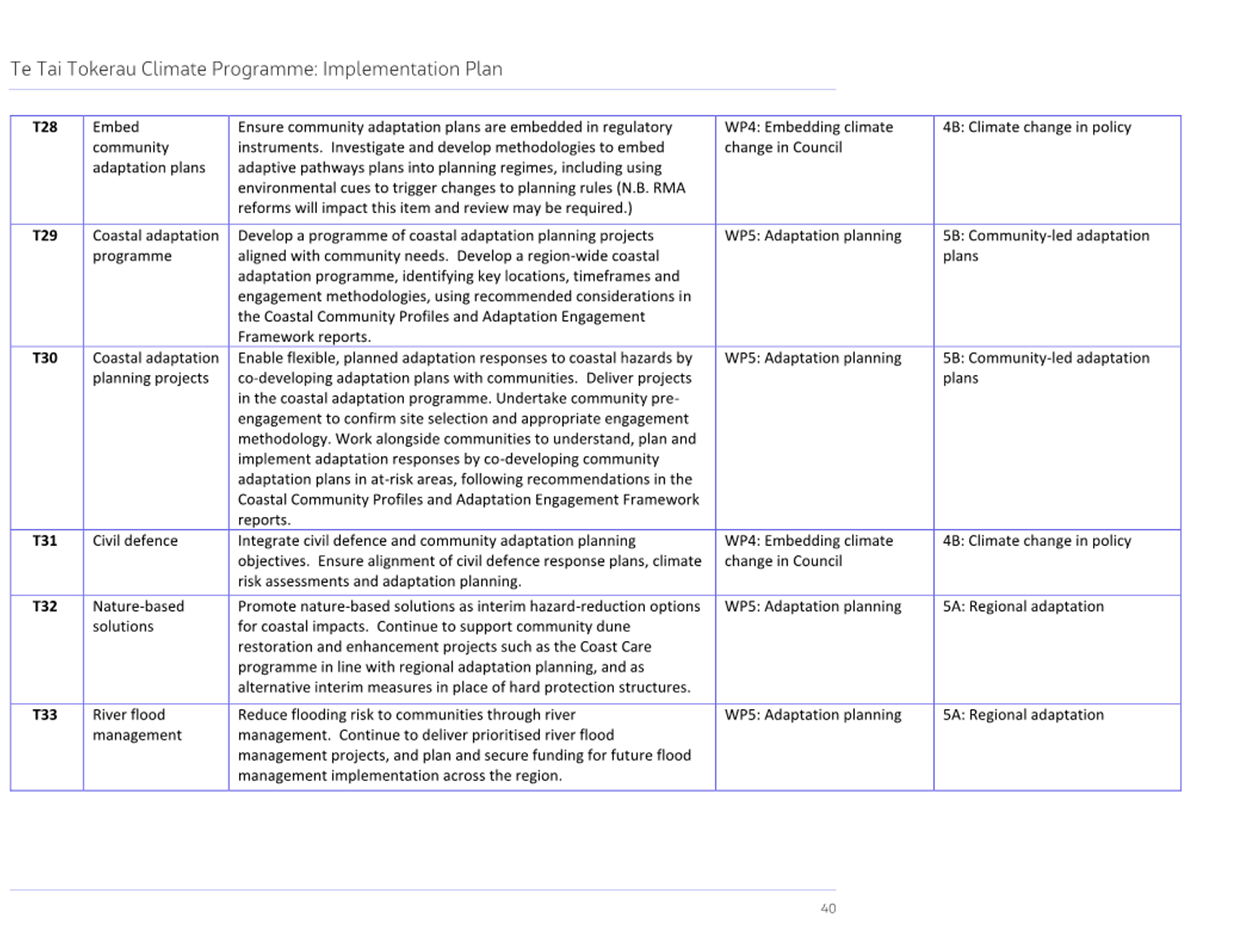
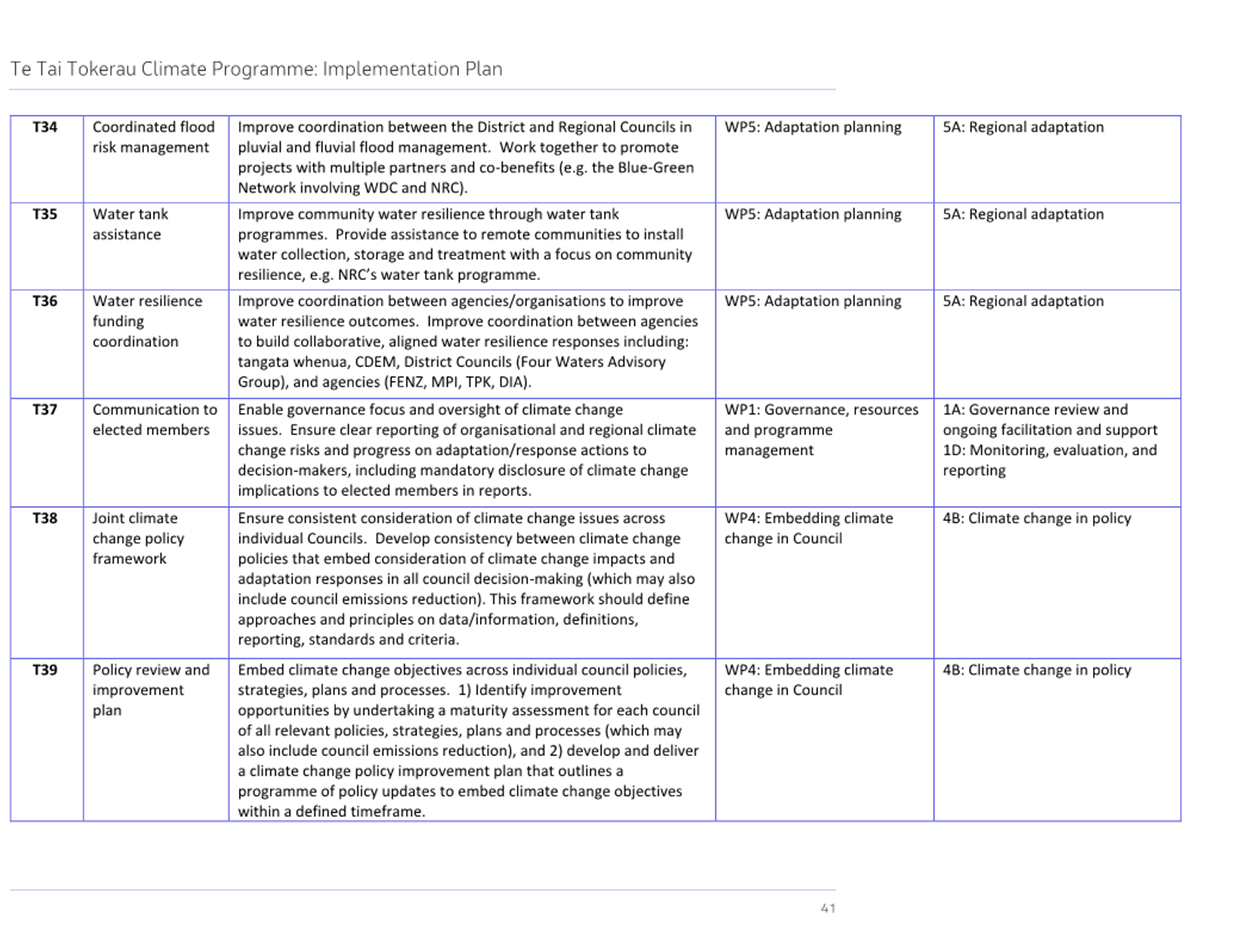
6.3 Delivering our Te Taitokerau Climate Adaptation Programme 20
6.4 Community Adaptation Planning update 120
6.5 Flood Adaptation Strategy 159
6.6 Other Business
Joint Climate Change Adaptation Committee item: 4.1
4 August 2023
|
TITLE: |
Confirmation of Minutes - 3 April 2023 |
|
From: |
Erica Wade, Personal Assistant - General Manager Community Resilience |
|
Authorised by Group Manager/s: |
Louisa Gritt, Group Manager - Community Resilience, on |
That the minutes of the Joint Climate Change Adaptation Committee meeting held on 3 April 2023, be confirmed as a true and correct record and that these be duly authenticated with the Chair’s electronic signature.
Attachments/Ngā tapirihanga
Attachment 1: Unconfirmed Minutes - 3
April 2023 ⇩ 
4 August 2023
|
TITLE: |
Receipt of Action Sheet |
|
From: |
Erica Wade, Personal Assistant - General Manager Community Resilience |
|
Authorised by Group Manager/s: |
Louisa Gritt, Group Manager - Community Resilience, on 27 July 2023 |
Whakarāpopototanga / Executive summary
The purpose of this report is to enable the meeting to receive the current action sheet.
That the action sheet be received.
Attachments/Ngā tapirihanga
Attachment 1: Action Tracker ⇩
Joint Climate Change Adaptation Committee item: 6.1
4 August 2023
|
TITLE: |
Policy updates |
|
From: |
Tom FitzGerald, Climate Change Manager |
|
Authorised by Group Manager/s: |
Louisa Gritt, Group Manager - Community Resilience, on 28 July 2023 |
Whakarāpopototanga / Executive summary
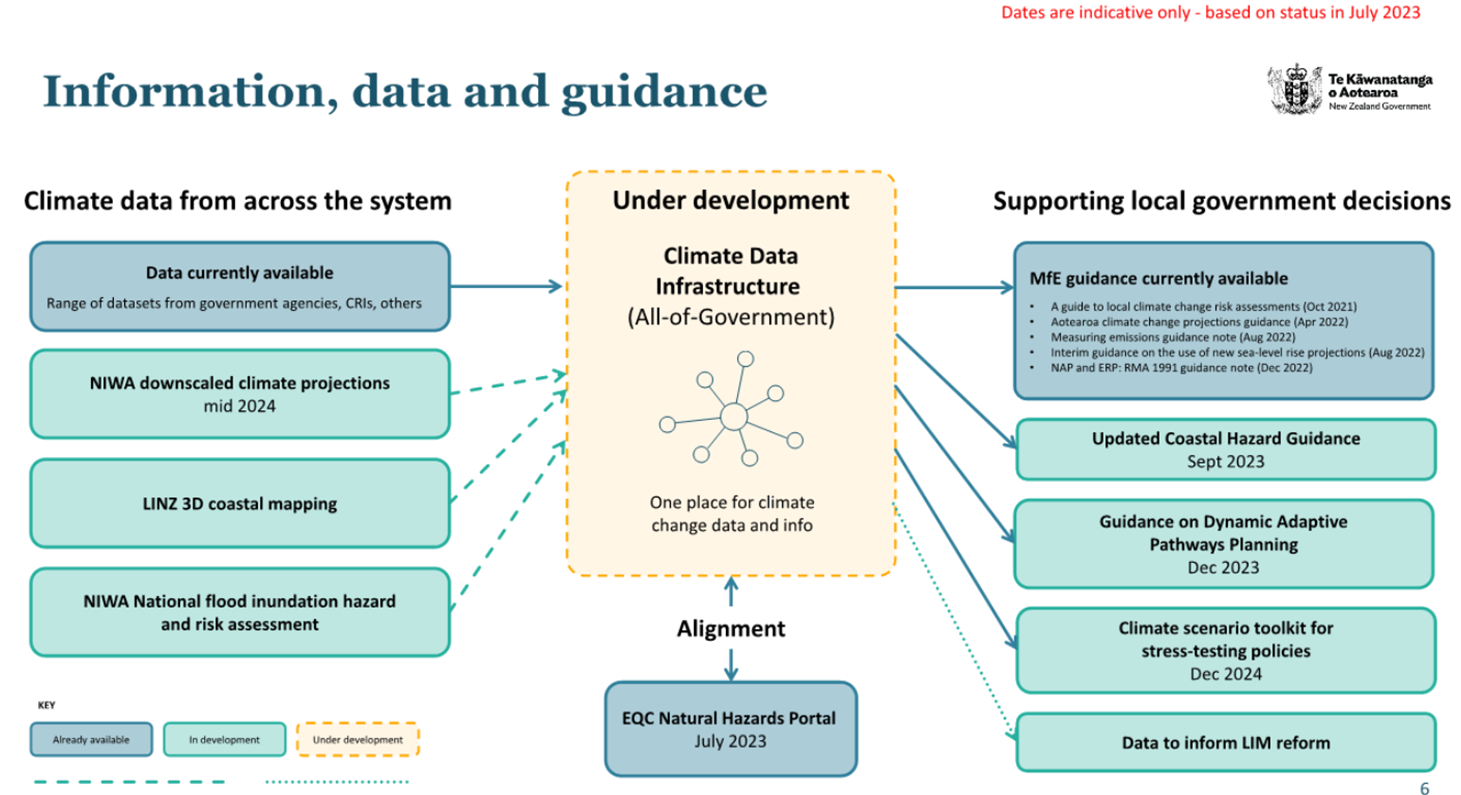
Central government is undertaking a number of large legislative and policy reforms. This item will identify key reforms ongoing at the national level, provide a broad overview of their implications and engender discussion and raise awareness.
Staff will give a verbal update on aspects of the reforms. This allows for flexibility and agility in responding to rapidly changing landscape.
1. That the report ‘Policy updates’ by Tom FitzGerald, climate Change Manager and dated 10 July 2023, be received.
Background/Tuhinga
Key reforms that will be covered include:
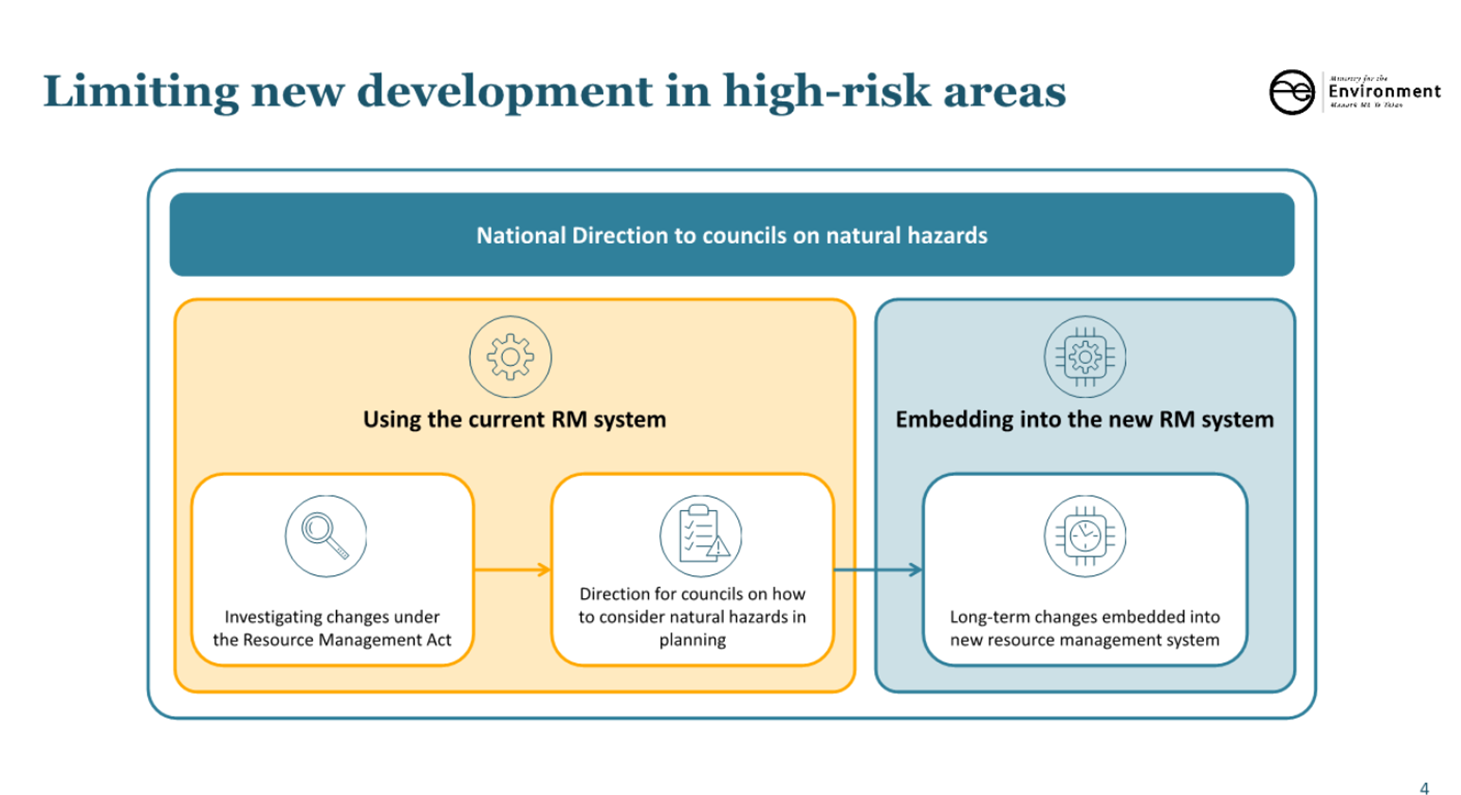
1. Changes to the RMA, including National Policy Statements, National Environmental Standards and other amendments.
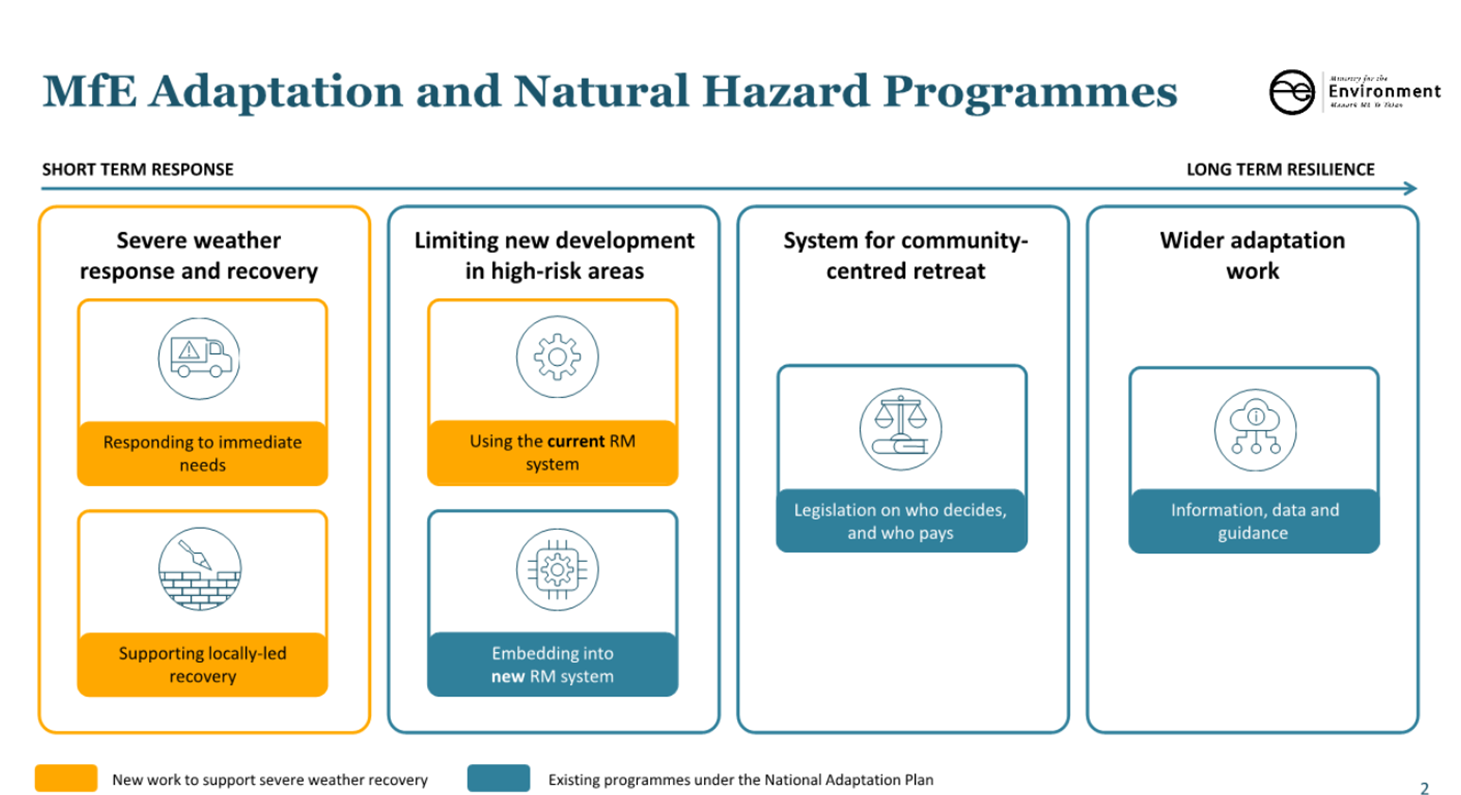
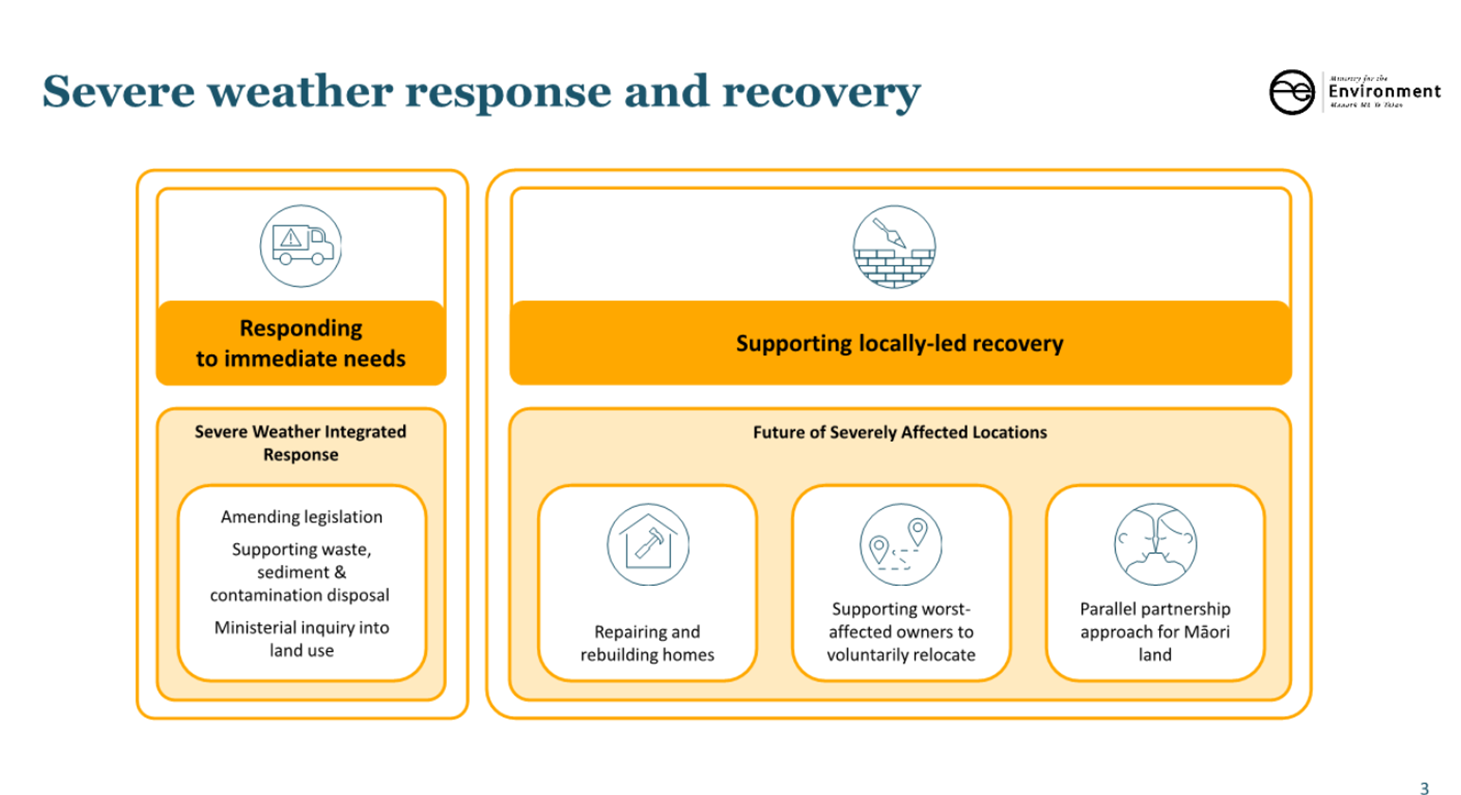
2. Cyclone Recovery and Severe Weather Incident Response, including Future of Severely Affected Land (FOSAL) programme
o FOSAL info: https://www.dpmc.govt.nz/sites/default/files/2023-07/Future-of-Severely-Affected-Land-FOSAL-Information-Pack.pdf
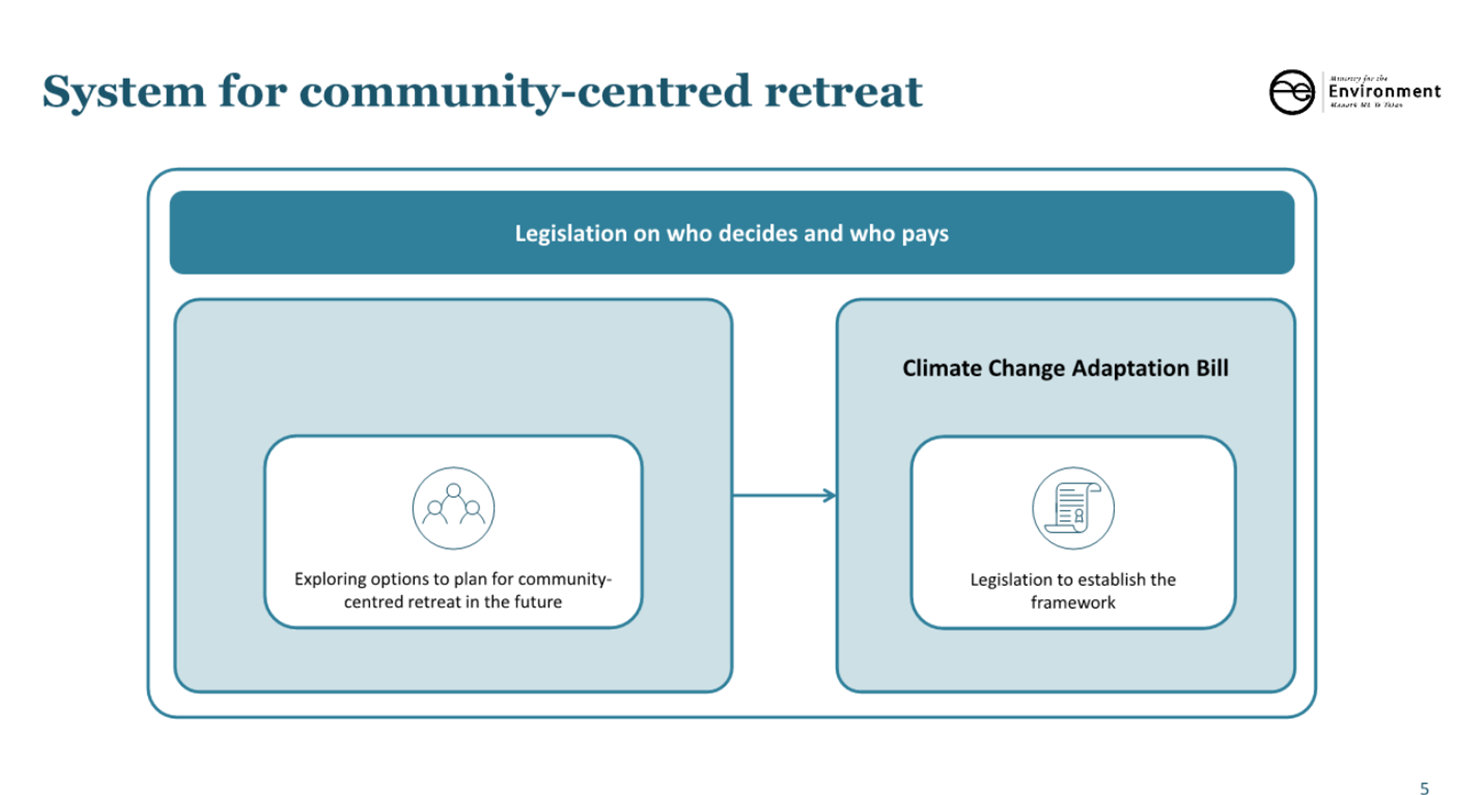
3. Progress on Climate Adaptation Bill and replacement resource management system – Natural and Built Environment Bill, Spatial Planning Bill.
o NBEA Bill: https://bills.parliament.nz/v/6/267f6032-6ceb-482a-ac45-0c02dd1edc60?Tab=history
o Spatial Planning Bill: https://bills.parliament.nz/v/6/5e622cec-50a3-427b-be27-6282d64e6c71?Tab=history
o See also MfE presentation from July 2023 (summarising 1-3) above at Attachment 1.
4. Land Information Memorandum (LIM) changes under the Local Government Official Information and Meetings Amendment Act (LGOIMA).
o Changes proposed: https://bills.parliament.nz/v/6/943398a6-d660-40e4-8480-234da510bf13?Tab=history
5. New emergency management legislation and overlaps with climate adaptation
o Draft Bill: https://bills.parliament.nz/v/6/0d1391e5-198f-44b9-8670-08db66e3a6bf?Tab=history
6. Other relevant updates
Attachments/Ngā tapirihanga
Attachment 1: MfE update - July 2023 ⇩
4 August 2023
|
TITLE: |
Update from Aotearoa Climate Adaptation Network (ACAN) |
|
From: |
Tom FitzGerald, Climate Change Manager |
|
Authorised by Group Manager/s: |
Louisa Gritt, Group Manager - Community Resilience, on 28 July 2023 |
Whakarāpopototanga / Executive summary
Staff will provide a verbal update on the Network, its purpose and activities.
The Aotearoa Climate Adaptation Network (or ACAN) was established in July 2021. It was formed to provide a space for local government practitioners working on adaptation to come together and have free and frank conversations about the challenges, opportunities and solutions to climate-driven problems. Originally formed around the need to adapt to coastal change as a result of rising sea levels, the Network now looks across the spectrum of natural hazards including flooding, landslide, debris flow, wildfire and others.
Members of the Network do not represent local government views but instead participate as ‘adaptation professionals’.
That the report ‘Update from Aotearoa Climate Adaptation Network (ACAN)’ by Tom FitzGerald, Climate Change Manager and dated 10 July 2023, be received.
Background/Tuhinga
ACAN currently hosts over 200 members from approximately 75% of all local governments in NZ (regional, unitary and territorial authority). Membership is voluntary and free of charge. Tom FitzGerald is Co-Convenor of ACAN with Jeff Farrell from Whakatane District Council.
An extract from the ACAN Terms of Reference is below:
Mission
To support and connect climate adaptation and resilience professionals to advance innovation and
excellence in this new field of practice.
Purpose
The Purpose of the Aotearoa New Zealand Climate Adaptation Network (ACAN) is to provide a network of practitioners working on climate adaptation planning or related programmes to facilitate:
· Practitioner networking and collaboration
· Support, guidance and resources for practitioners that build on successes while moving away
· from approaches that aren’t working
· Collaboration and advocacy with central government
· Collaboration with the research community
Scope
This Network recognises the multidisciplinary, cross-scale nature of climate adaptation and resilience mahi. At this stage, membership is limited to Aotearoa New Zealand local government practitioners involved in adapting to changing risk from natural hazards (as per IPCC 6AR glossary).
Value Proposition for Members
The ACAN provides opportunities for members and member organisations faced with climate
adaptation and resilience challenges to access information and a range of expertise from multiple
disciplines that will enable efficiencies in adaptation initiatives and optimise investment in their
implementation.
ACAN adds value to local government organisations and their communities through:
· Providing networking opportunities and peer support for staff members involved in the field of climate change adaptation (the Sector);
· Providing access to best practice (and developing/emerging practice) guidelines on adaptation interventions together with associated processes and procedures;
· Providing access to expert practitioners from multiple disciplines who can provide knowledge, insights, and advice;
· Coordinating common research needs;
· Providing a vehicle for identifying and resolving strategic issues faced by the Sector;
· Promoting consistency of practice (where appropriate) and limiting unnecessary duplication;
· Providing a mechanism for information transfer and sharing;
· Optimising organisations’ financial investment in adaptation initiatives through the above.
Attachments/Ngā tapirihanga
Nil
Joint Climate Change Adaptation Committee item: 6.3
4 August 2023
|
TITLE: |
Delivering our Te Taitokerau Climate Adaptation Programme |
|
From: |
Tom FitzGerald, Climate Change Manager |
|
Authorised by Group Manager/s: |
Louisa Gritt, Group Manager - Community Resilience, on 28 July 2023 |
Whakarāpopototanga / Executive summary
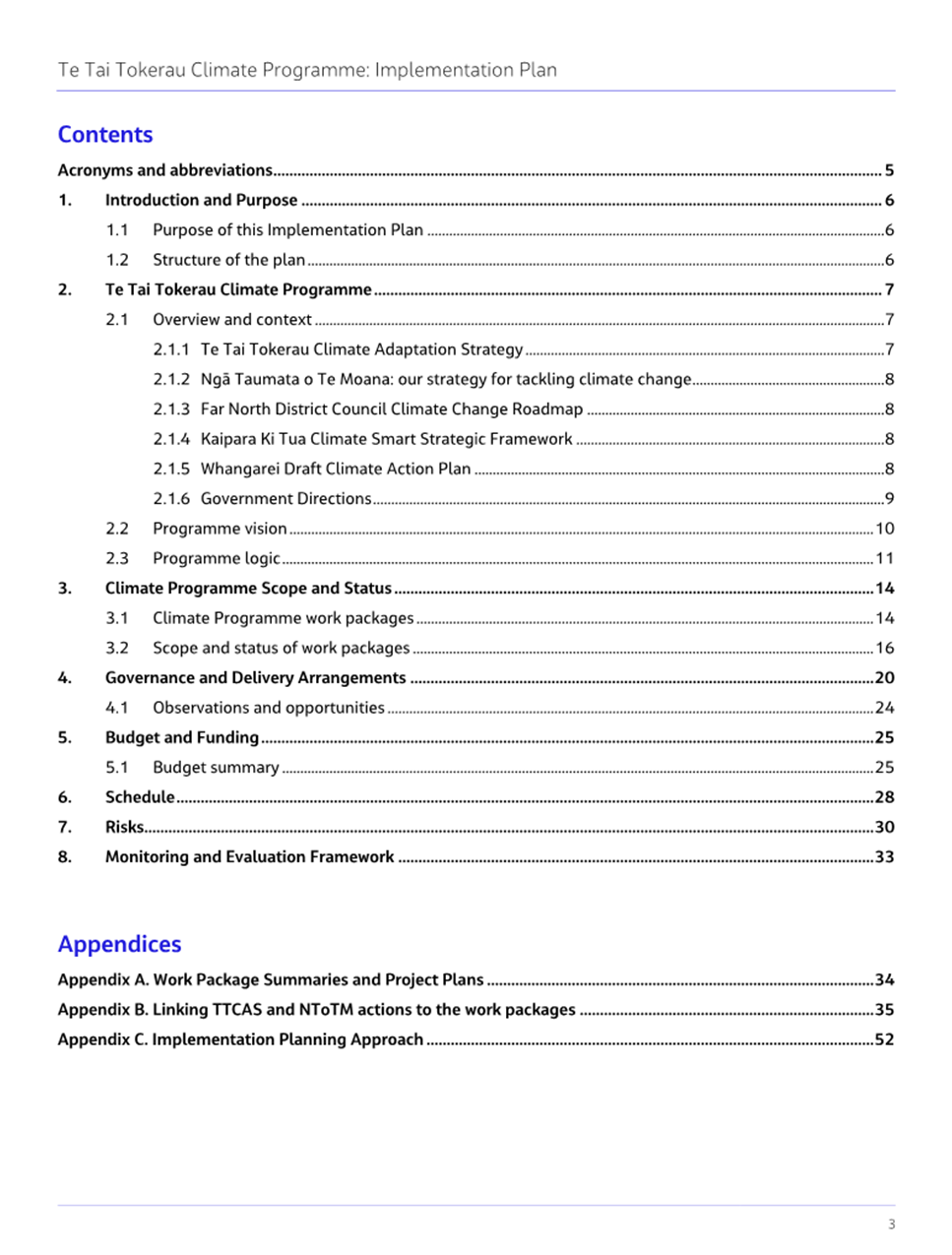
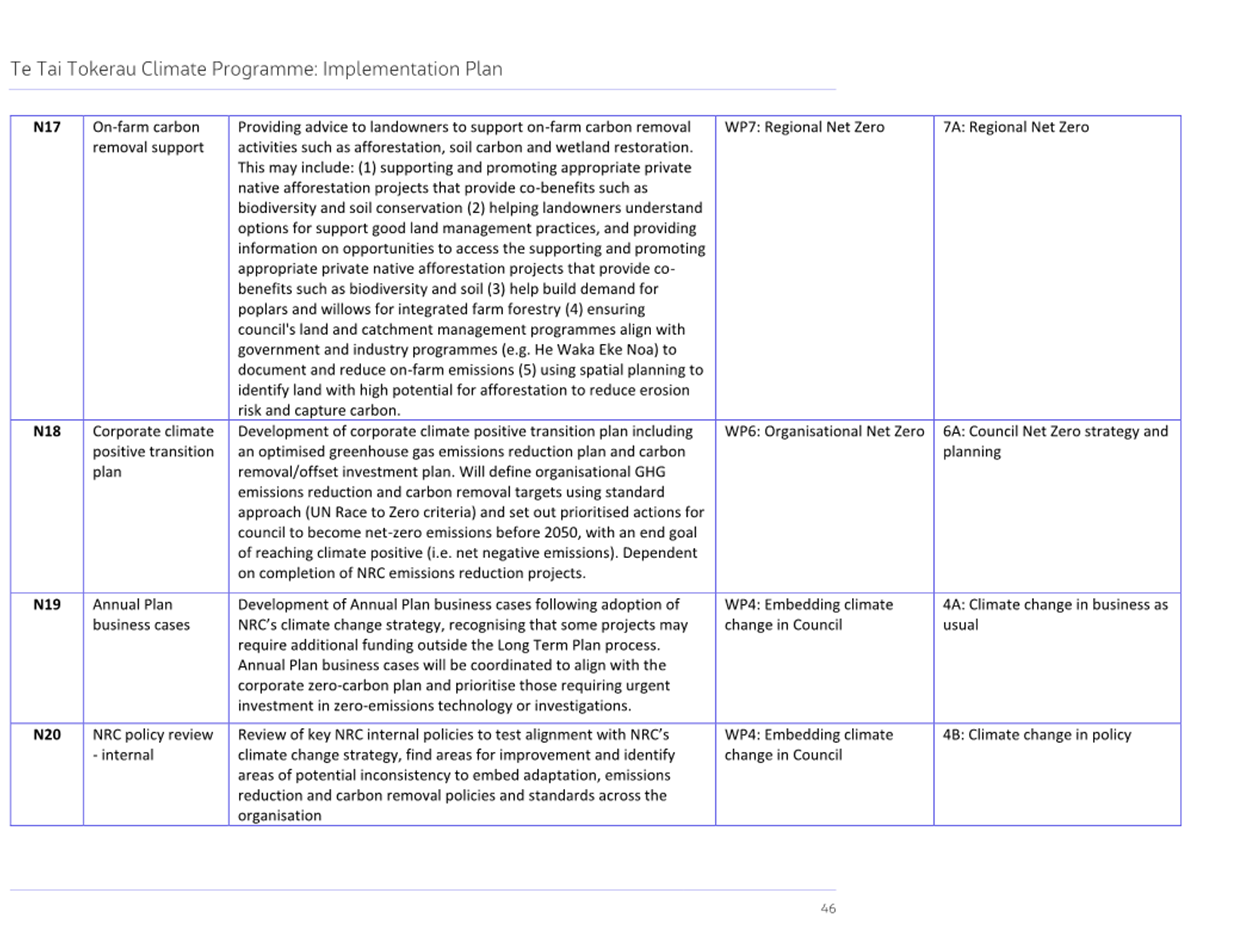
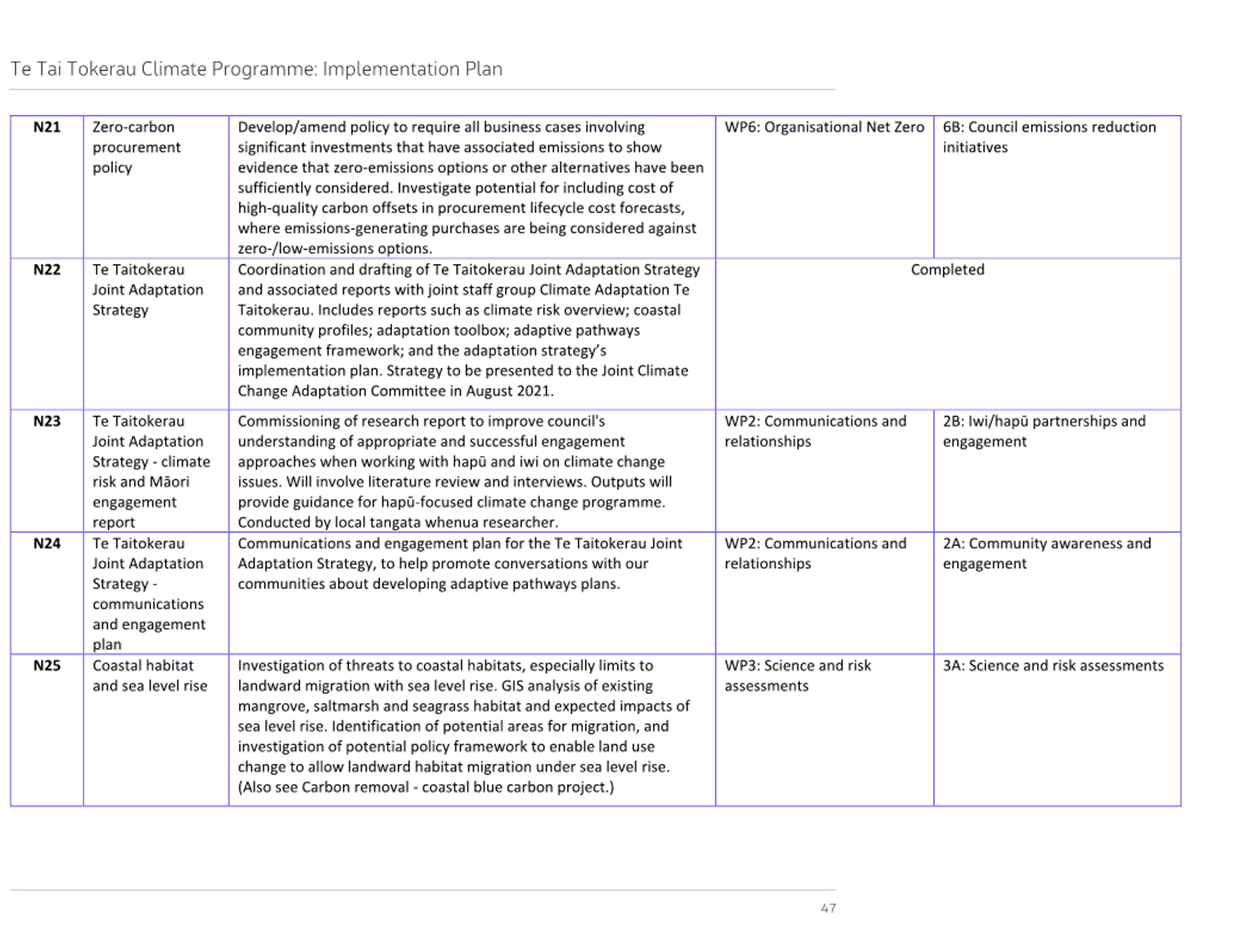
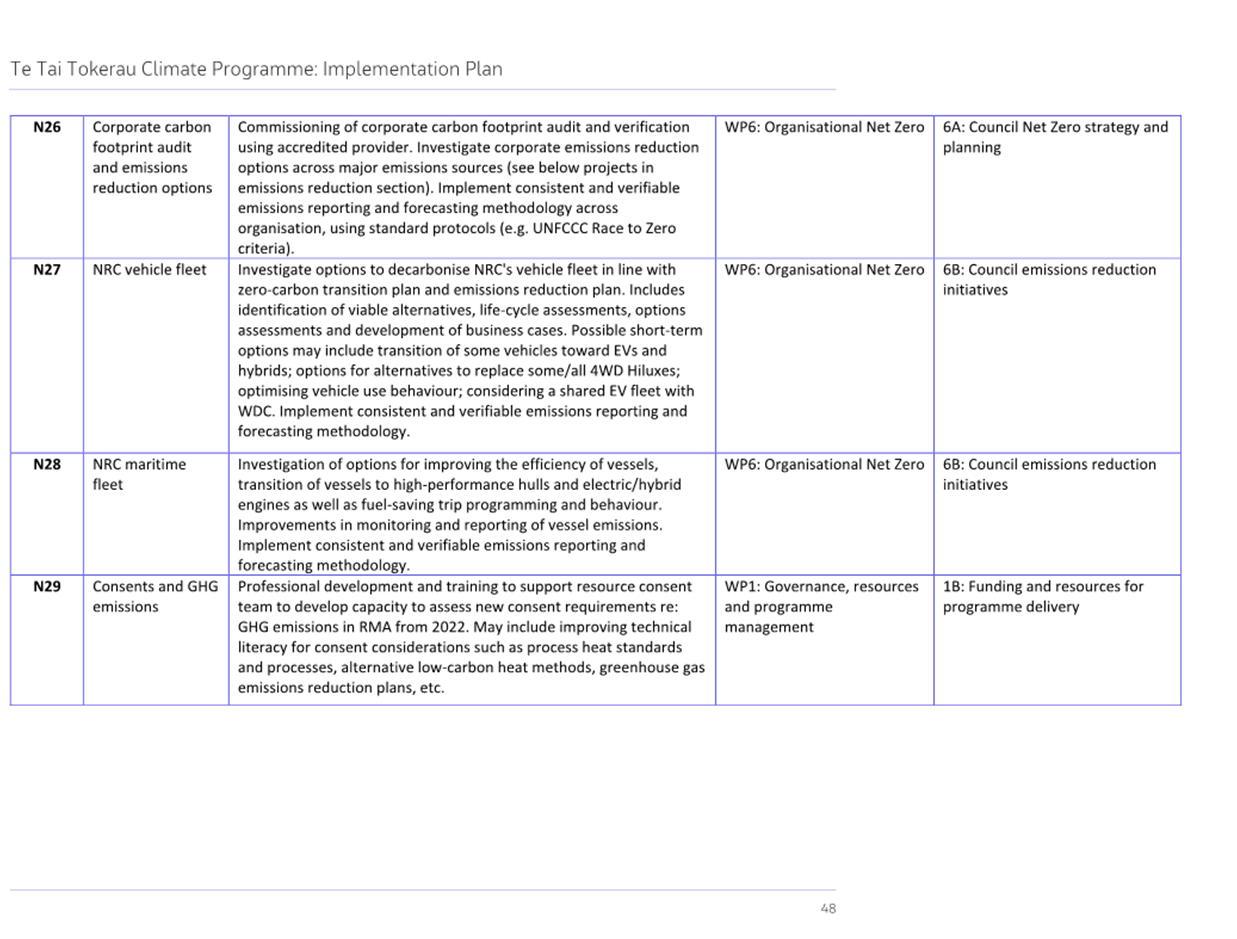
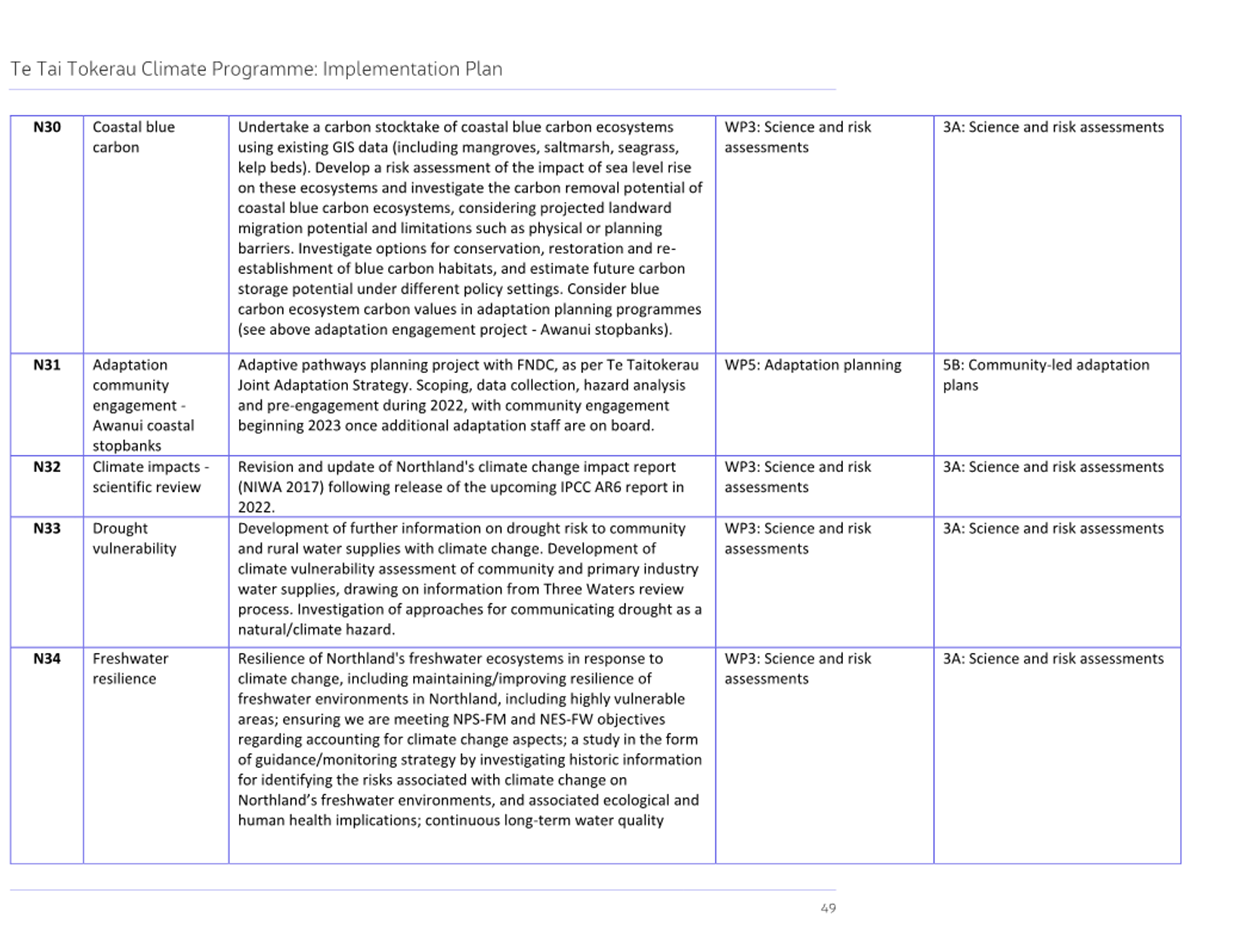
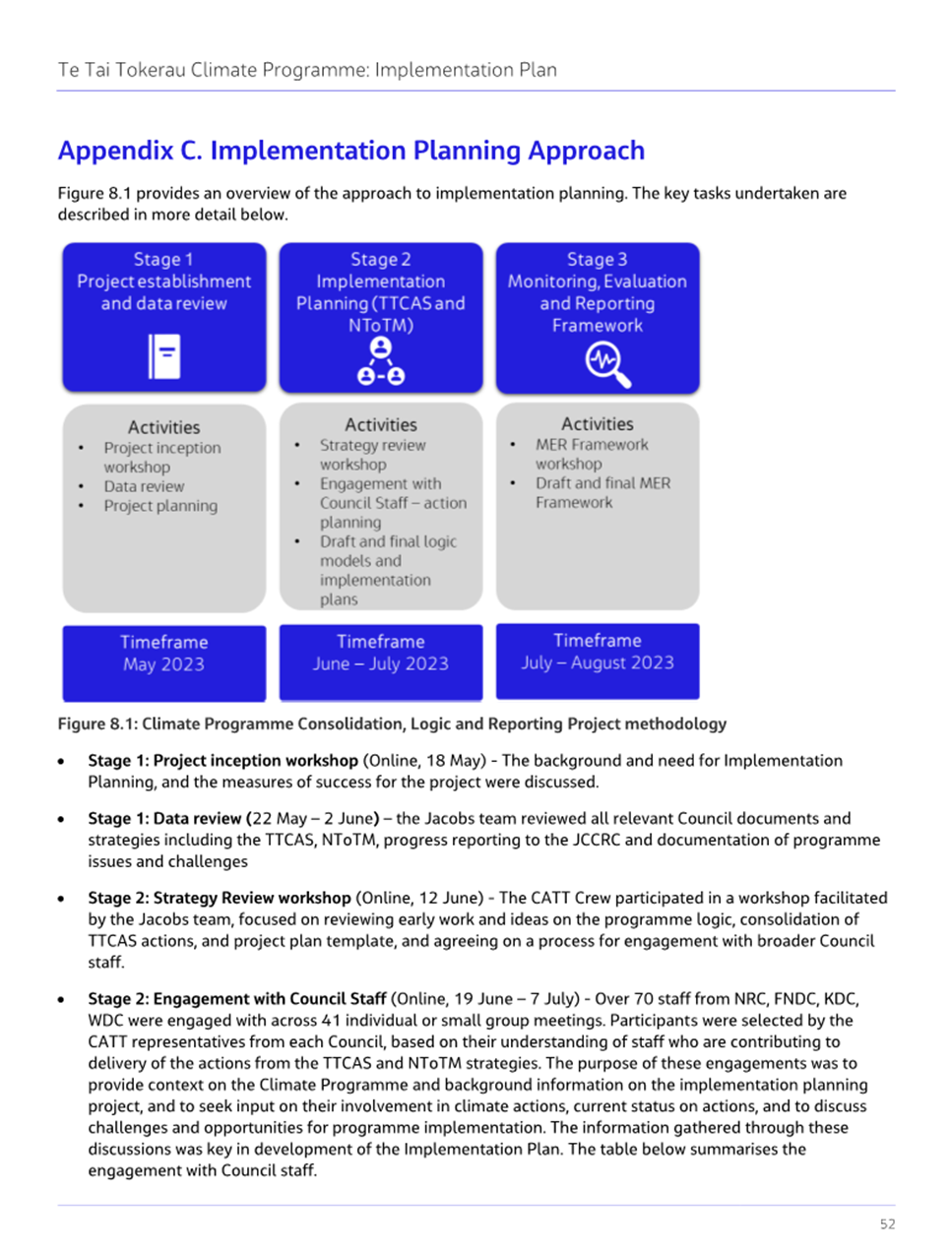
In May 2023 Northland Regional Council (NRC) contracted Jacobs to develop a clear implementation plan to deliver on the intent of the Te Taitokerau Climate Adaptation Strategy (TTCAS). To inform this implementation plan and help Councils and their partners prioritise actions for the 2024-27 Long Term Plan (LTP) a number of key elements have been developed:
1. An updated clear, concise and consolidated implementation plan,
2. A programme logic - linking on-ground actions to high level outcomes,
3. Indicative project plans for each work package, and
4. A Monitoring, Evaluation and Reporting (MER) framework (to be developed).
This project is known as the Climate Programme Consolidation, Logic and Reporting (CPCLR) project. The project is fundamental to the establishment of a delivery and implementation programme for the region.
This paper presents the outputs of this work and makes recommendations to the Committee to endorse this approach and take these work packages back to their respective councils to inform their own climate programmes and LTPs.
1. That the report ‘Delivering our Te Taitokerau Climate Adaptation Programme ’ by Tom FitzGerald, Climate Action and Natural Hazards Manager and dated 10 July 2023, be received;
2. That the Committee advocates for and advances our shared approach to climate action in their respective councils/entities and notes the draft findings and direction of the Climate Programme Consolidation, Logic and Reporting project that links implementation with longer-term climate adaptation outcomes and goals;
3. That the Committee endorses a shared climate adaptation programme be integrated into each council’s 2024-27 LTP;
4. That the Chair and Deputy Chair of the Committee write to the Mayors and Chair of each Council endorsing a shared climate adaptation programme be integrated into each council’s 2024-27 LTP;
Background/Tuhinga
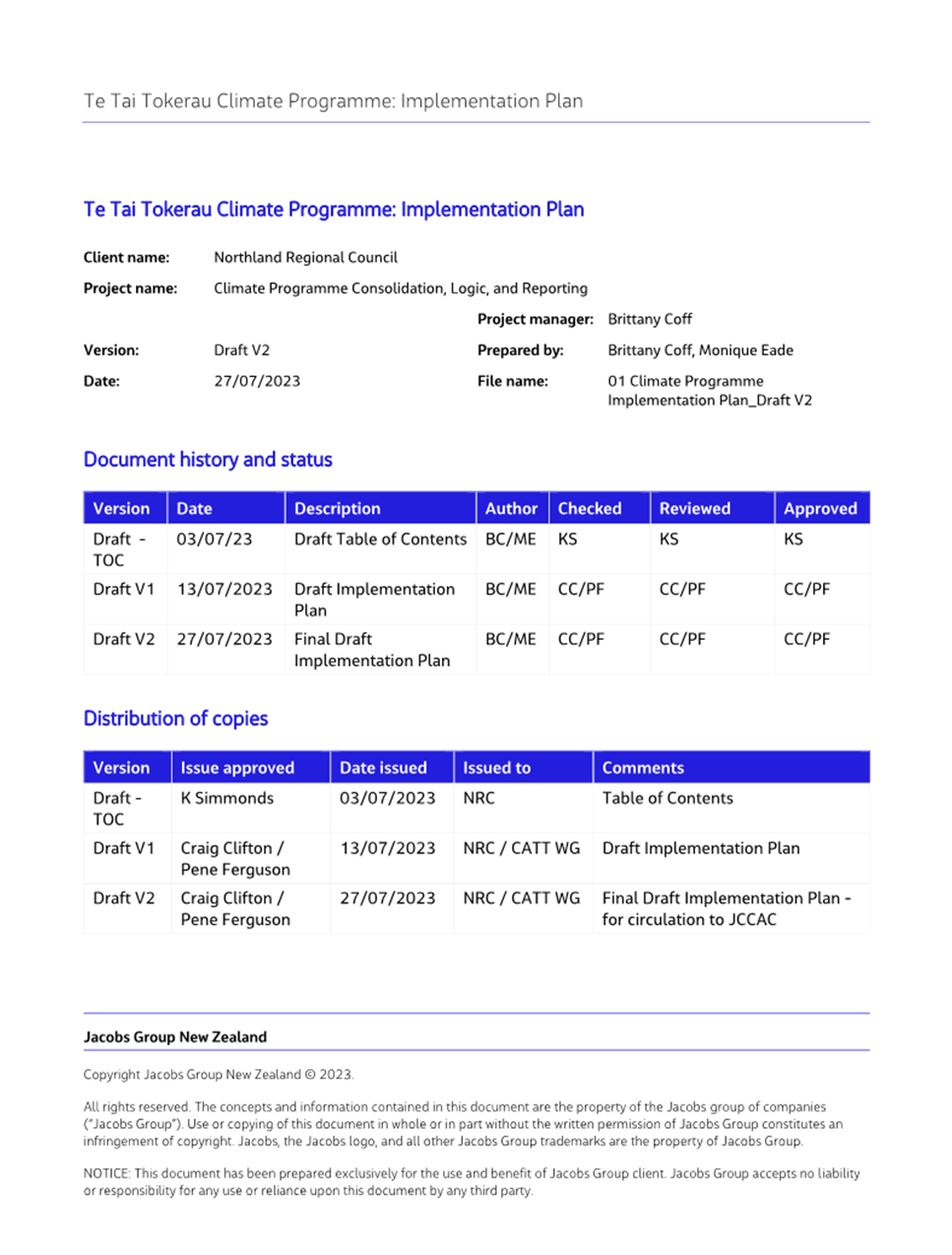
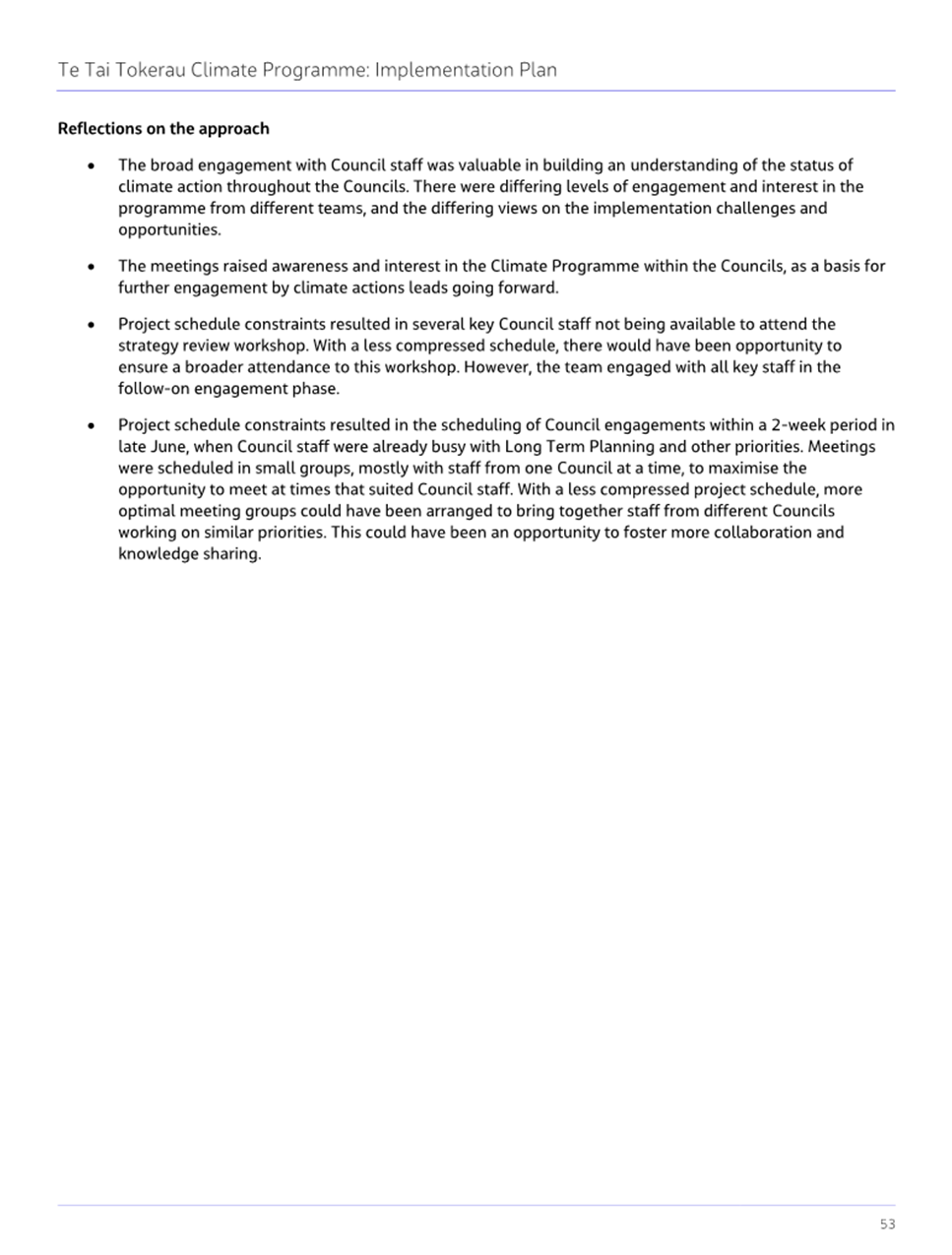
The Climate Programme Consolidation, Logic and Reporting (CPCLR) project was led by staff from Northland Regional Council and funded from NRC’s adaptation budget. The outputs of this project will be referred to as ‘the Jacobs report’ from hereon.
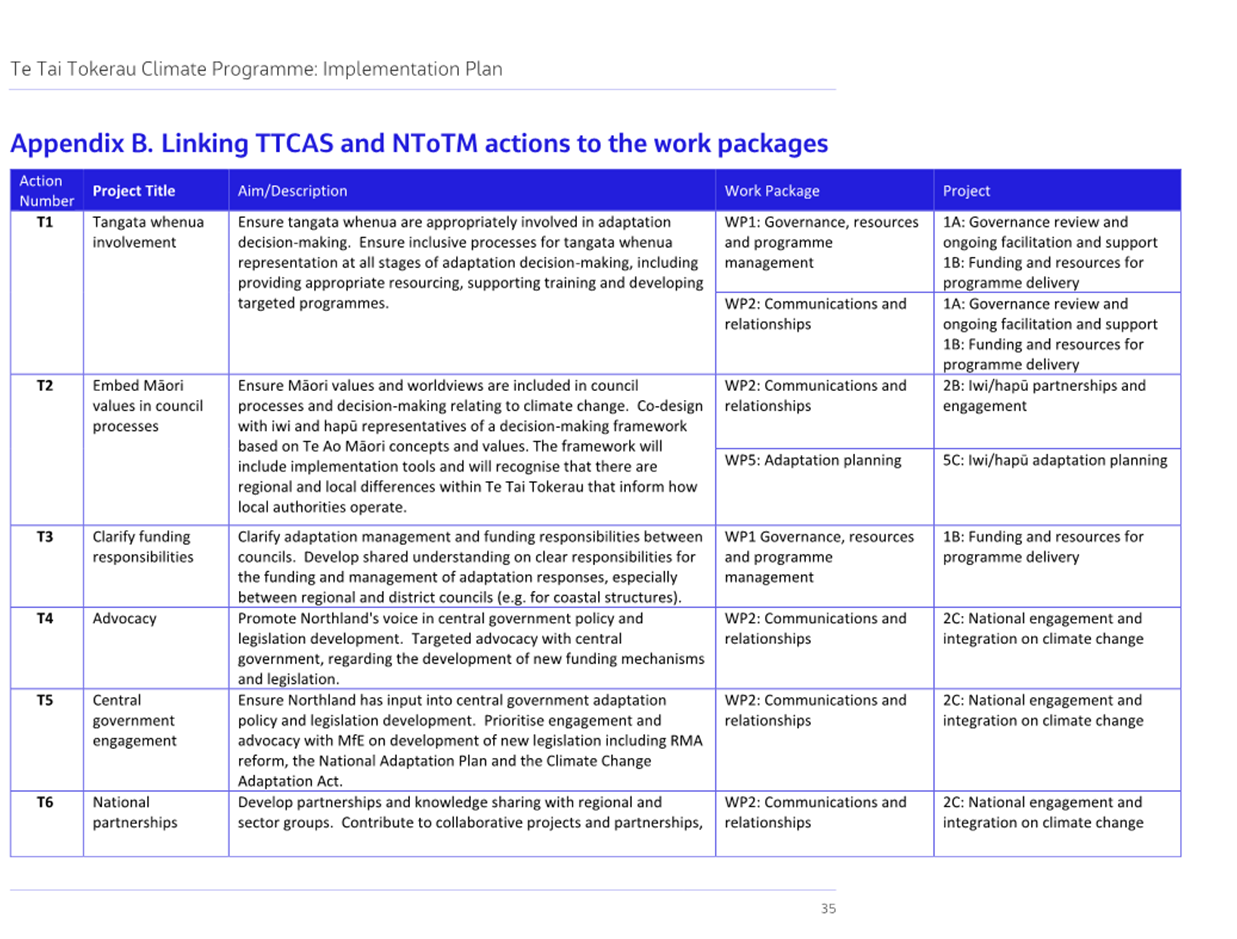
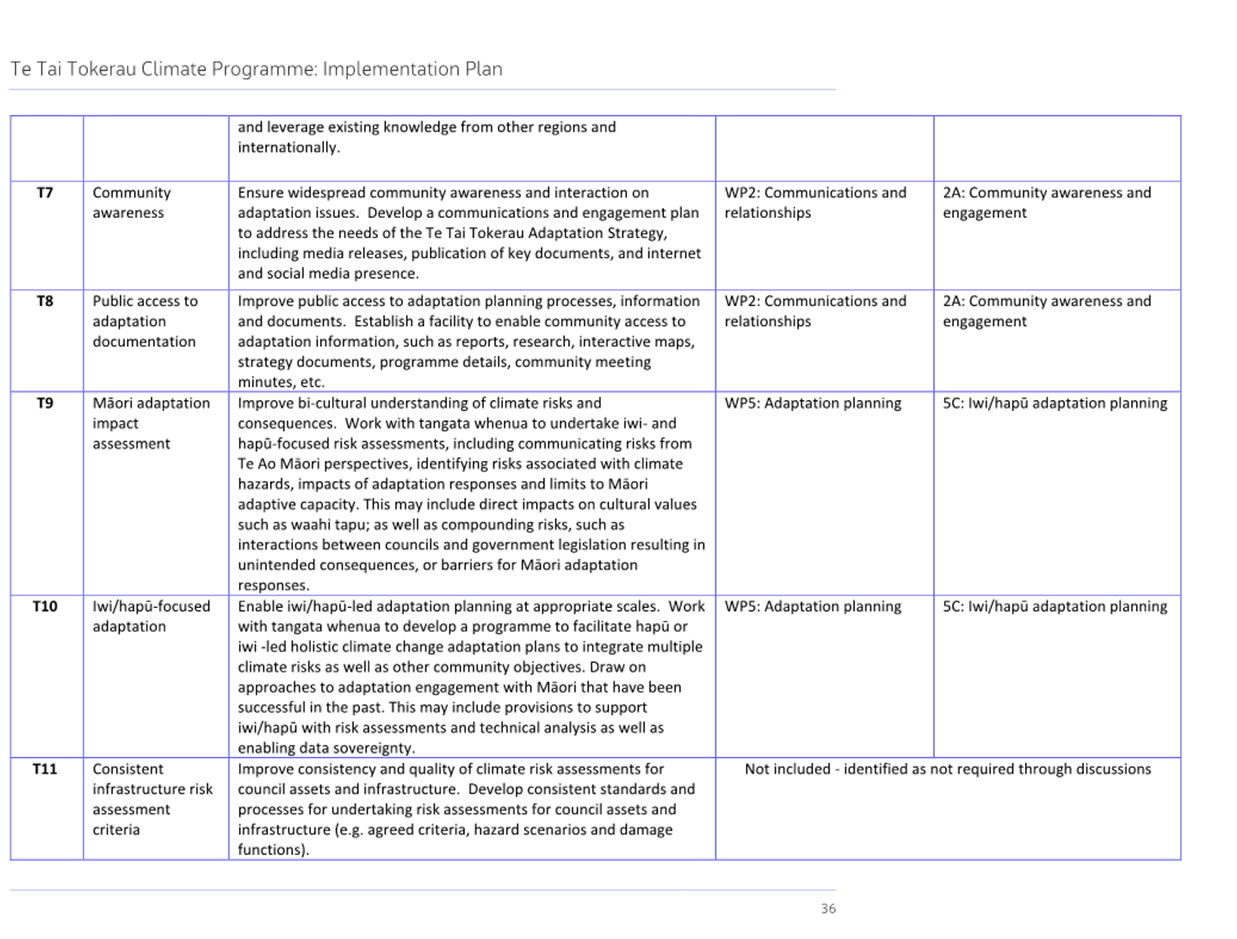
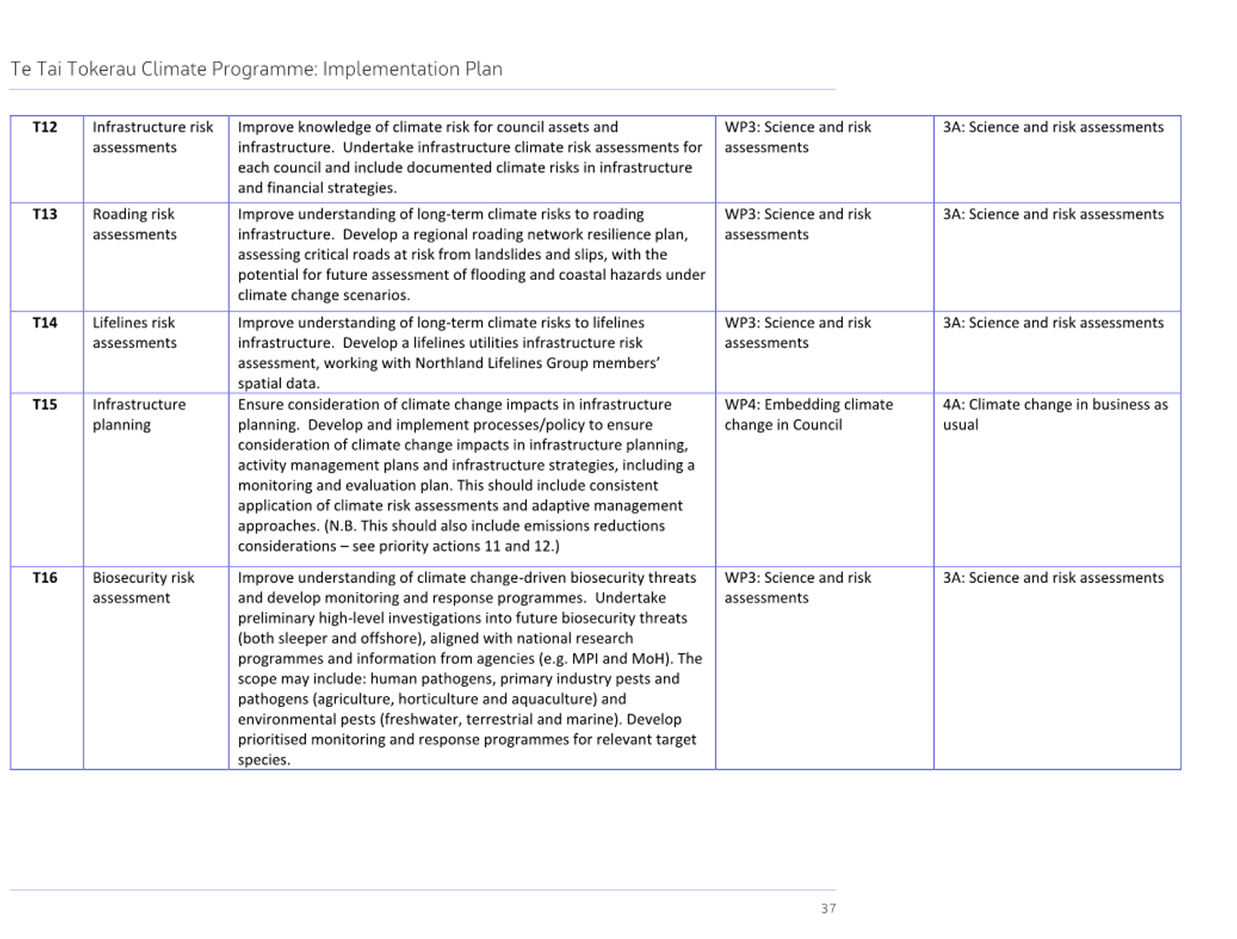
To achieve best value for money NRC also used the CPCLR project to align its own climate strategy implementation plan (set out in support of Ngā Taumata o Te Moana) with the Te Tai Tokerau Climate Adaptation Strategy.
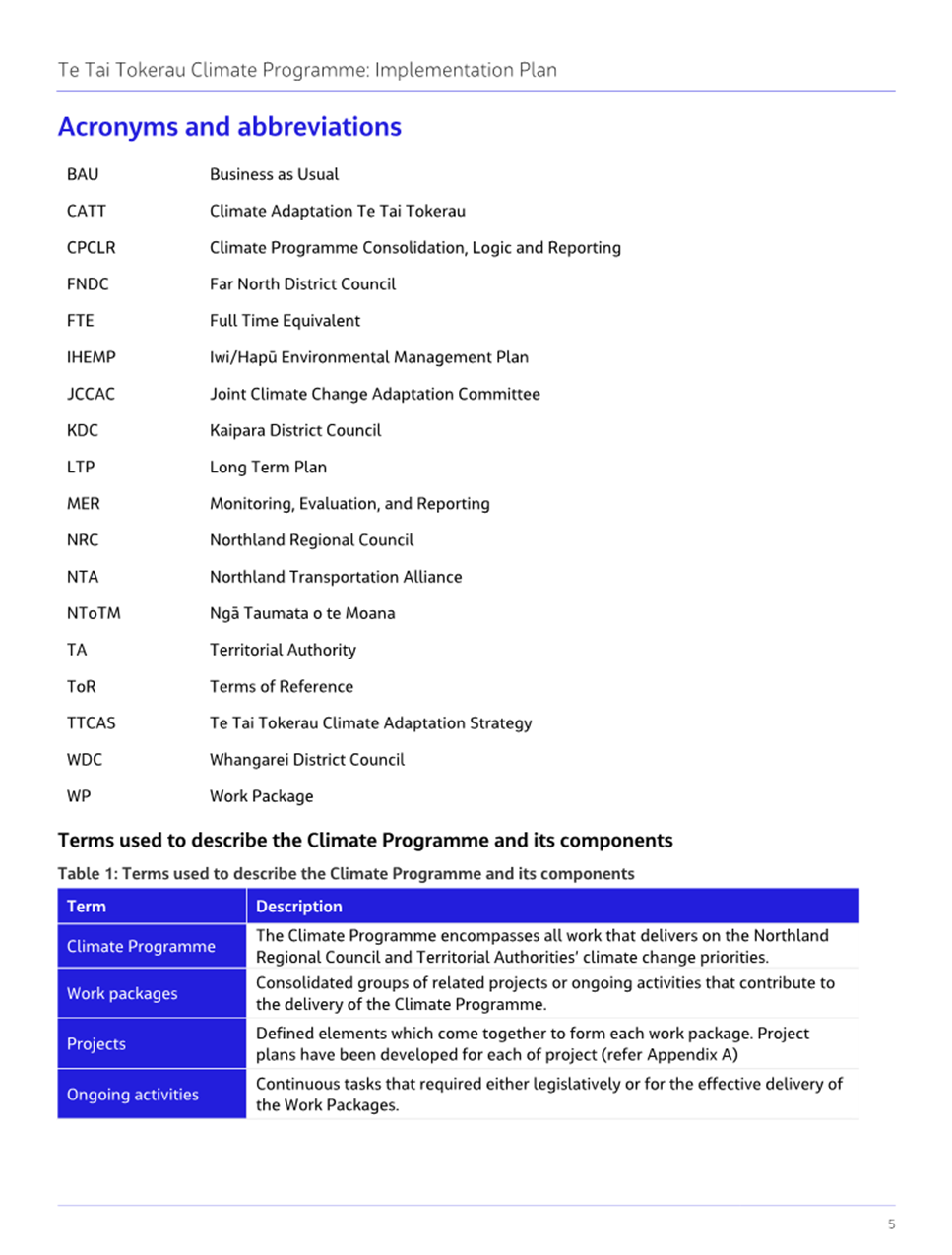
Note 1: Each Territorial Authority (TA) has their own climate strategy, framework or roadmap (whether in draft or adopted) and will continue to undertake alignment of their own climate programmes with that set out here.
Note 2: Given the disparity, diversity and quantum of iwi/hapū voices in Te Taitokerau, this project has only sought to consolidate climate actions led and funded by the four councils.
The following context and issue definition sets out the scope of the project and reflects NRC’s perspective and challenges in undertaking climate action. However, in doing so it provides a regionally applicable programme logic that can be picked up by others and utilised.
Context
Over the past two years Northland Regional Council has adopted two different climate strategies:
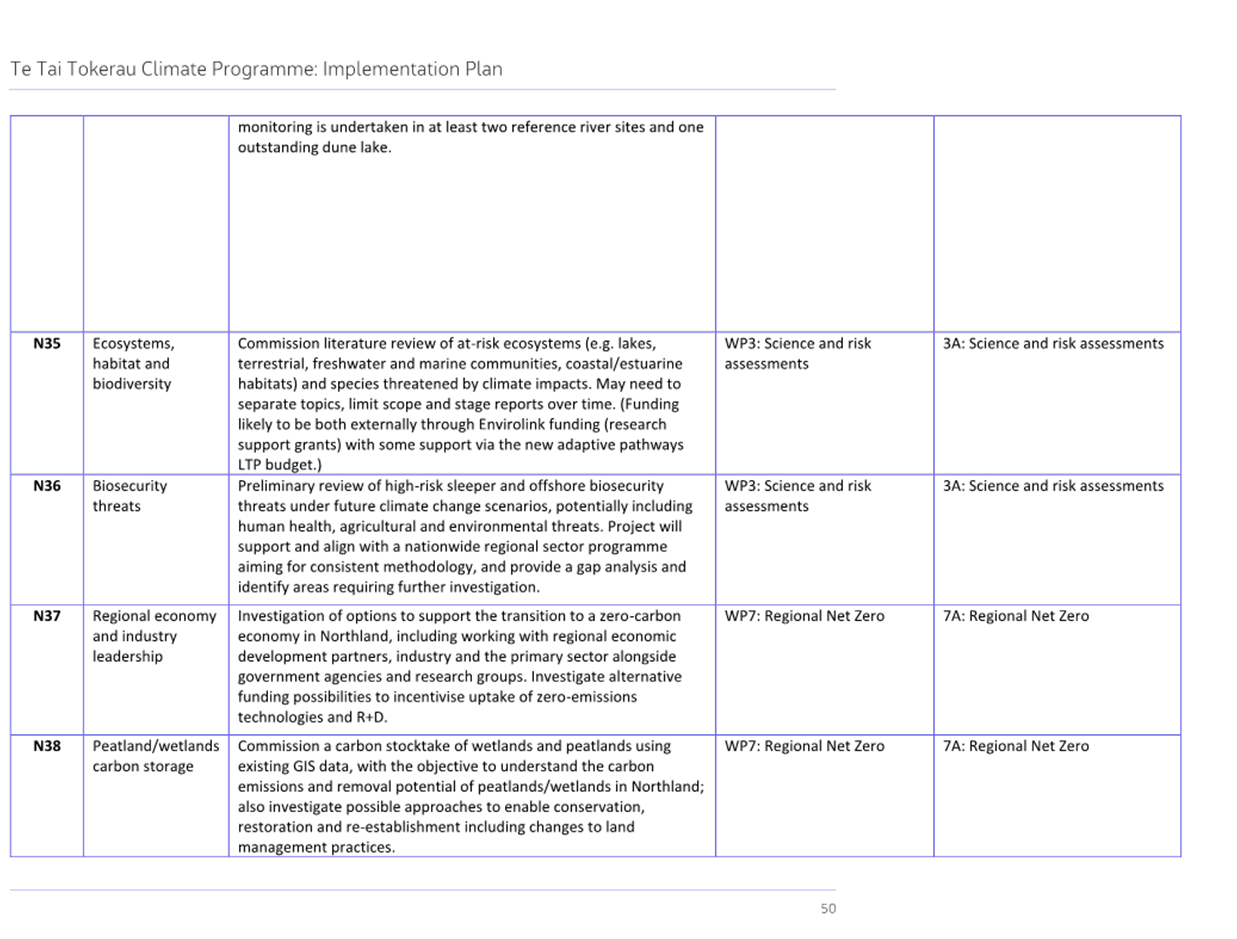
1. Ngā Taumata o Te Moana: our strategy for tackling climate change (NToTM) - 43 actions, adopted July 2021
2. Te Tai Tokerau Climate Adaptation Strategy (TTCAS) - 46 actions, adopted April 2022
The first Strategy (NToTM) looks at NRC’s own role in addressing the climate crisis and uses three pou to group specific actions - GHG reduction, removal and adaptation. The second is our region-wide joint strategy solely focused on adaptation[1]. The TTCAS was built as a partnership between NRC, the three northern TAs - Kaipara, Whangārei and Far North District Councils, and Treaty/Tiriti partners.
Both of the above strategies are referenced in the Jacobs report, however this report to the Joint Climate Change Adaptation Committee focuses only on the TTCAS – the Te Tai Tokerau Climate Adaptation Programme.
The issue
Addressing the climate crisis poses new challenges for councils in the way we work and the way we work with others. The strategies adopted above illustrate the fact that climate change will impact every aspect of Council business in some way or another. In this regard, there are multiple opportunities for misalignment of policies and action that may work against each other to stymie climate action – potentially even leading to maladaptation[2].
What is increasingly apparent is that there are also multiple positive opportunities to work together for the greater good, increase value for money and work toward shared outcomes. This optimistic outlook reflects the true intent of the partnership envisaged when the Joint Climate Change Adaptation Committee was established.
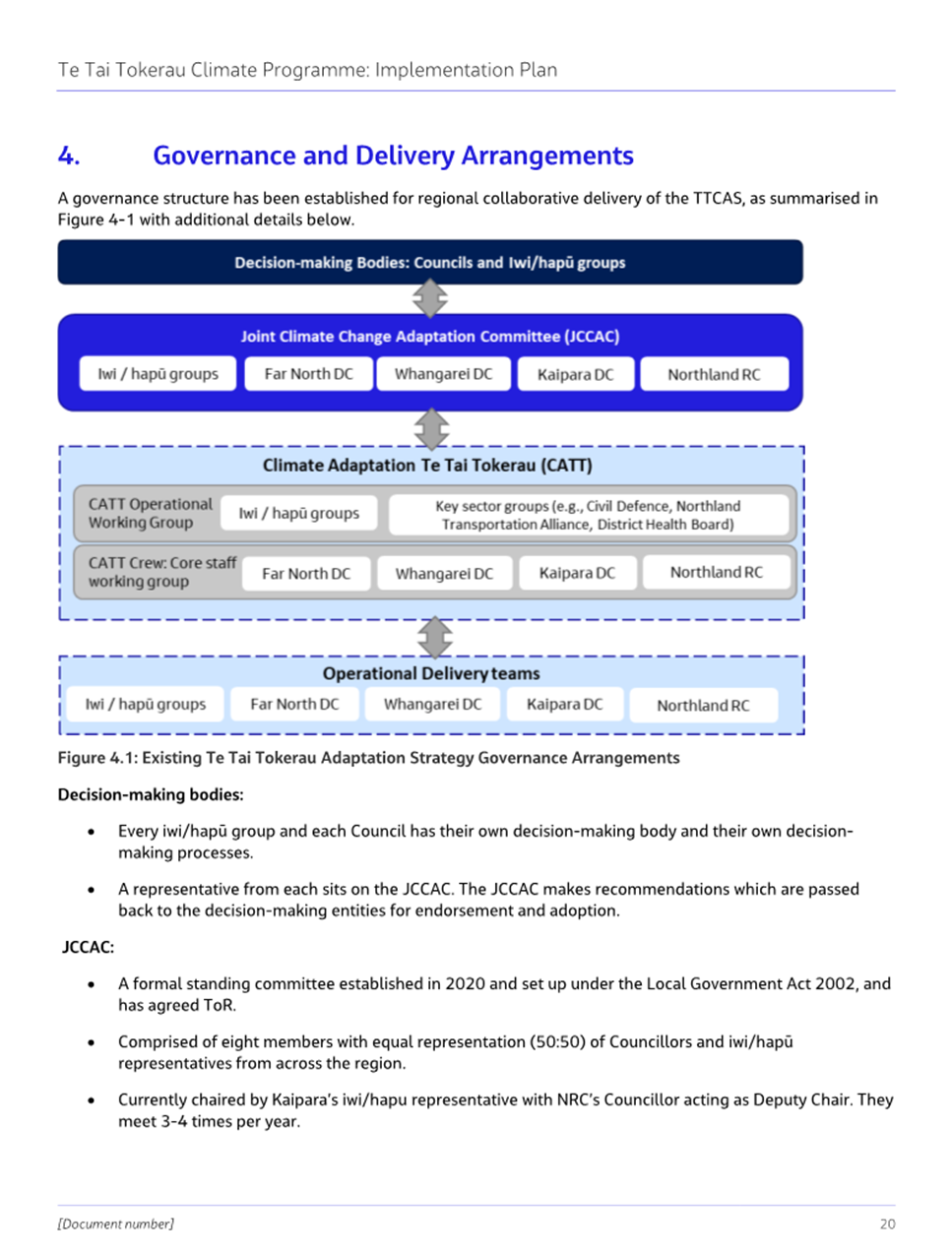
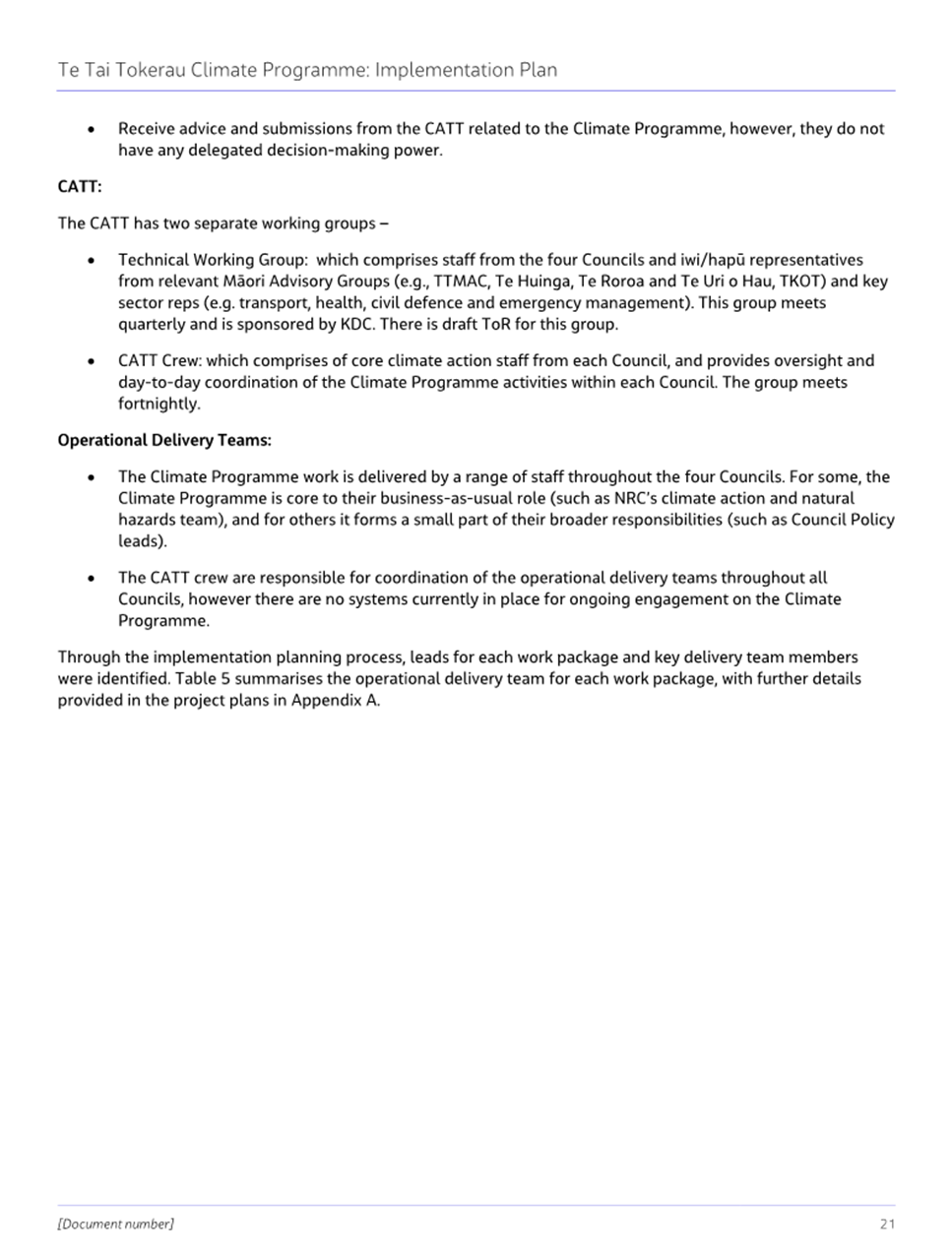
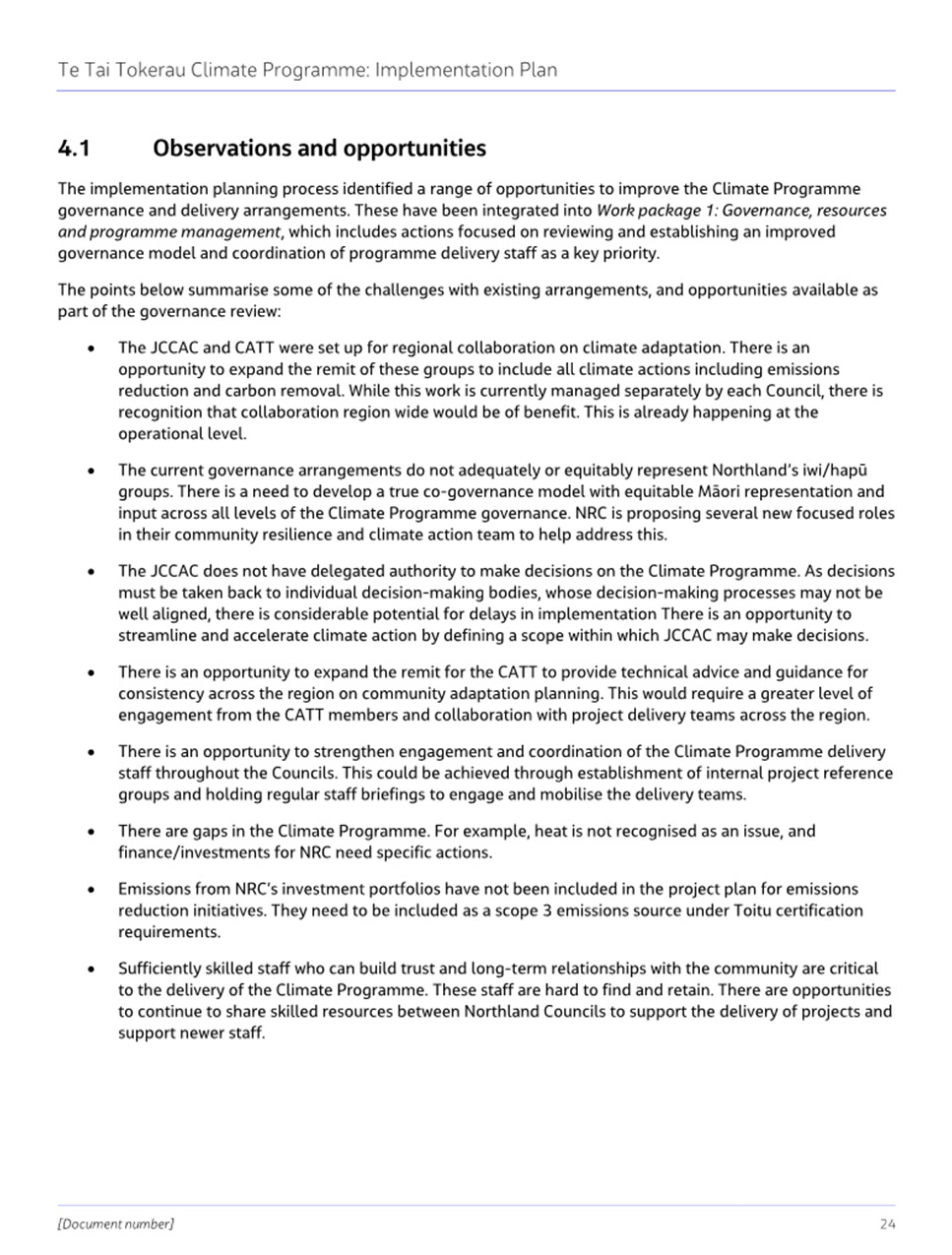
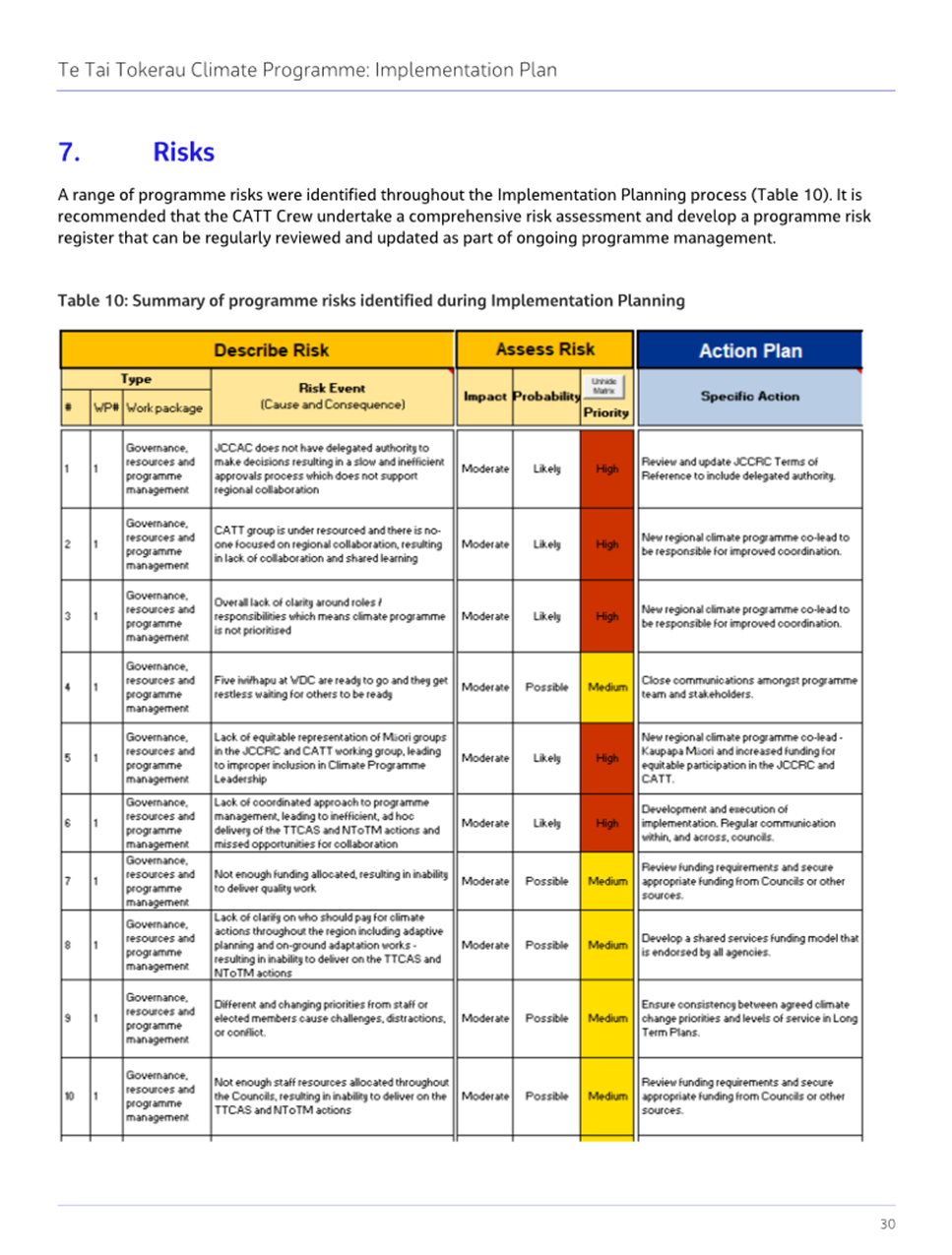
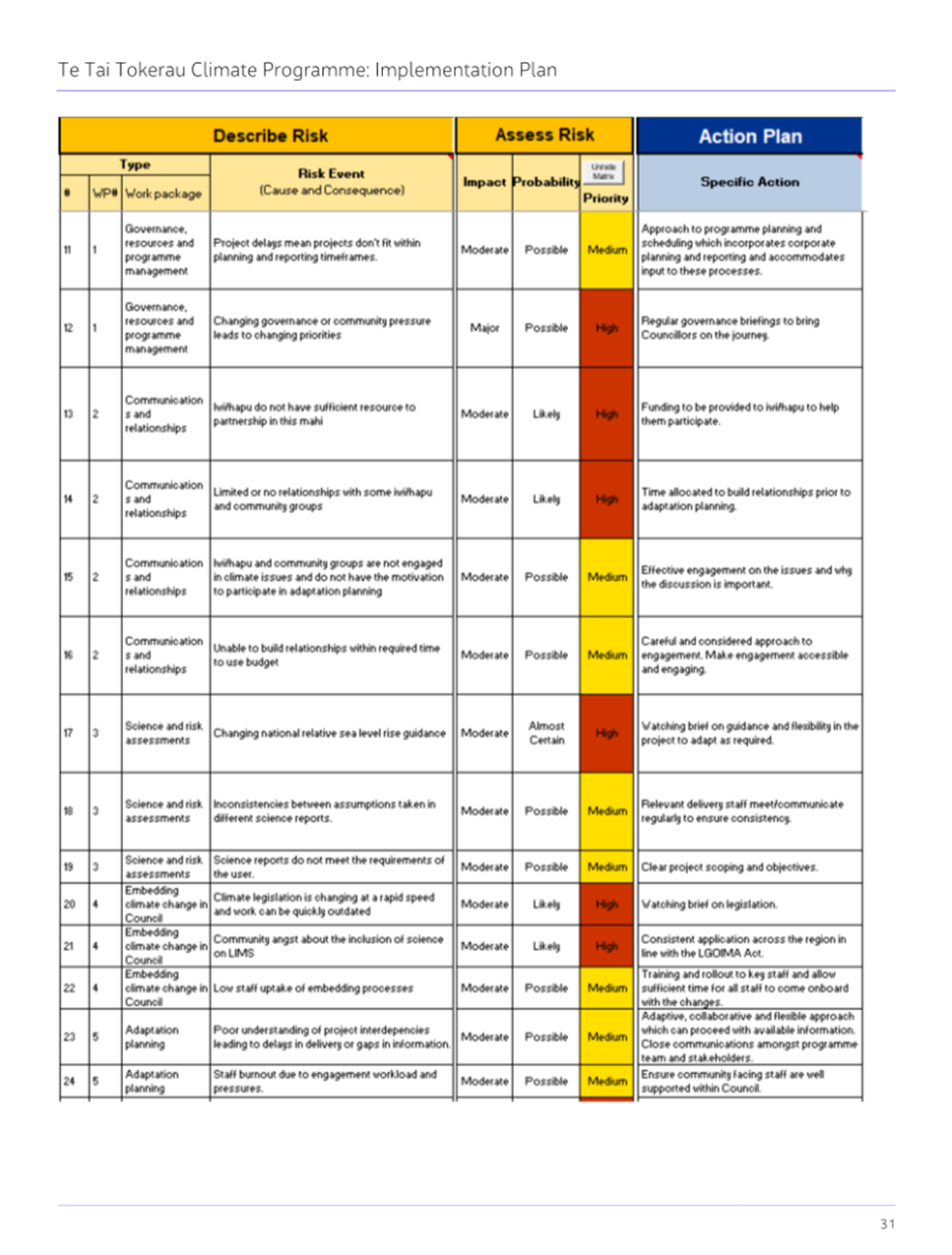
In adopting the TTCAS, the challenges of implementing each of the 46 ‘priority actions’ have become clear. These challenges include lack of specificity around the action itself, policy [mis]alignment, lack of clarity around roles and responsibilities, no coordinated funding arrangements, general coordination, and overarching reporting to give effect to Council’s transparency and accountability foundations. The current collaborative approach (commonly referred to as Climate Adaptation Te Taitokerau, or CATT), whilst having gotten us this far, requires further strengthening.
Alongside our regional approach to adaptation sits NRC’s own climate strategy. NToTM has its own Implementation Plan that outlines an additional 43 ‘priority actions’ to be undertaken over an ambitious three-year timeframe. However, the actions were not well defined and developed separately (prior) to those in the TTCAS.
The implementation of each of these Strategies has become problematic for several reasons:
· lack of definition in actions (no agreed scope);
· multiple overlapping climate strategies, frameworks and roadmaps across scales;
· the publication of the National Adaptation Plan;
· no clear link to strategy objectives, Council outcomes, national adaptation goals;
· no explicit leadership or ownership of each action; and
· no real appreciation of the resources required to deliver.
This lack of programme clarity also poses challenges if and when the Minister for Climate Change or the Climate Commission make any requests under section 5ZW of the Climate Change Response (Carbon Zero) Act 2002[3].
For effective and efficient programme management to occur, the two climate strategies must also talk to and support each other.
Project aims
This project will look to the connections between the regional and district councils and uncover gaps, friction or misalignment and their implications. The aim is to align NRC with its stated climate goals and ambitions and build ‘future fit’ programme management, project management and reporting. We envisage this consolidated approach can provide a backbone for the ongoing improvements to climate governance across the region.
To help us keep track of progress, highlight areas of success or areas for improvement, and display true transparency and accountability we are also developing a simple monitoring, evaluation and reporting (MER) framework. This will set out potential metrics and indicators that can be used for a variety of reporting processes.
The outputs so far
A draft version of the Jacobs report is at Attachment 1.
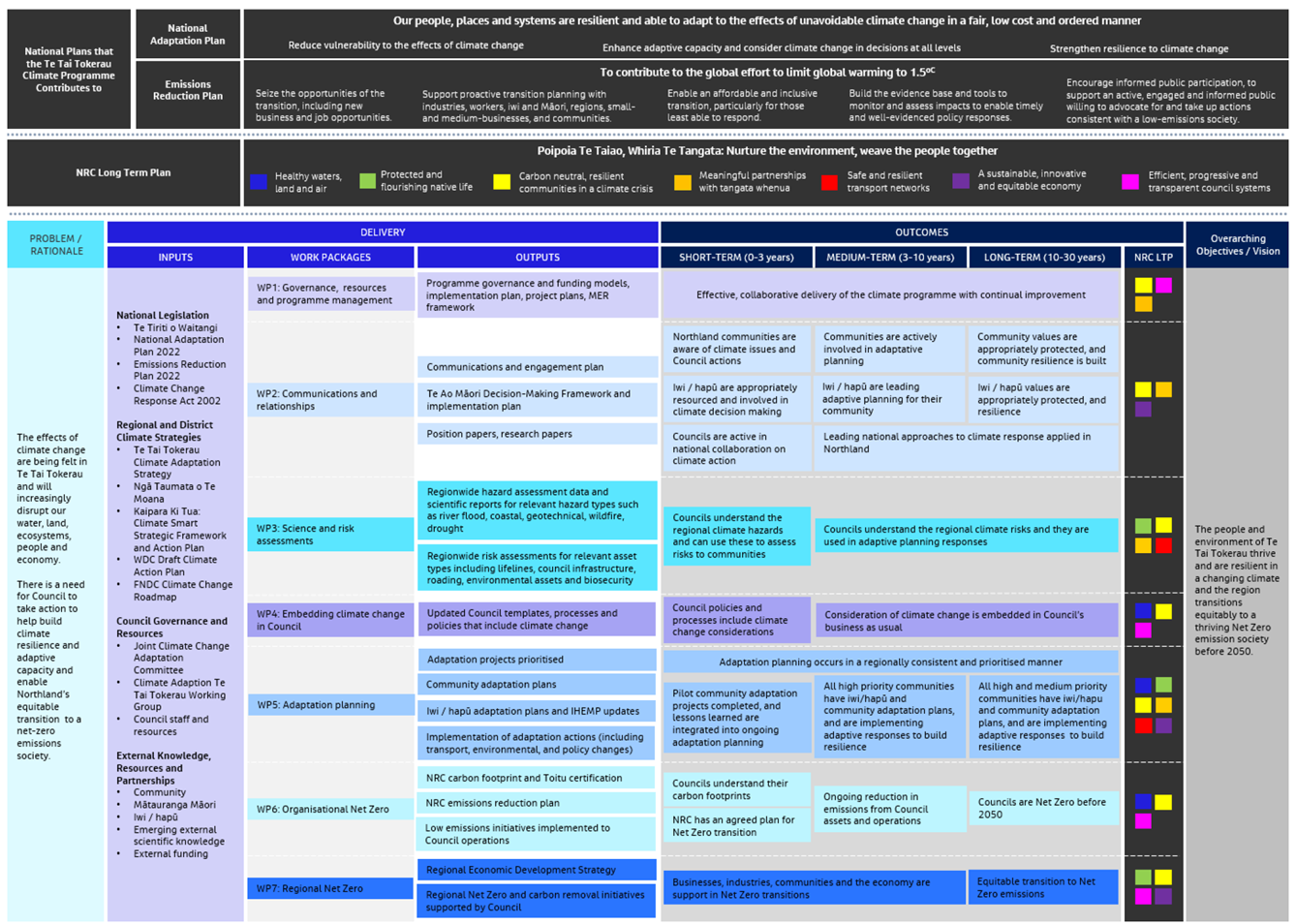
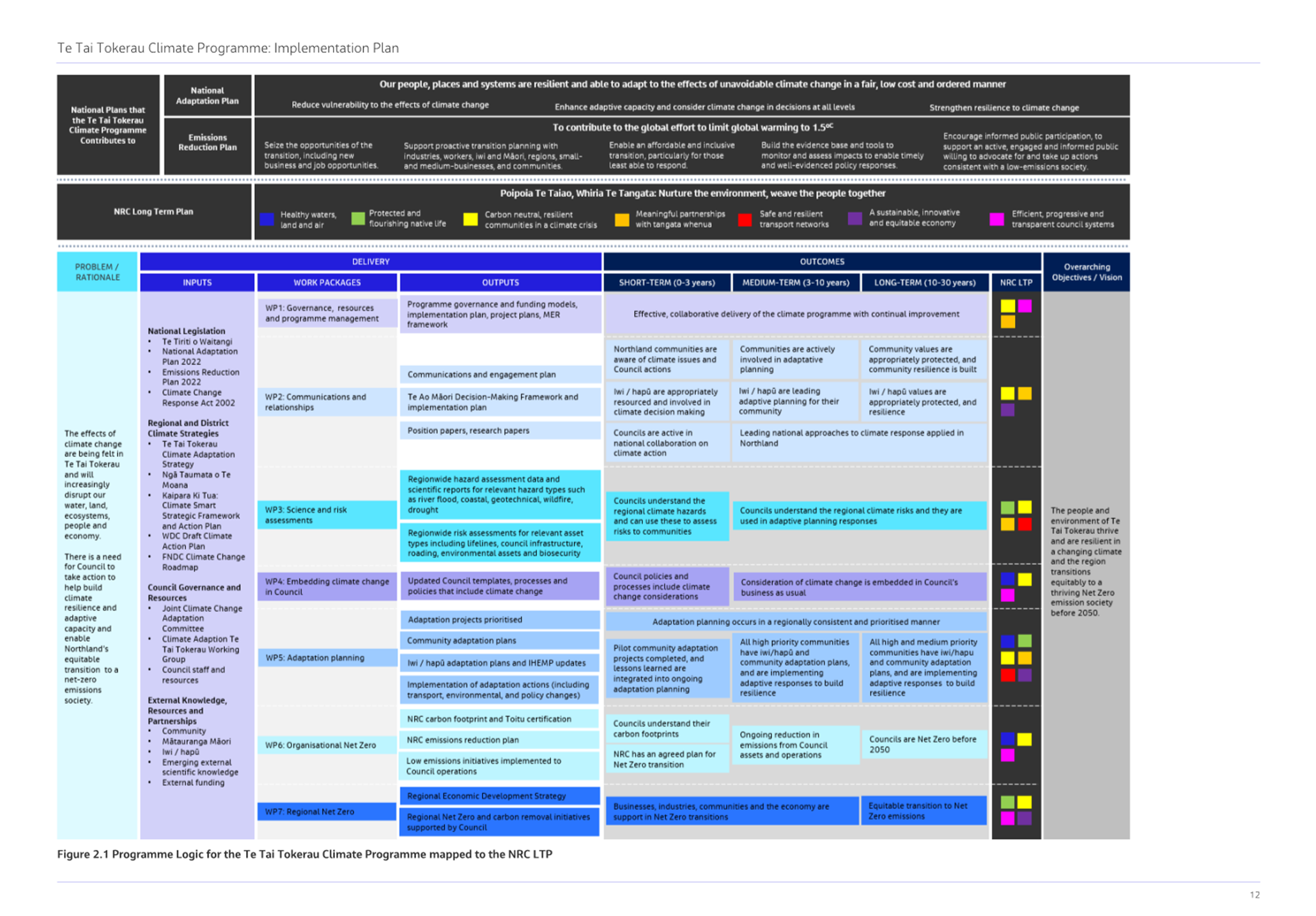
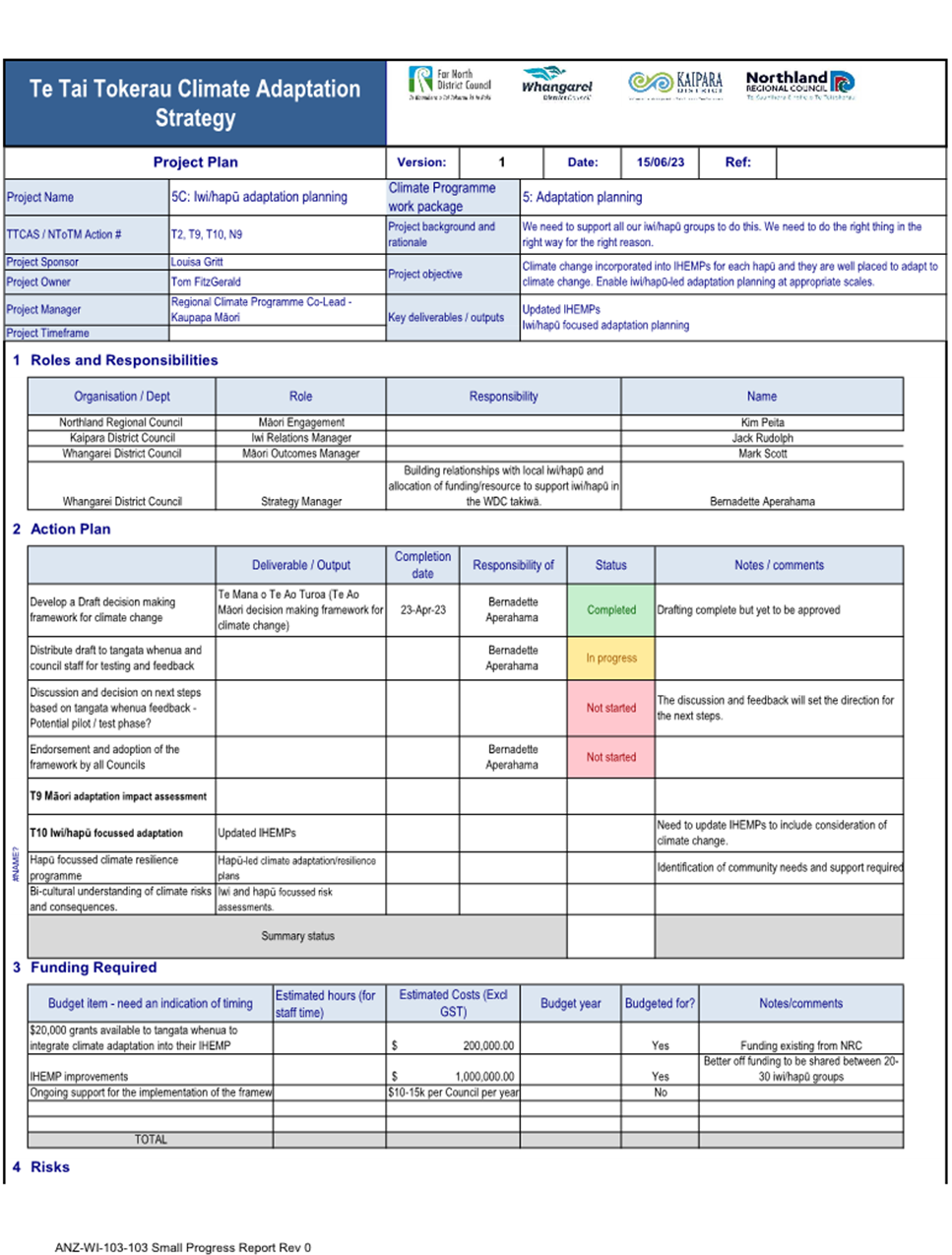
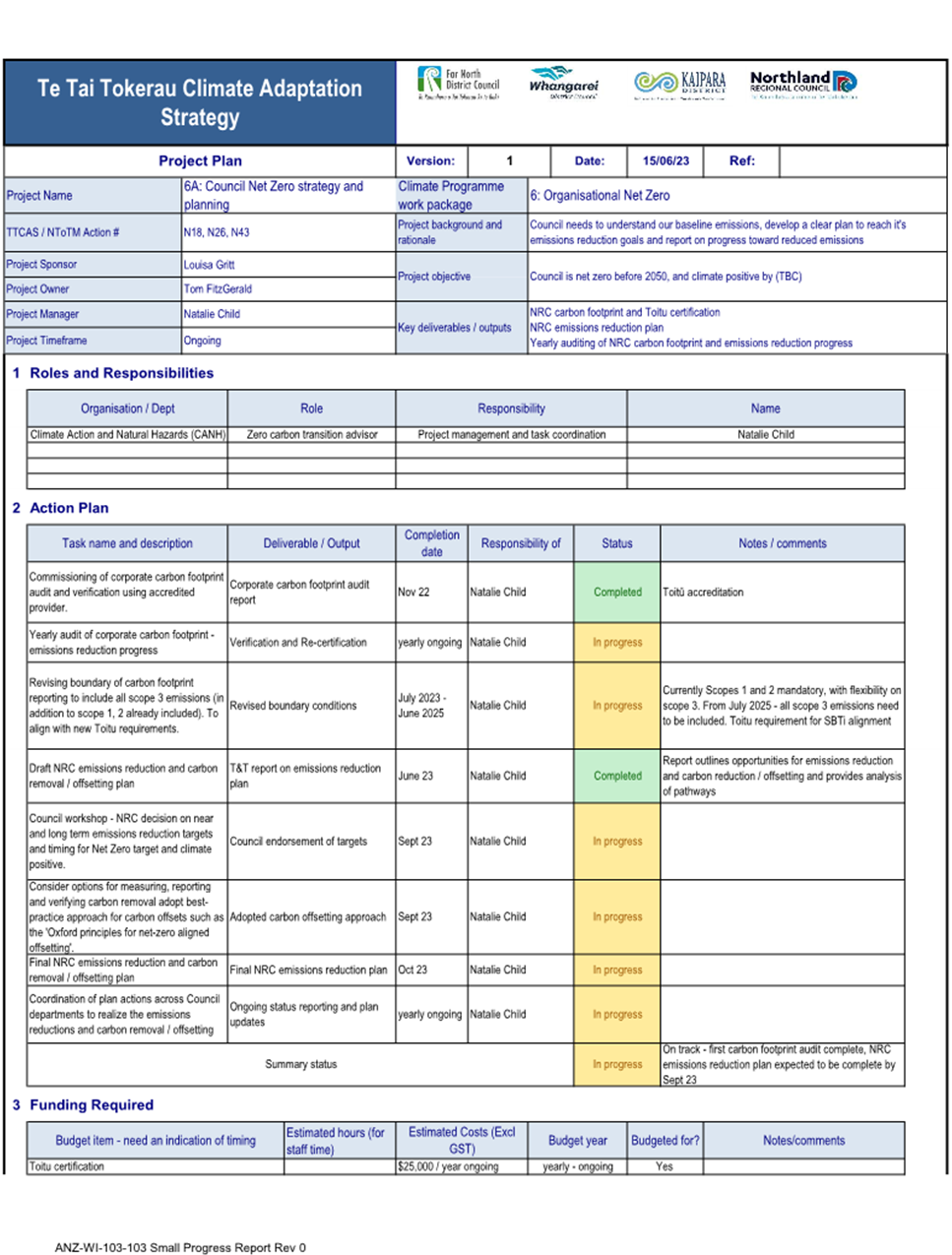
A key element of the project was the development of a programme logic. A programme logic summarises a ‘theory of change and provides a roadmap for how climate actions collectively contribute to longer term outcomes. A draft version of this theory of change is copied below:
Joint Climate Change Adaptation Committee item: 6.3
4 August 2023
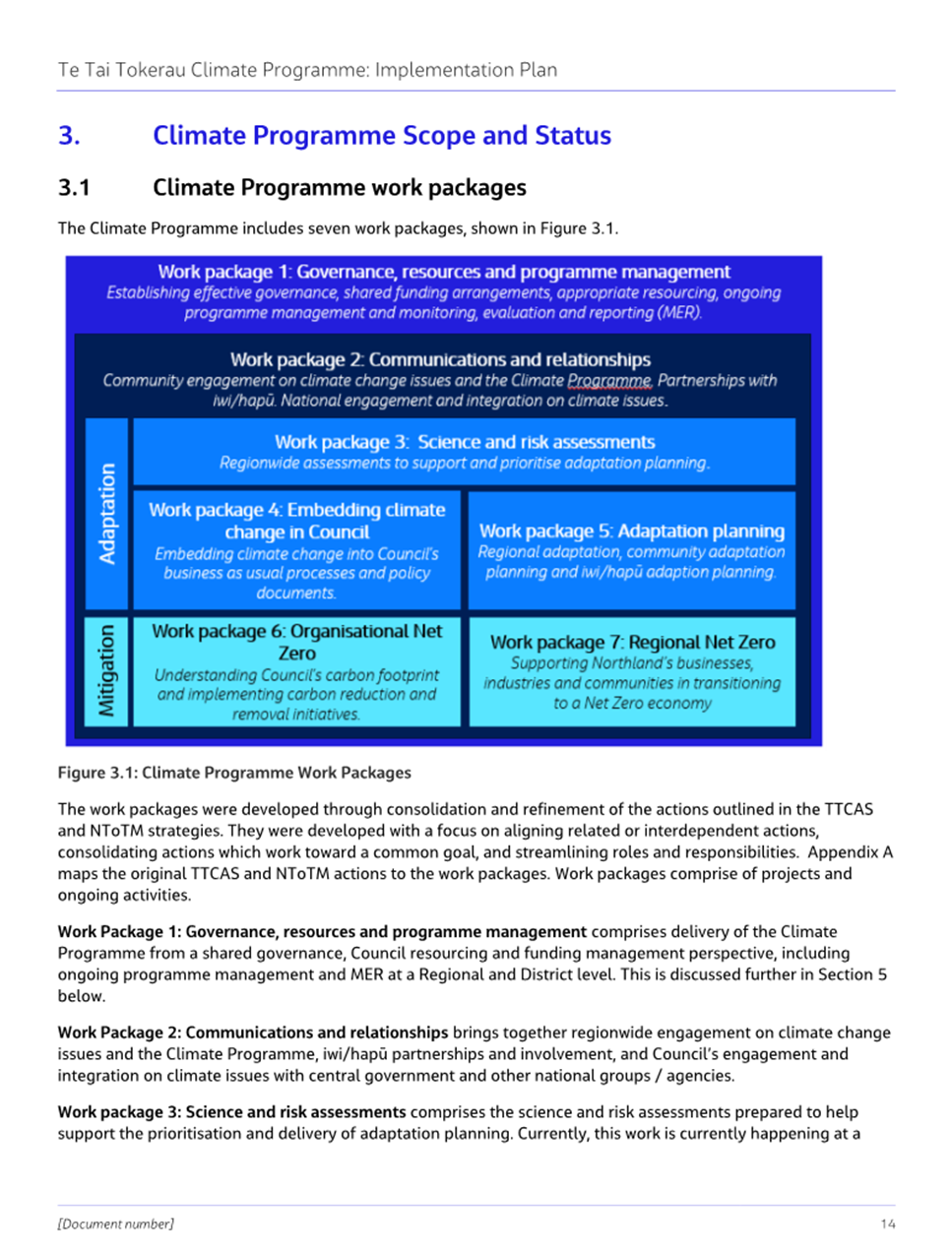
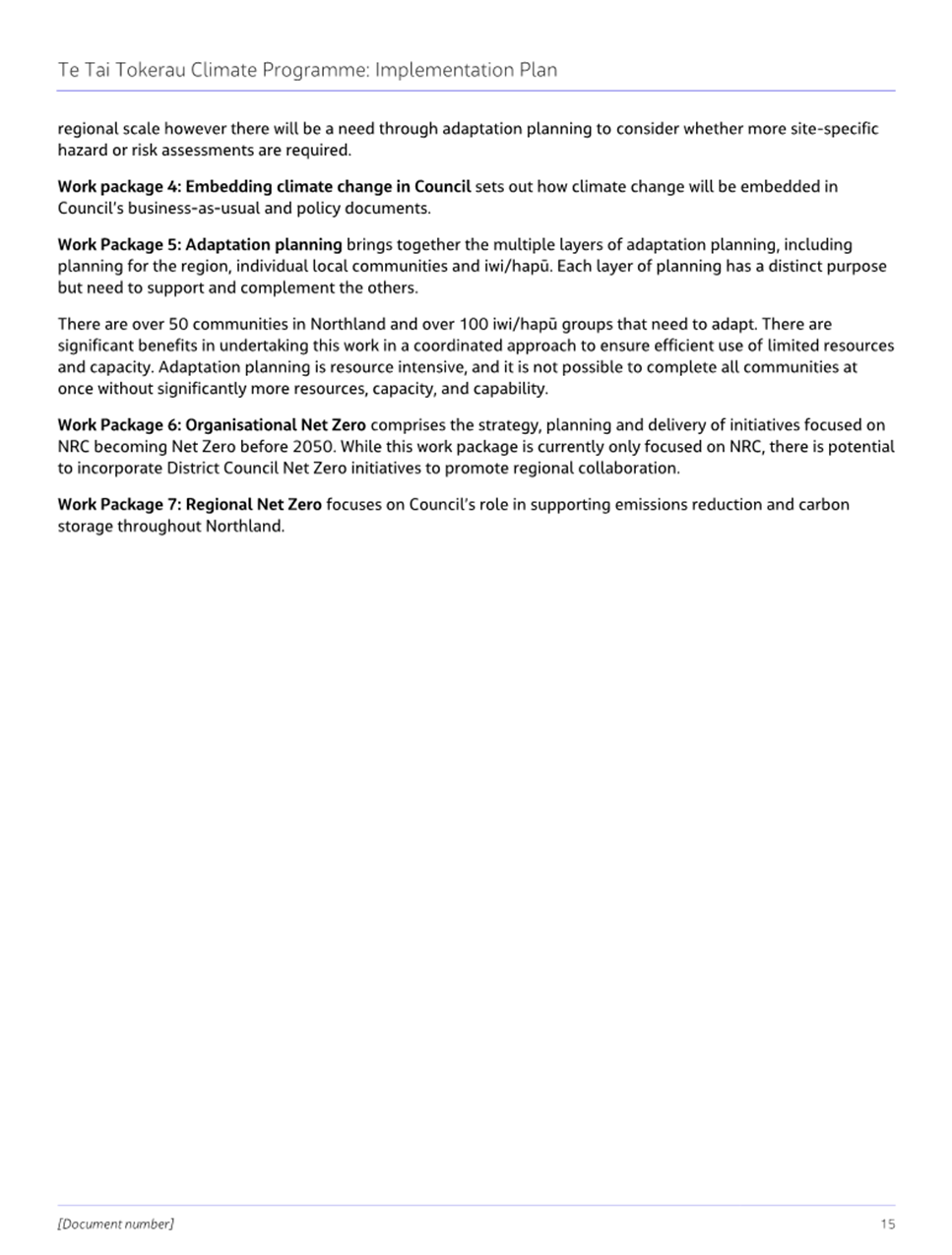
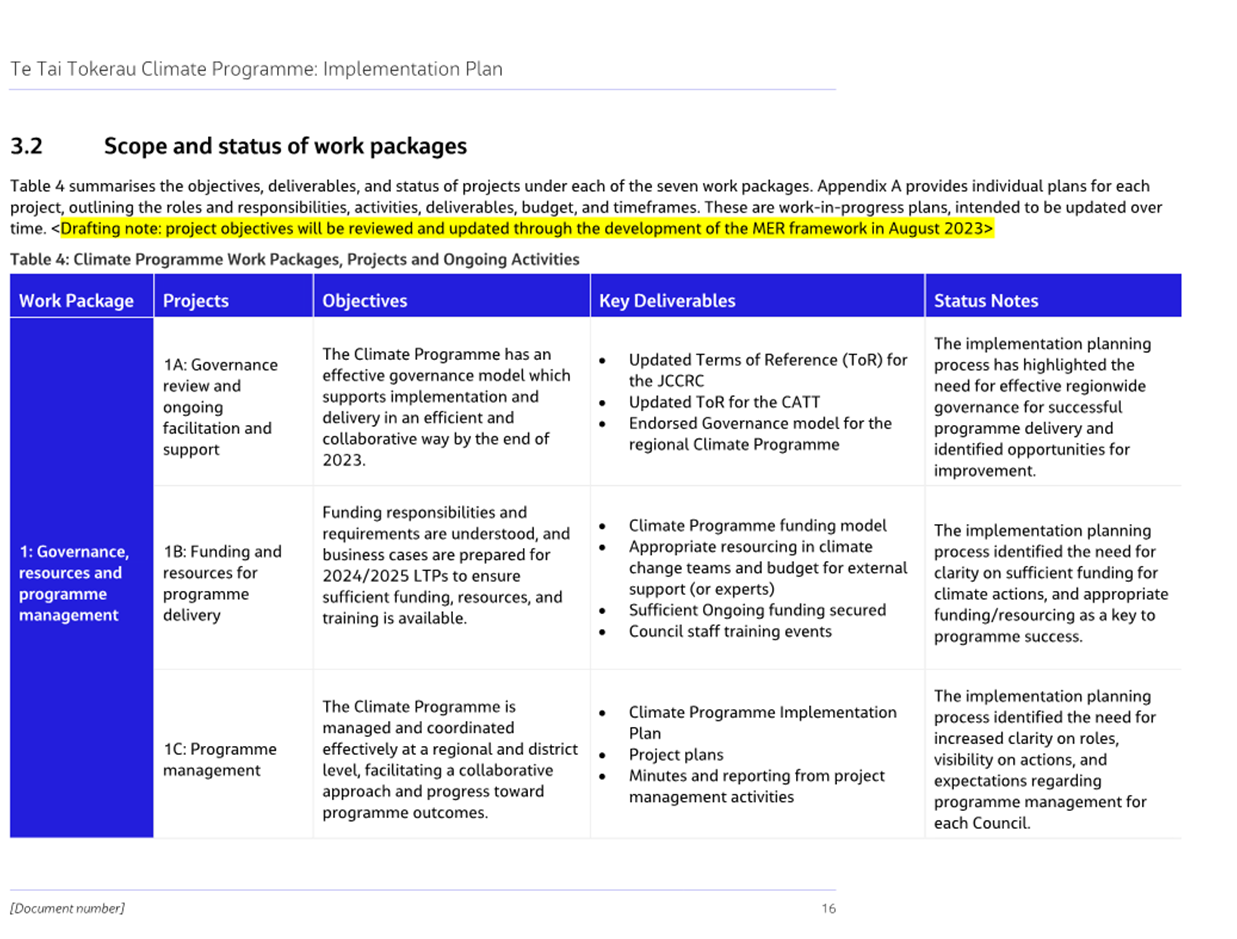
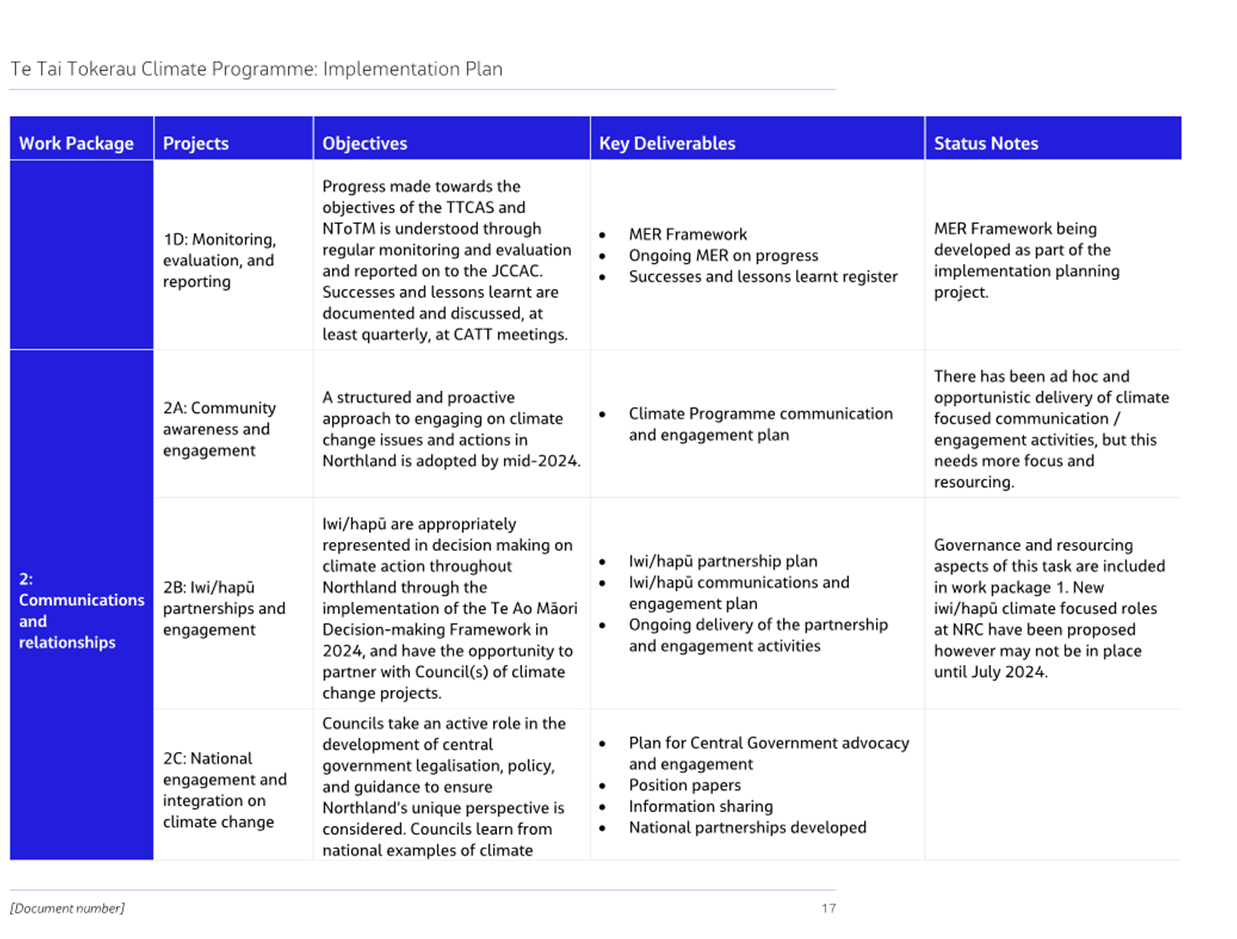
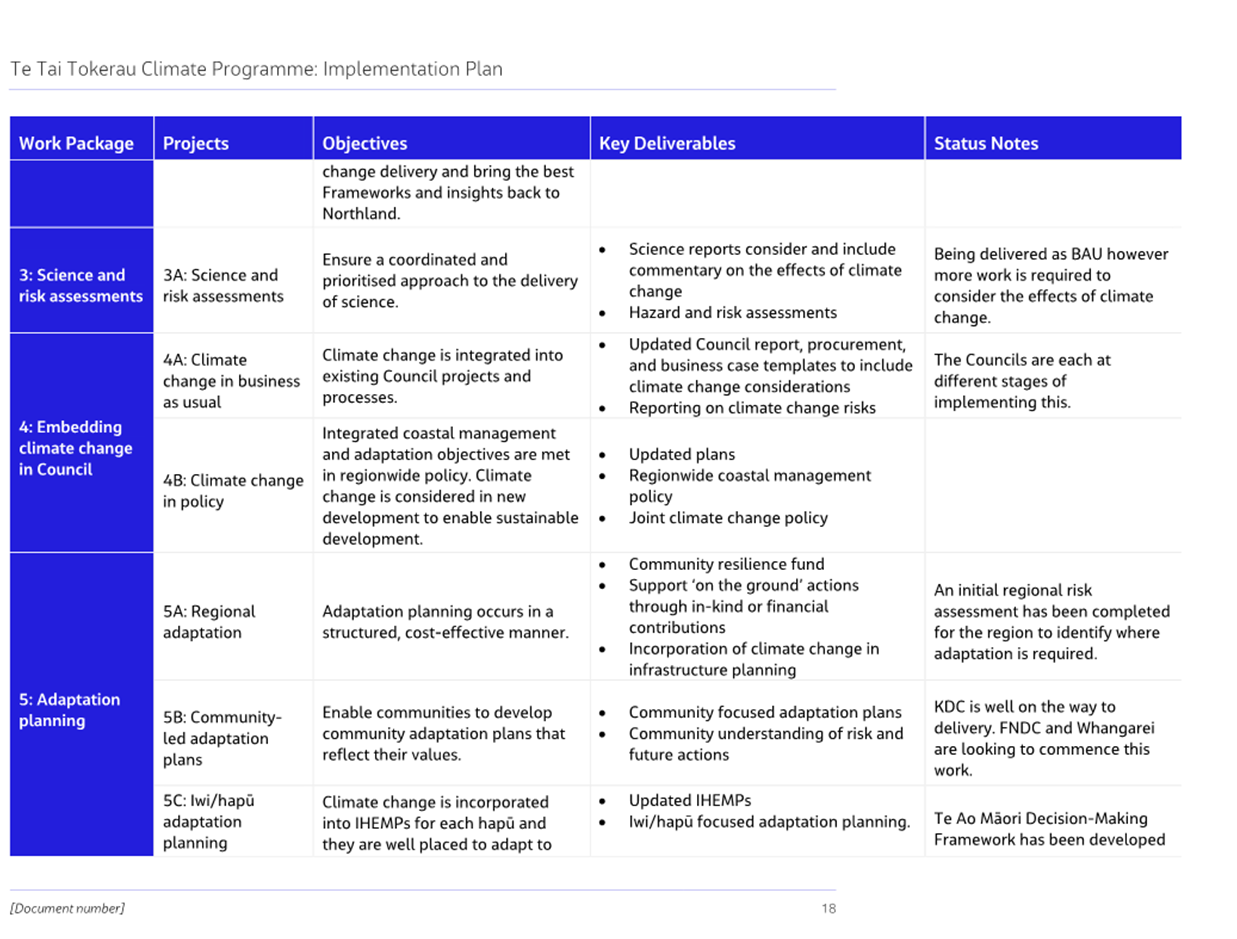
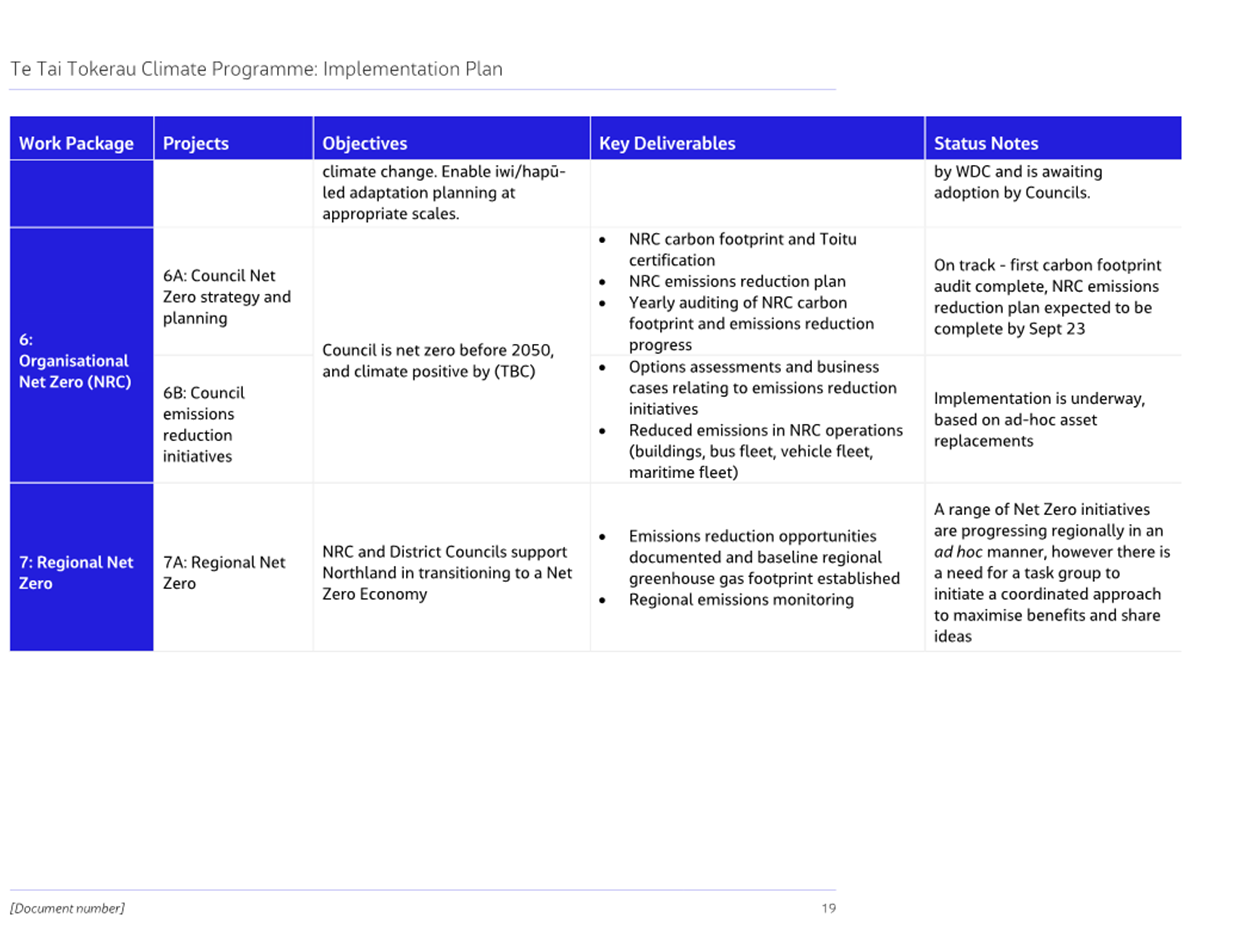
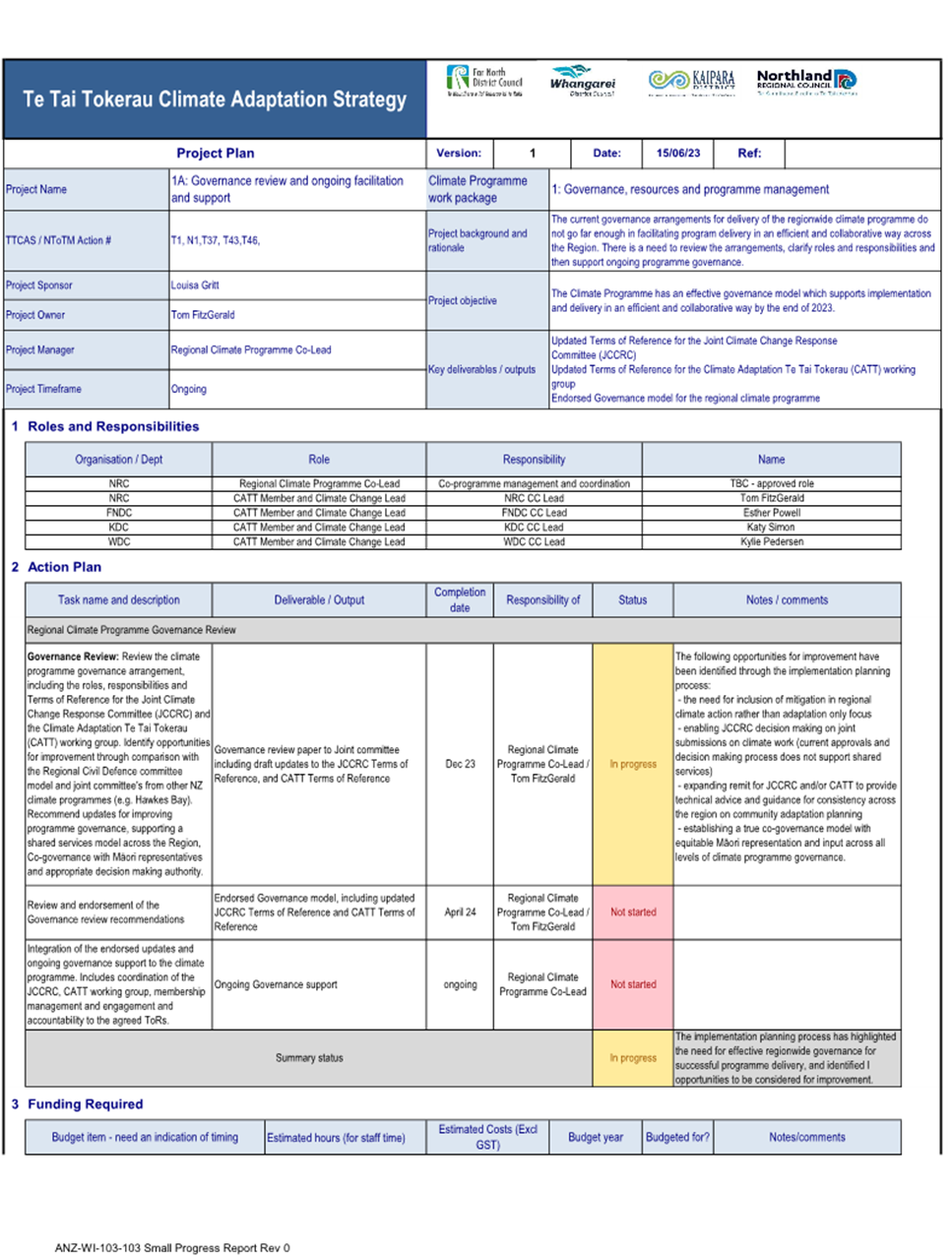
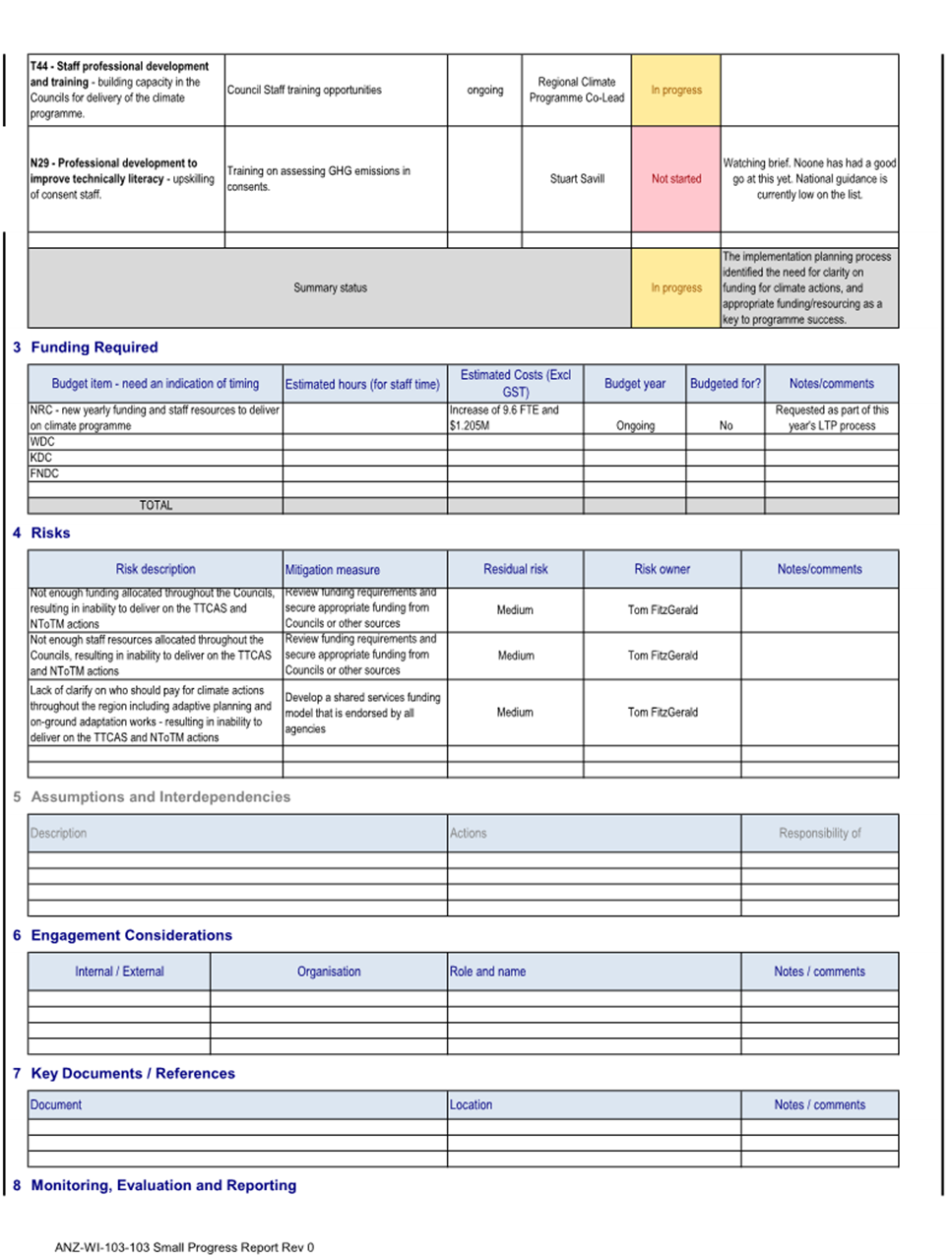
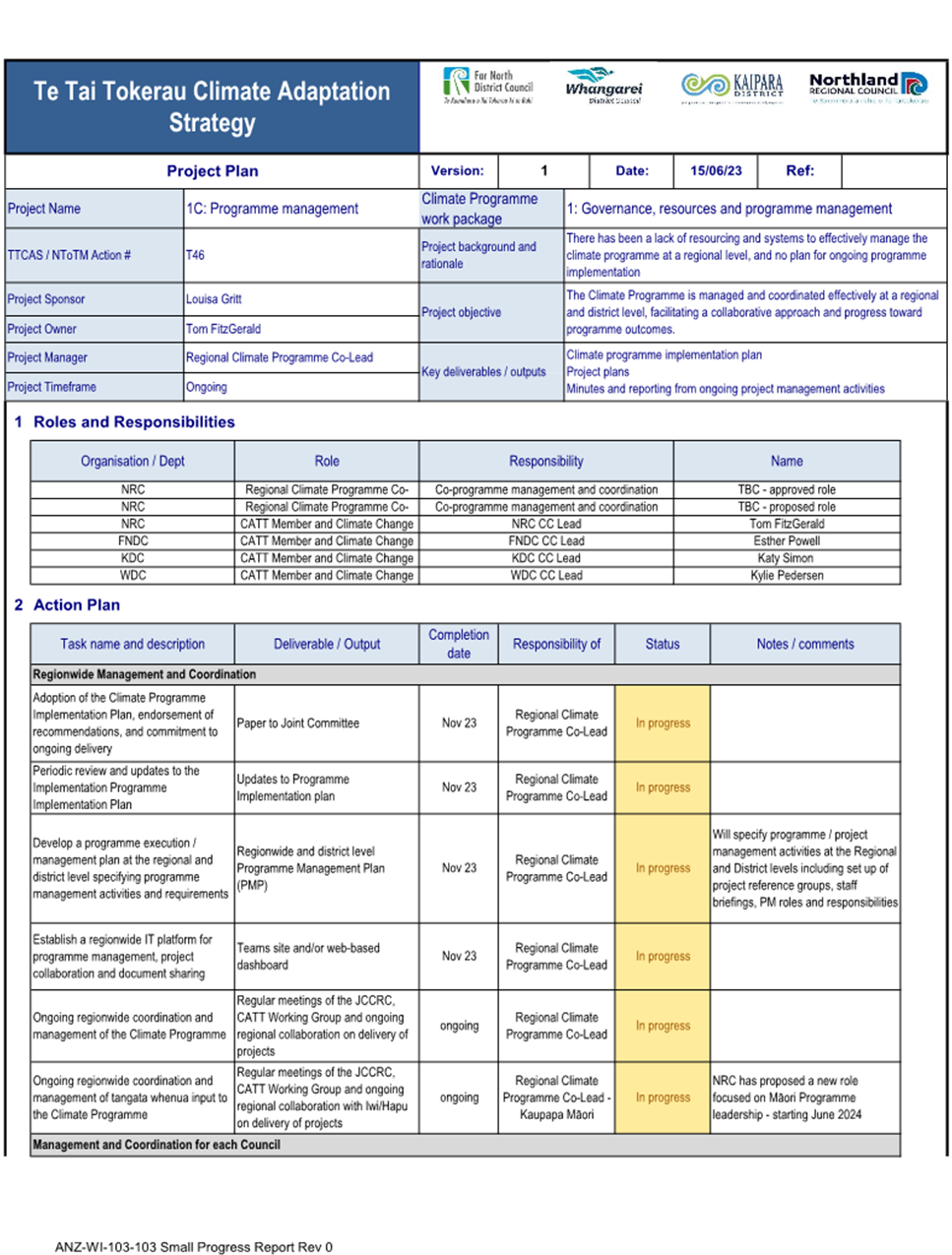
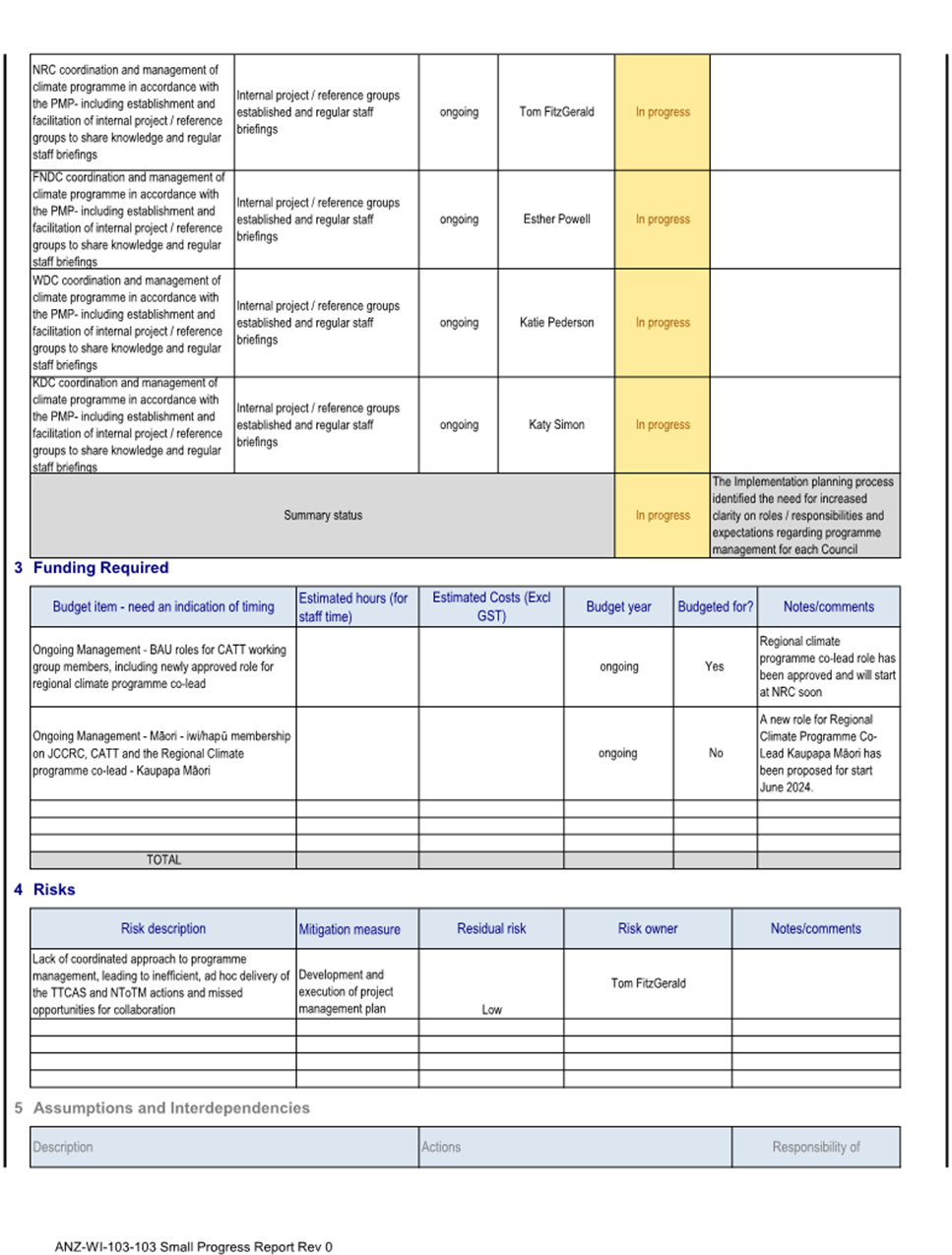
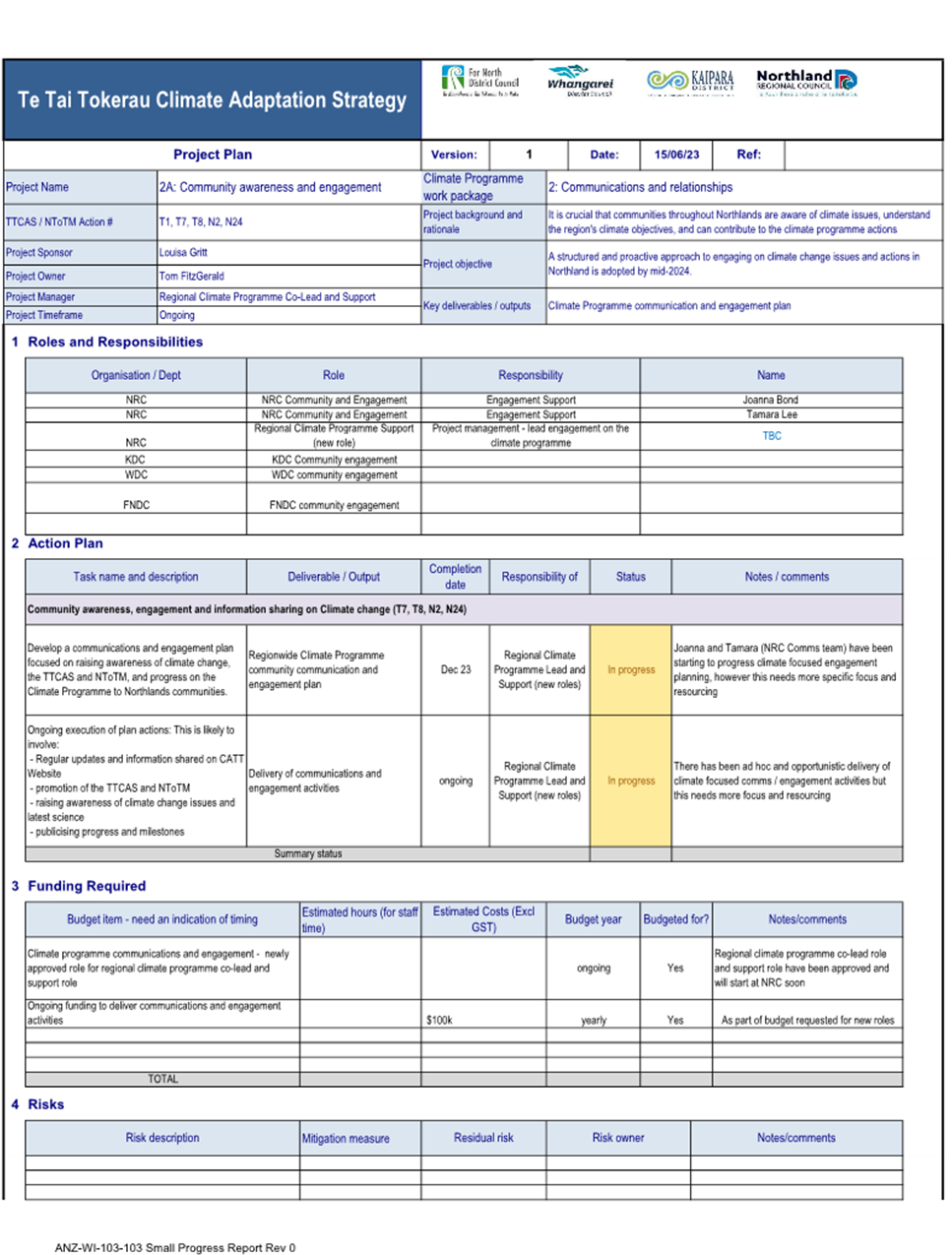
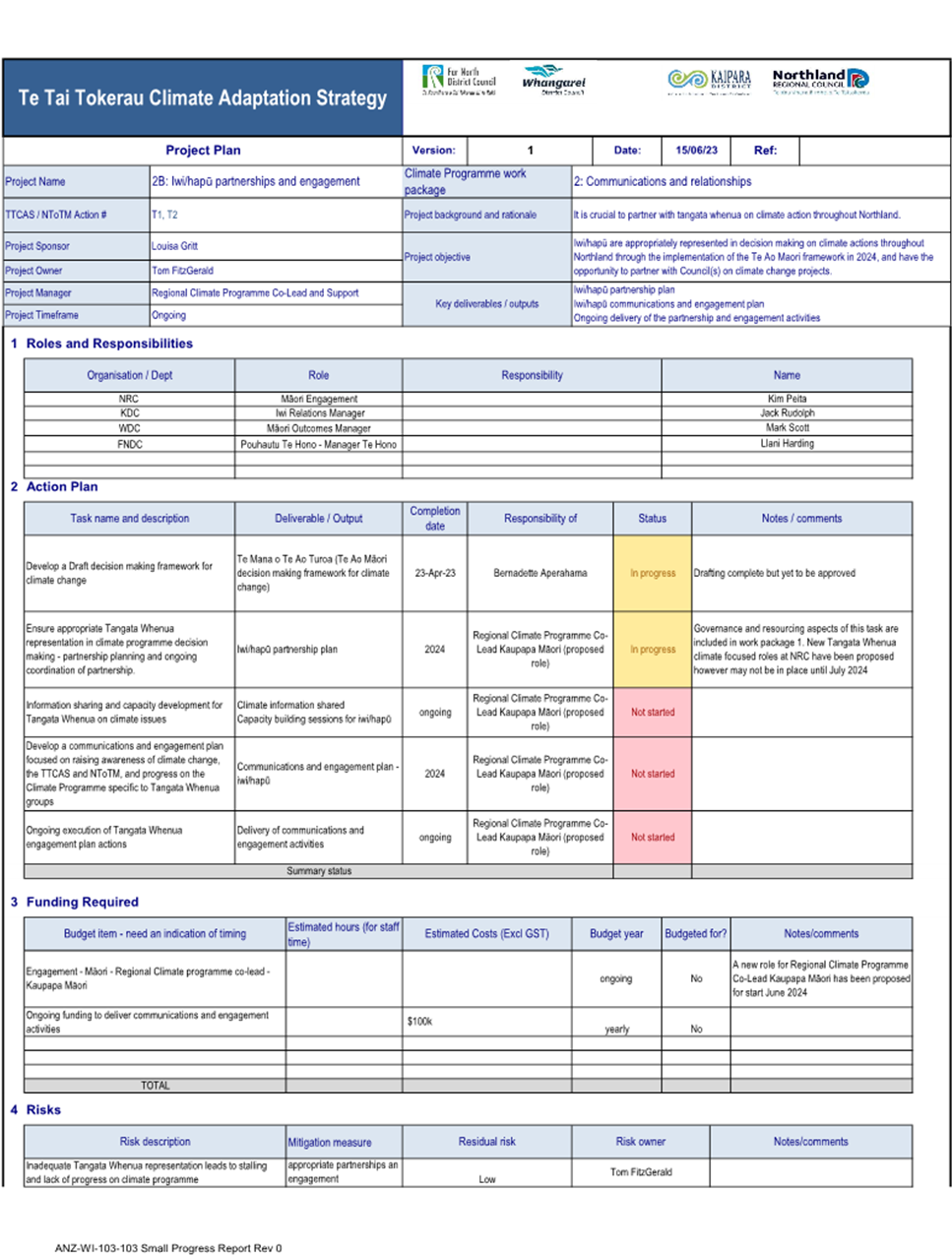
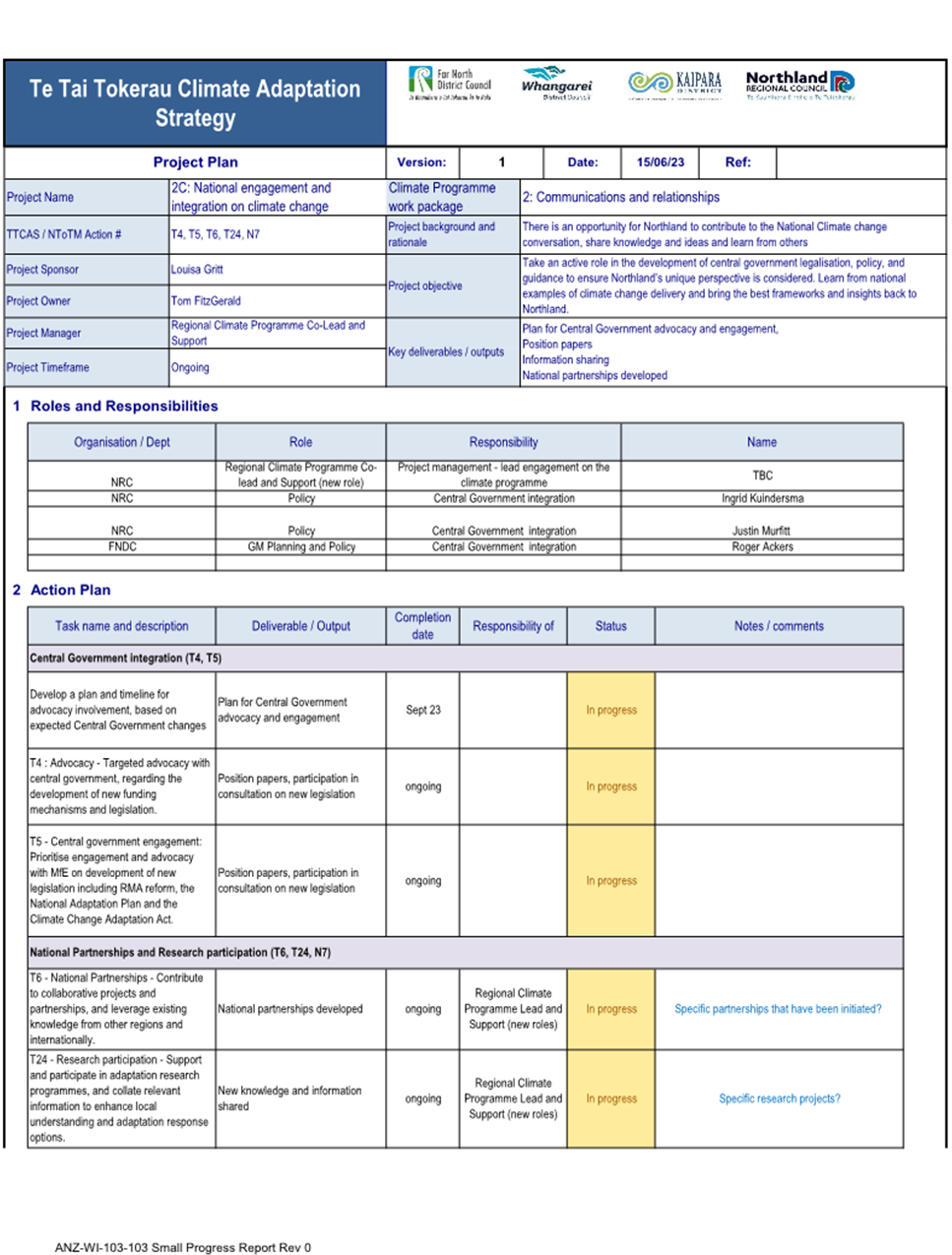
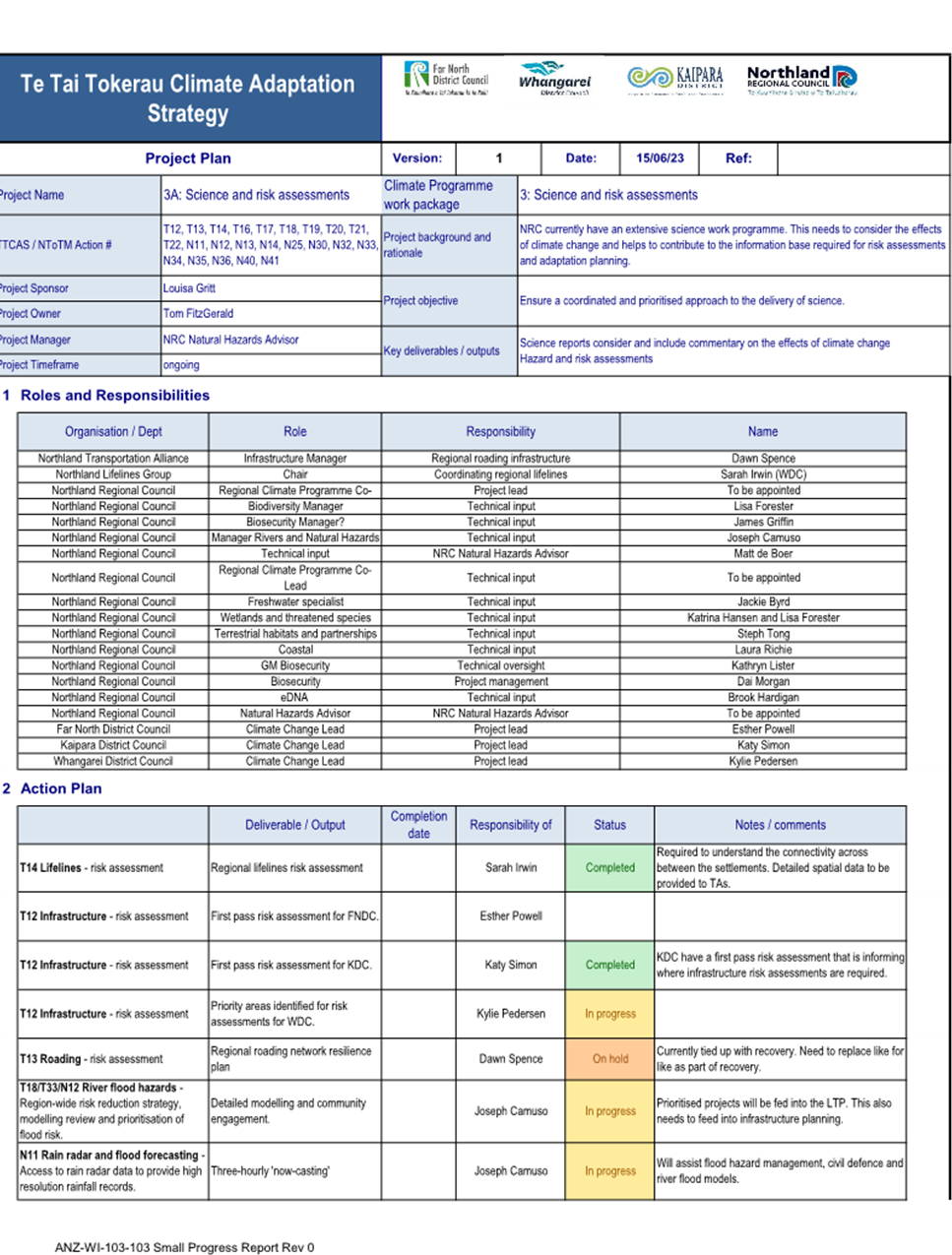
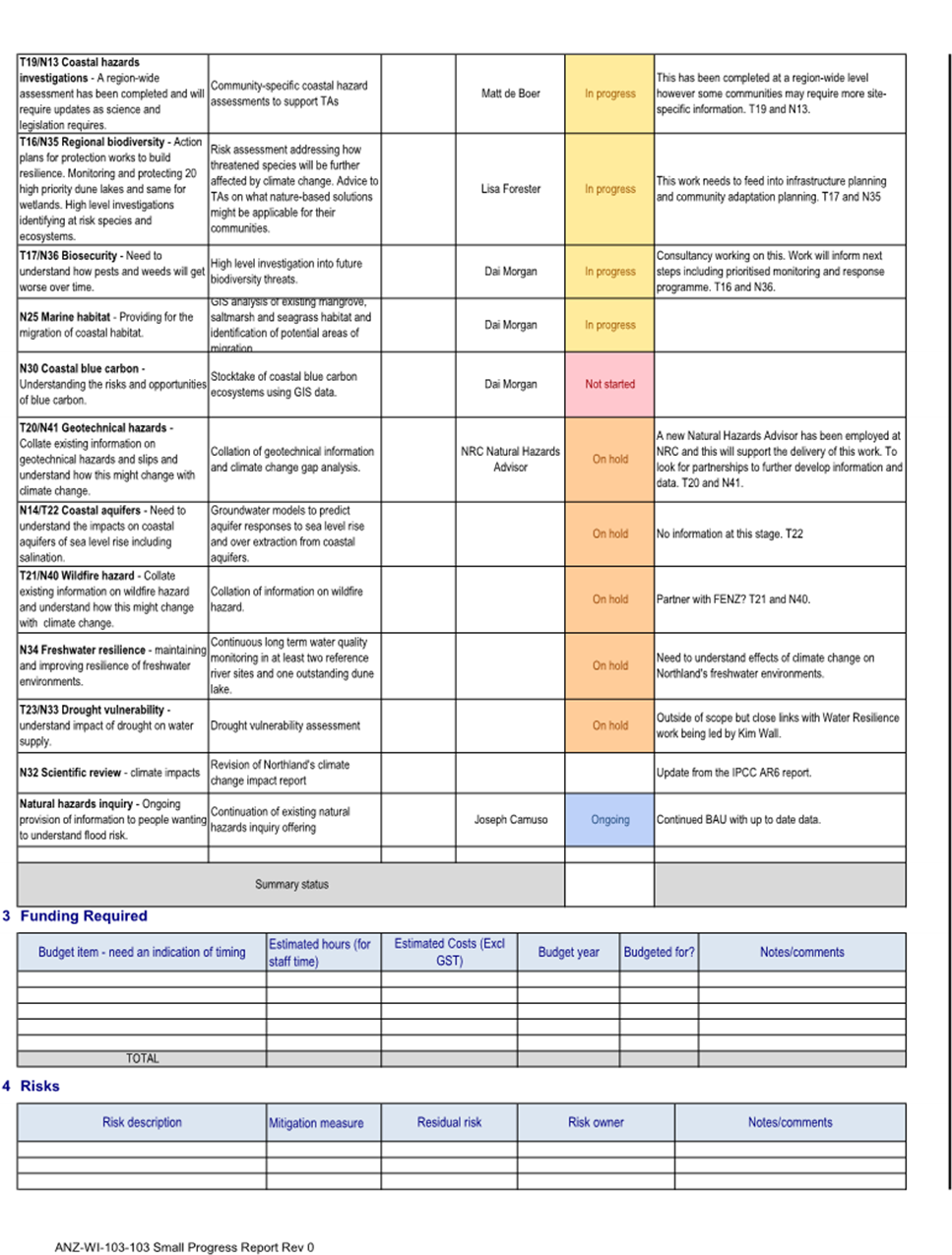
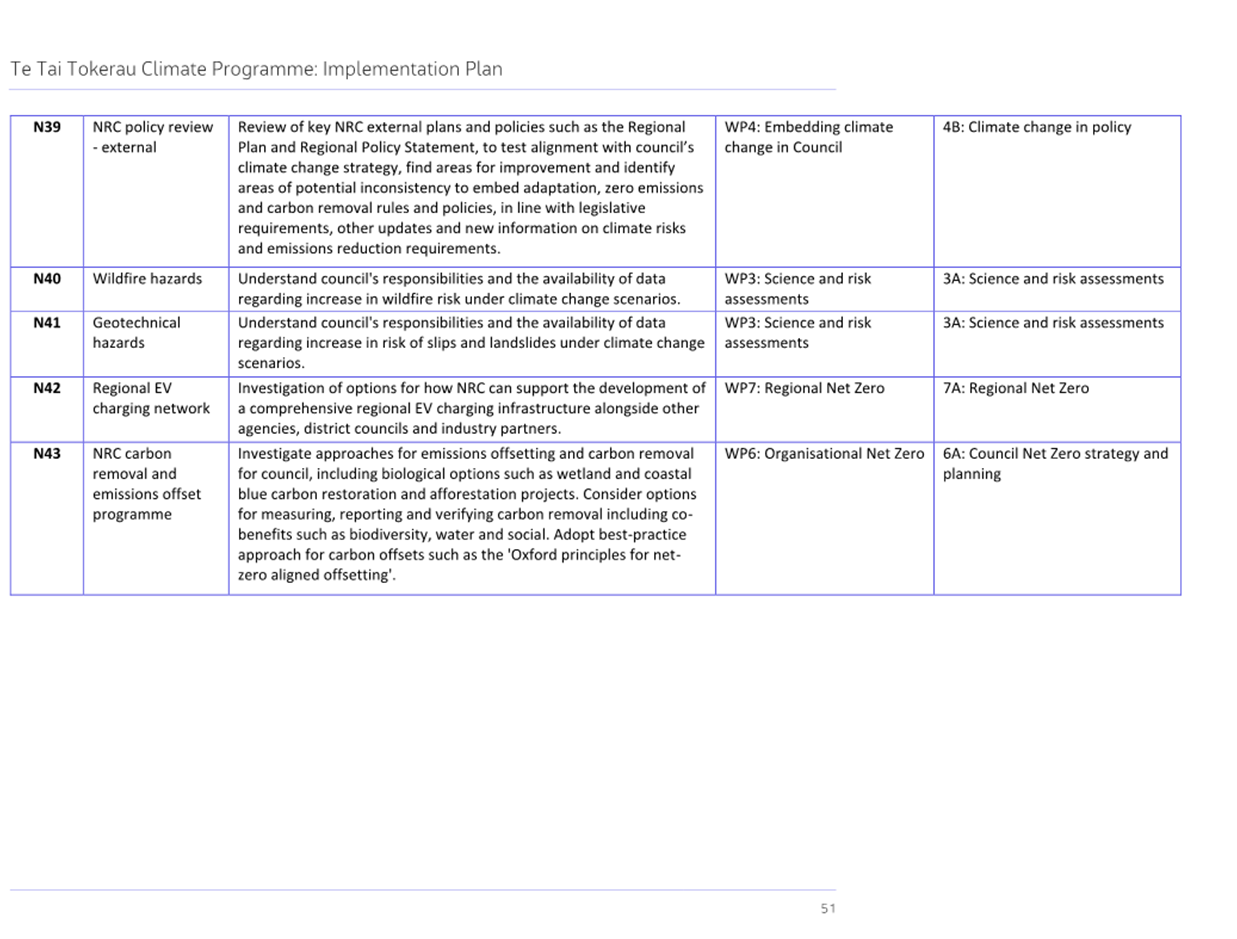
In essence the project has vastly simplified the overall climate programme for NRC and the climate adaptation programme for all Councils. There is now a clear link between delivery and outcomes, between investment and results and the long list of ‘priority actions’ has been whittled down to a more manageable, coherent set of seven (7) work packages (see Figure 2).
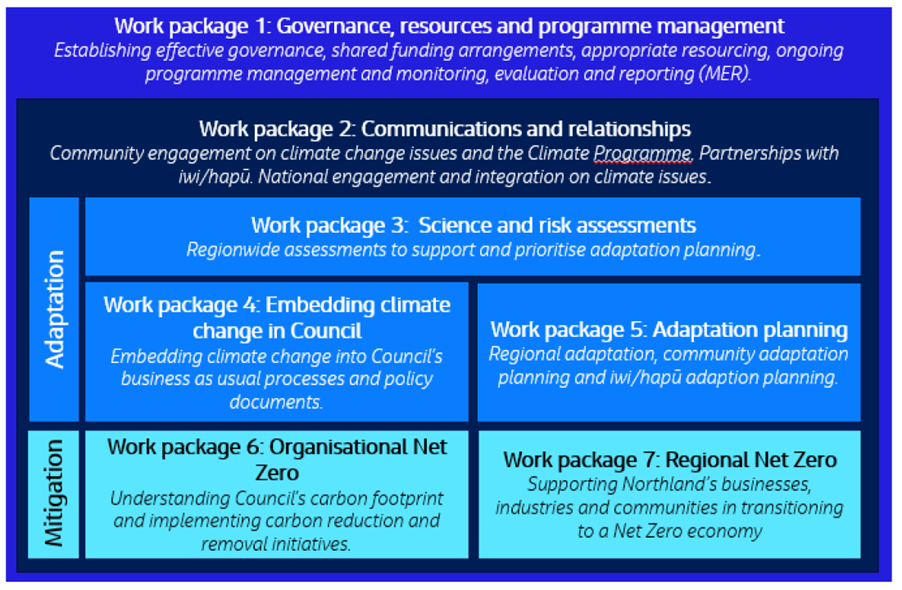
Figure 2 Climate programme work packages. Each work package identified above is supported by specific project plans.
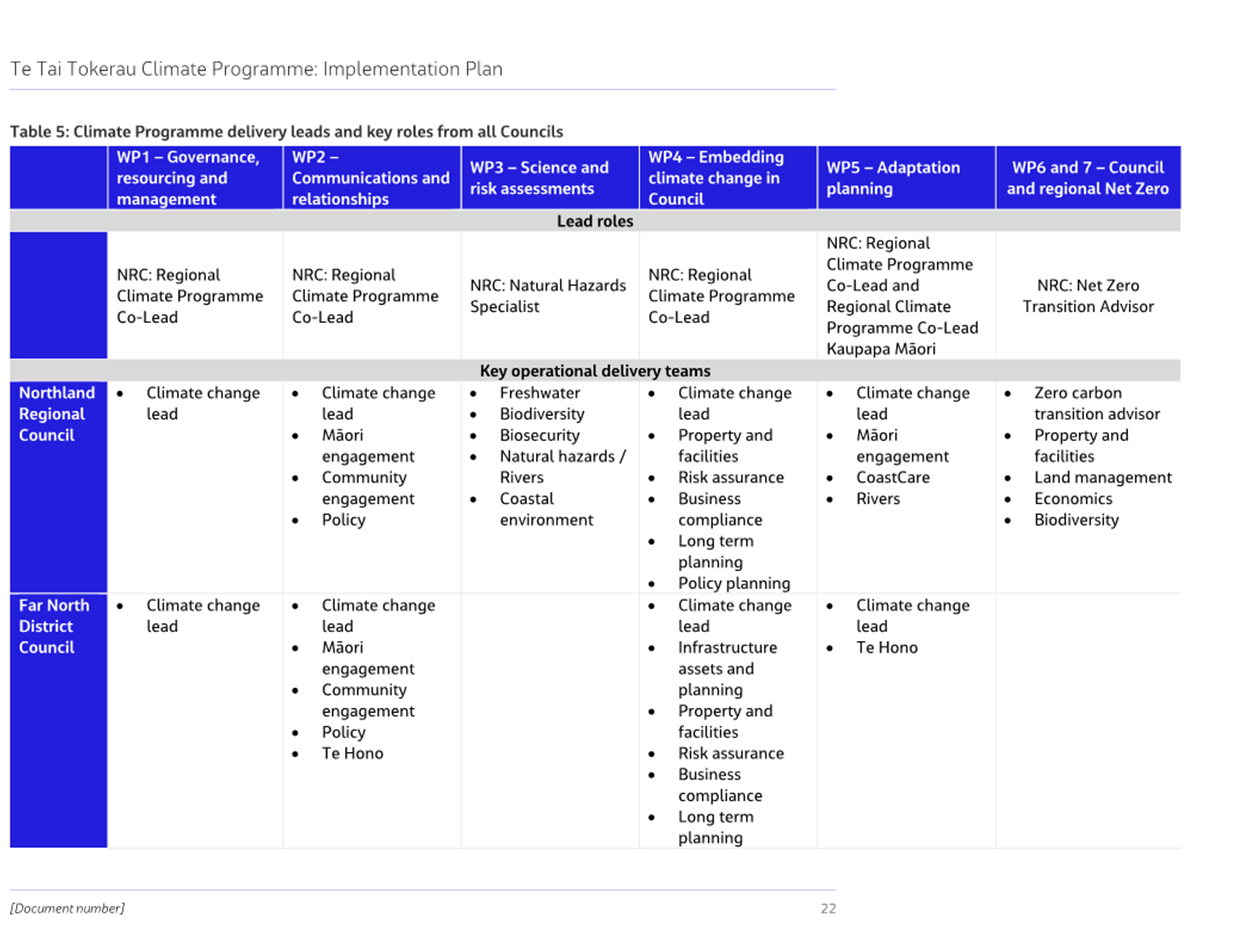
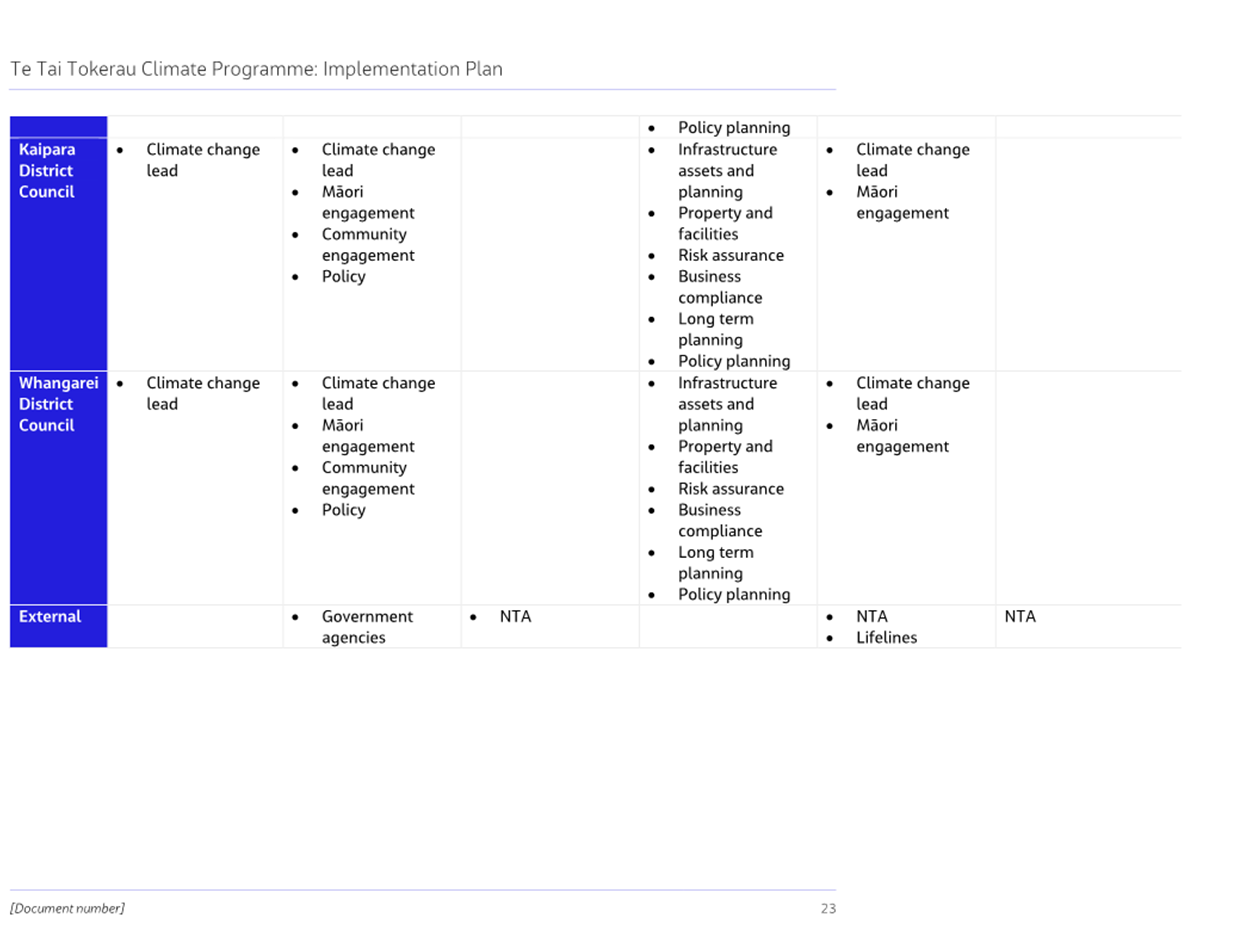
The work packages (WP) approach emphasises the underlying criticality of strong governance, resources and programme management (WP1) as well as the foundations provided by robust community engagement, good communications and healthy relationships (WP2). Science and risk assessments, adaptation planning and embedding climate action as Council BAU are identified as the remaining adaptation focused work packages that would be undertaken or supported by each council. WP 6 and 7 however only relate to NRC’s overall climate programme at this stage.
Project plans
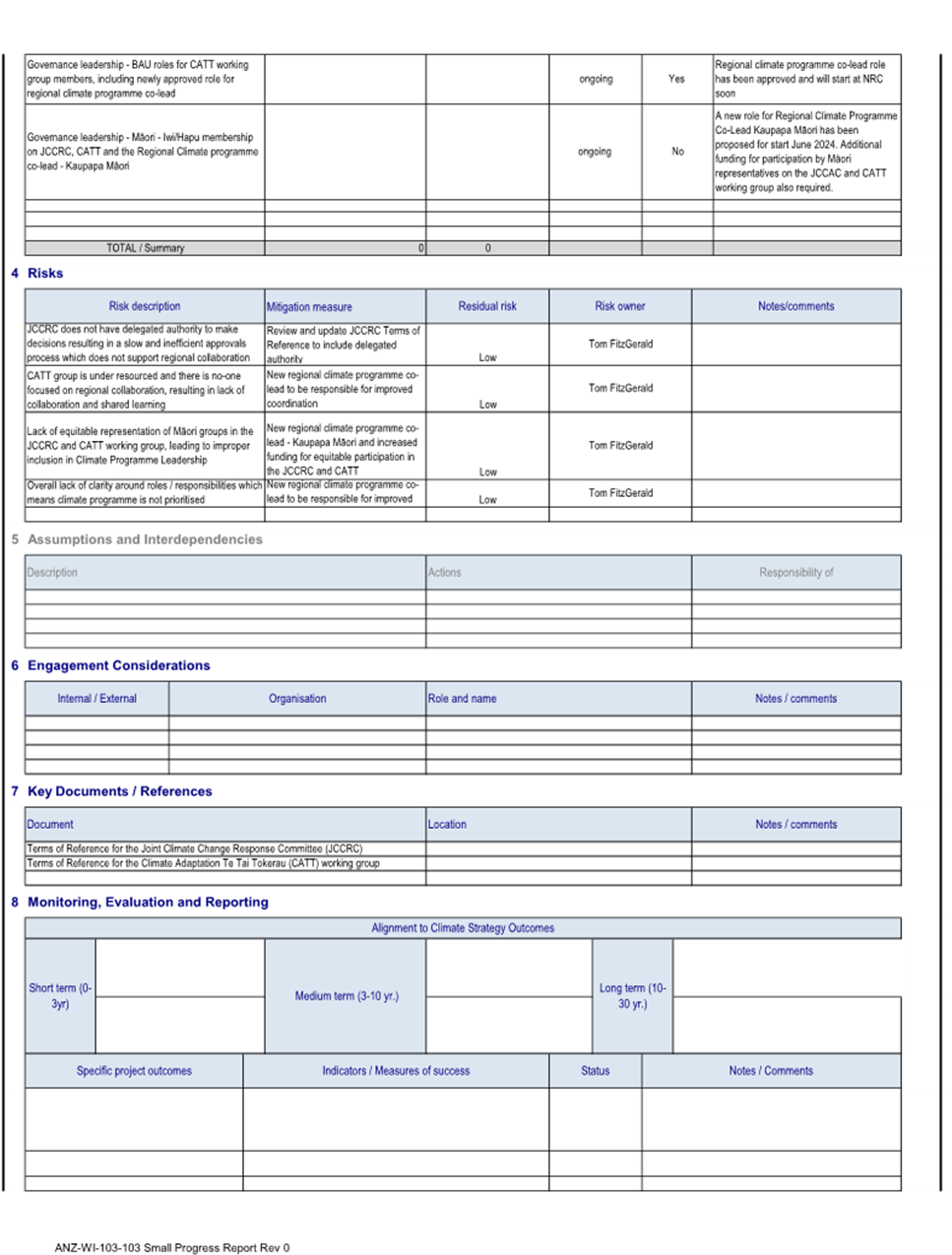
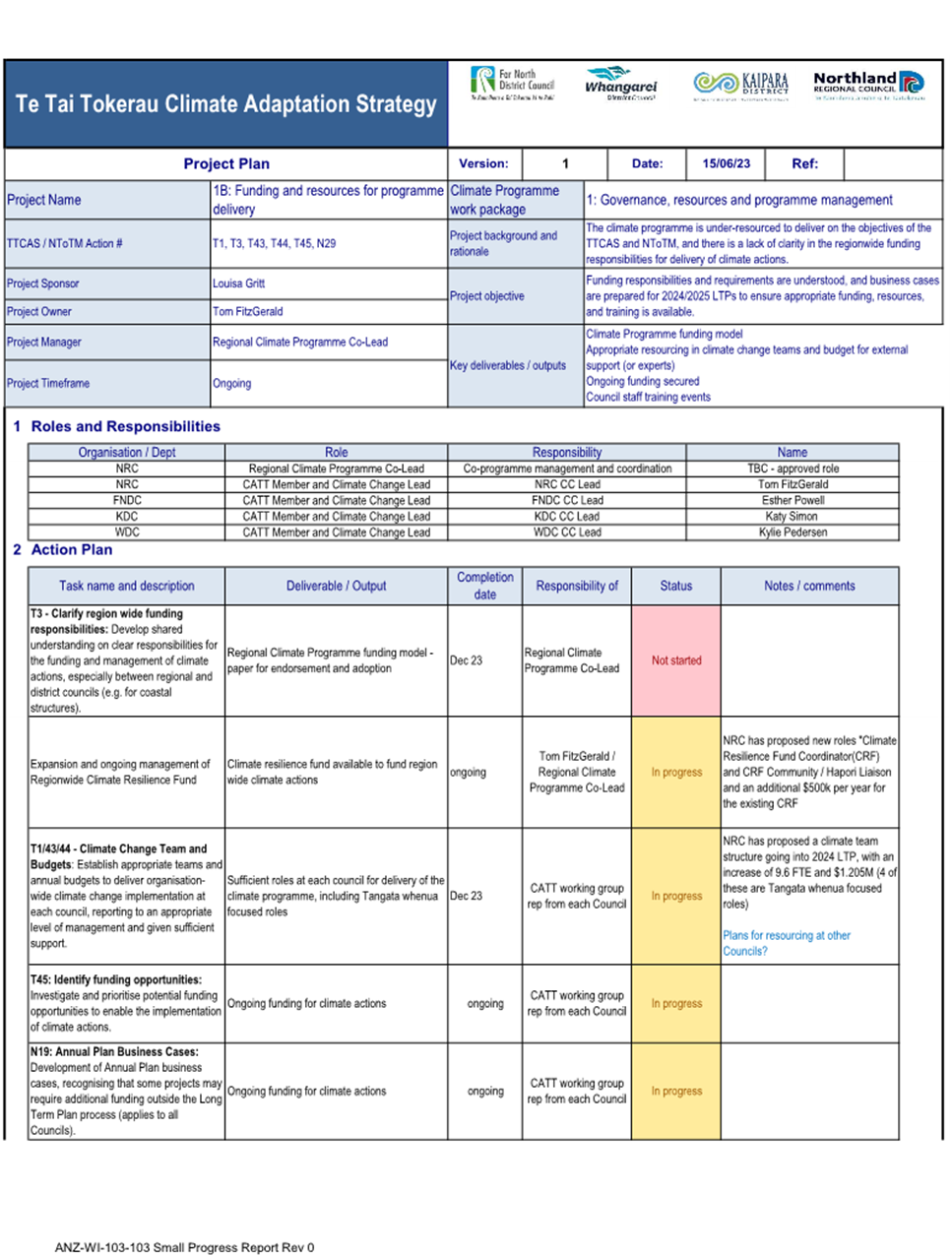
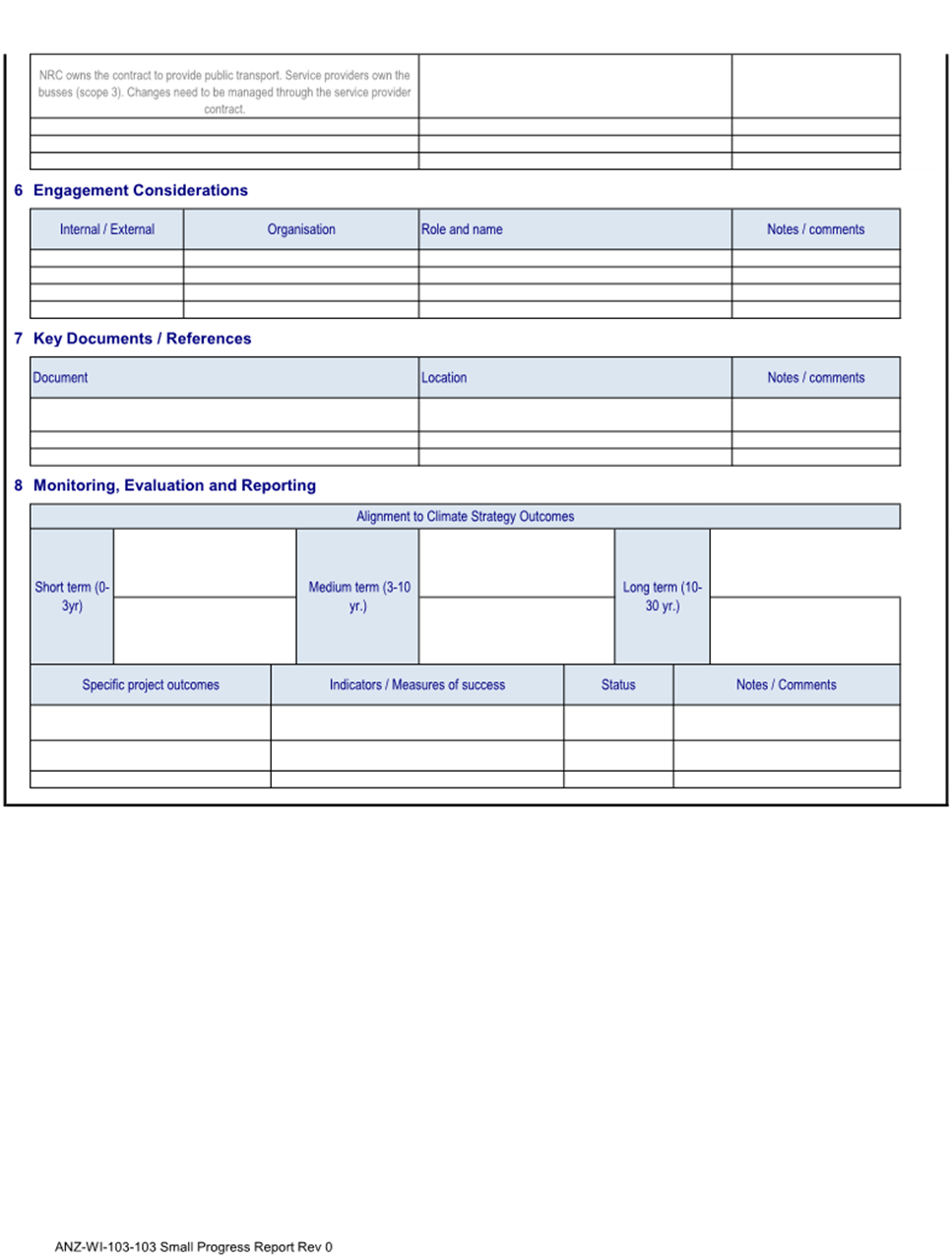
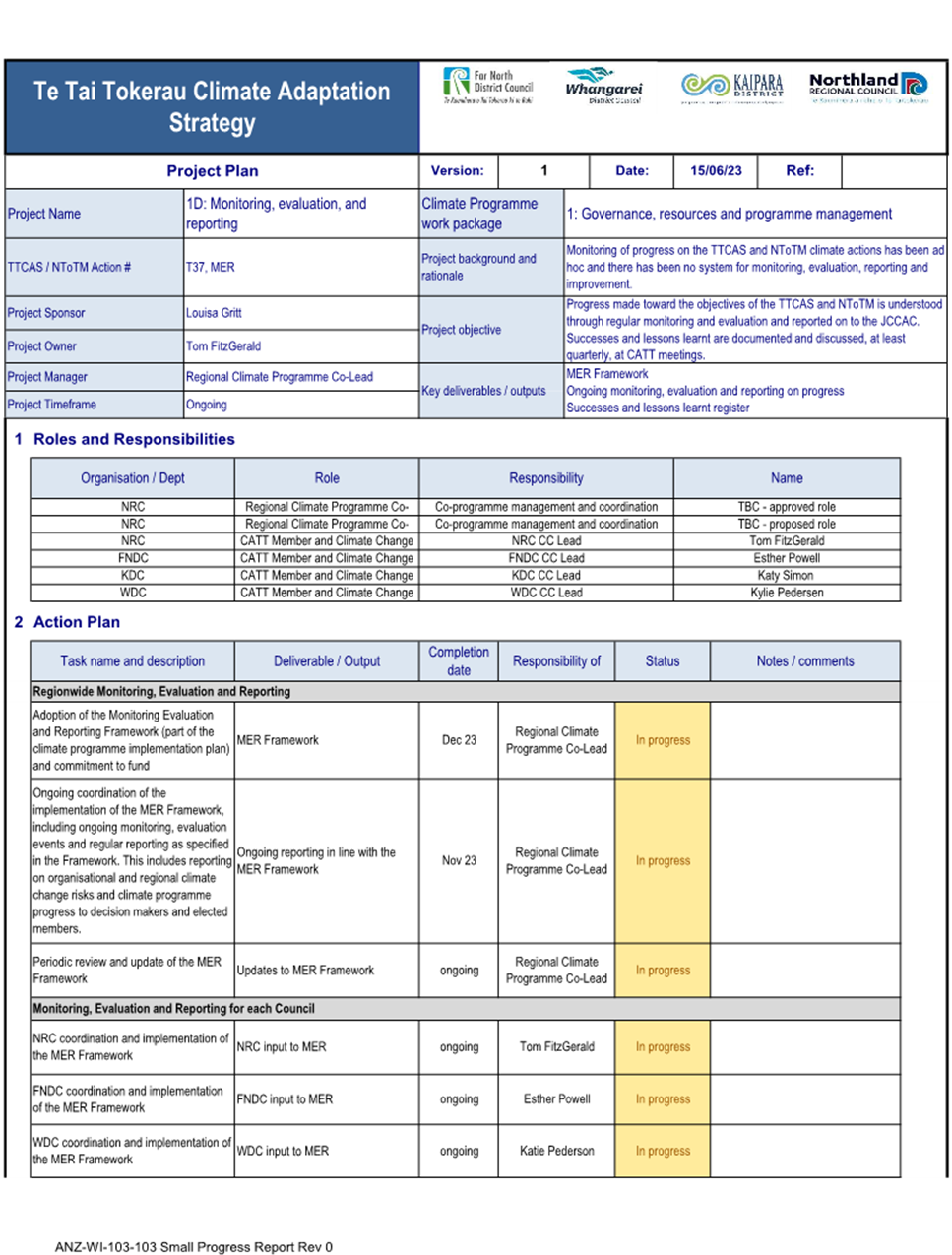
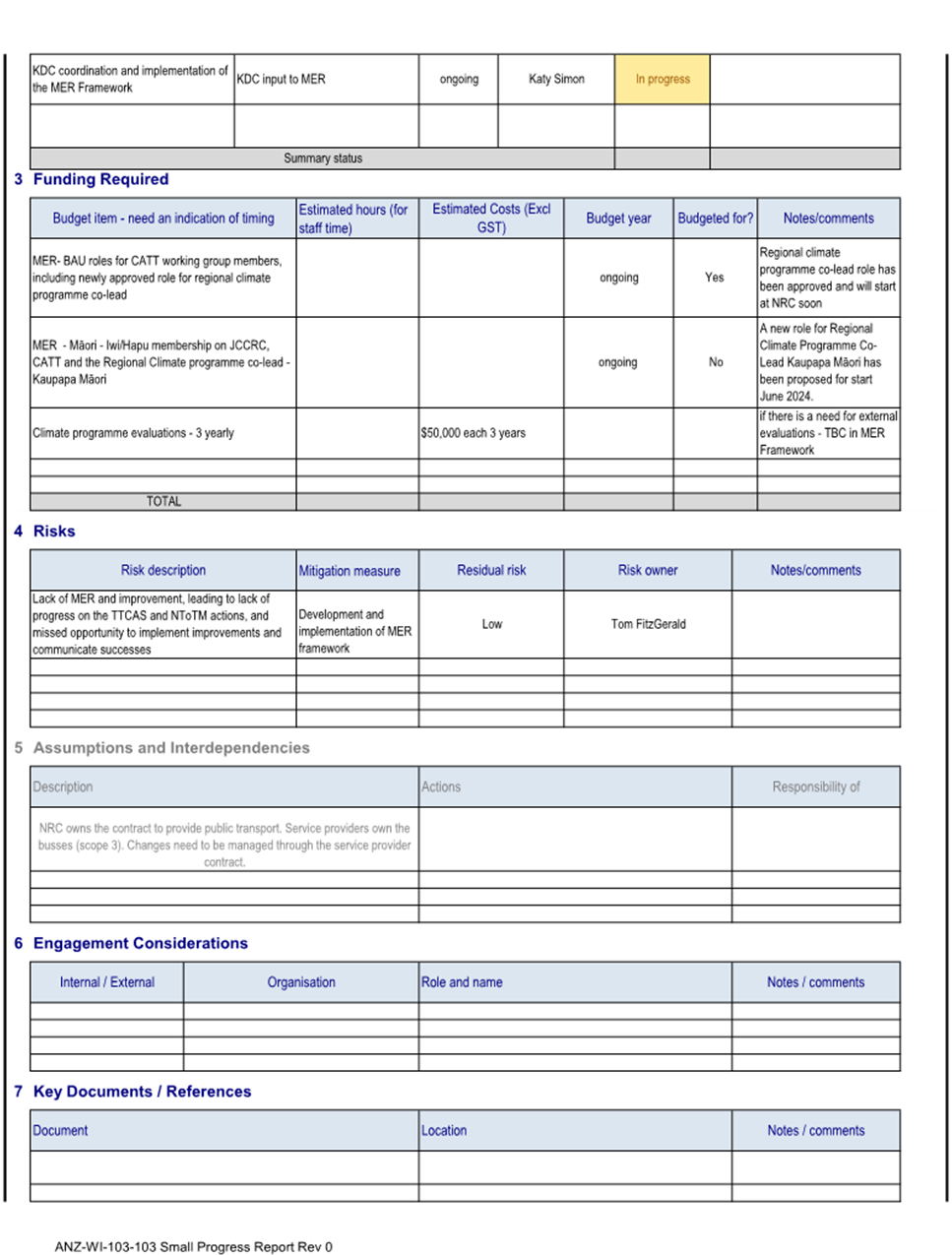
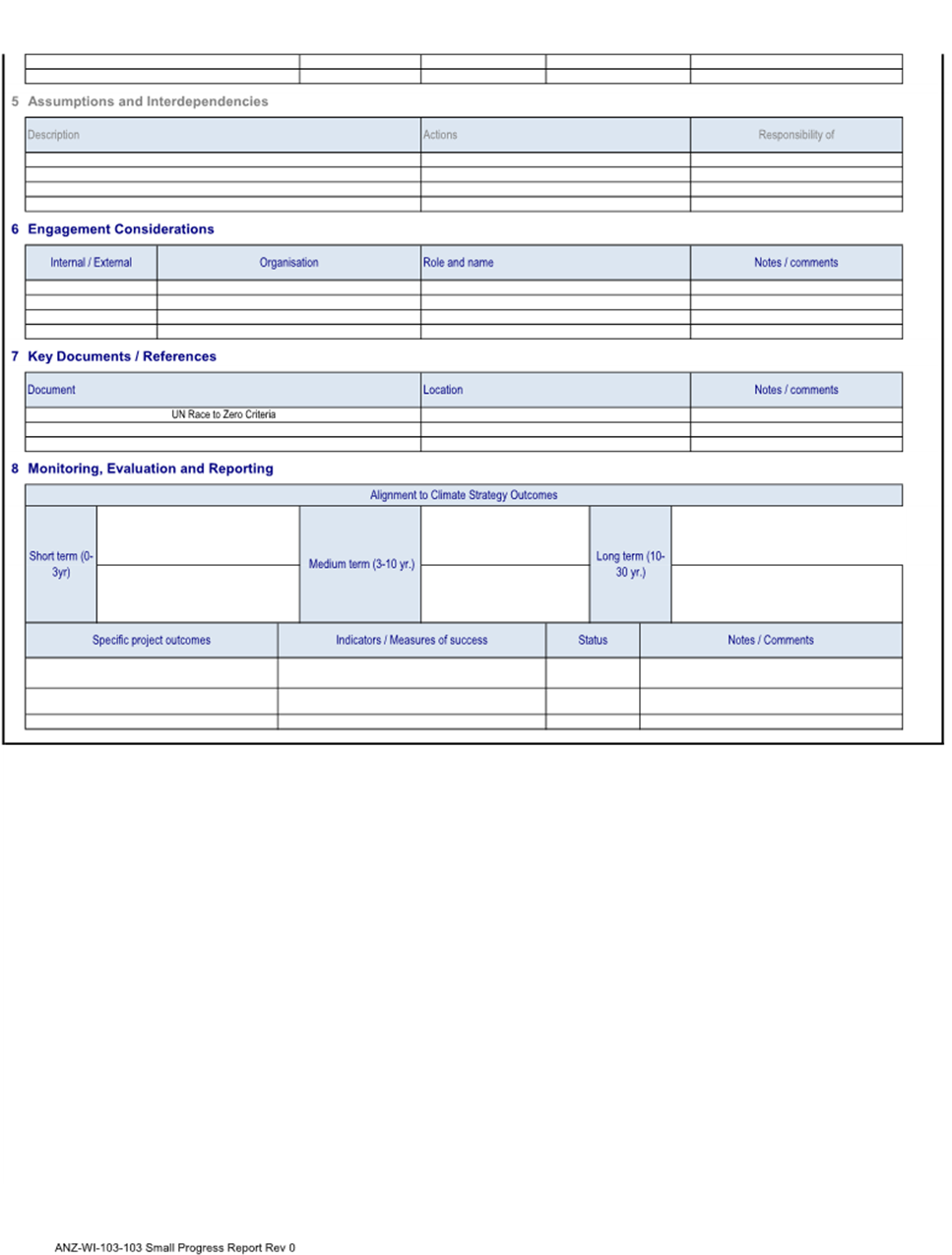
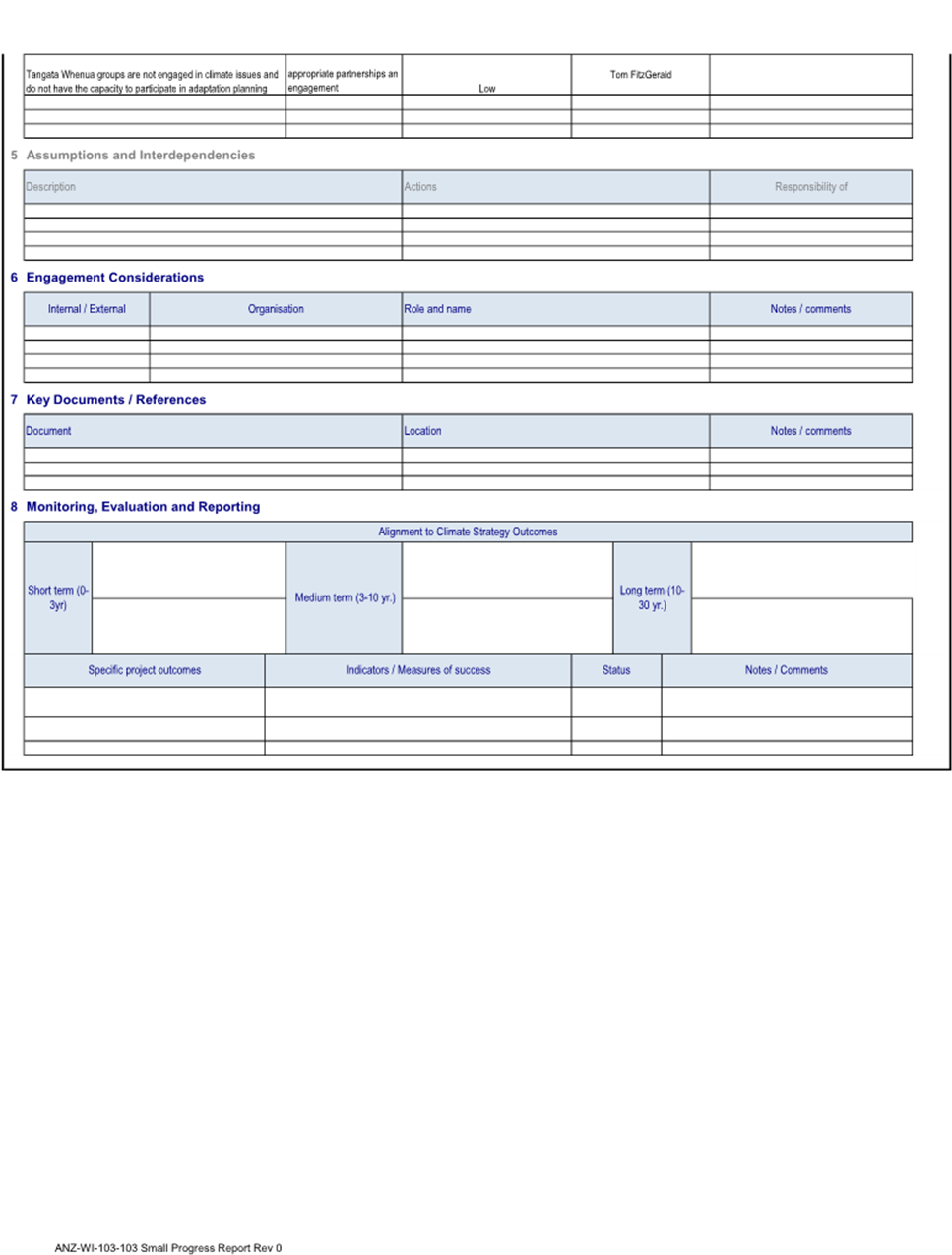
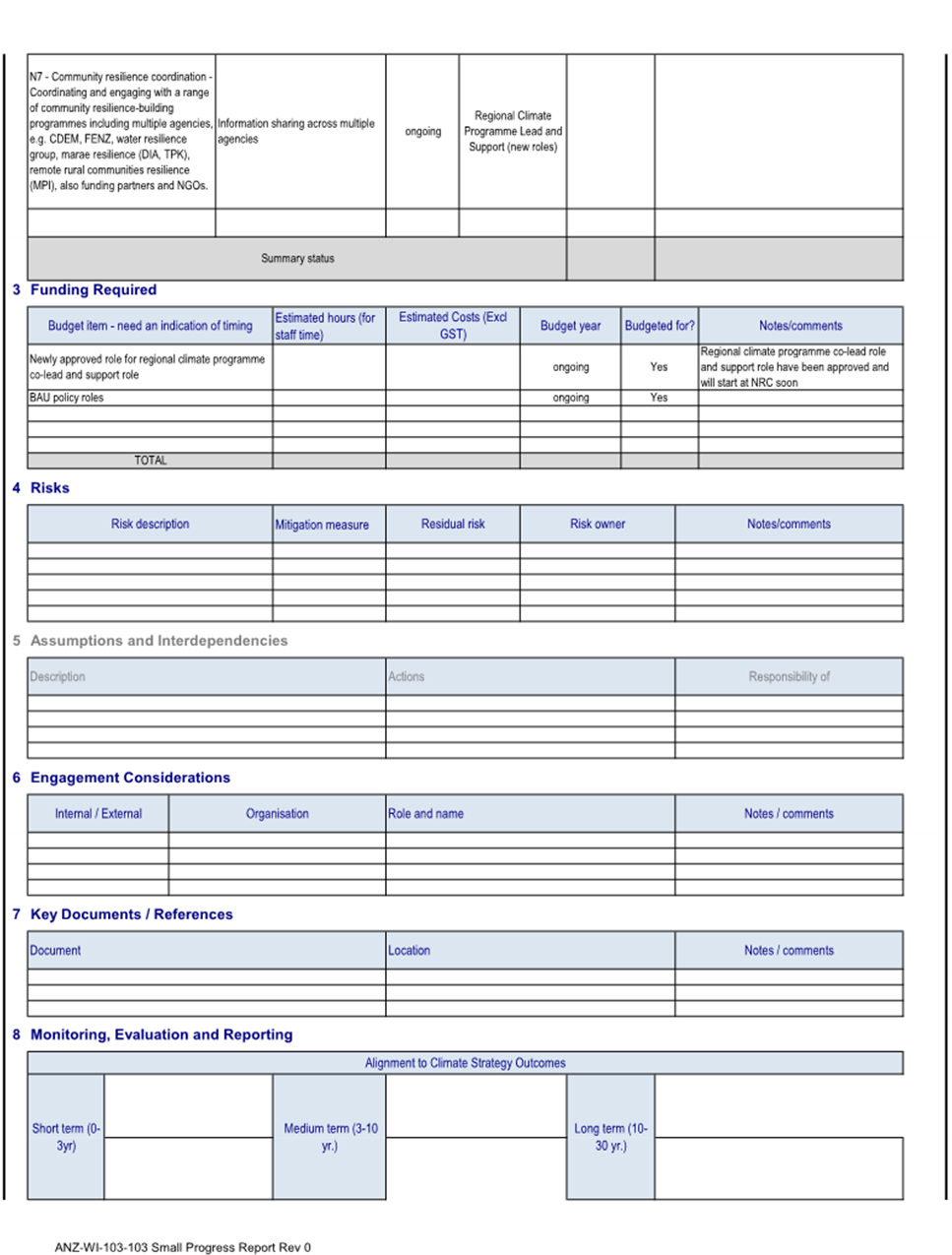
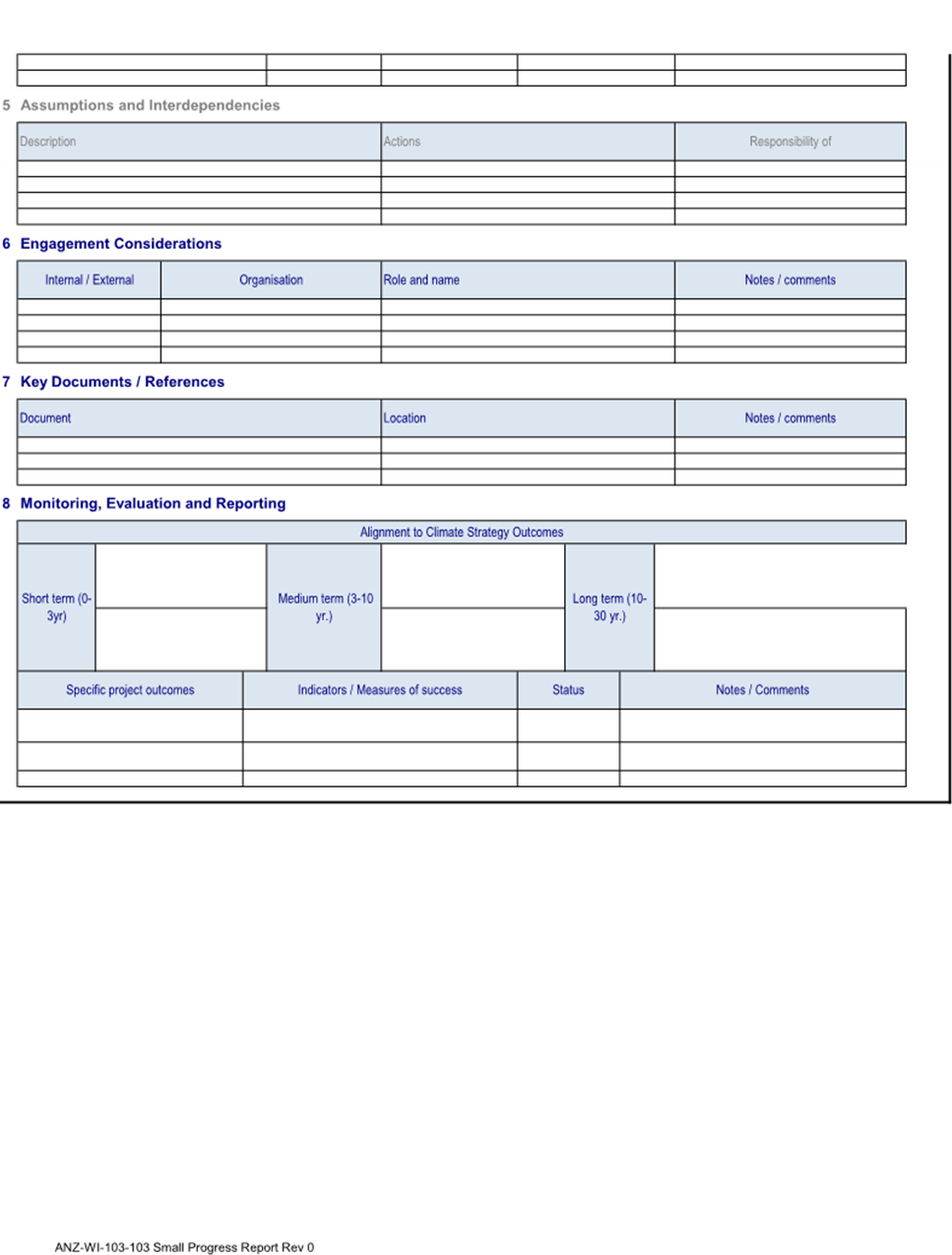
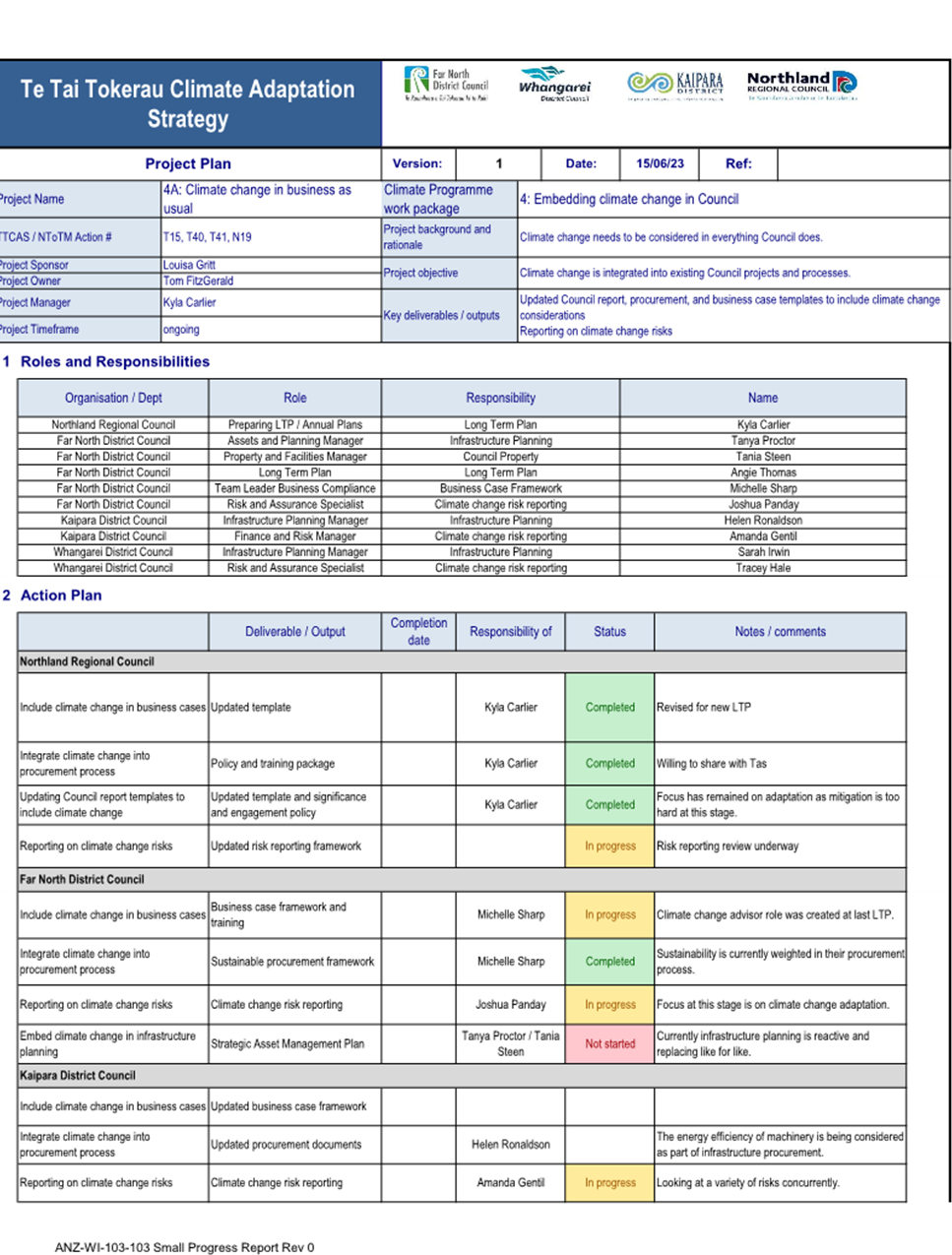
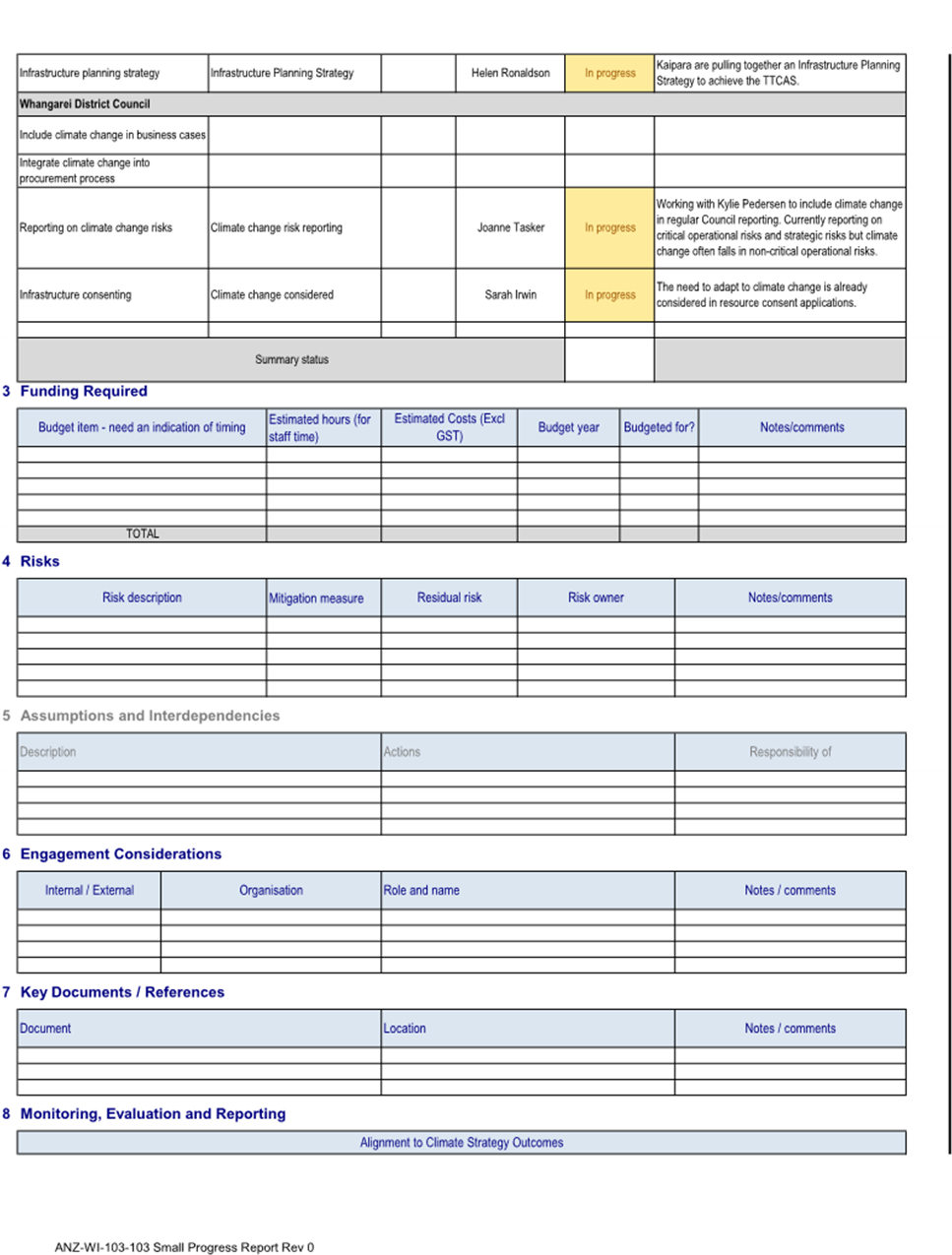
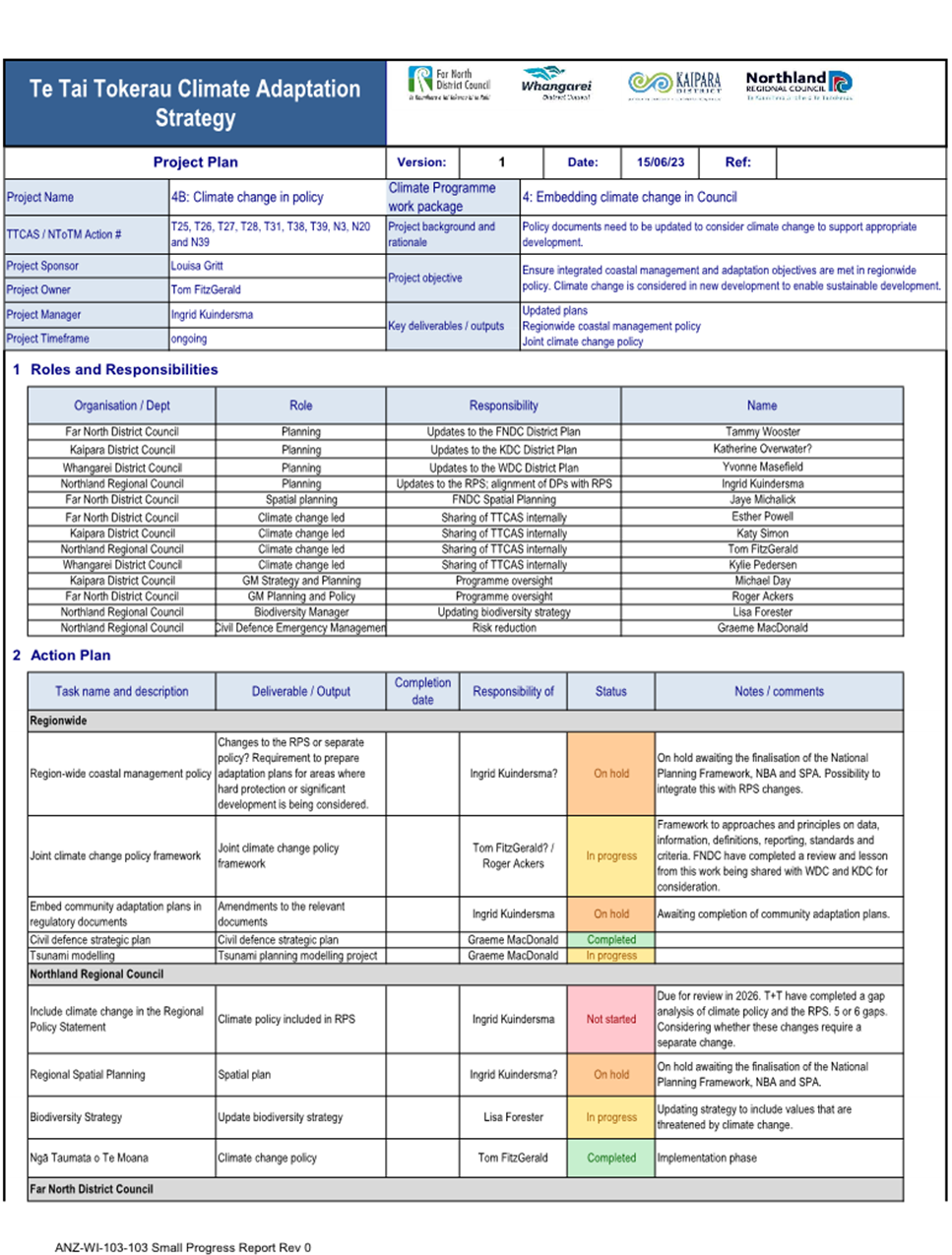
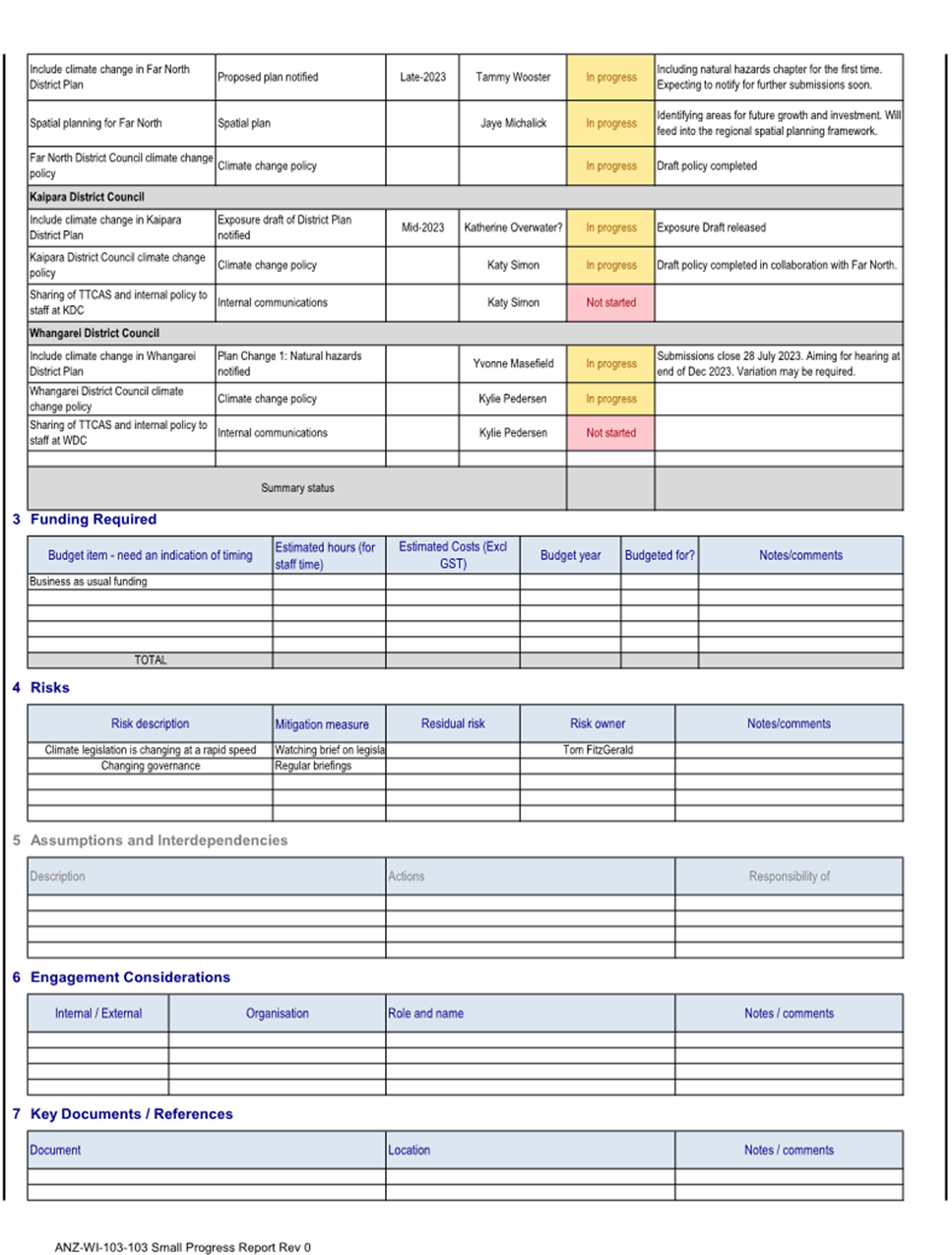
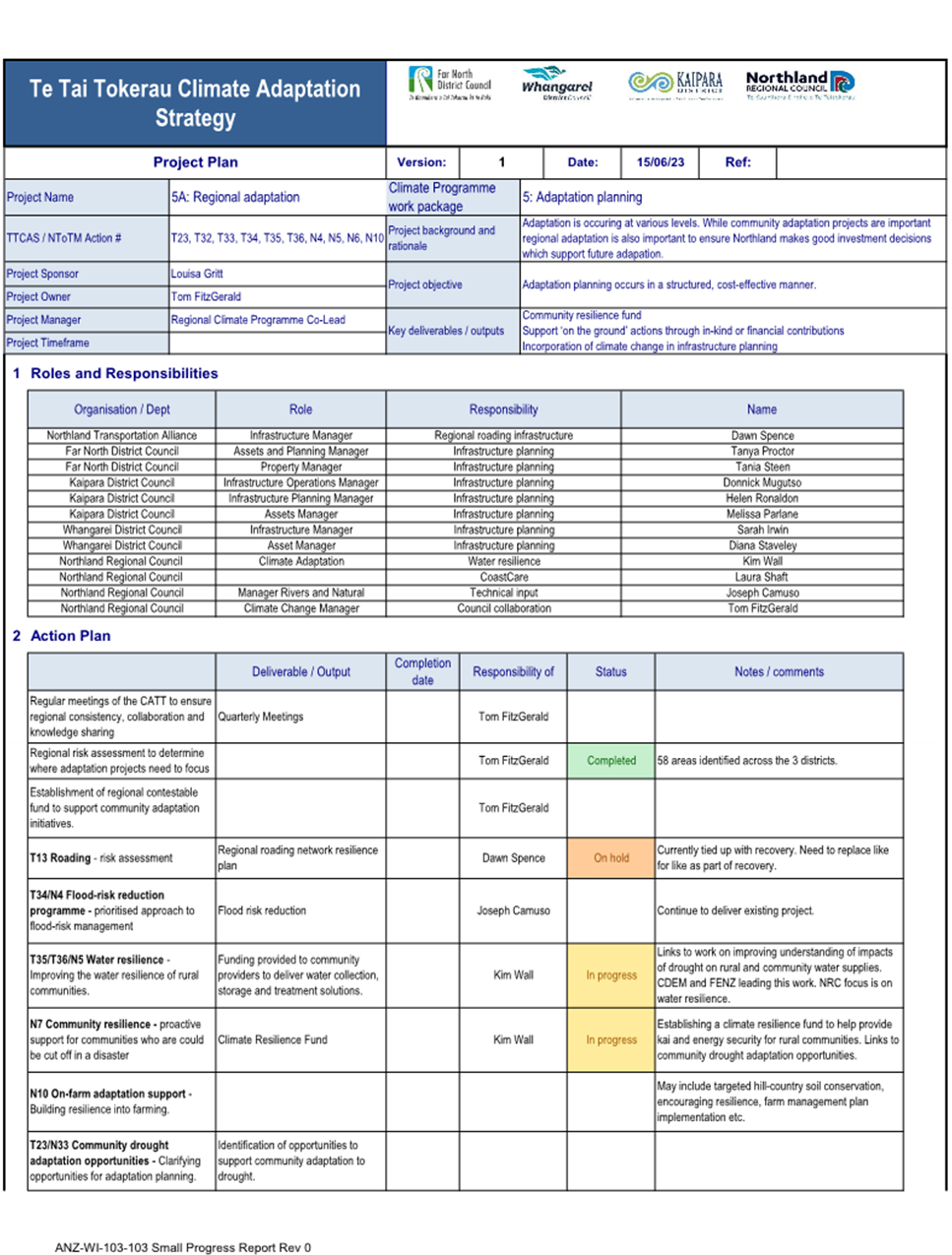
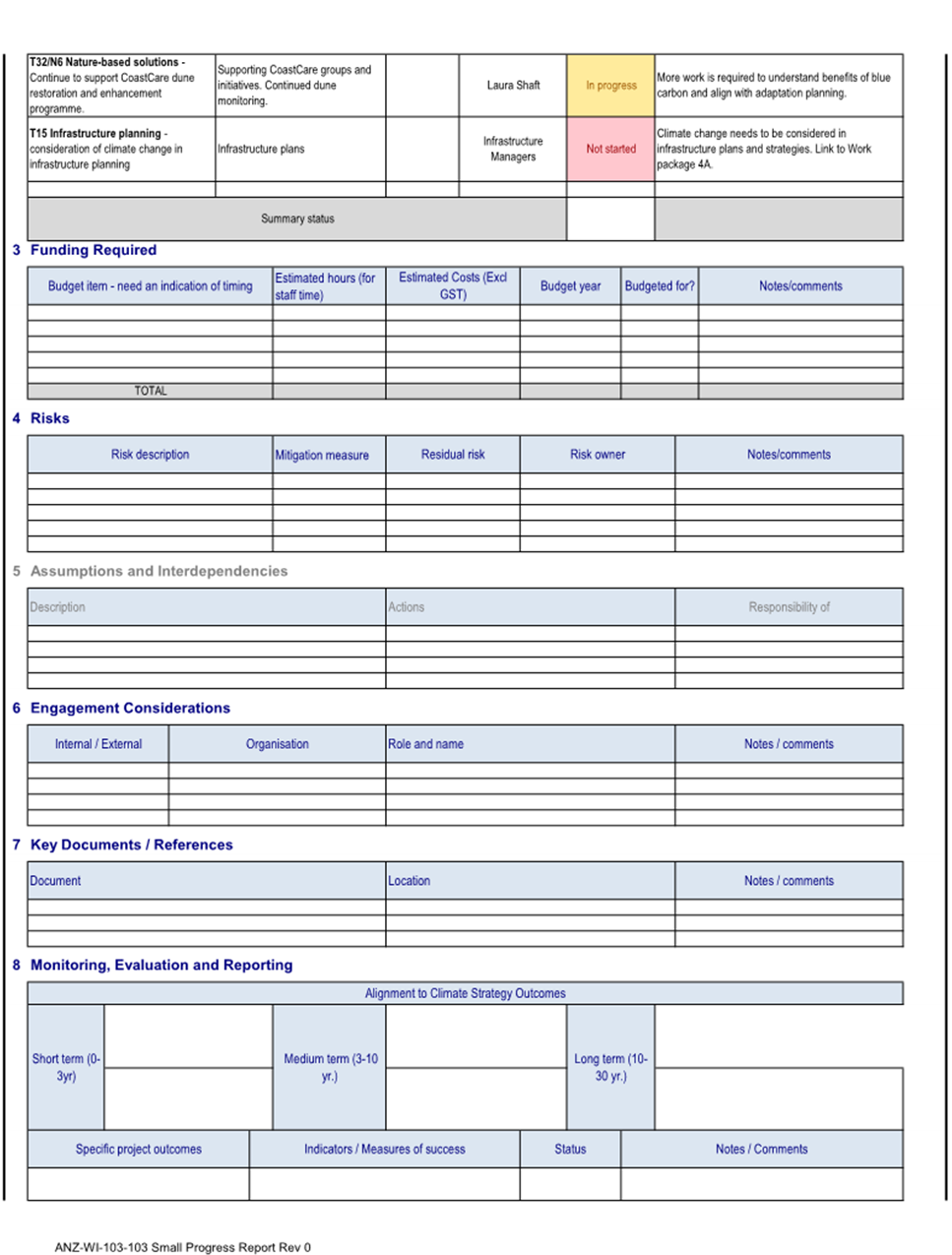
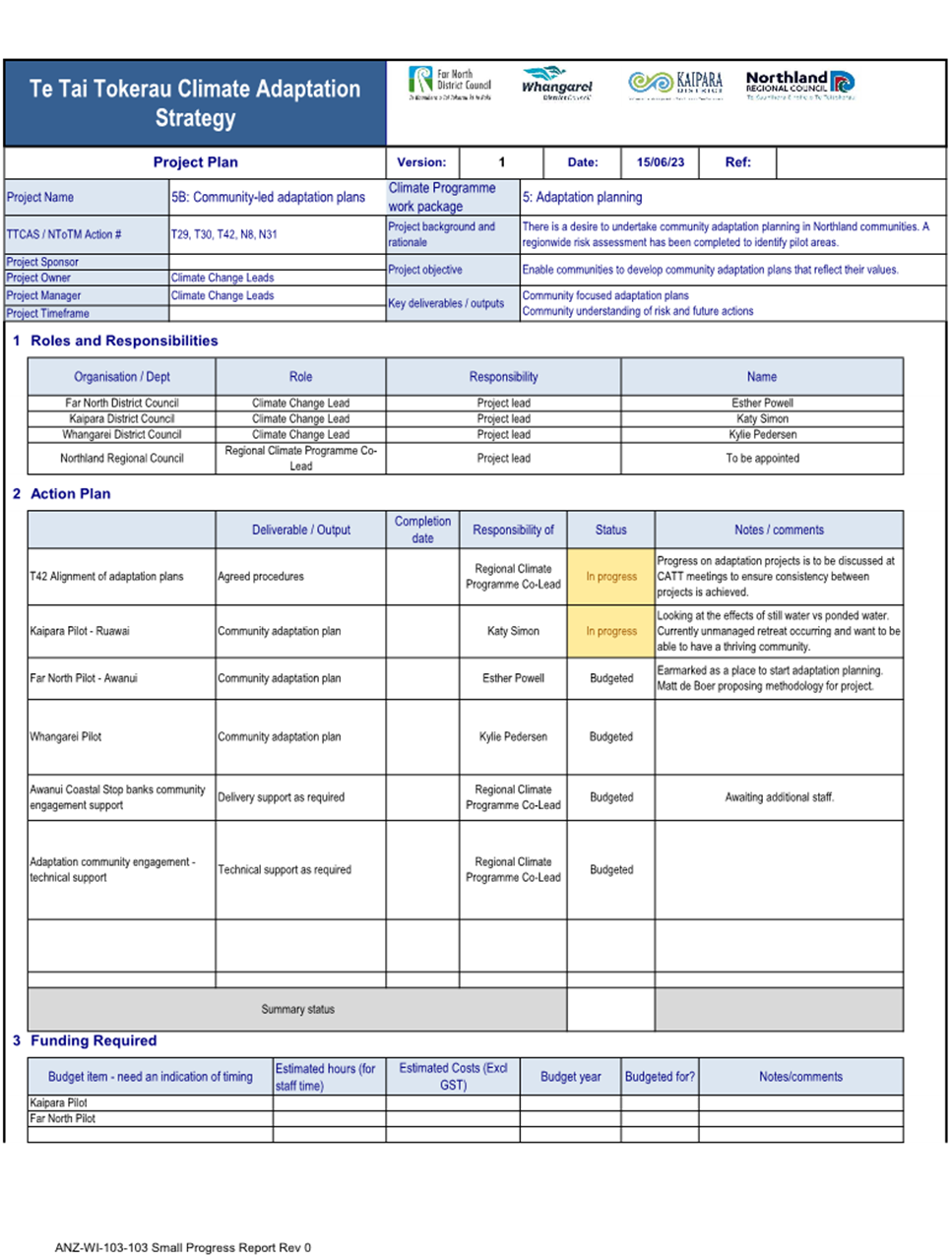
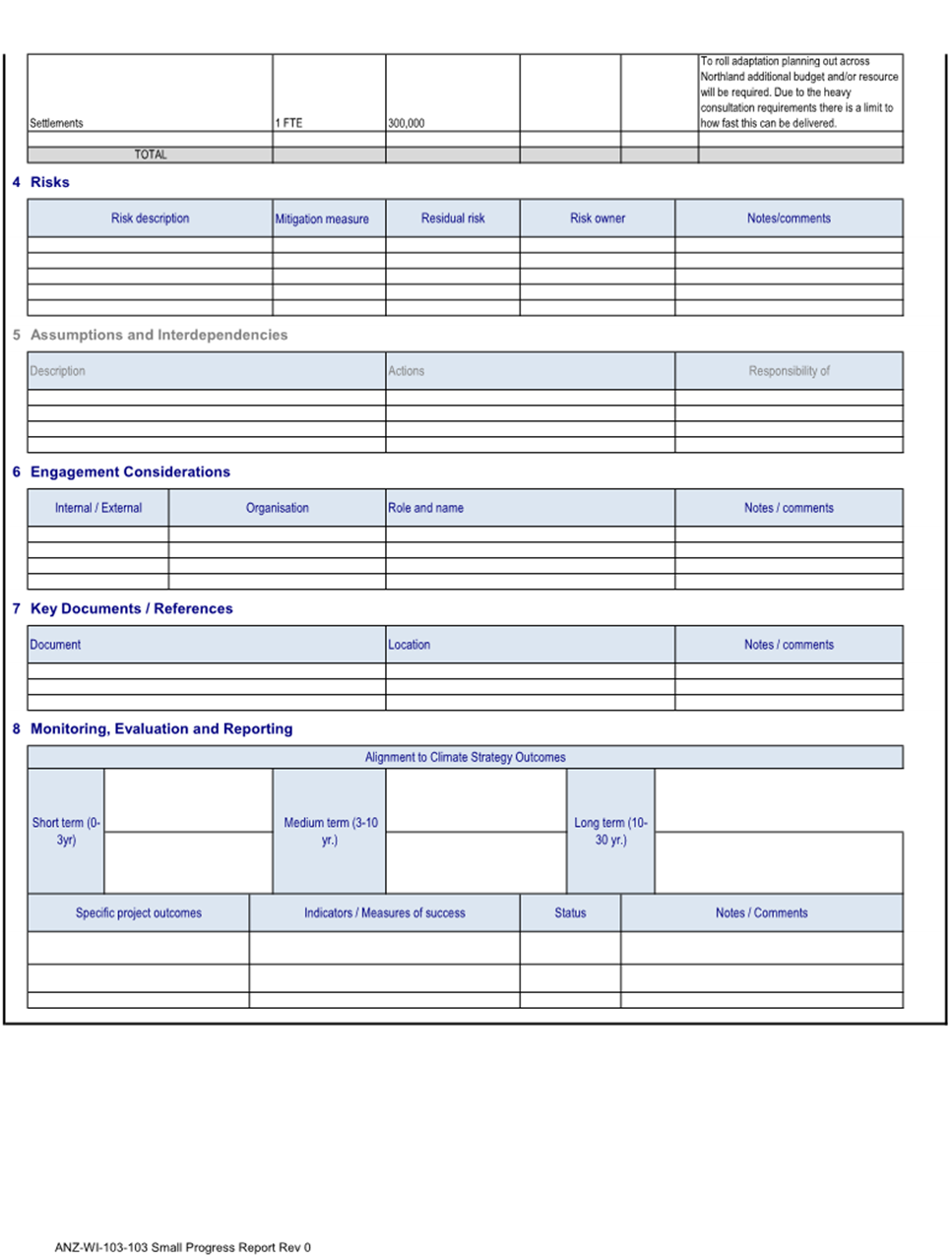
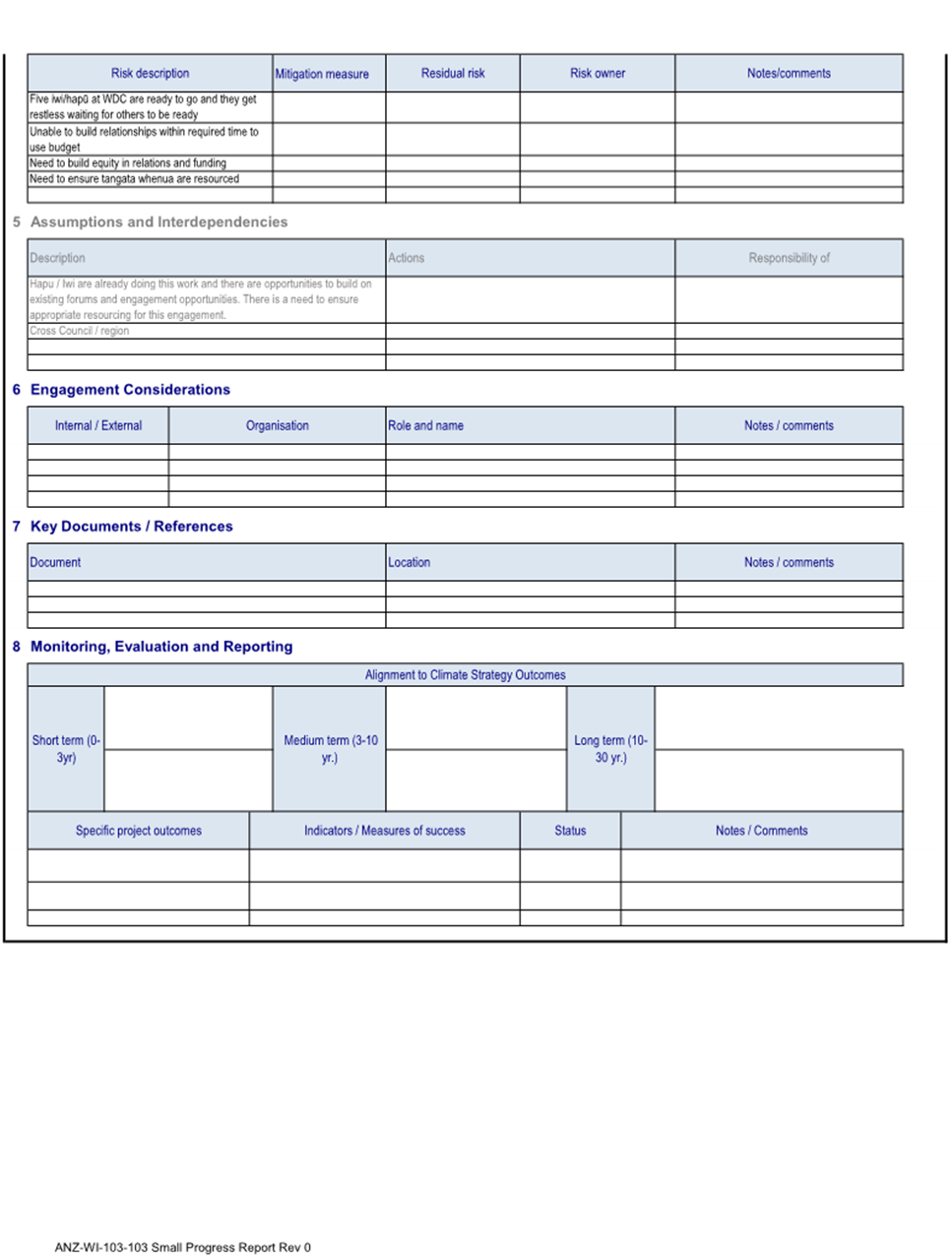
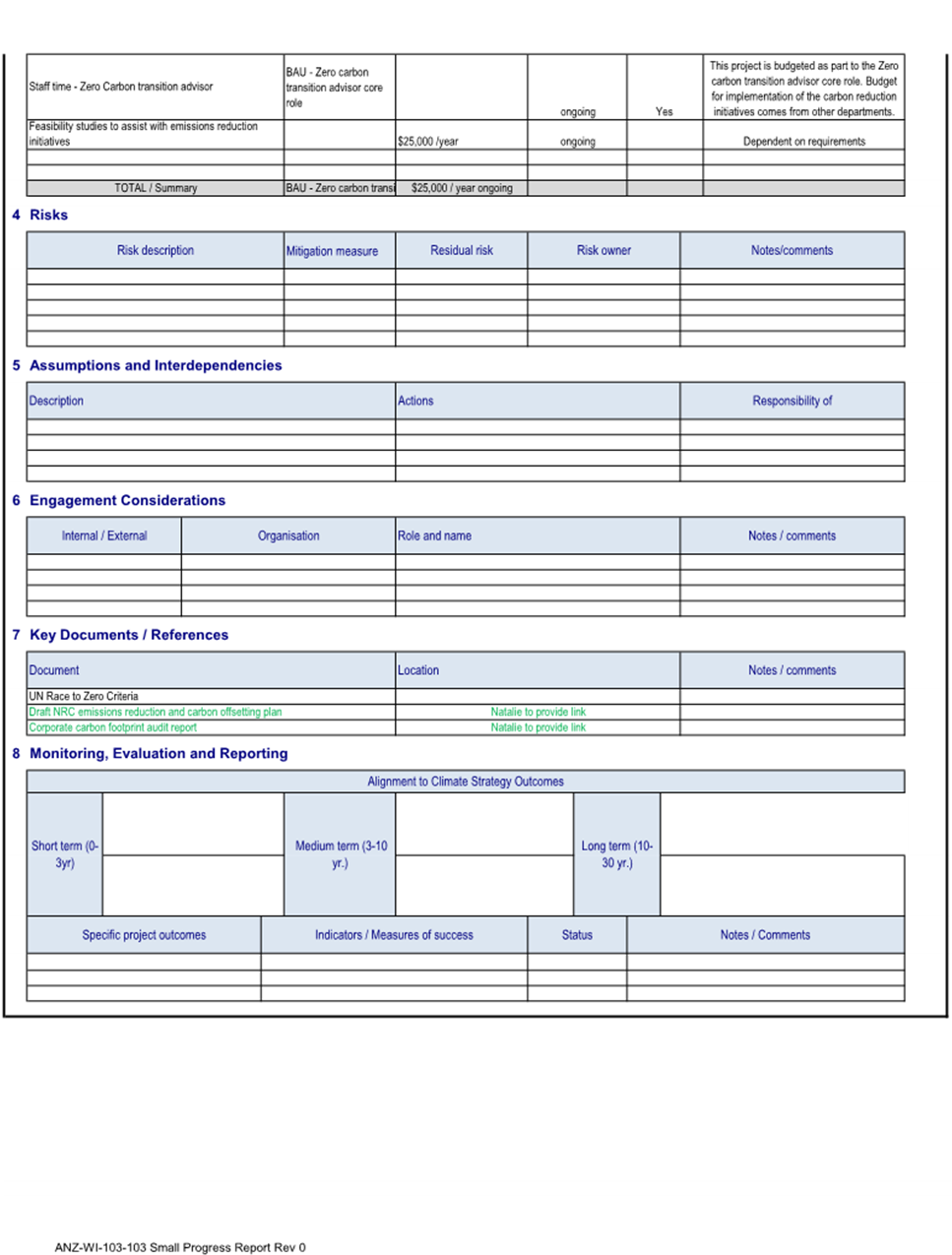
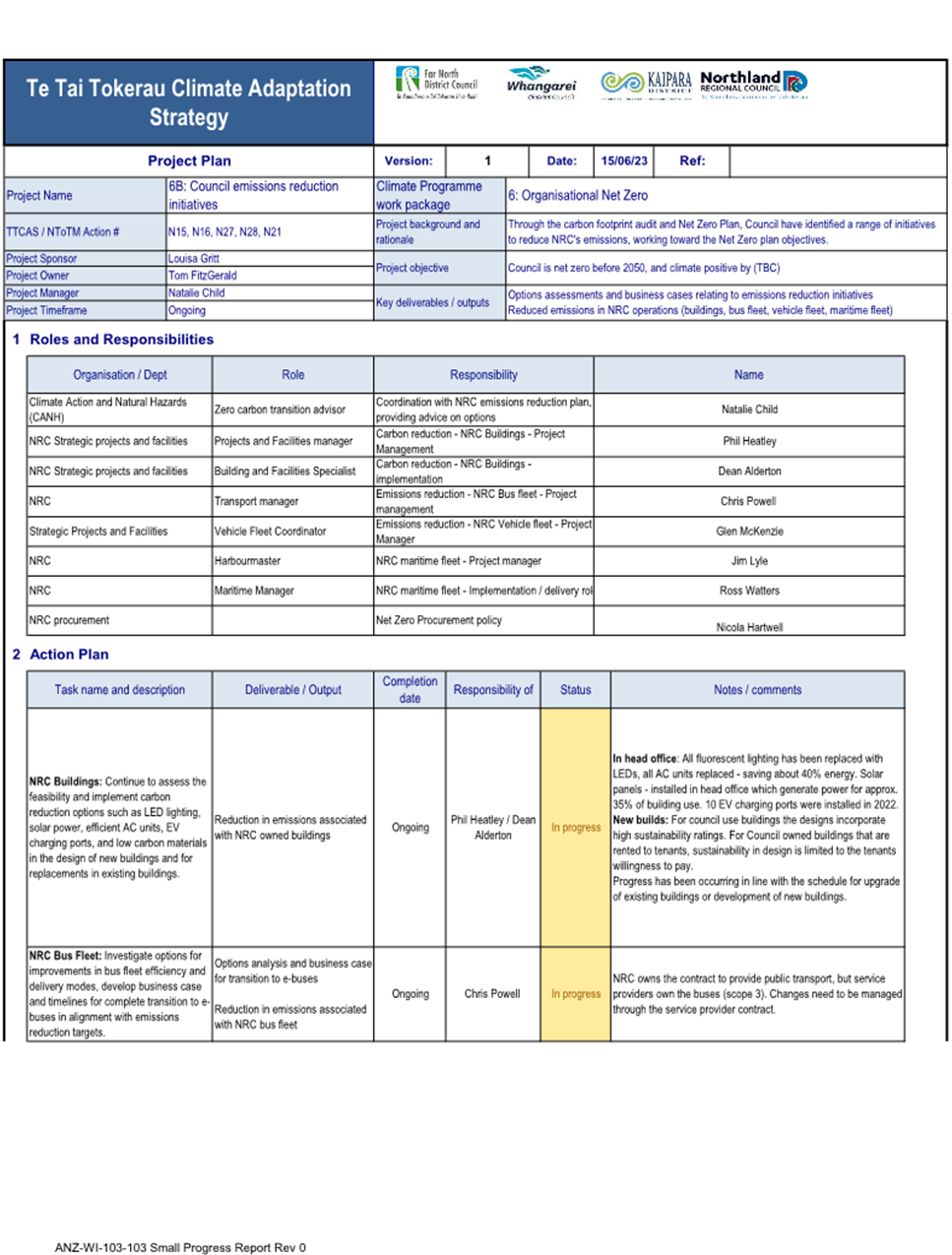
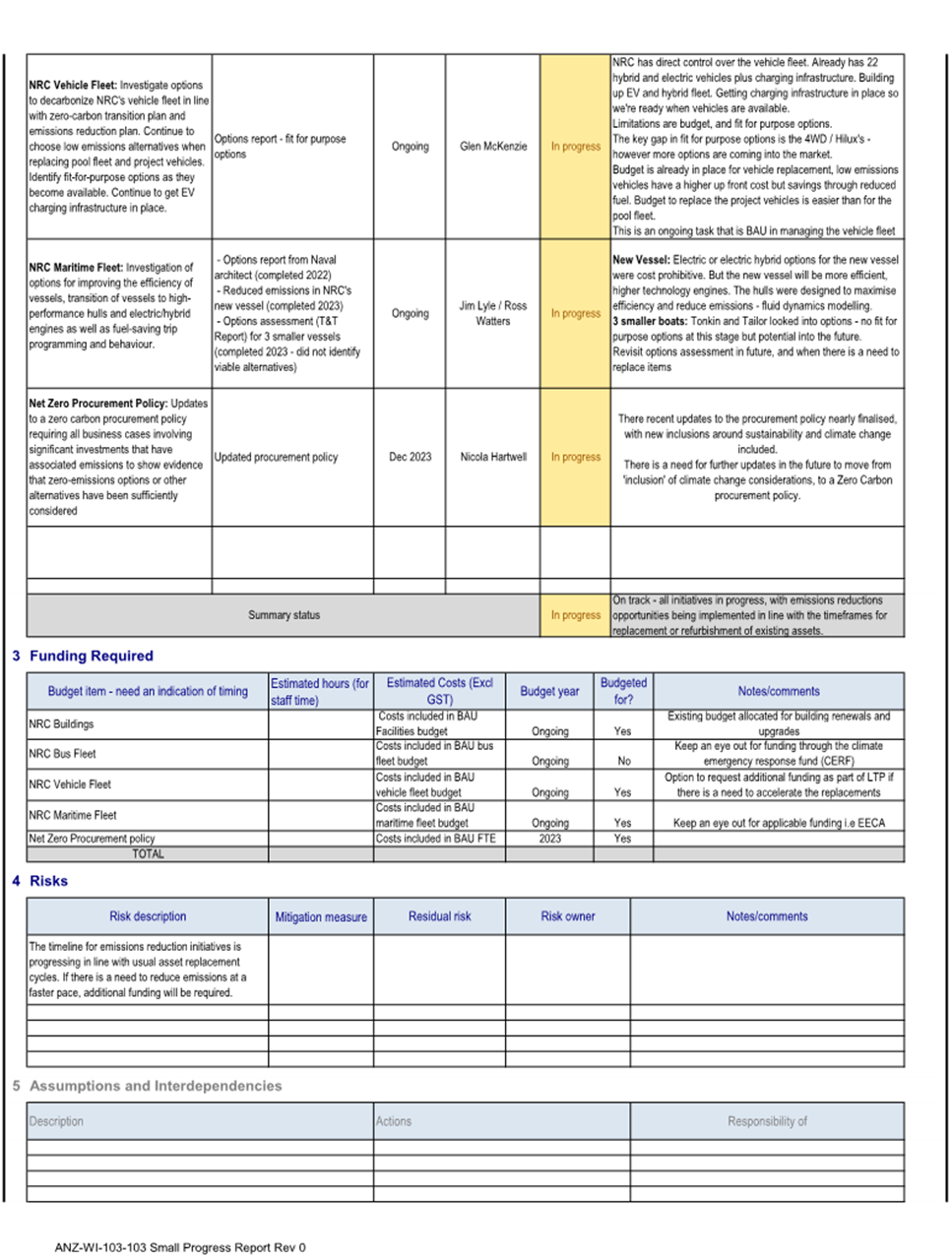
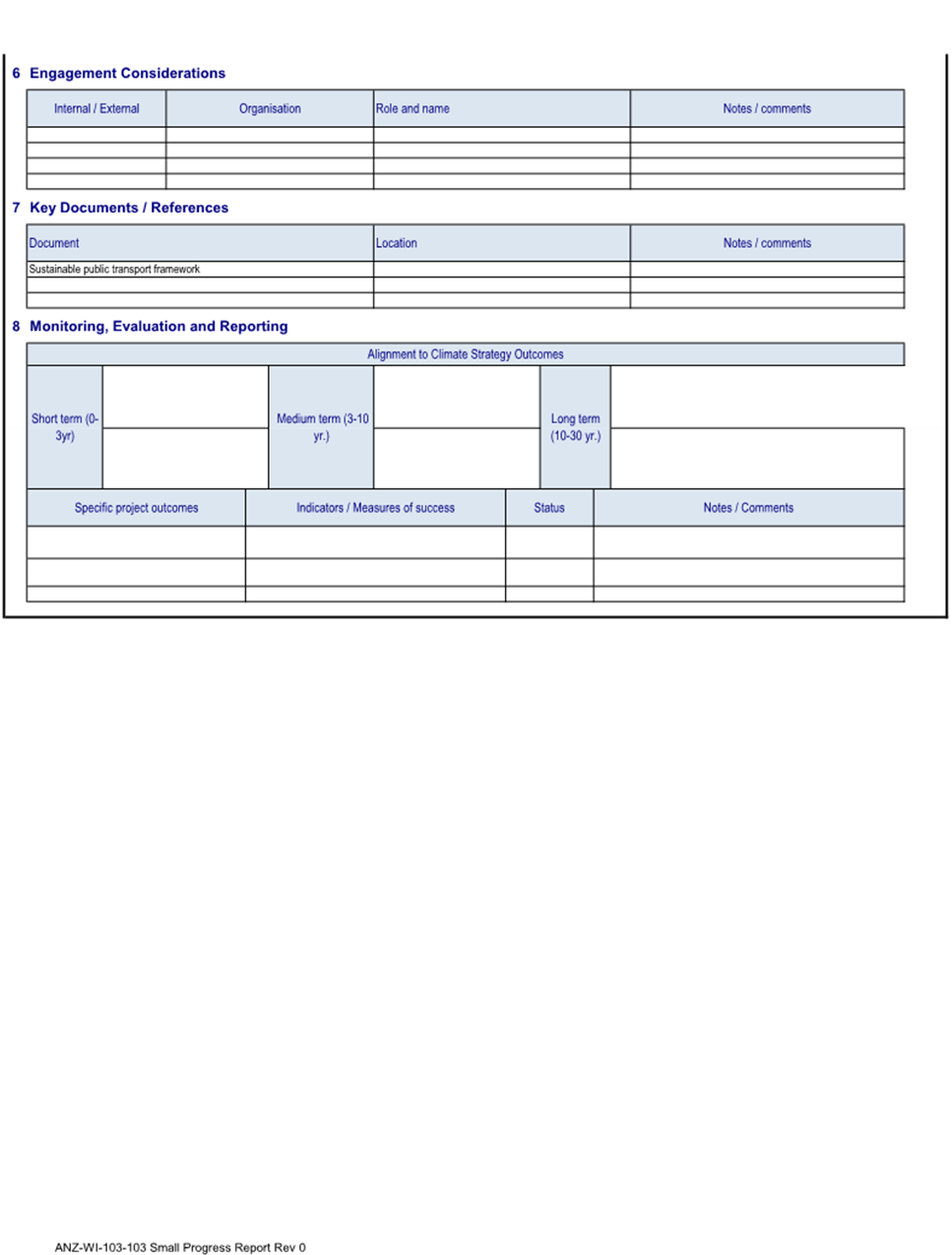
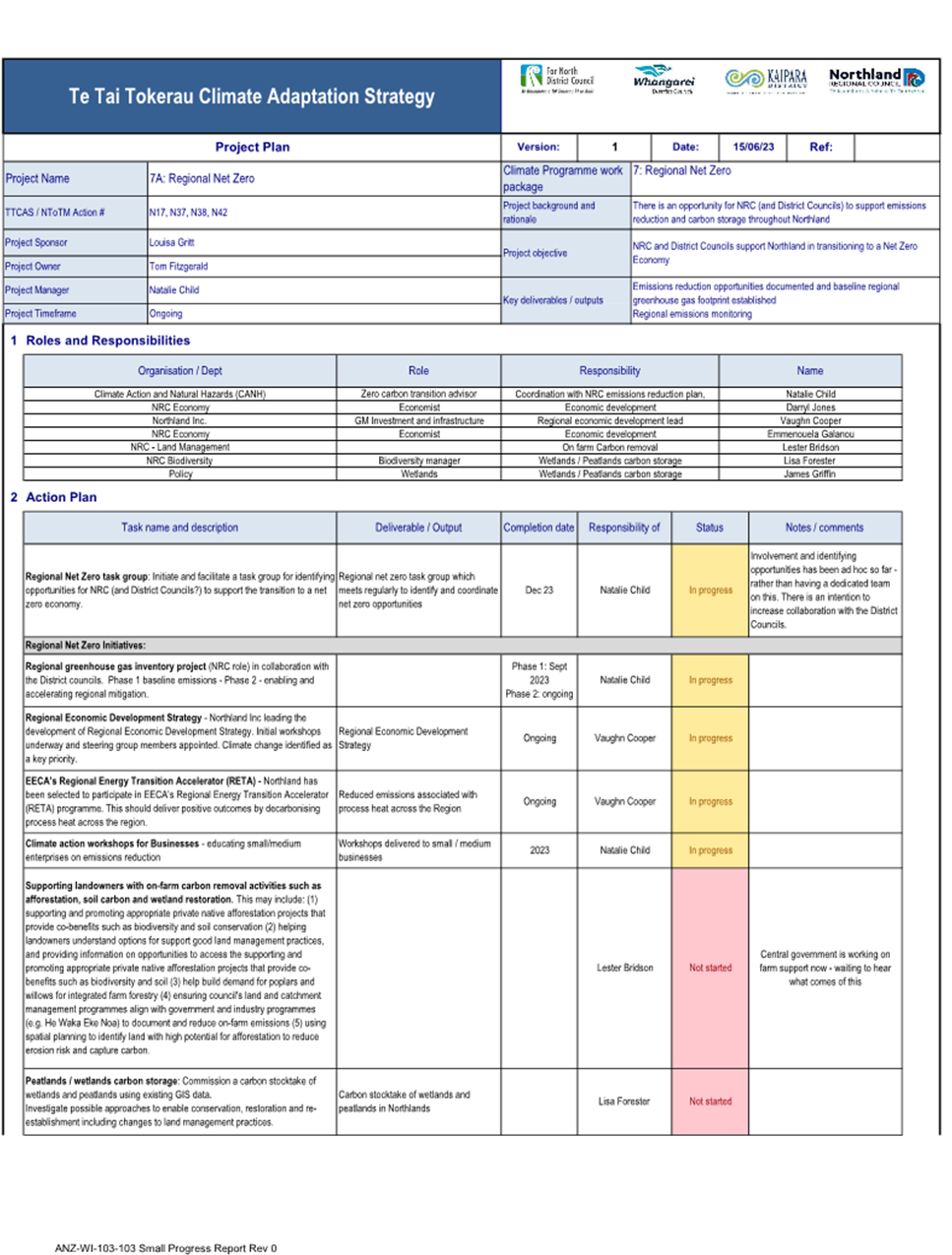
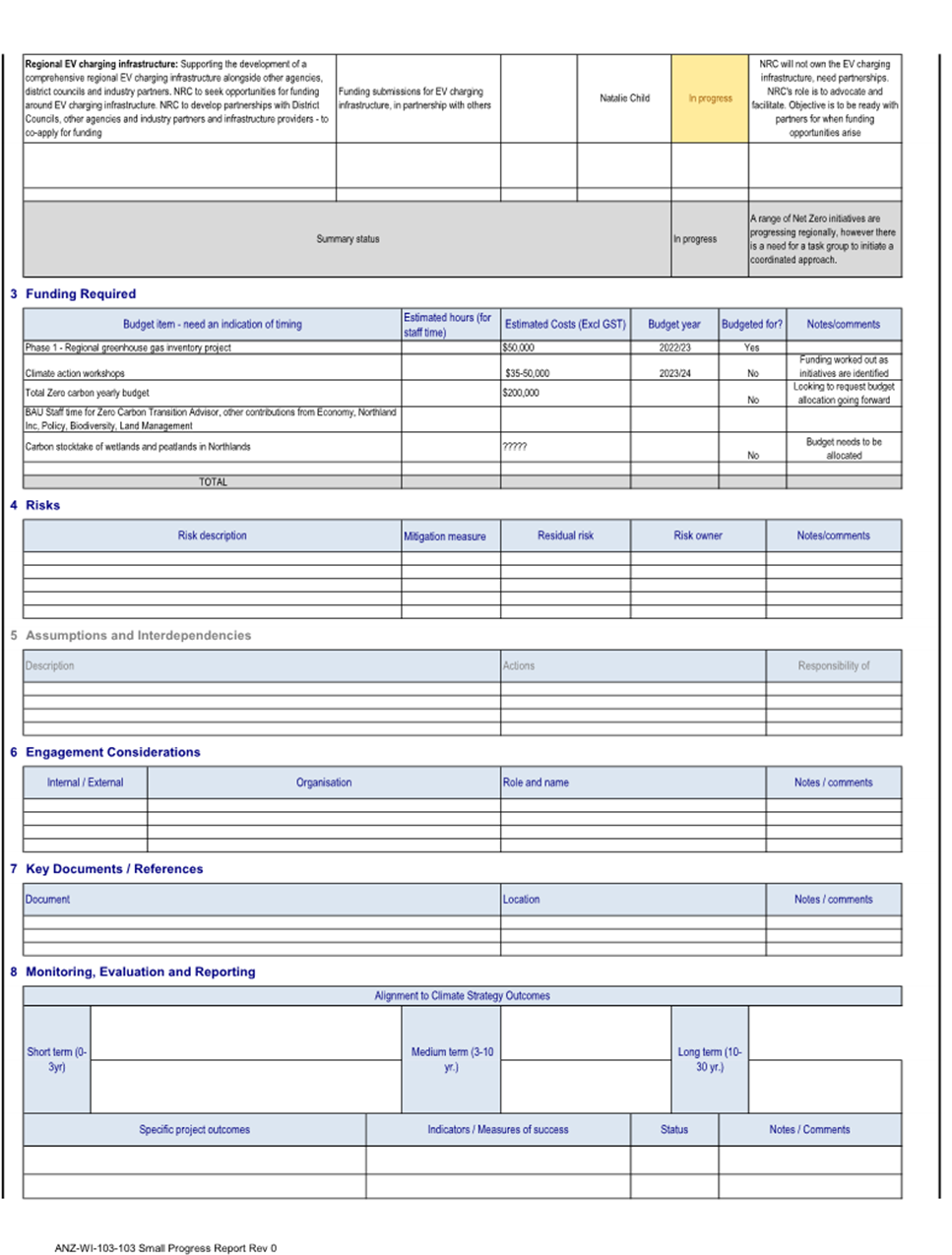
As you will note from the draft report and supporting appendices, each work package contains supporting project plans that identify key project details, including:
- Project sponsor, owner and manager
- Timeframes
- Project objectives and outputs
- Roles and responsibilities
- Tasks
- Funding requirements
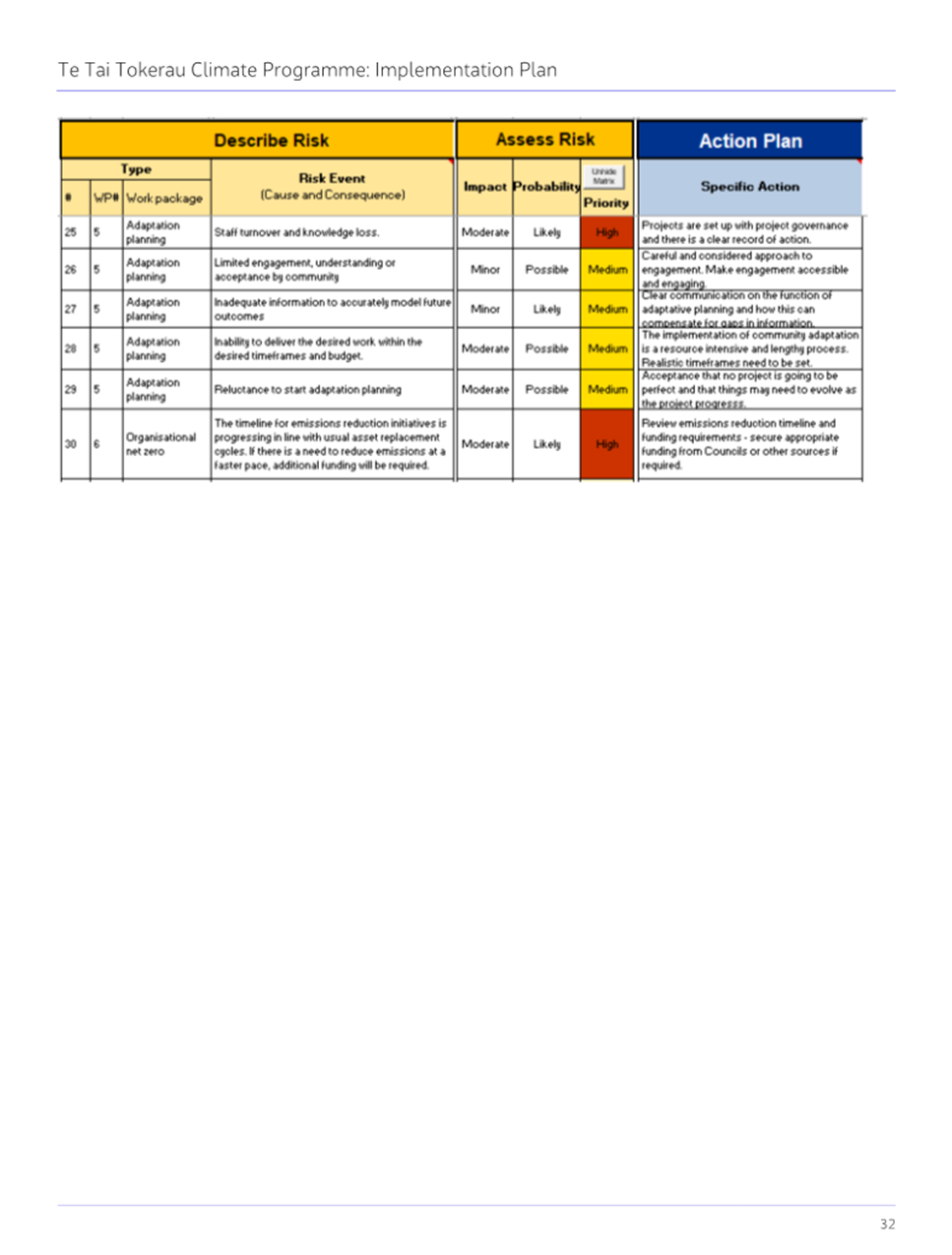
- Risks
- Assumptions and interdependencies
- Engagement considerations e.g. stakeholders, partners and community
- Key references
- MER indicators and metrics (tbc)
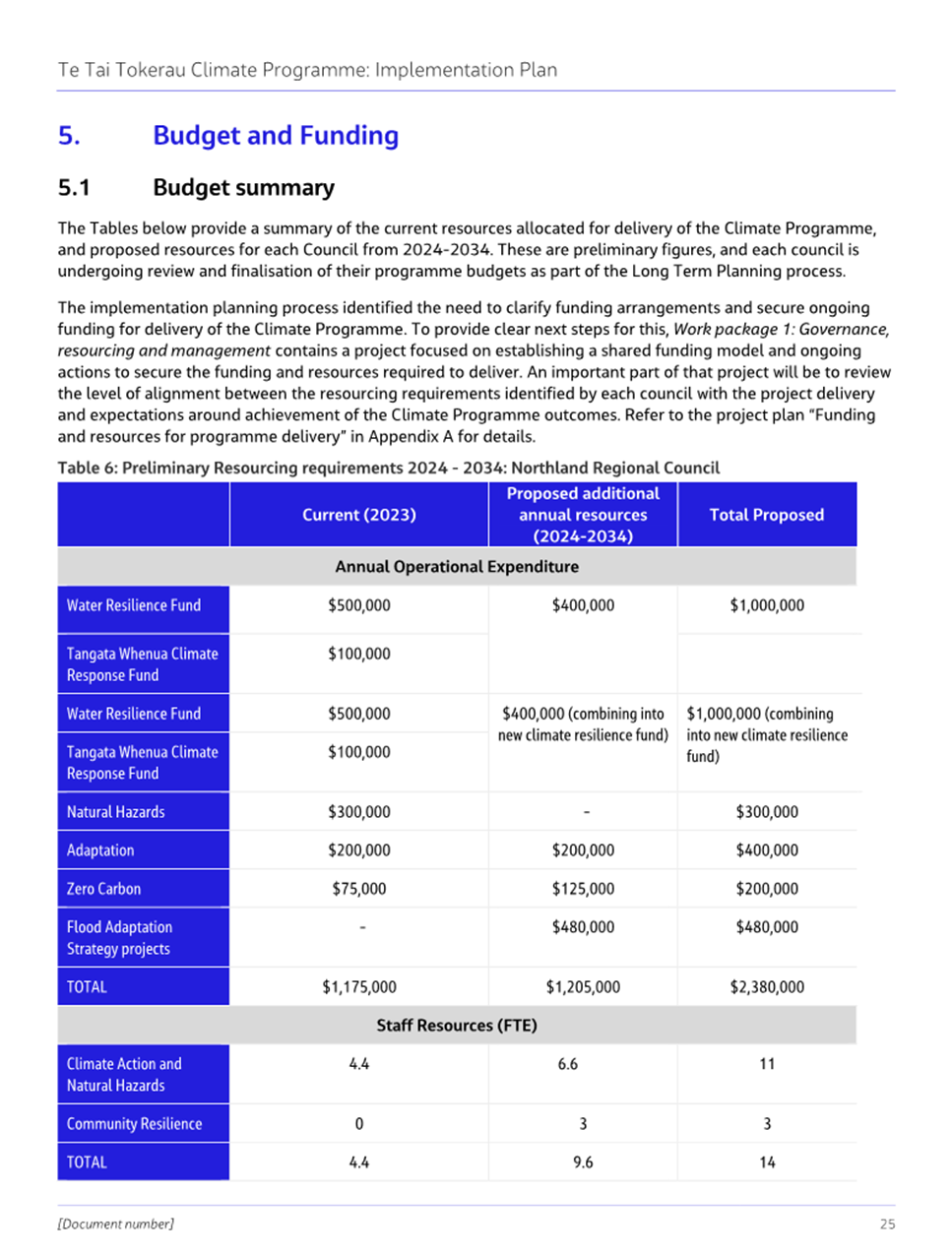
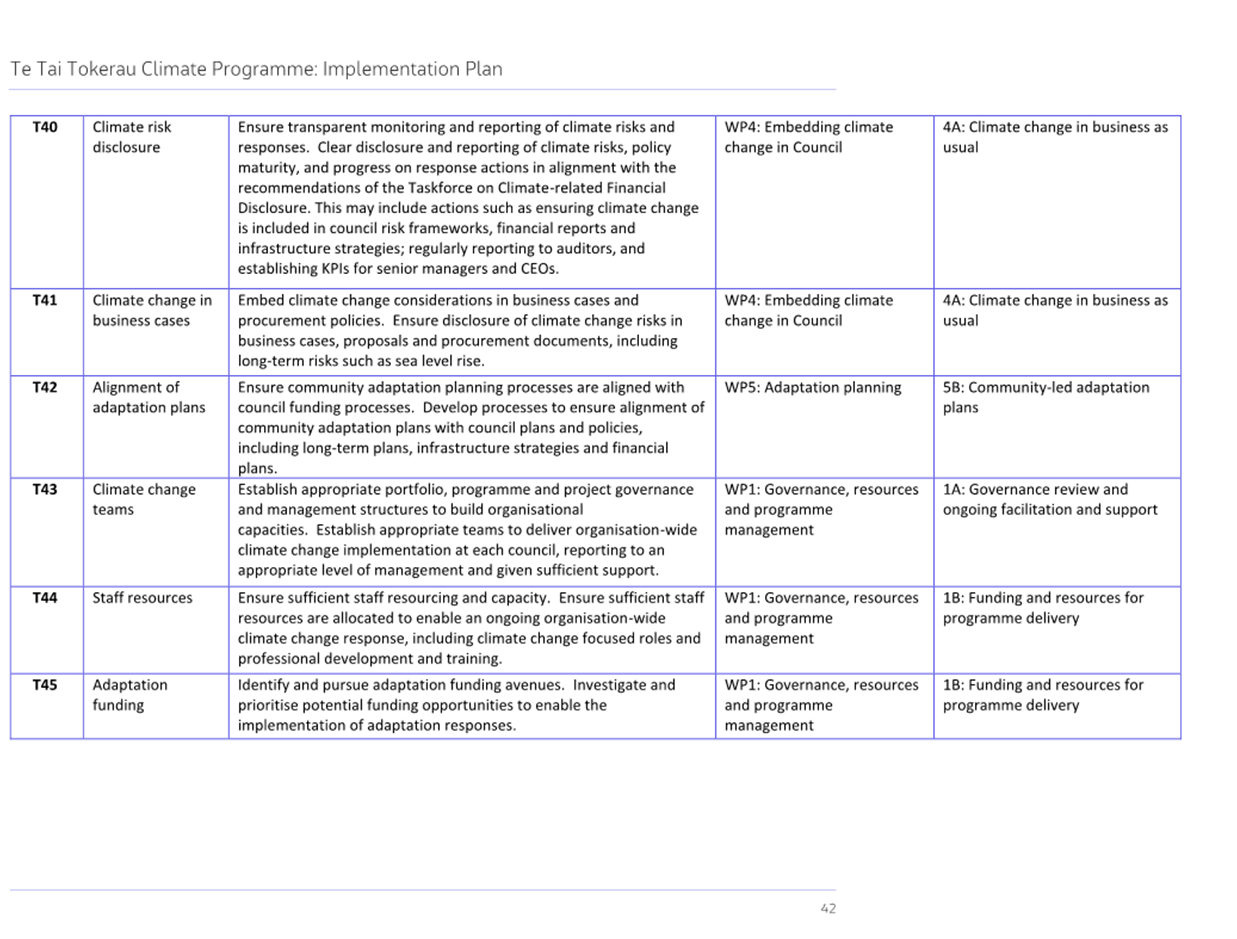
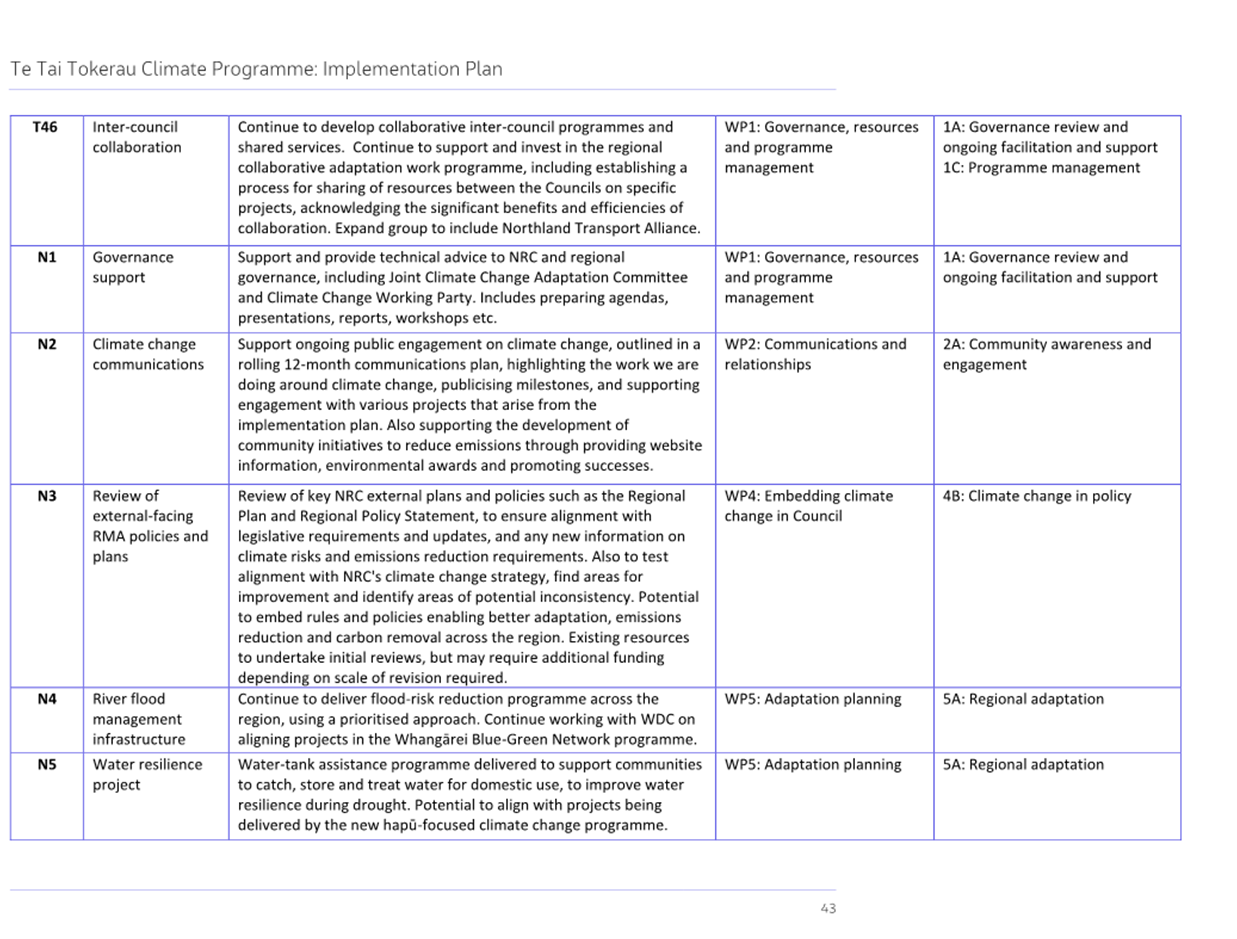
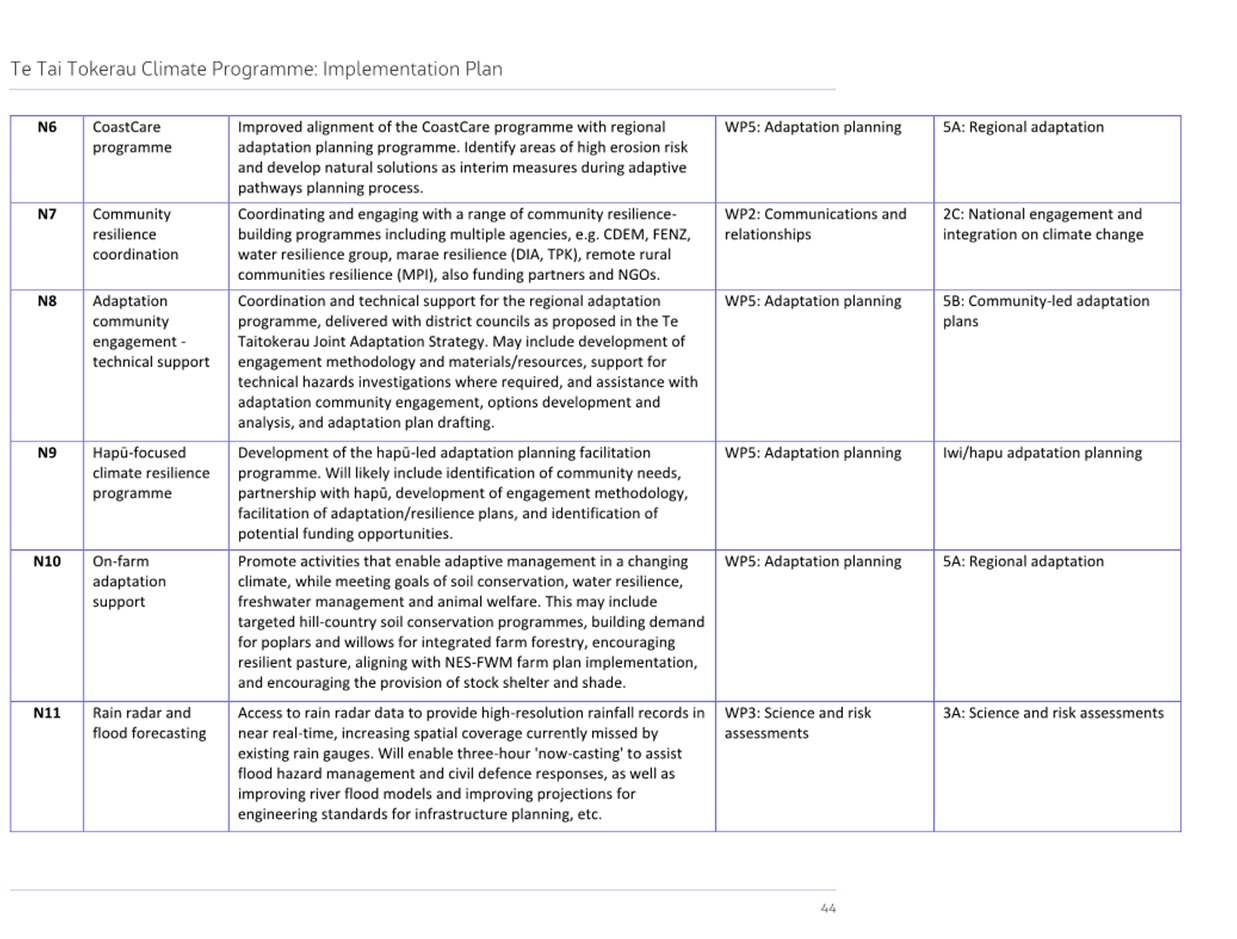
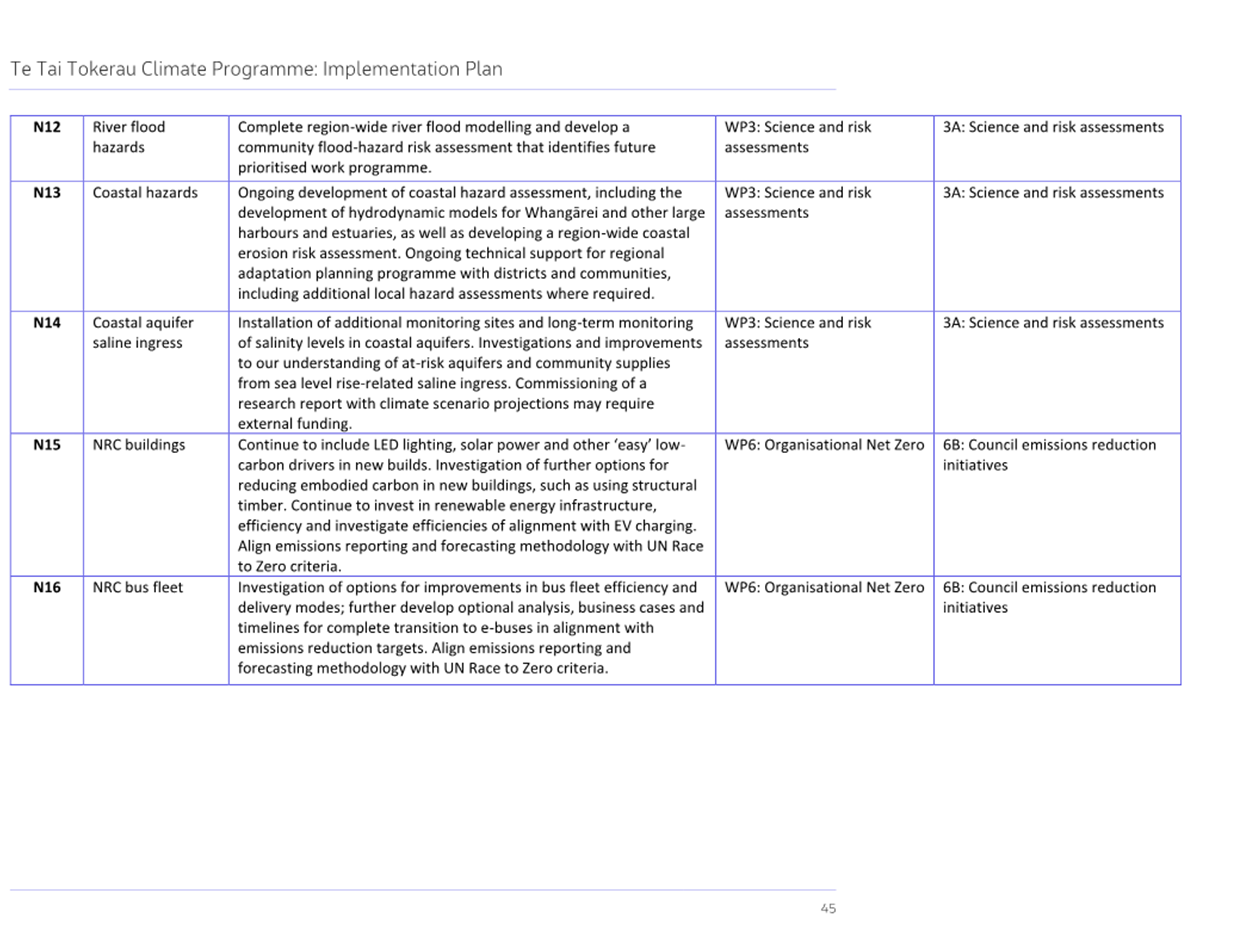
These project plans have been designed to be compatible and are able to be picked up by each council and integrated directly into their corporate planning processes (e.g. Long Term Plans, Annual Plans). Refer to Appendix A of the Jacobs report.
It is anticipated that project plans will be continually updated and exist as ‘live’ documents, similar to the TTCAS. This will allow for a ‘common operating picture’ that encourages collaboration, increases efficiencies, removes duplicated effort and ultimately delivers tangible and effective climate action.
Next steps
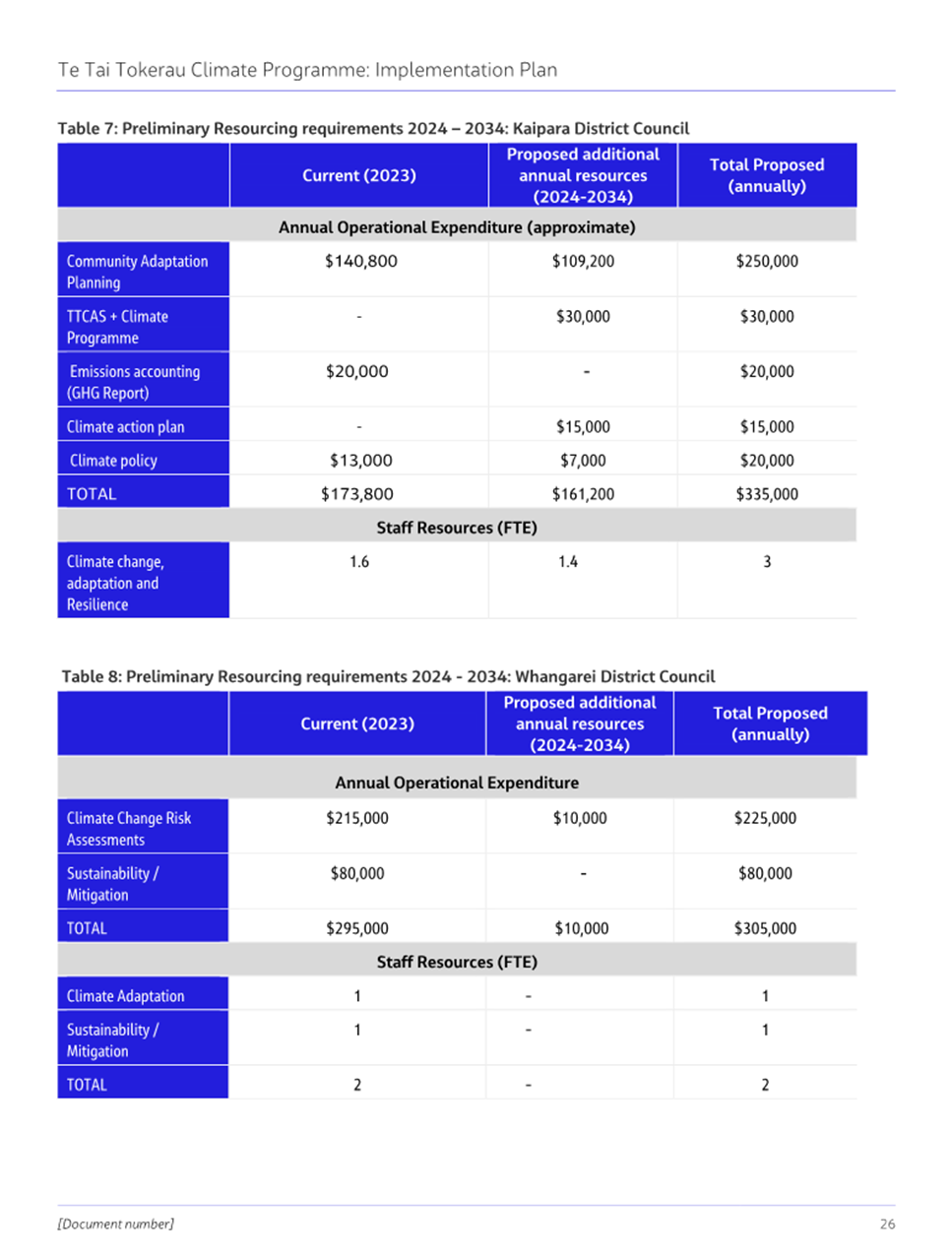
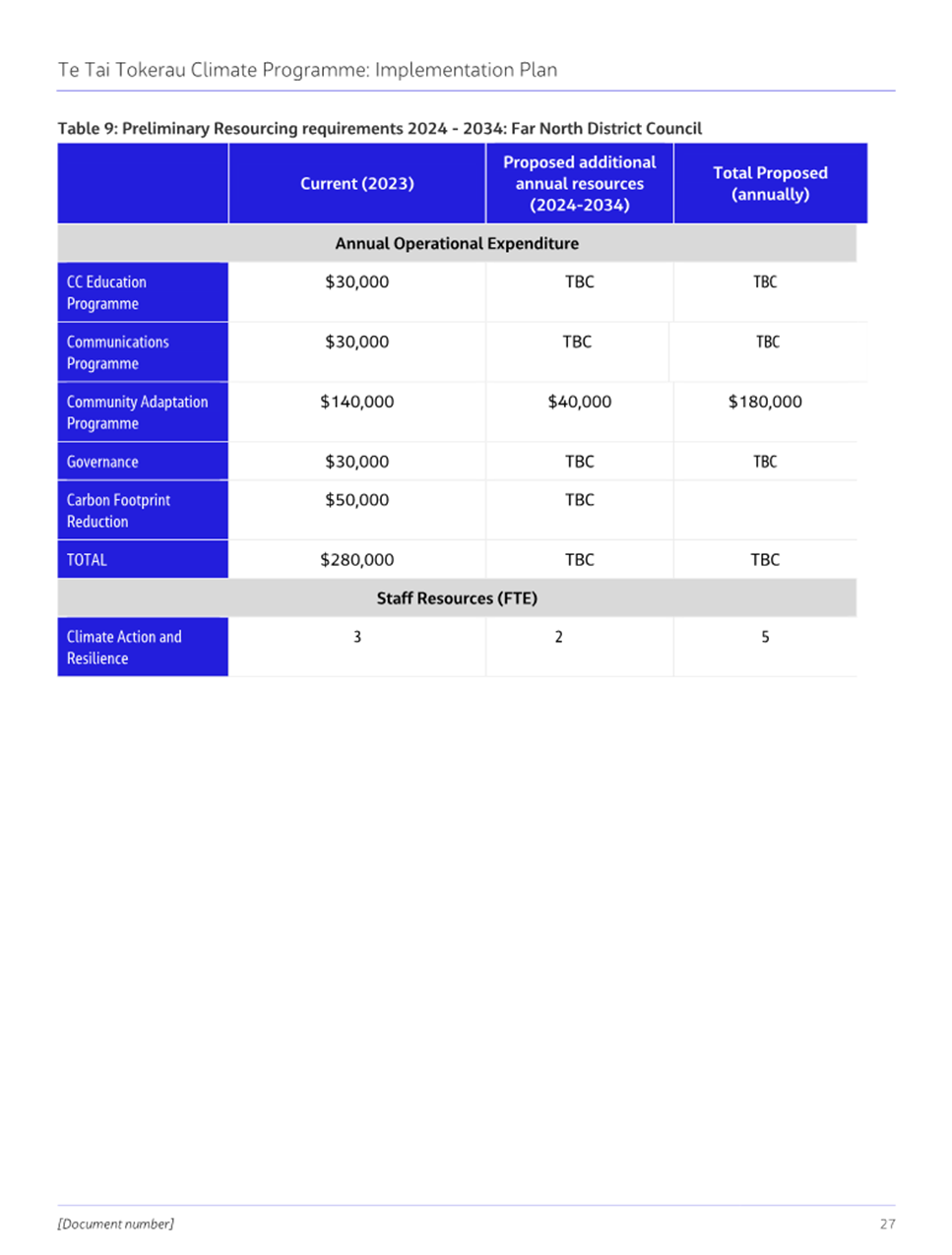
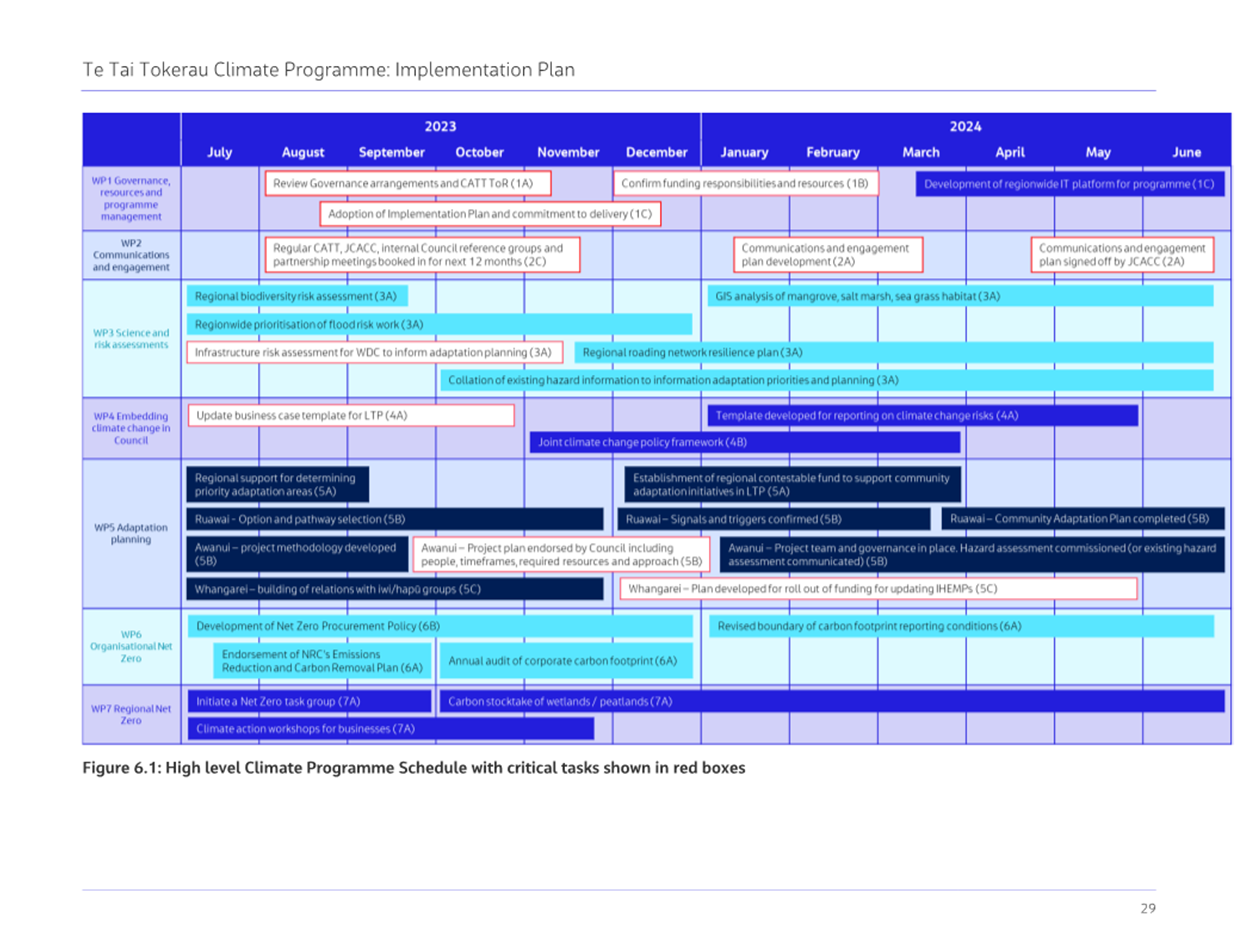
The final Jacobs report is expected in August. This will include finalised project plans, rough order costs to inform LTPs, identified investment priorities and timelines. This will result in a new version (repackaging) of the current TTCAS implementation plan (Appendix 1).
Operational updates to ‘priority actions’ such as that proposed here would be considered a minor update (as per Section 4 of the TTCAS) and require only approval from sponsoring Group Managers and presentation back to the Joint Climate Change Adaptation Committee.
Attachments/Ngā tapirihanga
Attachment 1: The Jacobs report - DRAFT
⇩
4 August 2023
|
TITLE: |
Community Adaptation Planning update |
|
From: |
Kylie Pederson, WDC Programme Manager, Climate Change Adaptation; Katy Simon, KDC - Climate Change Manager and Esther Powell, FNDC, Manager Climate Action and Community Resilience |
|
Authorised by Group Manager/s: |
Louisa Gritt, Group Manager - Community Resilience, on 25 July 2023 |
Whakarāpopototanga / Executive summary
This report updates the Joint Climate Adaptation Committee (Committee) on Northland councils’ aligned community adaptation planning. The report also updates the Committee on each district council’s adaptation planning programme and pilot projects.
That the report ‘Community Adaptation Planning update ’ by Kylie Pederson, WDC Programme Manager, Climate Change Adaptation; Katy Simon, KDC - Climate Change Manager and Esther Powell, FNDC, Manager Climate Action and Community Resilience and dated 10 July 2023, be received.
Background/Tuhinga
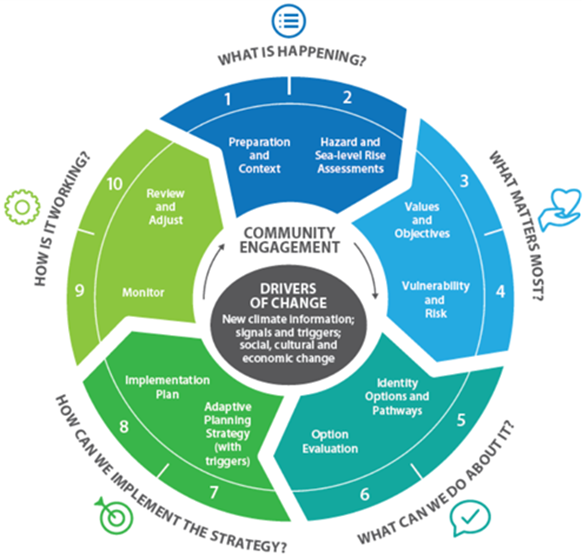
Under Te Tai Tokerau Climate Adaptation Strategy (TTCAS) all Northland councils commit to community adaptation planning. Community adaptation planning addresses coastal hazards risks to our communities. TTCAS establishes dynamic adaptive pathways planning (adaptive pathways) as the preferred, best-practice approach for community adaptation planning. Adaptive pathways is both an engagement approach and a decision-making approach. Councils will co-develop, with communities, flexible plans on how to prepare for, and respond to increasing coastal hazards. The process follows the Ministry for the Environment’s 2017 Coastal hazards and climate change: Guidance for local government (Figure 1).
|
|
Figure 1. Ministry for the Environment Adaptation Planning Cycle (2017)
|
Adaptive pathways provides a robust, structured process that enables communities to lead the conversation on their resilience. Councils will support community panels to work through risk assessments, engineering designs, options assessments, and a prioritisation processes. This technical work feeds into the development of adaptive pathways / community adaptation plans, shown as steps one through seven in Figure 1.
After the completion of step seven and the endorsement of community adaptive pathways plans, councils will be responsible for implementation of the plans (steps eight - ten). This includes monitoring environmental indicators and delivering actions when specific trigger points are reached, i.e changing land-use zoning or delivering new infrastructure.
Community adaptation planning is not a one-size-fits all process. The CATT staff group are working to customise community adaptation planning projects, scaling the engagement and technical elements up or down to fit the size and complexity of situation. This scaling supports the best use of resourcing available and could allow councils to facilitate and/or support multiple adaptation planning cycles at the same time.
TTCAS outlines three potential scales of community adaptation planning:
1. Larger communities, full engagement and technical approach
2. Smaller communities, condensed or customised approach
3. Iwi and hapū led projects
Under the 2021-2031 Long Term Plan, each district council commits to starting a community adaptation planning pilot. The district councils are leading the project design and facilitation, including community engagement. Northland Regional Council supports the district councils with natural hazards modelling, technical support and general in-kind process management support. The rest of this report provides an update on community adaptation planning from each district council.
1. Far North District Council
Far North District Council (FNDC) has engaged Adapterra to provide expert guidance on how best to implement a community adaptive planning programme in the Far North District. Climate resilience specialist, Matt de Boer of Adapterra is working with Traverse Environmental and Puawai Kake of Kohu Planning, to produce a methodology that incorporates adaptive pathway planning and Te Ao Māori. This report is expected in late September. The methodology will provide a framework that can be used in communities of different scales to undertake adaptive planning and will frame how FNDC can provide assistance, leadership and/or technical support in the adaptive planning process.
As part of this project Adapterra is also working with Urban Intelligence to provide a geospatial analysis of risk, vulnerability, and exposure of the district’s communities. This data will feed into a multi criteria analysis and inform decisions to be made on appropriate pilot communities based on specific metrics.
Groundwork relationship building and networking is being undertaken to support future adaptive pathway planning. Civil Defence Emergency Management (CDEM) has been engaged to identify synergies between reduction planning and pre-disaster recovery planning as part of adaptive pathway planning process. Shared projects with Far North Waters are being planned to undertake community adaptive planning in relation to asset management. A community education programme is underway in conjunction with libraries to raise awareness of adaptive planning and engage youth and marginalized persons in adaptation and resilience dialogue. It is envisioned that multiple micro and macro adaptation programmes will be commenced by the end of 2023.
2. Kaipara District Council
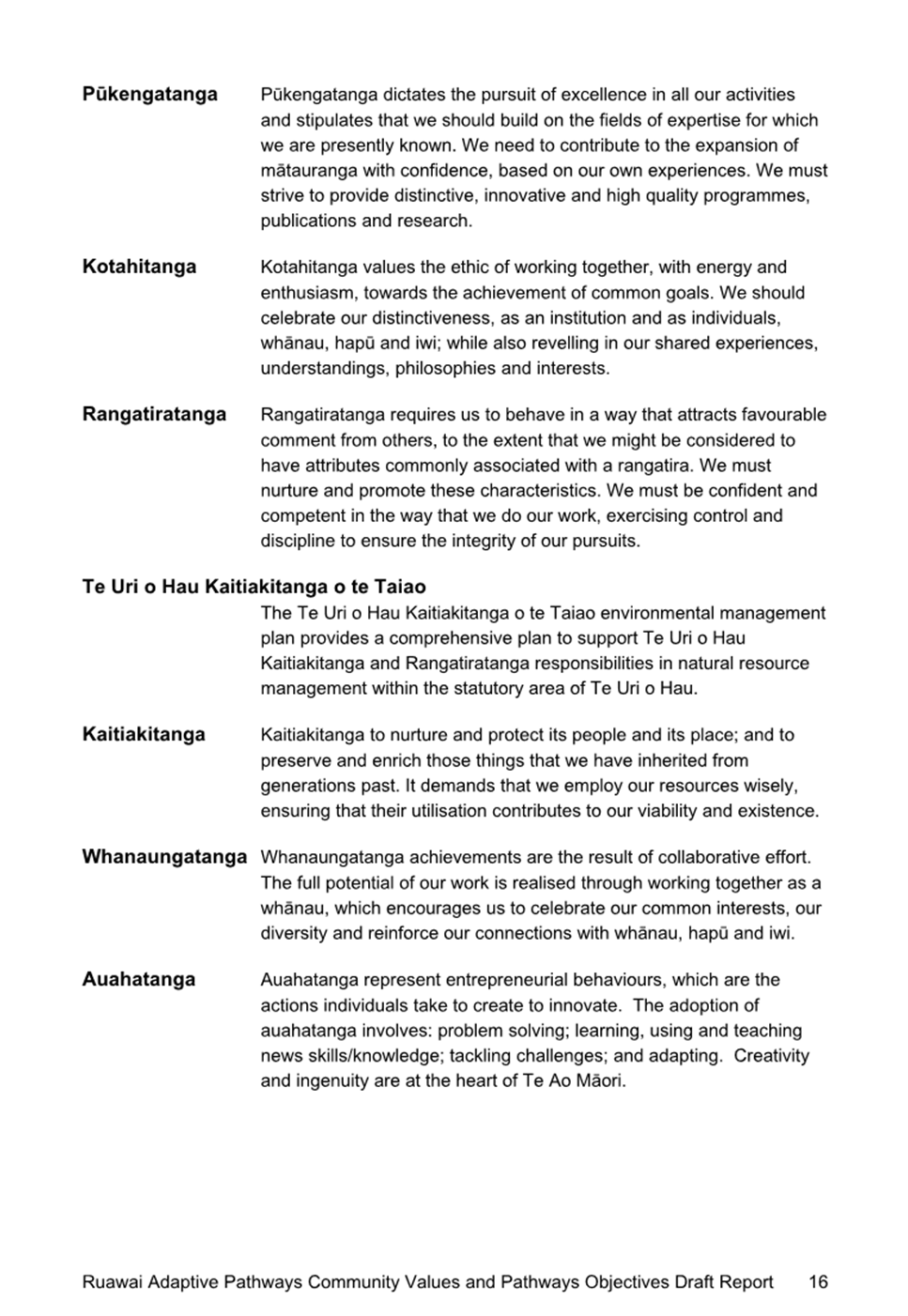
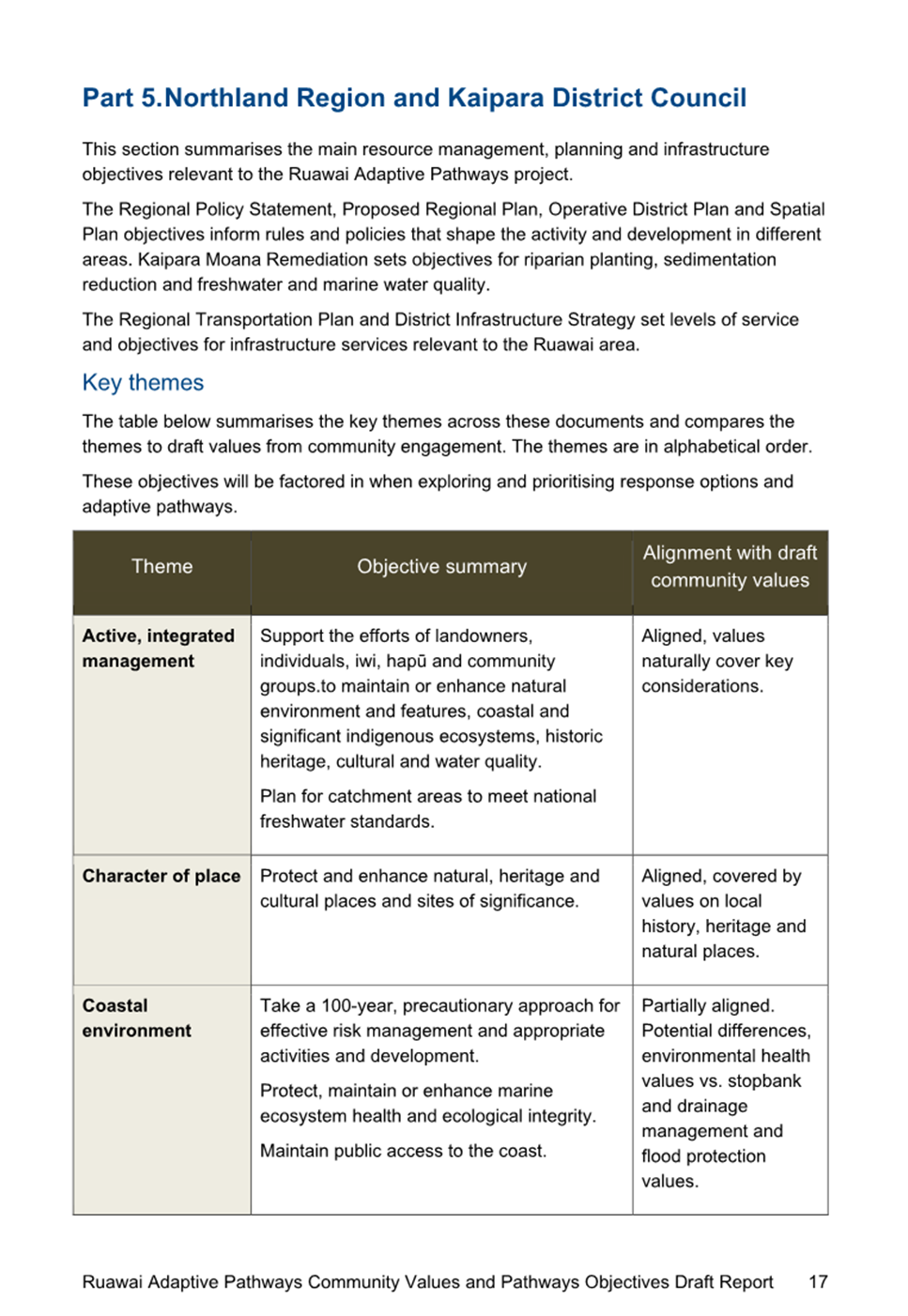
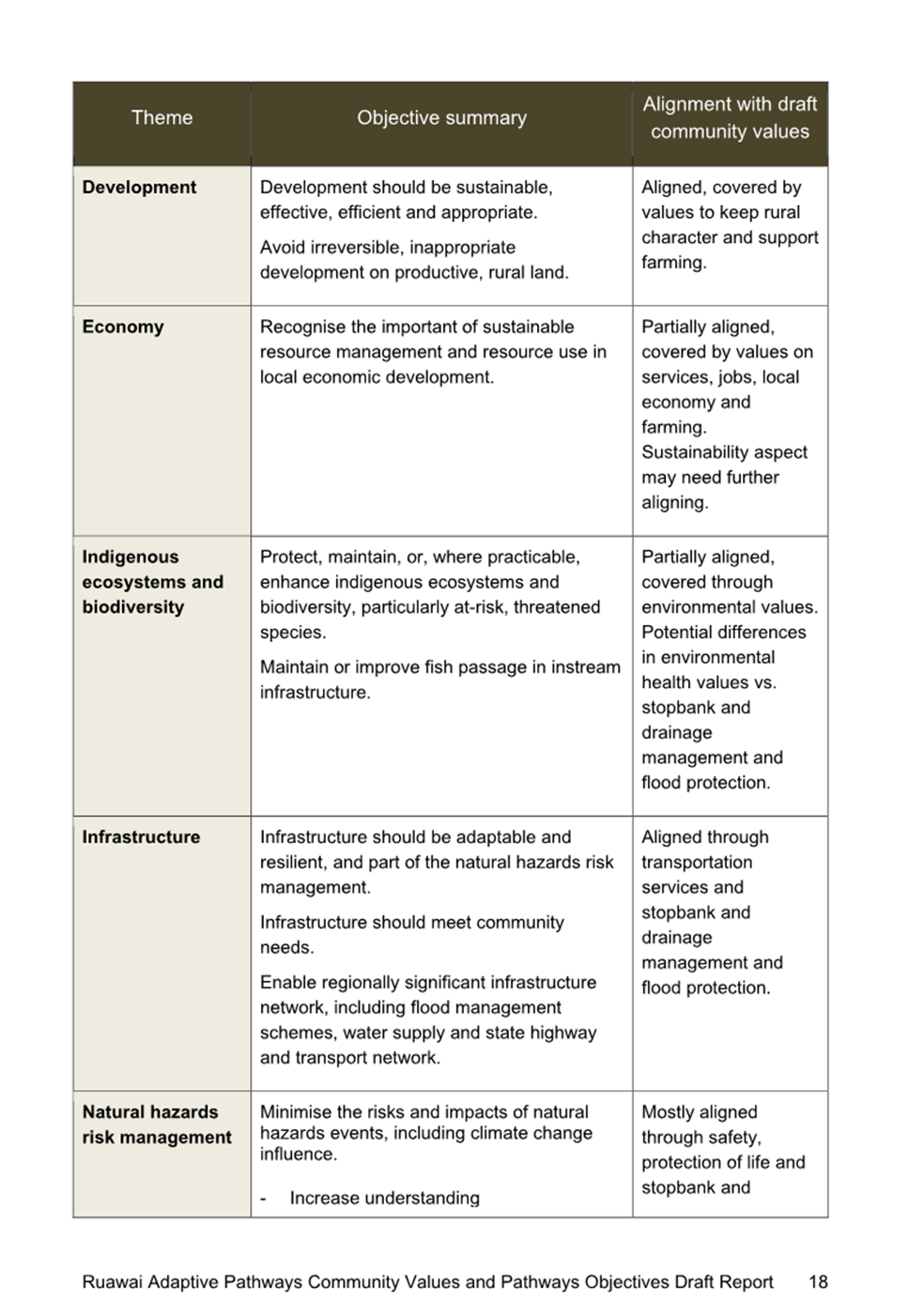
Ruawai Adaptive Pathways (RuAP) is Kaipara District Council’s (KDC) community adaptation pilot. In 2021 Council worked through a multi criteria analysis (MCA) process to identify six potential pilot locations and score those sites based on exposure to coastal hazards, community readiness and existing relationships with KDC. Te Uri o Hau Settlement Trust and Te Roroa Whatu Ora and Mana Whenua Trust also provided input on the pilot decision, confirming Ruawai area as the pilot.
The Ruawai Community Panel (Panel) is leading the adaptive pathways planning process. The Panel consists of 19 members, including Ruawai residents, Te Uri o Hau kaumātua and Raupo Drainage Committee representatives.
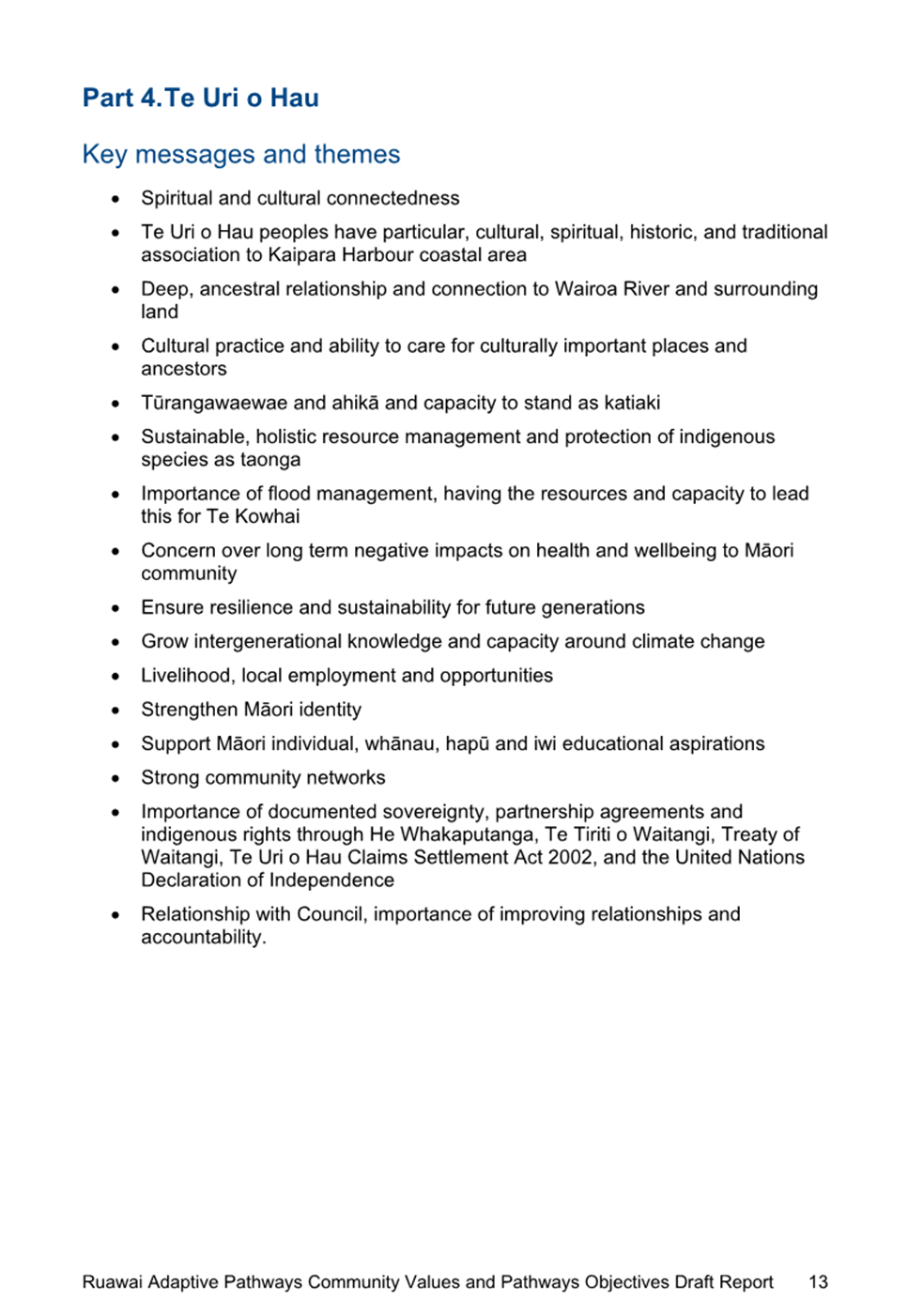
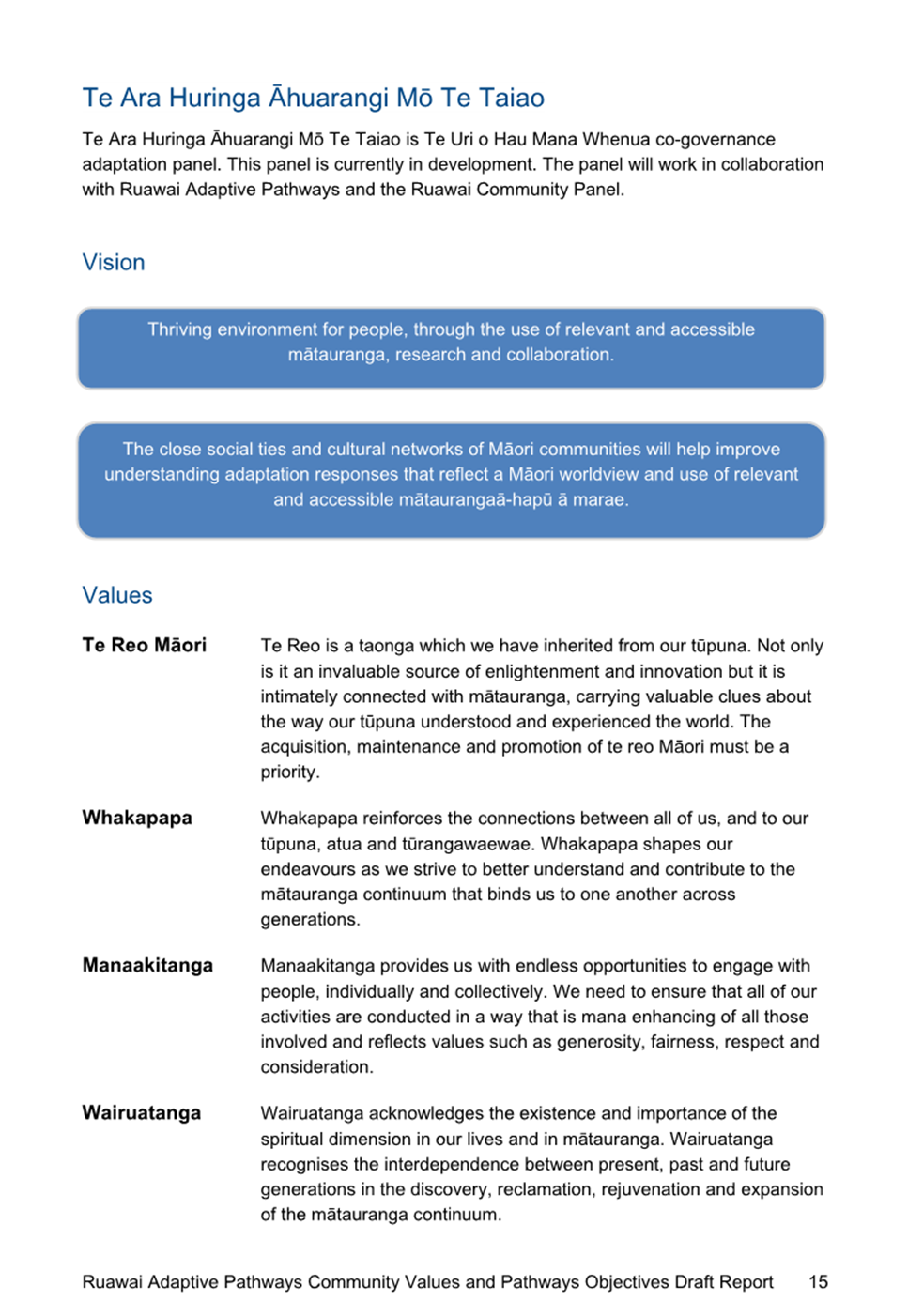
Te Ara Huringa Āhuarangi Mō Te Taiao is Te Uri o Hau adaptation co-governance panel (TAHA) that works alongside the Ruawai Community Panel and the project team. TAHA was formally established on 8 June 2023 via Te Uri o Hau Settlement Trust Taumata Kaunihera resolution. The Taumata Kaunihera is the kaumātua group responsible for all matters relating to tikanga and for the organisation of marae development.
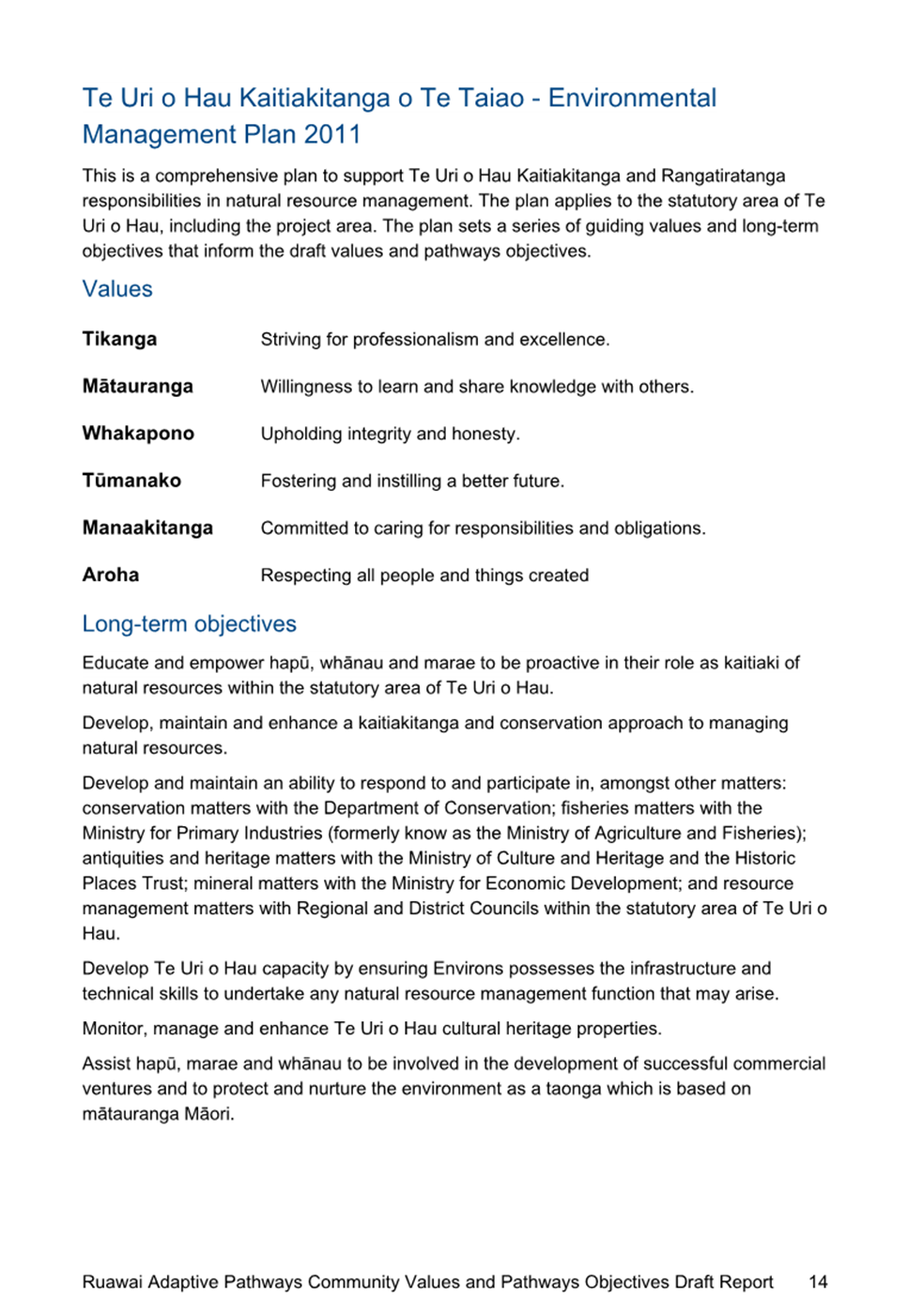
TAHA helps fulfil commitments under TTCAS to work alongside Te Uri o Hau and support Māori interests. TAHA also helps fulfil commitments under the Memorandum of Understanding between Te Uri o Hau Settlement Trust and KDC.
TAHA is made up of seven Te Uri o Hau kaumātua, ahikāroa, Naumai Marae, Parirau Marae and Te Kowhai Marae representation and tangata whenua cultural and technical advisors. Six of the seven TAHA members are also on the Panel. A complimentary work programme for TAHA is in development. TAHA also led an adaptation engagement hui with Naumai Marae, Parirau Marae and Te Kowhai Marae kaumātua, whānau and kaitiaki at Naumai Marae on 24 July.
TAHA vision is as follows:
1. Establish an aligned decision-making panel that values Mātauranga Māori research in collaboration with the Ruawai Adaptive Pathways pilot project;
2. Gain a greater understanding to address the threat of climate change in the rohe; and
3. Share a Te Ao Māori worldview relevant to mātauranga- ā hapū ā marae (Te Uri o Hau and marae knowledge and worldviews)
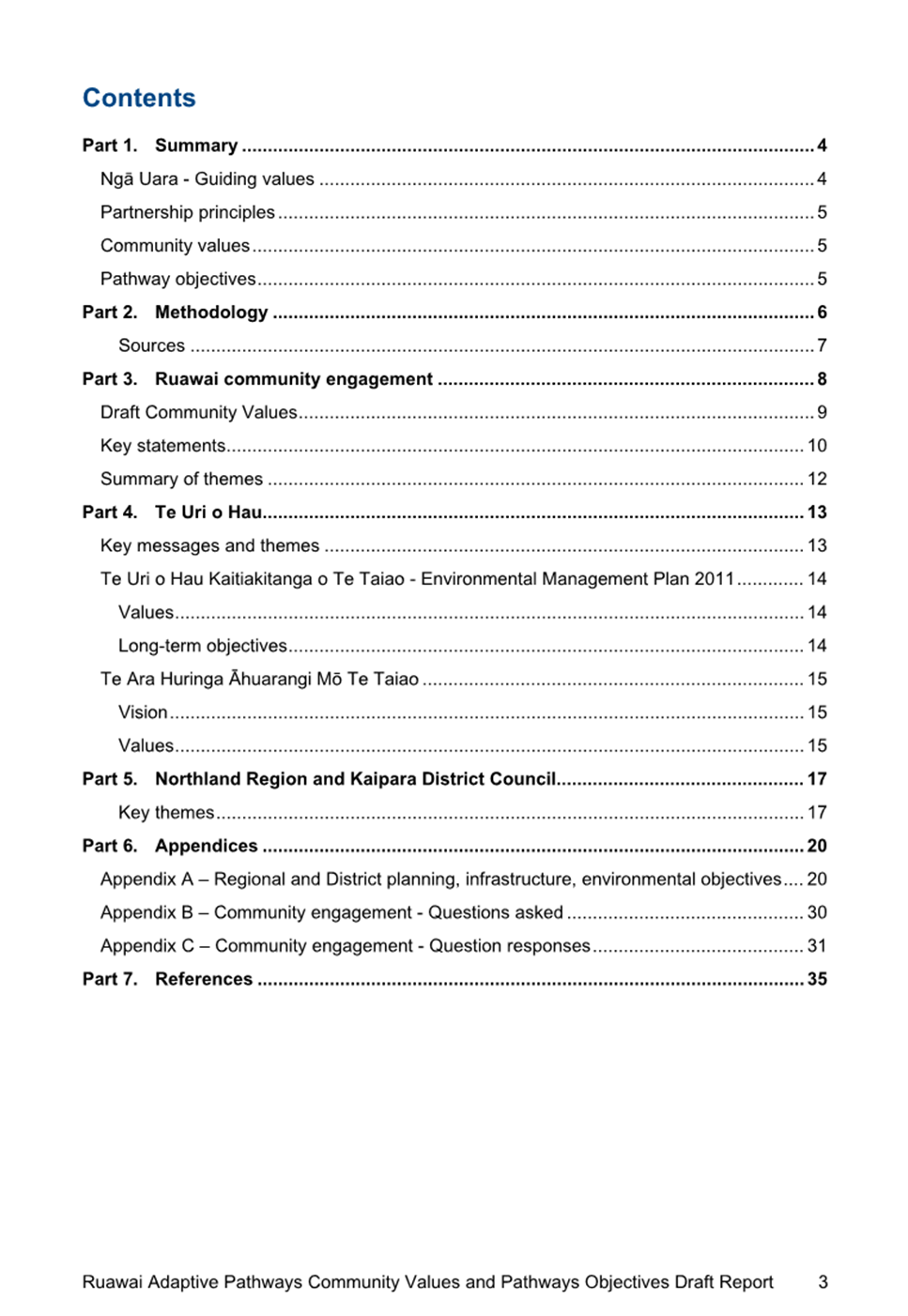
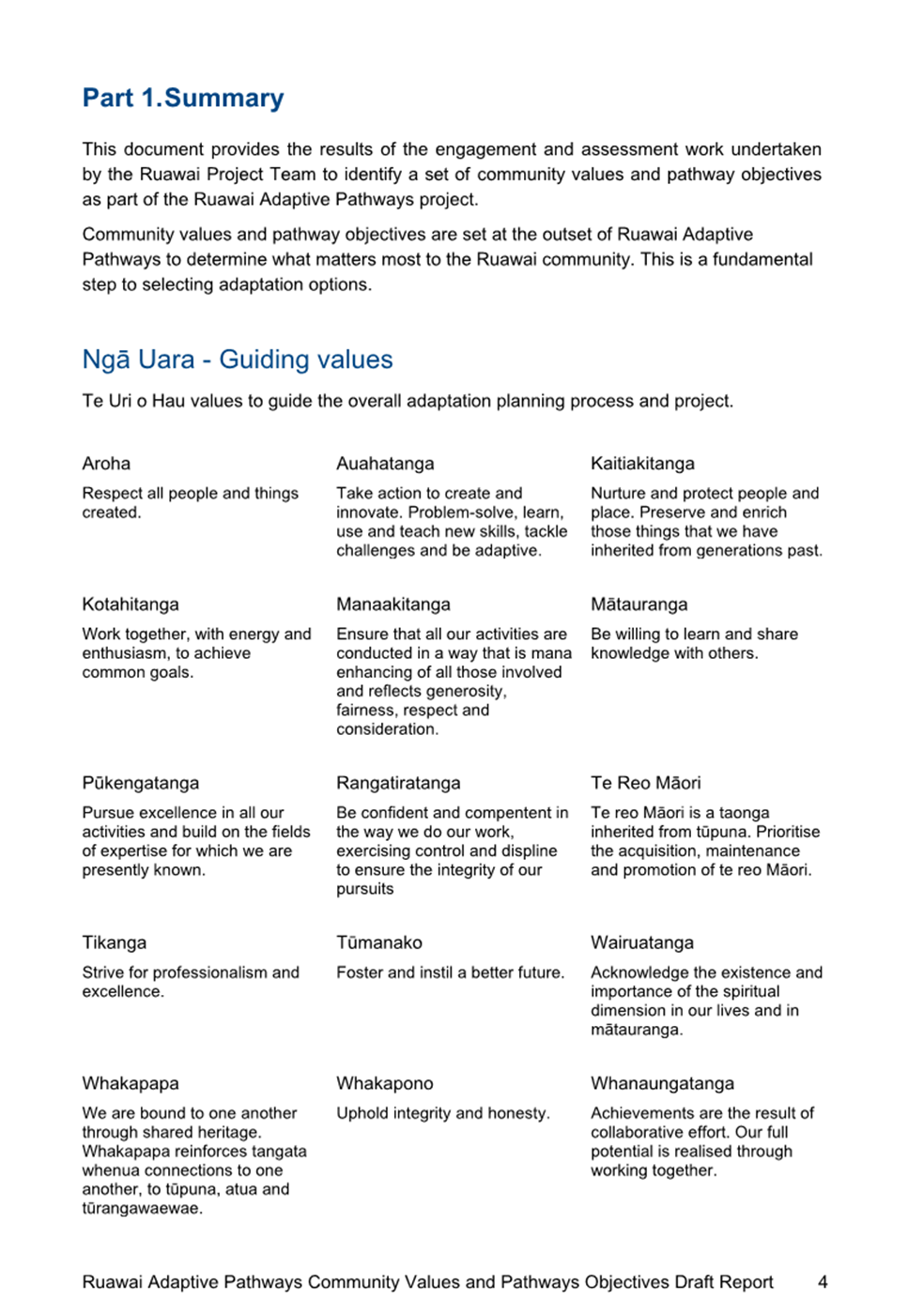
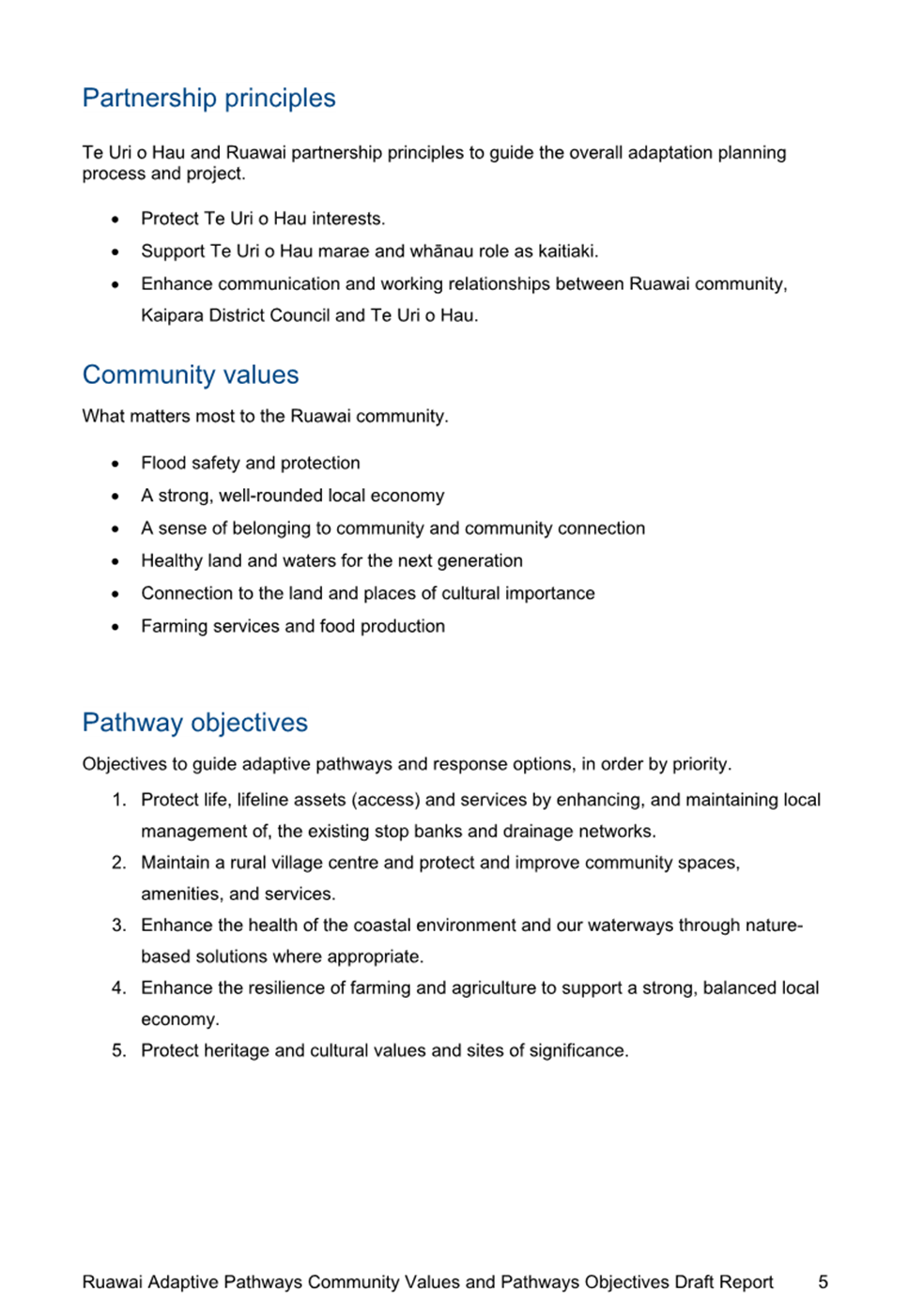
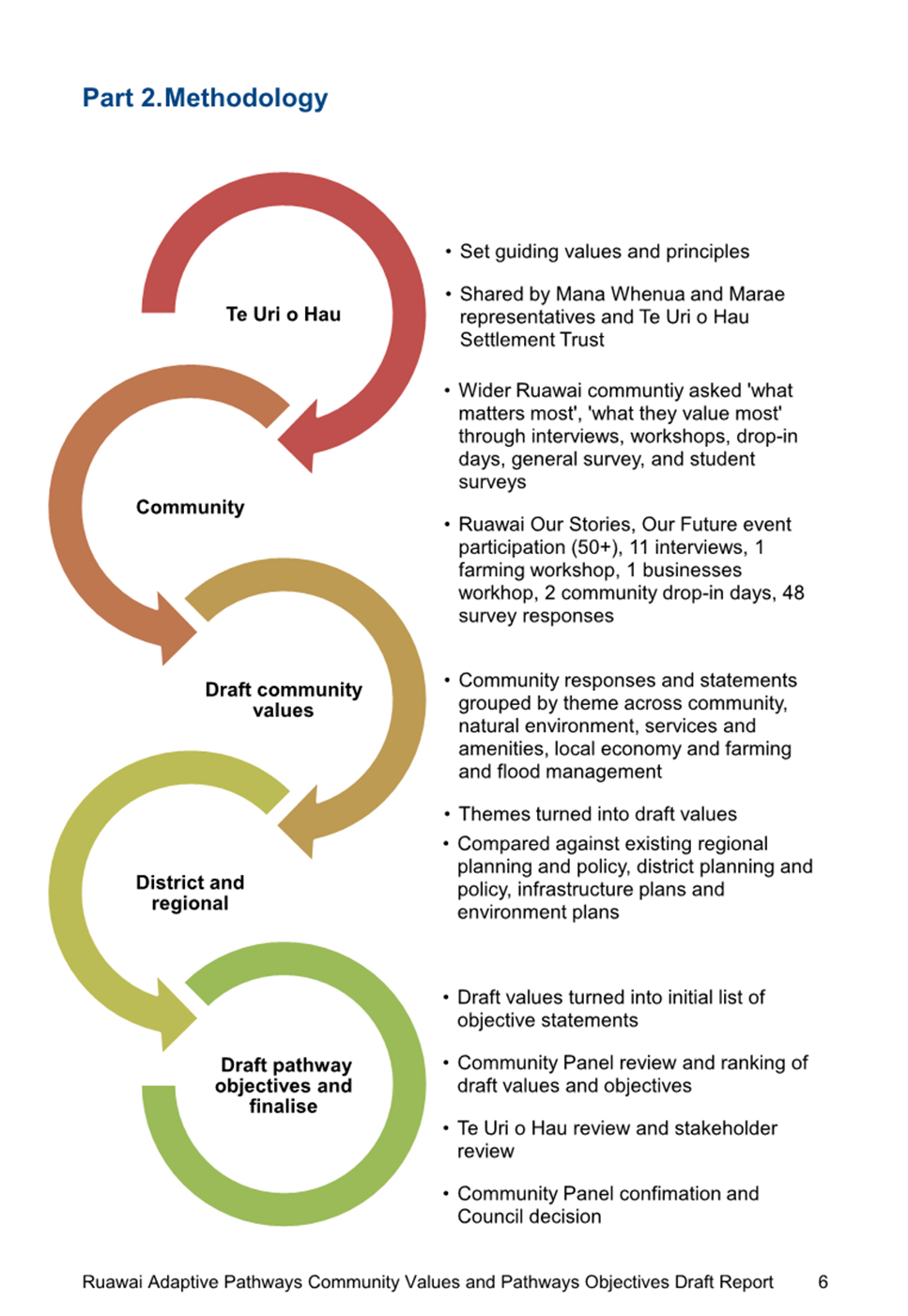
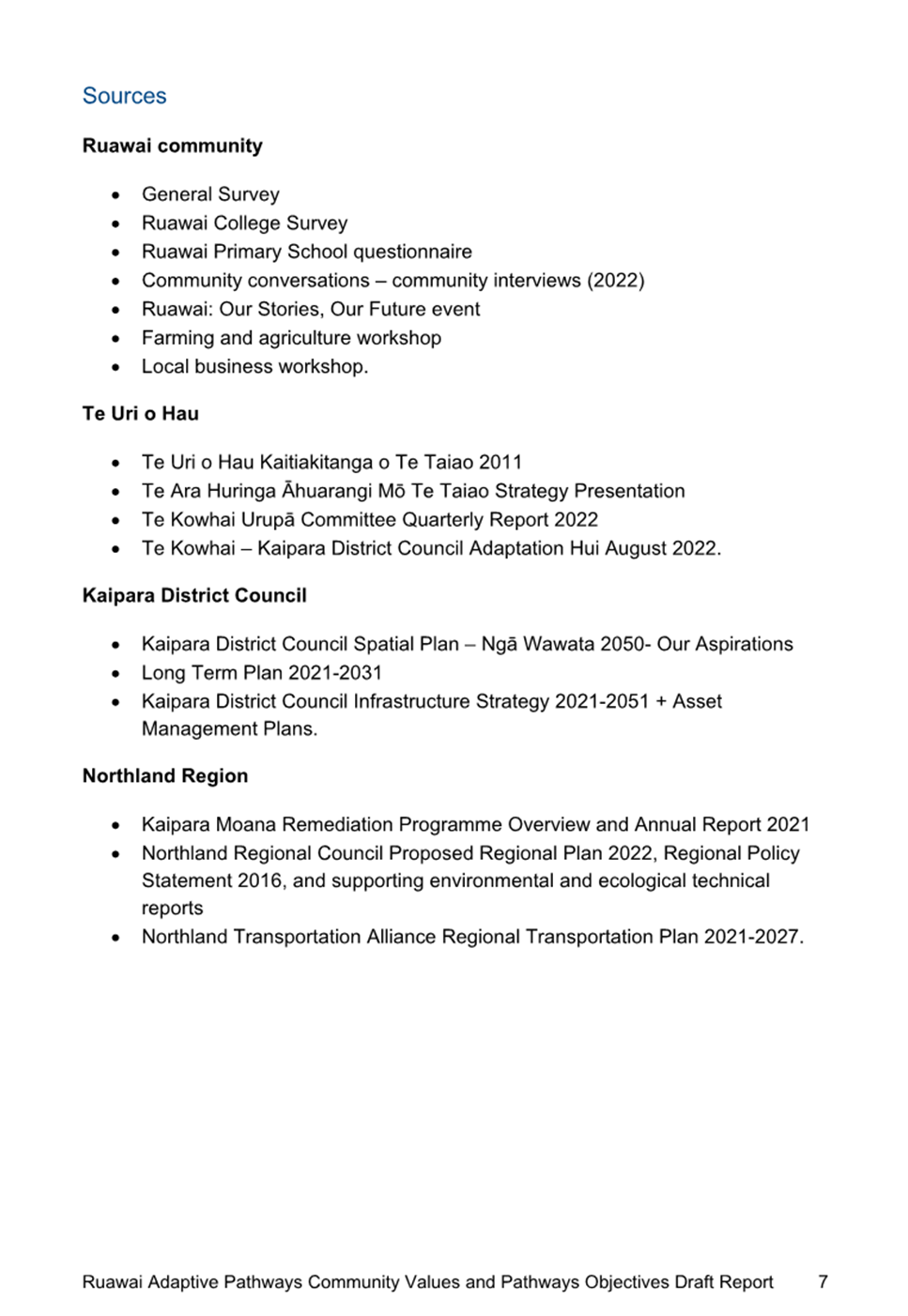
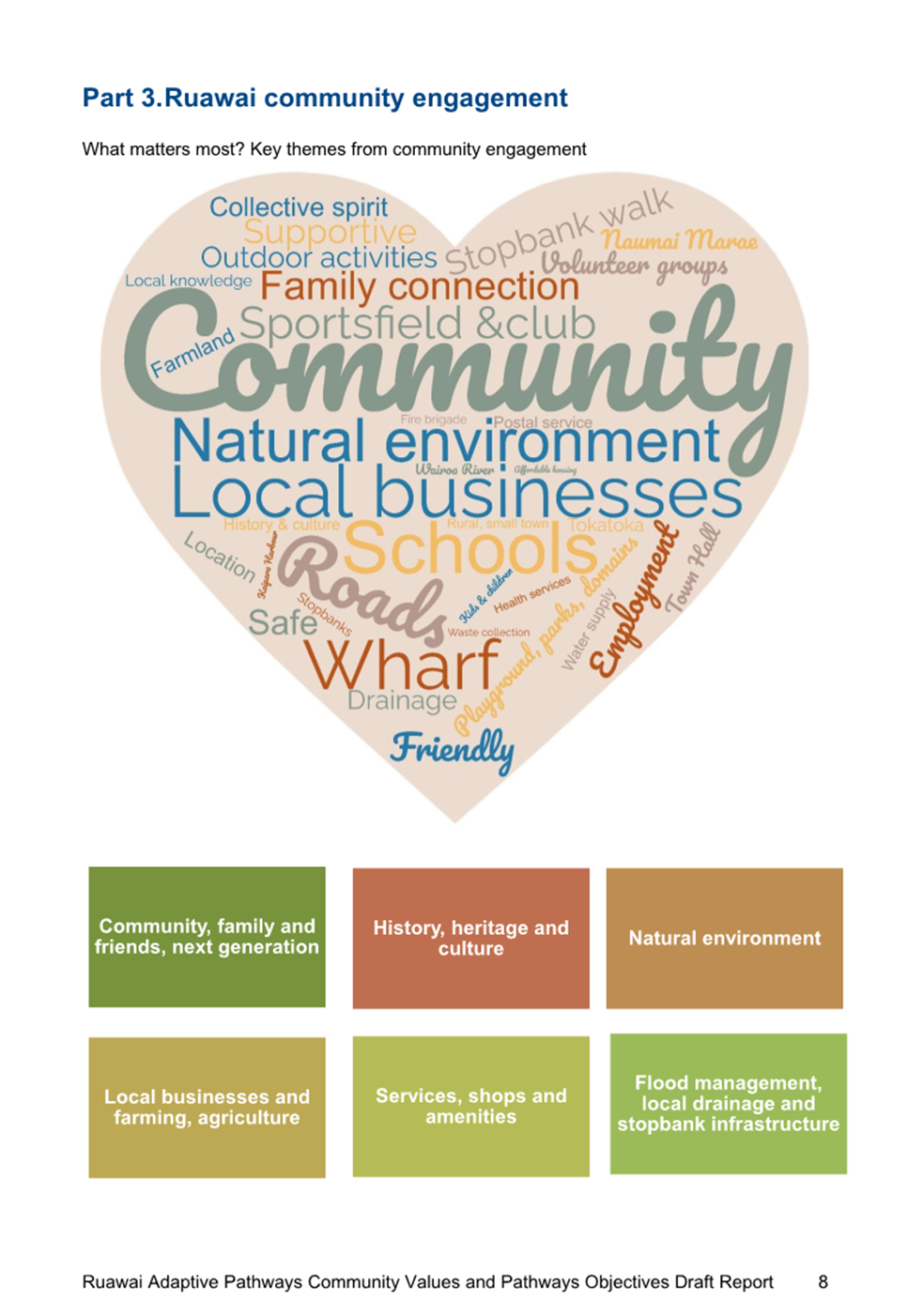
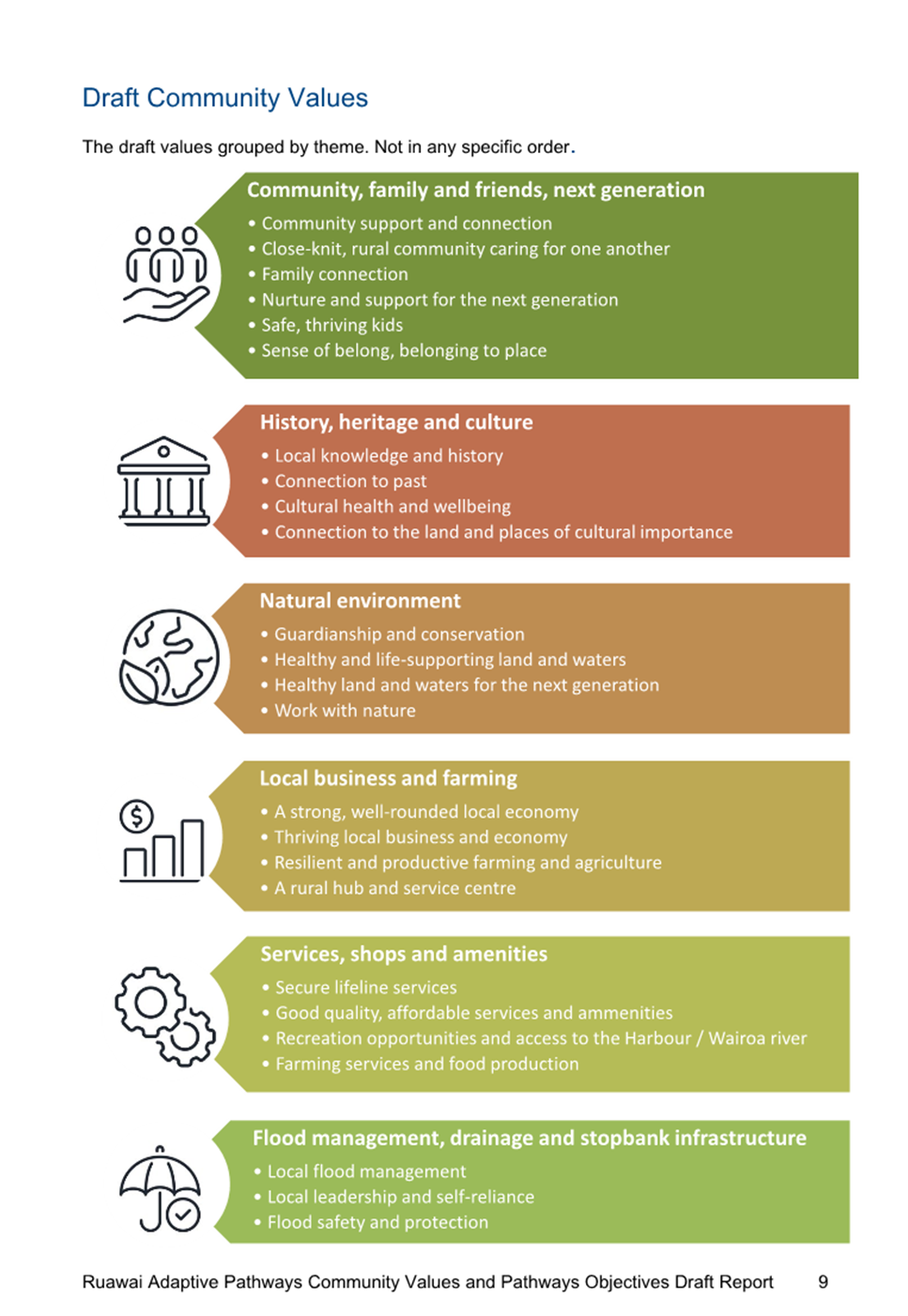
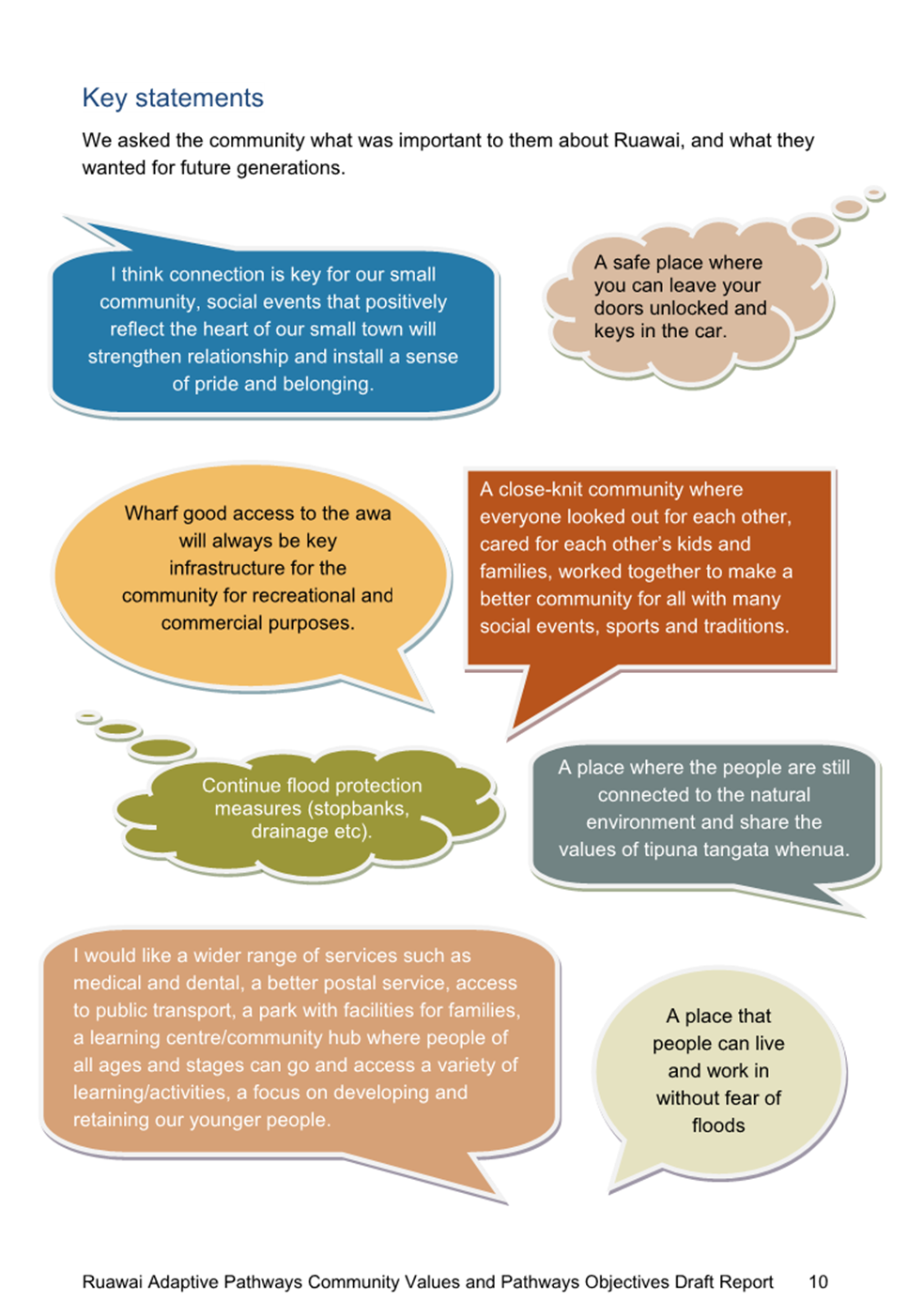
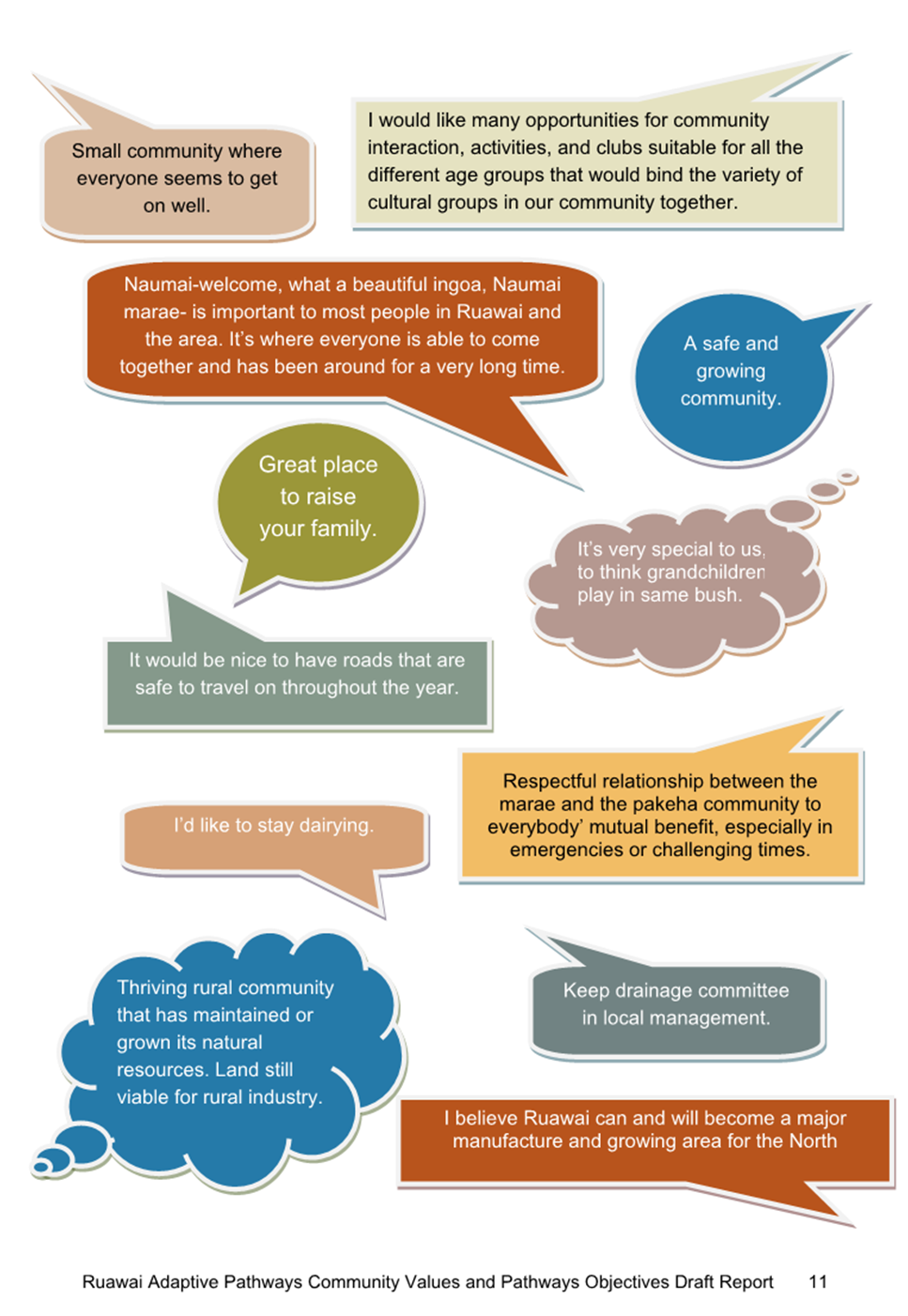
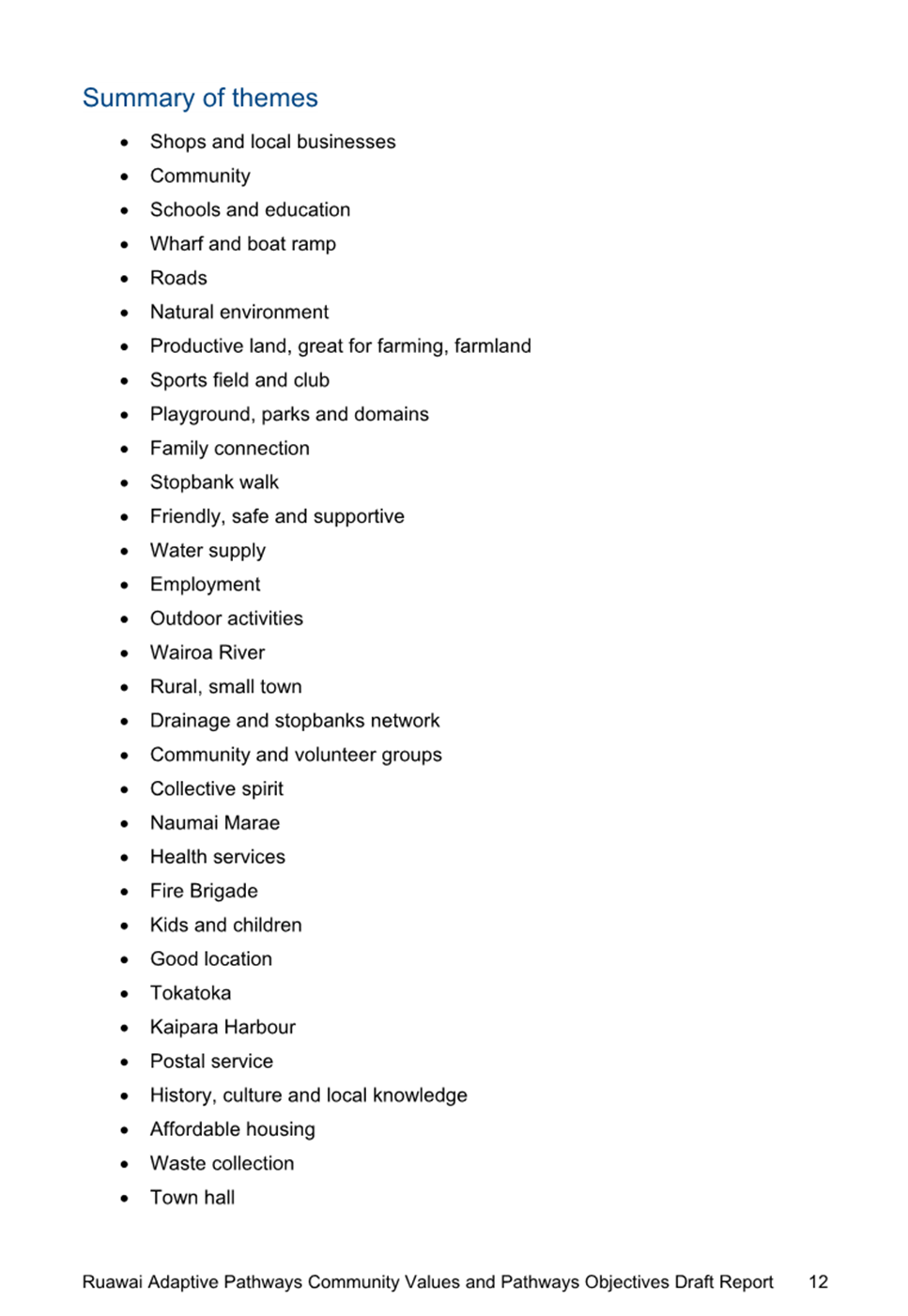
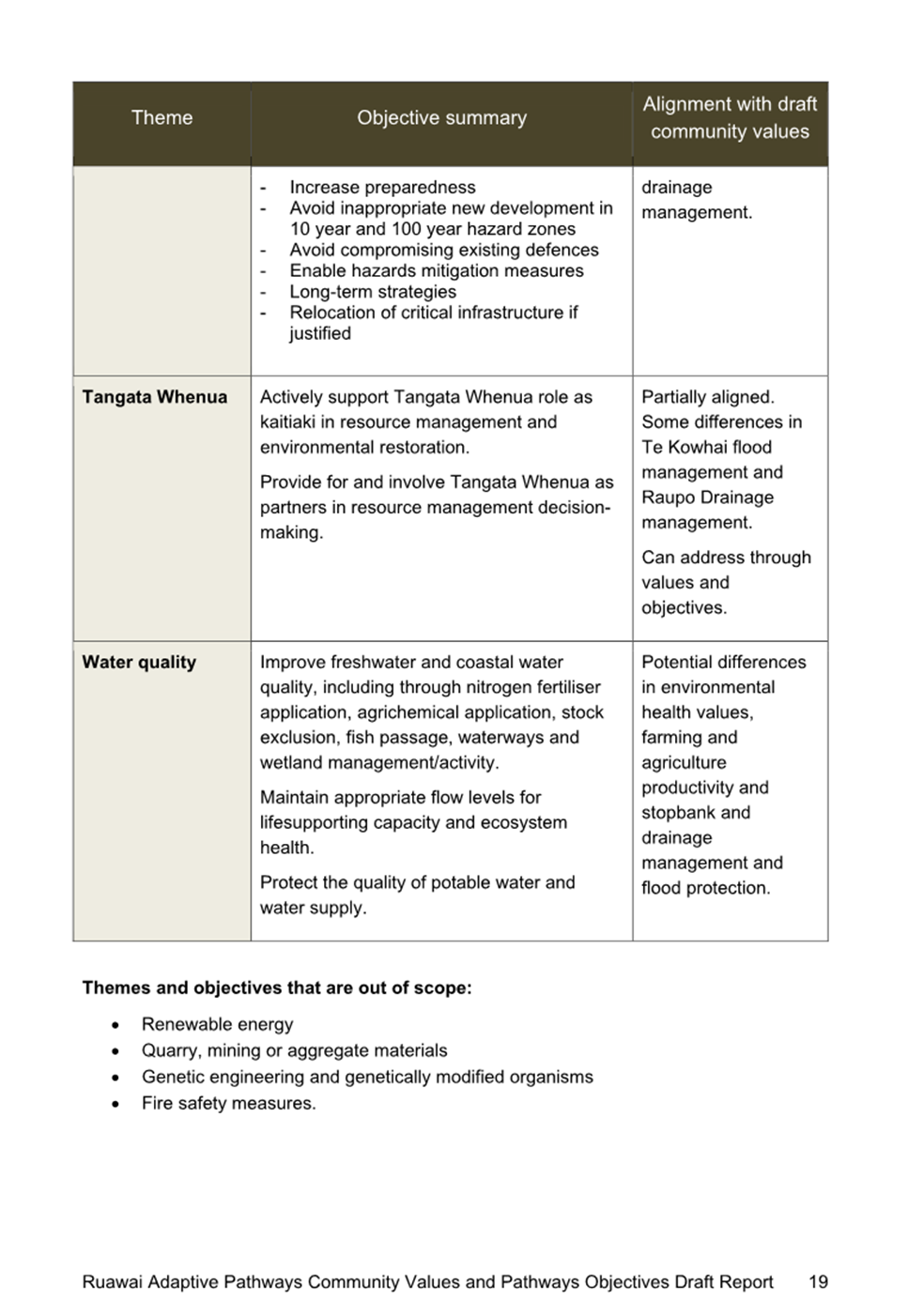
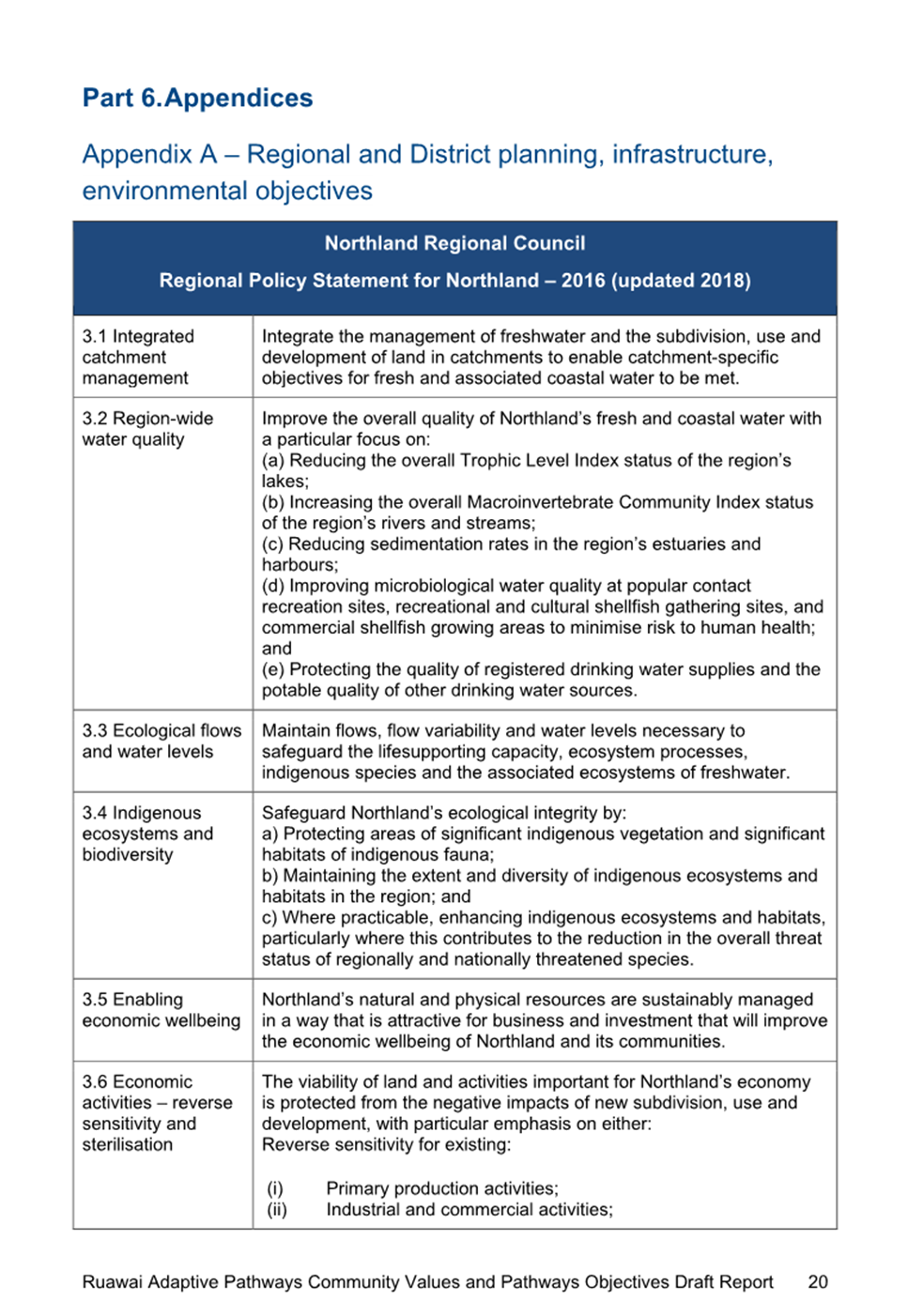
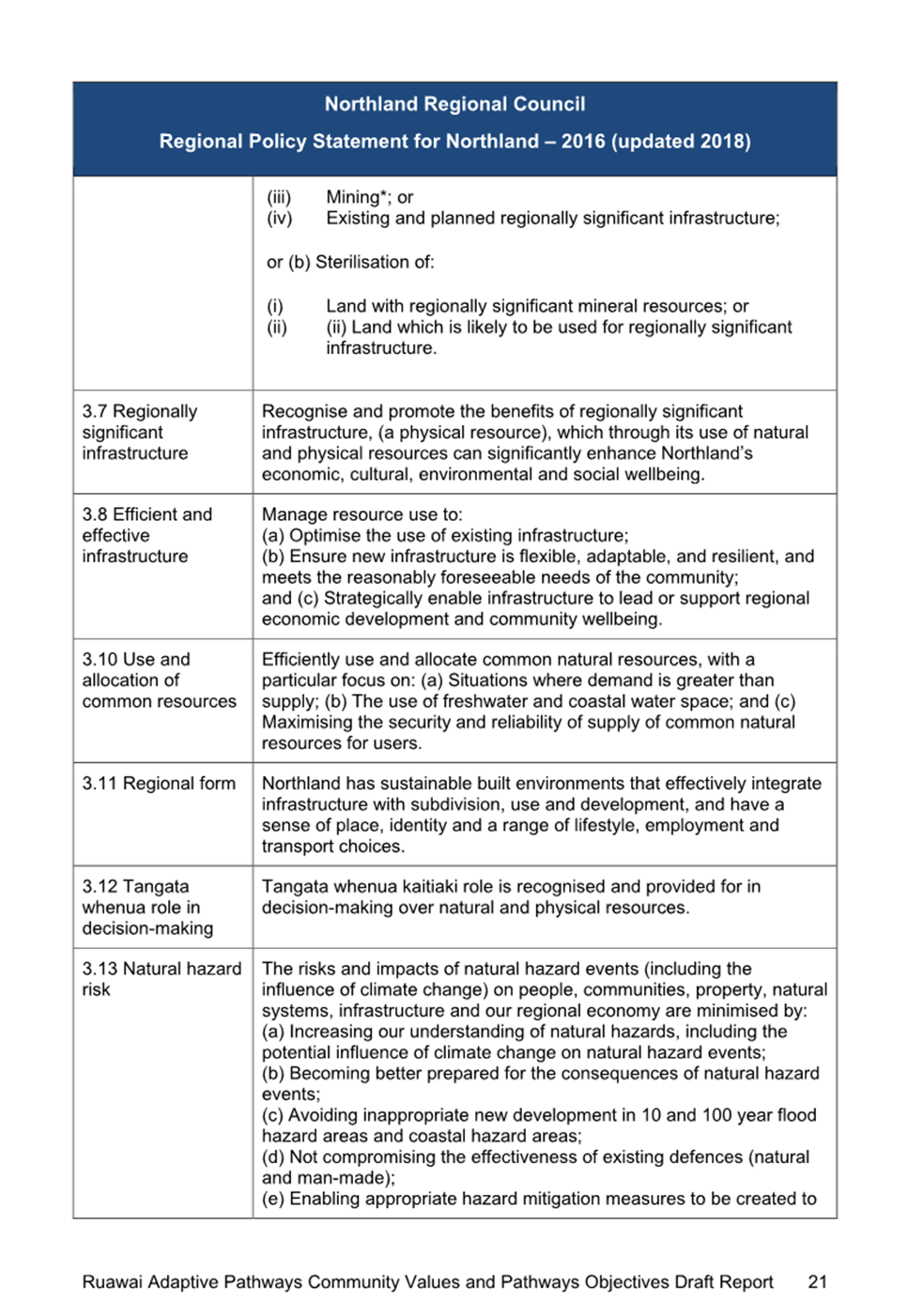
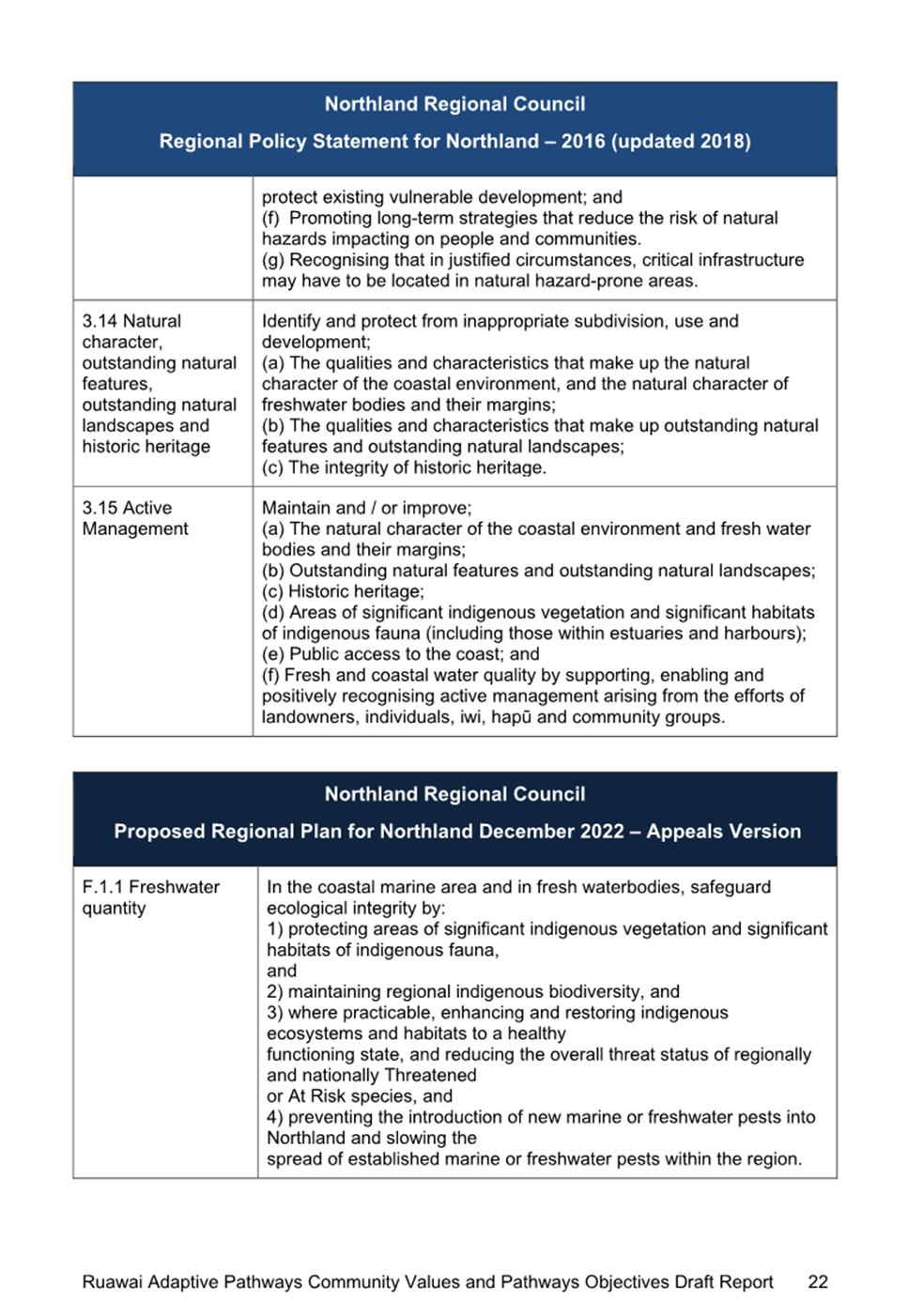
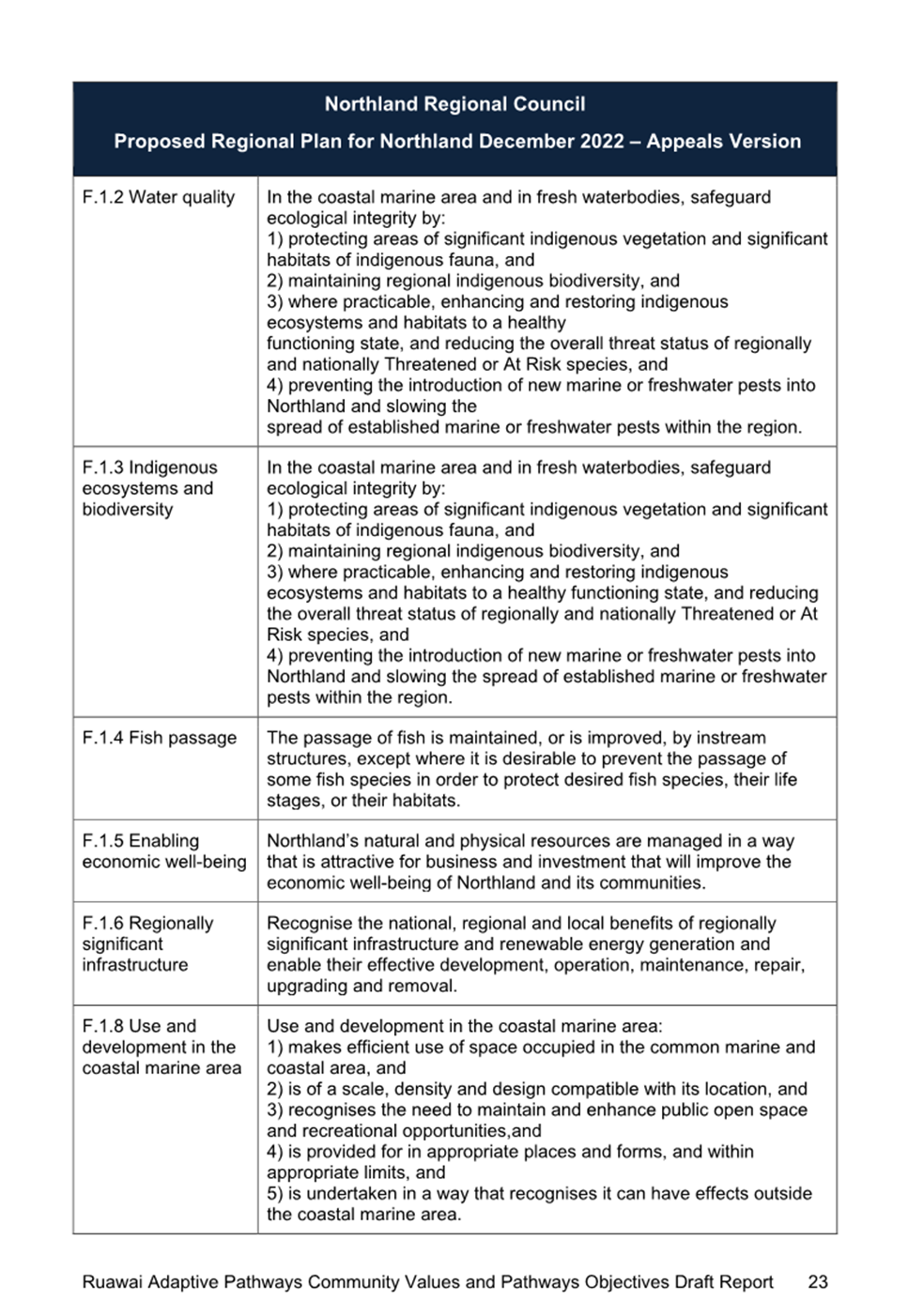
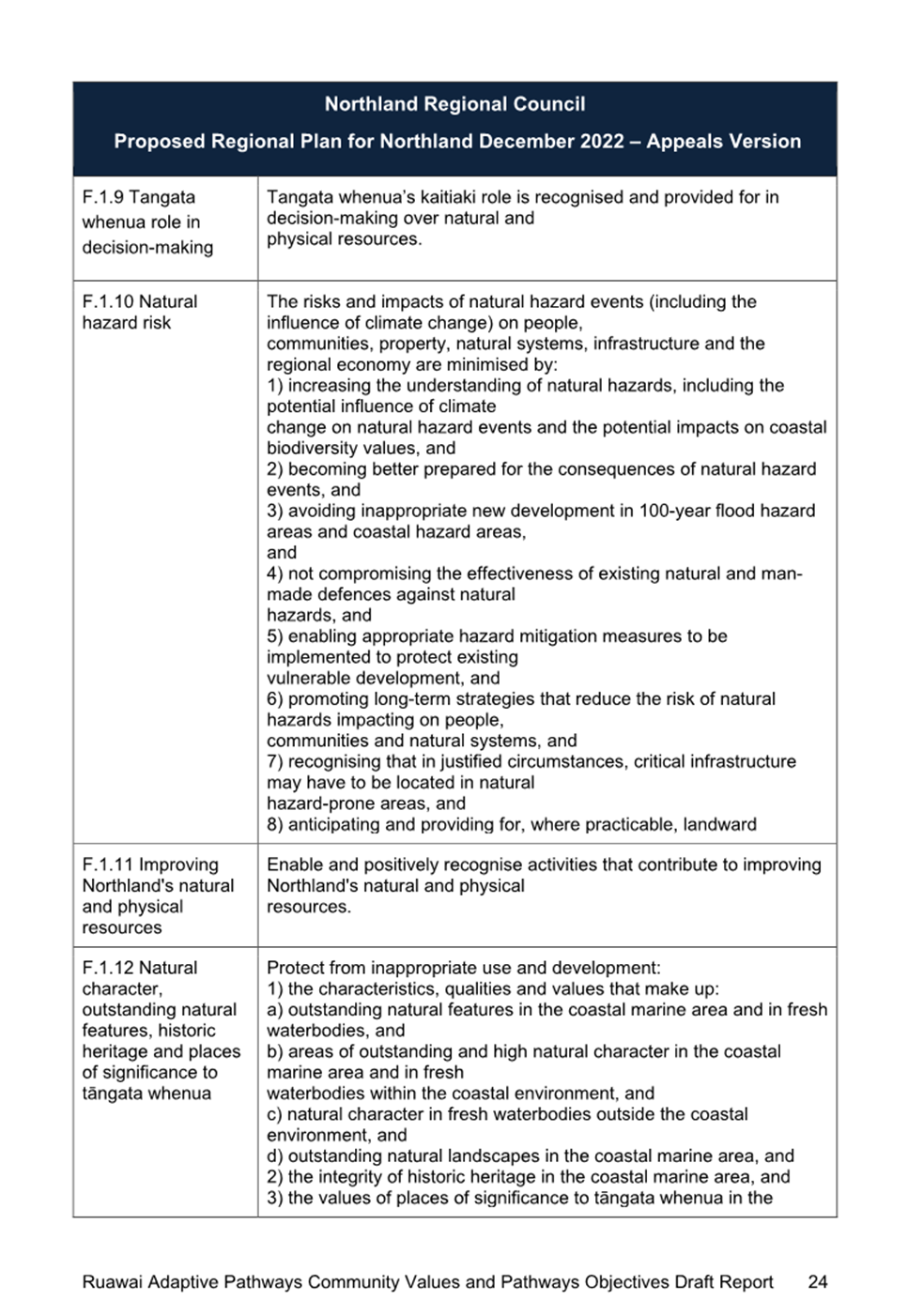
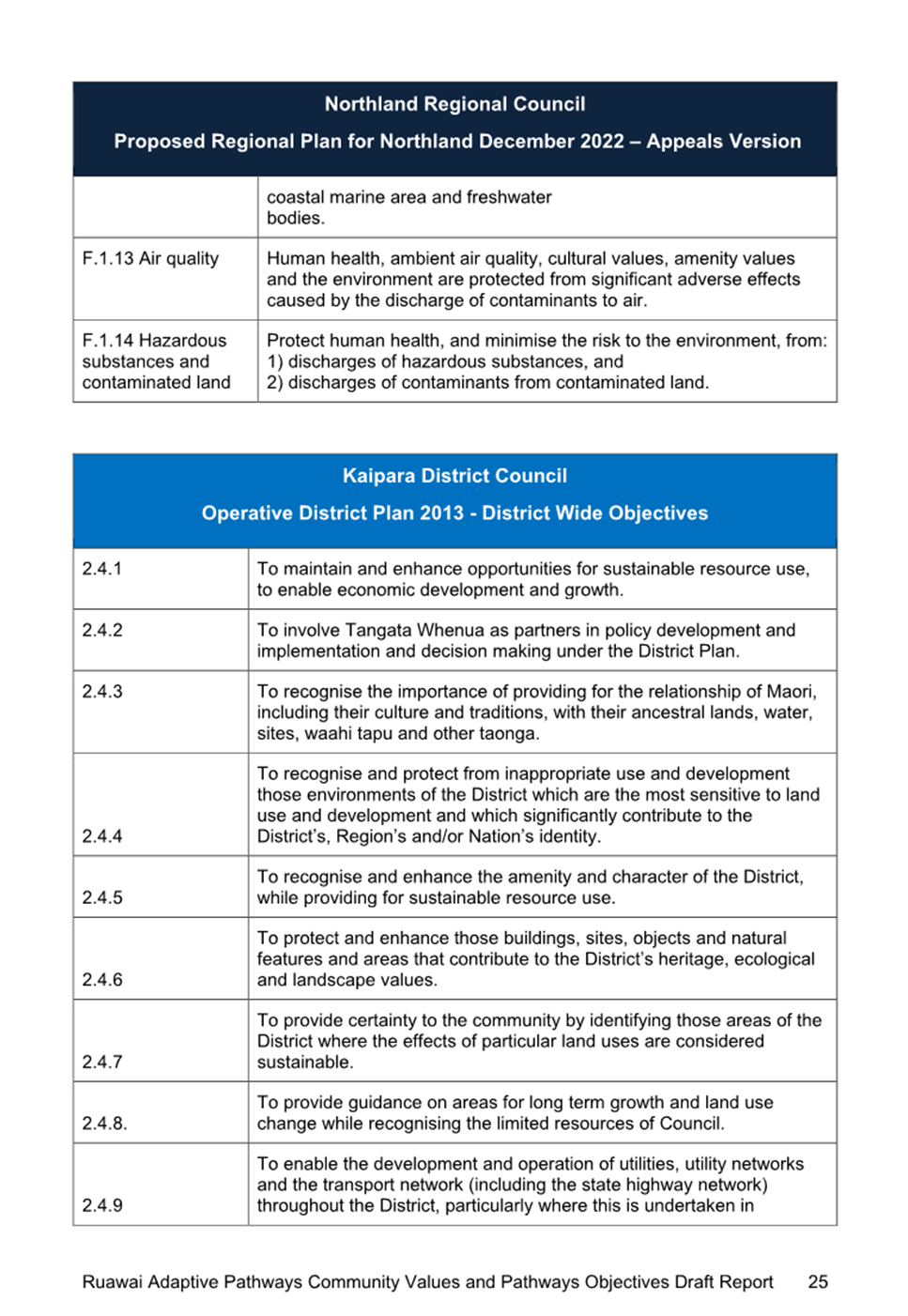
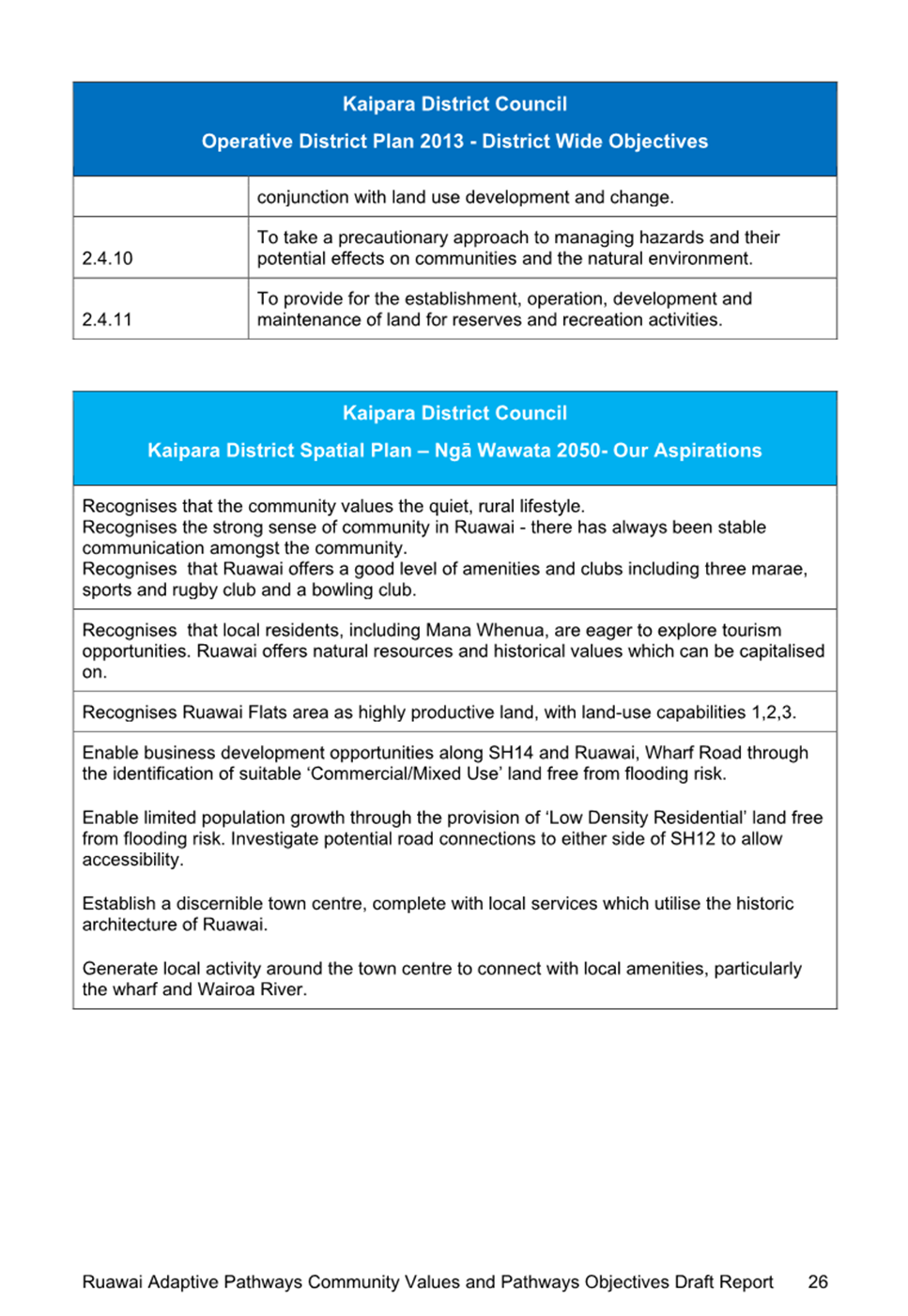
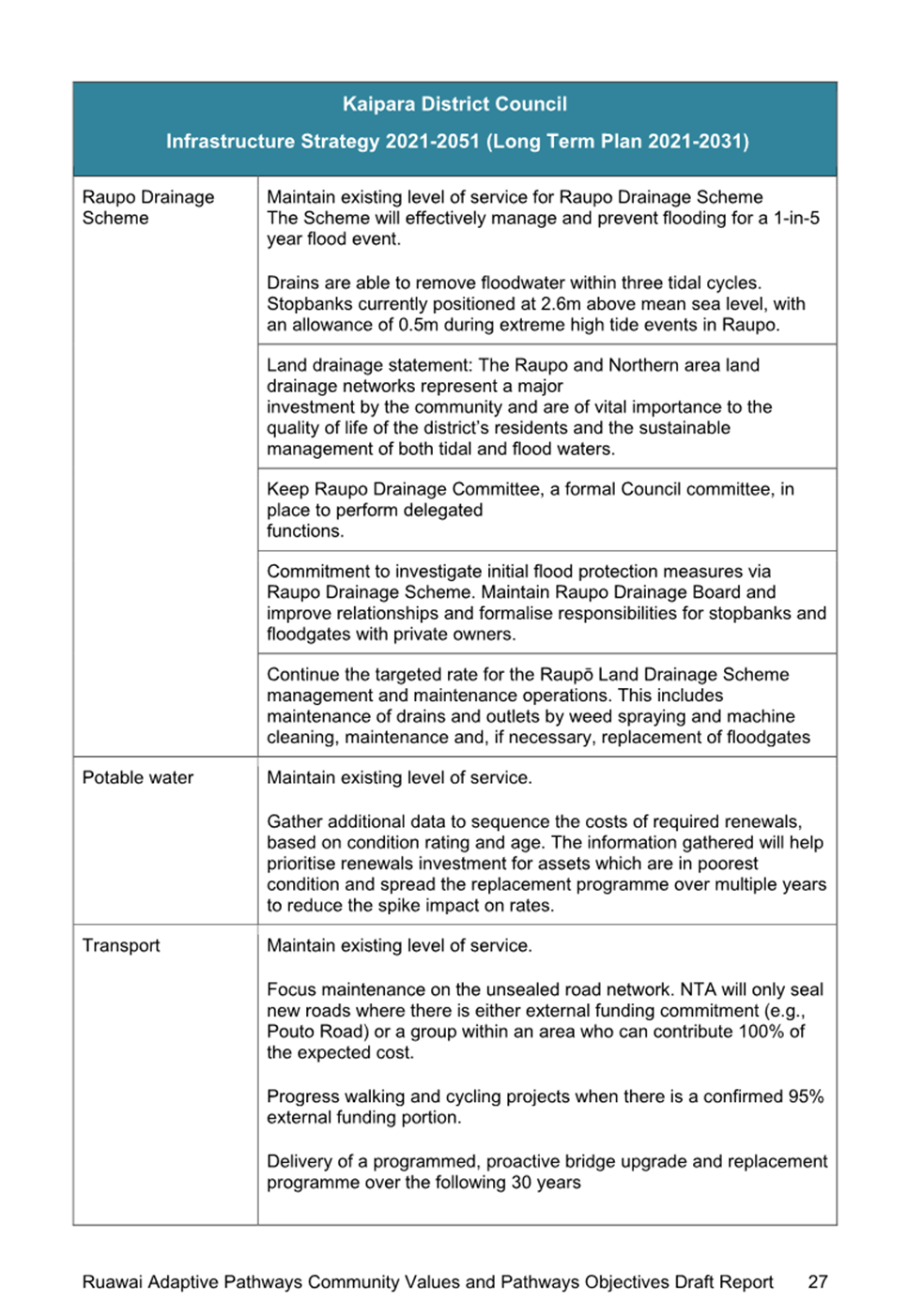
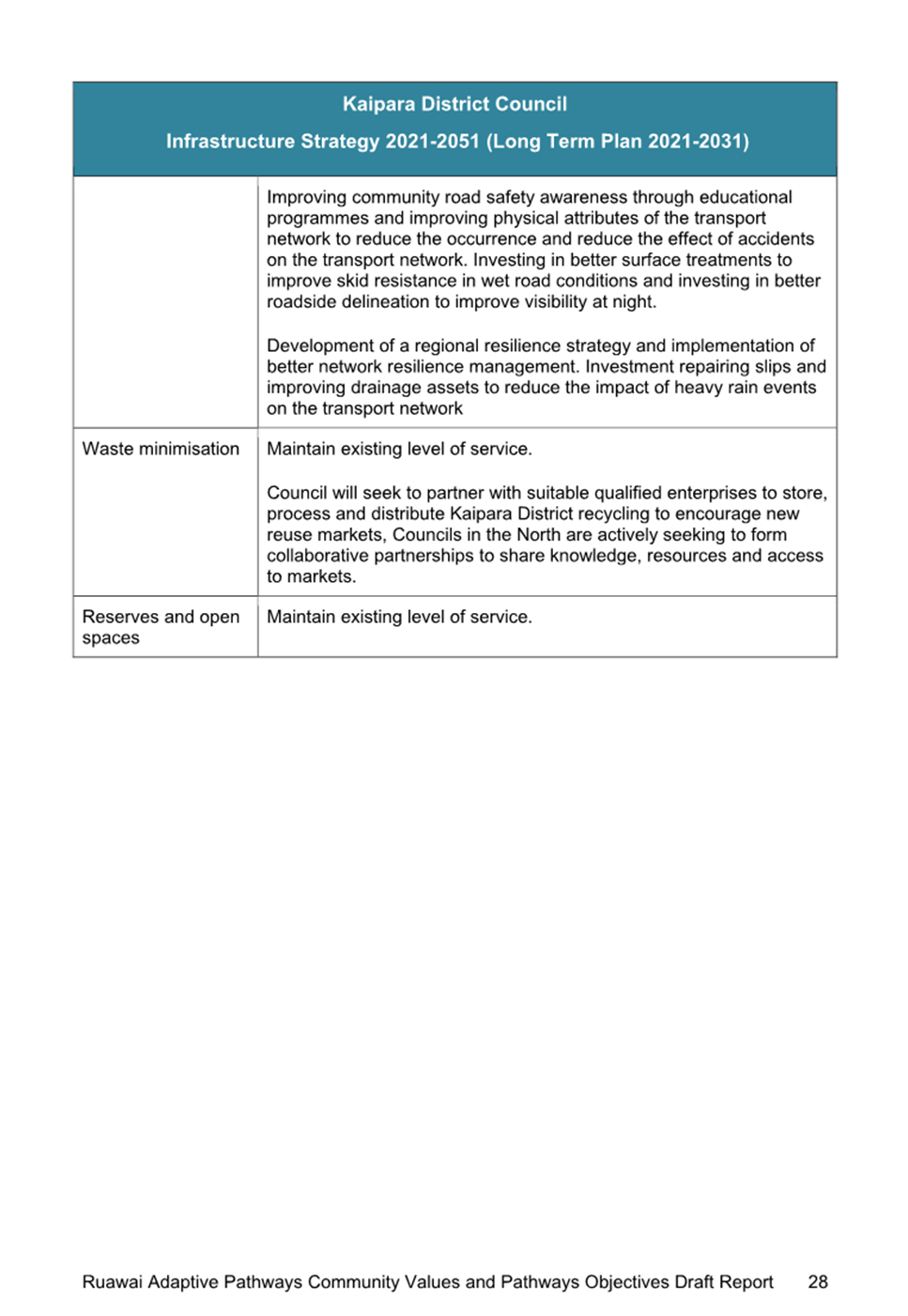
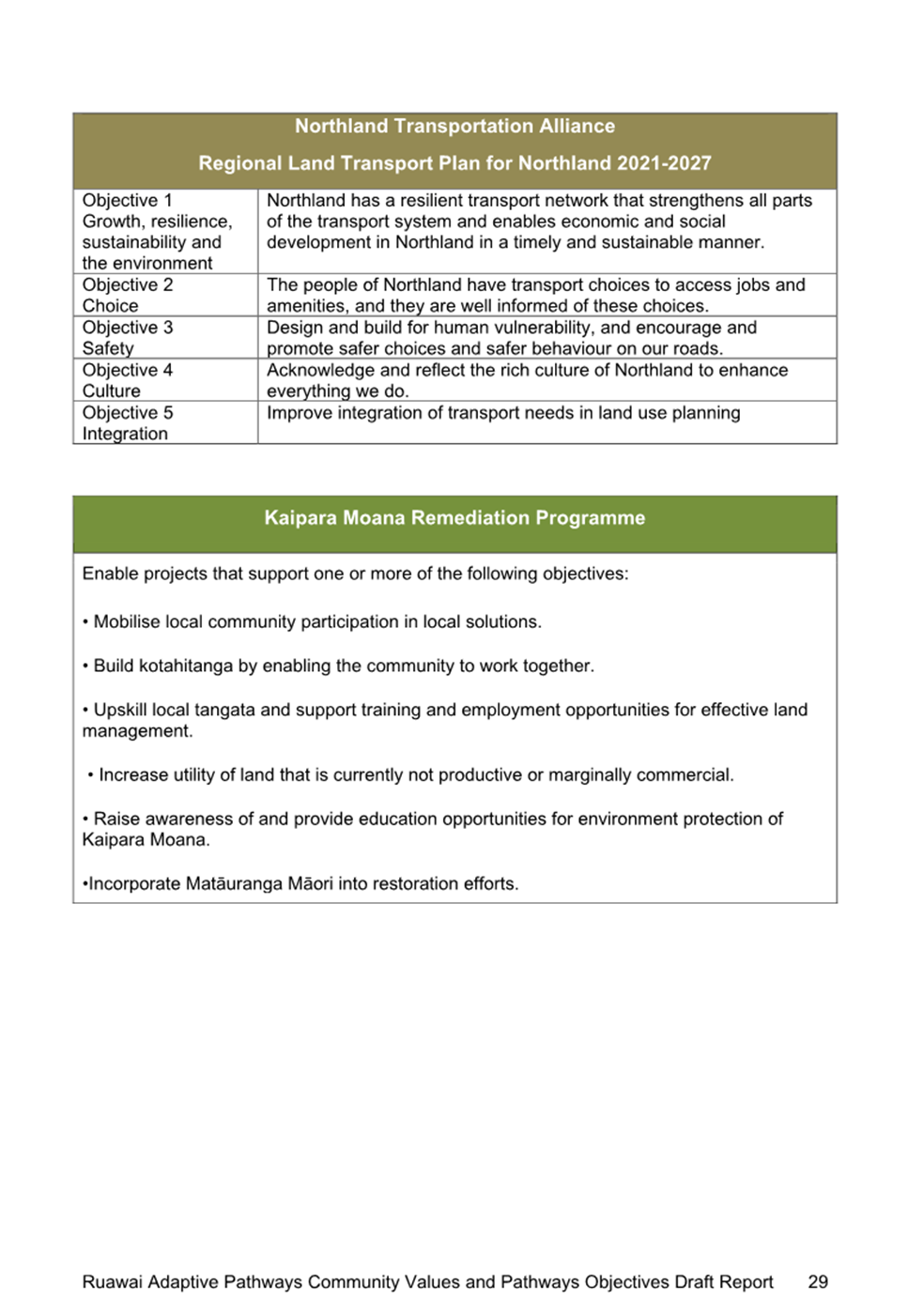
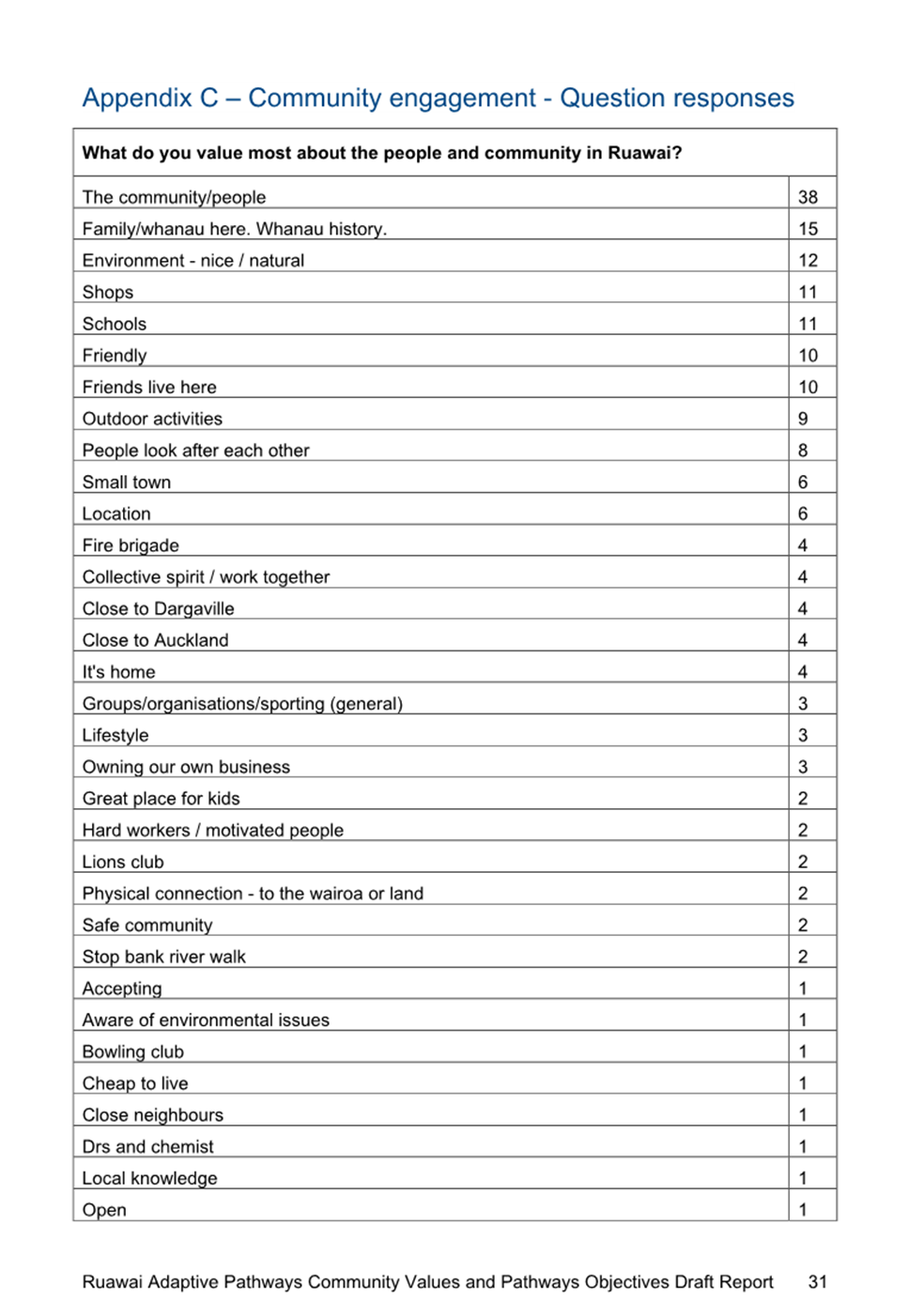
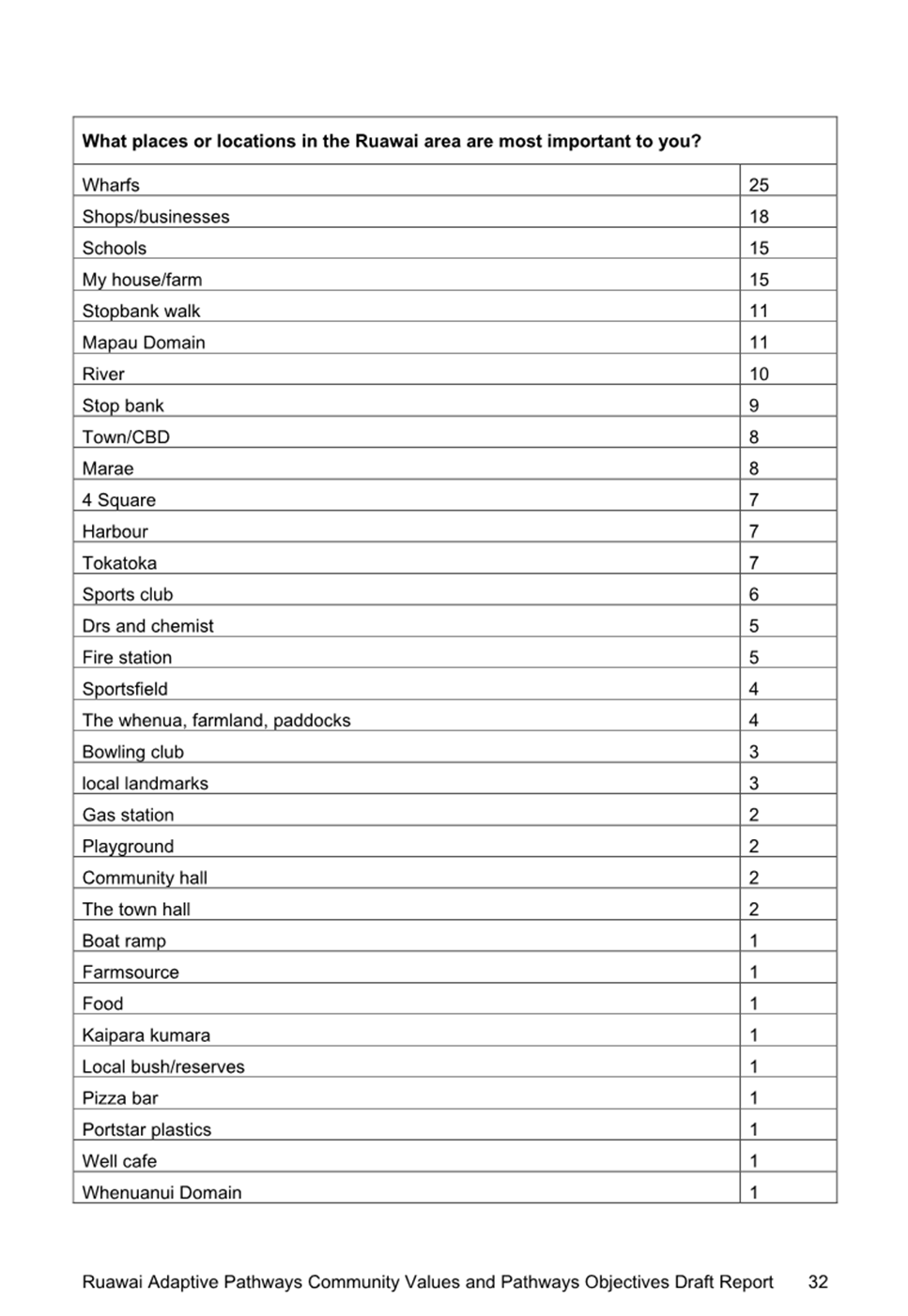
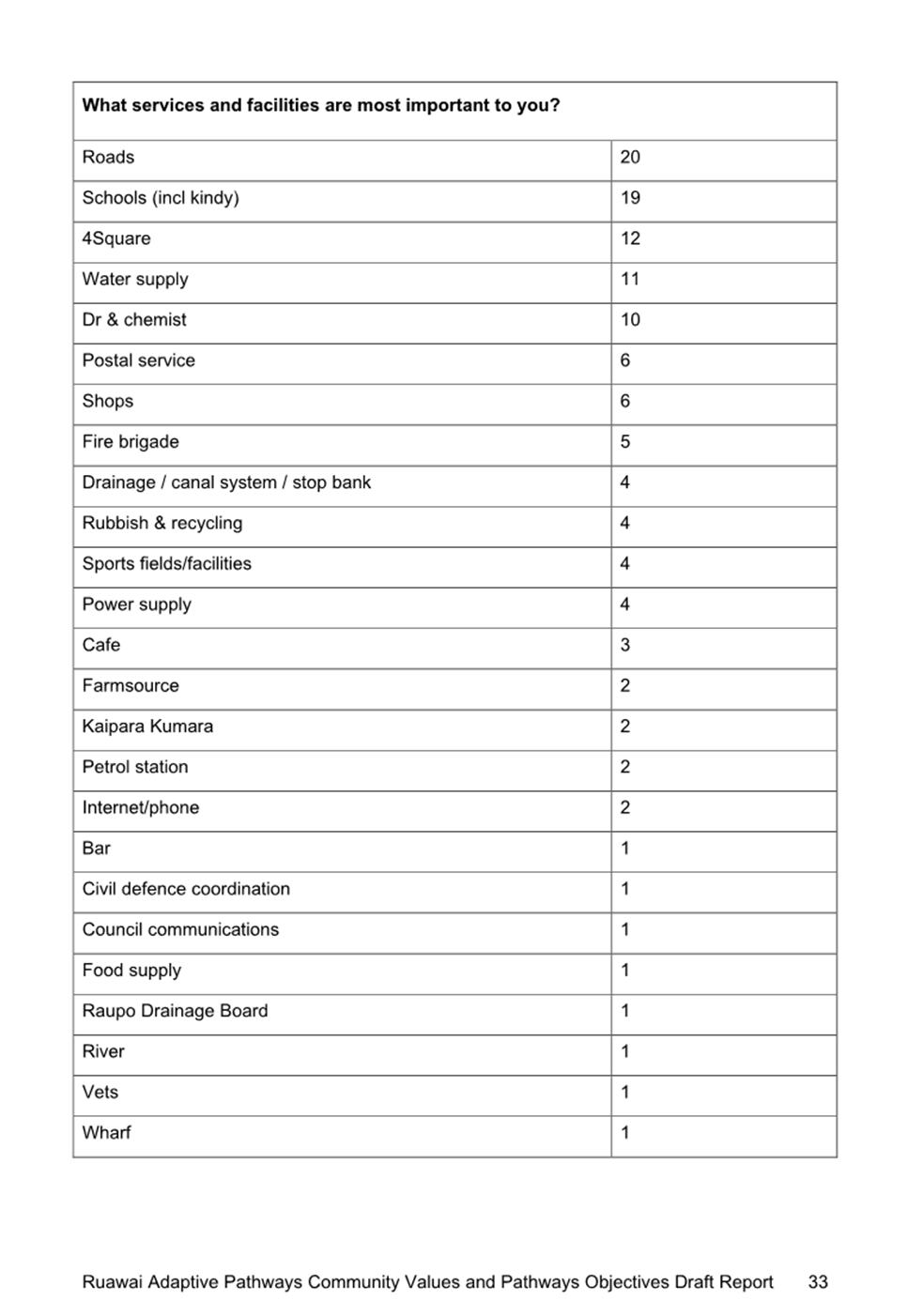
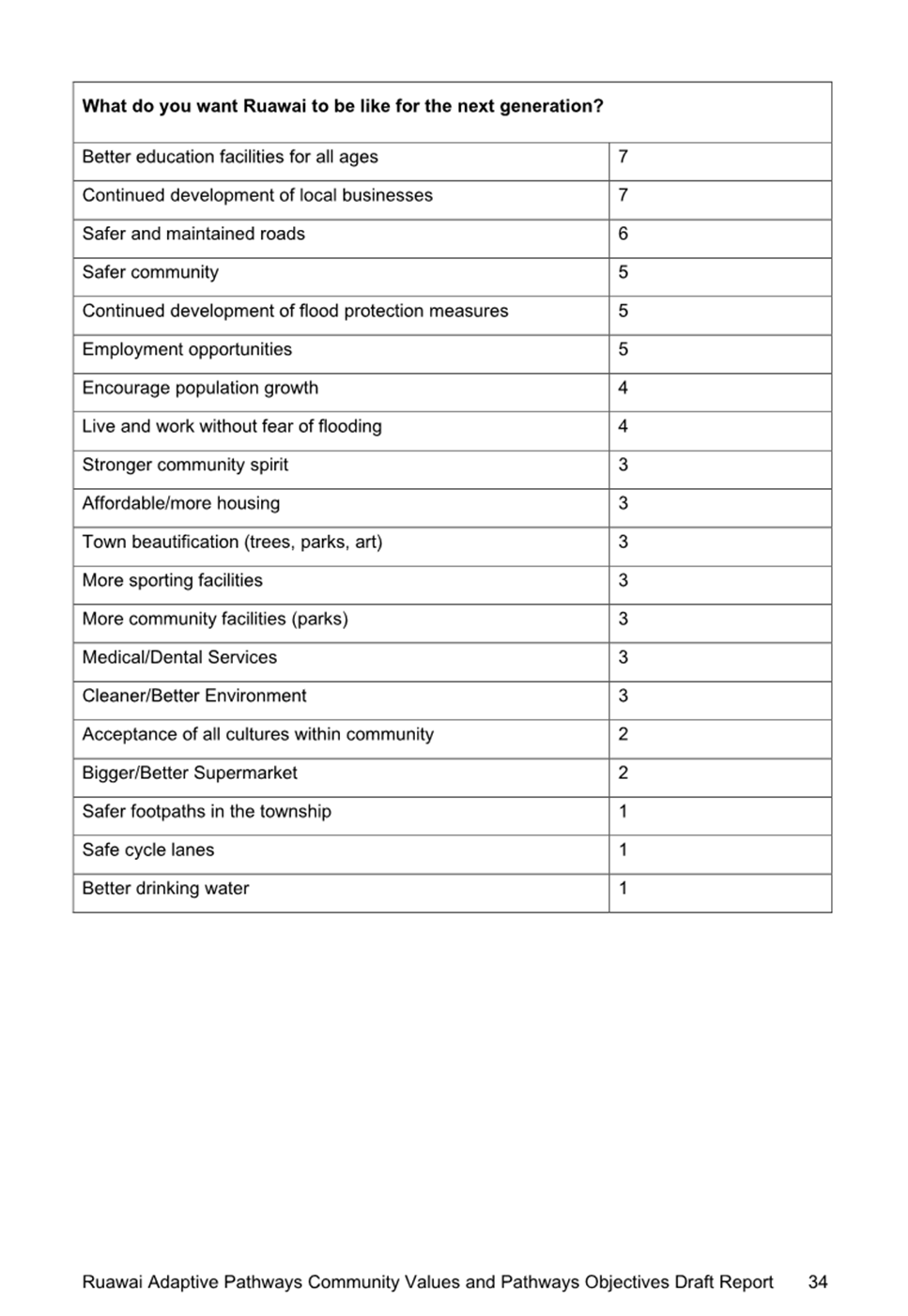
RuAP is currently in the ‘What Matters Most?’ phase of the adaptation planning cycle, moving from step three to step four. Community values and pathways objectives have been confirmed by the Panel and recommended for KDC’s approval (26 July Council Meeting). The community values and pathway objectives are presented in Part 1, Summary, as part of a larger report (Attachment A).
TAHA and the Panel are now advising on a risk assessment and community risk thresholds, step four. The aim is to deliver the Ruawai adaptation plan by mid-2024.
RuAP is an iterative process. As KDC’s pilot and Tai Tokerau’s pilot, the lessons learned are shared through CATT and the JCCAC to help guide future community adaptation planning.
3. Whangarei District Council
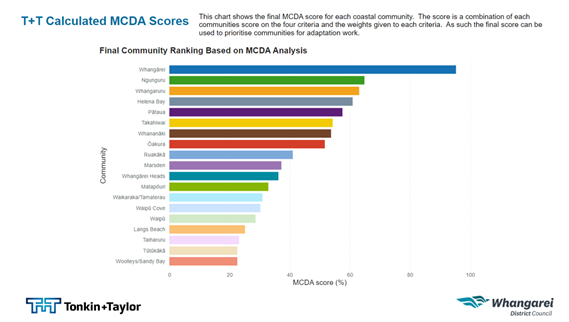
Design for Whangarei’s adaptation programme continues with an MCA being completed on the criteria set by council and hapu representatives. The coastal communites have been ranked below:
|
|
WDC councillors and Te Karearea have been briefed and feedback has been that we need to merge coastal communitites to increase the speed at which the coastal community adaptation planning programme can be implemented, acknowledging this will require further resourcing.
Better off funding:
Punaruku flooding
A project manager has been engaged to work with the local hapū working group, together they are developing a business case to design flood mitigation initiatives with
Iwi/hapū-focused adaptation
WDC staff are working with the Maori Outcomes team to establish an equitable method to deliver actions in the TTCAS that will build resilience within Whangārei to climate change and natural hazards through Priority Actions #9 – Māori adaptation impact assessment and #10 – Iwi/hapū-focused adaptation.
Attachments/Ngā tapirihanga
Attachment 1: Ruawai Adaptive Pathways
Community Values and Pathway Objetives Report ⇩
4 August 2023
|
TITLE: |
Flood Adaptation Strategy |
|
From: |
Tom FitzGerald, Climate Change Manager; Matt De Boer, Climate Change Resilience Coordinator; Victoria Rowe, River Management Engineer and Joseph Camuso, Rivers & Natural Hazards Manager |
|
Authorised by Group Manager/s: |
Louisa Gritt, Group Manager - Community Resilience, on 24 July 2023 |
Whakarāpopototanga / Executive summary
· This paper provides an overview of the Flood Adaptation Strategy project. We outline the background to the project, why it’s important, our engagement approach so far, what the project will deliver and when.
· The project aims to set out a cross-organisational approach to flood risk management for NRC. It takes a holistic view of all aspects of flood risk management, considering a wide range of council functions. These include policy and planning; civil defence response and recovery; community readiness; flood data and modelling; early warning systems; adaptation planning; catchment management and flood protection infrastructure and river works.
· The project used data from flood models and spatial analysis alongside cross-organisational engagement to identify flood risks in different catchments. This risk analysis data supports the ongoing identification of a range of actions tailored to the needs of different catchments, helping NRC target specific risks in locations with high risk of flood impacts over time.
· The actions are operationalised via NRC’s Long Term Plan process, through an integrated approach to funding flood risk management activities. Business cases for funding new initiatives have been developed and submitted for consideration, including projects across the Rivers, Climate Action, Science and Civil Defence teams. Teams are working on coordinating funding proposals and improving the visibility of interconnections between proposals.
· Meeting the needs and aspirations of tangata whenua is critical to the success of flood risk management in Te Taitokerau Northland. The project has engaged with a range of hapu to identify issues around flood risk management. Specific actions including engagement, adaptation planning and marae flood risk management have been identified for funding.
· The next phase of the project will develop strategic policy direction to help NRC prioritise and coordinate ongoing investment in flood risk reduction activities for communities. This will require coordination not only across NRC, but among district councils, hapu and iwi, central government agencies and lifelines organisations
That the report ‘Flood Adaptation Strategy’ by Tom FitzGerald, Climate Change Manager; Matt De Boer, Climate Change Resilience Coordinator; Victoria Rowe, River Management Engineer and Joseph Camuso, Rivers & Natural Hazards Manager and dated 10 July 2023, be received.
Background/Tuhinga
Background/Tuhinga
Context
Flooding is one of the most impactful natural hazards in Te Taitokerau and is top of the list of risks in our regional CDEM group plan. Most impacts of flooding are not, or cannot be, costed. It is difficult to estimate or even grasp the wide-ranging social, economic, and cultural impacts of flooding. Because of this we have a limited understanding of pre-existing flood risks and vulnerabilities.
The impacts of flooding on Māori in Te Taitokerau are significant and disproportionate, and these impacts are likely to increase with sea level rise. We also know from experience that the timely delivery of flood management projects is dependent on authentic engagement with hapū and iwi. The needs of Iwi and hapū are critically important to consider, especially in regard to our responsibilities under the Treaty/Tiriti.
The vulnerability of Northland communities plays a massive role in how the impacts of flooding are experienced. In October 2022, the Department of Internal Affairs released a national scale report that identified a number of Northland locations as being particularly vulnerable to flood hazard.
Regional councils have legislated responsibilities to manage flood risks for our communities, as do district councils and new Water Service Entities under the “Affordable Water Reforms”. NRC has embarked on an ambitious programme of flood risk management work over the past 15 years.
In 2008 NRC staff identified 26 river catchments (Priority Rivers catchments) where the risks from river flooding were considered highest to communities and essential infrastructure throughout Northland. High-level river management plans were developed for each of these 26 catchments which documented the potential flood risks and identified mitigation options in order to reduce the impacts of flooding. NRC now owns and operates five flood schemes (Awanui, Kāeo-Whangaroa, Whangārei, Panguru and Kawakawa) and has two under construction (Otiria-Moerewa, Awanui upgrade).
Additional to these river flood risk management roles, council also delivers a range of flood risk management functions including civil defence emergency management, hydrology and science, natural hazard modelling, and RMA planning and policy.
Coordinated, prioritised river flood risk management is identified as a key action under the Te Taitokerau Climate Adaptation Strategy (Actions 18, 34) and Ngā Taumata o Te Moana: our strategy for tackling climate change (Actions N4, N12).
Why is the project important?
Council’s forward work programme of flood protection infrastructure has been fast-tracked by unexpected external funding from Central government (Kanoa). This means we no longer have a comprehensive programme of flood protection work to progress through the next 10-year LTP.
Our current approach to flood risk management in Te Taitokerau does not take sufficient account of region-wide risk including from intersecting hazards and climate change impacts such as sea level rise. Sea level rise will have a major impact on future flood impacts in major urban centres including Dargaville and Whangarei, as well as numerous smaller townships.
Adaptation to climate change impacts reduces the likelihood of investing in options that may inadvertently ‘lock-in’ suboptimal or maladaptive responses to future flood risks. For example, flood walls and coastal defences that create additional drainage issues or increase risks in catastrophic events by incentivising development behind present day defences.
Recent experiences from Cyclone Gabrielle highlight the fact that infrastructure cannot eliminate flood risk to zero. Flood risk management needs to be comprised of a well-aligned portfolio of approaches across many of NRC’s functions.
Such a portfolio needs to include not only infrastructure-based protection-based approaches to flood risk management, but also involve land-use planning, catchment management, flood risk information and analysis and community engagement. Community Response Plans, Marae Resilience Plans, and civil defence emergency management (CDEM) risk reduction, readiness, response, and recovery functions (the 4 Rs) also play critical roles.
In some floodplains (or other risky areas), relocation of some communities out of harm’s way in will need to be seriously considered. At present the government is preparing the Climate Adaptation Bill, which will include a mechanism for undertaking community adaptation planning (to be known as Local Adaptation Strategies), and other actions to facilitate managed retreat if required.
Local adaptation planning will increasingly be employed across Aotearoa for not only coastal communities, but also flood risk affected communities, to ensure that long-term risks are being well-managed.
Investment decisions made today can have long-term ramifications and it is increasingly imperative to have robust, transparent, coordinated, and defensible investment decision-making processes.
What are the objectives of the project?
This project will help NRC (and partners) adopt best-practice for adaptive, evidence-based flood risk management planning. It will ultimately make recommendations as to appropriate approaches for flood risk management across all of Northland’s catchments, building on the existing Priority Rivers programme.
This year the project will detail specific actions flood risk management activities and associated funding requirements for a limited number of high needs/priority catchments. Information supporting the recommended actions will feed directly into the Infrastructure Strategy and LTP, as well as enabling applications for future external funding when needed.
The project will also outline a broader strategic policy direction for NRC. This will likely include an integrated, multi-party framework that identifies pathways to strategic flood risk management, that supports communities across the region including those outside the initial group of high needs/priority catchments.
What are the expected long-term outcomes of the project?
· Risk of flooding in vulnerable and exposed Northland communities continues to reduce,
· Community resilience to flood events continues to improve.
· Alignment and integration between Council’s, and other agencies, flood risk management functions are increased.
· Adaptation to climate change impacts is embedded in flood risk infrastructure planning.
· Council’s flood risk management investment decisions are balanced, equitable, effective, cost-efficient, clearly mapped over time, and defensible.
· Council has a clear portfolio and programme of flood risk management projects developed to the ‘shovel-ready’ stage to take advantage of any future opportunities for external funding.
Hapū and iwi engagement
Input from Māori is essential to ensure that Māori values are included in the evaluation processes used. At this stage we have engaged eight hapū representatives from across the region to form a tangata whenua advisory group for the project. Members contributed via a series of online hui/workshops from May-July. Representatives are being reimbursed in line with NRC’s new Māori Expertise Procurement Policy.
This engagement process has been useful in identifying some risks and issues, and has led directly to the development of specific project funding proposals, including:
· additional staff for hapu engagement across Climate Action, Rivers and Civil Defence teams;
· a marae flood resilience programme (involving detailed investigations and engagement for 35 flood-affected marae, followed by flood modelling, risk assessment, design and construction for marae on an ongoing, as-needs basis)
Nonetheless, staff acknowledge that the online format has not been successful in building a strong coalition of hapu collaboration in decision-making. Staff are now in the process of planning a series of wananga via a ‘listening tour’ in the next six months in collaboration with the wider CATT group to improve our understanding of flooding issues and build relationships.
How are we managing the project?
An internal project manager (NRC Natural Hazards Specialist, Matt de Boer) and consultant (BECA) have been tasked to deliver the project. The project is on track to be completed on time to align with Long-Term Plan processes.
An internal technical advisory group has met three times to provide guidance and input into the project. They include NRC staff from economics, planning and policy, rivers, civil defence, communications, corporate planning, climate action and natural hazards, Māori relationships teams. Other internal interviews with staff from rivers, science, hydrology, and civil defence have also taken place.
What will the project deliver?
1. Evaluation of impacts from flooding
A spatial risk assessment will use the latest flood hazard modelling to estimate exposure and potential impacts on community values and assets for all catchments across the region. This includes input from the hapū advisory group to identify key issues and considerations.
2. Identification of flood adaptation actions for catchments
A process for determining an appropriate approach to flood risk management and adaptation will evaluate high-level approaches and recommend a suite of activities across catchments, considering risk, community needs and hapu perspectives.
Flood protection infrastructure solutions will be appropriate in a small number of catchments across the region. In many cases, non-structural approaches will be required, such as proactive community engagement, early-warning systems, catchment management, enabling property-level protection or local adaptation planning.
3. Project business cases for NRC’s 2024-34 Long-Term Plan and Infrastructure Strategy
Flood risk management actions, including timeframes and rough-order costs, will be developed to support business cases for funding. These will feed into Council’s Infrastructure Strategy and the Long-Term Plan.
4. Strategic flood adaptation policy direction
The final phase of the project will develop strategic policy direction to help NRC prioritise and coordinate ongoing investment in flood risk reduction activities for communities.
Project status
The evaluation of impacts at a catchment level (Phase 1) is now complete. Staff are continuing work across NRC teams to develop relevant and targeted flood management actions for each catchment.
A number of LTP project new initiative business cases have been developed and submitted for consideration (as of end July 2023). These are yet to be approved, and include:
· 12 structural flood management projects at various scales and stages of implementation
· Marae flood resilience programme for 35 flood-affected marae
· Additional staff to lead hapu engagement across the climate action, Rivers and CDEM teams
· support for community adaptation planning with district councils
· scoping investigations for a second flood early warning system
· radar storm tracking and nowcasting to support during-event responses
· a flood/tide predictive model for the Northern Wairoa/Dargaville
 |
Attachments/Ngā tapirihanga
Nil
[1] Adaptation is defined as: Adjustment in natural or human systems in response to actual or expected climatic stimuli or their effects, which moderates harm or exploits beneficial opportunities.
[2] Maladaptation is defined internationally as: Any changes in natural or human systems that inadvertently increase vulnerability to climatic stimuli; an adaptation that does not succeed in reducing vulnerability but increases it instead.
[3] Section 5ZW allows the Minister or Commission to request from local governments a (1) description of governance in relation to climate risks (2) description of actual and potential effects of risks and opportunities on business, strategy and planning (3) risk management processes (4)metrics and targets and (5) other matters specified in regulations.