|
Joint Climate Change Adaptation Committee Monday 27 May 2024 at 1.00pm
|
|
|
|
|


|
Joint Climate Change Adaptation Committee Monday 27 May 2024 at 1.00pm
|
|
|
|
|
Meeting to be held in the NRC Council Chamber
36 Water Street, Whangārei
on Monday 27 May 2024, commencing at 1.00pm
Recommendations contained in the agenda are NOT decisions of the meeting. Please refer to minutes for resolutions.
MEMBERSHIP OF THE Joint Climate Change Adaptation Committee
Chairperson, Te Uri o Hau and Te Roroa Representative Fiona Kemp
|
Deputy Chairperson Amy Macdonald |
KDC Mayor Craig Jepson |
FNDC iwi/hapu representative Antony Thompson |
|
WDC Councillor Scott McKenzie |
FNDC Councillor Tamati Rakena |
WDC Iwi/hapu representative Deb Harding - Councillor WDC |
RĪMITI (Item) Page
1.0 Ngā Mahi Whakapai/Housekeeping
2.0 Ngā Whakapahā/apologies
3.0 Ngā Whakapuakanga/declarations of conflicts of interest
4.0 Overview of climate change modelling (NIWA presentation) 3
5.0 Ngā Whakaae Miniti / Confirmation of Minutes
5.1 Confirmation of Minutes - 10 November 2023 4
6.1 Far North District Council membership changes 9
6.2 Election of Deputy Chair of Committee 10
6.3 Overview of Climate Change modelling (NIWA Presentation) 16
6.4 Resilient Pastures Project Overview 17
6.5 Programme Key Performance Indicators from the monitoring, evaluation and reporting framework 24
6.6 Programme update 34
Joint Climate Change Adaptation Committee item: 4.0
27 May 2024
|
TITLE: |
Overview of climate change modelling (NIWA presentation) |
|
From: |
Rakesh Pinao, Regional Climate Adaptation Programme Lead |
|
Authorised by Group Manager/s: |
Louisa Gritt, Group Manager - Community Resilience, on date 16 May 2024 |
Whakarapopototanga / Executive summary
Dr. Andrew Tait, Chief Scientist - Climate, Atmosphere and
Hazards at NIWA will provide an overview of climate change modelling for the
committee and give opportunity for questions.
NIWA is due to release new national modelling in June 2024 that will provide
updated climate change projections for the country. These projects and model
data is likely to be used for future natural hazard modelling in the region.
NIWA’s project comes on the back of global modelling initiatives that
have been released a the last few years. Andrew will explain how the two relate
and what to expect from NIWA downscale modelling.
An overview of NIWA project to update National climate projections can be found
here:
https://niwa.co.nz/climate-and-weather/updated-national-climate-projections-aotearoa-new-zealand
That the report Overview of Climate Change Modelling – Dr, Andrew Tait from NIWA
be received.
Attachments/Ngā tapirihanga
Nil
Joint Climate Change Adaptation Committee item: 5.1
27 May 2024
|
TITLE: |
Confirmation of Minutes - 10 November 2023 |
|
From: |
Sandra Harris, Personal Assistant - Pou Tiakai Taiao |
|
Authorised by Group Manager/s: |
Louisa Gritt, Group Manager - Community Resilience, on 04 April 2024 |
That the minutes of the Join Climate Change Adaptation Committee meeting held on 10 November 2023, be confirmed as a true and correct record and that these be duly authenticated with the Chair’s electronic signature.
Attachments/Ngā tapirihanga
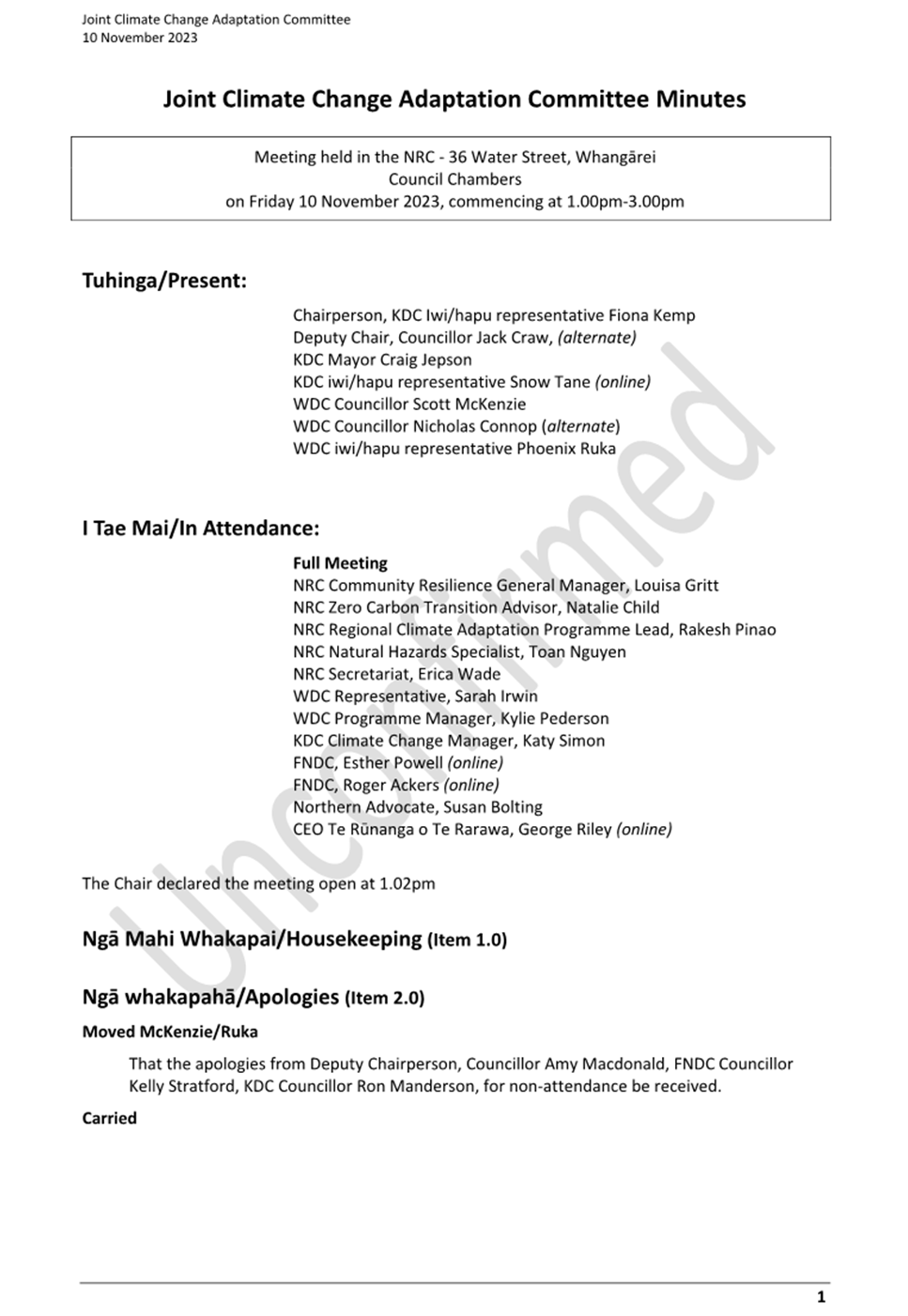
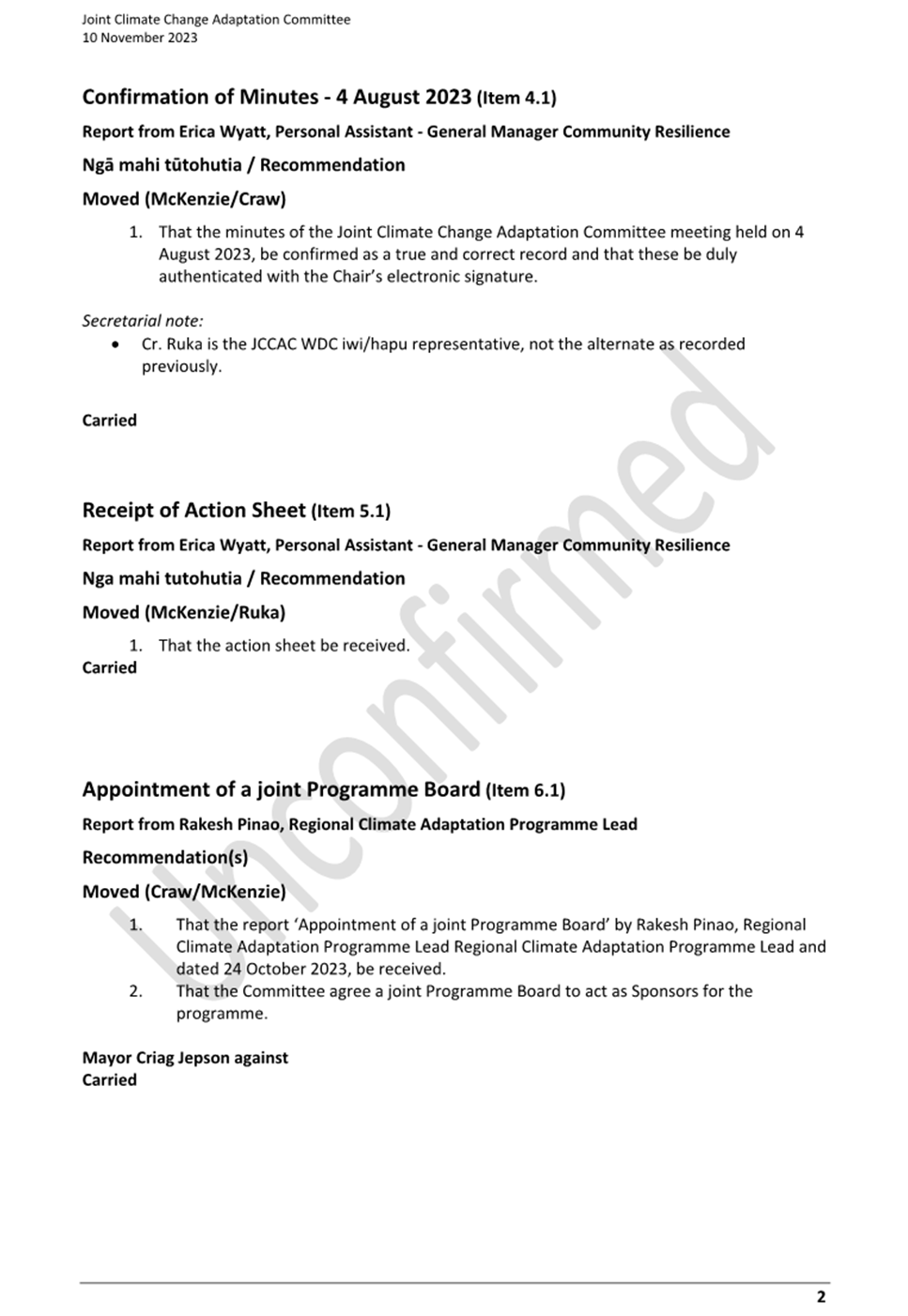
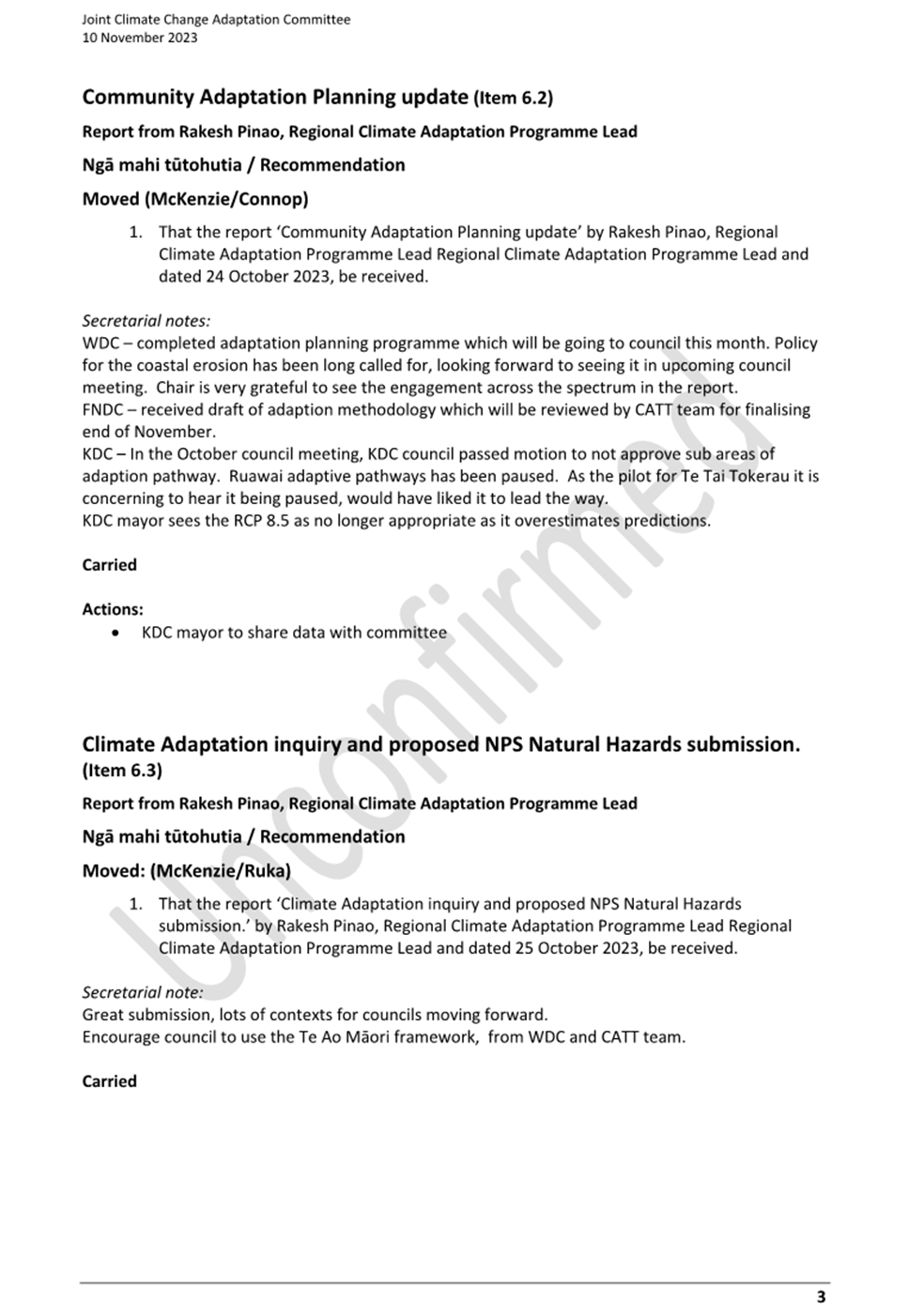
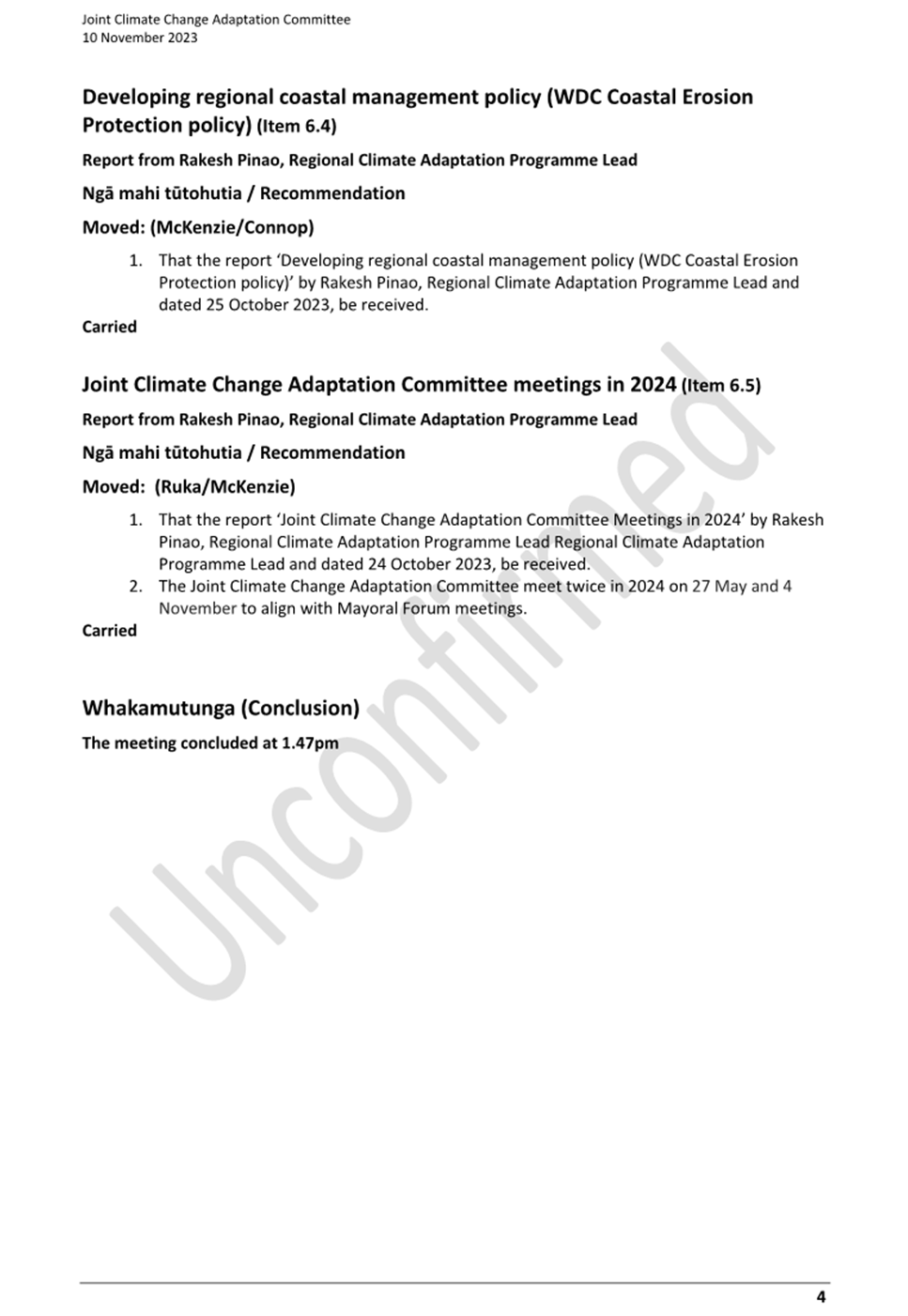
Attachment 1: JCCAC Minutes 10 November
2023 ⇩ 
27 May 2024
|
TITLE: |
Far North District Council membership changes |
|
From: |
Gavin Dawson, Governance Specialist |
|
Authorised by Group Manager/s: |
Louisa Gritt, Group Manager - Community Resilience, on 30 April 2024 |
Whakarāpopototanga / Executive summary
This report advises the Committee of Far North District Council (FNDC) membership changes. It also asks the Committee to note the change and to have the relevant documents updated by the committee secretariat.
1. Receives the report ‘Far North District Council membership changes ’ by Gavin Dawson, Governance Specialist dated 30 April 2024.
2. Notes that Deputy Mayor Kelly Stratford has been appointed as the Far North District Council member on the Joint Climate Change Adaptation Committee.
3. Notes that Cr Tamati Rakena has been appointed as the alternate member of the Joint Climate Change Adaptation Committee.
Background/Tuhinga
FNDC conducted a mid-term governance review of their governance structure and membership in the first part of 2024. Changes to the committee membership for FNDC, have been agreed to fit with the work programmes and availability of their elected members.
The appointments were effective from the time the decision was made by the FNDC. There are no other decisions or actions required to be undertaken by FNDC or the Committee. The Committee secretariat will update the relevant documentation after this meeting.
Attachments/Ngā tapirihanga
Nil
Joint Climate Change Adaptation Committee item: 6.2
27 May 2024
|
TITLE: |
Election of Deputy Chair of Committee |
|
From: |
Gavin Dawson, Governance Specialist |
|
Authorised by Group Manager/s: |
Louisa Gritt, Group Manager - Community Resilience, on 21 May 2024 |
Executive summary/Whakarāpopototanga
This report asks the Committee to elect a new Deputy Chair and note the appointment of two new members from the Northland Regional Council (NRC).
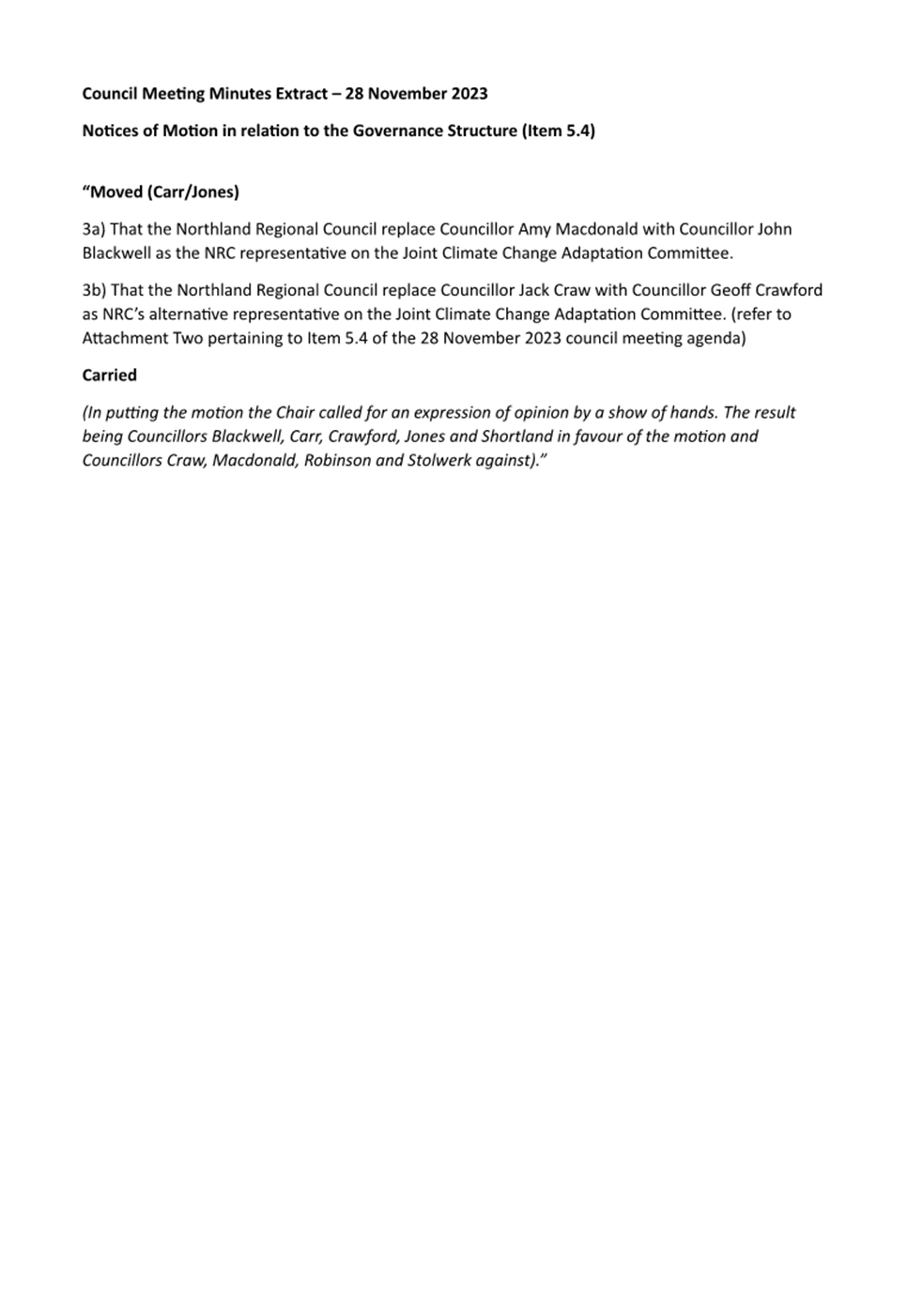
This follows the removal of Councillor Amy Macdonald (Cr Macdonald) and Councillor Jack Craw from the Committee in November 2023 by the NRC. At the same meeting, Councillor John Blackwell was appointed as the replacement member, with Chair Geoff Crawford appointed as the alternate (Attachment 1).
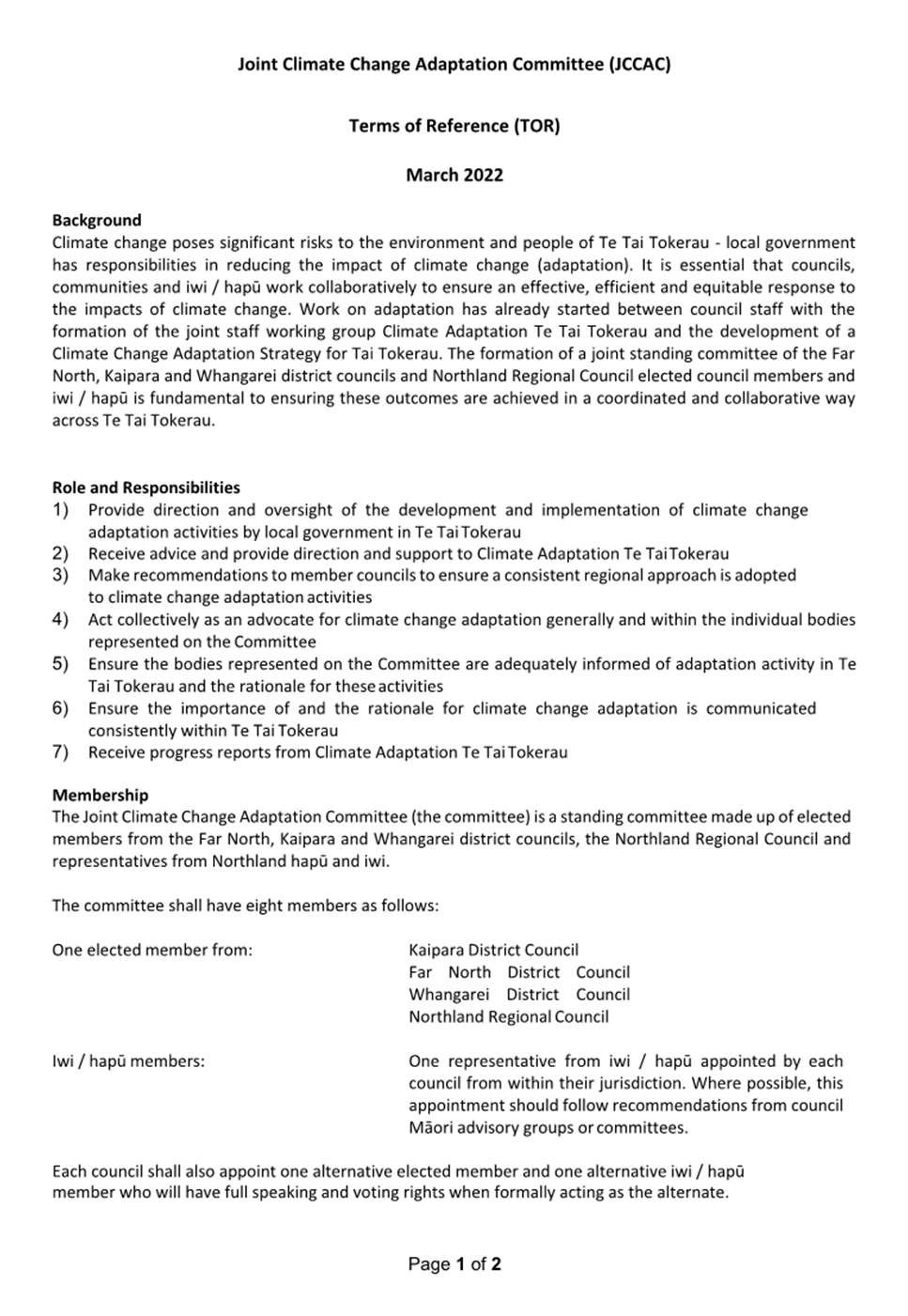
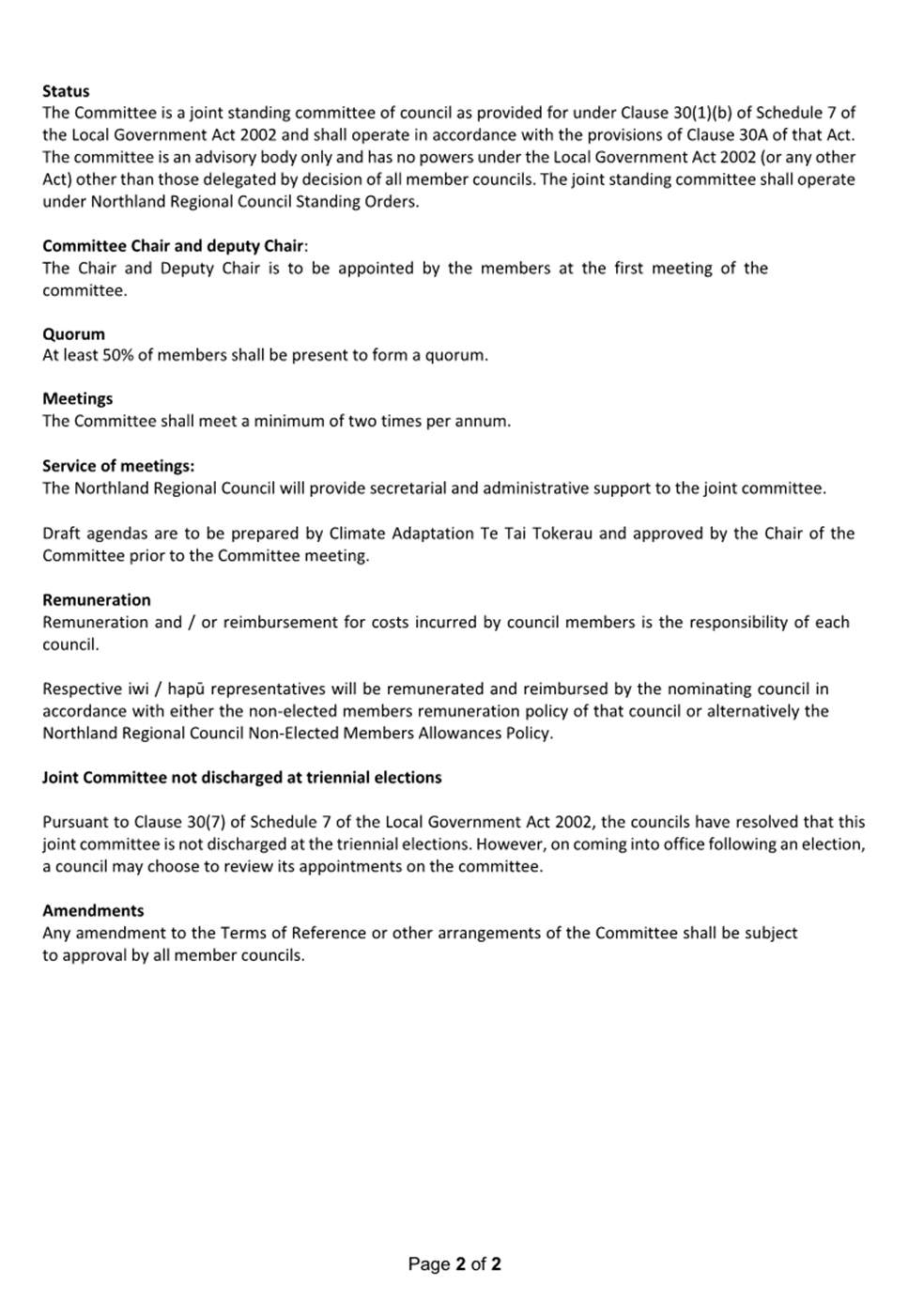
The role of Deputy Chair is now vacant as a result, and a replacement needed to meet the membership requirements provided in the Committee terms of reference (Attachment 2). The election is facilitated according to NRC Standing Orders, with the appointment effective as soon as a decision is agreed by the Committee.
1. That the report ‘Election of Deputy Chair of Committee’ by Gavin Dawson, Governance Specialist and dated 15 February 2024, be received.
2. That the Joint Climate Change Adaptation Committee notes the change in Northland Regional Council representation from Councillors Amy Macdonald and Jack Craw, to be replaced by Councillors John Blackwell (member) and Chair Geoff Crawford (alternate).
3. That voting system B provided for in Northland Regional Council Standing Orders is used for the election of the Deputy Chair of the Joint Climate Change Adaptation Committee.
4. That INSERT NAME is elected as the Deputy Chair of the Joint Climate Change Adaptation Committee.
Options
|
No. |
Option |
Advantages |
Disadvantages |
|
1 |
That the Committee elected a new Deputy Chair according to voting system B provided for in NRC Standing Orders. |
This voting method provides a simple and effective method to elect a new Deputy Chair. |
There are no known disadvantages. |
|
2 |
That the Committee elected a new Deputy Chair according to voting system A provided for in NRC Standing Orders. |
This voting system can be efficient where there are many candidates. |
This voting system can be inefficient where there are a small number of candidates. |
The staff’s recommended option is option 1 as the voting method provides a simple and effective method to elect a new Deputy Chair.
Considerations
1. Climate Impact
There are no climate impacts related to this matter.
2. Environmental Impact
There are no environmental impacts related to this matter.
3. Community views
Community consultation is not required for this matter.
4. Māori impact statement
The Northland Regional Council supports greater involvement of Māori in council governance arrangements, and this is reflected in the approved structure of the committee. There are no known impacts on the current approved arrangements.
5. Financial implications
There are no known financial implications for this matter.
6. Implementation issues
Details of the election result will be notified and published following the meeting.
7. Significance and engagement
In relation to section 79 of the Local Government Act 2002, this decision is considered to be
of low significance when assessed against council’s significance and engagement policy
because it is part of council’s day to day activities. This does not mean that this matter is not
of significance to Tangata Whenua and/or individual communities, but that council is able to
make decisions relating to this matter without undertaking further consultation or engagement.
1. Policy, risk management and legislative compliance
This matter is compliant with policy and legislative requirements.
Background/Tuhinga
The NRC voted to make governance leadership and structure changes at the November 2023 council meeting. The changes included the removal of Councillors Amy Macdonald (Cr Macdonald) and Jack Craw from the Committee. Councillor John Blackwell was appointed the replacement member, with Chair Geoff Crawford as the alternate (Attachment 1).
Prior to the November 2023 decision, Cr Macdonald held the role of Deputy Chair. As a result of the November 2023 decision, the role is now vacant, and the Committee must now elect a new Deputy Chair. The role is provided for in the agreed terms of reference for the Committee (Attachment 2).
It is recommended that the successful candidate is from the pool of available council elected members, to provide a balanced councils and iwi/hapu model of representation.
There are two voting systems that can be used for the election under section 5.3 of NRC Standing Orders.
System A
The candidate will be elected or appointed if he or she receives the votes of a majority of the
members of the local authority or committee who are present and voting. This system has the
following characteristics:
(a) There is a first round of voting for all candidates;
(b) If no candidate is successful in the first round, there is a second round of voting from which the candidate with the fewest votes in the first round is excluded; and
(c) If no candidate is successful in the second round, there is a third round, and if necessary
subsequent rounds, of voting from which, each time, the candidate with the fewest votes in the previous round is excluded.
In any round of voting, if two or more candidates tie for the lowest number of votes, the person to be excluded from the next round is resolved by lot. Resolving by lot can be conducted by the toss of a coin or putting each person's name on the same size piece of paper and put in a box from which the name is drawn.
System B
The candidate will be elected or appointed if he or she receives more votes than any other candidate. This system has the following characteristics:
(a) there is only one round of voting; and
(b) if two or more candidates tie for the most votes, the tie is resolved by lot.
The successful candidate will become Deputy Chair as soon as the decision is agreed. Information will be updated on the Northland Regional Council website after the meeting.
Attachments/Ngā tapirihanga
Attachment 1: Council Meeting Minute
Extract - 28 Nov 2023 ⇩
Attachment 2: JCCAC Terms of Reference ⇩
27 May 2024
|
TITLE: |
Overview of Climate Change modelling (NIWA Presentation) |
|
From: |
Rakesh Pinao, Regional Climate Adaptation Programme Lead |
|
Authorised by Group Manager/s: |
Louisa Gritt, Group Manager - Community Resilience, on 21 May 2024 |
Whakarāpopototanga / Executive summary
Doctor Andrew Tait, Chief Scientist - Climate, Atmosphere
and Hazards at NIWA will provide an overview of climate change modelling for
the committee and give opportunity for questions.
NIWA is due to release new national modelling in June 2024 that will provide
updated climate change projections for the country. These projects and model
data is likely to be used for future natural hazard modelling in the region.
NIWA’s project comes on the back of global modelling initiatives that
have been released a the last few years. Andrew will explain how the two relate
and what to expect from NIWA downscale modelling.
An overview of NIWA project to update National climate projections can be found
here:
https://niwa.co.nz/climate-and-weather/updated-national-climate-projections-aotearoa-new-zealand
That the report ‘Overview of Climate Change modelling (NIWA Presentation)’ by Rakesh Pinao, Regional Climate Adaptation Programme Lead and dated 21 May 2024, be received.
Attachments/Ngā tapirihanga
Nil
Joint Climate Change Adaptation Committee item: 6.4
27 May 2024
|
TITLE: |
Resilient Pastures Project Overview |
|
From: |
Rakesh Pinao, Regional Climate Adaptation Programme Lead |
|
Authorised by Group Manager/s: |
Louisa Gritt, Group Manager - Community Resilience, on 16 May 2024 |
Executive summary/Whakarāpopototanga
Farmers and industry have come together to develop a cross-sectoral (dairy and sheep/beef) program of research, development and extension that will enable the adaptation of pastoral farming to climate. This item seeks endorsement and support from the JCCAC for the 7-year Resilient Pastures programme to facilitate the project to obtain Government co-funding.
The Issue
- New Zealand’s farm systems that are based on grazing pastures enable our export product to be competitive on the international market, are relatively low in greenhouse gas emissions and achieve high animal welfare standards.
- Since early 2000’s the amount of pasture grown on farm in Te Tai Tokerau has been declining, in part due to a warming climate and extreme weather events.
- The effect of the decline has been masked by increased supplement use on dairy farms and is leading to falling productivity and profit on both dairy, and sheep and beef farms.
Resilient Pastures Project
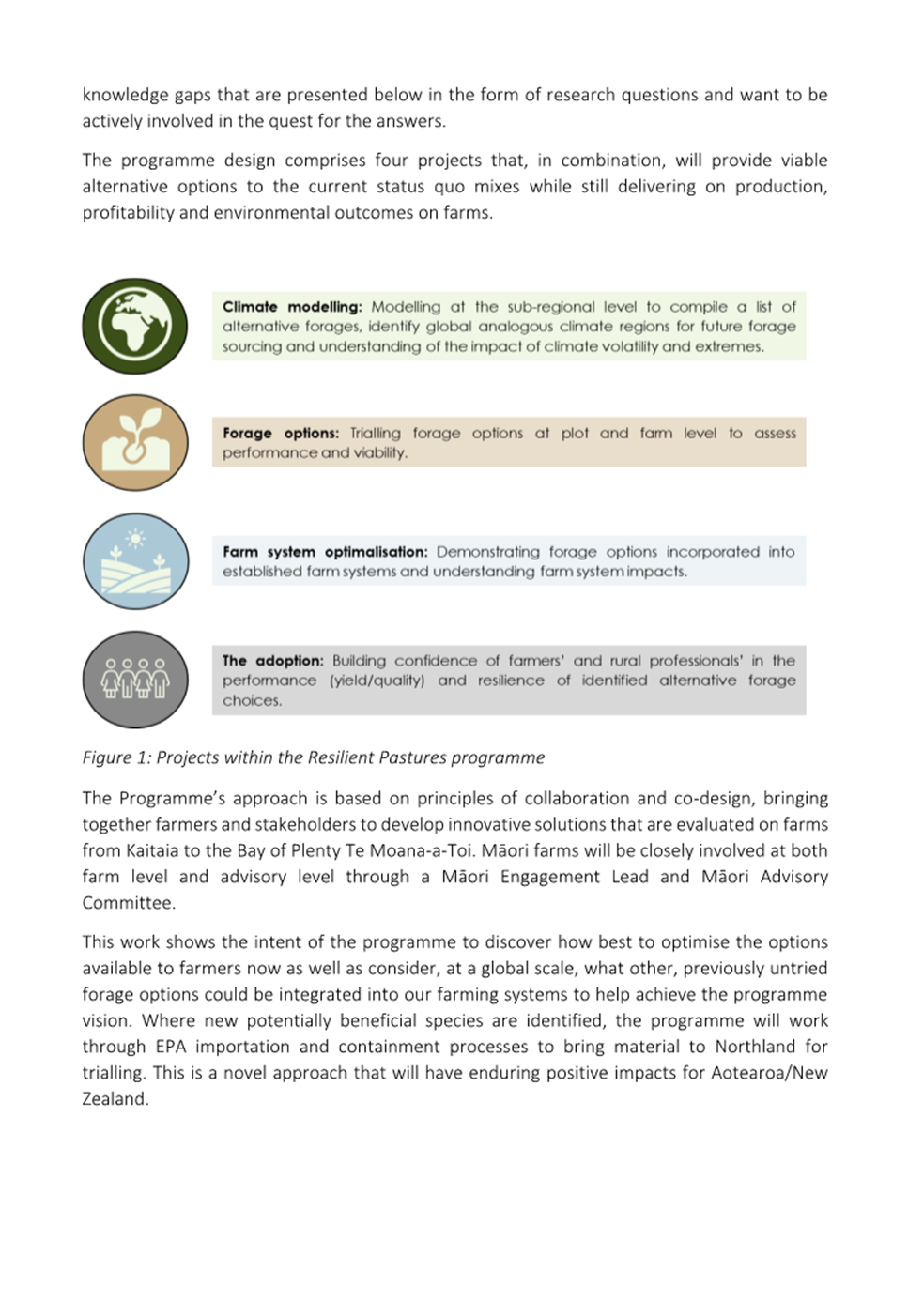
- A passionate group of farmers and industry stakeholders are developing a cross sectoral (dairy, sheep and beef) research, development and extension programme that will identify pasture species that are better adapted to climate, and management guidelines for extending the persistence of high-quality pastures.
- The 7-year Resilient Pastures Programme will be based in Northland and will bring together farmers, iwi, researchers, rural professionals, and the seed industry to co-develop and test solutions on farm.
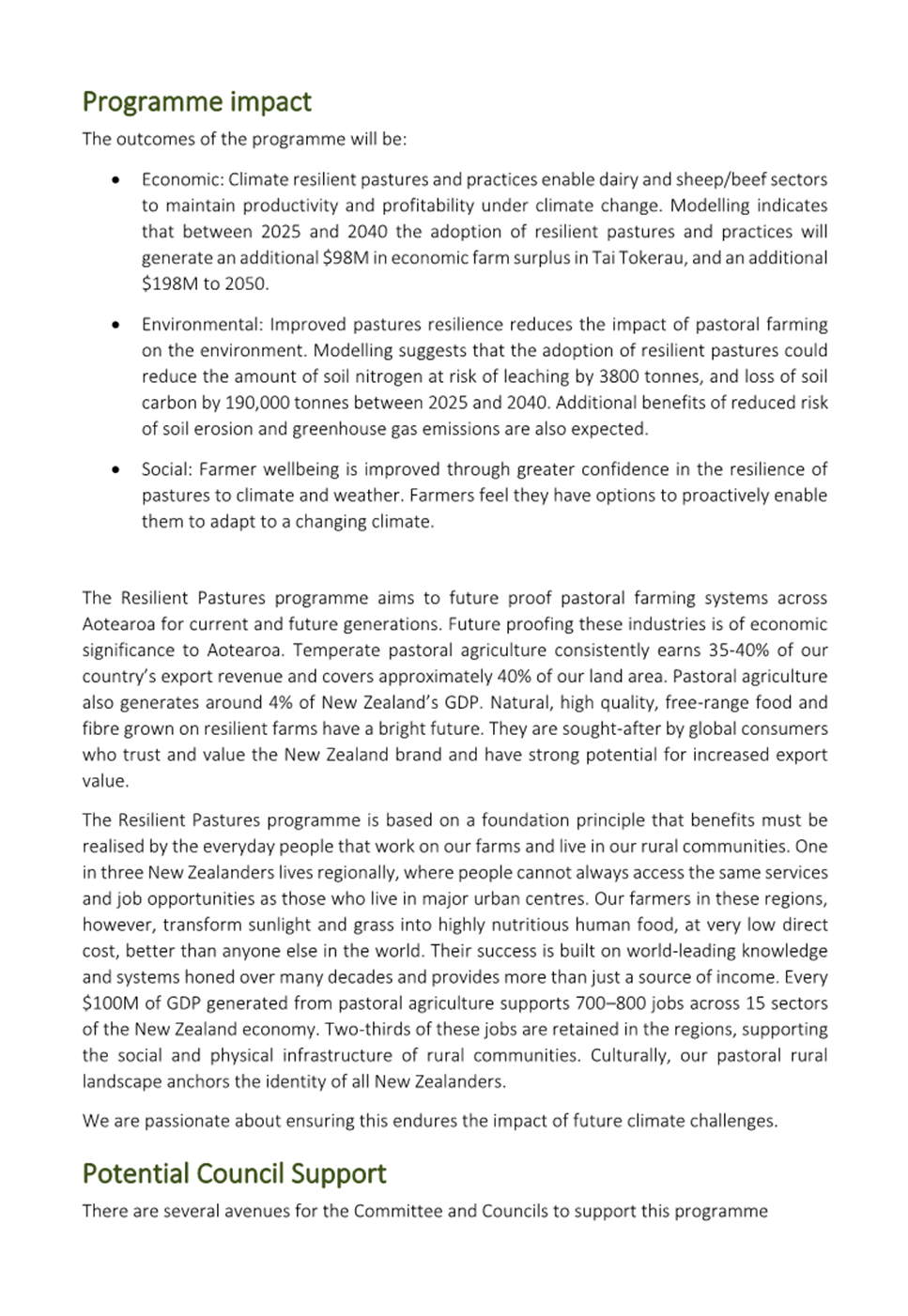
- Modelling predicts the Programme will return $98 million in benefit to Te Tai Tokerau through improved farm profit and more resilient farm systems between 2025 and 2040. The total value of the programme is underestimated, as modelling does not account for ripple effects of increased income to the region.
Request to the JCCAC
- Significant co-funding for the Programme has been secured, but further funding is needed. The Programme is currently developing a business case to obtain Government funding.
- The Programme is seeking support from the Joint Climate Adaptation Committee, in several avenues:
o Support Resilient Pastures Programme application for Government funding. For example, via a written letter of support alongside funding applications.
o Inform and engage with upper North Island Regional Councils on the opportunities with the Resilient Pastures Programme. For example, via Chief Executives writing too or meeting with counterparts in Local Government.
o Connections to potential partners and interested parties. For example, sharing news of the Programme across other committees, working groups or iwi forums.
o Raise awareness of the Programme with potential stakeholders. For example, Council communications that feature Resilient Pastures programme.
1. That the report ‘Resilient Pastures Project Overview’ dated 16 May 2024, be received.
2. That the Joint Climate Change Adaptation Committee endorse the Resilient Pastures Programme with advocacy with Central Government, other Regional Councils, potential regional partners and key stakeholders.
Options
|
No. |
Option |
Advantages |
Disadvantages |
|
1 |
Do nothing |
None. |
None. |
|
2 |
Endorse Resilient Pastures Programme |
· Improved engagement with the agriculture sector on climate adaptation. · Programme supports economic, social and environmental resilience of regional agriculture sector. |
· Minor resource implications for members and staff. |
The staff’s recommended option is to Endorse the Resilient Pastures Programme.
Considerations
1. Climate Impact
Climate adaptation is a core drive for the project and aligned with the committee’s strategy interest in key industry adaptation in the agriculture sector.
There are no direct climate impacts for councils in considering their support for the programme.
2. Environmental Impact
The project remain accountable for the same environmental considerations under the Resource Management Act and will be subject to gaining consent for all consent able activities. This decision in no way impacts on those requirements.
3. Community views
Community views have not been gathered by Council staff. The programme’s engagement plans are expected to identify and engage with key interested and affected parts of the community.
4. Māori impact statement
The regional investment into resilient pastures specific for the economy is expected to be of high interest to Māori. The programme has aspirations to involve and engage with Māori as a specific interest group and would welcome the committee views on ensuring value is also obtained for Māori as part of the project.
5. Financial implications
There are no specific financial implications for councils as this time.
6. Implementation issues
Advocacy may require committee members, elected members and/or council staff time that may impacts a range of teams; Senior executive (All), Climate adaptation or resilience teams (All), Communications and Engagement (All), Land Management (NRC).
7. Significance and engagement
In relation to section 79 of the Local Government Act 2002, this decision would not be considered significant as both advocacy and funding has been consulted on within the scope of climate adaptation resourcing.
8. Policy, risk management and legislative compliance
There are no issues of policy or legislative compliance with this decision. This decision considers the strategic regional risk from climate change by addressing sector-based adaptation.
Attachments/Ngā tapirihanga
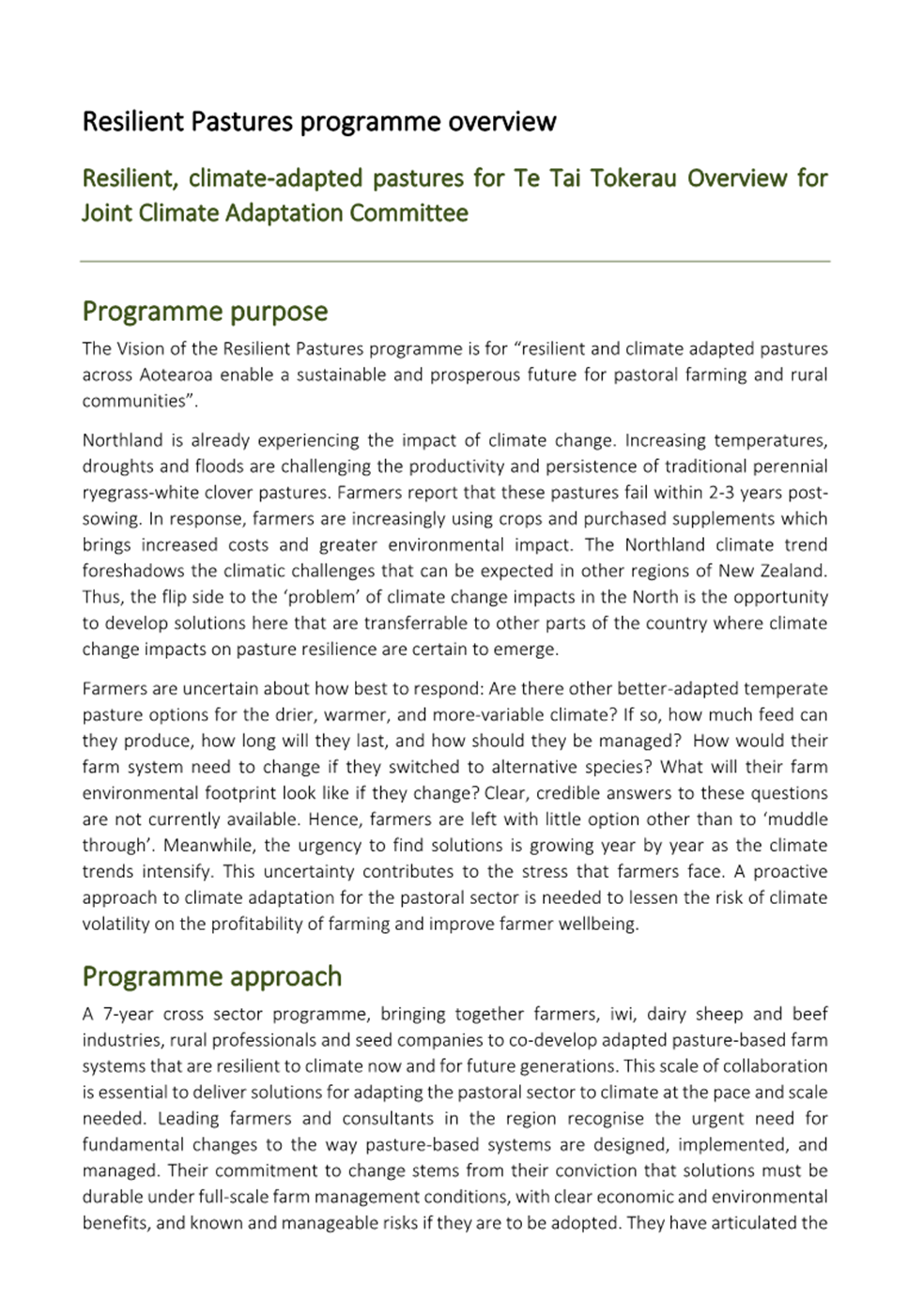
Attachment 1: Resilient Pastures
Programme Outline ⇩
27 May 2024
|
TITLE: |
Programme Key Performance Indicators from the monitoring, evaluation and reporting framework |
|
From: |
Rakesh Pinao, Regional Climate Adaptation Programme Lead |
|
Authorised by Group Manager/s: |
Louisa Gritt, Group Manager - Community Resilience, on 13 May 2024 |
Executive summary/Whakarāpopototanga
This paper seeks the Joint Climate Change Adaptation Committee’s (JCCAC) endorsement of Key Performance Indicators to monitor progress and track lessons as the Climate Programme is delivered.
The primary purpose of KPI reporting for the Climate Programme is to
provide regular updates on progress toward the programme outcomes and provide
accountability to the JCCAC, Councillors, Executives from all Councils, and the
public. It will also cover all reporting requirements of the Climate Change
Response Act 2002. Key progress updates and achievements will be shared with
the public online and through engagement activities.
Key performance indicators are presented in the paper to cover the 5 objectives that are linked to the climate programme.
1. That the report ‘Programme Key Performance Indicators from the monitoring, evaluation and reporting framework’ by Rakesh Pinao, Regional Climate Adaptation Programme Lead and dated 10 April 2024, be received.
2. That the Committee endorse the Objectives and Key Performance Indicators.
Options
|
No. |
Option |
Advantages |
Disadvantages |
|
1 |
Do nothing |
Ability to adjust KPIs to perceived community need. |
Delay to reporting and communications while KPIs are reworked. |
|
2 |
Endorse KPIs |
Enables strategic programme
progress reporting across councils. |
None. |
The staff’s recommended option is 2: Endorse KPIs.
Considerations
1. Climate Impact
This will better enable communication around climate adaptation.
2. Environmental Impact
There are no environmental impacts of this decision.
3. Community views
Public engagement on the programme has started and this will enhance how the engagement messages climate adaptation and council’s goals. The programme will also review KPIs based on engagement feedback.
4. Māori impact statement
The KPIs provided do not have a significant impact on
Māori but do frame the climate adaptation programme around risk reduction
and engagement from a western science perspective. In this way it still
excludes Māori voices more than the programme would like.
Space will be made for Te Ao Māori world views and engagement outcomes
specifically that may require a change to those specific objectives and KPIs in
time. The programme expects to progress this via engagement and adaptation
planning.
5. Financial implications
Financial implications have been considered in the identification of the KPIs, and an option to seek existing or achievable metrics was part of this early consideration. They are aligned to the existing programme’s development of risk, management and engagement.
6. Implementation issues
There are no significant implementations issues.
7. Significance and engagement
8. Policy, risk management and legislative compliance
There are no expected risks associated with endorsing the programme KPIs.
It is expected that the overall MER framework, including these KPIs cover all of Council’s reporting requirements of the Climate Change Response Act 2002.
Background/Tuhinga
At the November 2023 Joint Climate Change Adaptation Committee meeting staff presented the output of the Climate Programme Consolidate Logic and Reporting (CPCLR) project that outlined the revised programme structure for the Te Tai Tokerau Climate Adaptation Strategy to enhance operational delivery. The CPCLR programme detailed the Strategy’s Priority Actions for delivery.
At that time the report excluded the Monitoring, Evaluation and Reporting (MER) framework, that is intended to enable progress to be tracked and lessons to be identified along the way. The MER framework identifies the programmes Key Performance Indicators (KPIs) that are aligned to the five programme objectives.
Key performance indicators
KPIs have been developed to measure ongoing progress toward each of the programme outcomes. As part of the 3-yearly (triennial) evaluation process, new KPIs may be developed based on the evaluation outcomes and to reflect evolution in the programme objectives.
Where baselines for a KPI are unknown, they will be measured as part of the first reporting process. Targets that are unknown at this stage should also be set at that point, and these are indicated with ‘TBC’ in the table below. Results can be compared against the baseline and target to show progress.
The table below outlines those objectives and associated KPIs. The purpose in presenting these to the committee for endorsement is to confirm they are suitable to:
· Reflect the measurable intent for each objective.
o Have you expected different measures?
· Communicating progress to the public.
o Do you find these convincing of programme progress to your constituents?
Endorsement of these metrics will allow commitment to invest in the identified measures and reporting systems. An initial baseline will be established for each, and progress will be tracked and reported in future.
|
Objective 1. Governance, resources and management: Councils establish and maintain effective governance, funding and resources arrangements to respond to the risks and impacts of climate change. |
|||
|
KPI Metric |
Baseline |
Target |
Review |
|
Number of complete recommendations from the last programme governance review. |
TBC |
80% |
Triennially |
|
Objective 2. Communications and Relationships: Northland communities, and Iwi / hapū groups are aware of climate change risks and are actively involved in adaptive planning. |
|||
|
KPI Metric |
Baseline |
Target |
Review |
|
Number of public engagements events per year on climate adaptation |
6 |
10 |
Annually |
|
Number of iwi/hapū engagements events per year on climate adaptation |
3 |
10 |
Annually |
|
Objective 3: Embedding climate change in Council: Climate change is embedded in Council’s business as usual activities. |
|||
|
KPI Metric |
Baseline |
Target |
Review |
|
Percentage of planned actions to incorporate climate change into Council’s usual operations completed by 2024. |
TBC |
100% |
Annually |
|
Objective 4:
Science and risk assessments: |
|||
|
KPI Metric |
Baseline |
Target |
Review |
|
Assessment of the completeness of regionwide hazard identification and risk assessment programme. |
TBC |
100% |
Triennially |
|
Objective 5: Adaptation
planning: |
|||
|
KPI Metric |
Baseline |
Target |
Review |
|
Percentage of priority community adaptation plans complete. |
TBC (0%) |
2024-34:
TBC |
Triennially |
The below tables of international adaptation monitoring indicators is provided below for context and to inform decision-making on the proposed KPIs above.
Natural environment
|
Country |
Title of Indicator |
Sector |
What does it monitor? |
Unit of measure |
Scale of data |
|
Canada |
Proportion of terrestrial and marine area conserved |
Nature and biodiversity |
Conserved areas help to maintain ecosystem services that, in turn, reduce the impacts of climate change on quality of life. |
% |
National |
|
UK |
Number of wood land bird species in decline |
Biodiversity |
Trend/change – Number of woodland bird species in decline (long-term and short-term). |
%, index |
Subnational |
|
UK |
Proportion of freshwater SSSI habitats in favourable or recovering condition |
Natural environment |
Trend/change – Proportion of freshwater SSSI habitats in favourable or recovering condition |
% |
Subnational |
|
UK |
Area of deep peat covered by catchment scale restoration programmes |
Natural environment |
Trend/change – The total area of deep peat covered by catchment scale restoration programmes |
Hectares |
Subnational |
|
UK |
Proportion of surface water bodies failing to meet Good Ecological Status, by water body type |
Natural environment |
Trend/change – Proportion of surface water bodies failing to meet Good Ecological Status, by water body type |
% |
Subnational |
Coasts
|
Country |
Title of Indicator |
Sector |
What does it monitor? |
Unit of measure |
Scale of data |
|
UK |
Km of coastline designated for Managed Realignment or NonActive Intervention coastline protected |
Spatial planning |
Trend/change – in Km of coastline designated for Managed Realignment or Non-Active Intervention coastline protected |
Km |
Subnational |
|
UK |
Number of properties protected from coastal erosion. |
Multi-sector |
Trend/change in number of properties protected from coastal erosion. |
Number |
Subnational |
|
UK |
Number of properties at risk of coastal erosion. |
Multi-sector |
Trend/change in number of properties at risk of coastal erosion. |
Number |
Subnational |
|
UK |
Number of properties lost to coastal erosion |
Built environment |
Trend/change in number of properties lost due to coastal erosion per year. |
Number, per year |
Subnational |
|
UK |
Proportion of coastal SSSI habitats in favourable or recovering condition |
Natural environment |
Trend/change – Proportion of coastal SSSI habitats in favourable or recovering condition |
% |
No time series |
Buildings, towns & cities
|
Country |
Title of Indicator |
Sector |
What does it monitor? |
Unit of measure |
Scale of data |
|
Germany |
Land used for human settlements and transport infrastructure |
Spatial planning |
Shows the trend in sealing for human settlements and transport infrastructure |
daily increase of human settlements and transport infrastructure area [ha/day] |
National |
|
UK |
Number of residential properties in each risk band |
Spatial planning |
Tracks the change in number of residential properties in different risk band levels |
Number per year |
Subnational |
|
UK |
Number of residential properties at high risk shifted to low risk |
Spatial planning |
Monitors the change in the number of residential properties whose status/ level of risk changes from high to low |
Number per year |
Subnational |
|
UK |
Net gain/loss in area/ proportion of urban green/blue space |
Spatial planning |
Tracks change in the natural / seminatural areas within town and cities. The urban greenspace indicator uses OS MM to calculate the area of land in urban areas classed as permeable and natural. |
Thousand hectares |
Subnational |
|
UK |
Awareness of property-level flood resilience schemes |
Civil protection |
Monitors the number of people aware of schemes that can help people protect their homes in case of flooding (e.g. installing flood barriers, flood gates, non-return valves) offered by different bodies. |
% |
Subnational |
|
UK |
Number of homes with a damp or mould problem |
Buildings |
Trend/change – monitors the percentage of homes in England with damp problems 1996-2014. |
number / % |
Subnational |
|
Scotland |
Cultural Heritage in Flood Risk Areas |
Built Environment |
Trend/change – Number of Cultural Heritage Assets located in areas at flood risk. |
Total number, % |
National |
|
Finland |
Insurance payouts for fluvial flood damages |
Multi-sector |
Financial significance of fluvial flood damages to buildings and private property |
€ |
Subnational |
|
Austria |
Climate-adapted public buildings - new building and refurbishment |
Buildings |
Shows if (and to what extent) the new construction or renovation of public buildings considers climate-adapted construction measures |
|
National |
|
UK |
Average length of time between flood events and people returning to their homes |
Civil protection |
Trend of time between flood events / evacuations and people returning to their homes |
Number of months |
Subnational |
|
UK |
Cost of flood insurance |
Resilient communities |
Monitors the potential changes in the premium thresholds for council tax bands D and G |
£ |
Subnational |
|
Scotland |
Number of community services at significant risk of flooding |
Resilient communities |
Number and percentage of community services at significant risk of flooding |
Total numbers, % |
National |
Infrastructure
|
Country |
Title of Indicator |
Sector |
What does it monitor? |
Unit of measure |
Scale of data |
|
Canada |
Number of longterm drinking water advisories for public systems on reserve |
Infrastructure |
Sustainable delivery of drinking water through public systems on reserves will be more resilient to disruptions, including those caused by climate change. |
Number |
|
|
UK |
Investment in resilience measures by electricity transmission and distribution companies |
Energy |
Trend in amount of actual and planned investment in resilience measures by electricity transmission and distribution companies |
no information available |
Subnational |
|
UK |
Leakage (Ml per year) |
Infrastructure |
Water lost from the distribution system. It includes water lost from the companies' distribution networks and supply pipe losses from consumers' pipes. |
MI/day |
Subnational |
|
Scotland |
Electricity supply disruption due to flooding |
Energy |
Number of interruptions due to flooding, Customer Minutes Lost (CML) |
Total numbers, minutes |
National |
|
Scotland |
Water treatment works in areas at flood risk |
Water |
Number and proportion of water treatment works in areas at flood risk |
Total numbers, % |
National |
|
Scotland |
Landslide events affecting the road network; Road closures due to landslides |
Transport |
Landslide events affecting the road network and number of road closures due to landslides |
Total numbers, % |
National |
|
Scotland |
Domestic and nondomestic water usage |
Water |
Quantity of water consumption – domestic and non-domestic |
Ml/d, litres per capita per day – non-domestic = Ml of water delivered per day |
National |
|
Austria |
Mainstreaming of climate change adaptation into instruments of transport planning |
Transport |
Shows if, and if yes to what extent, instruments of transport planning consider adaptation relevant aspects |
Checks relevant aspects in national transport scheme, transport concepts/strategies of the 9 Austrian provinces |
Subnational |
Joint Climate Change Adaptation Committee item: 6.5
27 May 2024
The below mock-ups have been developed for the proposed KPIs to show members how the reporting is expected to highlight performance in terms of process and quality.
EXAMPLE MOCK-UP 1 - Climate Adaptation Programme dashboard – to allow drill down into adaptation metrics
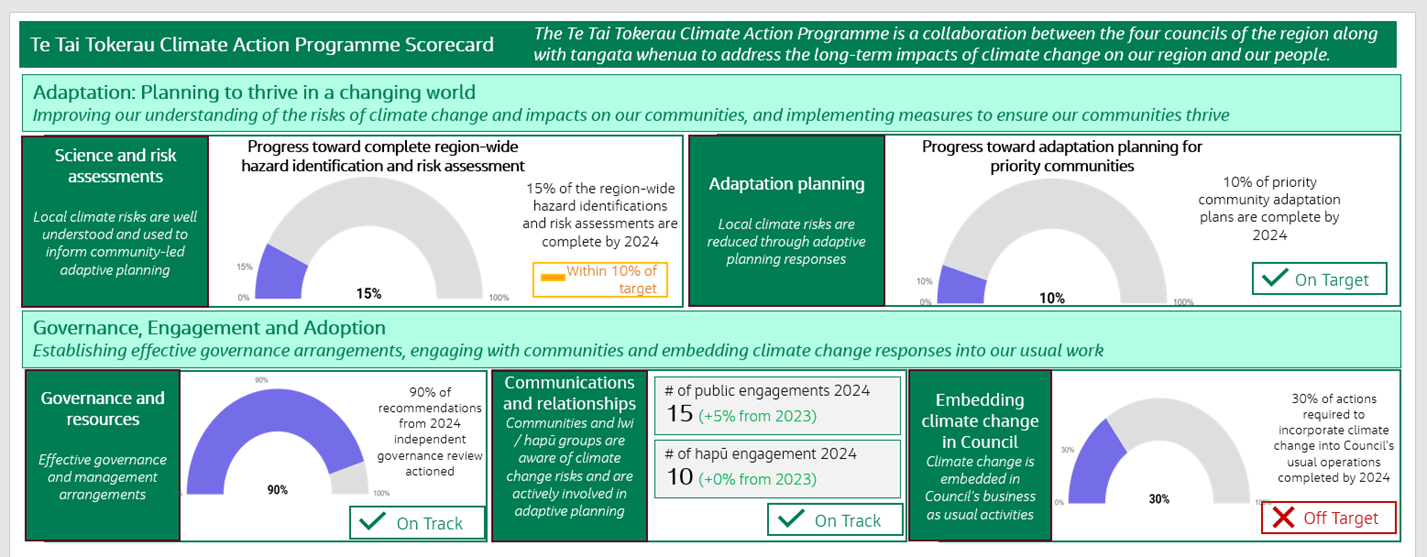
EXAMPLE MOCK-UP 2 - Climate
Adaptation Planning Dashboard – showing overall KPIs for Themes 4 and 5
and specific location, hazard/risk, and planning status information.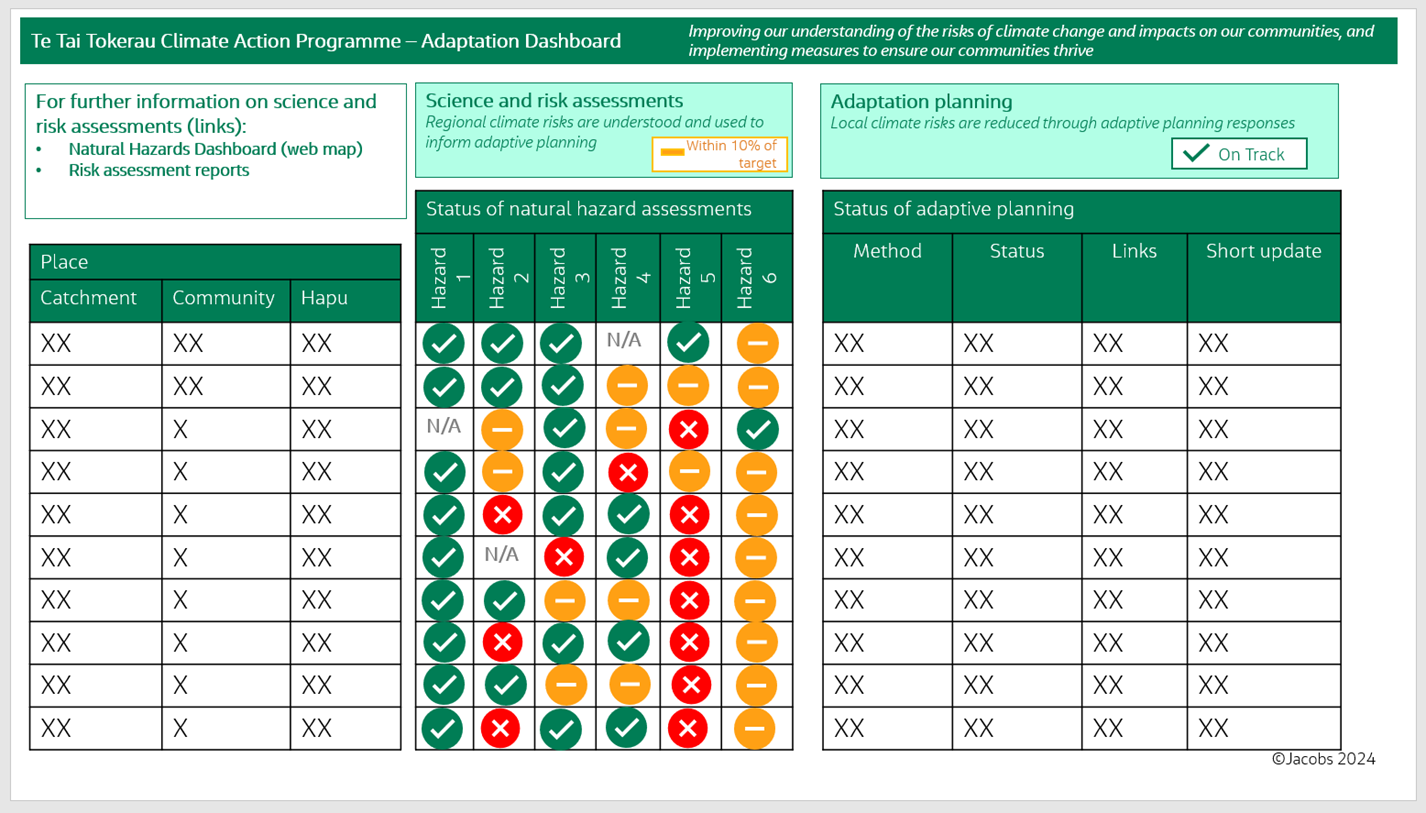
Attachments/Ngā tapirihanga
Nil
Joint Climate Change Adaptation Committee item: 6.6
27 May 2024
|
TITLE: |
Programme update |
|
From: |
Rakesh Pinao, Regional Climate Adaptation Programme Lead |
|
Authorised by Group Manager/s: |
Louisa Gritt, Group Manager - Community Resilience, on 13 May 2024 |
Whakarāpopototanga / Executive summary
This report provides a climate programme update for members information. The report highlights progress in community adaptation planning, including community adaptation programmes for Whangarei and Far North District Councils. There are also several community-led resilience initiatives underway facilitated by NRC’s Tangata Whenua Climate Adaptation Fund.
Progress on the Science and Risk workstream has been slower that anticipated but expected to move forward more quickly with the award of the tender for the Risk Portal and development of regional support guidance to assist with coastal hazard management.
The community engagement work programme has made good progress with completion of the communications and engagement plan and staff engaging with the public at several events over the summer season.
That the report ‘Programme update’ by Rakesh Pinao, Regional Climate Adaptation Programme Lead and dated 10 April 2024, be received.
Climate Adaptation Programme Update
The joint regional climate adaptation programme has been progressing under the new programme logic working structure since late 2023, with key programme planning activities underway. Highlights include:
Community Adaptation Planning
· Whangārei District Council’s Community Adaptation Planning
o In December 2023 of Whangārei District Council’s Adaptation Programme confirmed a catchment scale delivery approach, with five coastal catchments.
o The first project, Oakura, to commence later this year.
· Far North District Council’s Community Adaptation Planning
o Far North District Council have finalised an adaptation programme design and are working on an adaptation framework and detailed programme plan.
o They have identified a stage one project area, which includes Hokianga, Whangape and Herekino areas. The project will start later this year.
· Kaipara District Council’s Community Adaptation Planning and Ruawai Adaptive Pathways pilot remain suspended until Long Term Plan 24-27 decision.
· Community-led resilience initiatives are underway and are expected to play and increasing role in the awareness raising for climate change issues in anticipation of adaptation planning programmes run by the district councils. Programme structure included in this report is a visual way of showing interconnections between adaptation planning workstreams and other projects.
o Tangata Whenua Climate Adaptation Fund recipients got underway later last year and early 2024. Completion for most is due in June 2024. We hope to capture lessons and improvement for future funding rounds. It is expected that an NRC council workshop will look at Climate Resilience Fund in June 2024.
Science & Risk
· While the operational science work has continued, establishing a roadmap of science and risk improvements has been slow due in part to vacancies in the last 6 months and a focus on LTP programme planning and Risk Portal. The next 6 months aims to establish a clear science and risk programme. This will allow more transparent use by resilience and adaptation programmes.
· Regional Risk Portal market tender will be awarded in May and will begin design and delivery later this year, timelines for public availability are yet to be identified.
· Coastal hazards remain a high-profile within communities. Development is underway on regional support guidance focused on better regional outcomes for coastal management to help align council staff and support communities with better personal decision-making.
Community engagement
· Over the summer period CATT staff attended Waitangi Day, North Hokianga A&P Show and Dargaville Field days (as part of FNDC and NRC stalls). Engagement involved the use of climate simulation games for general public awareness of climate adaptation considerations. They were well received and provide an opportunity to raise key aspects of climate change impacts for the region as well as introduce concepts of resilience and adaptation. The simulation games are expected to play an ongoing role in awareness raising alongside more specific or targeted engagements and a range of audiences.
· The communication and engagement plan is now complete, and confirms how cross council engagement activities can be coordinated, reviewed and improved annually. The approach is focussed on building trust with communities and is design to be flexible to emerging demands. Communications will aim to promote partnerships and highlight the roles of individuals and communities alongside council and central government responses. While there are a range of climate change views the key concept of “everyone doing their part” has been received well. Further areas of development include wider CATT agencies inclusion and sector/industry-based climate adaptation and resilience initiatives.
o A focus area for engagement in the next 12 months will be in support of establishing WDC and FNDC first adaptation projects. In addition to that, regional support on coastal hazards engagement, and the purpose of adaptation planning.
o Update of the catt.org.nz website is now scheduled.
o Partnership and collaboration discussions are ongoing to align programme works with other workstreams.
Note:
A full programme management report by workstream is available on request. Programme management reports will go to the programme Sponsor and be distributed to Climate Adaptation te Tai Tokerau working group. It provides a level of operational detail that will be available if requested by the public once a system to track and manage these details is in place. It will not form part of regular external communications.
Attachments/Ngā tapirihanga
Nil