|
Civil Defence Emergency Management Group Meeting Tuesday 3 September 2024 at 11:30am - 1:00pm
|
|
|
|
|
|
Civil Defence Emergency Management Group Meeting Tuesday 3 September 2024 at 11:30am - 1:00pm
|
|
|
|
|
Civil Defence Emergency Management Group Meeting
3 September 2024
Civil Defence Emergency Management Group Meeting Agenda
Meeting to be held in the Council Chamber
36 Water Street, Whangārei
on Tuesday 3 September 2024, commencing at 11:30am - 1:00pm
Recommendations contained in the agenda are NOT decisions of the meeting. Please refer to minutes for resolutions.
MEMBERSHIP OF THE Civil Defence Emergency Management Group Meeting
Chairperson, FNDC Deputy Mayor Kelly Stratford
|
Deputy Chairperson Vincent Cocurullo |
Councillor Rick Stolwerk |
KDC Councillor Gordon Lambeth |
|
NEMA Representative Mike Gillooly |
NZ Police Representative Matthew Srhoj |
FENZ Representative Wipari Henwood |
|
NRC Alternate Tui Shortland |
WDC Alternate Nicholas Connop |
FNDC Alternate Moko Tepania |
|
KDC Alternate Eryn Wilson-Collins |
|
|
KARAKIA / WHAKATAU
RĪMITI (ITEM) Page
1.0 Ngā Mahi Whakapai/Housekeeping
2.0 Ngā Whakapahā/apologies
3.0 Ngā Whakapuakanga/declarations of conflicts of interest
4.0 Ngā Whakaae Miniti / Confirmation of Minutes
4.1 Confirmation of Minutes - 4 June 2024 4
5.1 Receipt of Action Sheet - September 2024 9
6.1 Presentation - Security Intelligence Service 11
6.2 National Emergency Management Agency Update 12
6.3 Government Inquiry into the North Island Severe Weather Events: Key Findings 16
6.4 Wellington Region Emergency Management Tour 53
7.1 CEG Chair Report 55
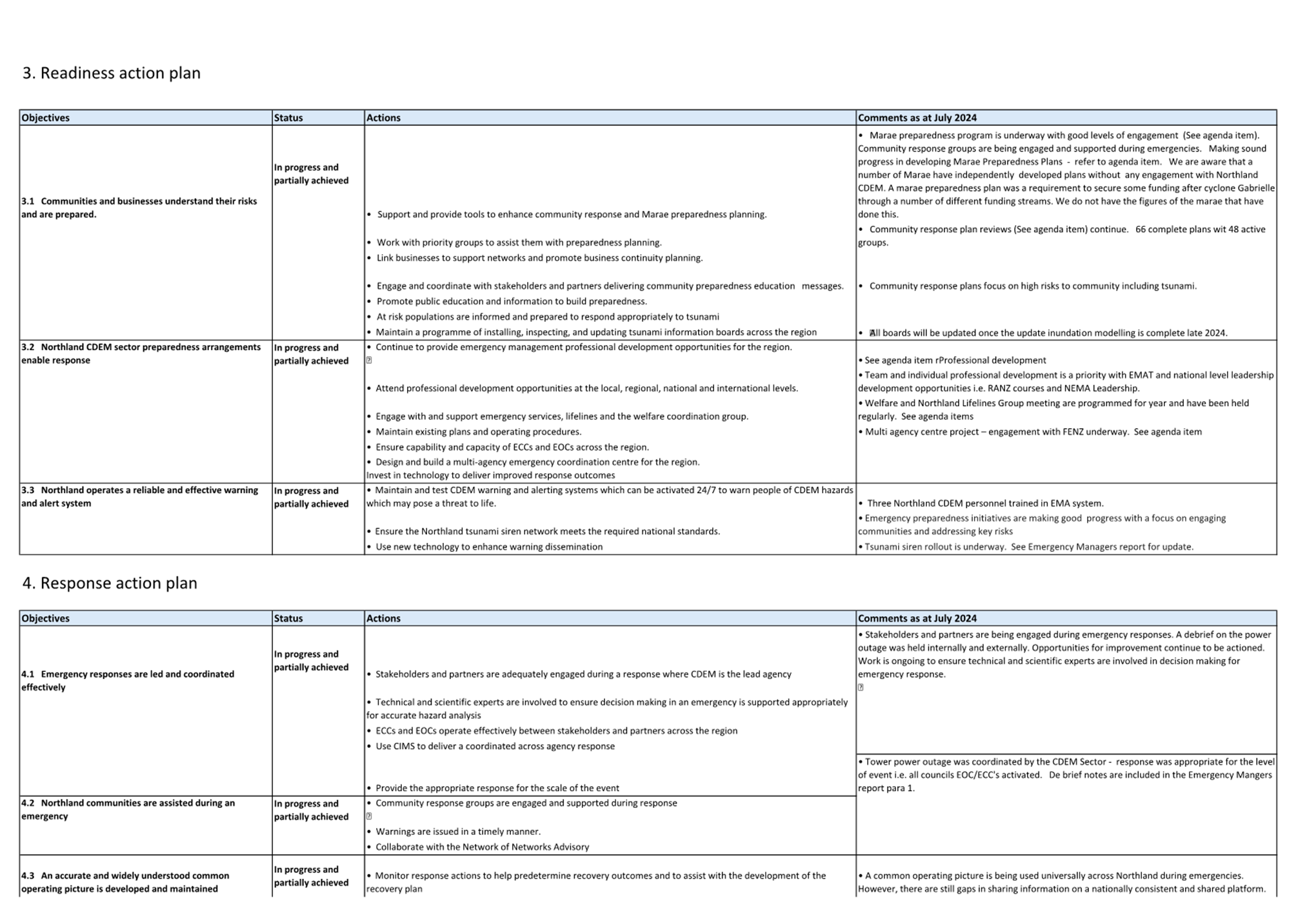
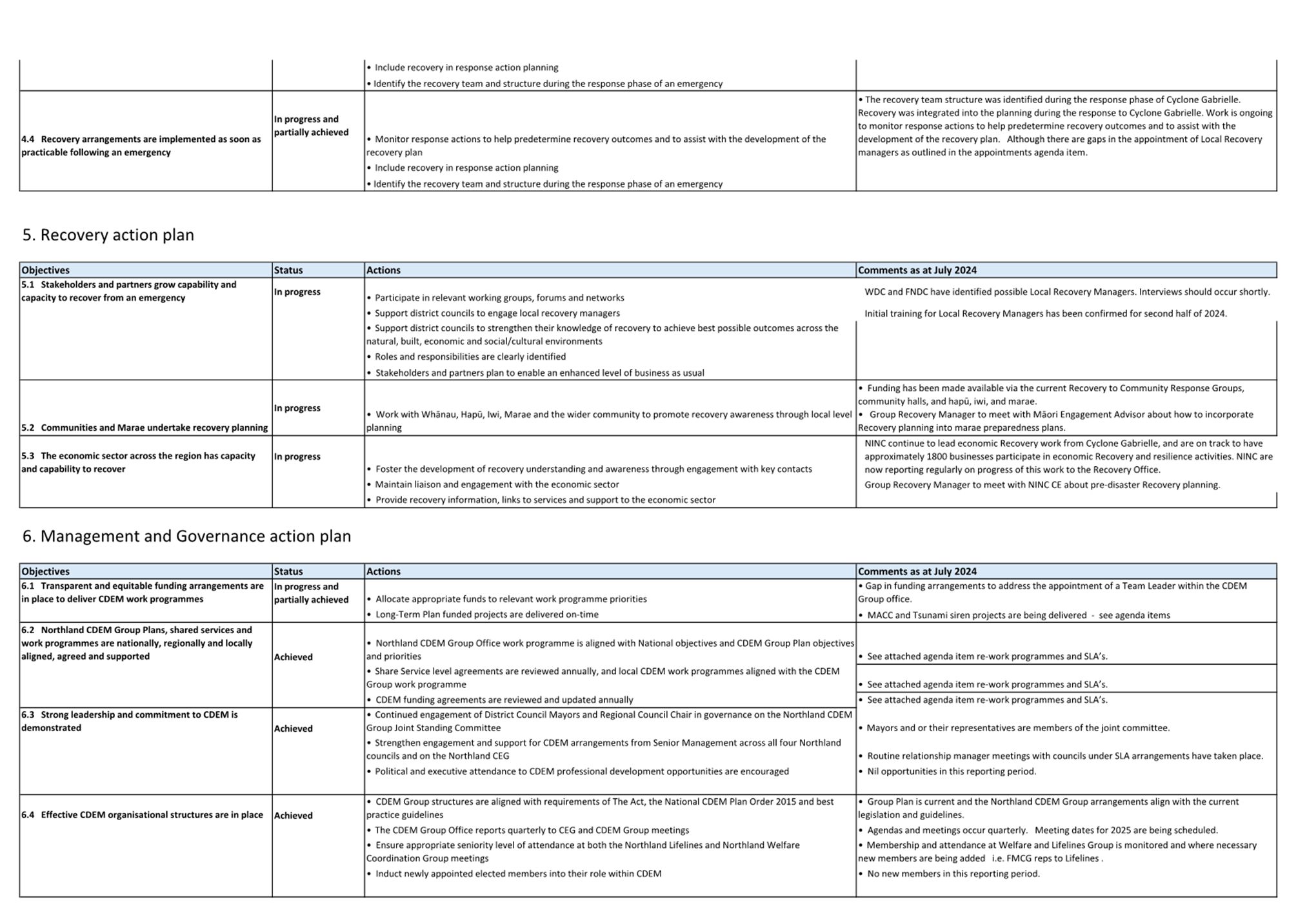
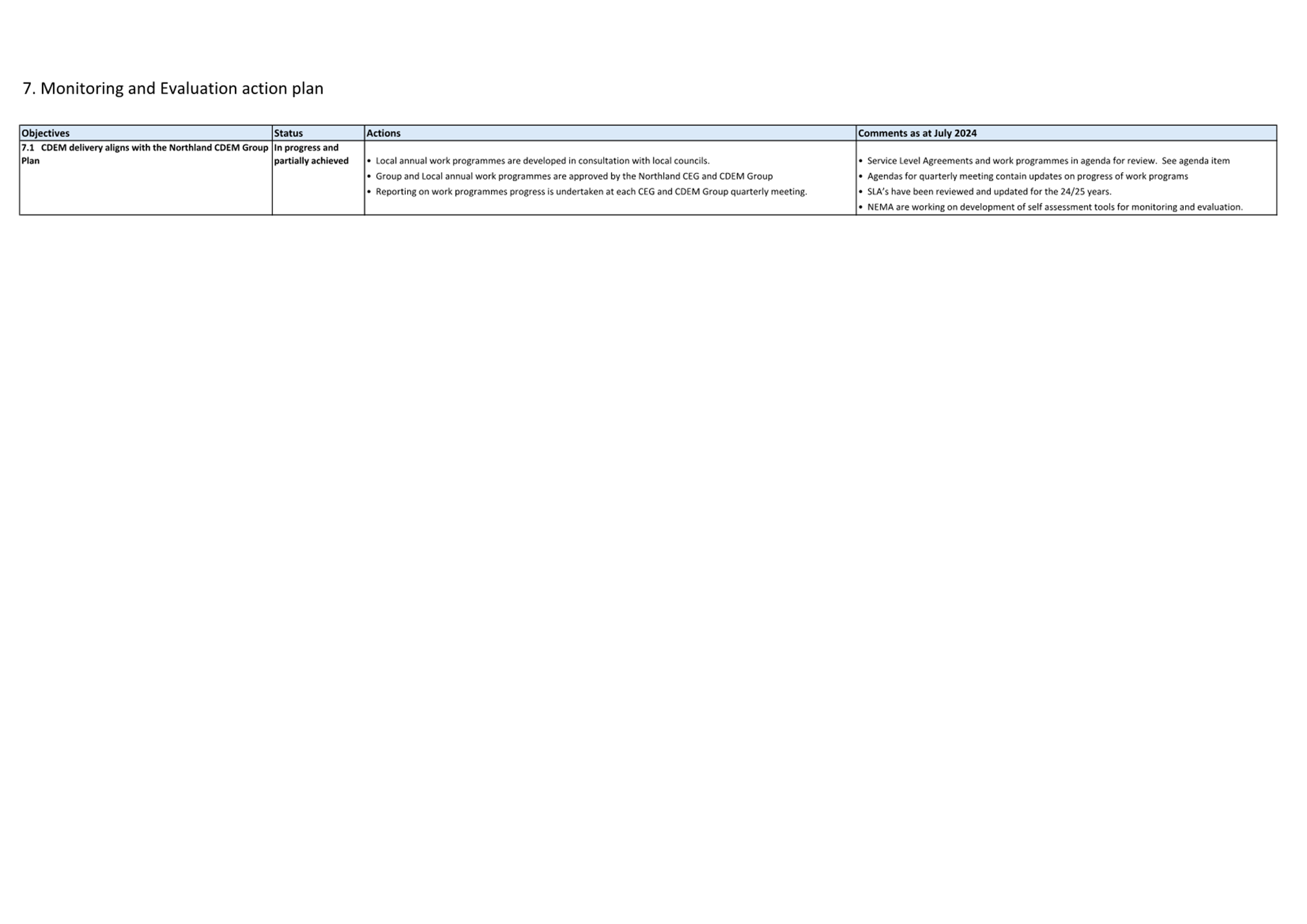
7.2 Northland CDEM Group plan 2021 - 2026 report on objectives, actions and timeframe for next review. 91
7.3 Membership and appointments – Northland CDEM Group 98
8.1 Marae Preparedness & Community Response Groups Update 102
Civil Defence Emergency Management Group Meeting item: 4.1
3 September 2024
|
TITLE: |
Confirmation of Minutes - 4 June 2024 |
|
From: |
Haylee Labelle, Personal Assistant Community Resilience |
|
Authorised by Group Manager/s: |
Louisa Gritt, Group Manager - Community Resilience, on 15 August 2024 |
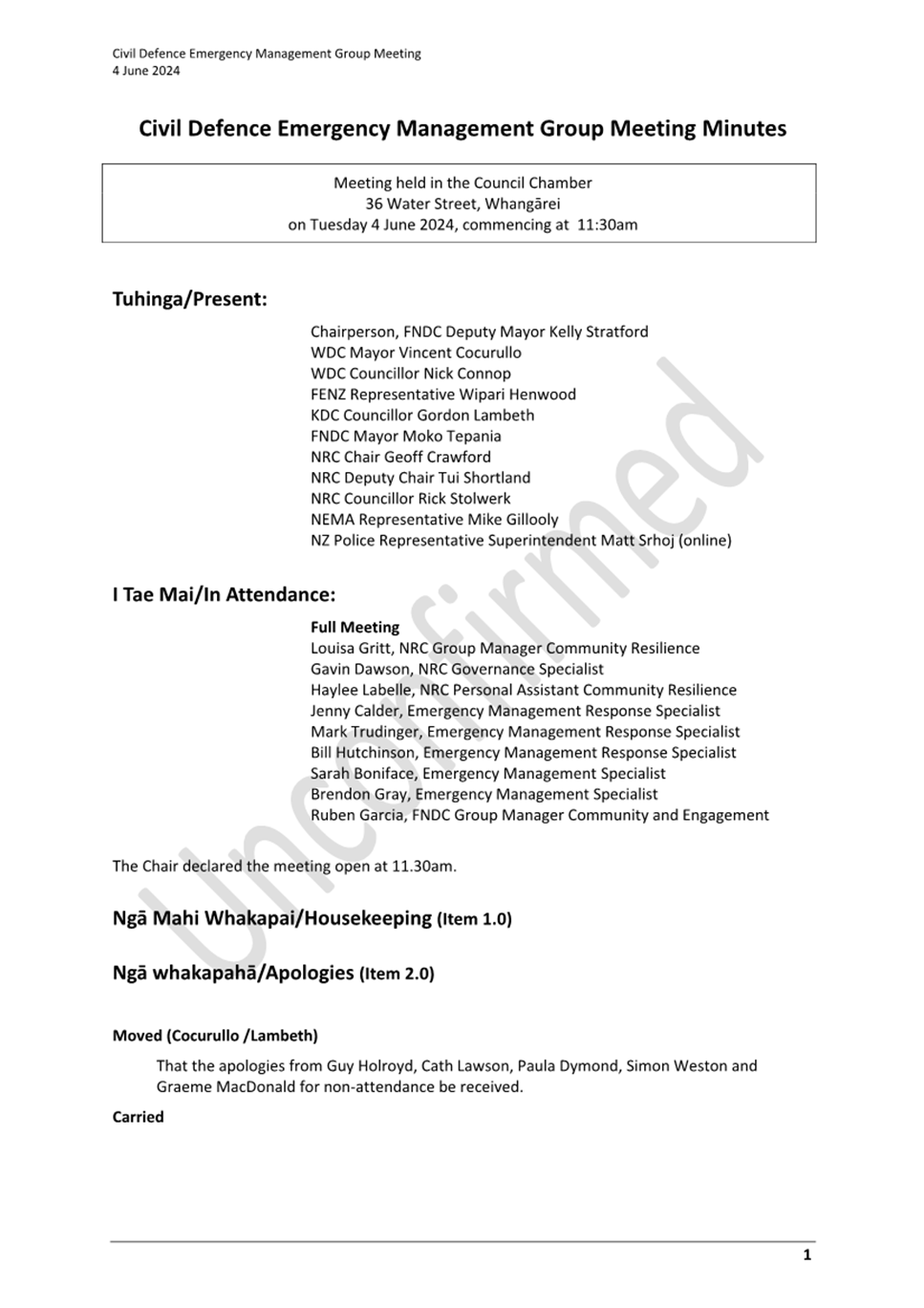
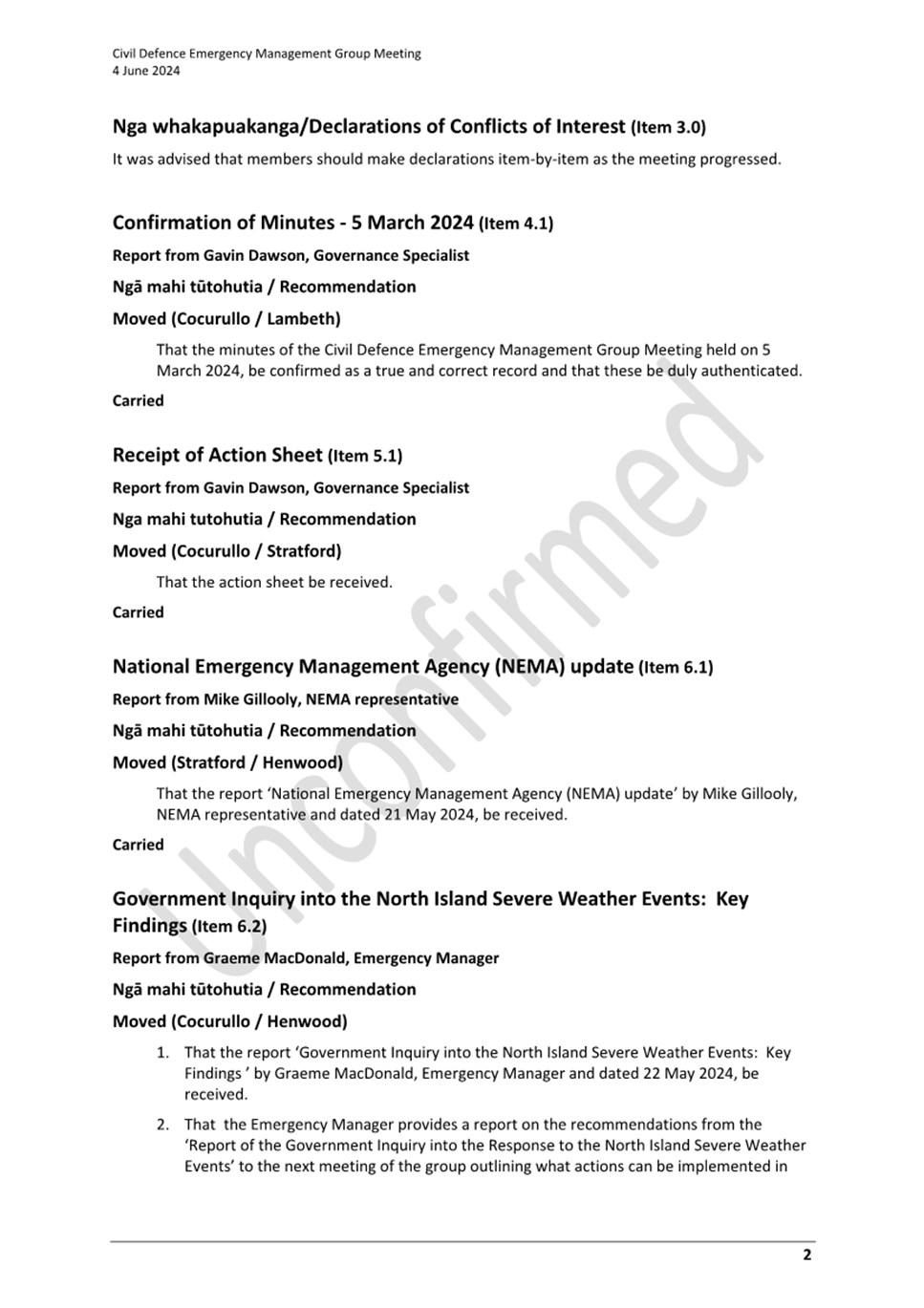
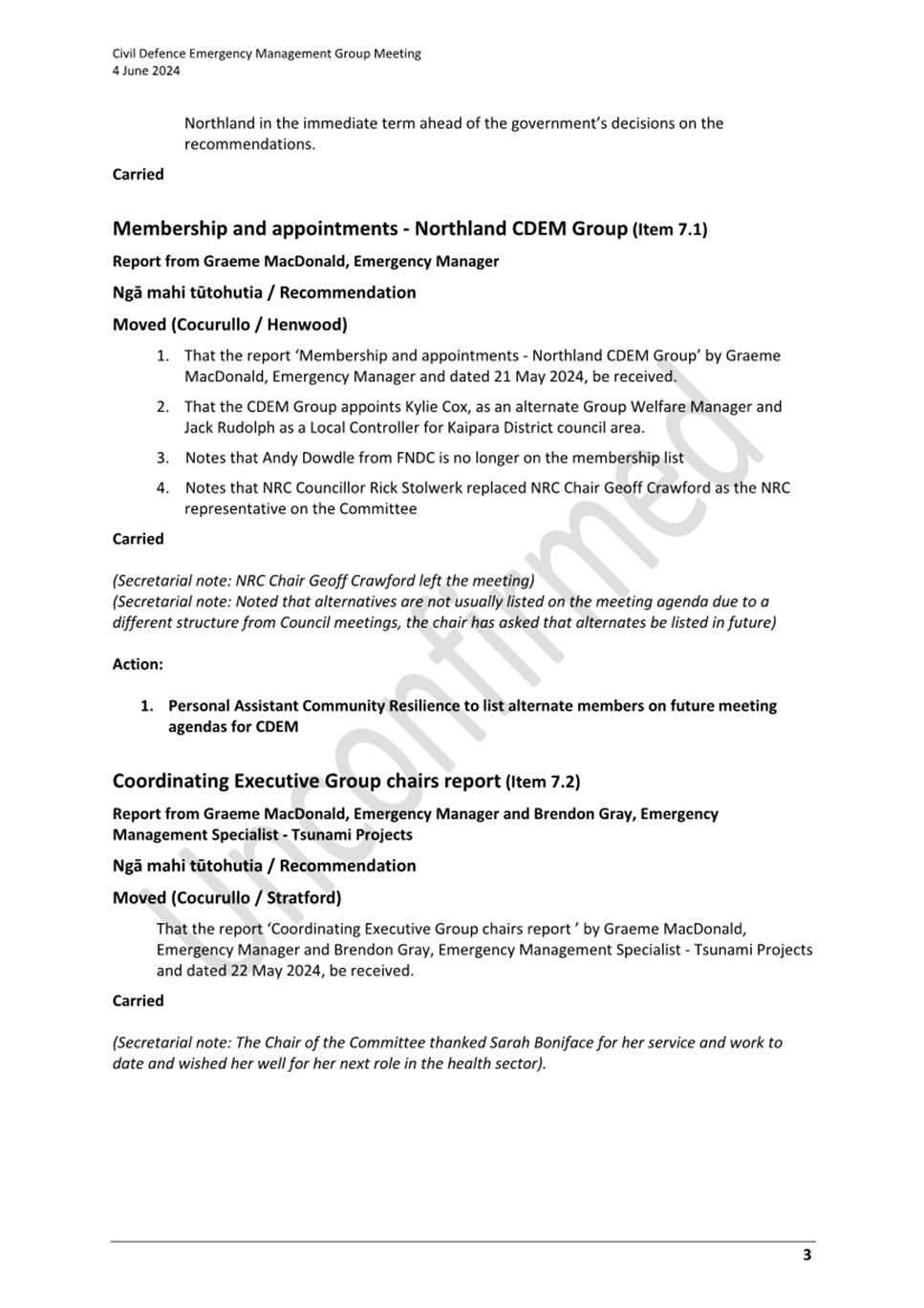
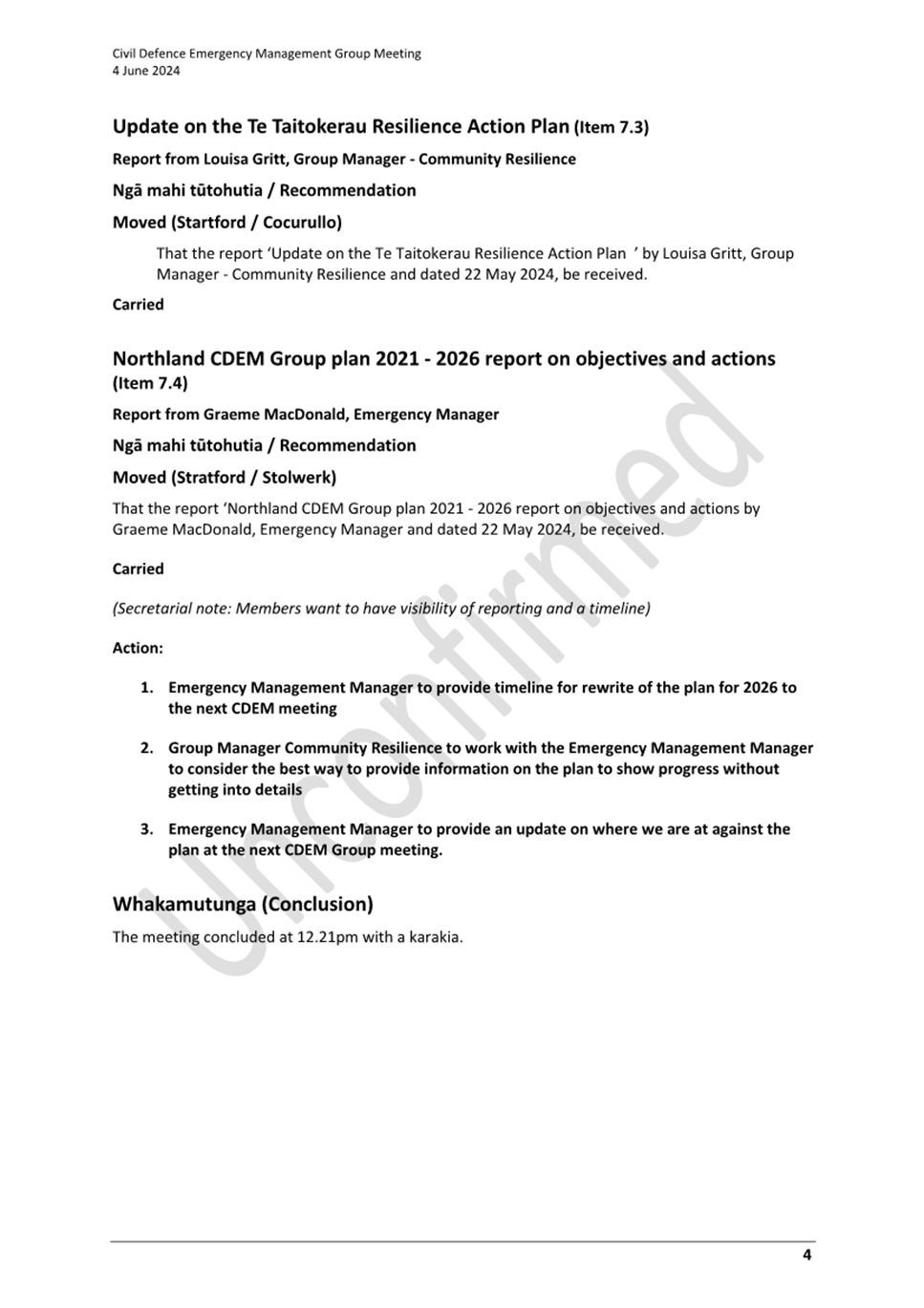
That the minutes of the Civil Defence Emergency Management meeting held on 4 June2024, be confirmed as a true and correct record and that these be duly authenticated.
Attachments/Ngā tapirihanga
Attachment 1: CDEM Meeting Minutes - 4
June 2024 ⇩ 
Civil Defence Emergency Management Group Meeting item: 5.1
3 September 2024
|
TITLE: |
Receipt of Action Sheet - September 2024 |
|
From: |
Haylee Labelle, Personal Assistant Community Resilience |
|
Authorised by Group Manager/s: |
Louisa Gritt, Group Manager - Community Resilience, on 15 August 2024 |
Whakarāpopototanga / Executive summary
The purpose of this report is to enable the meeting to receive the current action sheet.
That the action sheet be received.
Attachments/Ngā tapirihanga
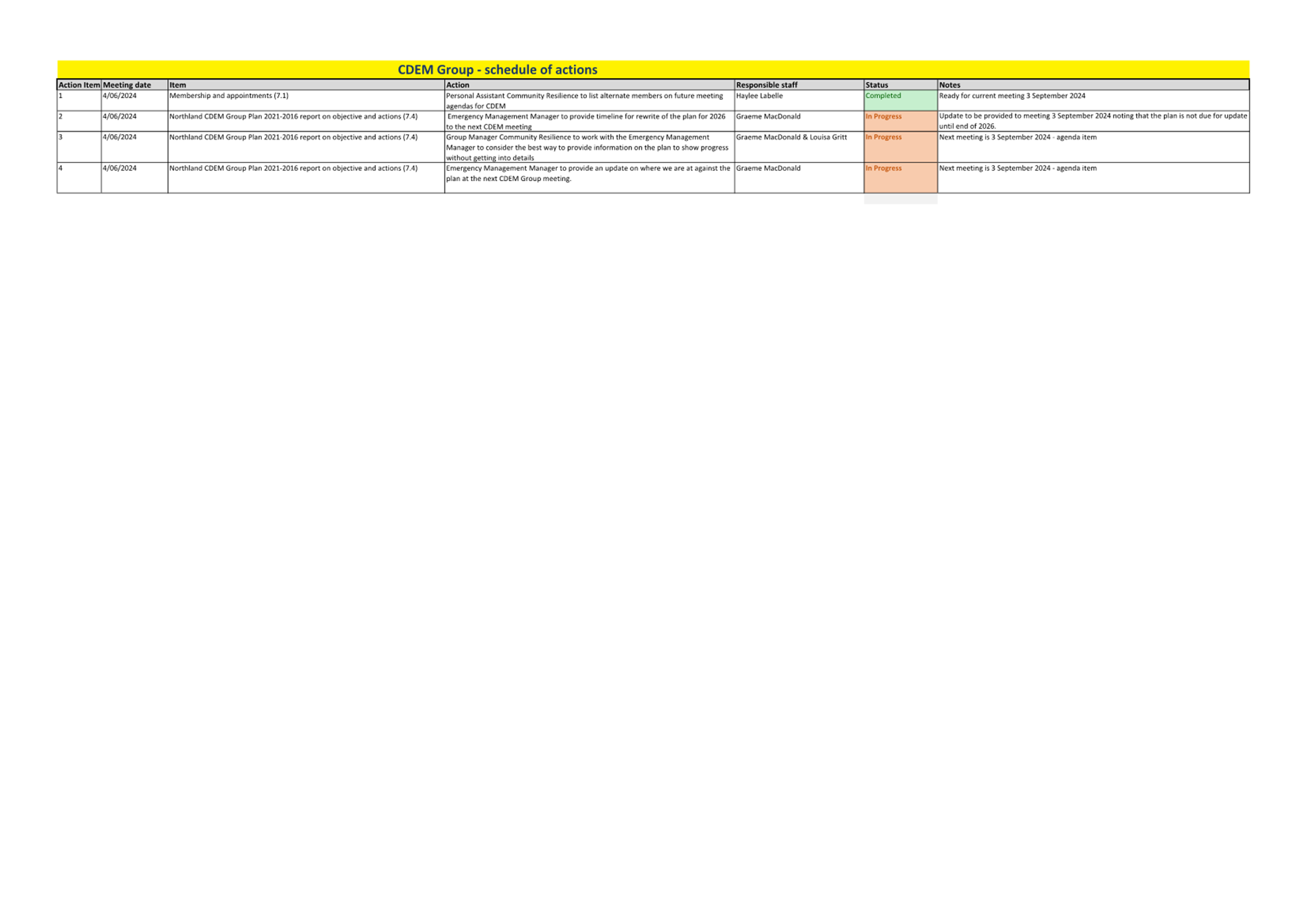
Attachment 1: CDEM Action Tracker -
September 2024 ⇩
Civil Defence Emergency Management Group Meeting item: 6.1
3 September 2024
|
TITLE: |
Presentation - Security Intelligence Service |
|
From: |
Graeme MacDonald, Emergency Manager |
|
Authorised by Group Manager/s: |
Louisa Gritt, Group Manager - Community Resilience, on 23 August 2024 |
Whakarāpopototanga / Executive summary
New Zealand Threat Assessment and Implications for CDEM
This presentation will include:
· An overview of the New Zealand threat assessment, so that the members can understand what threats we are seeing in New Zealand and can consider them within their environment.
· SIS will discuss the Terror Threat Level, and what this might mean from a CDEM perspective, in particular for consideration in Group Plans.
· information on mitigating and reporting threats to national security.
That the report ‘Presentation - Security Intelligence Service’ by Graeme MacDonald, Emergency Manager and dated 23 August 2024, be received.
Attachments/Ngā tapirihanga
Nil
Civil Defence Emergency Management Group Meeting item: 6.2
3 September 2024
|
TITLE: |
National Emergency Management Agency Update |
|
From: |
Mike Gillooly, NEMA representative |
|
Authorised by Group Manager/s: |
Louisa Gritt, Group Manager - Community Resilience, on 23 August 2024 |
Whakarāpopototanga / Executive summary
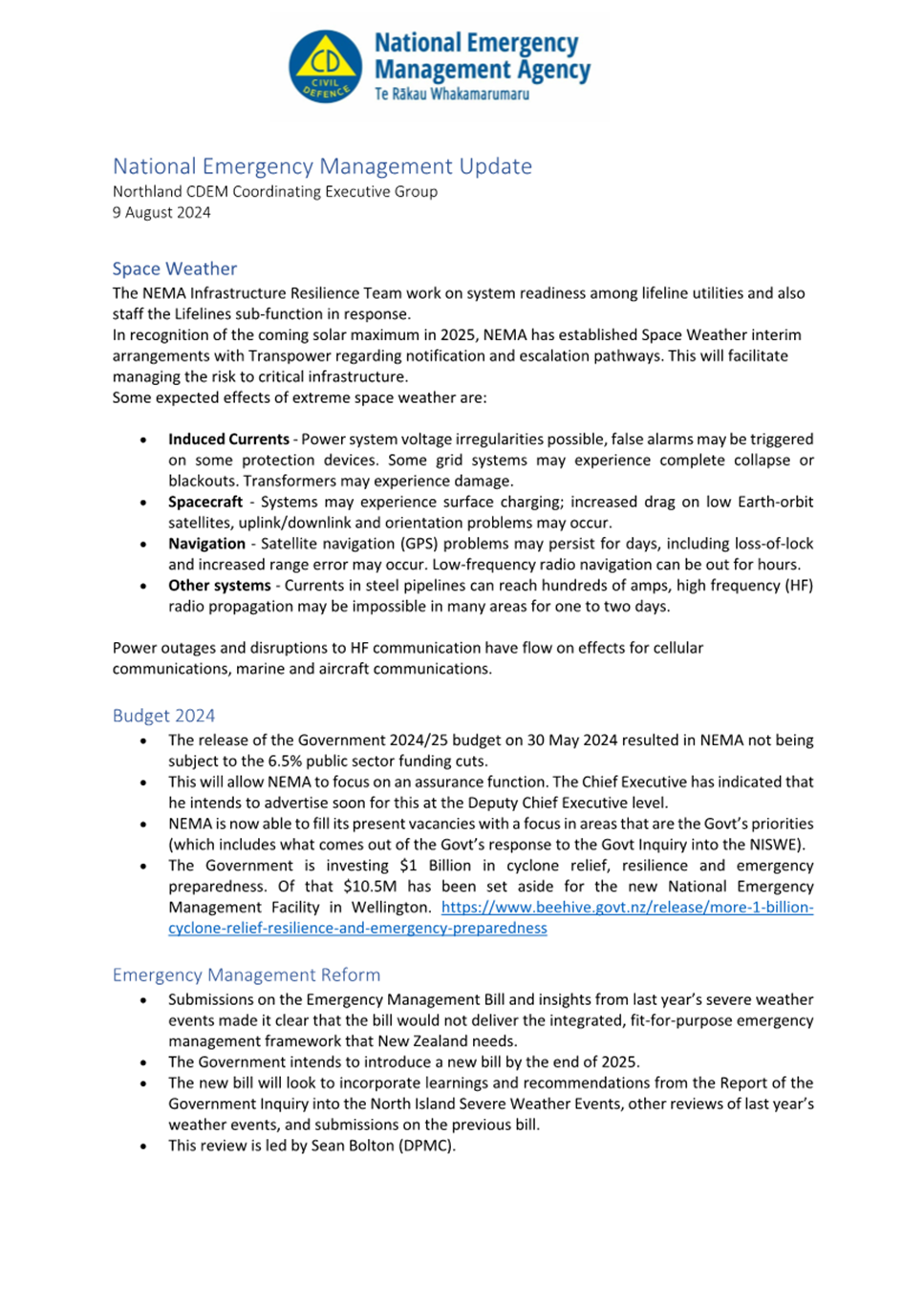
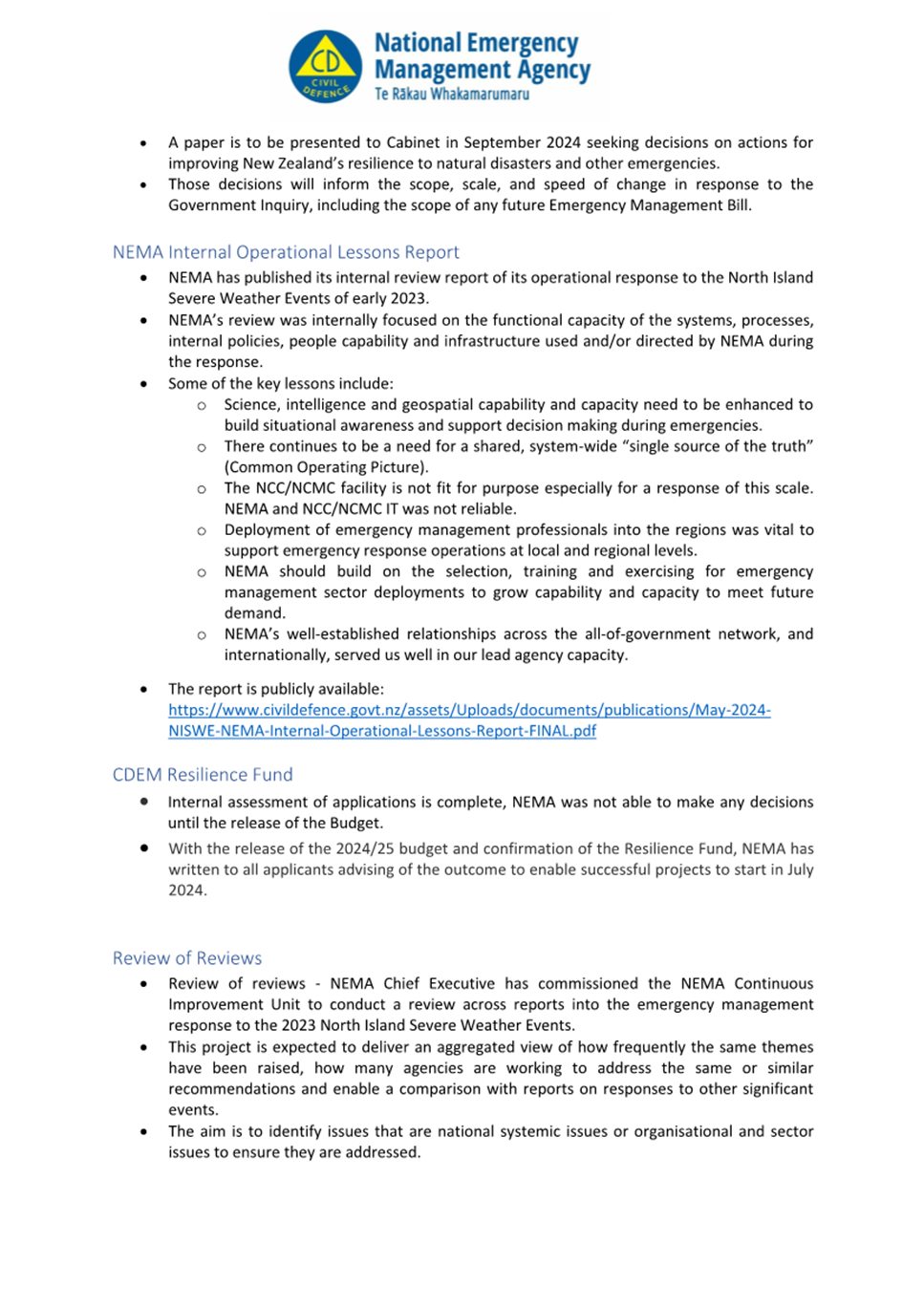
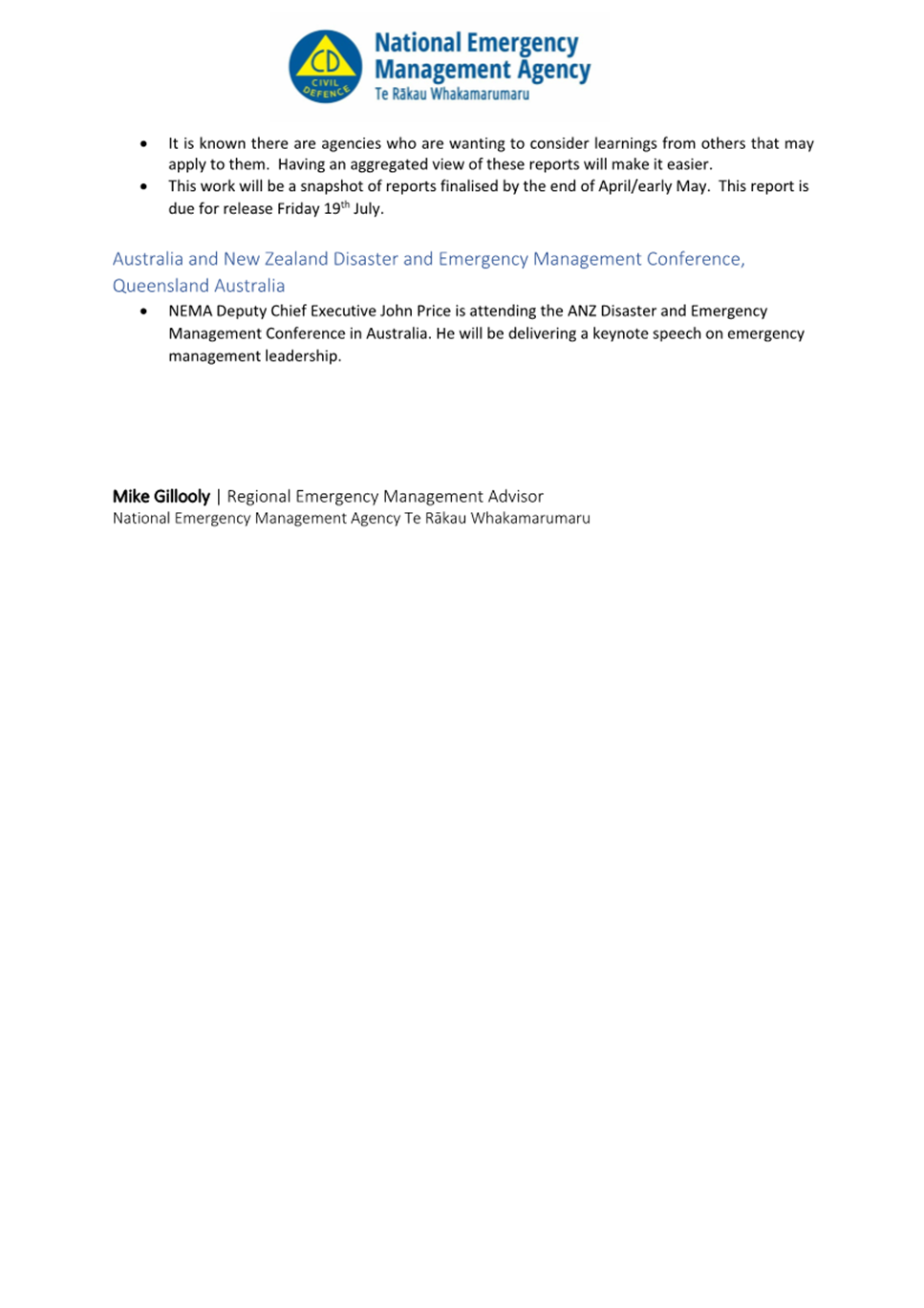
Attached is the July update presented by Mike Gillooly from the National Emergency Management Agency.
That the report ‘National Emergency Management Agency Update ’ by Mike Gillooly, NEMA representative and dated 14 August 2024, be received.
Attachments/Ngā tapirihanga
Attachment 1: National Emergency
Management Agency update July 2024 ⇩
Civil Defence Emergency Management Group Meeting item: 6.3
3 September 2024
|
TITLE: |
Government Inquiry into the North Island Severe Weather Events: Key Findings |
|
From: |
Graeme MacDonald, Emergency Manager |
|
Authorised by Group Manager/s: |
Louisa Gritt, Group Manager - Community Resilience, on 21 August 2024 |
Whakarāpopototanga / Executive summary
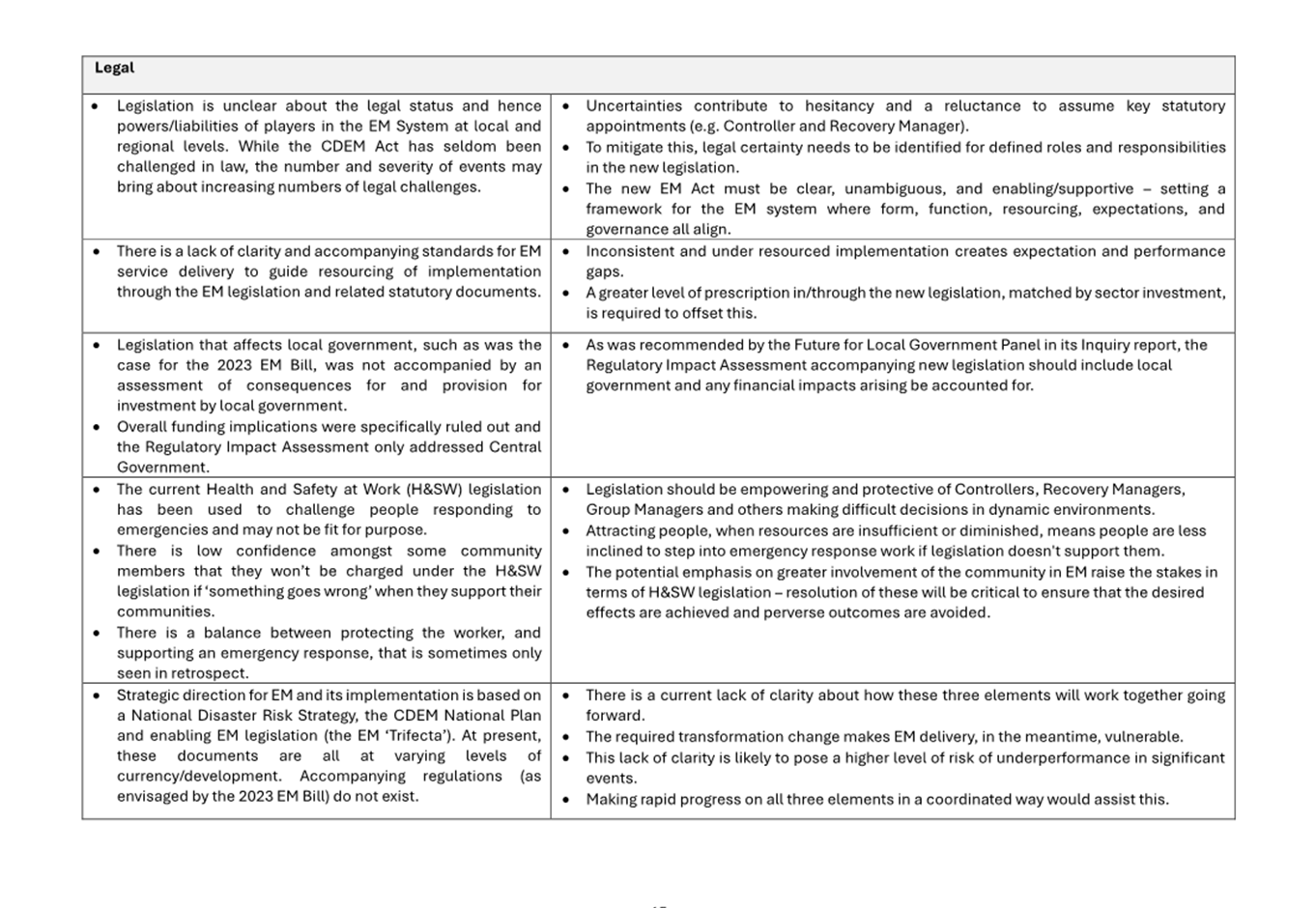
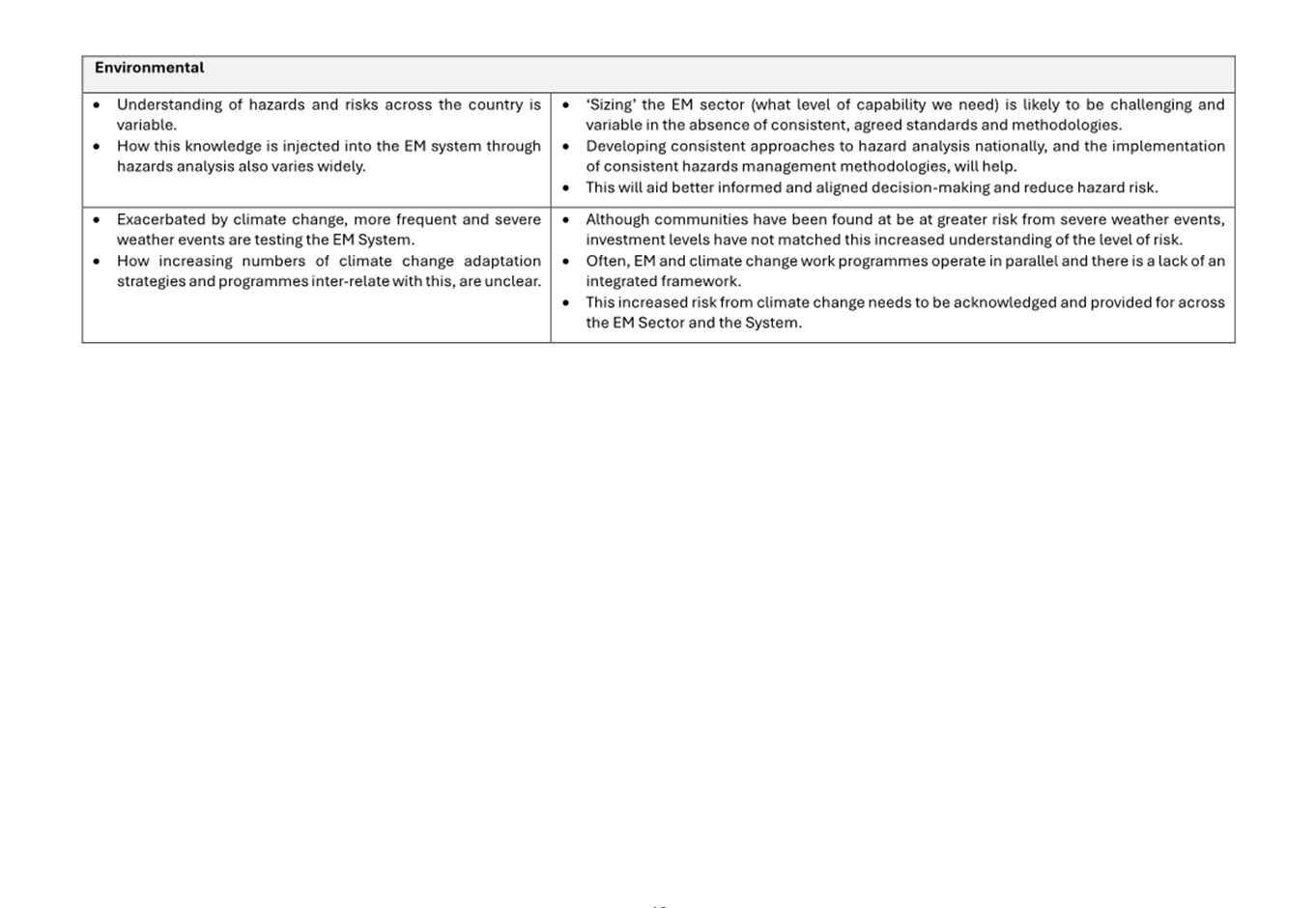
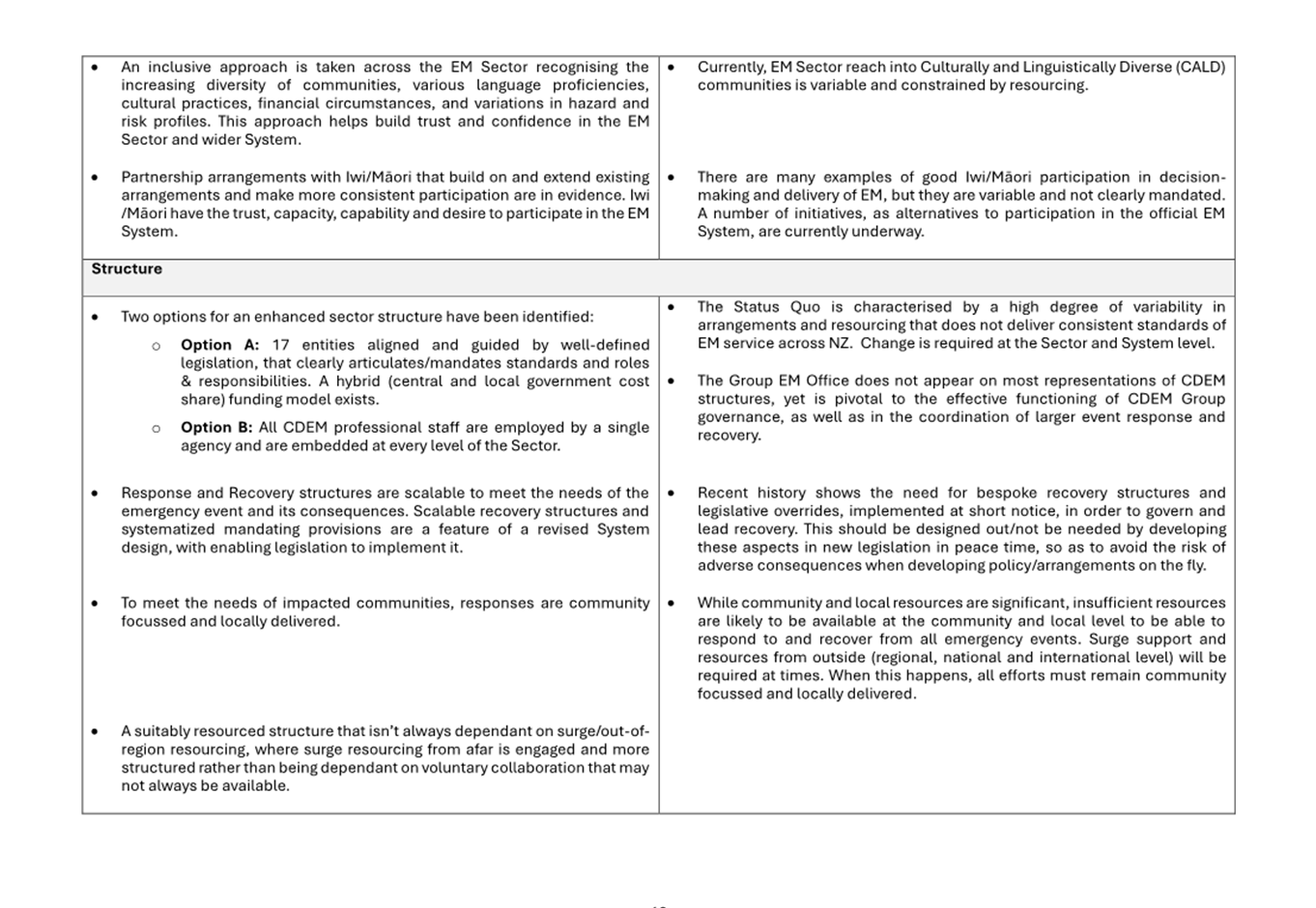
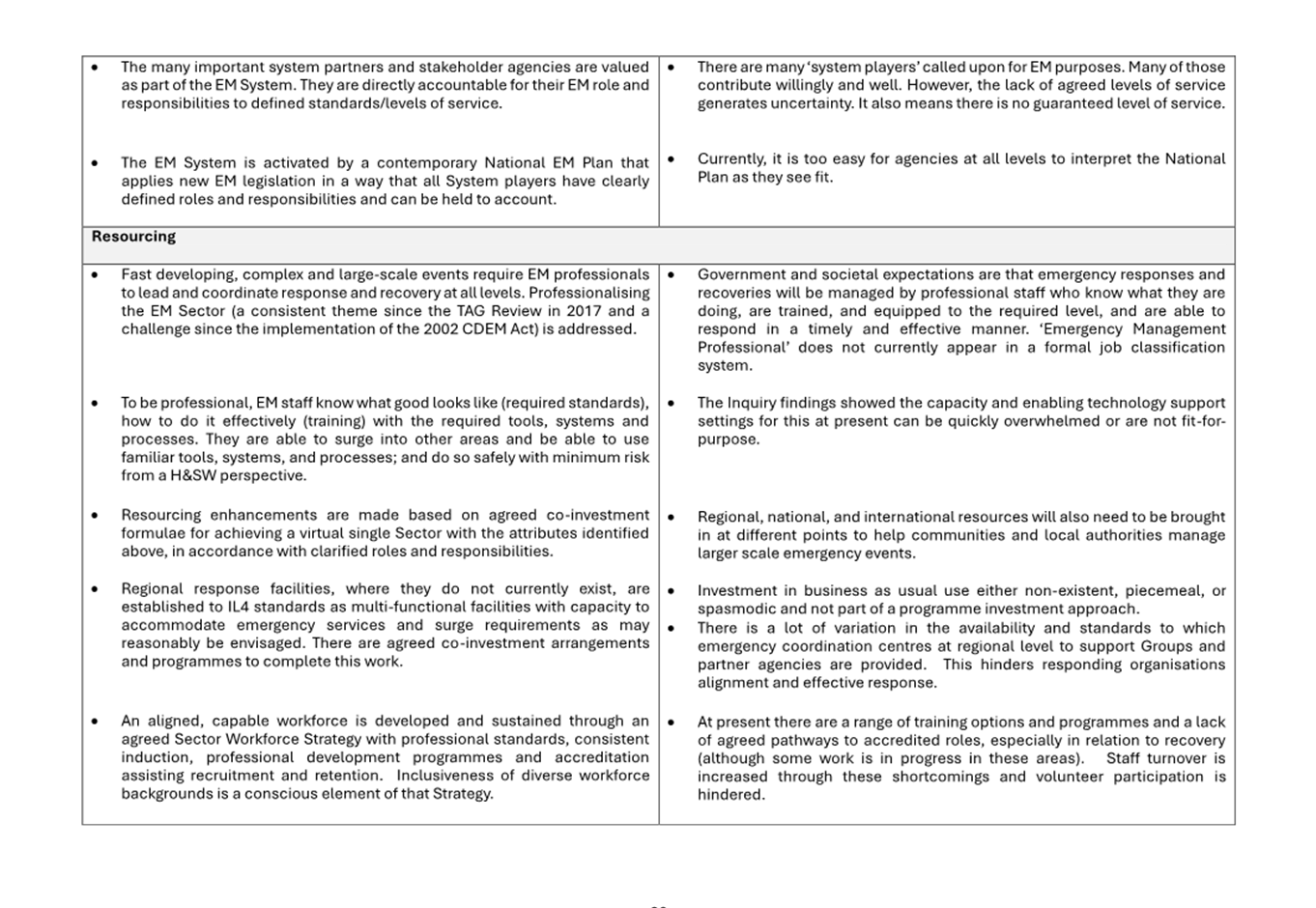
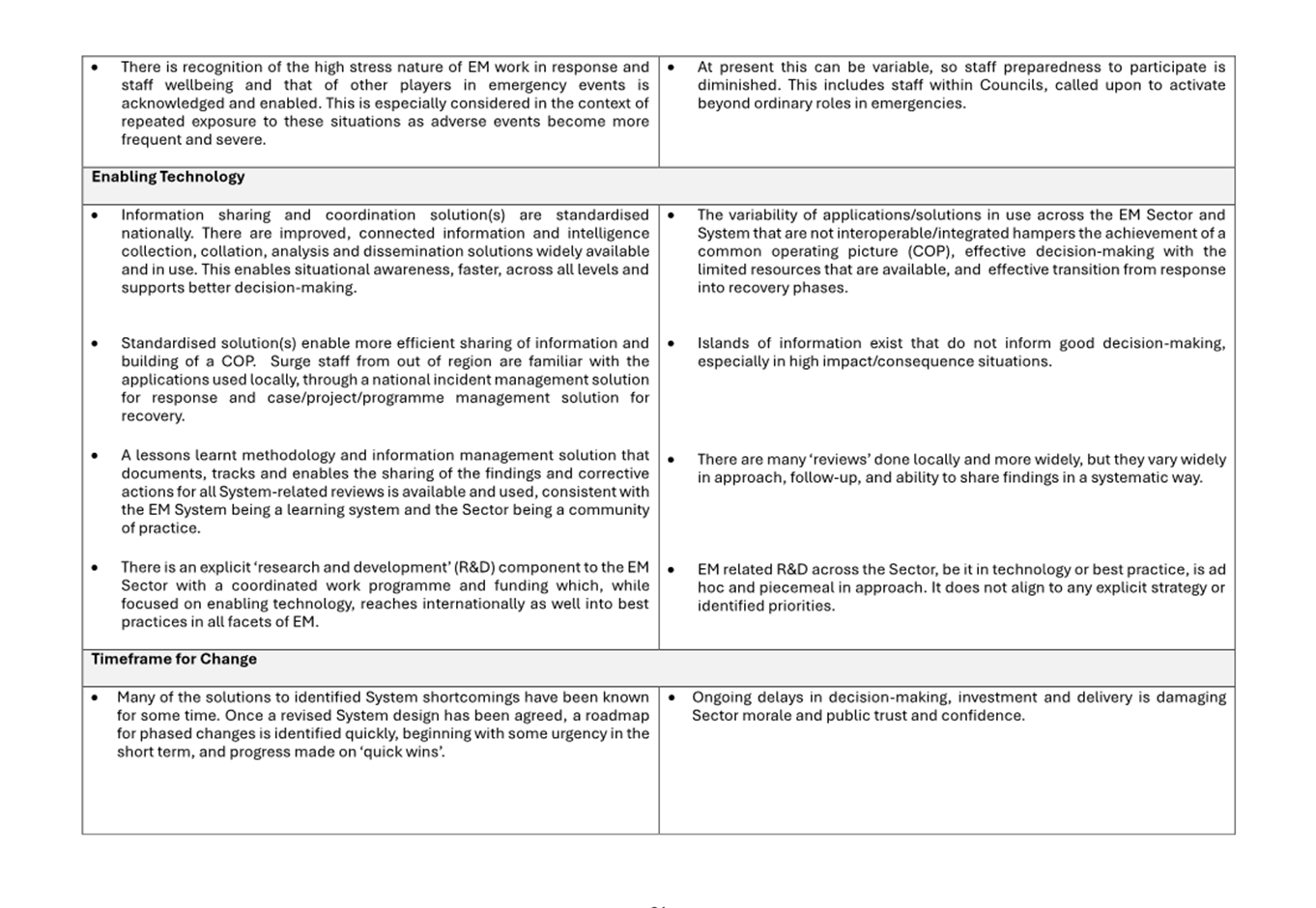
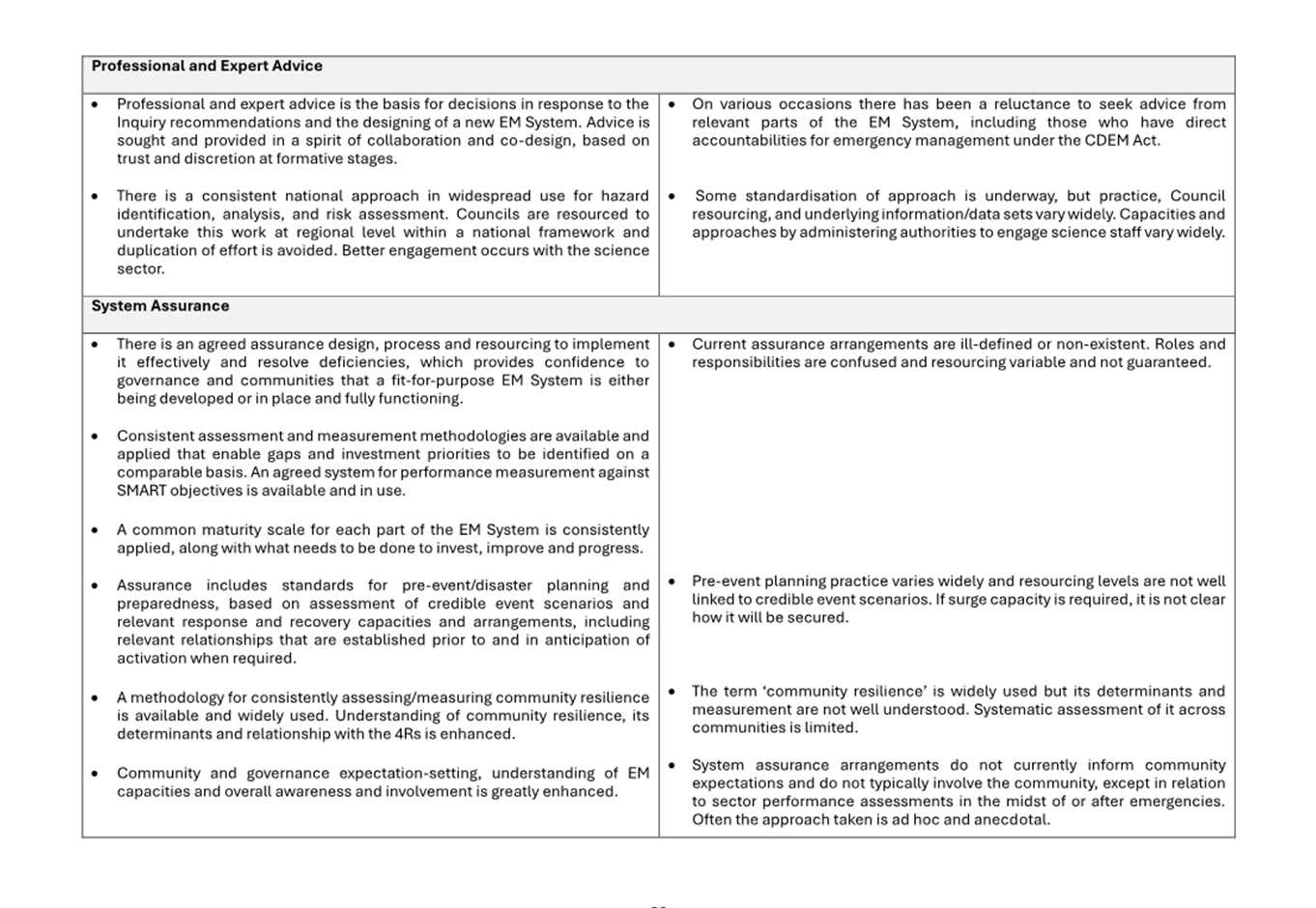
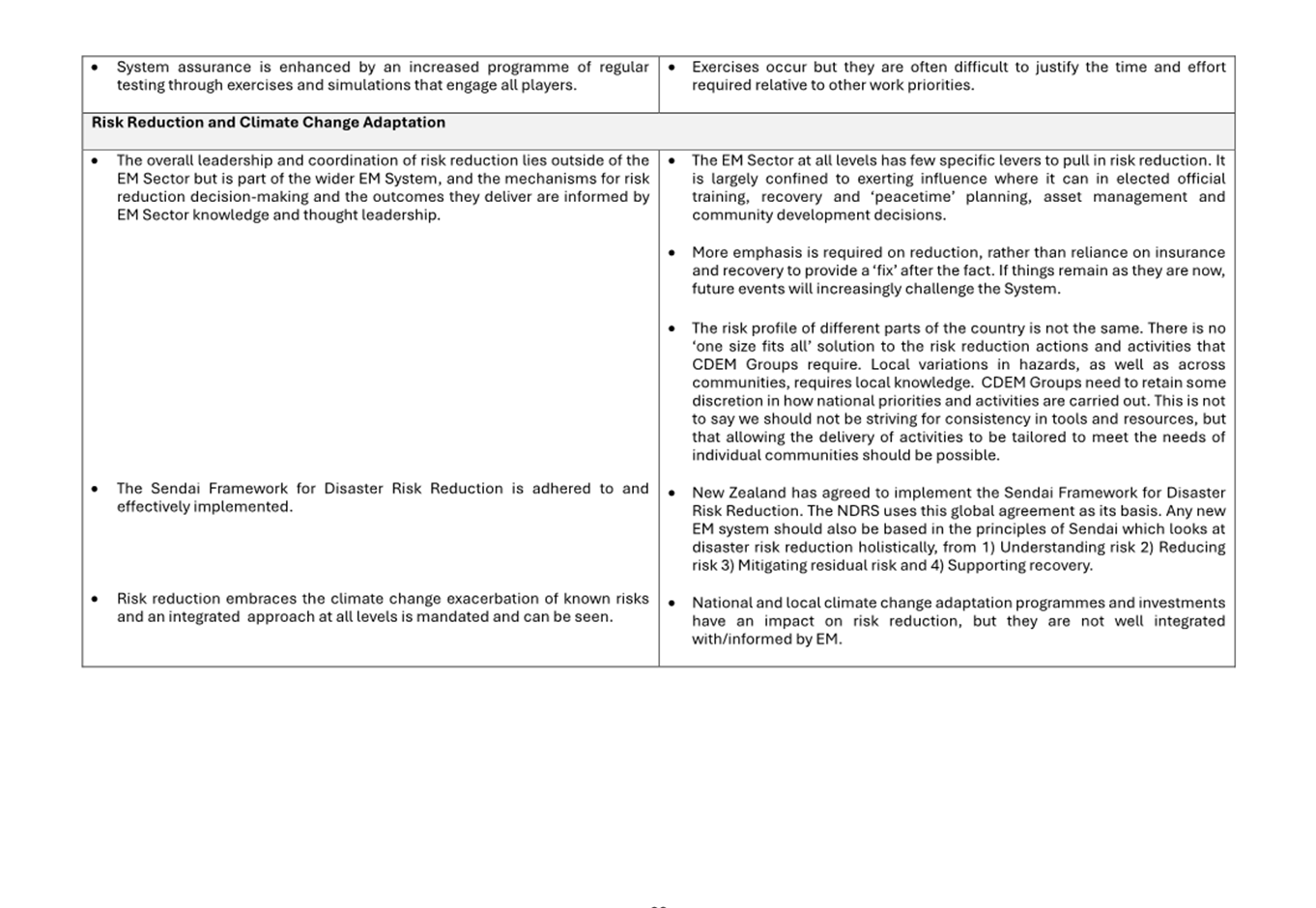
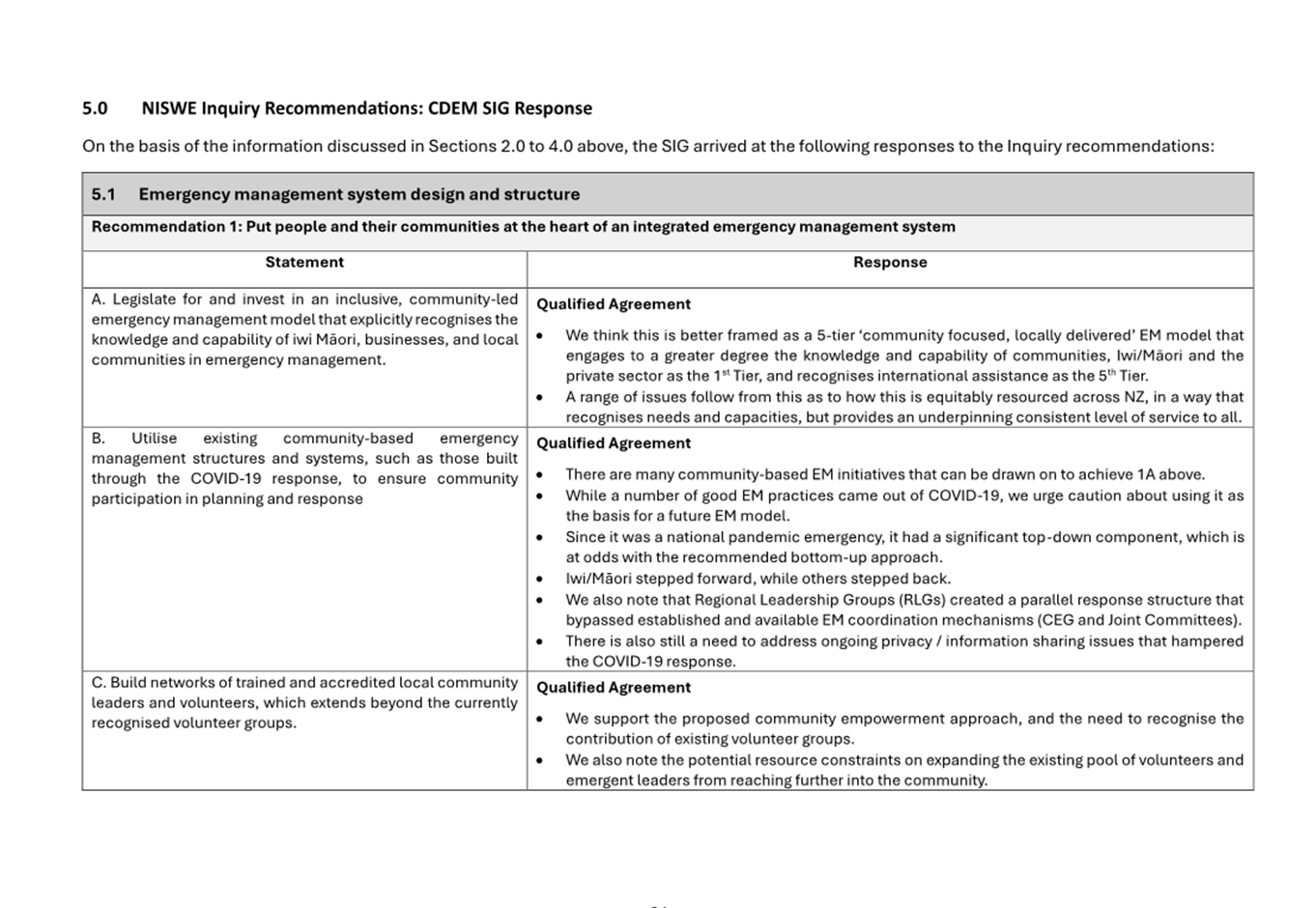
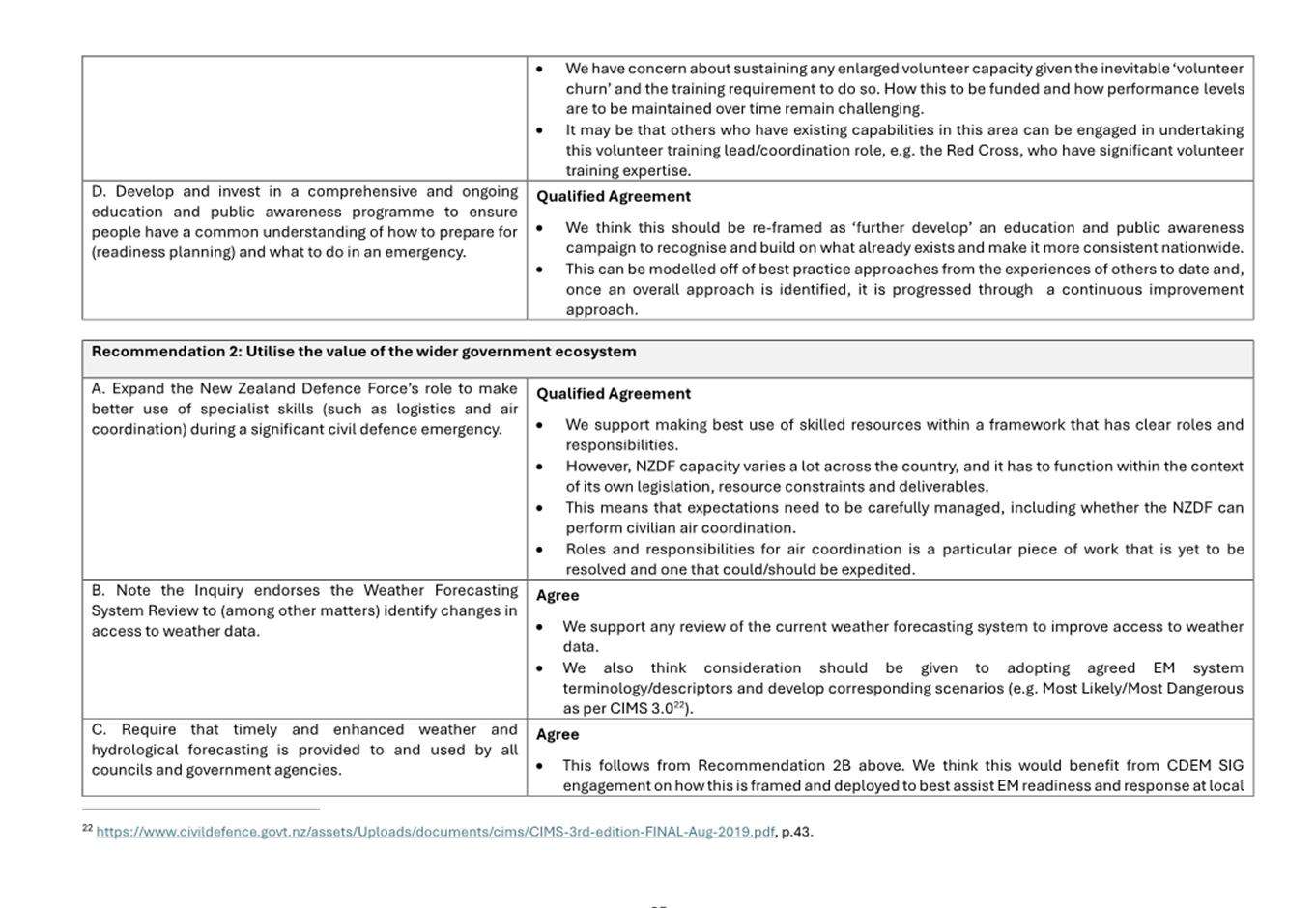
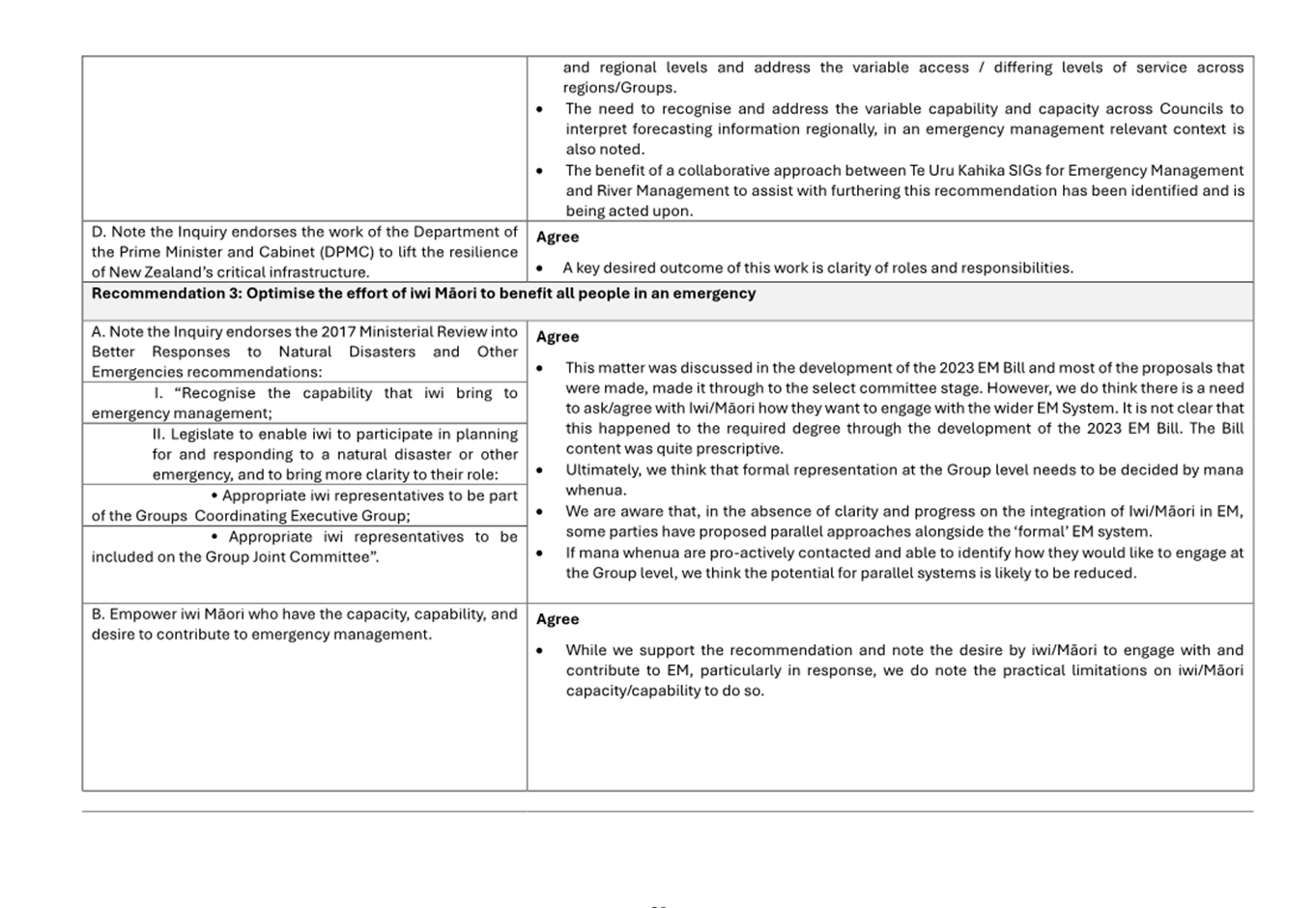
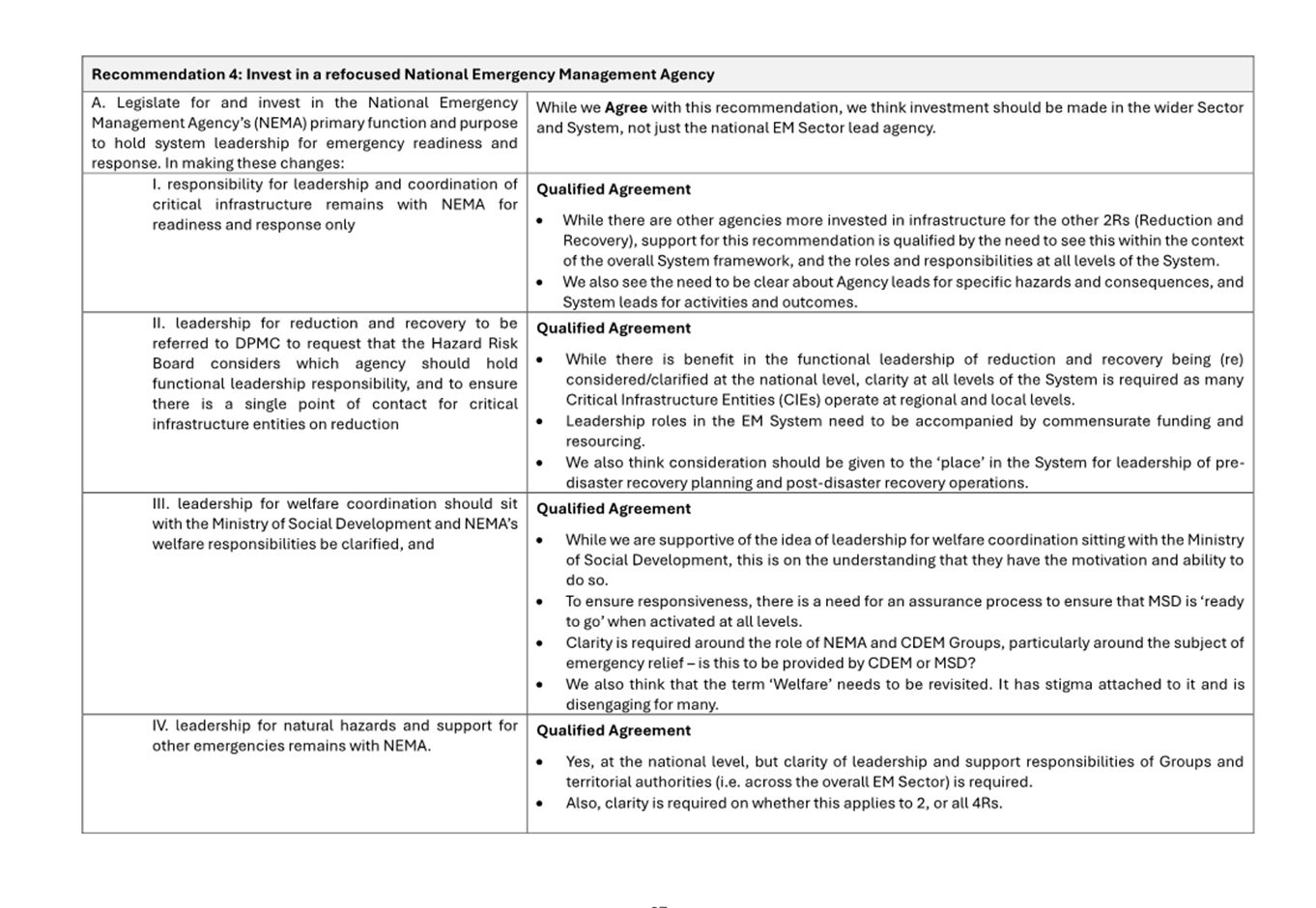
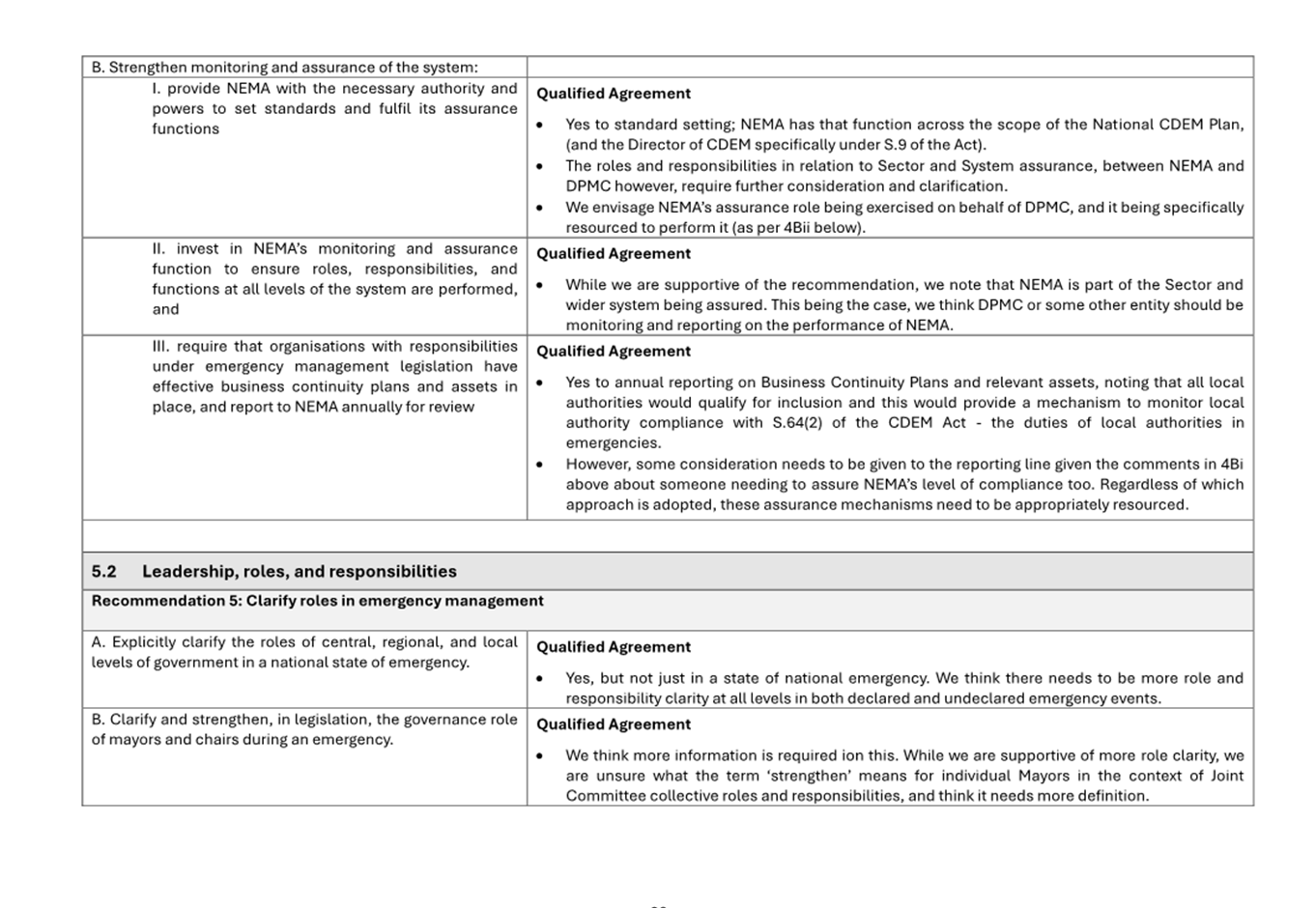
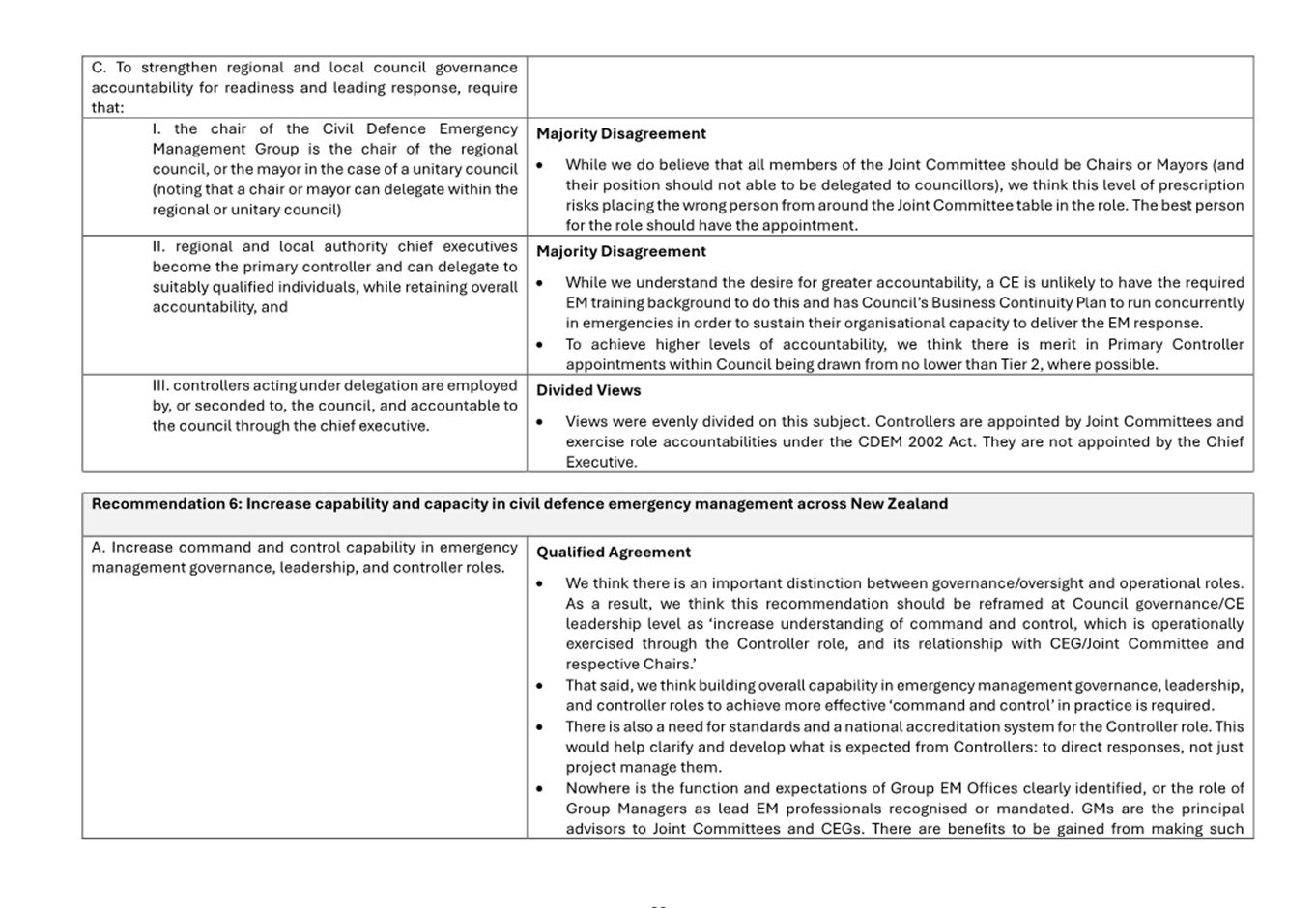
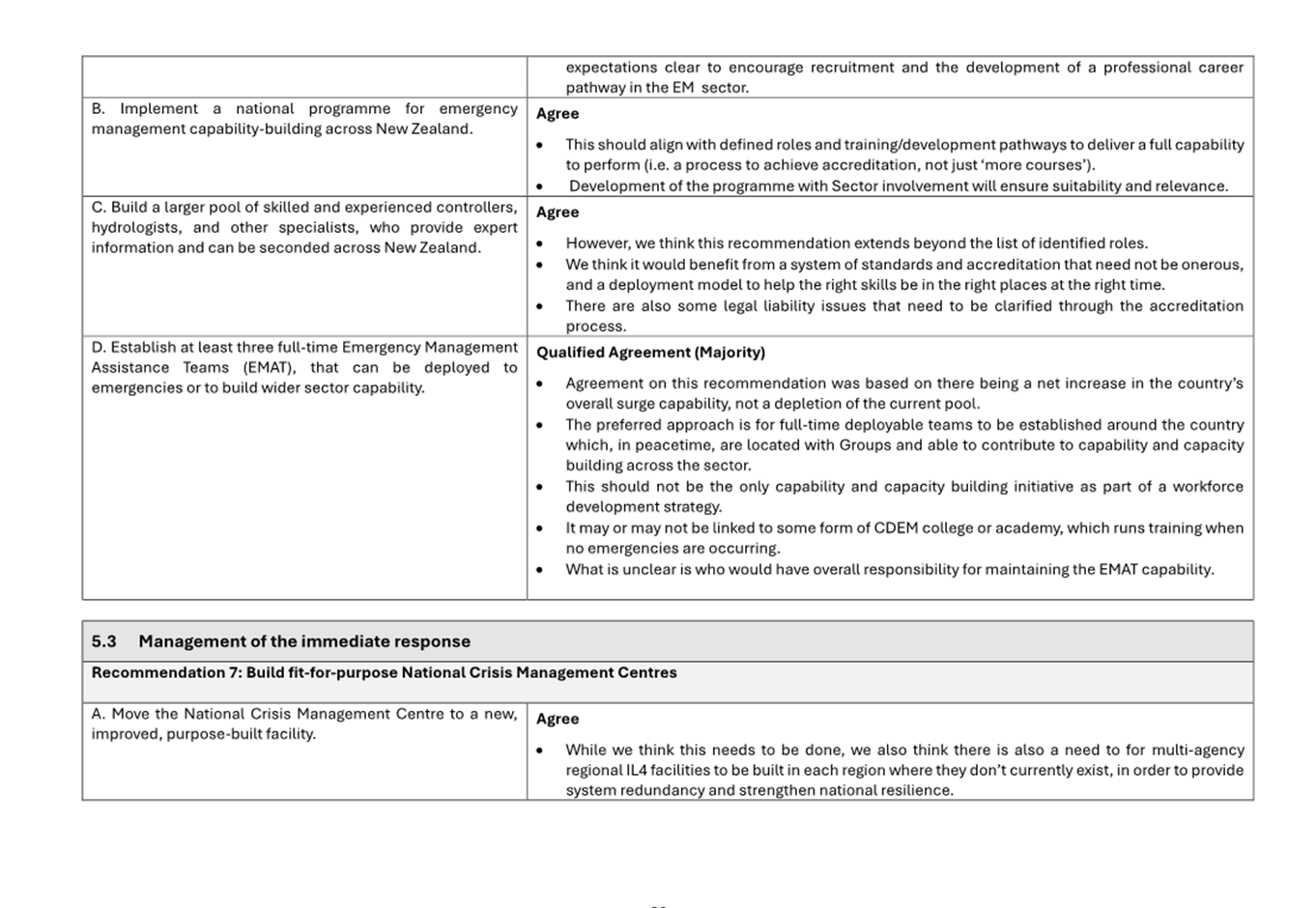
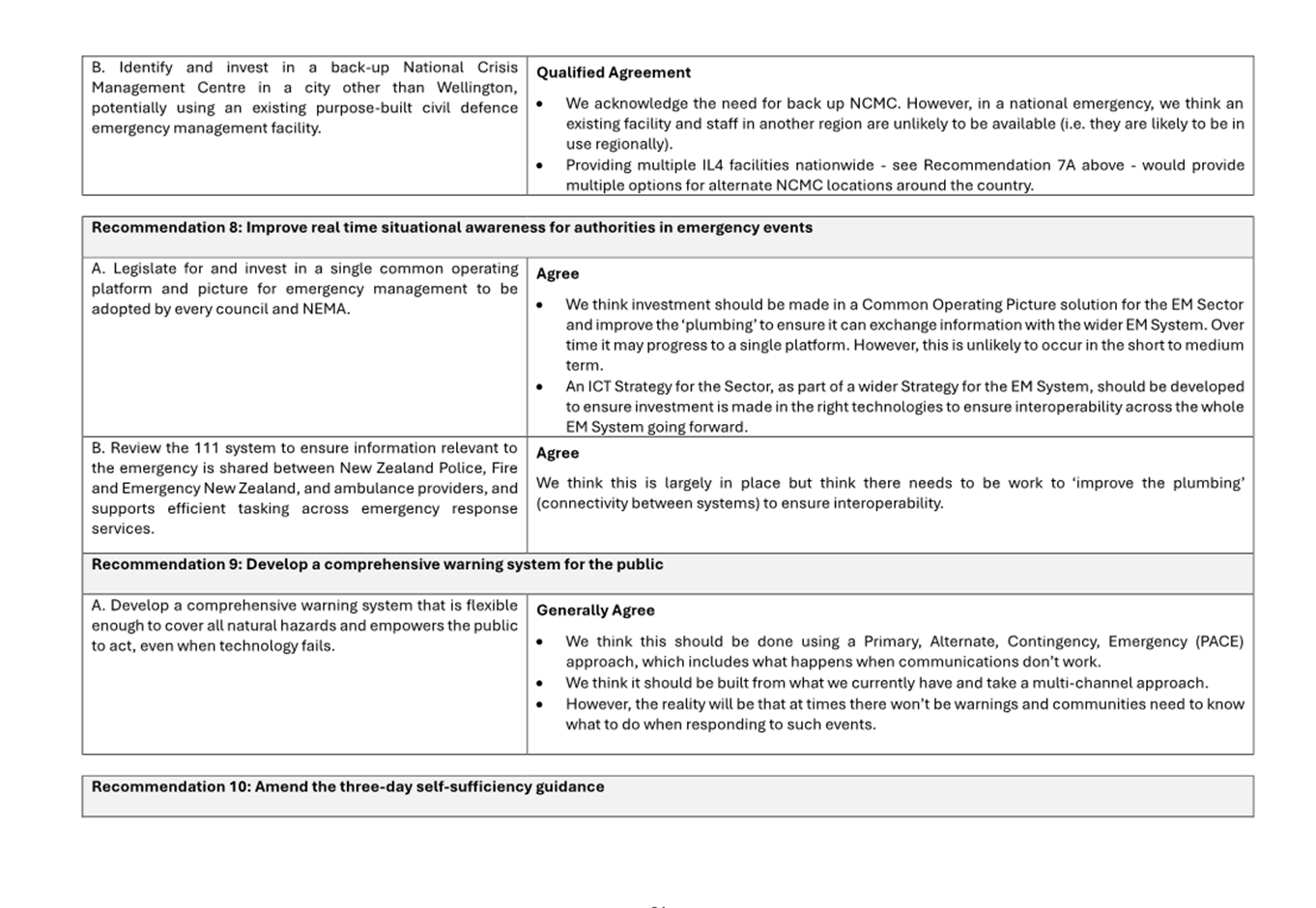
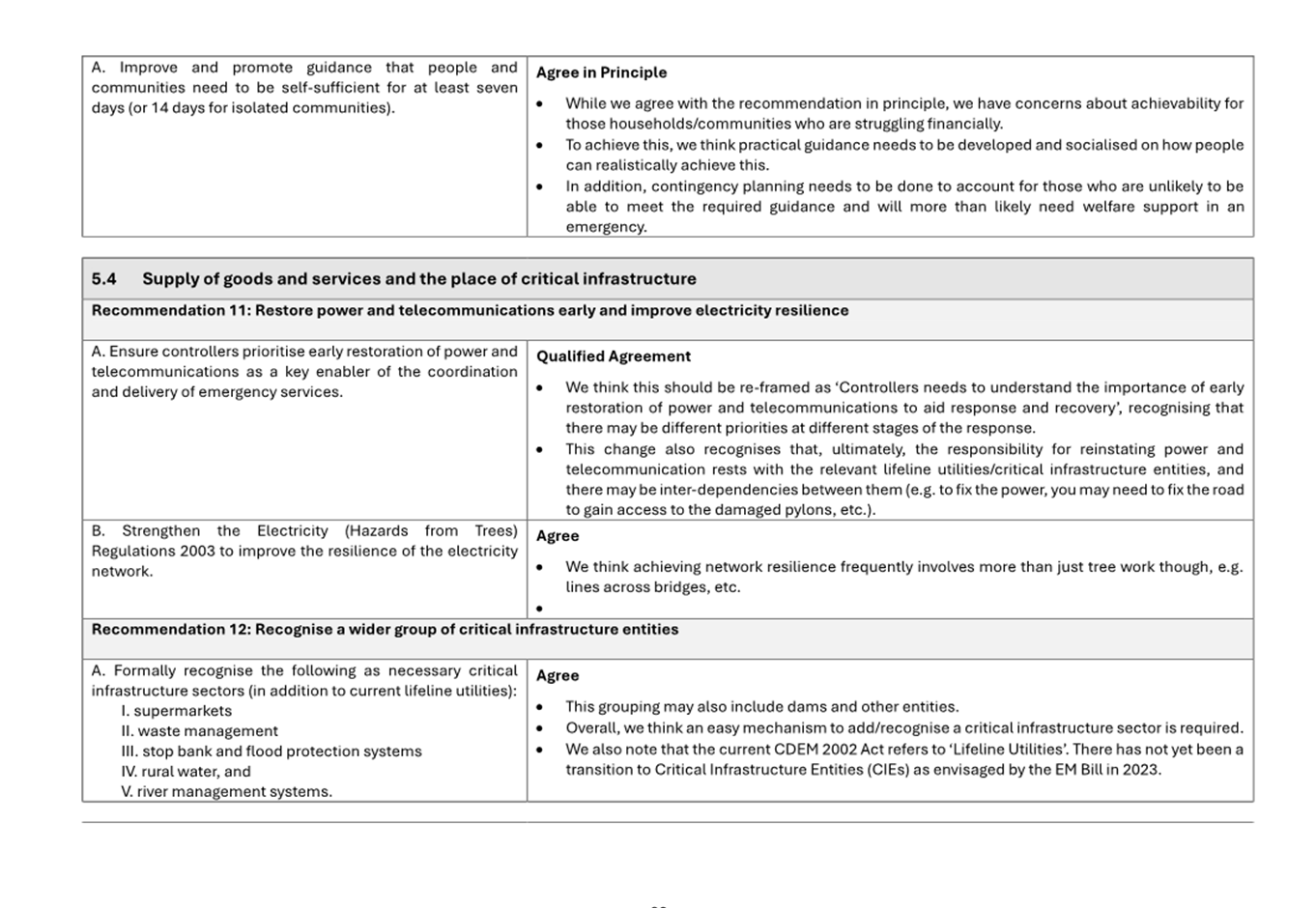
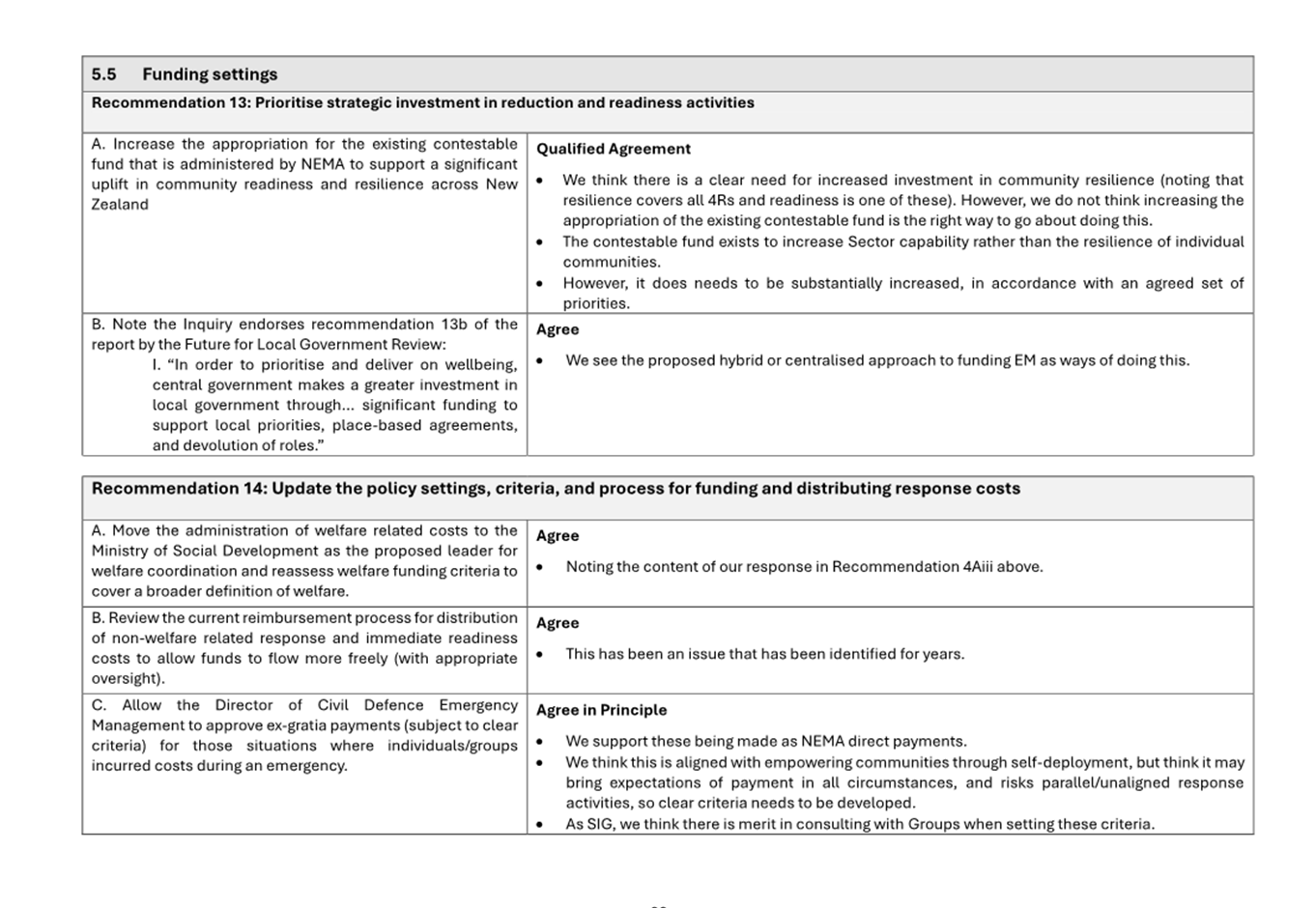
At the May meeting, the CEG reviewed the key takeaways from the "Report of the Government Inquiry into the Response to the North Island Severe Weather Events" (the Inquiry).
While awaiting final government decisions on the Inquiry's recommendations, the CEG asked to identify actionable items that could be implemented proactively within Northland. To facilitate this, the CEG requested a dedicated agenda item for the next meeting to explore these specific actions.
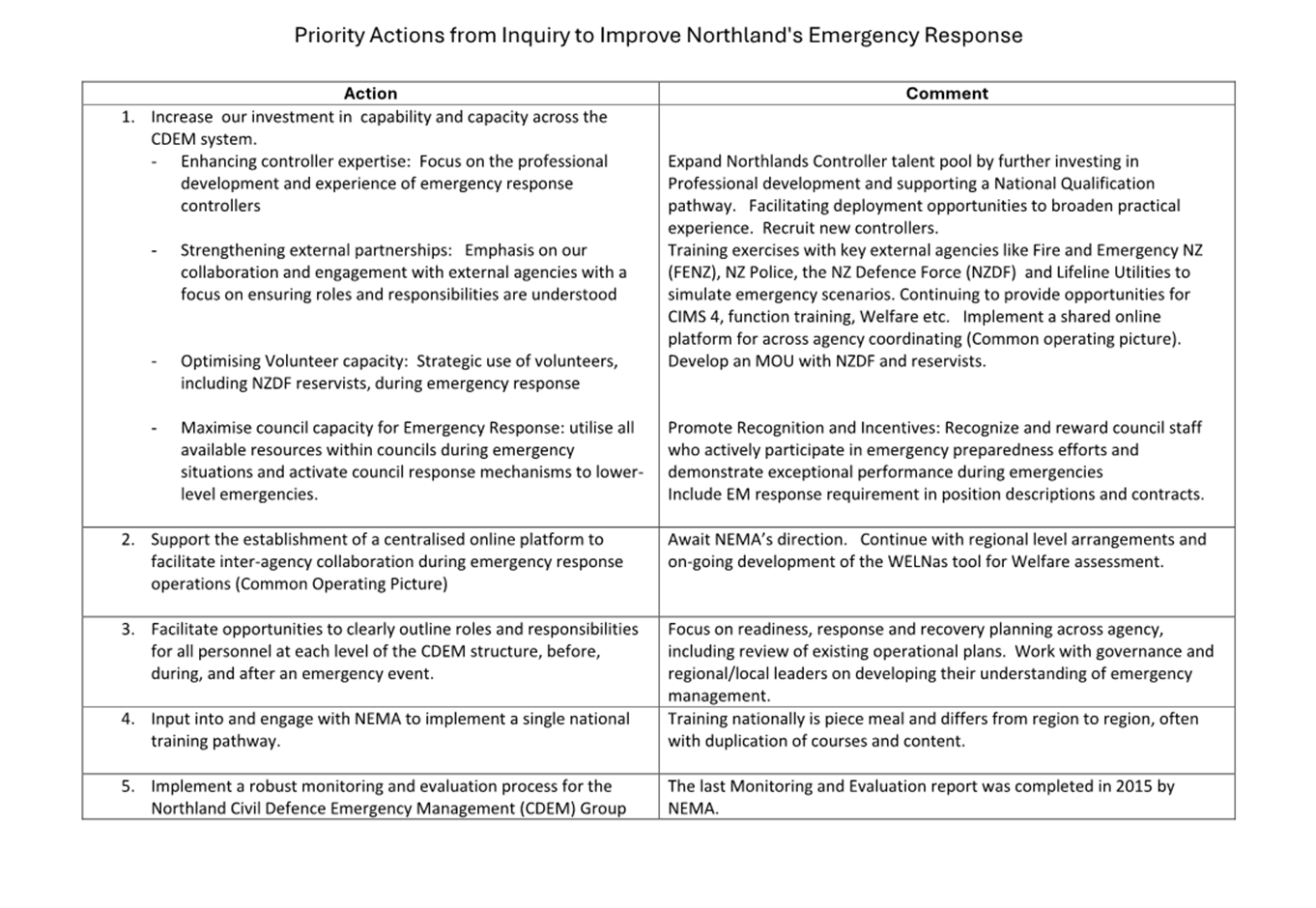
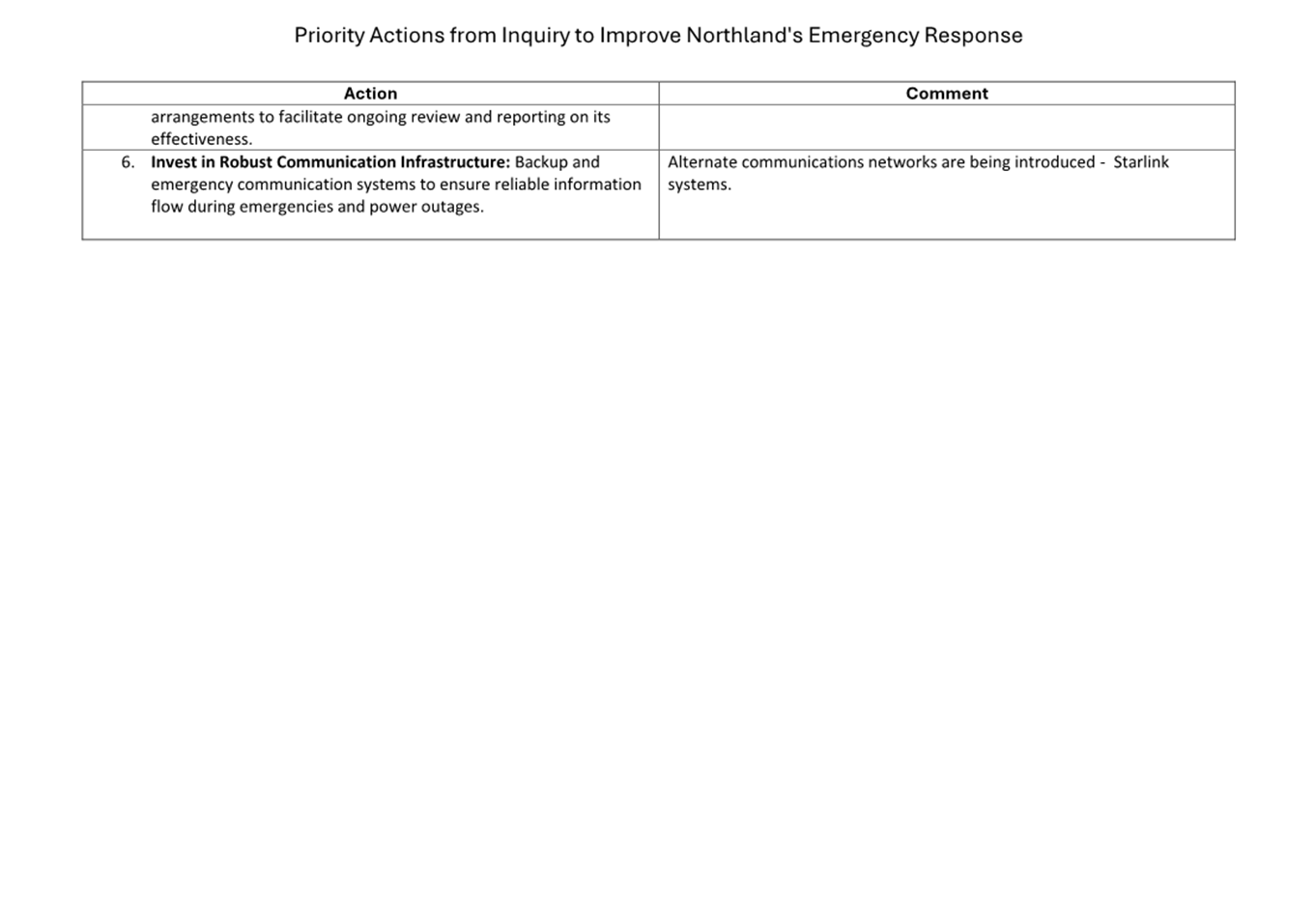
Actionable items table
Attached for the information of the Group is the table from the Emergency Managers report and the recommendations from the inquiry. (Attachment 1).
Emergency Managers Input on Government Response (May 2024)
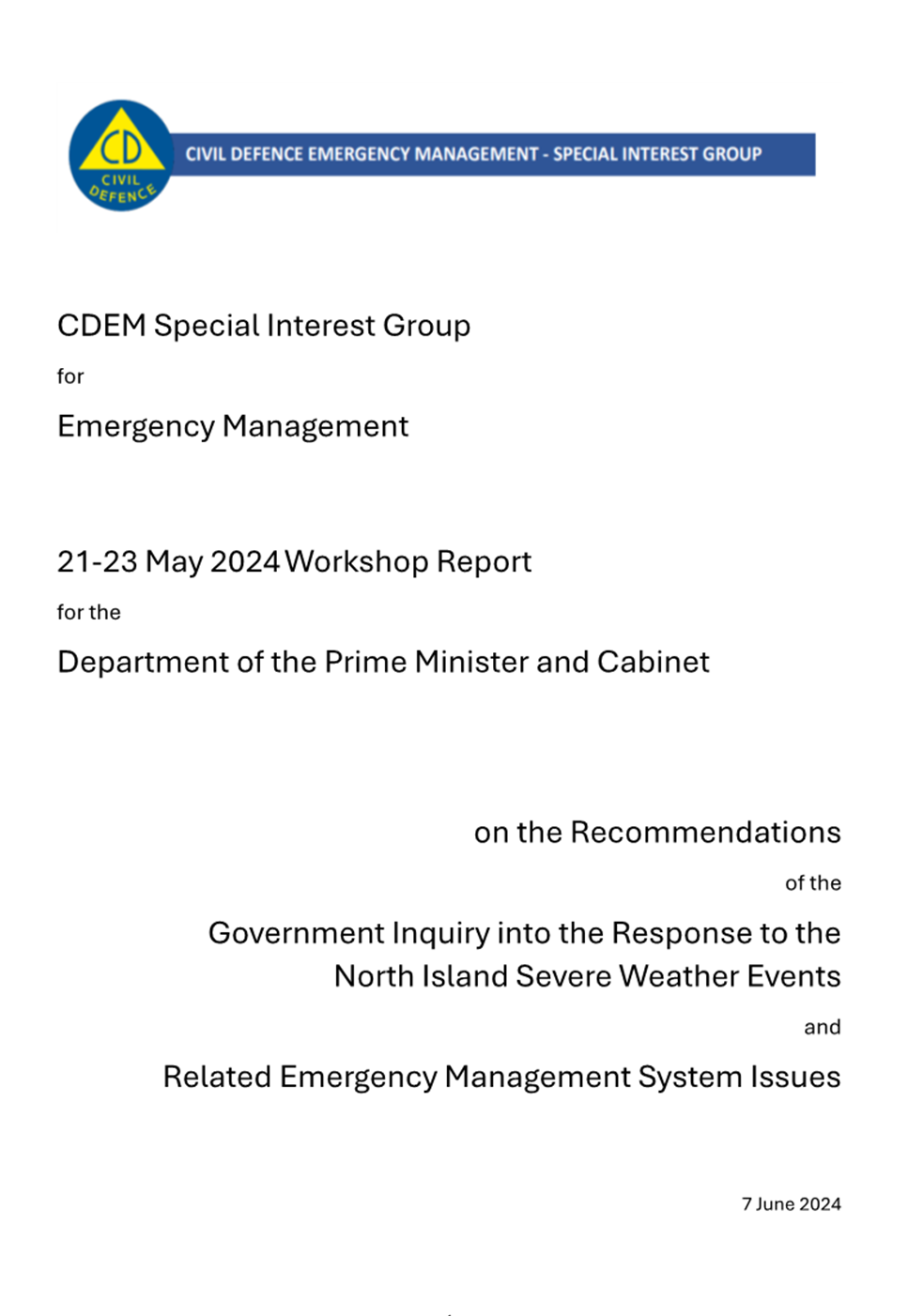
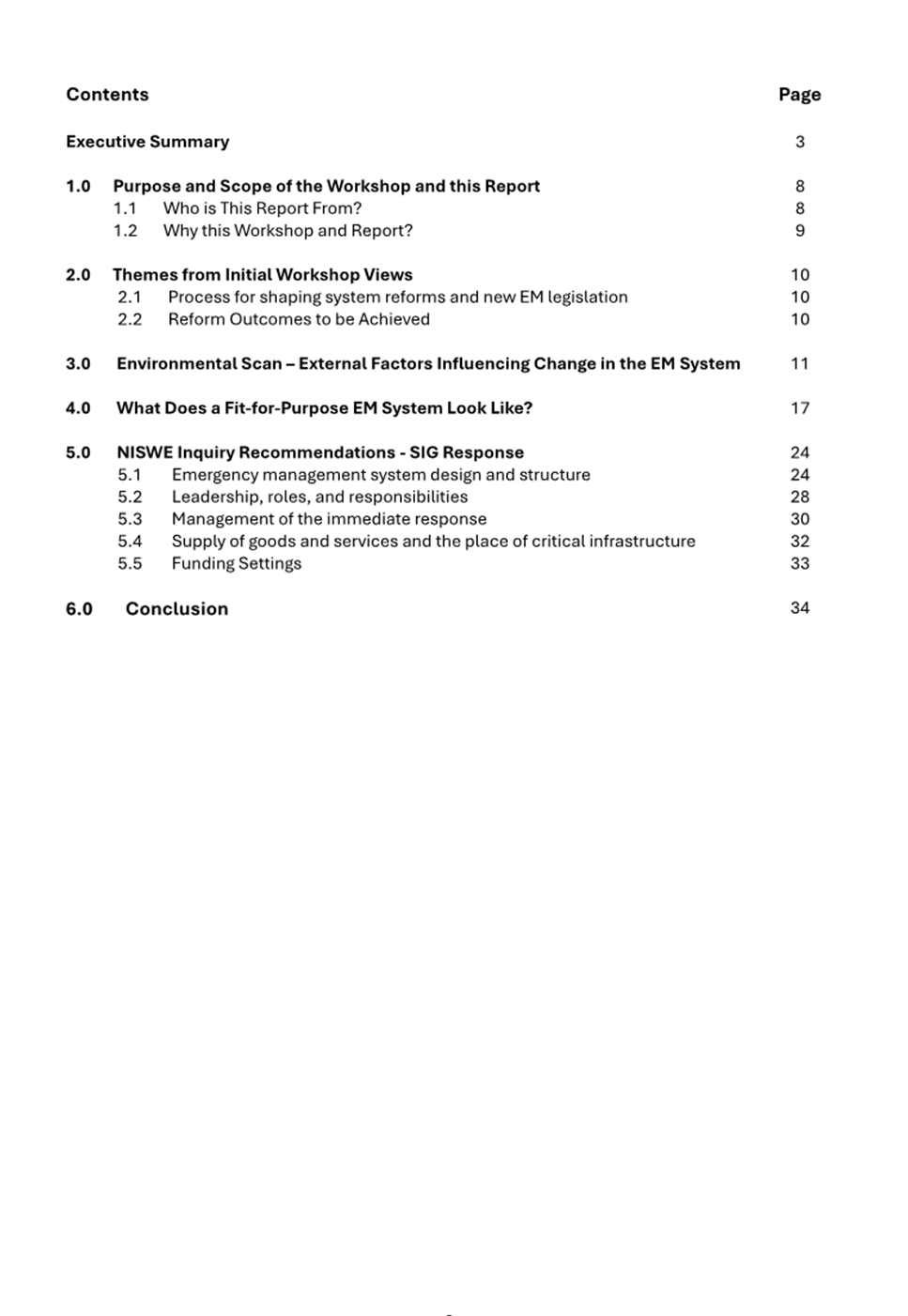
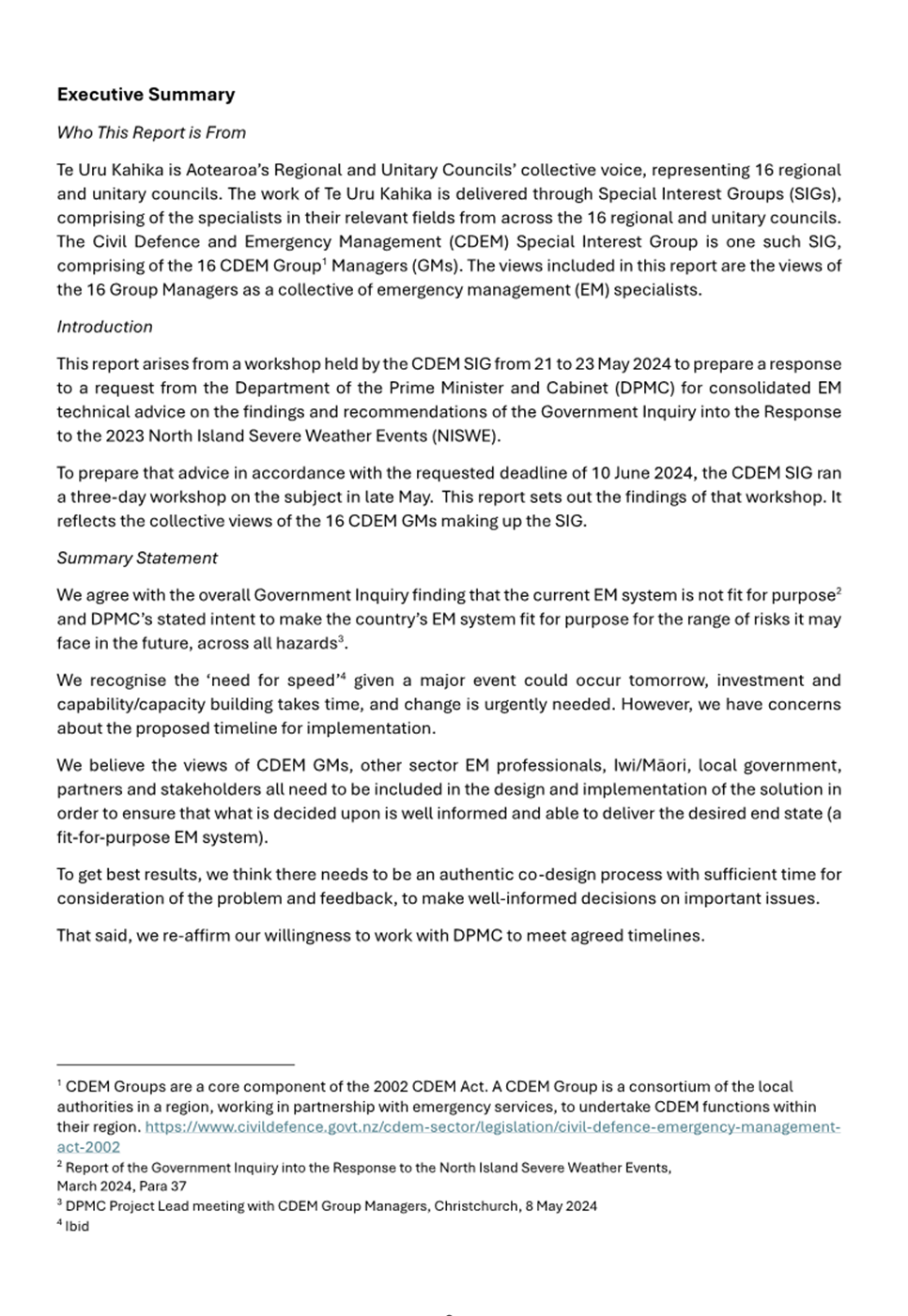
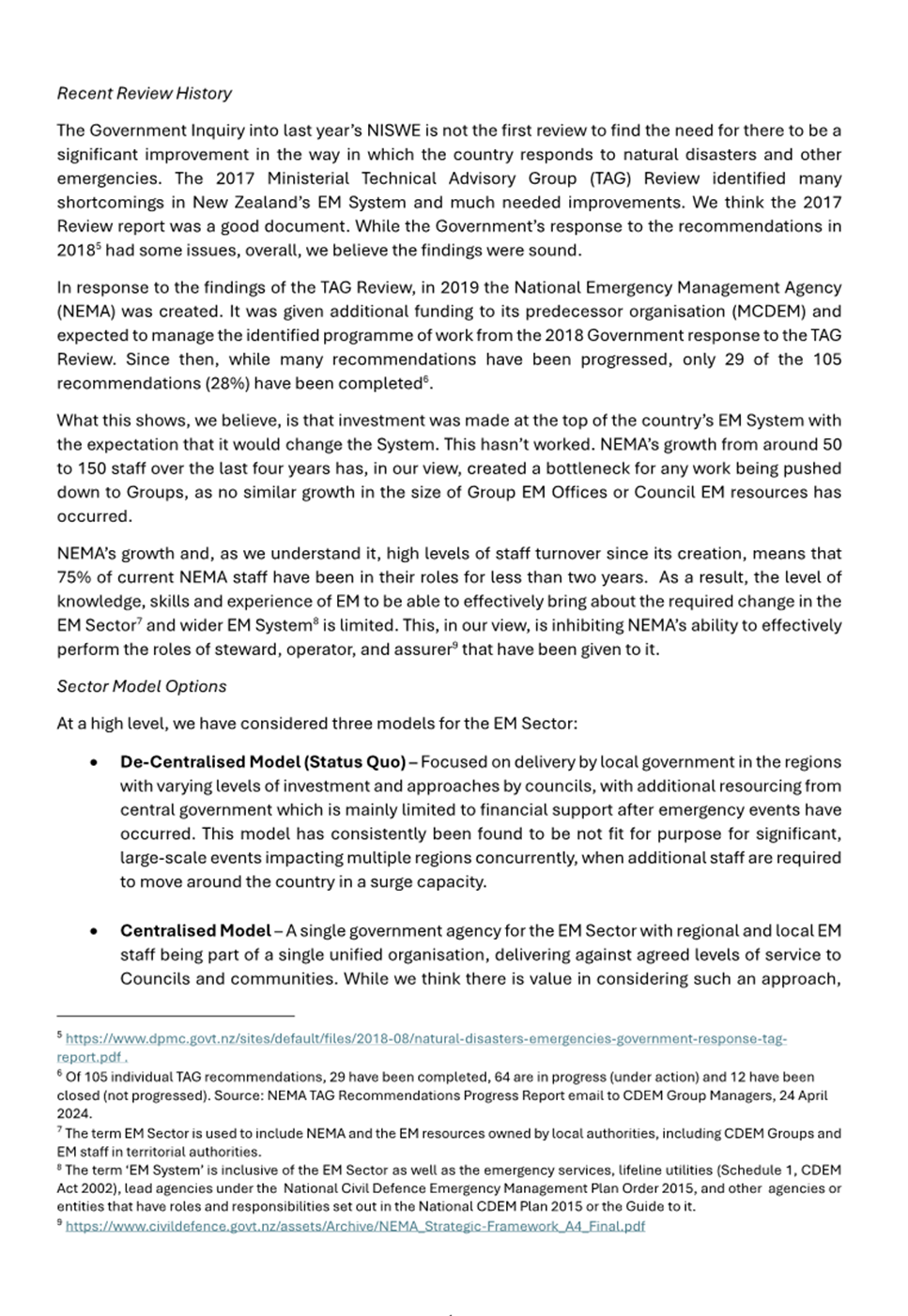
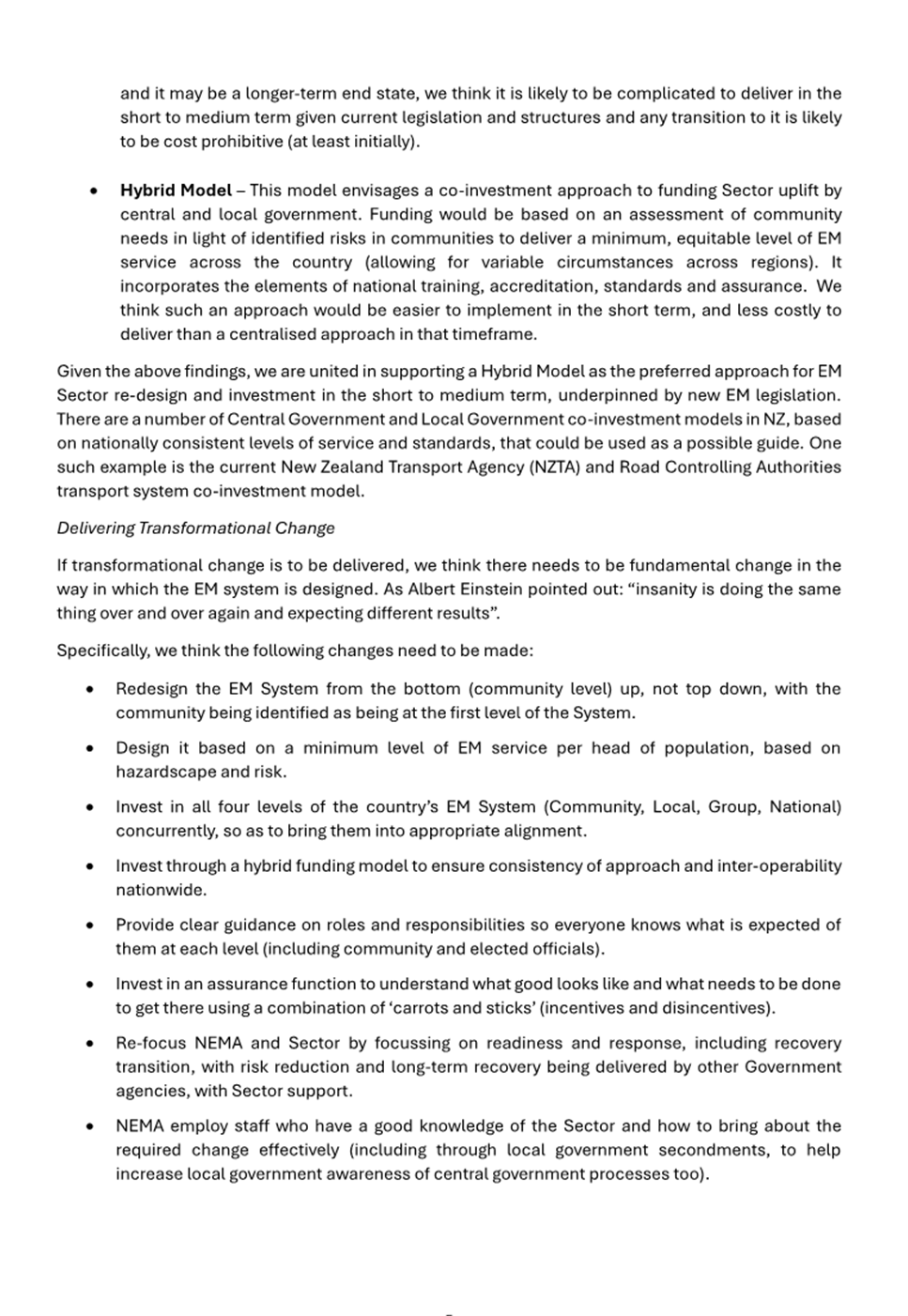
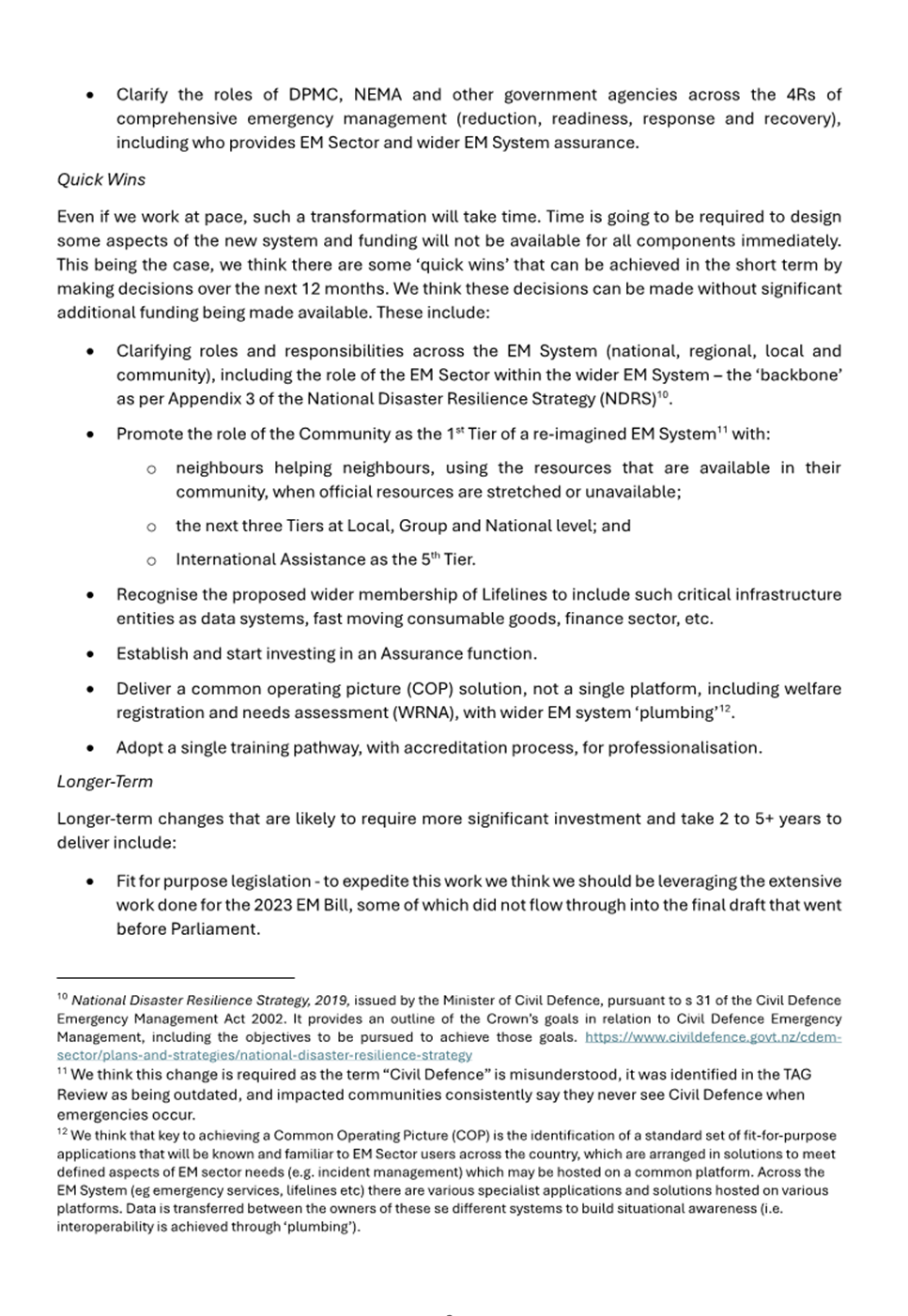
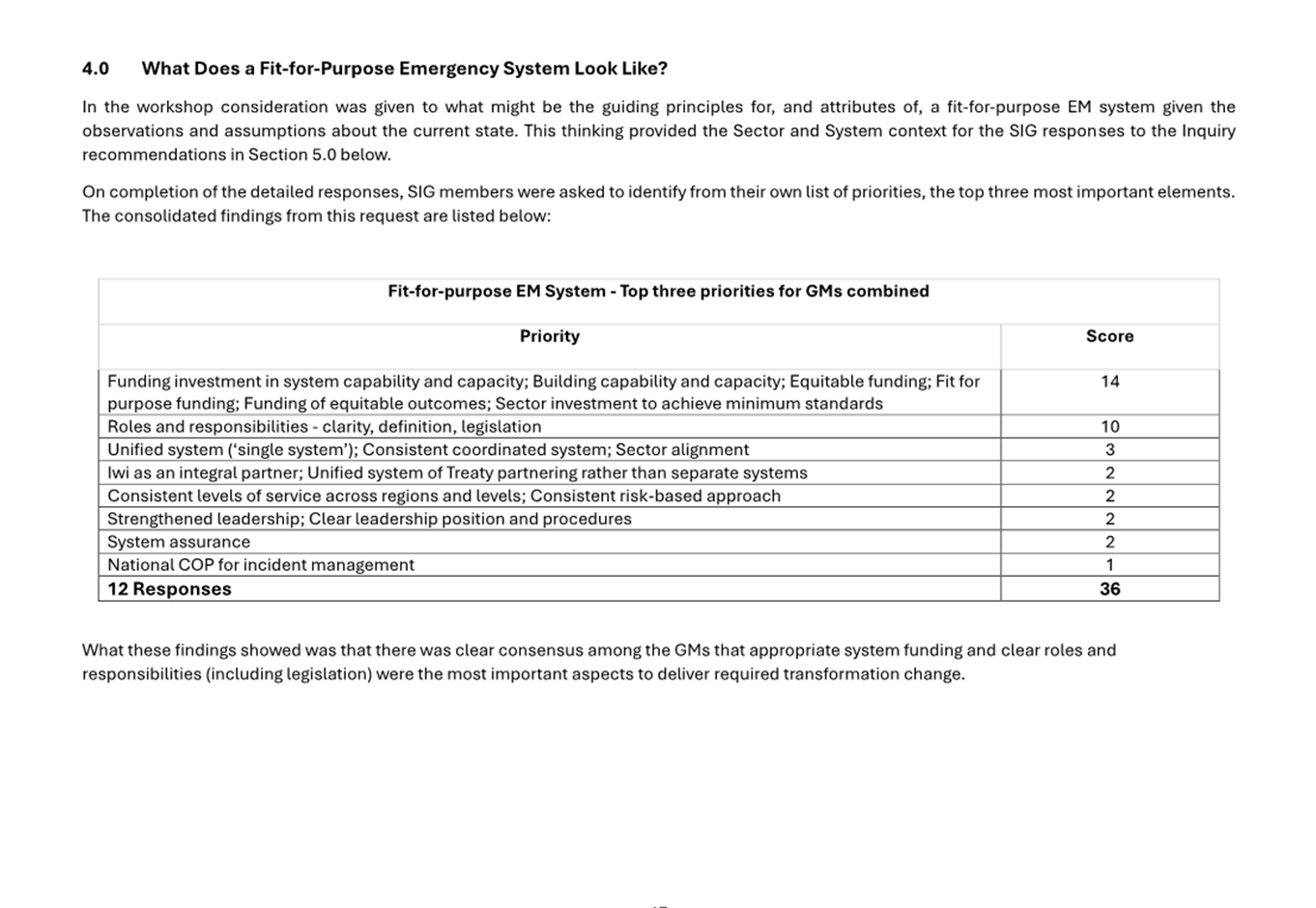
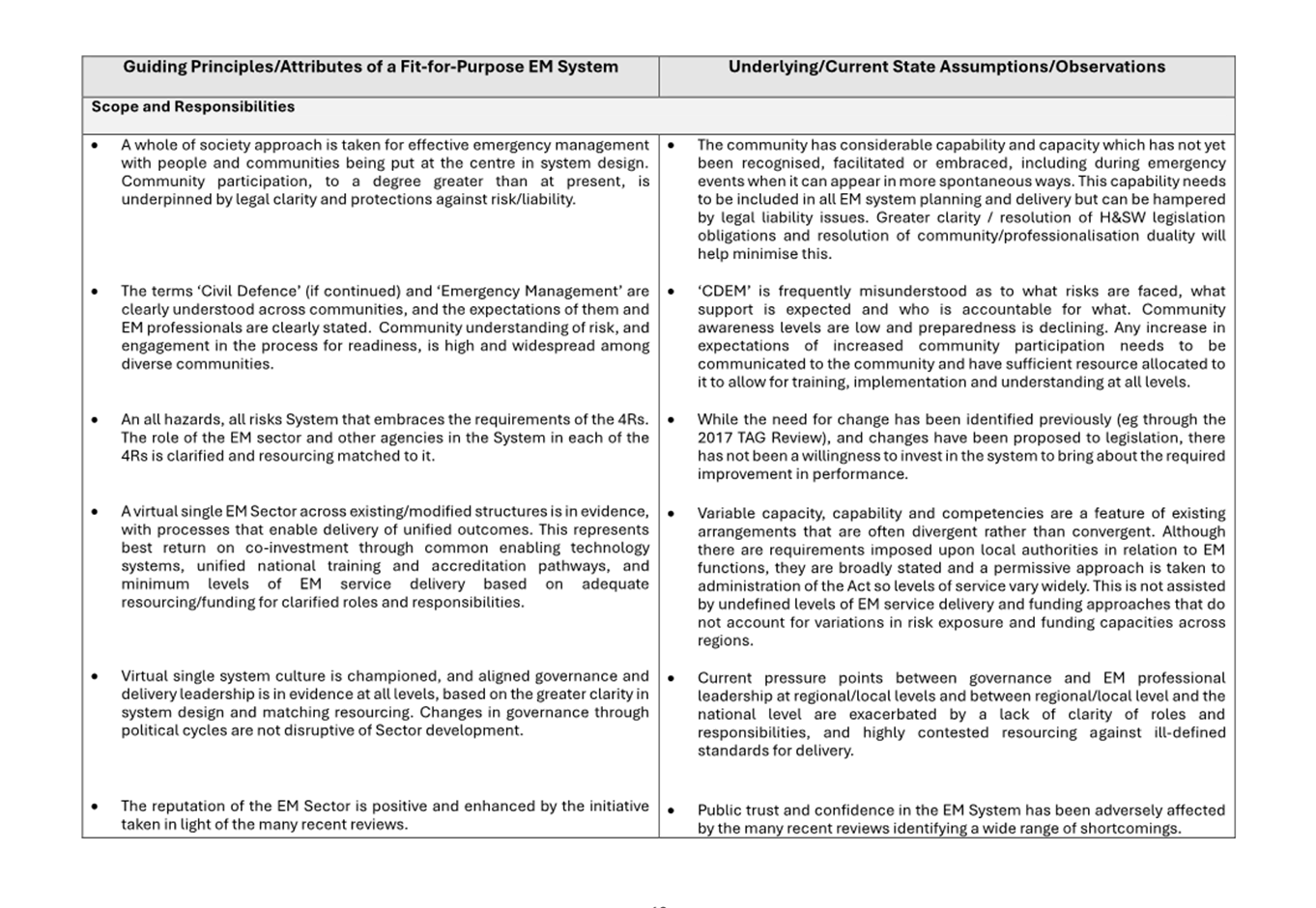
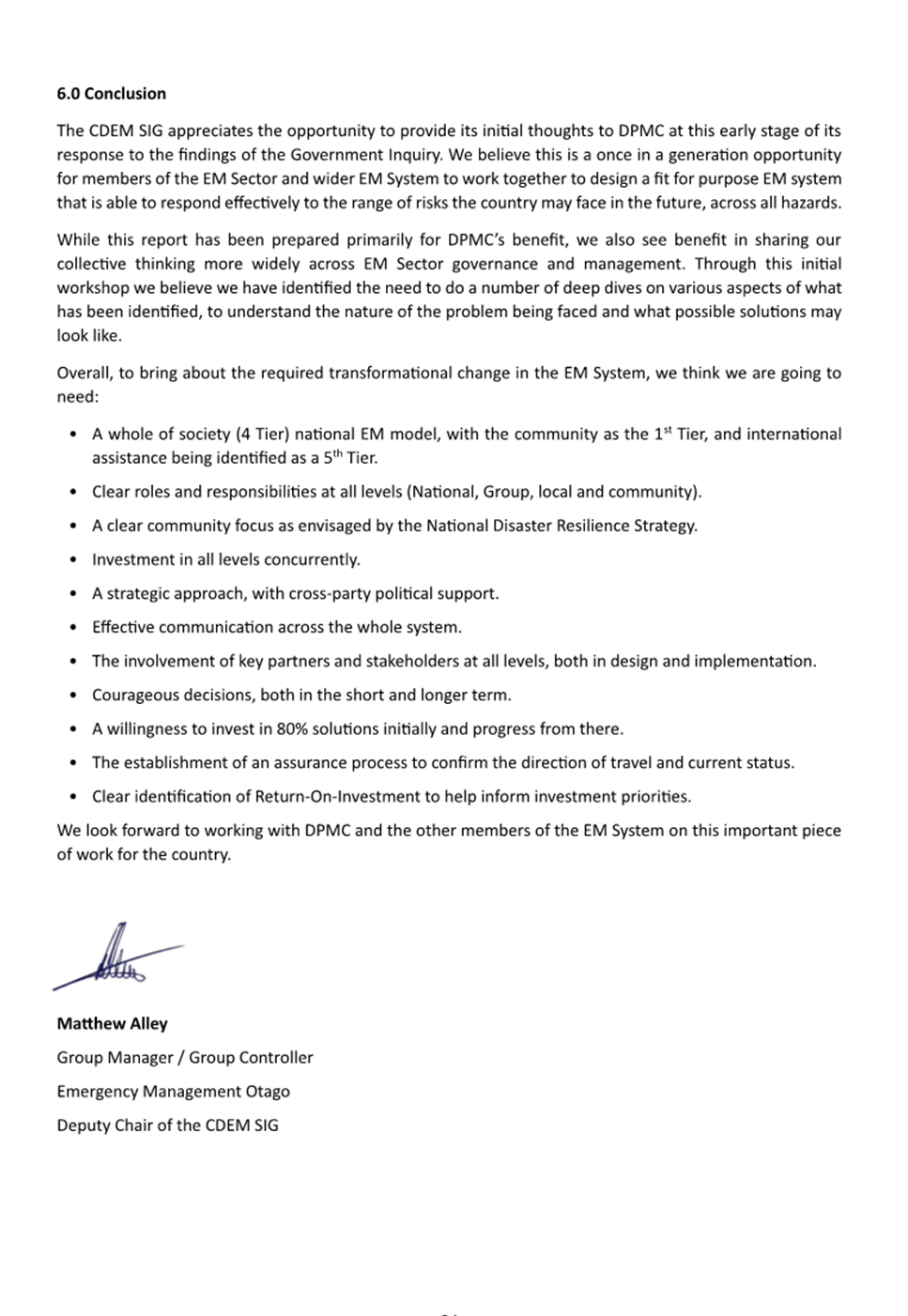
At DPMC's request, to inform the Government's response to the Inquiry recommendations, the Emergency Managers Special Interest Group (EM SIG) convened for a three-day workshop in May. The outcome of this workshop is at Attachment 2).
The report offers the collective insights of all 16 CDEM Group Emergency Managers (GMs). This group represents a wealth of experience across New Zealand's past and future emergency events.
The report reflects the collective views of the GMs, distinct from those of individual CDEM Group Joint Committees and member local authorities. It does not represent the stance of any specific CDEM Group or council.
That the report ‘Government Inquiry into the North Island Severe Weather Events: Key Findings ’ by Graeme MacDonald, Emergency Manager and dated 19 August 2024, be received.
Attachments/Ngā tapirihanga
Attachment 1: Priority Actions
Northland CDEM Group ⇩
Attachment 2: CDEM Group Managers
review report ⇩
Civil Defence Emergency Management Group Meeting item: 6.4
3 September 2024
|
TITLE: |
Wellington Region Emergency Management Tour |
|
From: |
Haylee Labelle, Personal Assistant Community Resilience and Louisa Gritt, Group Manager - Community Resilience |
|
Authorised by Group Manager/s: |
Louisa Gritt, Group Manager - Community Resilience, on 23 August 2024 |
Whakarāpopototanga / Executive summary
The chair of the Northland CDEM group, Cr Kelly Stratford recently attended a tour of Wellington Region Emergency Management with the following observations.
During the recent visit to the Wellington Region Emergency Management Office (WREMO), several operational structures and strategies were observed that closely align with our own Northland Region model. Key takeaways from the tour emphasised that the decision to activate emergency management protocols heavily depends on the IMPACTS of an event, rather than a predefined trigger. And as Northland has seen, it can vary depending on what else is happening or has happened.
WREMO community response hubs are quite similar to Northland community and Marae response groups. However, they are resourcing them.
Wellington City Council Emergency Management Model:
· Staffing Structure: Wellington operates with a full-time emergency management coordinator and a dedicated logistics person. The logistics person works on building and maintaining relationships in peacetime. Additionally, a number of staff are seconded into emergency management roles, ensuring that everyone is aware of their responsibilities during an emergency. The full organisational chart is shared and displayed prominently, reinforcing which staff members have a role in emergency response. And how valuable their contribution is.
· Tākaihere Role: they have introduced the Tākaihere role, a staff position specifically designed to connect hapū and iwi with the operations team, enhancing the inclusiveness and cultural responsiveness of their emergency management efforts.
· This is funded through rates, and it is on top of their contribution to the regional WREMO.
Kapiti Council Approach: Kapiti Council has taken a proactive stance by training all their staff in emergency management, ensuring a well-prepared workforce ready to respond to crises.
Insights from NEMA CE Dave Gawn:
Dave Gawn shared his experiences, highlighting that many of the challenges faced post-Christchurch earthquakes persist today. The issues are deeply systemic, and given the current fiscal constraints, addressing these challenges may take 5 to 10 years. NEMA continues to play an assurance role in overseeing emergency management practices.
Review Update:
NEMA has distanced themselves from the Severe weather review process. The review report is expected to be submitted to the minister by the end of September.
That the report ‘Wellington Region Emergency Management Tour’ by Haylee Labelle, Personal Assistant Community Resilience and Louisa Gritt, Group Manager - Community Resilience and dated 23 August 2024, be received.
Attachments/Ngā tapirihanga
Nil
Civil Defence Emergency Management Group Meeting item: 7.1
3 September 2024
|
TITLE: |
CEG Chair Report |
|
From: |
Graeme MacDonald, Emergency Manager |
|
Authorised by Group Manager/s: |
Louisa Gritt, Group Manager - Community Resilience, on 21 August 2024 |
Whakarāpopototanga / Executive summary
This report provides a summary of activities undertaken by or directly related to the delivery of the Northland Civil Defence Emergency Management Group plan over the period since the last CEG meeting in August 2024.
That the report ‘CEG Chair Report’ by Simon Weston, dated 14 August 2024, be received.
Background/Tuhinga
INDEX OF REPORTS
Page
1. Activations and response
2. CDEM Group
3. Far North CDEM Update
4. Kaipara CDEM Update
5. Whangārei District CDEM Update
6. Welfare Coordination Group Update
7. Northland Lifelines Group Update
8. CDEM Communications Update
9. Tsunami siren replacement Project Update
10. Tsunami inundation mapping Project Update
11. Cyclone Gabrielle recovery
12. Māori Engagement Update
13. Multi Agency Coordination Centre
14. Professional Development and Engagement
15. Natural Hazards update
1. Activations
and response
Weather warning – 19 June
On 19 June, an orange weather warning was received for Northland, with an expectation of 100 – 150 mm of rain, increasing to 150 to 250 mm in localised places, particularly eastern areas and north of the Bay of Islands.
At 4:15 pm the Emergency Coordination Centre (ECC) held a stakeholder meeting to gauge the readiness of agencies should the weather event escalate.
At 8:00 pm an updated weather forecast from Met Service, still indicating an orange weather warning and thunderstorm watch was received. This warning indicated reduced expected rainfall amounts.
On 20 June at 8.15 am the Incident Management team (IMT) made the decision to cancel the next stakeholders meeting as the Met Service had indicated the weather had past and the warning would be lifted.
Transpower Power outage – debriefs from EOC’s and agencies.
On 20 June, at approximately 11:00 am Northland was affected by a sudden onset power outage.
By 11:15 am Northland CDEM had established contact with both Northland lines companies (Top Energy and Northpower), confirmed the reason for the outage and had determined supporting workstreams.
A 220 kV transmission tower located in a field near Glorit had fallen unexpectedly whilst maintenance work was being carried out, causing the loss of power to homes and businesses in Northland.
Northpower had 52,964 connections (residential and commercial) without power
Top Energy had 35,500 customers (residential and commercial) without power.
There were no weather watches or warnings in place and temperatures were warm, ground conditions were wet due to rain over the previous 2 days. The concurrent critical issues affecting Northland were the Mangamuka and Brynderwyn Hill closures.
Northland CDEM Group Emergency Coordination Centre (ECC)
At 12:30 pm Northland CDEM established the ECC.
At 2:00 pm a stakeholder briefing was held to understand the impact and determine what actions were being undertaken by key stakeholders.
It was established there was potential for power to remain off for several hours, possibly days. Both Top Energy and Northpower were working to restore power to Northland homes and businesses while Transpower restored as much capacity as possible through the lower capacity 110 kV.
This saw the power coming on at various times across the region, with load controlling and power conservation messaging from the power companies. Most households had their power restored within 7 hours.
Situational awareness was quickly established and Sitreps were provided to NEMA and key stakeholders. The ECC was prepared to support the lead agency, stakeholders and to support the EOC’s as required.
At 6:00 pm a second stakeholder call was held to understand impacts on Northland. Power had been restored to most areas by this time, and plans were in place to restore power to the remaining households and businesses.
The ECC was stood down at 7:00 pm with staff on standby to re-activate if required.
An ECC debrief was held 10 July. Learnings from the event include
· The team activated and quickly established an overview of the situation,
· Continue building capability of ECC staff to operate remotely, if required,
· Stakeholder relationships ensured information sharing was not hindered,
· Emergency Services need to have business continuity plans in place, and
· Requesting staff support through NRC early on in the response ensures capacity is quickly established to manage and maintain public facing communications.
Far North District Council
The Far North District Council established an Incident Management Team (IMT) by 11.30 am. An across agency / stakeholder meeting initiated by the Northland CDEM Group quickly gave a situational overview and impact to the region. A second multi-agency briefing held at 6.00 pm including representation from Transpower, Northpower and Top Energy outlined their collaborative planning to allow for an earlier restoration than anticipated. The IMT stood down at 7.00 pm as power was restored but maintained a stand-by status for the following 48 hours.
Actions taken:
• Establish Incident Management Team
• Refer to Northland Lifelines Utility Group Power Outage Plan.
• Liaise with Council Water Alliance Partner (Ventia) and request status report and impact to all councils reticulated water and sewerage plants including actions taken and any anticipated issues.
• Develop Incident Action Plans for 8-hour (and a further 24-hour period if required)
• Complete Sitrep
• Plan for full EOC setup and staffing for extended event.
Learnings:
• Light on the ground with some functional roles. IE Operations Manager, Response Manager Controllers.
• Physical presence of water alliance partner in EOC would have been an advantage
• The additional time required to assemble a team for unplanned events due to flexible working arrangements and key staff on leave.
• Lack of business continuity planning in private sector, (ie: Rest homes)
• While there was power provided by backup generator to the area designated as EOC, it was found there was no power connection to support lighting. (The IMT relocated to the council chambers which was previously used as EOC and is fully powered)
Opportunities for improvements:
• On going emphasis on in-house CDEM recruiting and training
• On going public education including business sector to improve resilience
• Physical representation in by Ventia in EOC as part of the Operations Team in future events
• Investigate ability to connect lighting for area now delegated as EOC to back up generator
Kaipara District Council
Kaipara District Council activated their EOC on Thursday afternoon 20 June 2024, providing information into the Regional Sitrep. EOC staff gained awareness on affected Council infrastructure and were prepared to support the communities as needed.
Whangarei District Council
The Whangarei District Council (WDC) activated their Emergency Operations Centre (EOC) on Thursday afternoon 20 June 2024. The activation was supported with sufficient staff and resources.
Challenges included a power outage and limited generator capacity. The EOC operated fully until 7 pm on 20 June, with the Incident Management Team (IMT) managing overnight and monitoring continuing over the weekend.
Debriefing sessions identified and are addressing issues with power, logistics, and ICT, focusing on insufficient generator capacity.
Lifelines
Northland Lifelines Group (NLG) held a debrief at the meeting on 5 July.
Learnings
· Strong messaging around restoration times from Transpower
· Good communications received by NLG members from GECC
· Good communications with Fuel Companies
· Recognition of fuel priority for Emergency Services
· Hot water controls implemented from Electric power distribution companies
· Telecommunication providers willingness to source generators to keep Towers active
· Airports have generators to run Airport operations
· NLG Power outage plan – good reference document
Opportunities for improvement
· Review of Critical Infrastructure assets in Northland
· Request to Telecommunication providers to advise on cell tower restoration that wasn’t able to be achieved (all towers having generator back-up)
· Telecommunication providers advised that some cell towers only had max 2hr battery back up (remote locations)
· NLG Power Outage Plan needs updating
· Card Access to sites, that required power to activate equipment
· If telecommunication battery back ups fail (4G) then this means that Traffic Lights will fail critically and take longer to bring back online when power is restored.
2. CDEM Group
Recruitment for the vacant position of Emergency Management Specialist based in Kaitaia is underway.
Kylie Cox has moved to the Emergency Management Specialist (Kaipara) role as Laura Exton has started a 6-month period of leave without pay. James Harvey has commenced as the Recovery Support Officer.
Australia New Zealand Disaster and Emergency Management Conference
A team of 5 from the Northland CDEM team attended the Australia New Zealand Disaster and Emergency Management Conference (ANZDEMC) on the Gold Coast 22-23 July. The team also had the opportunity to visit the City of Gold Coast Disaster and Emergency Management Centre – a state-of-the-art operational emergency centre.
The 2024 conference had more than 600 in-person delegates and over 100 on-line attendees – the largest audience the conference has received to date. The two-day conference hosted a range of high calibre speakers, covering an extensive array of EM topics from empowering communities, building resilience and preparedness, through to learning from experience, inclusivity and the future challenges, opportunities and innovation.
The Northland CDEM team contributed to the conference opening, with Papanui Polamalu providing a mihi to acknowledge and pay respects to the land and the traditional families of the Yugambeh region, and their elders past, present and emerging. The team supported Papanui on stage with waiata This is the first time this acknowledgement has been done at the conference, supporting and strengthening the Aotearoa NZ commitment and enhancing the cultural aspects of the conference.
Highlights included presentations from Dr Neryl East,(Credible Leadership and communications), Dr Melanie Irons (Psychological safety), Insights from Wujal Wujal Aboriginal Shire (Ex Tropical Cyclone Jasper), Mona Currie (Lahaina Fire tragedy, Hawaii), and our kiwi presenters.
Networking opportunities identified a large Aotearoa NZ contingent including EM members from the Manawatu-Whanganui and AEM CDEM Groups, Selwyn District Council, Winsborough Ltd, the Kiwifruit industry, NZDF, NEMA, Red Cross and more. Two of the keynote speakers were from NZ (John Price, NEMA, and Sarah Stuart-Black, NZ Red Cross) whose presentations were well received by the audience.
Jenny Calder was a member of the conference committee and has been asked to remain on the committee for the 2025 conference. This is an opportunity to continue to grow the Aotearoa NZ input into the conference.
The learnings and connections made at the conference will be of benefit going forward as well as supporting the development of our EM staff.
Service Level Agreements and work Programmes
The CEG received and approved the 2024/25 years SLA’s and noted the Work Programmes for:
a. Welfare Coordination Group
b. Northland Lifelines Utility Group - Business Plan
c. Far North District Council Service Level Agreements
d. Kaipara District Council Service Level Agreements
e. Whangarei District Council Service Level Agreements
The following notes are for the information of the CDEM Group on work programmes and SLA’s.
Welfare Work Programme
· The Northland Welfare Coordination Group (WCG) maintains a comprehensive work programme that is updated annually.
· The programme is developed collaboratively, ensuring consultation with all Northland WCG members.
· The current programme outlines the activities and responsibilities of all group members, including the Group Welfare Manager and relevant welfare agencies responsible for sub-functions within the broader welfare services structure.
Northland Lifelines Utility Group Work Programme
· The Northland Lifelines Group develops its annual work programme collaboratively through member participation.
· During the group's most recent meeting in June, the work programme was thoroughly discussed and subsequently approved.
· The updated business plan includes a revised status list for the group's planning documents and their revision schedule.
Service Level Agreement (SLA) Work Programmes
· The Service Level Agreements (SLAs) for the 2024/25 year with Far North, Kaipara, and Whangarei District Councils outline their respective work programmes.
· These SLAs have been reviewed by the designated relationship managers for each council.
· As part of the annual review process, SLAs and work programmes are updated to reflect current needs.
· This year's updates incorporate findings from our recent emergency response reviews.
· Where applicable, these findings will be translated into actionable steps within the work programmes.
· The updated work programmes are in alignment with objectives, tasks, and priorities outlined in the Northland CDEM Group Plan 2021-2026.
Recovery Work Programme
· Recovery from Cyclone Gabrille in Northland has continued for the past 15 months.
· The recovery work programme for the next 12 months reflects the ongoing recovery work associated with Cyclone Gabrielle and development of rigorous recovery methodology.
3. Far North CDEM Update
A summary of work and activities undertaken by the Far North Emergency Management Specialists and Far North District Council include:
Ongoing community engagement to support and enhance marae, community resilience and reviews of community response plans. Included is supporting Northland Regional Council Rivers and Natural Hazards team with the flood affected marae project Ngāti Wai. Refer to Agenda Item: Marae Preparedness and Community Response Groups Update.
A review of the emergency plan for Ngawha Geothermal Power Station in collaboration with Fire Emergency New Zealand and Ngawha Generation Ltd.
Participation in the National Exercise Ru Whenua on 12 June. An Emergency Operations Centre was established, and key actions worked through as part of the initial actions and response to the exercise. A post exercise debrief has been carried out to consider any opportunities for improvement.
An Incident Management Team (IMT) was established to monitor the Orange Weather Warning received from the Met Service on 19 of June. Shortly after the weather warning was downgraded on 20 June, the IMT was quickly re-established in response to an unplanned power outage affecting the Transpower lines network and impacting the wider Northland area. A further debrief was undertaken for this event. Refer to Agenda Item: Transpower Power outage – debriefs from EOC’s and agencies
A readiness check and review of Emergency Operation Centre and IT equipment has been carried out.
Three StarLink Units have been provided to the Far North District Council by the Northland CDEM Group. The intended use is for deployment at the discretion of the Local Controller, for use within Emergency Operating Centres or out in communities where-ever the need is the greatest to assist with communications during an emergency event.
Other activities undertaken have been relative to the 2023-2024 Work Plan as outlined in the Far North District Council Service Level Agreement (SLA) including annual reviews and of SLAs.
4. Kaipara CDEM Update
Below is an outline of the work that has been conducted to actively build KDC’s capability and capacity to respond to an event.
Two deployable kits for KDC’s CDEM Starlink units were delivered to the Dargaville and Mangawhai EOCs in July. Training for these kits will be provided in the coming months.
A review of KDC’s Local Welfare Plan has commenced, through engagement with KDC’s two Local Welfare Managers.
KDC’s new CDEM EOC SharePoint and Teams system is currently being updated to incorporate learnings from its soft launch during the Northland Power Outage response. It should be ready for a hard launch and staff training within the coming months.
NRC have recently provided a generator to the Kaipara Service Centre in Dargaville, ensuring an alternate power source for KDC’s EOC. While NRC holds responsibility for generator maintenance and operation, select KDC staff have been trained to connect the generator to the building in case NRC staff are unavailable at the time it is required during an event.
The Dargaville Evacuation Plan, which has been developed over the past year, was presented to key stakeholders on Thursday 13 June. The plan’s purpose is to build inter-agency relationships and ensure effective collaboration during responses. The plan brings the people, and the people bring the solutions. The group will review the plan annually.
A new KDC CDEM Relationship Manager, Gillian Bruce, Manager Business Support, was inducted to Civil Defence in July. NCDEM would like to thank the previous KDC CDEM Relationship Manager, Michael Day, for his work and support over the past two years.
5. Whangārei District CDEM Update
CIMS4 and Function courses have been completed during this reporting period, with 11 more scheduled over the next 4 months. A Response Manager course is set for 1 October for current and future Response Managers, Controllers, and NCDEM staff.
A Starlink Unit has been placed at the WDC CDEM location for use by the WDC EOC in an event, either for a community, Marae or the EOC.
The WDC are developing a Procurement Policy with WDC Finance and Logistics to clarify financial requisitions during events. This policy will be integrated into WDC's financial systems (TechOne) and include a training package for the logistics team.
Enhancements to the WDC Emergency Management Kete SharePoint site are in progress. On completion, MS TEAMS will be set up as a template for future events, with organised folders, templates, and document saving ability by function roles.
Approximately 20 community engagement opportunities have been completed in the Whangarei District. Further engagement is scheduled to support on-going CDEM works and NRC projects.
6. Welfare Coordination Group Update
The next Welfare Coordination Group (WCG) meeting is scheduled for 5 September. The agenda content is to be confirmed.
Engagements
The Group Welfare Specialist has met with or attended meetings or events
with the following agencies over the past three months:
· MBIE TAS
· Northable
· Red Cross
· Volunteering Northland
· Northland Lifelines
WelNAS
The WelNAS needs assessment tool has been completed. A Needs Assessors training was provided to local welfare managers and interested welfare function staff on 14 June where we showcased the new tool and gave attendees the opportunity to trial it. Next steps are the development of a training manual and a suite of videos on how to use certain parts of the system.
7. Northland Lifelines Group Update
A Northland Lifelines Group meeting was held on Friday 5 July. The group used this meeting to hold a formal debrief for members of the 20 June Northland Power Outage.
The group also adopted the 2024-25 Lifelines Group Business Plan.
Work has continued on the Updated Severe Weather Plan with the view to formally approving the plan at the meeting on 27 September.
Engagement
The Lifelines Programme Manager has attended the following meetings over the past three months:
• Auckland Lifelines Group Steering Committee
· NZTA Waka Kotahi ‘First responders brief’ meeting re opening of the Brynderwyns
• NRC Natural Hazards team regarding the proposed NRC risk portal
Work continues to strengthen and enhance relationships with all members of the group with representatives from the Fast Moving Consumer Goods sector having been added to the Lifelines Group recently.
8. CDEM Communications Update
CDEM Facebook page insights, May 1, 2024 – July 1, 2024
Ÿ Page visit: 25,200
Ÿ Facebook Page followers: increased 364
Ÿ Total FB page followers as of 1 July 2024: 38,422
Our top performing post was an update post about the Transpower outage on June 20, which had reach of approximately 39,841. https://www.facebook.com/civildefencenorthland/posts/pfbid02Dt4ifanKiyMajArvAsVJMRMWghn11fCUfU4v1sWU8N4SPotBB9QfUnHus6CyPTbHl
We also continue to see good reach and engagement on our weather-related posts, with most having reach over 35K.
Apart from weather and response related posts our next best performing posts were related to:
The Tsunami sire upgrade project with 14,136 estimated reach:
An update on the Brynderwyns hills closure with 9,911 estimated reach:
A post promoting our annual CDEM Forum with 7,861estimated reach:
Overall engagement on posts remains steady and follower numbers continue to increase.
Northland CDEM Web section insights, May 1, 2024 – July 1, 2024
Ÿ Total page visits: 8,915
Ÿ Most popular pages:
1. Power outages: 2636
2. Listen to the tsunami siren sounds: 1887
3. Tsunami siren replacement project: 526
Power outage information overtook the usual number one spot of the tsunami siren sound. This can also certainly be attributed to the Transpower outage event as people searched for information on what to do in a power outage. The Tsunami siren replacement project continues to feature in our popular topics as we continue to promote this project.
Media
Following the annual CDEM Forum in May, there were a number of stories published about the event and some of the content from its presenters, including:
Empowering disabled communities: https://www.nzherald.co.nz/northern-advocate/news/empowered-disabled-community-strengthens-emergency-response/JYRD6STGWJHITIUZJO3FNSL3CY/
An update on the water tank resilience project: https://www.nzherald.co.nz/northern-advocate/news/free-water-tanks-build-resilience-for-remote-northland-rural-communities/NMXZ2423ZZBFDCGHLBK4ECDT7A/#google_vignette .
As well as the normal response media coverage we have, there was also an interesting piece that covered Civil Defence’s role in the Transpower outage response: https://www.nzherald.co.nz/northern-advocate/news/northland-civil-defence-powers-up-in-face-of-te-tai-tokerau-electricity-failure/EOMGL3VJKZEALG6FEC3F7G7PPY/
9. Tsunami Siren project installation update
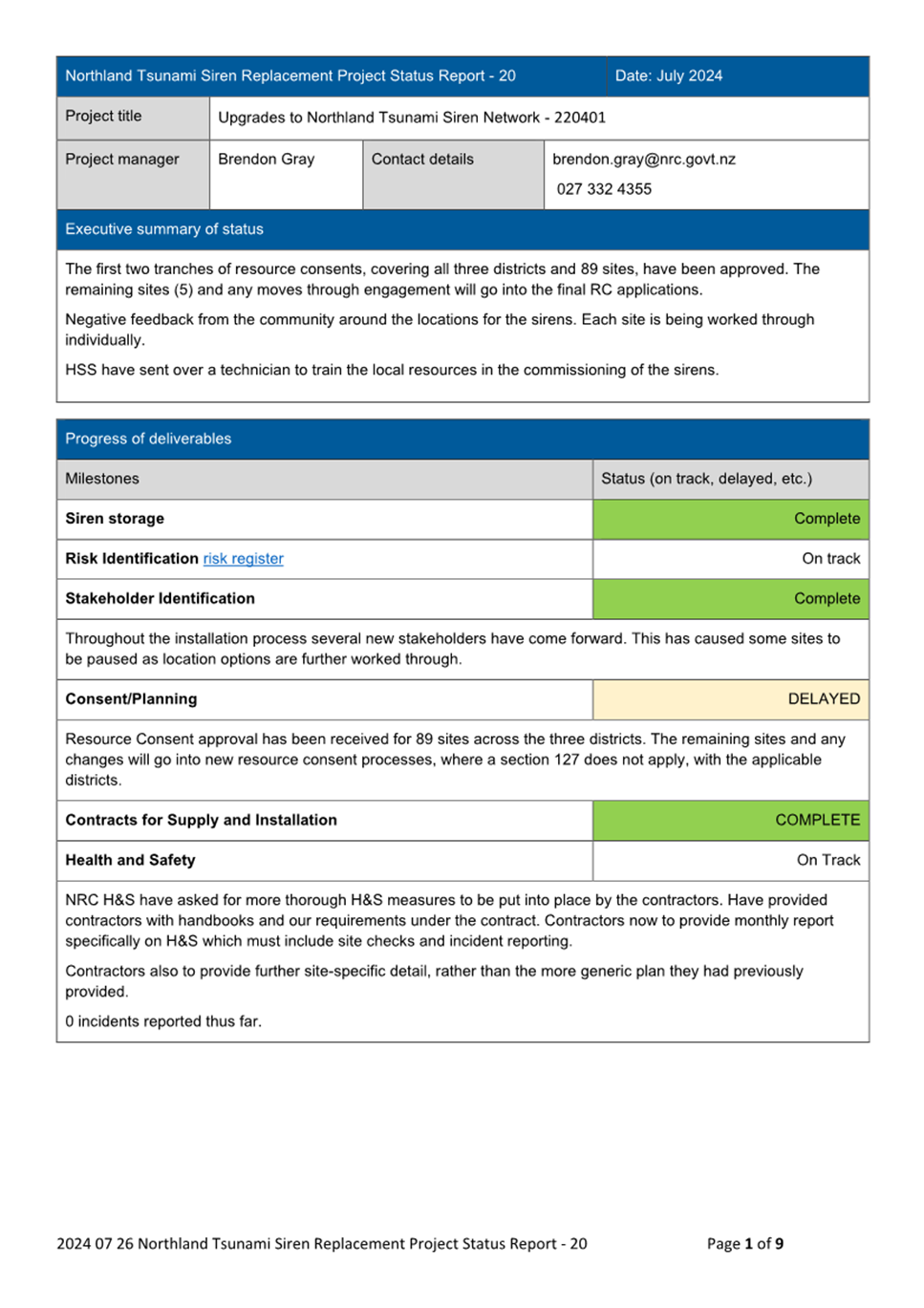
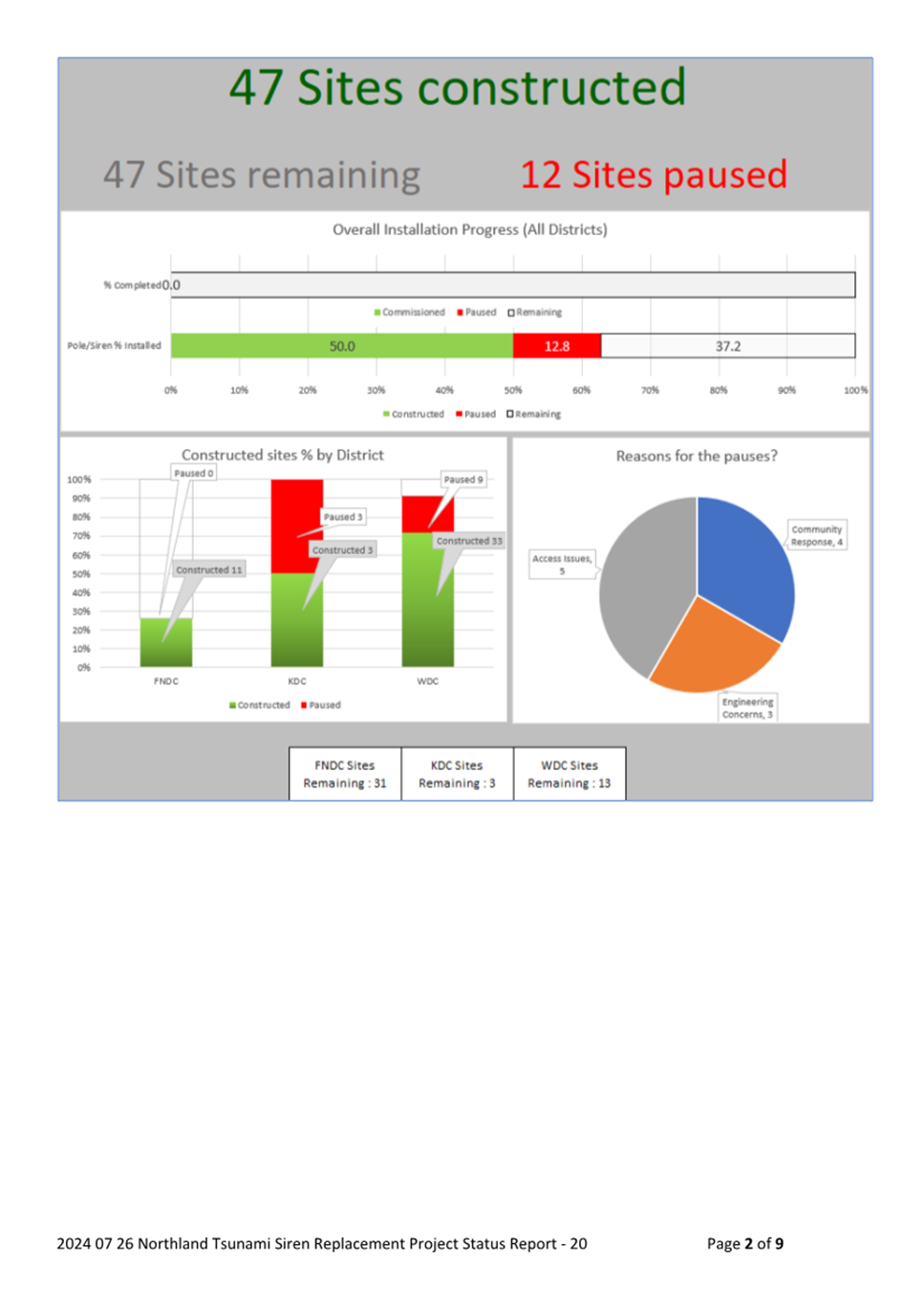
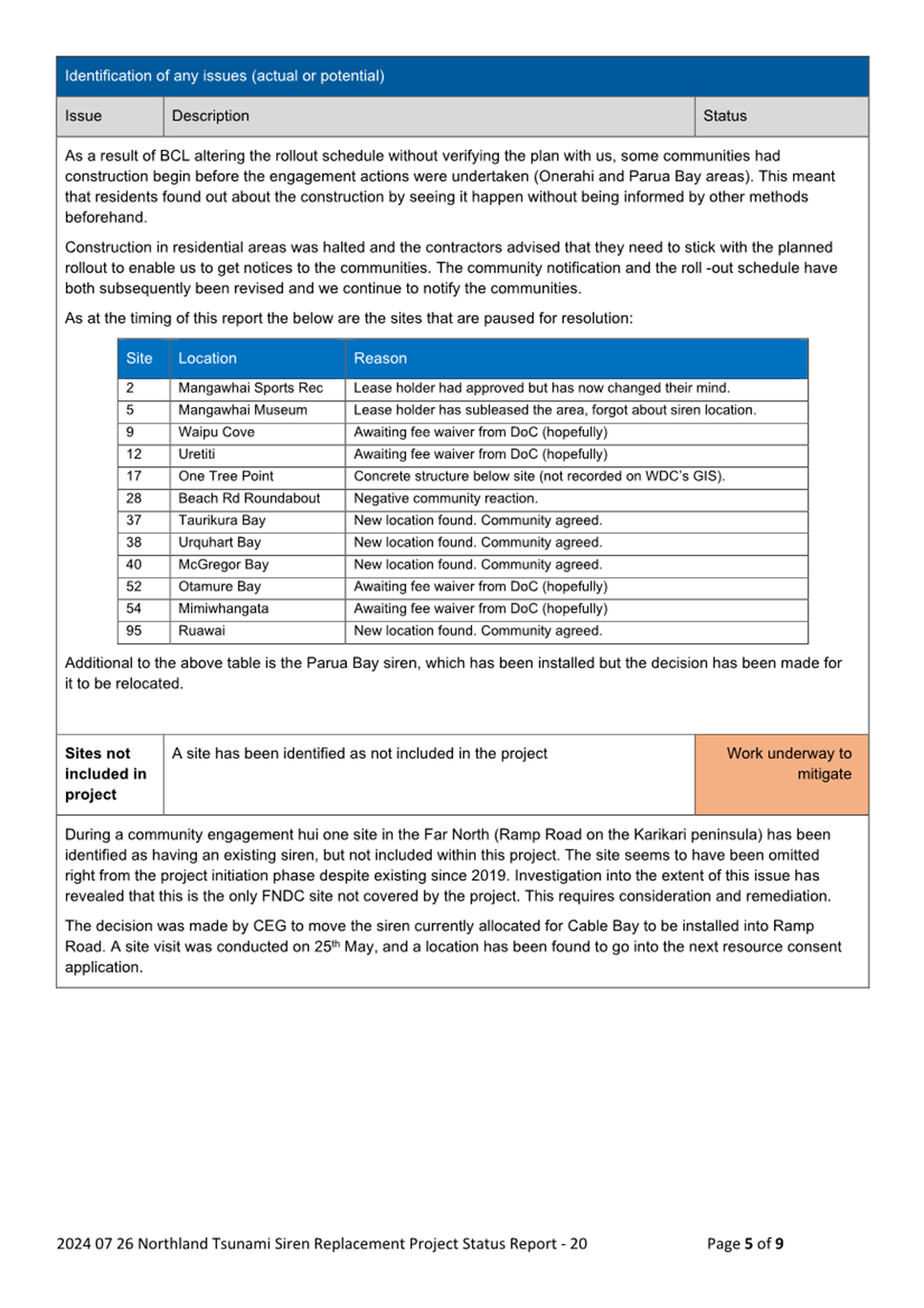
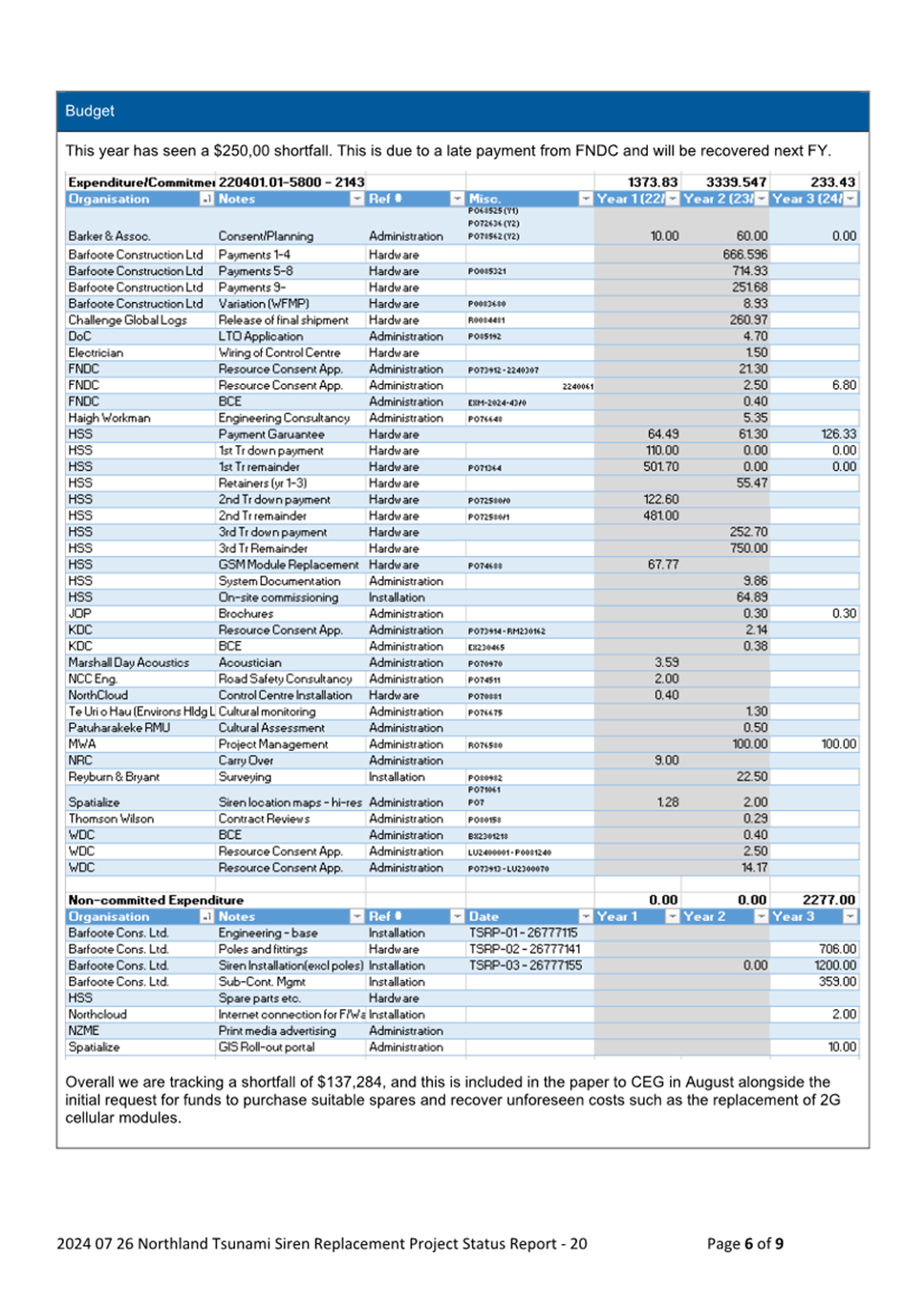
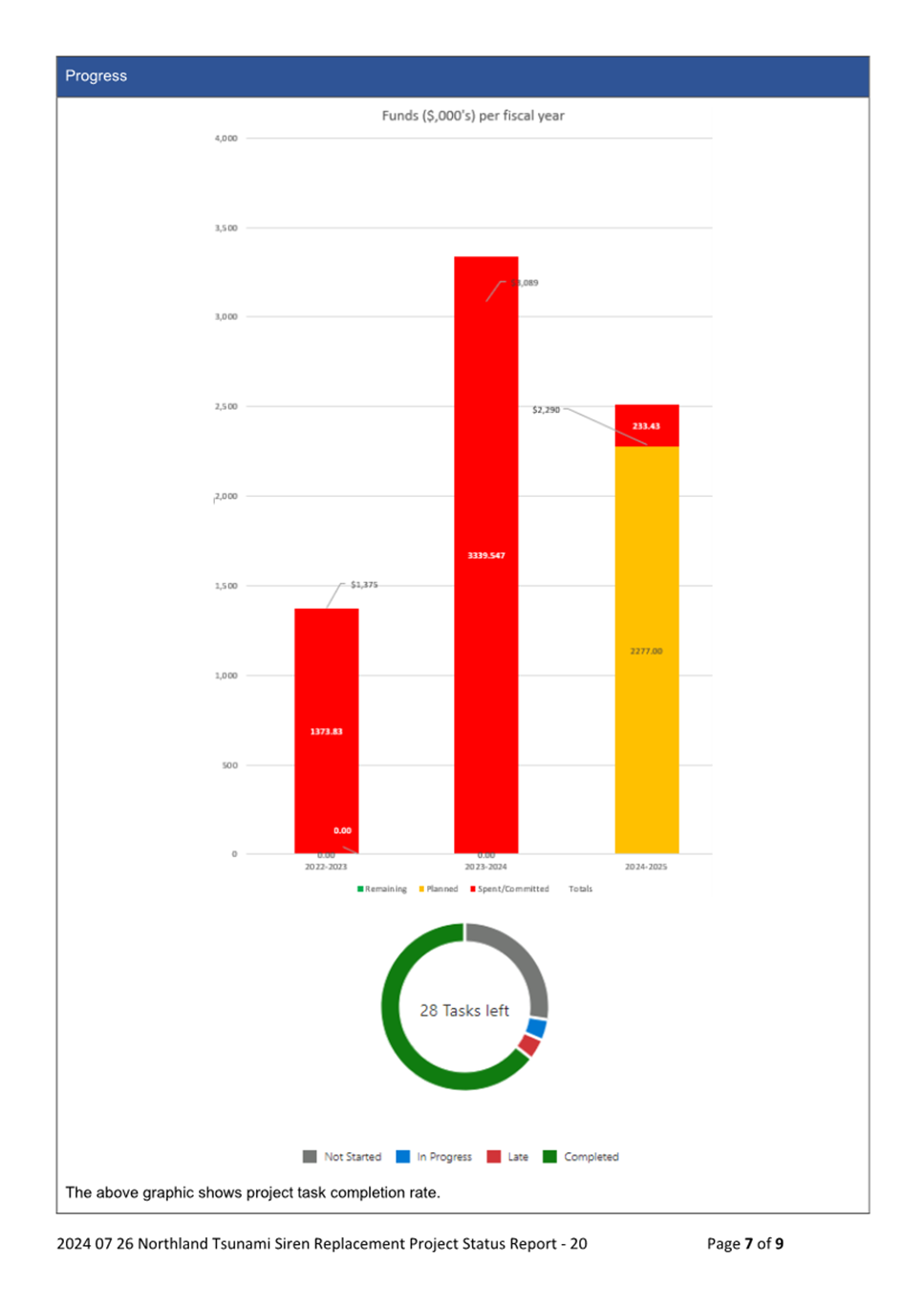
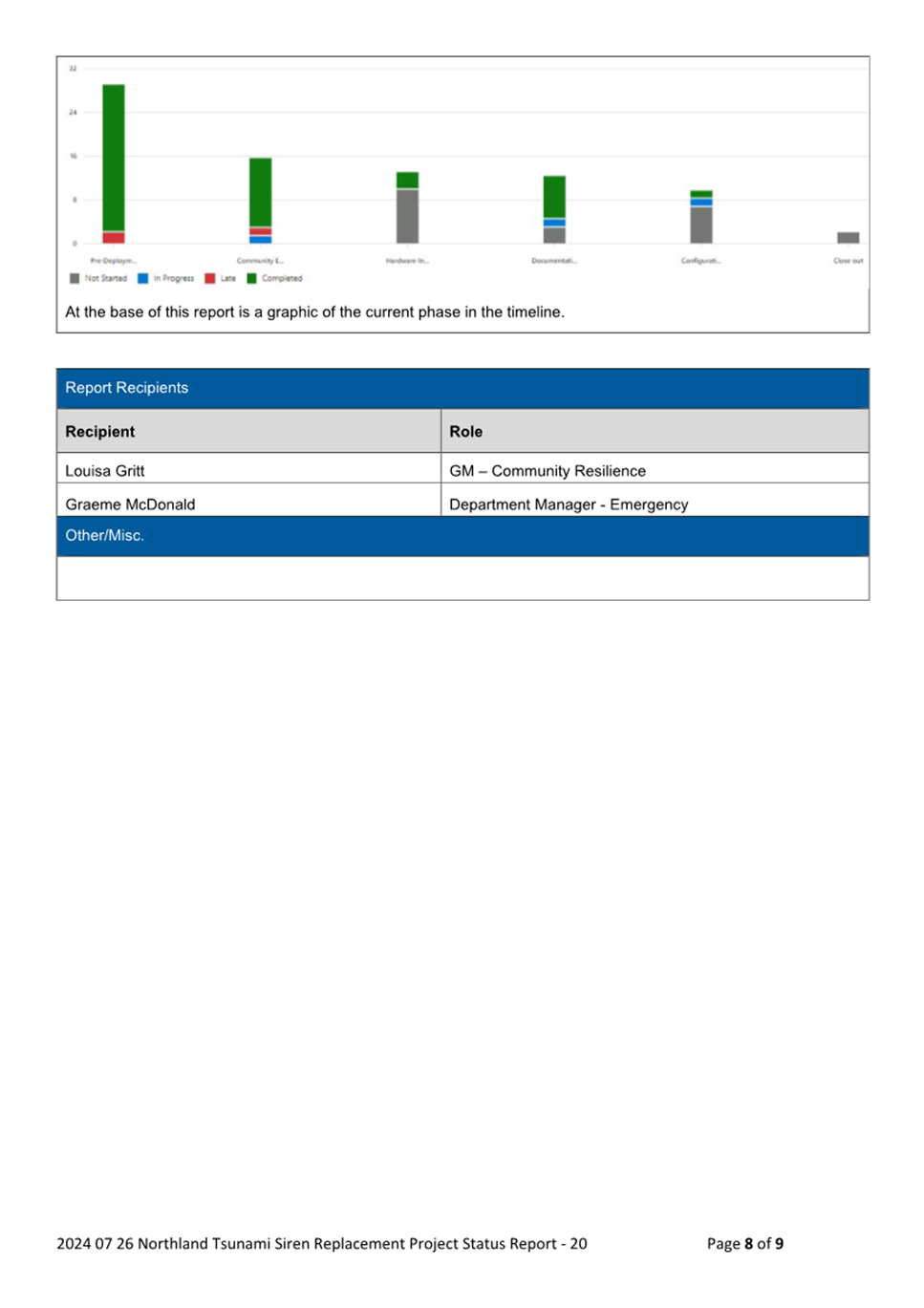
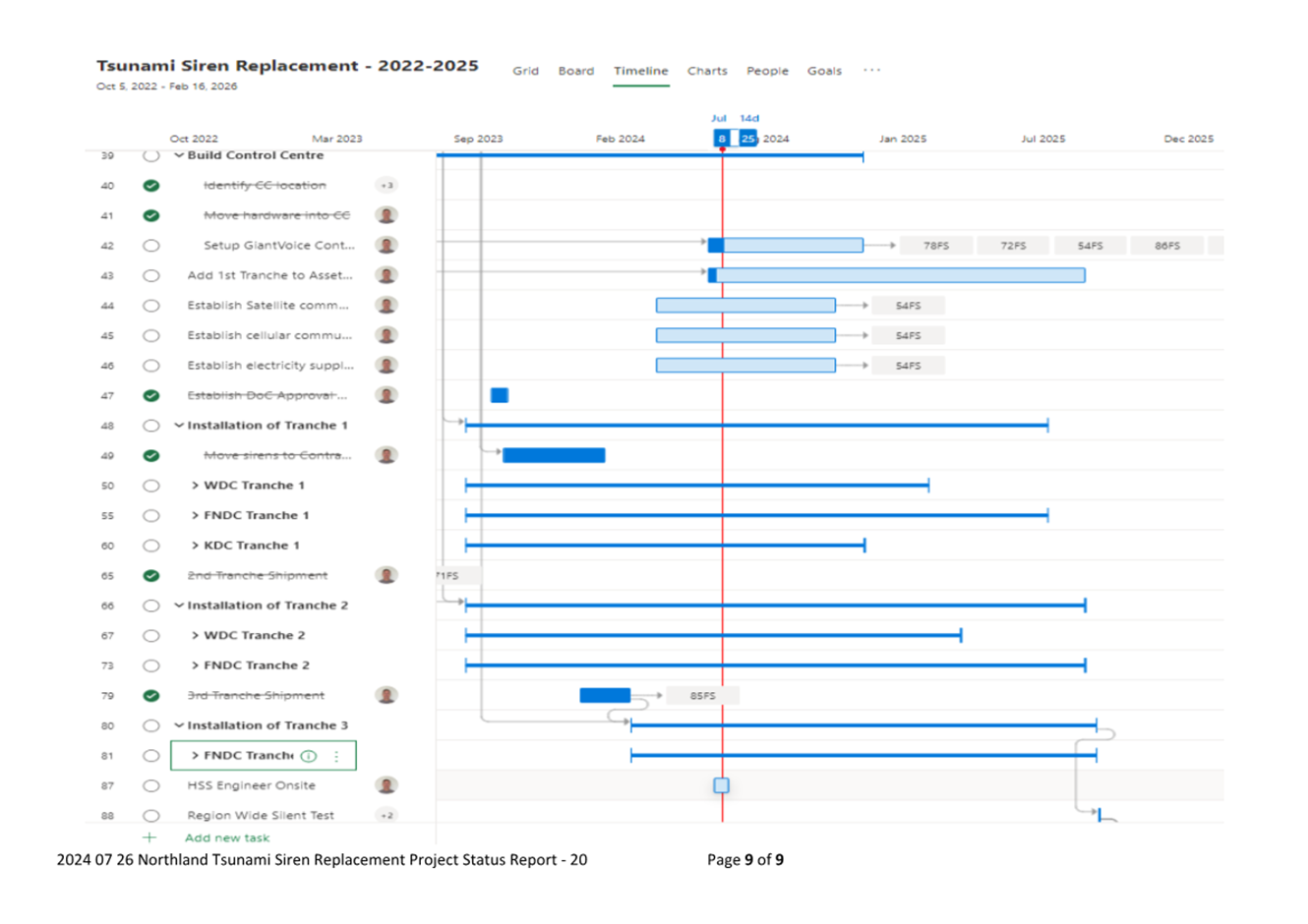
As per the attached project progress report (Attachment 1 - 2024 07 26 Northland Tsunami Siren Replacement Project Status Report – 20), progress continues with over 50% now having been constructed throughout Northland.
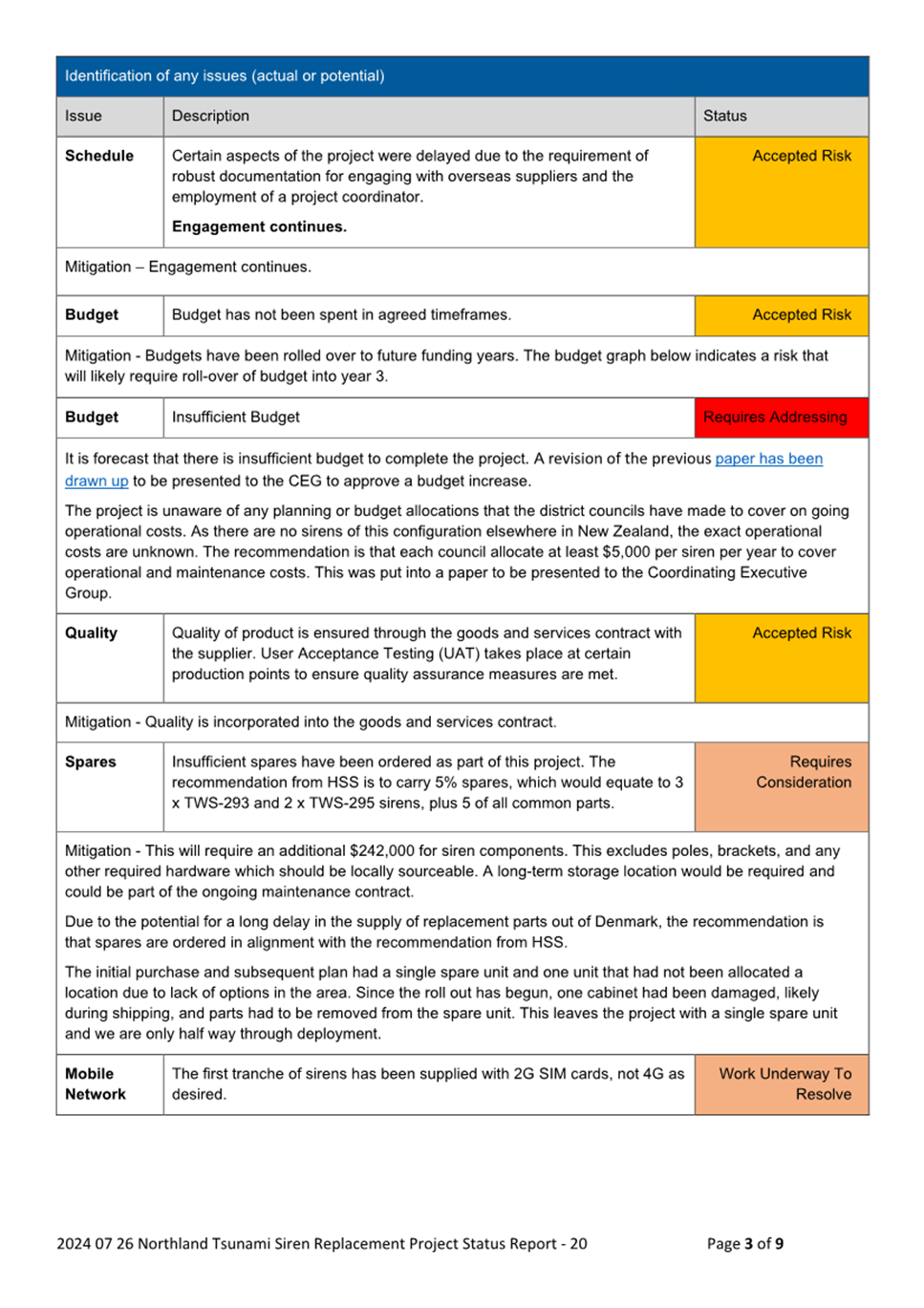
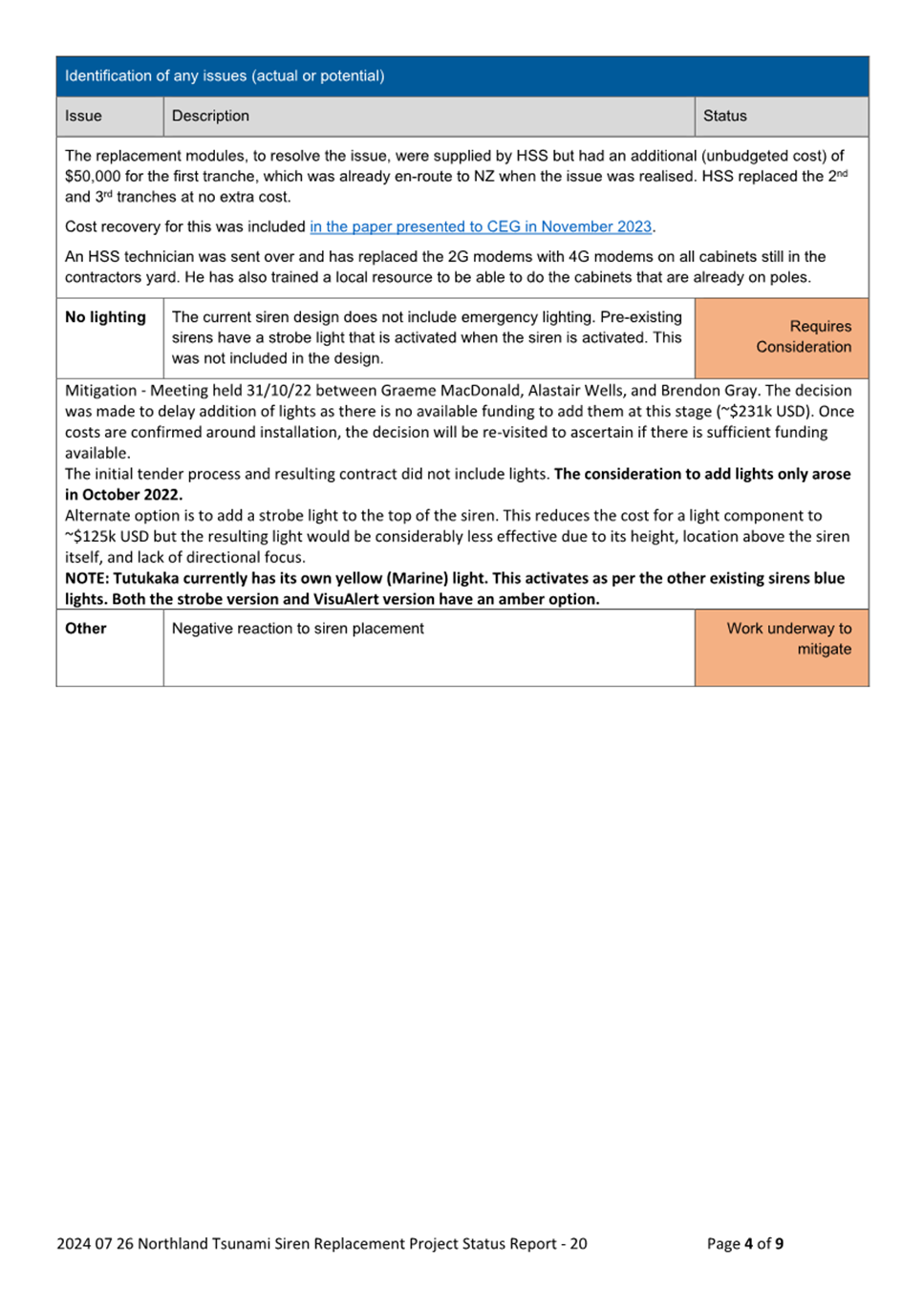
There are concerns around the remaining budget in particular the increase in costs since the initial project budget was allocated back in 2019. A separate paper detailing costs will be submitted to CEs for consideration.
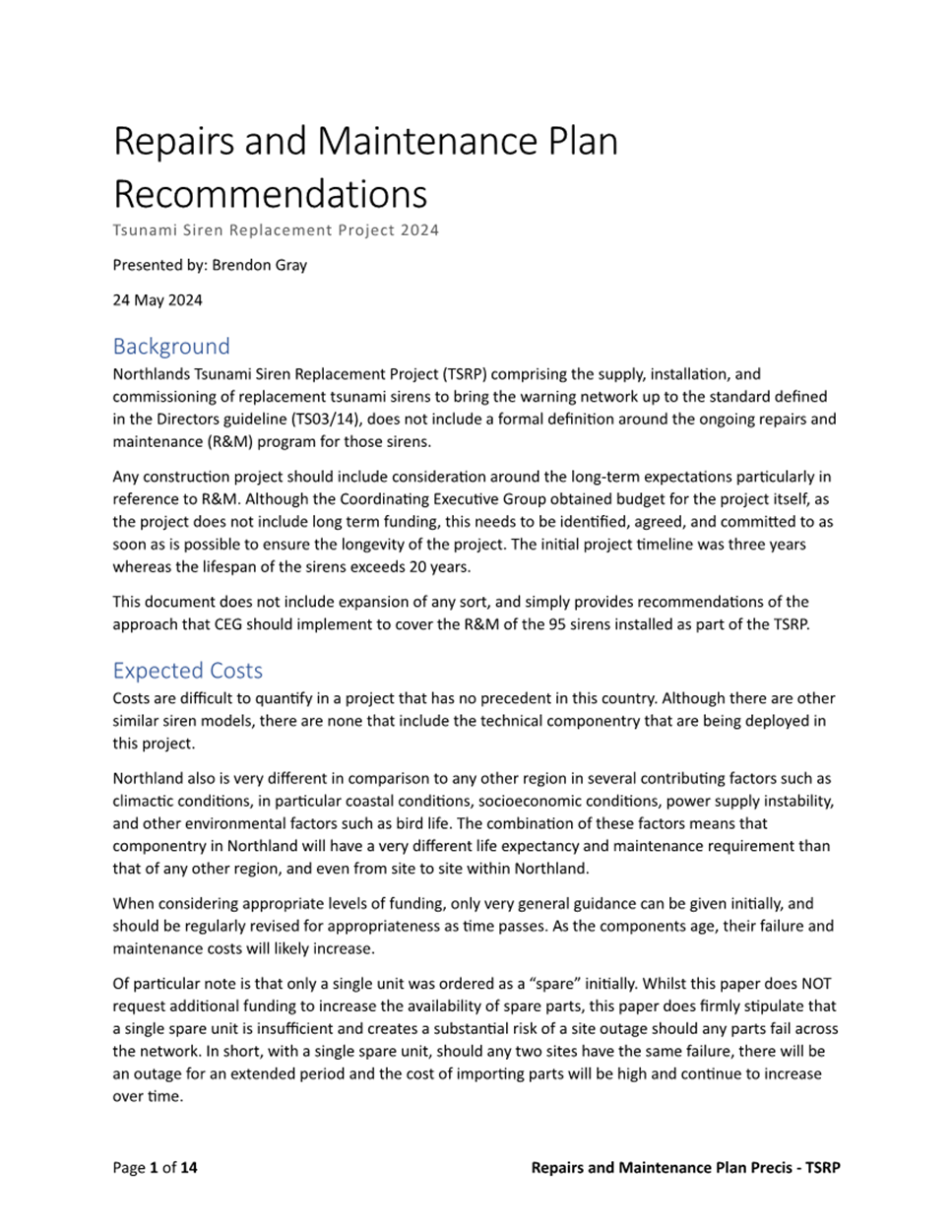
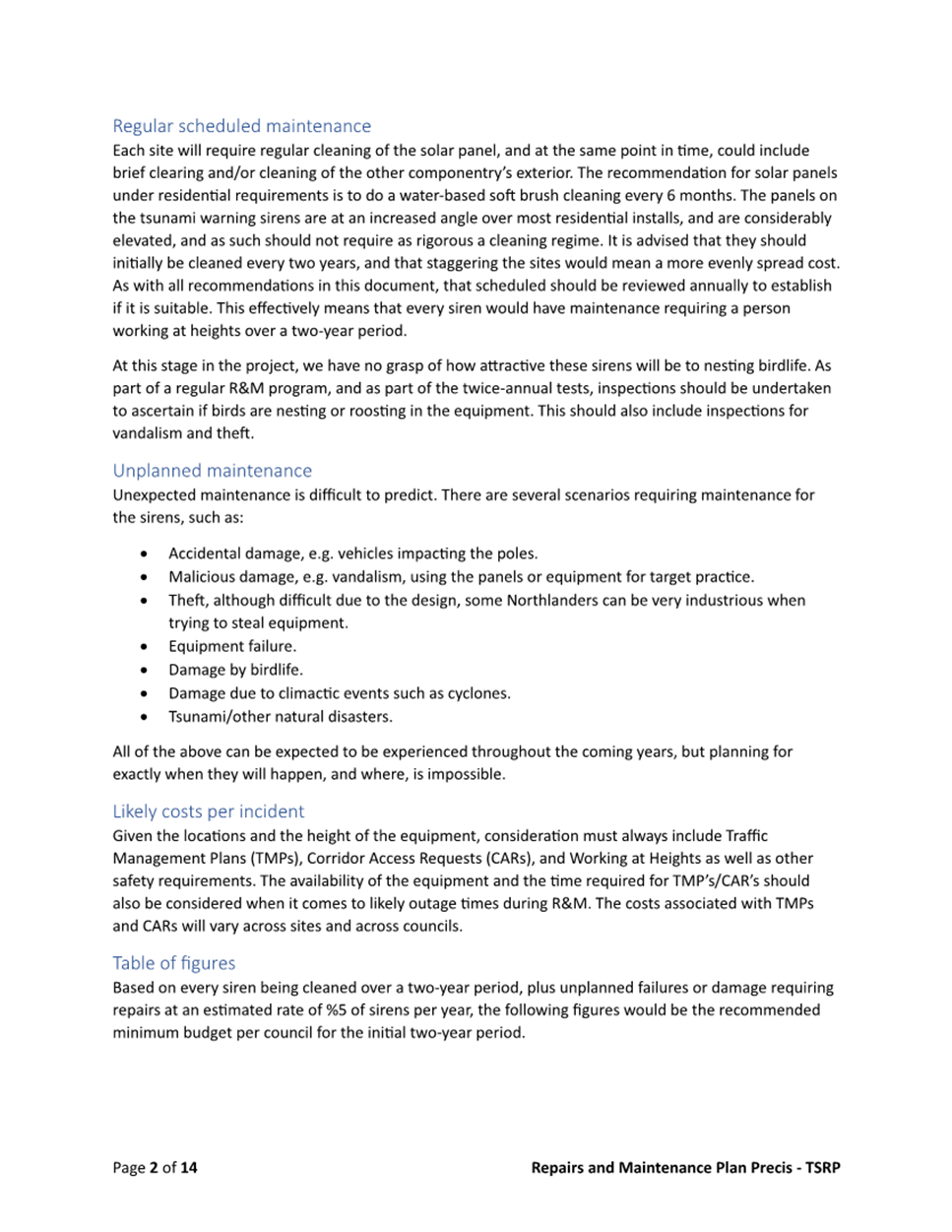
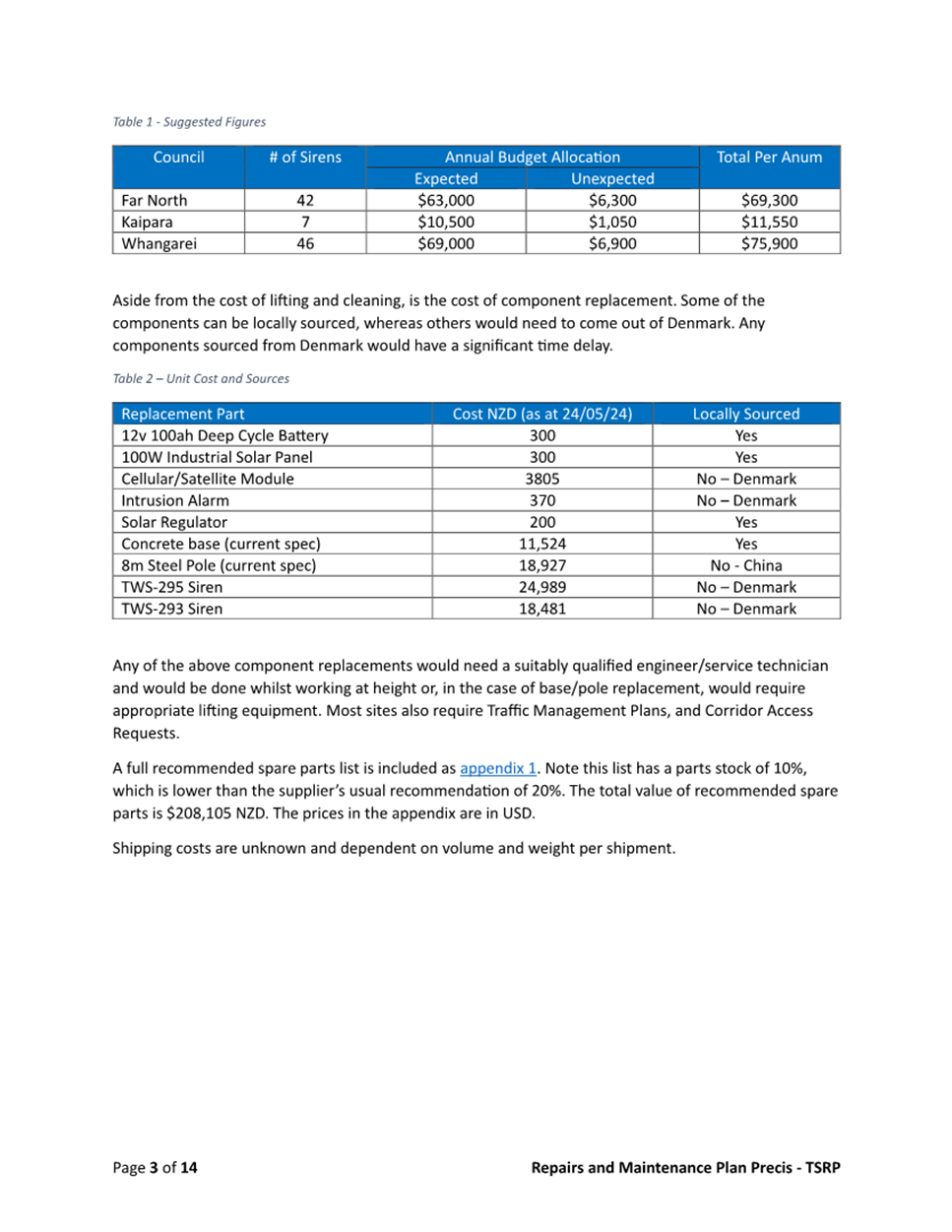
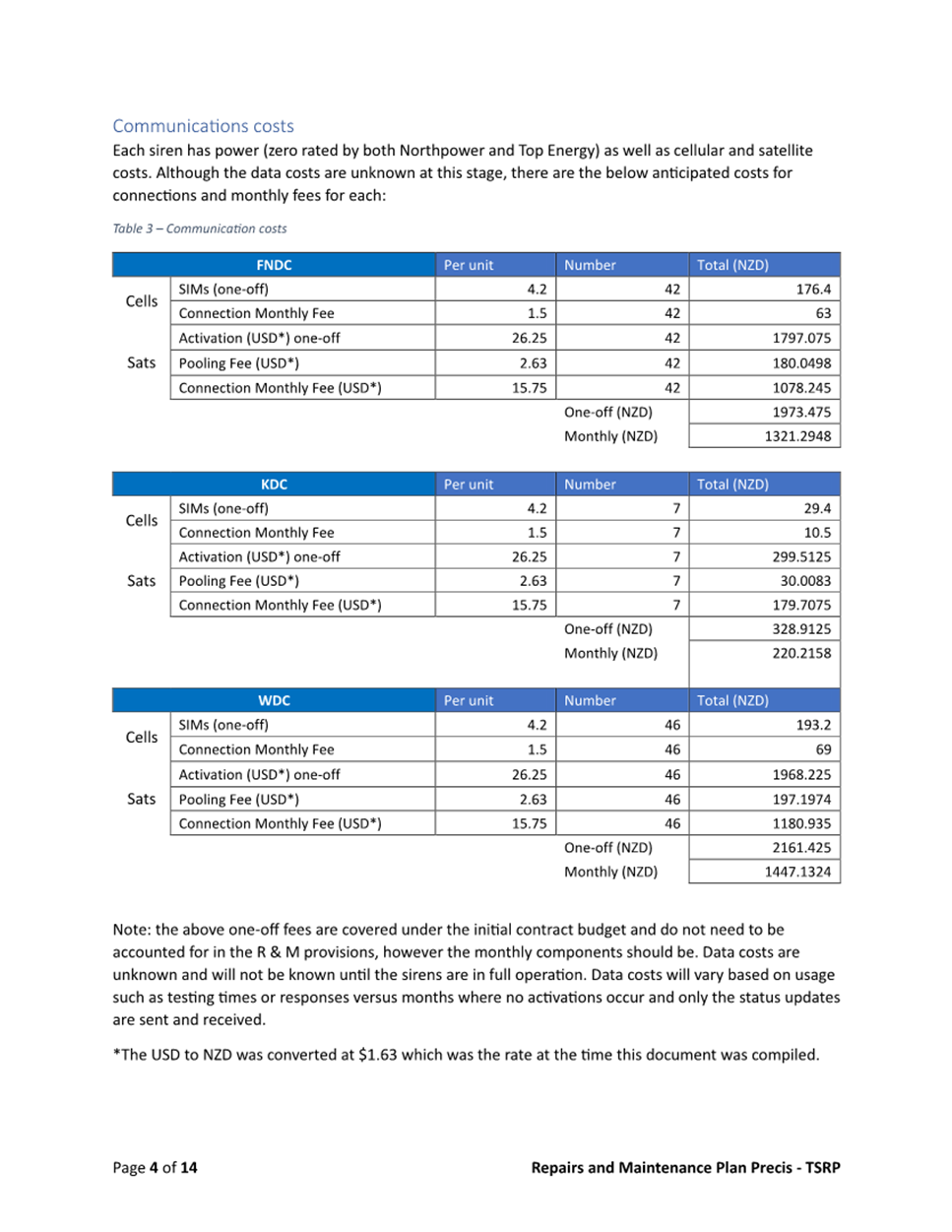
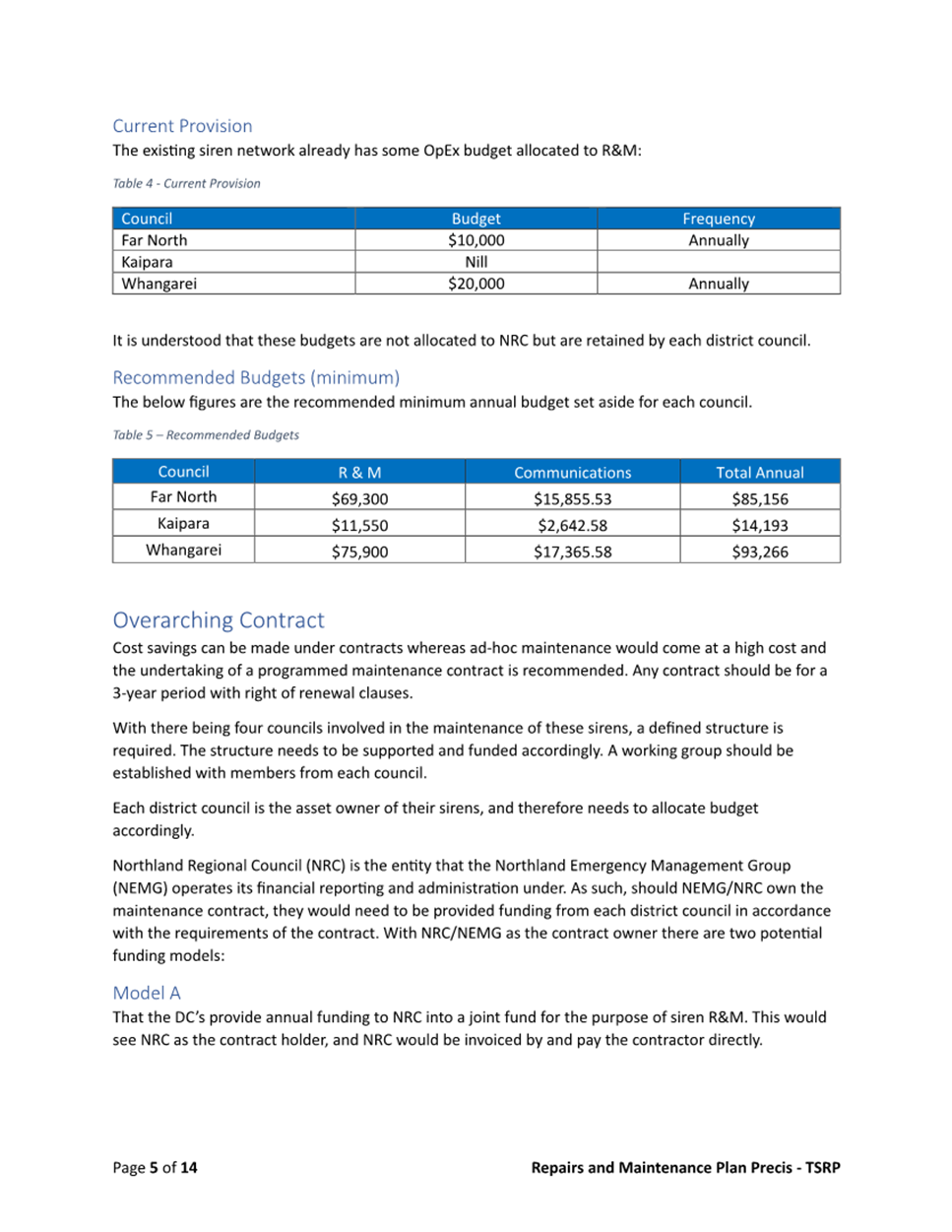
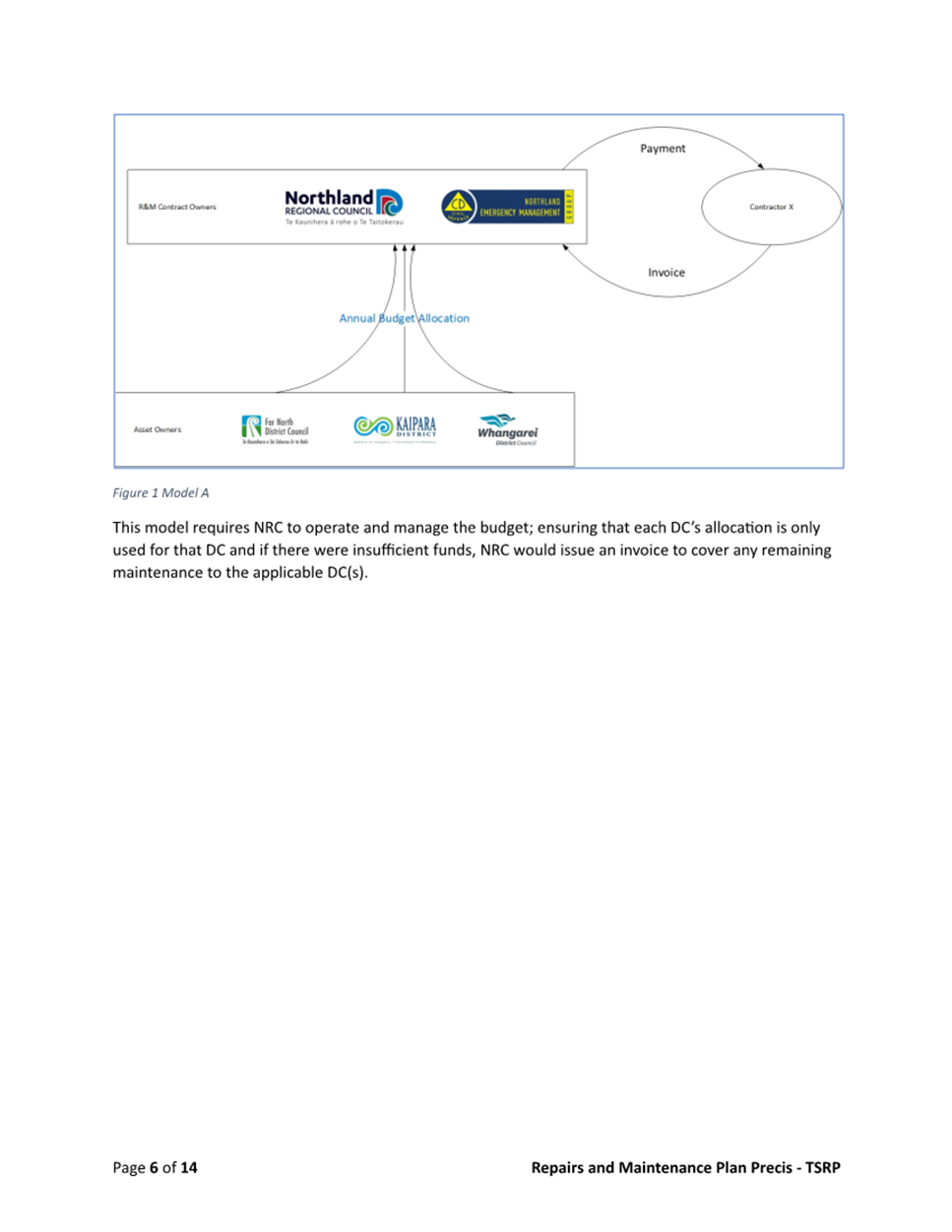
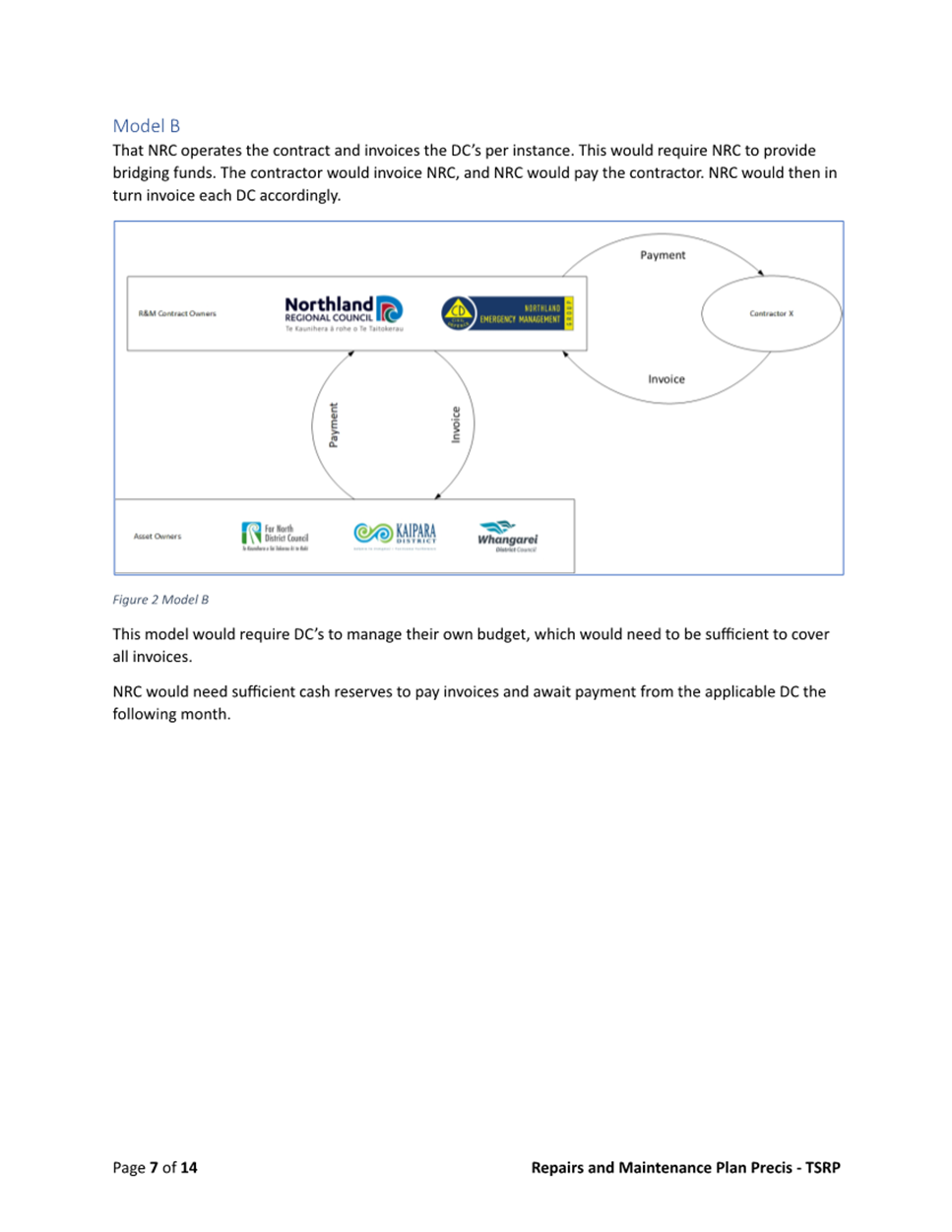
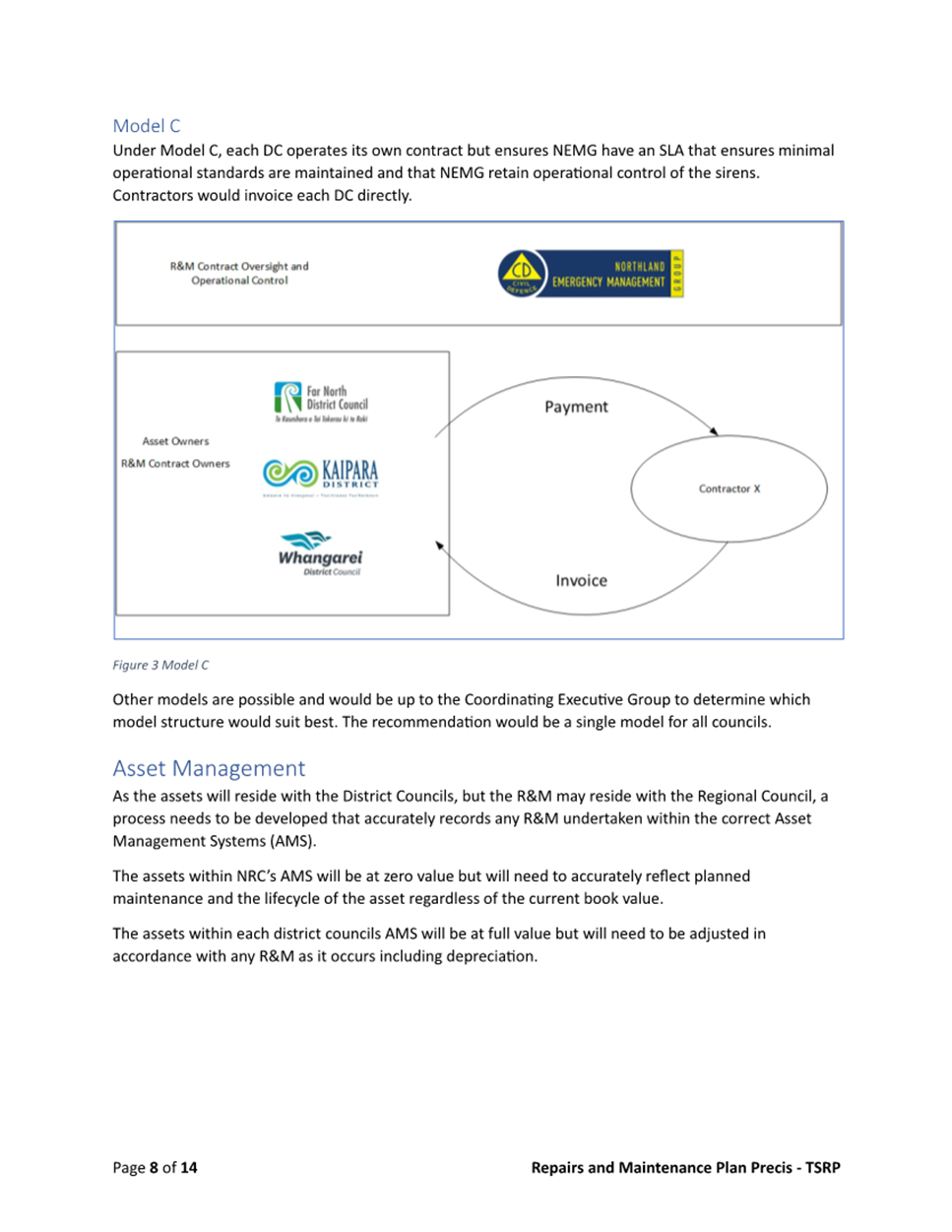
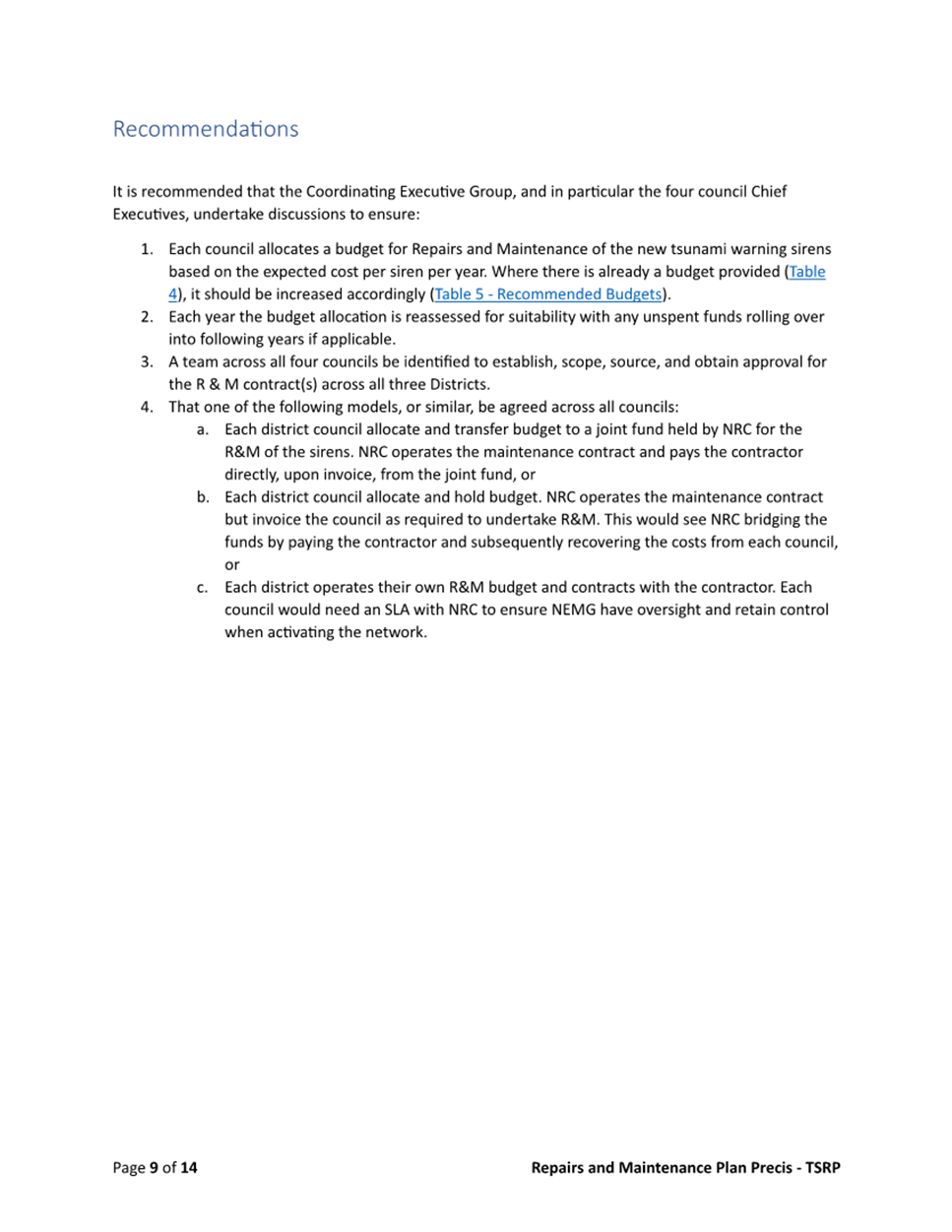
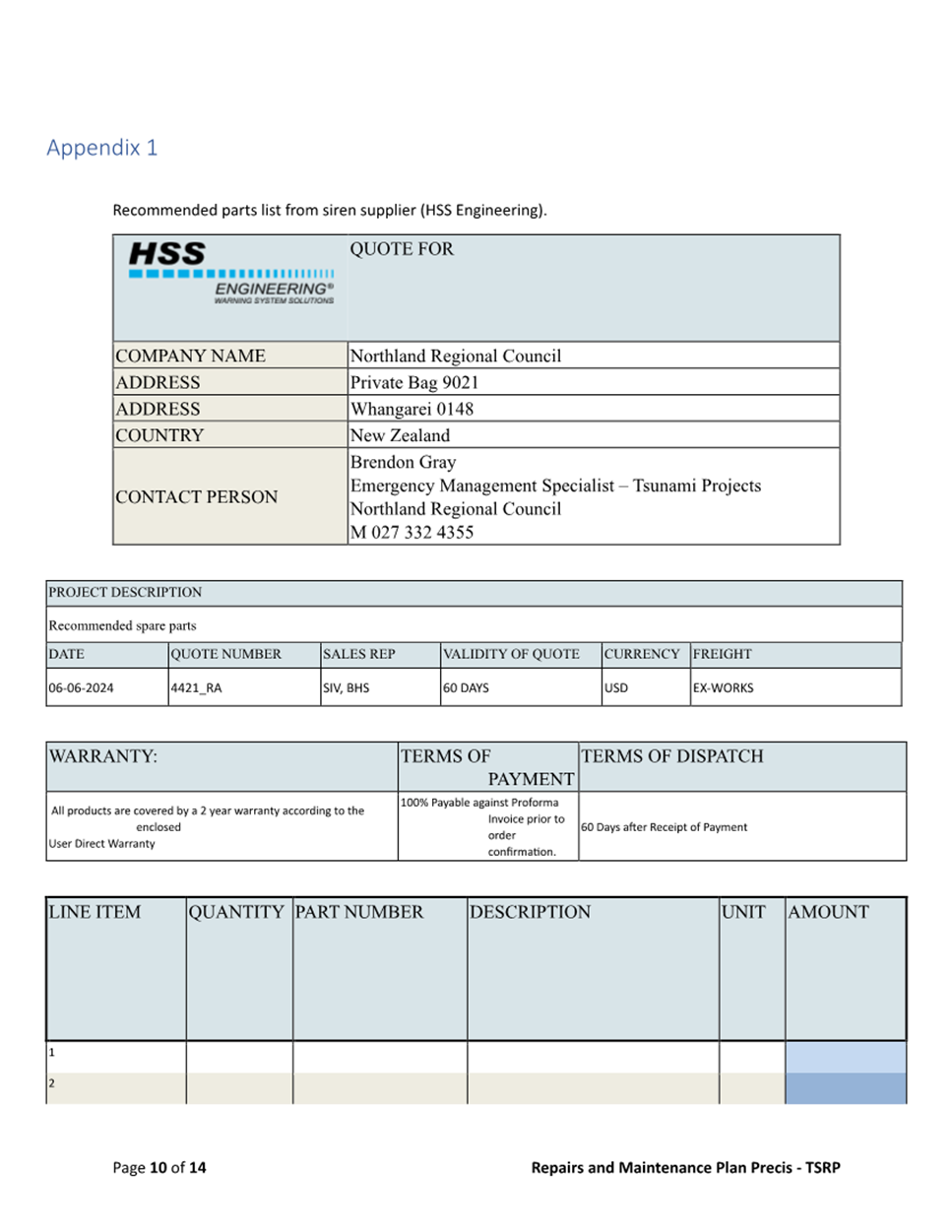
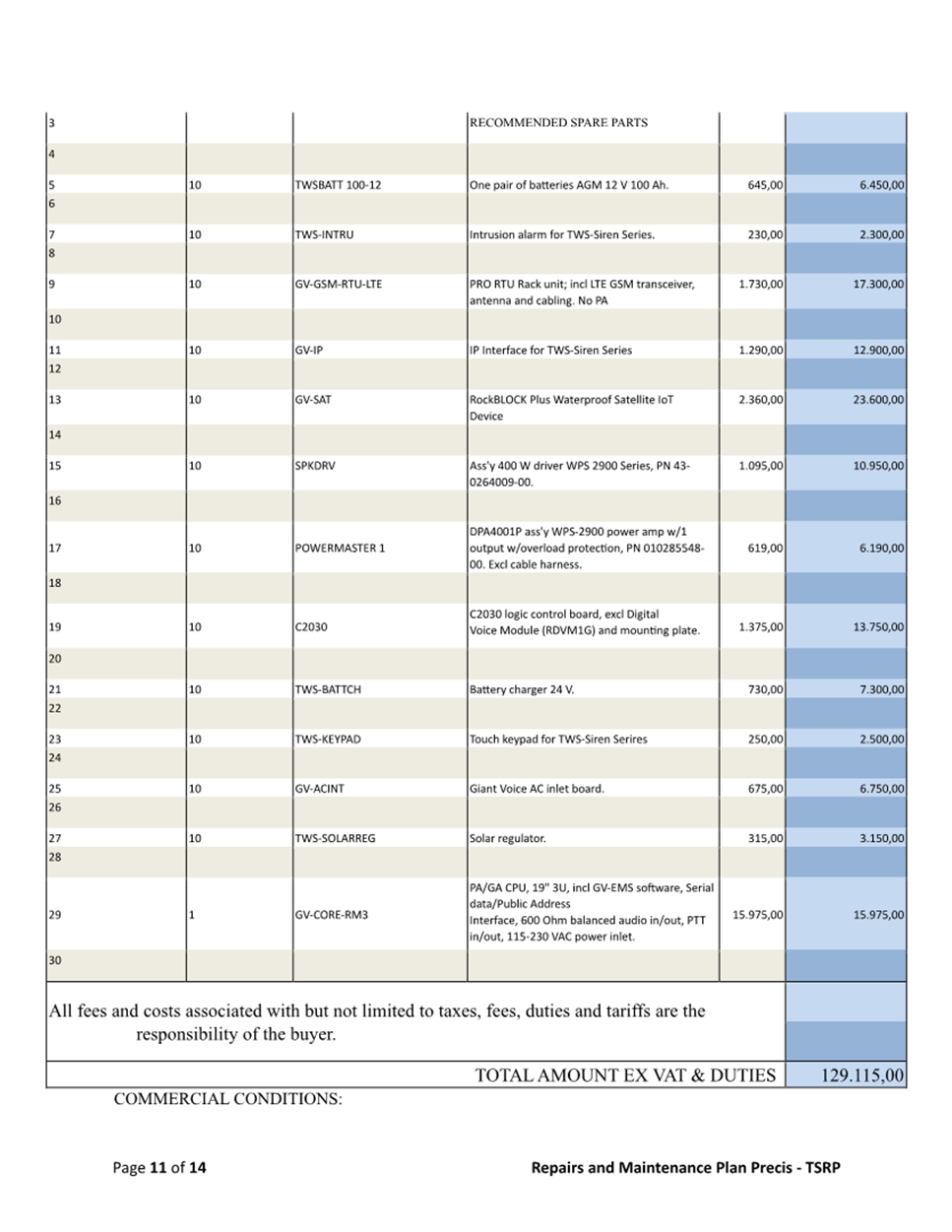
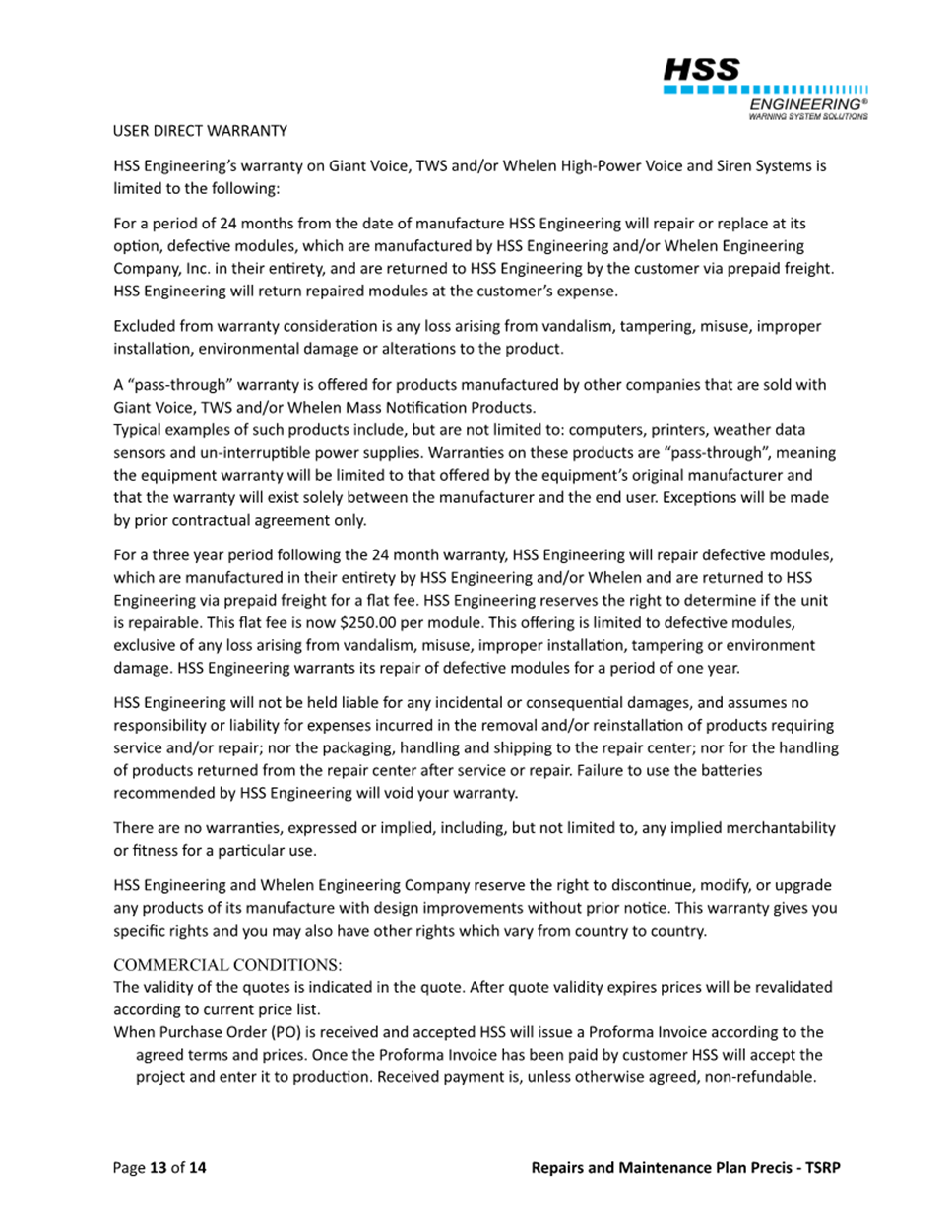
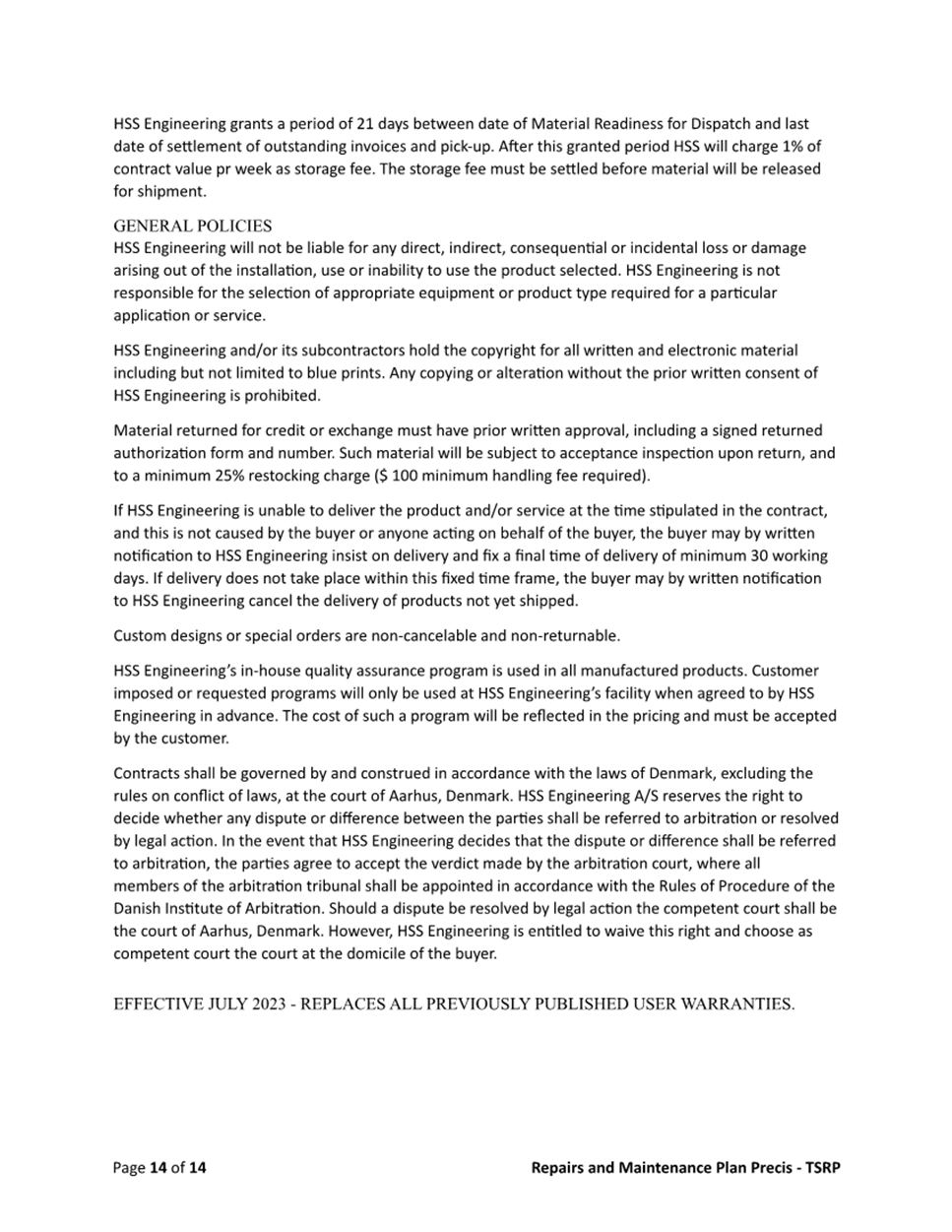
Work now needs to begin to better establish the repairs and maintenance program, this is also included in a further attachment (Attachment 2 - Repairs and Maintenance Plan Precis - TSRP – 2024).
10. Tsunami Inundation Mapping Update
This project has largely paused due to the time requirement from the Tsunami Siren Replacement Project. The next steps are to disseminate the information out to councils, and to verify the preliminary maps drawn up by the GIS consultant. These are expected to be done by the end of this calendar year.
11. Cyclone Gabrielle Recovery
Completed the Business Continuity in Emergencies Workshops for farmers.
NINC’s economic Recovery work continues, with more than 930 businesses having participated to the end of June, and 1450 total businesses registered across the suite of economic Recovery, resilience, and business continuity initiatives.
Work on the final regional Recovery report is underway and due for printing in late August / early September. Following the style of the Regional Recovery Report and the community consultation / ‘stories of community resilience’ document, the final report will be a public document, showcasing the work not only of NCDEM, but also the Councils, iwi, government agencies, and communities.
FOSAL (Future of Severely Affected Locations): Assisted FNDC in their adoption of FOSAL; presented to NRC Council about FOSAL; continued coordinating the all-of-Councils FOSAL monthly meetings.
Confirmed an external contractor to undertake an evaluation of Northland’s Cyclone Gabrielle recovery. Interviews with stakeholders will occur in October.
Current timeframes for Cyclone Gabrielle exit/wind-down:
· Write, edit, design final report: August 2024
· Print final report: August/September 2024
· Prepare lessons identified document: September 2024
· Prepare exit strategy: September 2024
· Coordinate external evaluation: October 2024
Attended the Rū Whenua National Exercise Day 3 in Wellington, with approximately 150 participants from across CDEM, central government agencies, business and infrastructure, and community. The day was followed by a Group Recovery Managers / National Recovery Coordination Group workshop the next day, looking at national arrangements and local/central working relationships. These were two days of critical catastrophic risk planning and relationship building.
Continued to coordinate the Ngā Manga Atawhai project. As of the end of June, the project has cleared 344 trees from waterways across eight sites. The MPI fund that was a possible source of the remaining $3.5 million of funded needed has changed focus; we need to find an alternative source for $3.5 million fairly urgently.
Training: completed the Foundations in Disaster Recovery course via University of Melbourne and Lessons Management Forum (AIDR/AFAC).
Met with WDC about appointing two Local Recovery Managers and have had initial conversations with FNDC about their appointment. Training for all Local Recovery Managers this year includes the Foundations in Disaster Recovery course and attendance at the National Lifeline Utilities Forum in October.
Submitted article to the Australian Journal of Emergency Management about the connection between Northland’s community consultation for Cyclone Gabrielle, the ‘Critical infrastructure commitments’ list in the Regional Recovery Plan and presenting at last year’s National Lifeline Forum.
Continued serving on the three national Recovery programme working groups for Pre-Disaster Recovery Planning (PDRP), Recovery Toolkit, and Recovery Capabilty Development. All involve large pieces of work that will increase sectoral capability and capacity across the country and inform regional pre-disaster Recovery planning next year.
12. Māori Engagement Update
· Presentation to Morehu Marae, Pawarenga. Initial engagement hui with whānau.
· Supported Brendon Gray with Tsunami Siren Replacement Project Hui: Numerous Iwi and Hapū whānau.
· Tsunami Siren Replacement Blessings: Whakawatea for Pohe Island installation site Ngāti Kahu o Torongare. Whakawatea Takahiwai Marae – Patuharakeke.
· Supported Laura Exton and KDC engagement with Ngāti Whatua Iwi and with Te Uri o Hau in Maungaturoto,
· Supported NRC Rivers and Natural Hazards team and Damian Rio with Flood affected marae project Ngāti Wai (Otetau, Mokau, Ngaiotonga) Ngāti Whatua (Otamatea, Naumai)
· Supported Mark Trüdiger with Ngā Mana Atawhai closing and whakawatea.
· Engaged with Te Kahu o Taonui to start the process of getting a new Iwi Replacement member for CEG.
13. Multi Agency Coordination Centre
The agreements required to get the project up and running have been drafted by NRC and are with FENZ and the three councils for feedback. The expectation is that these are signed by project start date, Monday 2 September. The agreements propose a governance structure which includes a Project Advisory Group made up of key FENZ and NRC staff which will report to the CEG. Governance of the project is provided by the CDEM Group Joint Committee through the CEG. Once the agreements have been signed staff will provide a further update confirming the project start date and anticipated timelines as well as the governance structure.
14. Professional Development and Engagement
Training across the CIMS structure is ongoing with further training in the Welfare space being implemented to strengthen the welfare component of responses. A summary of training attended is shown in the table below.
|
Training |
Attendees |
||||||
|
FNDC |
KDC |
NRC |
WDC |
CDEM |
Agency |
Community |
|
|
CIMS4 |
3 |
|
1 |
|
|
7 |
|
|
EOC Function |
4 |
|
|
12 |
3 |
5 |
1 |
|
Needs Assessment |
1 |
2 |
2 |
9 |
5 |
|
|
|
CLC Workshop |
|
|
|
|
2 |
|
8 |
|
Mental Health 101 |
|
1 |
|
|
1 |
|
|
|
Rū Whenua (Day 1) |
|
|
|
|
10 |
|
|
Exercise Rū Whenua
The NEMA led, tier 4 exercise, Exercise Rū Whenua was held over three days: 12, and 26 June and 10 July.
Background
The objective of the exercise was to improve New Zealand’s ability to respond to and recover from a significant destructive event.
The scenario was based on an Alpine Fault magnitude 8 (AF8) event, one of Aotearoa New Zealand’s major fault lines with the capacity to generate a severe earthquake, causing loss of life, major devastation, and disruption to the country.
Northland CDEM participated in Day One of the exercise, establishing the Group Emergency Coordination Centre (ECC).
Local Emergency Coordination Centres (EOC) were not required to be set up; however Far North District Council took the opportunity to run through an EOC set up.
Day One, 12 June
At 6.05 am Day One of the exercise commenced via a National Warning System message, received by various people, including two Northland CDEM staff. This information was shared with the CDEM team and key stakeholders.
Further
information was received via the NWS, however only to one point of contact for
the team.
The CDEM team assembled in the NRC building, established the ECC and commenced
with a briefing of known information and determined initial actions to be
undertaken.
Throughout the day a SITREP was established, deployable capability to support the exercise was being collated, an Action Plan and Communications Plan were developed, information was shared, and key stakeholders were kept updated.
As a group, the team attended both the National Controller Call and Multi Agency briefing to understand a) the information being shared, and b) as a learning opportunity.
Northland CDEM was not invited to be a part of the Day Two, and the team Recovery Specialist attended Day Three of the exercise, in Wellington.
Summary
The exercise was identified as a training opportunity by Northland CDEM so to participate, Northland CDEM developed General and Coordinating Instructions, a briefing paper and injects to support a Northland ECC response to ensure we provided support for the exercise and were able to test group KPI’s (see attached).
The need to continue exercising and developing capability was identified, as well as strengthening the team capability across all CIMS functions.
The exercise information from NEMA, both prior to and during the exercise, lacked detail, direction and urgency, and was not designed to include groups/regions that were deemed, by NEMA, to be unaffected by the earthquake event.
15. Natural Hazards Update
Risk
Northland Regional Council are undertaking several activities to understand and address the risk from natural hazards in Te Tai Tokerau. Current work includes updating and expanding our river hazard models with the Ruawai, Waima and Whangarei catchment models all near completion. The information from these models will be shared with district councils and be added to our Natural Hazards Portal for public consumption.
NRC received post-Gabrielle funding to undertake detailed modelling of the Wairoa River in particular looking to model how the different influences (tide, storm surge, and isostatic pressure) can be modelled and understood; this work is currently out for tender. Our Rivers Team received funding to work with 35 Marae across the region – this project aims to share information on flood hazards, emergency planning and some funding for building works to improve resilience at these high-risk Marae. Additional funding was also received to improve flood protections works in Kaitaia and Kawakawa. NRC also received funding to begin developing an Early Flood Warning Forecast model to better enable our hydrology team to understand potential threats and provide advice to Civil Defence.
NRC have selected Urban Intelligence to deliver their ‘Resilience Explorer’ as Te Tai Tokerau’s Risk Portal. Resilience Explorer provides a geospatial tool to build on our existing natural hazard and geospatial information to better understand the risk to our communities and infrastructure. NRC are supporting Far North District Council in using this tool to identify sites that were potentially affected by Cyclone Gabrielle to support FNDC’s FOSAL (Future of Severely Effected Land), this will also enable us to identify information that should be gathered in future storm and flood events to help our communities recover.
Attachments/Ngā tapirihanga
Attachment 1: Attachment 1 - 2024 07 26
Northland Tsunami Siren Replacement Project Status Report – 20 ⇩
Attachment 2: Attachment 2 - Repairs
and Maintenance Plan Precis - TSRP – 2024 ⇩
Civil Defence Emergency Management Group Meeting item: 7.2
3 September 2024
|
TITLE: |
Northland CDEM Group plan 2021 - 2026 report on objectives, actions and timeframe for next review. |
|
From: |
Graeme MacDonald, Emergency Manager |
|
Authorised by Group Manager/s: |
Louisa Gritt, Group Manager - Community Resilience, on 23 August 2024 |
Whakarāpopototanga / Executive summary
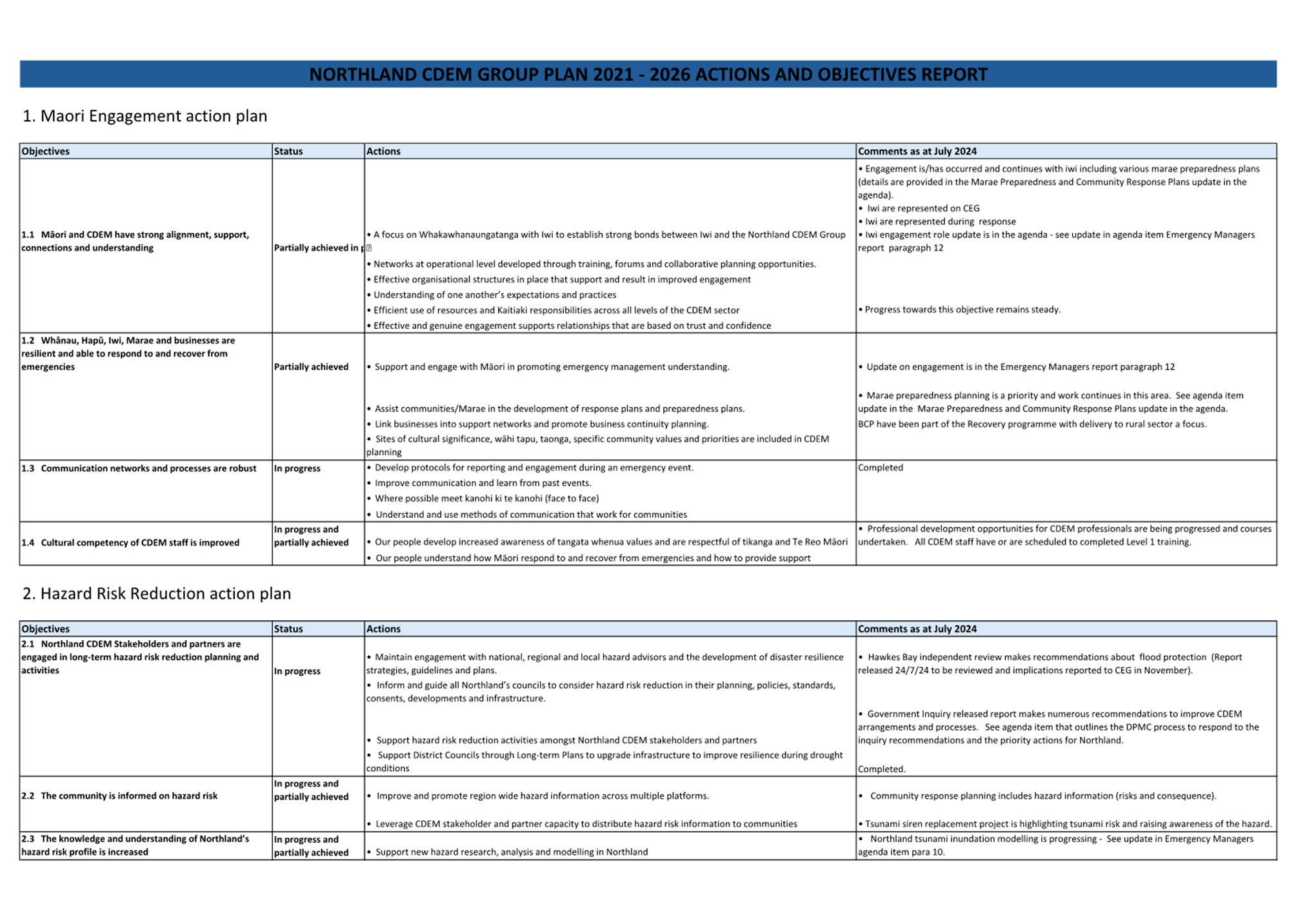
This item provides an update on progress to implement the Objectives and Actions in the 2021 – 2026 Northland CDEM Group plan. (See attached table).
The Northland Civil Defence Emergency Management Group Plan 2021 -2026 was approved by the joint committee in December 2021. The plan is available at https://www.nrc.govt.nz/media/luegn0l3/northland-civil-defence-emergency-management-group-plan-2021-2026.pdf)
The plan is the statutory reference for the Northland CDEM Group and outlines the arrangements for CDEM within the Group’s jurisdiction over a five-year period.
The plan outlines the strategic direction of CDEM engagement, participation, planning, collaboration, response coordination, recovery, CDEM management and governance and how CDEM provides resilience to the people of Northland.
Group Plan review
At the last group meeting in July the Northland CDEM Group Plan review timelines were discussed. The next plan is due for review by December 2026. The four plans produced by the Northland CDEM Group under the current legislation have all followed a Project Management methodology and have all been delivered on time. At this time no detailed timeline has been developed to review the plan but given the approximate timelines for each stage is it expected that the review process will start in quarter 4 of 2025.
1. That the report ‘Northland CDEM Group plan 2021 - 2026 report on objectives, actions and timeframe for next review. by Graeme MacDonald, Emergency Manager and dated 14 August 2024, be received.
2. That the overview of Project Plan for the review of the Northland CDEM Group Plan in 2026 be noted.
Background/Tuhinga
Group Plan review - Process and Timeframes
This overview is a broad look at what the review process encompasses for the 2026 Plan review.
· CDEM Group plans are a requirement under the CDEM Act 2002.
· Directors Guidelines provide guidance for the development of CDEM Group plans to ensure a nationally consistent approach.
· The Northland CDEM Group have to date produced 4 plans (the previous plans were adopted in 2004, 2010, 2016 and 2021).
· The final plan must be forwarded to the Minister of Civil Defence for his comments before being adopted.
· Only minor amendments to plans can be made without following the full review process.
The review process typically involves the following stages:
Stage 1: Initiation and Planning (2-3 months)
· Form a review team: Assemble a group of stakeholders, including representatives from local authorities, emergency services, and subject matter experts.
· Define scope and objectives: Clearly outline the purpose and goals of the review, including identifying areas for potential improvement.
· Develop a review methodology: Determine the approach for the review, such as desk-top analysis, stakeholder consultations, and gap analysis.
· Allocate resources: Secure necessary funding, personnel, and equipment for the review process.
Stage 2: Data Collection and Analysis (3-4 months)
· Gather existing information: Collect the current CDEM Group Plan, relevant policies, procedures, and data.
· Conduct a hazard and risk assessment: Evaluate the current and potential hazards and risks facing the community.
· Assess plan effectiveness: Evaluate the plan's performance in previous emergencies and identify areas for improvement.
· Consult with stakeholders: Gather feedback from community members, emergency services, and other relevant parties.
Stage 3: Plan Development and Consultation (3-4 months)
· Develop draft plan amendments: Based on the findings of the review, propose changes to the plan.
· Undertake public consultation: Seek feedback on the proposed amendments through various channels (e.g., public meetings, online surveys, submissions).
· Incorporate feedback: Consider and incorporate public feedback into the plan.
Stage 4: Plan Approval and Implementation (1-2 months)
· Submit plan for approval: Present the revised plan to the CDEM Group for approval.
· Communicate plan to stakeholders: Disseminate the approved plan to relevant parties.
· Develop implementation plan: Outline the steps required to implement the revised plan.
· Provide training and education: Conduct training sessions for emergency management personnel on the updated plan.
Potential Milestones
· Review initiation: Formation of the review team and development of the review plan.
· Data collection completion: Completion of hazard and risk assessment and plan effectiveness evaluation.
· Draft plan development: Completion of the initial draft of the revised plan.
· Public consultation end: Conclusion of the public consultation period.
· Plan approval: Adoption of the revised plan by the CDEM Group.
· Implementation commencement: Initiation of the plan implementation process.
Additional Considerations
· Timeframes: The overall timeframe for the review can vary depending on the complexity of the plan, the scope of the review, and available resources.
· Resource allocation: Adequate funding and personnel are essential for a successful review.
· Stakeholder engagement: Effective communication and collaboration with stakeholders are crucial for building trust and ensuring plan ownership.
· Emerging threats: The review should consider emerging threats and vulnerabilities, such as climate change and cyberattacks, terrorism.
· Legislation and policy changes: Stay informed about changes in relevant legislation and policies that may impact the CDEM Group Plan.
· Out of scope: Detailed SOP’s and Operational plans and documentation, detailed work programmes or projects, in depth analysis and detailed information relating to hazards or risk.
Attachments/Ngā tapirihanga
Attachment 1: NCDEM Group Plan
Implementation - August 2024 ⇩
Civil Defence Emergency Management Group Meeting item: 7.3
3 September 2024
|
TITLE: |
Membership and appointments – Northland CDEM Group |
|
From: |
Graeme MacDonald, Emergency Manager |
|
Authorised by Group Manager/s: |
Louisa Gritt, Group Manager - Community Resilience, on 21 August 2024 |
Executive summary/Whakarāpopototanga
Whakarāpopototanga | Executive Summary
This report provides an up-to-date list of members and key appointments for the Northland CDEM Group. The CEG are seeking approval to appoint a new Local Controller for WDC and a new iwi representative on the CEGas recommended by Te Kahu o Taonui. The list of key appointments is available on the Northland CDEM Group plan webpage.
1. That the report ‘Membership and appointments – Northland CDEM Group ’ by Graeme MacDonald, Emergency Manager and dated 14 August 2024, be received.
2. That the Northland CDEM Group appoints Shona Morgan as a Local Controller for the Whangarei District Council area.
3. That the Northland CDEM Group coopts JJ Ripikoi as an iwi representative on the CEG.
Tuhinga | Background
Membership of the Northland Civil Defence Emergency Management Group:
Ÿ Councillor Stratford FNDC - Chair of CDEM Group
Ÿ Councillor Stolwerk NRC
Ÿ Mayor Cocurullo Mayor, WDC
Ÿ Councillor Lambeth KDC
Ÿ Wipari Henwood Commander, Fire and Emergency NZ
Ÿ Superintendent Matt Srhoj Northland Police District Commander
Ÿ Mike Gillooly NEMA (observer)
Membership of the Coordinating Executive Group:
Ÿ Jonathan Gibbard CEO, NRC
Ÿ Ruben Garcia FNDC delegated representative
Ÿ Simon Weston CEO, WDC – Chair of CEG
Ÿ Jason Marris CEO, KDC
Ÿ Wayne Ewers Inspector, NZ Police
Ÿ Graeme Quensell Assistant Area Commander, Fire and Emergency NZ
Ÿ Sarah Boniface Northland Health
Ÿ Ben Lockie St John Ambulance
Ÿ Mike Gillooly NEMA (observer)
Ÿ Liz Philips Interim MoH Representative
Ÿ Russell Watson Northland Lifelines Group
Ÿ Evania Arani Northland Welfare Coordination Group
Ÿ Hone Dalton Iwi Representative
Ÿ Snow Tane Iwi Representative
Group Controllers:
Ÿ Graeme MacDonald
Ÿ Alistair Wells
Ÿ John Burt
Ÿ Simon Weston
Ÿ Victoria Harwood
Ÿ Louisa Gritt
Ÿ Jenny Calder
Local Controllers for the Whangārei District:
Ÿ Simon Weston
Ÿ Victoria Harwood
Local Controllers for the Kaipara District:
Ÿ Alistair Dunlop
Ÿ John Burt
Ÿ Jack Rudolph
Local Controllers for the Far North District:
Ÿ Alistair Wells
Ÿ Ken Ward
Group Welfare Managers:
Ÿ Evania Arani
Ÿ Kylie Cox
Ÿ Chris McColl
Ÿ Raewyn Smythe
Local Welfare Managers for the Whangārei District:
Ÿ Paula Urlich
Ÿ Toby Hoey
Ÿ Kate Biddlecombe
Local Welfare Managers for the Kaipara District:
Ÿ Jenny Rooney
Local Welfare Managers for the Far North District:
Ÿ Kirsty Roper
Ÿ Kara-Mia Rogers
Ÿ Ange Simonsen
Group Recovery Managers:
Ÿ Graeme MacDonald
Ÿ Jenny Calder
Ÿ Mark Trudinger
Local Recovery Managers:
Ÿ TBA (WDC)
Ÿ TBA (FNDC)
Ÿ Glynis McCarthy (KDC)
Iwi representation on the Northland Coordinating Executive Group (CEG)
Following on from a recent Te Kahu o Taonui Chairs hui, JJ Ripikoi, Deputy Chairperson of Ngātikahu ki Whangaroa (Kahukuraariki Trust) has recommended that he be appointed as the Te Kahu o Taonui representative to the Coordinating Executive Group to replace Mariameno Kapa-Kingi.
The CDEM Group has the authority to co-opt any person onto the Coordinating Executive Group. (CDEM Act 2002, S.20 (1)(e)).
It is recommended that the CDEM Group appoints JJ Ripikoi, Deputy Chairperson of Ngātikahu to the Northland Coordaining Executive Group.
New Appointments
The following are recommendations for new appointments to be made by the CDEM Group
Whangarei District Council – Local Controller
WDC have identified Shona Morgan to be appointed by the CDEM Group as a Local Controller for the Whangarei District Council. It is recommended that the CDEM Group appoints Shonna Morgan as a Local controller for the Whangarei District Council area. This will provide additional capacity to WDC who, following a recent resignation have only two local controllers.
Shona’s experience and skills include:
· Shona Morgan is an experienced Emergency management practitioner. Having well over a decade of emergency management experience as a specialist, a Northland CDEM Group Welfare Manager, Northland CDEM Group Controller and current member of the National Emergency Management Assistance Team (EMAT). She has deployed and supported over a dozen national and regional emergency responses.
· She undertook the national Controller training 2016 and has continued her professional development in leadership in the emergency management context, particularly through her EMAT membership. She is currently a Response Manager within the WDC Emergency Operations Centre and takes an active role within CDEM arrangements for the council.
Kaipara District Council – Local Controller
John Burt, who has been a Group and Local Controller for the Kaipara District Council for over 12 years, and recently left KDC. KDC have entered into a contract with John to provide Group and Local Controller role.
Local Recovery Manager Appointments
Whangarei District Council has made initial recommendations for two appointments to the Local Recovery Manager position. Far North District Council has identified one possible Local Recovery Manager. Interviews for these positions should occur shortly.
Lifelines Representation on CEG
Russell Watson, the current Lifelines Group representative on the CEG will be retiring early next year and it is proposed that the current Lifelines Chair, Sarah Irwin, will replace Russell Watson at the December meeting.
Russell has been an active member of the Northland Lifelines Utility Group since it was established in 2004, having been the Northpower representative and also the NLG representative on the CEG.
Attachments/Ngā tapirihanga
Nil
Civil Defence Emergency Management Group Meeting item: 8.1
3 September 2024
|
TITLE: |
Marae Preparedness & Community Response Groups Update |
|
From: |
Evania Arani, Emergency Management Specialist; Damian Rio, Emergency Management Specialist; Tony Devanney, Emergency Management Specialist; Laura Exton, Emergency Management Specialist – Kaipara and Bill Hutchinson, Emergency Management Specialist |
|
Authorised by Group Manager/s: |
Louisa Gritt, Group Manager - Community Resilience, on 21 August 2024 |
Whakarāpopototanga / Executive summary
This report provides an overview of the work being carried out with Community Engagements, Community Response Groups and on Marae Preparedness. A spatial representation of the work can be found at the link: https://localmaps.nrc.govt.nz/localmapsviewer/?map=355ec9f65a9240e3a2b36dcfd331ef3c
That the report ‘Marae Preparedness & Community Response Groups Update’ by Evania Arani, Emergency Management Specialist; Damian Rio, Emergency Management Specialist; Tony Devanney, Emergency Management Specialist; Laura Exton, Emergency Management Specialist – Kaipara and Bill Hutchinson, Emergency Management Specialist and dated 14 August 2024, be received.
Background/Tuhinga
Marae Preparedness
The table below shows the engagement in the past quarter for Marae Preparedness.
|
MARAE |
COMPLETED |
WORK IN PROGRESS |
|
Far North |
||
|
Motuti Marae |
Plan in place |
|
|
Parihaka Marae |
|
Meeting attended Plan development underway |
|
Te Hiku o te Ika Marae |
|
Meeting attended Plan development underway |
|
Potahi Marae |
|
Plan development underway |
|
Haiti tai Marangai Marae |
|
Initial engagement |
|
Roma Marae |
|
Meeting attended Initial and ongoing engagement |
|
Oturu Marae |
|
Plan development underway |
|
Ngai Tawake Marae |
|
Meeting attended Plan development underway |
|
Pipiwai Marae |
Plan in place |
Meeting attended Initial and ongoing engagement |
|
Morehu Marae |
|
Meeting attended Initial and ongoing engagement |
|
Motatau |
|
Meeting attended Initial and ongoing engagement |
|
Mohinui Marae |
Plan in place |
|
|
Motukaraka (Te Roopu Whaka o Nga Tupoto Ki Motukaraka) |
Plan in Place |
|
|
Mangamuka Marae |
Plan in Place |
Meeting attended Committee have an existing plan but would be advantageous to link it to CDEM |
|
Kaipara |
||
|
Matatina and Pananawe Marae |
|
Plan development underway |
|
Naumai marae |
|
Initial and ongoing engagement |
|
Otamatea marae |
|
Initial and ongoing engagement |
|
Te Pounga marae |
|
Plan development underway |
|
Waikara marae |
Plan in place |
|
|
Whangarei |
||
|
Mokau Marae |
|
Meetings and planning workshop attended Further engagement scheduled |
|
Oakura Marae |
|
Meetings and planning workshop attended Further engagement scheduled |
|
Otetao Reti Marae |
|
Meetings and planning workshop attended Further engagement scheduled |
|
Ngatiwai Marae |
|
Meetings and planning workshop attended Further engagement scheduled |
|
Tuparehuia Marae |
|
Planning workshop attended Further engagement scheduled |
|
Korokota Marae |
|
MBIE Renewable Energy Project Further engagement scheduled |
|
Te Aroha Marae |
|
MBIE Renewable Energy Project Further engagement scheduled |
|
Whangarei Terenga Paraoa Marae |
|
MBIE Renewable Energy Project |
|
Ngunguru Marae |
|
Meeting attended Further engagement scheduled |
|
Kaikou Marae |
|
Email correspondence Further engagement scheduled |
|
Whakapara Marae |
|
Meeting attended Further engagement scheduled |
|
Tau Henare Marae |
|
Meeting attended Further engagement scheduled |
|
Whananaki Marae |
|
Engagement scheduled |
|
Akerama Marae |
|
Engagement scheduled |
|
Maungārongo Marae |
|
Engagement scheduled |
Marae preparedness planning
We are aware that several marae preparedness plans have been developed in Northland without any engagement with Northland CDEM. A marae preparedness plan was a requirement to secure some funding after cyclone Gabrielle through a number of different funding streams. We do not have the figures of the marae that have done this.
Hapu and Iwi Māori Engagement
CDEM engagement with hapū and iwi Māori continues to grow. Hapū and iwi throughout Te Taitokerau have been working alongside CDEM groups enhancing connections and developing hapū-led initiatives. Additionally, hapū have also been pivotal in supporting the Northland Tsunami Siren Replacement Project.
Northland Flood Resilient Māori Communities and Marae Project
The Northland Regional Council (NRC) Rivers Team are currently executing this project to reduce the risk of flooding in 6 flood-affected Māori communities. CDEM is supporting this project by providing Marae Preparedness planning for the 35 identified Marae across Te Taitokerau that are currently exposed to one in 100yr flood events.
Community Response Groups
The table below provides a snapshot of the status of community response group by district.
|
COMMUNITY |
GROUP STATUS |
|
Far North |
|
|
Te Hapua |
Active and engaged |
|
Te Kao |
Active and engaged |
|
Pukenui |
Not active and not engaged |
|
Karikari Peninsula |
Active and engaged |
|
Kaimaumau |
Active and engaged |
|
Taipa |
Not active not engaged |
|
Waipapakauri/Lake Ngatu |
Not active and not engaged |
|
Kaitaia |
Active and engaged |
|
Ahipara |
Active and engaged |
|
Hihi |
Engaged |
|
Taupo Bay |
Engaged |
|
Mahinepua/Wainui/Te Ngaere |
Active and engaged |
|
Totara North |
Not active and not engaged |
|
Kaeo |
Not active and not engaged |
|
Tapuaetahi |
Active and engaged |
|
Te Tii |
Active and engaged |
|
Rangitane / Doves Bay / Opito Bay |
Active and engaged |
|
Kerikeri / Waipapa |
Engaged |
|
Russell |
Engaged |
|
Okaihau |
Active and engaged |
|
Kawakawa |
Active and engaged |
|
Waikare / Waihaha |
Active and engaged |
|
Kohukohu |
Engaged |
|
Rawene |
Active and engaged |
|
Mitimiti |
Active and engaged |
|
Ngawha Springs |
Active and engaged |
|
Waima |
Not active and not engaged |
|
Waimamaku |
Not active and not engaged |
|
Moerewa |
Active and engaged |
|
Doubtless Bay |
Engaged |
|
Tauranga Bay |
Engaged |
|
Lake Ohia |
Engaged |
|
Kaipara |
|
|
Baylys Beach |
Active and engaged |
|
Kaiwaka |
Active and engaged |
|
Mangawhai |
Not active and not engaged |
|
Matakohe |
Active and engaged |
|
Maungaturoto |
Active and engaged |
|
Oneriri / Te Pounga |
Status to be confirmed |
|
Oruawharo / Topuni |
Active and engaged |
|
Paparoa |
Active and engaged |
|
Pouto |
Active and engaged |
|
Ruawai |
Active and engaged |
|
Tangiteroria |
Status to be confirmed |
|
Tinopai |
Active and engaged |
|
Waikara |
Active and engaged |
|
Whakapirau |
Active and engaged |
|
Whangarei |
|
|
Whangaruru North (Bland Bay) |
Active and engaged |
|
Whangaruru South (Oakura) |
Active and engaged |
|
Teal/Helena Bay |
Active and engaged |
|
Whananaki |
Active and engaged |
|
Ngati Hau |
Not active and not engaged |
|
Akerama |
Engaged |
|
Hikurangi |
Active and engaged |
|
Tutukaka Coast |
Active and engaged |
|
Ngati Taka me ona hapori |
Active and engaged |
|
Mangakahia Central |
Not active and not engaged |
|
Pakotai |
Active and engaged |
|
Te Wairiki Civil Defence Roopu |
Active and engaged |
|
Parua Bay |
Active and engaged |
|
Onerahi |
Active and engaged |
|
Tamaterau/Waikaraka |
Active and engaged |
|
Portland |
Active and engaged |
|
Whangarei Heads |
Active and engaged |
|
Ruakaka |
Engaged |
|
Waipu |
Active and engaged |
Attached to this report is a static image displaying the two sets of information as per the table above.
- Northland Community Response Groups – status indicated by symbols.
- Northland Community Response Plans – territorial local authority (TLA) shown by colour.
Summary of new and existing Community Response plans and groups
|
FNDC |
KDC |
WDC |
TOTAL |
|
|
Existing Community Response Groups |
19 |
12 |
17 |
48 |
|
Existing Community Response Plans |
34 |
15 |
17 |
66 |
|
Requests for NEW Community Response Groups |
0 |
0 |
0 |
0 |
|
Requests for revised/updated Community Response Plans |
0 |
0 |
0 |
0 |
|
Requests for NEW Community Response Plans |
0 |
0 |
0 |
0 |
Summary of community engagements, meetings undertaken
|
ACTIVITY |
|
Far North |
|
Community Response Group Meeting / Plan review - Okaihau |
|
Community Response Group Meeting / Plan review - Kawakawa |
|
Community Response Group Meeting / Plan review - Russell |
|
Community Response Group Meeting / Plan review – Rangitane |
|
Community Response Group Meeting / Plan review – Ngawha Springs |
|
Community Response Group Meeting / Plan review – Moerewa |
|
Community Response Group Meeting / Plan review - Tapuaetahi |
|
Community Response Group Meeting / Plan review – Te Hapua |
|
Attendance at the Fire and Emergency New Zealand Marae Resilience Meeting |
|
Attendance at Ngā Manga Atawhai pōwhiri launch, Te Whakamaharatanga Marae Waimamaku |
|
Attendance at Ngawha Geothermal Community Liaison Committee meeting |
|
Presentation at the Kaitaia Business Association – Business Continuity |
|
Attendance at the BOI Cruise Ship Logistics Meeting |
|
Presentation to Kaitaia Age Concern |
|
Attendance and participation at emergency planning meeting Ngawha Geothermal Power Station. |
|
Attendance at the Rural Support Collaboration evening – Broadwood |
|
Meeting and assisting Ngawha Business and Innovation Park with their Resilience Plan |
|
Attendance at Emergency Service Group Meeting. |
|
Kaipara |
|
Meeting with potential Coordinator for Donnelly’s Crossing |
|
Presentation to community meeting at Te Kopuru |
|
Meeting with new Co-Coordinators for Baylys Beach |
|
Meeting with community members in Kaihu |
|
Presentation to Te Uri o Hau Environs Kaitiaki hui |
|
Presentation to Naumai marae |
|
Meeting with Naumai marae Secretary |
|
Meeting with Otamatea marae Chair |
|
Meeting with MSD Dargaville |
|
Meeting with Dargaville High School |
|
Meeting with Rodney Neighbourhood Support Coordinator |
|
Whangārei |
|
CD presentation delivered to Māori Woman’s Welfare League |
|
Engagement activities conducted with Whakapara |
|
Community Led Centre training delivered to Parua Bay, Tamaterau/Waikaraka, and Whangarei Heads CRG’s |
|
Engagement activities conducted with Pakotai CRG |
|
Initial engagement with Patuharakeke hapū trust |
|
Engagement activities conducted with Maungatapere group |
|
Engagement activities conducted with the Tutukaka Coast CRG |
|
Engagement activities conducted with WDC coastal communities – Tsunami Siren Replacement Project |
|
Engagement activities conducted with Whangaruru South CRG |
|
Planning and coordination meetings conducted with Ngatiwai Trust Board |
|
Marae Preparedness Planning workshop delivered to 5 Whangaruru Marae |
|
Engagement activities conducted with Te Waiariki Civil Defence Roopu |
|
Engagement activities conducted with the Pipiwai and Kaikou CRG’s |
|
Engagement activities conducted with Ngati Taka me ona hapori CRG |
|
Engagement activities conducted with the Tai Timu Tai Pari |
|
Initial engagement with Whakapara Marae |
|
EOC Familiarisation Training delivered to WDC EOC Staff |
|
CIMS and training opportunities attended |
Community Response Planning GIS Integration
Northland have an extensive network of Community Response Groups and Community Response Plans. In early 2022 the Coordinating Executive Group requested a static map displaying the spread and location of these communities to identify any gaps. As this project progressed, the Emergency Management Specialists identified an opportunity to include this information on a publicly available Map on the NRC Website. The mapping of community response groups with plans has now been completed and is live on the Northland Regional Council website: The next step is to work with our GIS team to map Marae that are engaged with Northland CDEM who have a current and up to date Marae Preparedness plan. We plan to have this work completed by the next scheduled CEG meeting.
You can view the community response group map on the following link: https://localmaps.nrc.govt.nz/localmapsviewer/?map=355ec9f65a9240e3a2b36dcfd331ef3c
Attachments/Ngā tapirihanga
Nil