|
Civil Defence Emergency Management Group Meeting Tuesday 3 March 2026 at 1:00 pm - 2:30 pm
|
|
|
|
|
|
Civil Defence Emergency Management Group Meeting Tuesday 3 March 2026 at 1:00 pm - 2:30 pm
|
|
|
|
|
Civil Defence Emergency Management Group Meeting
3 March 2026
Civil Defence Emergency Management Group Meeting Agenda
Meeting to be held in the Council Chamber
36 Water Street, Whangārei
on Tuesday 3 March 2026, commencing at 1:00 pm - 2:30 pm
Recommendations contained in the agenda are NOT decisions of the meeting. Please refer to minutes for resolutions.
MEMBERSHIP OF THE Civil Defence Emergency Management Group Meeting
Chairperson, Councillor Colin Kitchen
|
FNDC Councillor, Deputy Chair - Kelly Stratford |
KDC Councillor, Gordon Lambeth |
WDC Mayor, Ken Couper |
|
FENZ Representative Wipari Henwood |
FENZ Representative Wipari Henwood |
NZ Police Representative Matthew Srhoj |
KARAKIA / WHAKATAU
RĪMITI (ITEM) Page
1.0 Ngā Mahi Whakapai/Housekeeping
2.0 Ngā Whakapahā/apologies
3.0 Ngā Whakapuakanga/declarations of conflicts of interest
4.0 Ngā Whakaae Miniti / Confirmation of Minutes
4.1 Confirmation of Minutes - 9 December 2025 4
5.1 Receipt of Action Sheet 10
6.1 National Emergency Management Agency Update 12
7.1 Membership and appointments – Northland CDEM Group 15
7.2 CDEM Group Plan Delivery 18
7.3 CDEM Finance Report 22
7.4 Section 17a Review Update 25
8.1 Agency Updates 36
8.2 CEG Chair Report 37
8.3 Emergency Management Bill Submission - Retrospective Approval 51
8.4 Community Response Planning and Marae Preparedness Planning 60
8.5 Landslide Assessments - Correspondence 64
Civil Defence Emergency Management Group Meeting item: 4.1
3 March 2026
|
TITLE: |
Confirmation of Minutes - 9 December 2025 |
|
From: |
Haylee Labelle, Personal Assistant Community Resilience |
|
Authorised by Group Manager/s: |
Louisa Gritt, Group Manager - Community Resilience, on 08 February 2026 |
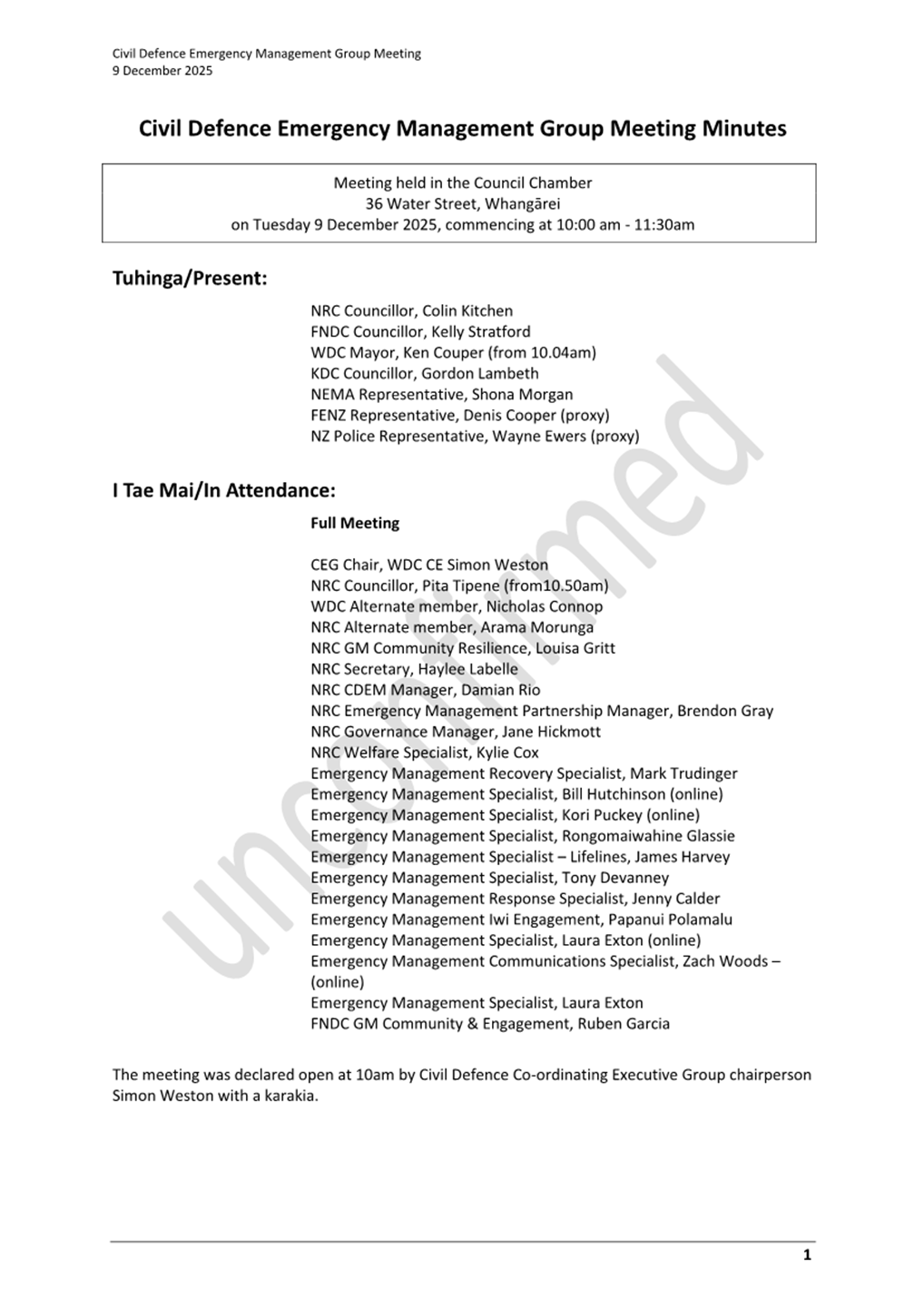
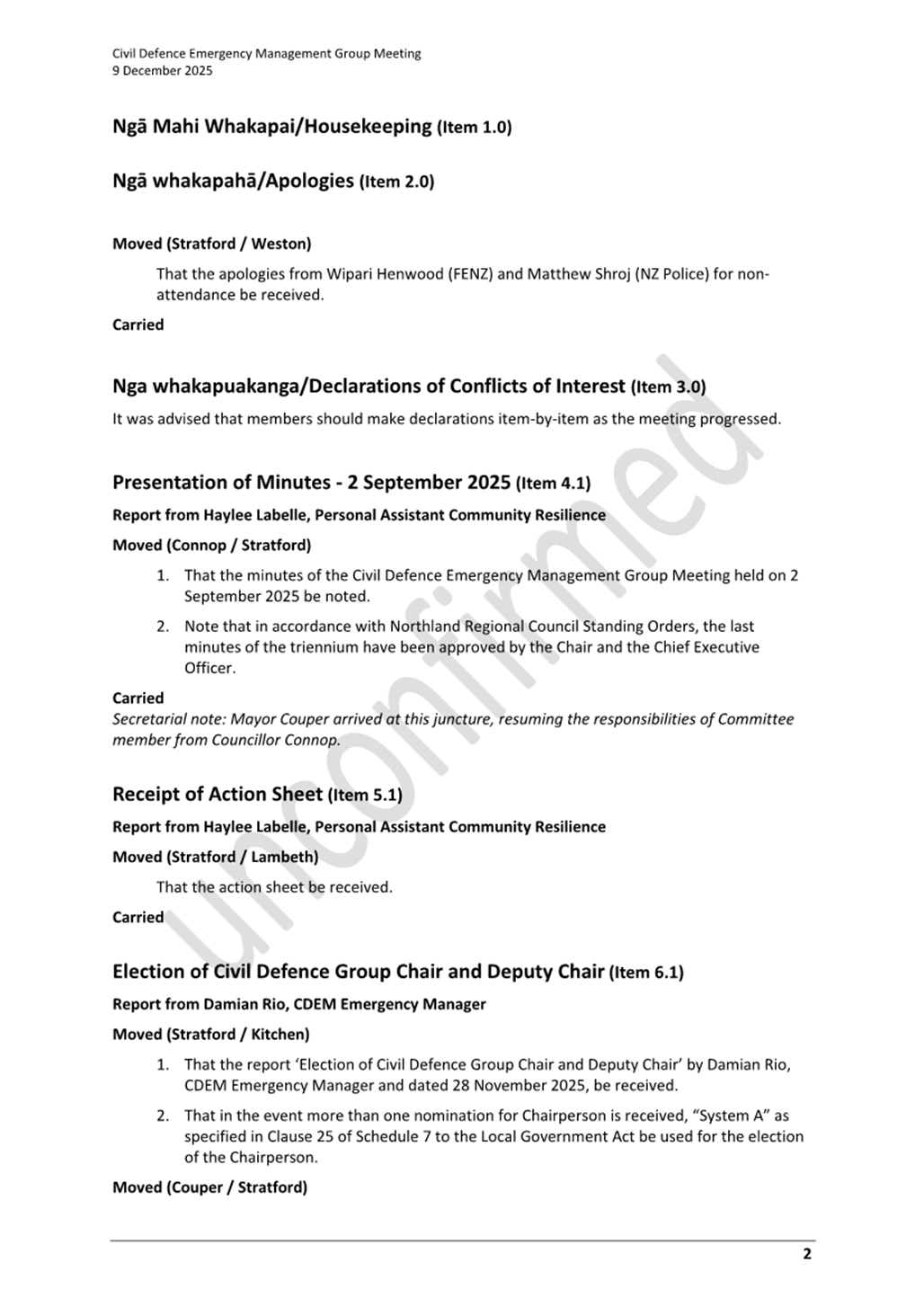
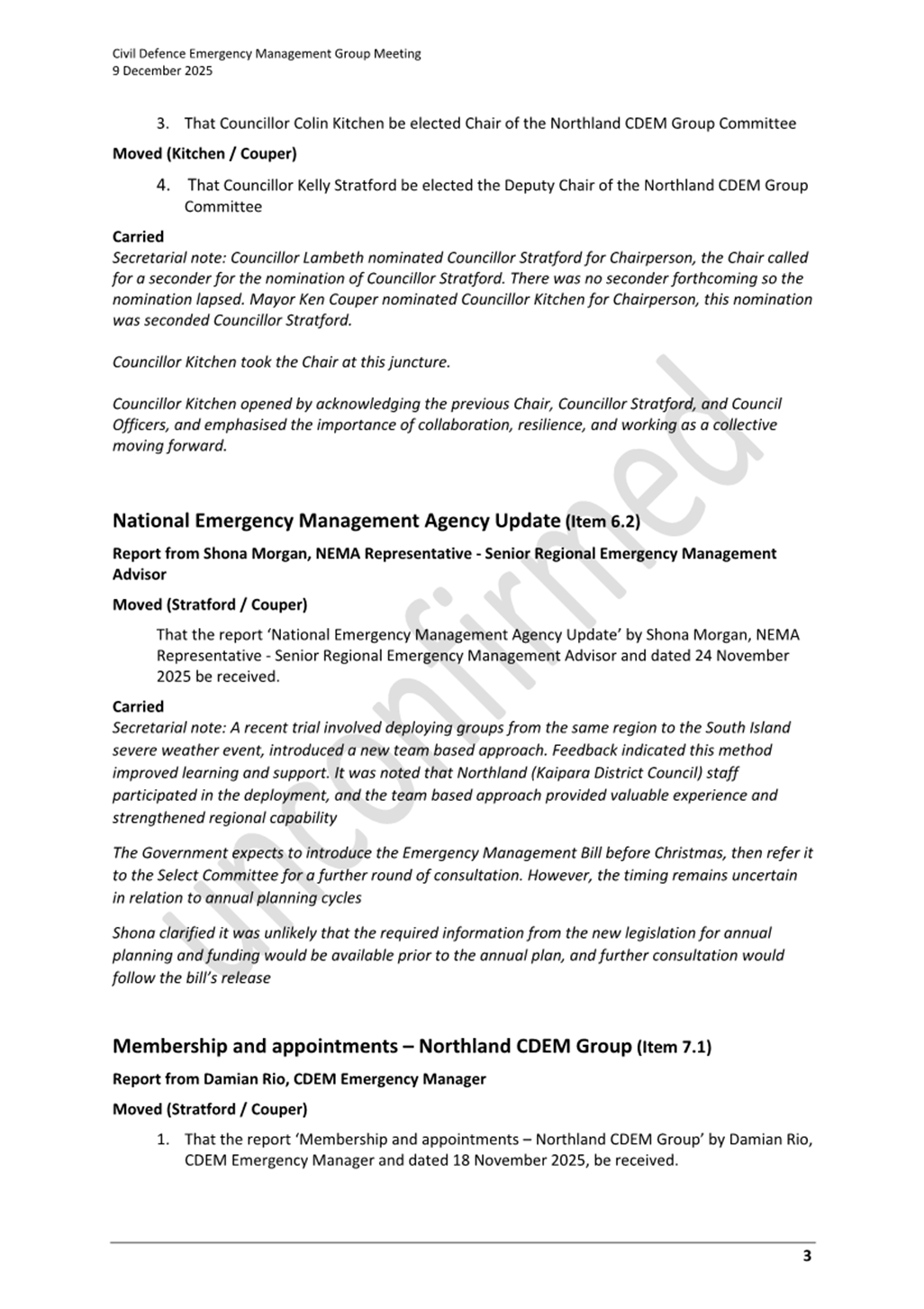
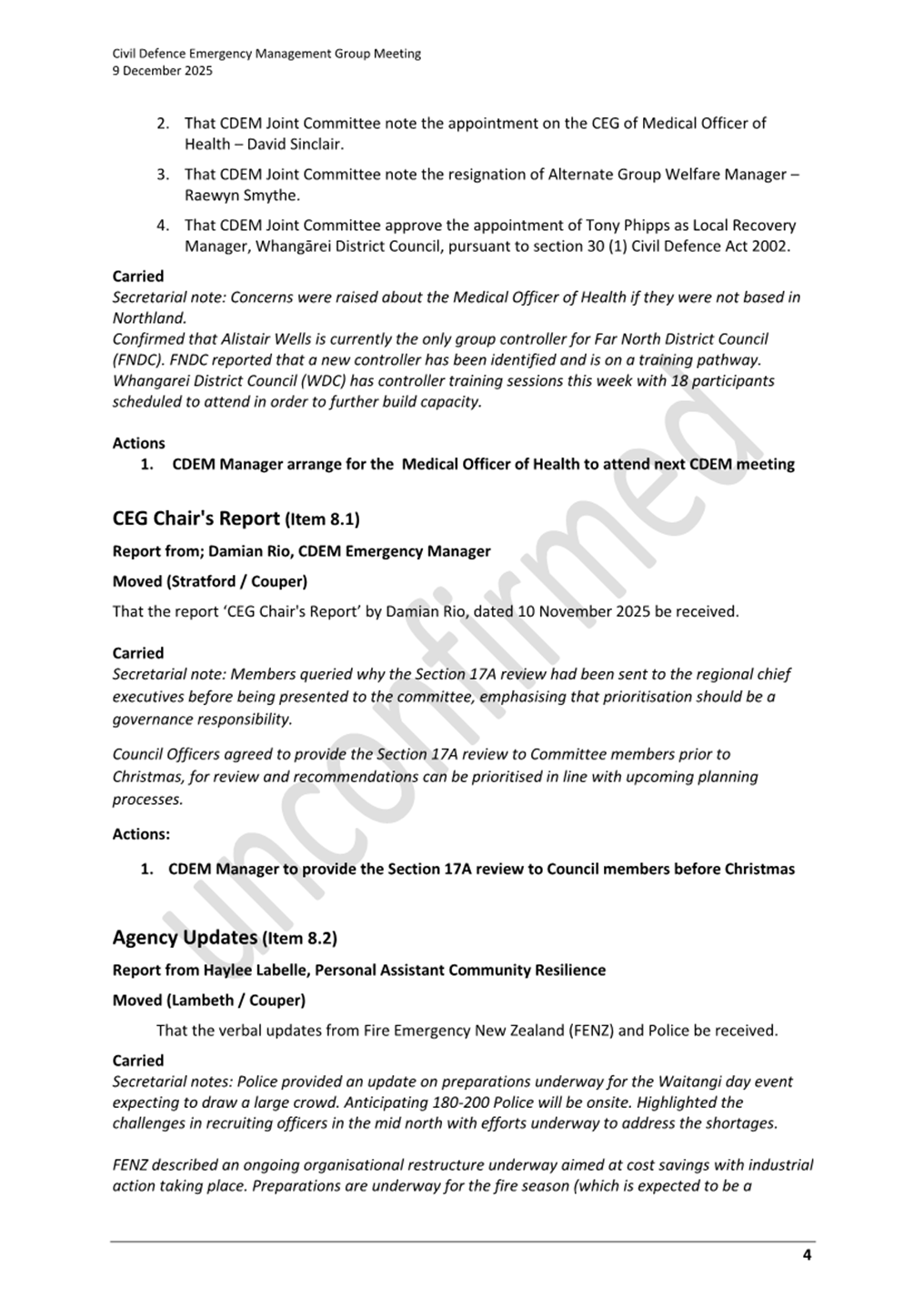
That the minutes of the Civil Defence Emergency Management Group meeting held on 9 December 2025, be confirmed as a true and correct record and that these be duly authenticated by the Chair.
Attachments/Ngā tapirihanga
Attachment 1:
Minutes - 9 December 2025 ⇩ 
Civil Defence Emergency Management Group Meeting item: 5.1
3 March 2026

|
TITLE: |
Receipt of Action Sheet |
|
From: |
Haylee Labelle, Personal Assistant Community Resilience |
|
Authorised by Group Manager/s: |
Louisa Gritt, Group Manager - Community Resilience, on 24 February 2026 |
Whakarāpopototanga / Executive summary
The purpose of this report is to enable the meeting to receive the current action sheet.
That the action sheet be received.
Attachments/Ngā tapirihanga
Attachment 1:
Action Sheet ⇩
Civil
Defence Emergency Management Group Meeting
3 March
2026
This page is a placeholder for a single page of a PDF attachment. It will be replaced by the actual PDF page when the PDF version of this document is generated.
Report: Receipt of Action Sheet
Attachment: Action Sheet
Page: 1
Civil Defence Emergency Management Group Meeting item: 6.1
3 March 2026
|
TITLE: |
National Emergency Management Agency Update |
|
From: |
Shona Morgan, NEMA Representative - Senior Regional Emergency Management Advisor |
|
Authorised by Group Manager/s: |
Louisa Gritt, Group Manager - Community Resilience, on 17 February 2026 |
Whakarāpopototanga / Executive summary
Attached is the February update from the National Emergency Management Agency
That the report ‘National Emergency Management Agency Update’ by Shona Morgan, NEMA Representative - Senior Regional Emergency Management Advisor and dated 13 February 2026 be received.
Attachments/Ngā tapirihanga
Attachment 1:
NEMA Update ⇩
Civil Defence Emergency Management Group Meeting item: 7.1
3 March 2026
|
Membership and appointments – Northland CDEM Group |
|
|
From: |
Damian Rio, CDEM Emergency Manager and Kylie Cox, Welfare Coordination Group Representative |
|
Authorised by Group Manager/s: |
Louisa Gritt, Group Manager - Community Resilience, on 23 February 2026 |
Executive summary/Whakarāpopototanga
This report provides an up-to-date list of members and key appointments for the Northland CDEM Group. The list of key appointments is available on the Northland CDEM Group plan webpage.
1. That the report ‘Membership and appointments – Northland CDEM Group ’ by Damian Rio, CDEM Emergency Manager and Kylie Cox, Welfare Coordination Group Representative and dated, 23 February 2026 be received.
2. That CDEM note the resignations of Health New Zealand representative – Sarah Boniface.
3. That CDEM note the stepping down of iwi representative Snow Tane from CEG.
Tuhinga | Background
Membership of the Northland Civil Defence Emergency Management Group:
|
Councillor Kitchen |
Chair of CDEM Group - NRC |
|
Councillor Stratford |
Deputy Chair of CDEM Group - FNDC |
|
Mayor Couper |
WDC - Mayor |
|
Councillor Lambeth |
KDC |
|
Wipari Henwood |
Commander, Fire and Emergency NZ |
|
Superintendent Matt Srhoj |
Northland Police District Commander |
|
Shona Morgan |
NEMA (observer) |
Membership of the Coordinating Executive Group:
|
Simon Weston |
Chair of CEG – CEO, WDC |
|
Jonathan Gibbard |
CE, NRC |
|
Ruben Garcia |
FNDC delegated representative |
|
Jason Marris |
CE, KDC |
|
Wayne Ewers |
Inspector, NZ Police |
|
Graeme Quensell |
Assistant Commander, Fire and Emergency NZ |
|
Callum Chapman |
Health New Zealand / Te Whatu Ora |
|
Ben Lockie |
St John Ambulance |
|
Dr. David Sinclair |
Medical Officer of Health - NPHS |
|
Kylie Cox |
Northland Welfare Coordination Group |
|
Sarah Irwin |
Northland Lifelines Group |
|
Thomas Hohaia |
Iwi Representative – Te Kahu o Taonui |
|
VACANT |
Iwi Representative – Te Kahu o Taonui |
|
Shona Morgan |
NEMA (observer) |
Controllers:
|
Group Controller(s) |
Local Controller(s) Whangārei District |
Local Controller(s) Kaipara District |
Local Controller(s) Far North District |
|
Jenny Calder |
Simon Weston |
Jack Rudolph |
Alastair Wells |
|
Graeme MacDonald |
Victoria Harwood |
Alistair Dunlop |
|
|
Alastair Wells |
Calvin Thomas |
|
|
|
Simon Weston |
John Burt |
|
|
|
Victoria Harwood |
|
|
|
|
John Burt |
|
|
|
|
Damian Rio |
|
|
|
Welfare Managers:
|
Group Welfare Manager(s) |
Local Welfare Managers Whangārei District |
Local Welfare Managers Kaipara District |
Local Welfare Managers Far North District |
|
Kylie Cox |
Toby Hoey |
Jenny Rooney |
Ange Simonsen |
|
Chris McColl (Alternate) |
Kate Biddlecombe (Maternity Leave until June 2026) |
Siobhan Holster |
Kara-Mia Rogers |
|
|
|
|
Kirsty Roper |
Recovery Managers:
|
Whangārei District |
Kaipara District |
Far North District |
|
|
Mark Trudinger |
Tony Phipps |
Tracey Deane |
Esther Powell |
|
Jenny Calder |
|
|
|
Iwi Representation
Snow Tane has stepped down from membership of CEG. Snow Tane stood for Councillor in the 2025 Kaipara District Local Elections and was elected. As part of his Councillor portfolio, Cr. Tane has been appointed as an Alternate to Cr. Gordon Lambeth for Kaipara District on the CDEM Joint Committee. We would like to thank Cr. Tane for his ongoing commitment and participation in CDEM within Northland.
Te Kahu o Tanui has been approached to nominate a suitable replacement for membership of the Coordinating Executive Group.
Health New Zealand Representation
Sarah Boniface has resigned from Health New Zealand her last day was 22 January 2026. In the interim, Callum Chapman, Emergency Management Regional Lead and Alternate member for Health New Zealand / Te Whatu Ora, is expected to provide support in Northland until a replacement is appointed.
We extend our sincere appreciation to Sarah for her valuable contribution and ongoing commitment to emergency management in Northland, particularly through her active involvement with the Northland CDEM Group.
Attachments/Ngā tapirihanga
Nil
Civil Defence Emergency Management Group Meeting item: 7.2
3 March 2026
|
TITLE: |
CDEM Group Plan Delivery |
|
From: |
Damian Rio, CDEM Emergency Manager |
|
Authorised by Group Manager/s: |
Louisa Gritt, Group Manager - Community Resilience, on 23 February 2026 |
Whakarāpopototanga / Executive summary
This item provides an update on progress to implement the Objectives and Actions in the 2021 – 2026 Northland CDEM Group plan.
The Northland Civil Defence Emergency Management Group Plan 2021 -2026 was approved by the joint committee in December 2021. The plan is available at https://www.nrc.govt.nz/media/luegn0l3/northland-civil-defence-emergency-management-group-plan-2021-2026.pdf)
The Plan is the statutory reference for the Northland CDEM Group and outlines the arrangements for CDEM within the Group’s jurisdiction over a five-year period.
The plan outlines the strategic direction of CDEM engagement, participation, planning, collaboration, response coordination, recovery, CDEM management and governance and how CDEM provides resilience to the people of Northland.
1. That the report ‘CDEM Group Plan Delivery’ by Damian Rio, CDEM Emergency Manager and dated 17 February 2026, be received.
2. That the Northland CDEM Joint Committee note the additional information requested by the Coordinating Executive Group to enable more effective oversight of the operational delivery of the Northland CDEM Group plan.
Background/Tuhinga
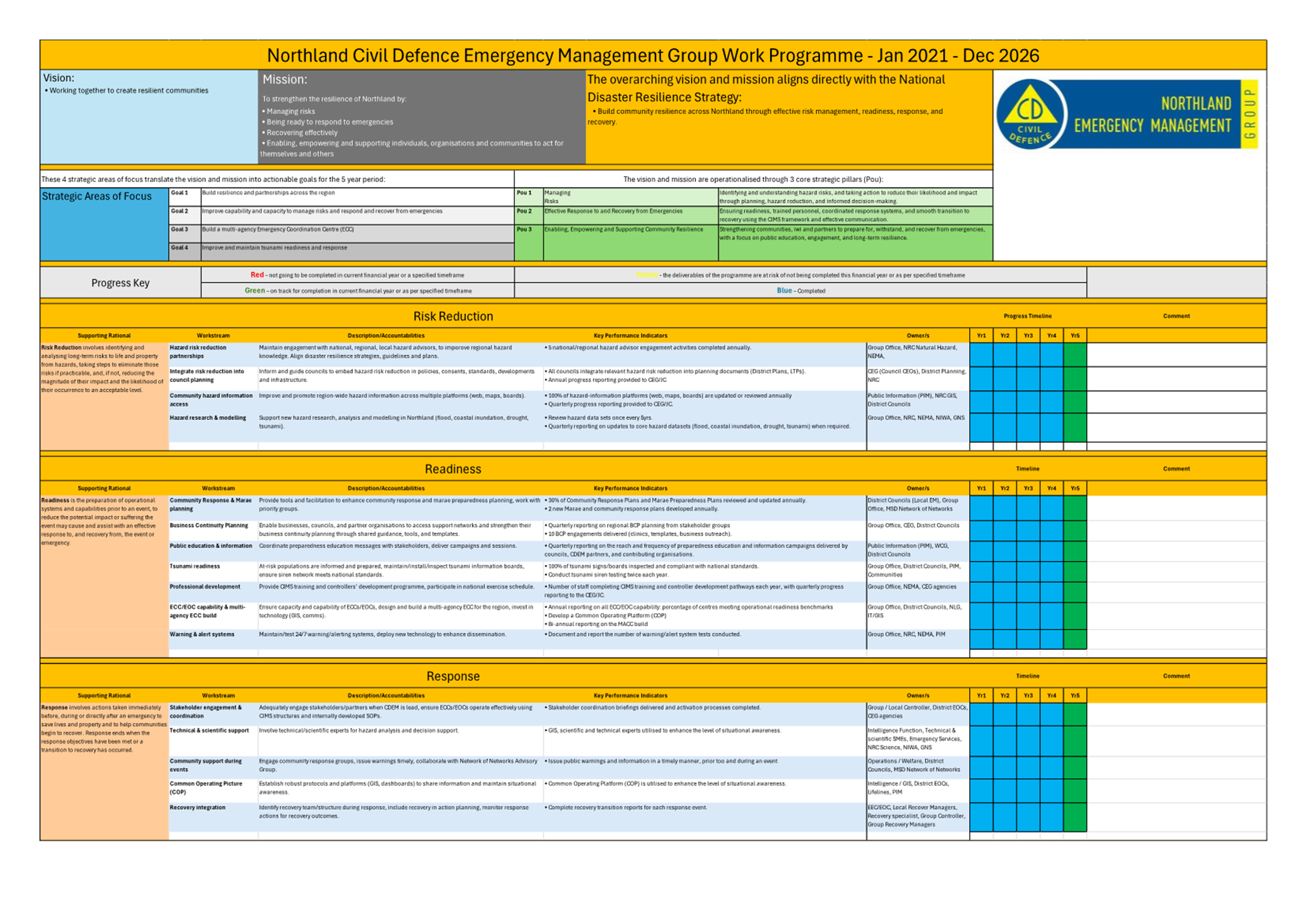
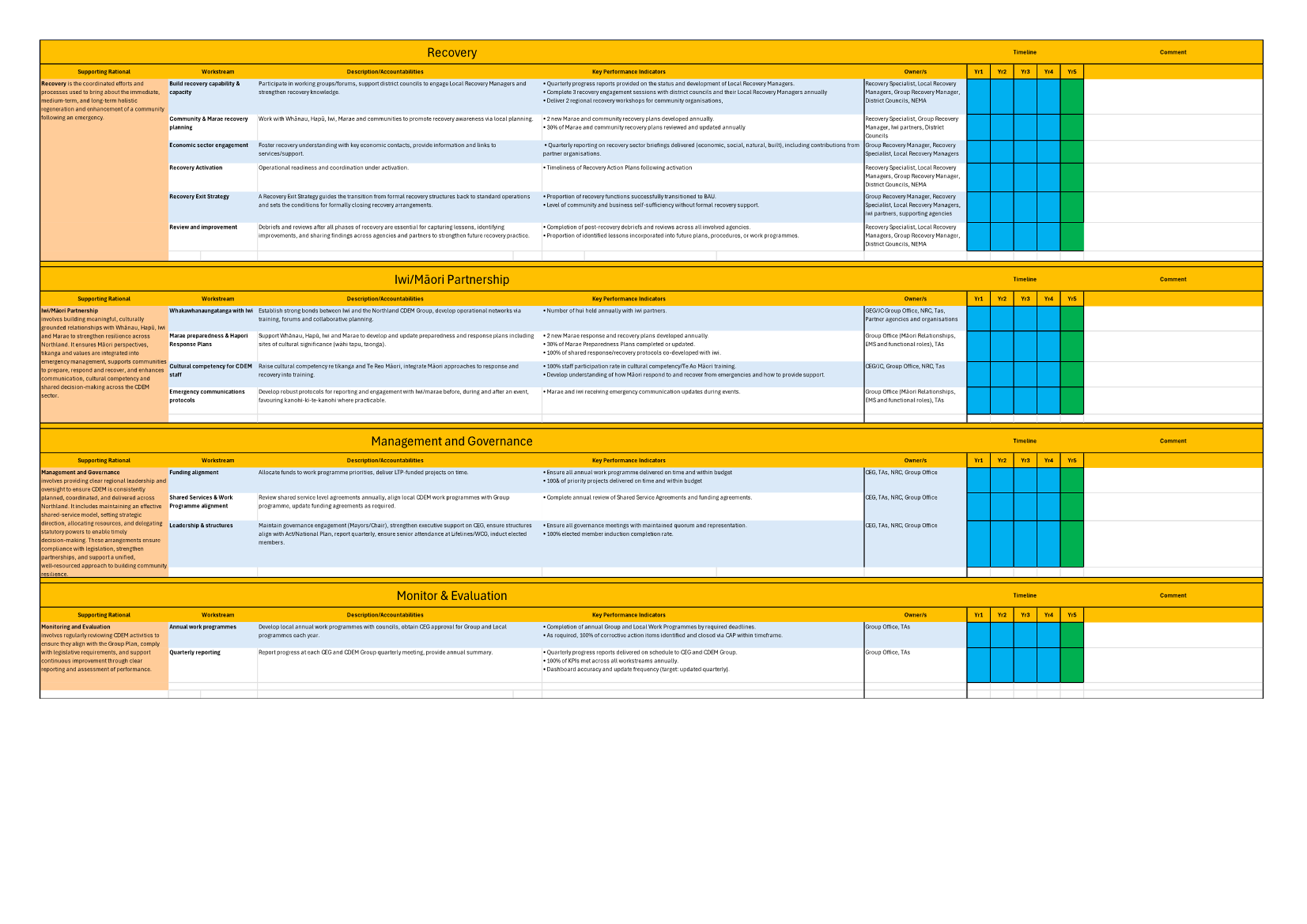
The attachment, (Northland Civil Defence Emergency Management Group Work Programme - Jan 2021 - Dec 2026) provides an overview of progress against the Objectives, targets and actions from the Northland CDEM Group Plan 2021 – 26.
This work programme is a new reporting format requested by the Coordinating Executive Group (CEG) to support clearer visibility of delivery across the Group Plan.
The CDEM Joint Committee is invited to consider and discuss the format, and provide any additional feedback, noting that, if endorsed it will be used for the remainder of the current Group Plan period. A refreshed work programme will then be collaboratively developed to align with the next Group Plan, its milestones, and its strategic objectives.
At the meeting on 29 January 2026 the CEG noted limitations in the current high‑level reporting format and agreed that more detailed, owner‑specific work programme is required to provide meaningful oversight. Work is underway to better integrate the Northland Group Plan development with emerging work streams, legislative updates, roles and responsibilities MOU, and service‑level agreement changes.
Key Actions from CEG meeting of 26 Jan 2026
1. Develop a revised, detailed reporting template for CEG endorsement
2. Circulate the previous Group Plan to Chief Executives.
3. Provide the NEMA‑aligned project timeline to the NRC CE.
4. Confirm preferred reporting format with NEMA to ensure consistency and utility.
Attachments/Ngā tapirihanga
Attachment 1:
CDEM Group Work Programme ⇩
Civil Defence Emergency Management Group Meeting item: 7.3
3 March 2026
|
TITLE: |
CDEM Finance Report |
|
From: |
Damian Rio, CDEM Emergency Manager and Tony Devanney, Emergency Management Specialist |
|
Authorised by Group Manager/s: |
Louisa Gritt, Group Manager - Community Resilience, on 23 February 2026 |
Whakarāpopototanga / Executive summary
This paper provides an overview of the Budget for CDEM Group Office. As of December 2025, the CDEM Group office budget is tracking in a positive variance. The forecast for FY2025/26 is an end of year positive variance (as of Dec 2025), due to a carry-over of a Recovery Grant. Noting, any under-spend of this Recovery Grant will have to be returned to Government Grant provider.
Going forward the CDEM Finance Report will cover the three Budget reports of the CDEM Total Budget, CEG/JC Administrative Budget and the CDEM Reserve Fund with overview of FY Budget, Actual costs and positive/negative variances highlighted.
That the report ‘CDEM Finance Report’ by Damian Rio, CDEM Emergency Manager and Tony Devanney, Emergency Management Specialist and dated 19 February 2026, be received.
Background/Tuhinga
CDEM Total Budget 2025/26
The CDEM Group Office budget has income from:
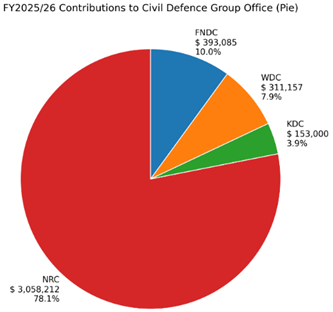
1/. NRC Targeted Emergency and Hazard Management Rate -$3,058,212.
2/. Service Level Agreements (SLA’s) of $857,242.
For the 2025/26 year the SLA amounts are:
· FNDC: $393,085 (previous 2024/25 - $385,000)
· WDC: $311,157 (previous 2024/25 - $326,612)
· KDC: $153,000 (previous 2024/25 - $153,000)
· TOTAL: $857,242 (previous 2024/25 - $864,612)
Amounts are GST exclusive
 |
TOTAL CDEM Group Office Budget FY2025/26
|
|
Description |
25/26 Budget |
comments |
|
INCOME |
|
|
|
|
|
Rates |
3,058,212 |
|
|
|
Service level Agreements |
857,242 |
|
|
|
Sundry |
7,217 |
Only for FY2025/26 |
|
|
Grant (Recovery) |
381,349 |
Only for FY2025/26 |
|
TOTAL INCOME |
|
4,304,020 |
|
|
|
|
|
|
|
EXPENDITURE |
|
|
|
|
|
Salaries |
1,506,193 |
|
|
|
Other Personnel Costs |
69,869 |
Overtime etc |
|
|
Operational Costs |
516,855 |
|
|
|
CEG/JC Costs |
30,000 |
For CEG/JC administrative costs |
|
|
Rating Cost |
46,240 |
Paid to TA’s to collect NRC rates |
|
|
Interest expense |
220,261 |
Interest on loan for MACC – not drawn yet |
|
|
Internal recharges |
1,220,996 |
These are standard internal business costs; ICT, HR, Finance, etc |
|
|
MACC Transfer |
500,258 |
Transferred to MACC fund |
|
TOTAL EXPENDITURE |
|
4,110,672 |
|
|
|
|
|
|
|
Net cost/surplus |
|
193,348 |
Next year will not have the circa $400k Grants income. |
Current Position:
The CDEM Group Office budget for FY2025/26 is tracking positively, primarily due to a one-off Recovery Grant carry-over, but this surplus is temporary as the Sundry income of $7,217 and a Recovery Grant of $381,349 will not be in the FY2026/27 budget.
Any Recovery Grant money unspent in this FY will be returned to Government.
CEG/JC Administrative Budget 2025/26:
The CDEM Joint Standing Committee (JC) and the Northland Coordinating Executive Group (CEG) is funded equally from the Service Level Agreements (SLA’s).
This funding line sits in the CDEM Group Office Budget and is managed by the Group Office.
Annually it amounts to $30,000
· FNDC – $10,000 to CDEM Group Funds 5030
· WDC – $10,000 to CDEM Group Funds 5030
· KDC – $10,000 to CDEM Group Funds 5030
NRC contributes in kind to this budget through its general administrative and support functions.
At Dec 2025:
Budget Income: $37,217
(This is $30,000 from three SLA’s and (one-off) $7,217 ‘grant’ from previous year).
YTD Expenditure (Dec 2025): ($26,627)
YTD Variance: $10,590
CEG/JC Administrative Reserve Fund 2025/26:
Over the years any under-spend on the CEG/JC Administrative Budget as well as other CDEM budget lines have been transferred to a ‘CEG/JC Administrative Reserve Fund (6223)’. In the past these funds have been allocated by the CEG and CDEM Group Joint Committee for projects such as the original Tsunami siren installation, tsunami inundation modelling, contribution to new generator at the KDC building and repairs and upkeep of the tsunami siren network and capability and capacity building at KDC.
· FY2024/25: CEG/JC decided to spend $223,384 on a Tsunami Siren project shortfall.
· FY2025/26: CEG/JC spent $45,000 on Consultants (Simplexity) for the 17A review.
Balance as of Dec 2025 – $82,565.88. This amount is allocated to Tsunami Siren spares, as per CEG/JC decision 2024/25.
Moving forward, any spend from the CEG/JC Administrative Reserve Fund (6223) will need an approved pre-approval process from CEG or Joint Committee.
Upcoming Spends:
There are no extraordinary spends foreseen in the next quarter.
Attachments/Ngā tapirihanga
Nil
Civil Defence Emergency Management Group Meeting item: 7.4
3 March 2026
|
TITLE: |
Section 17a Review Update |
|
From: |
Damian Rio, CDEM Emergency Manager |
|
Authorised by Group Manager/s: |
Louisa Gritt, Group Manager - Community Resilience, on 23 February 2026 |
Executive summary/Whakarāpopototanga
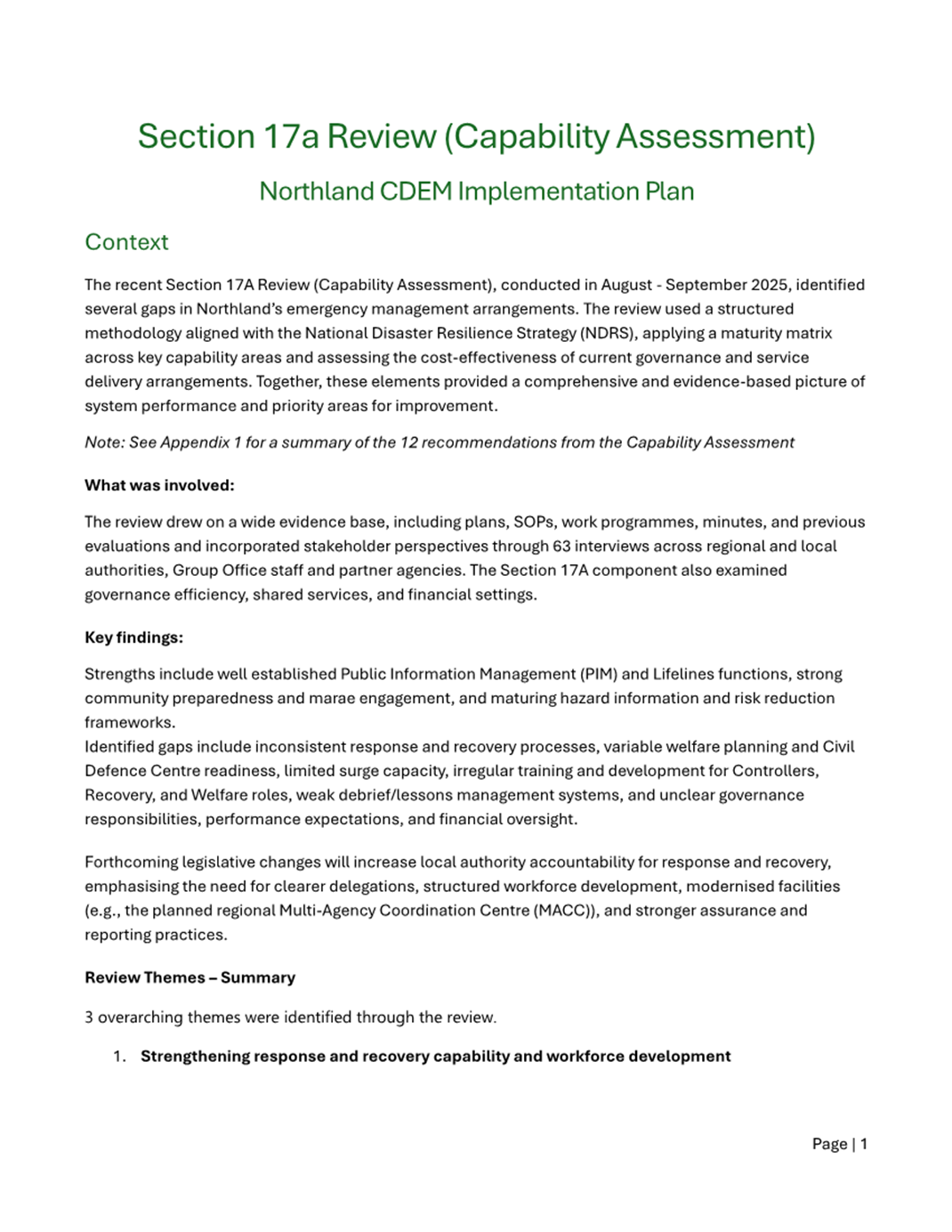
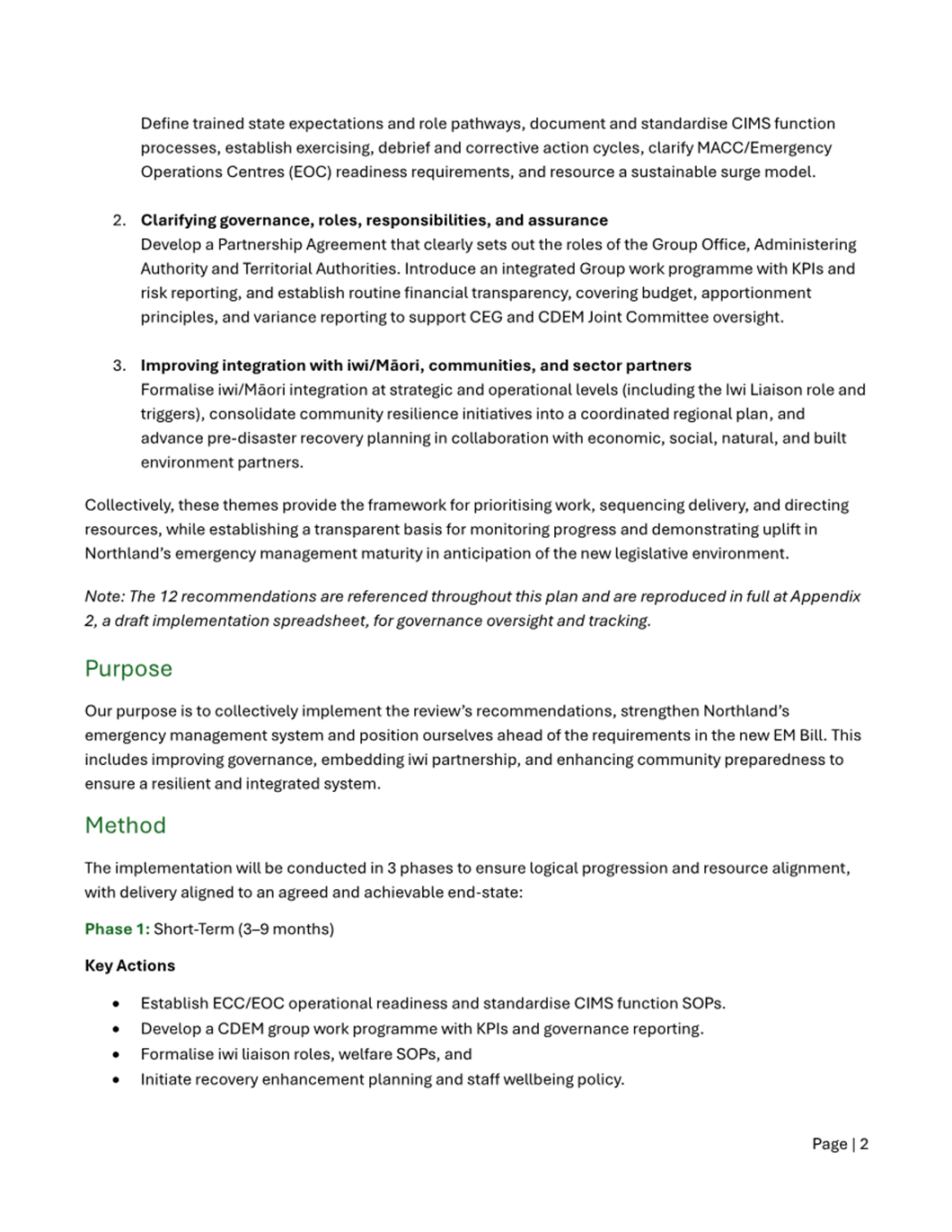
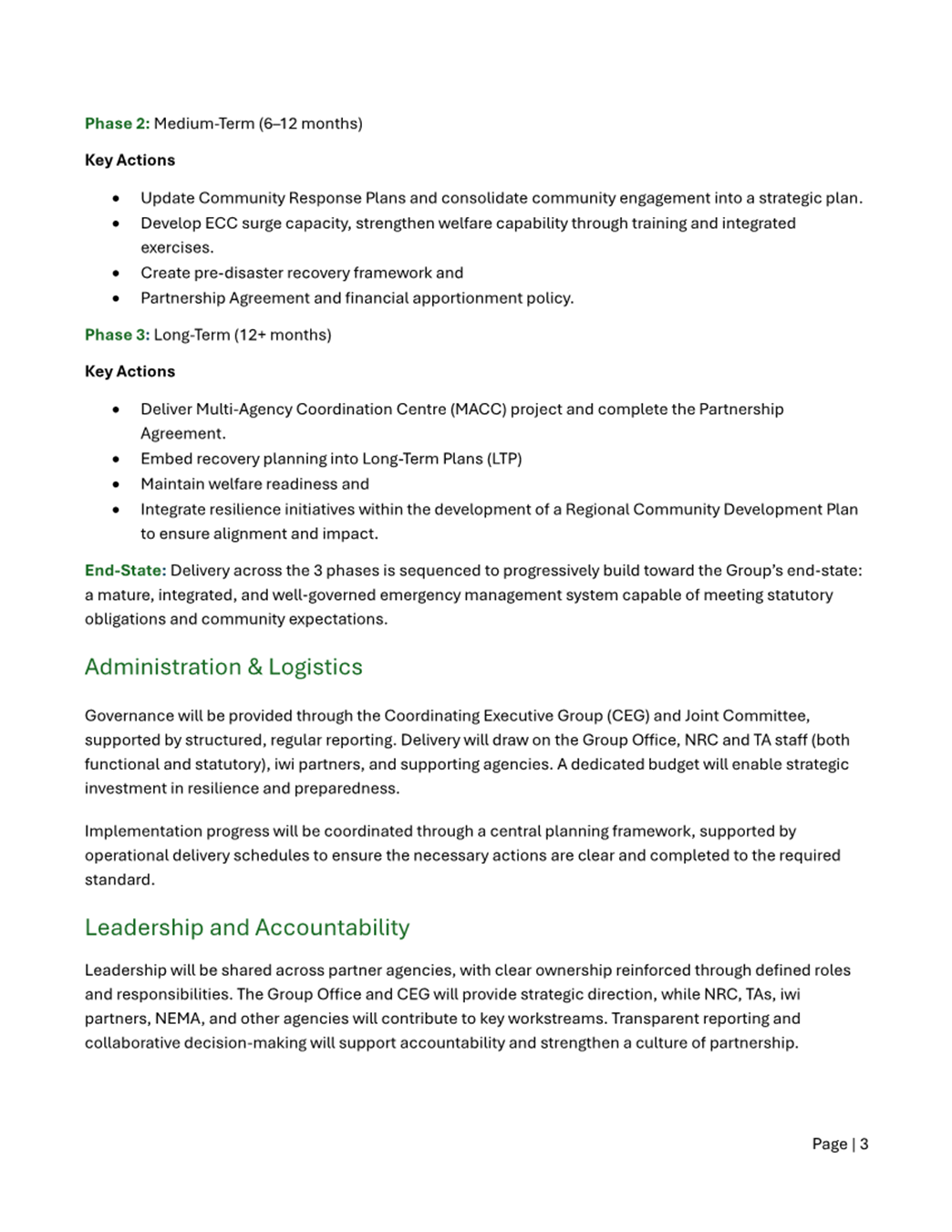
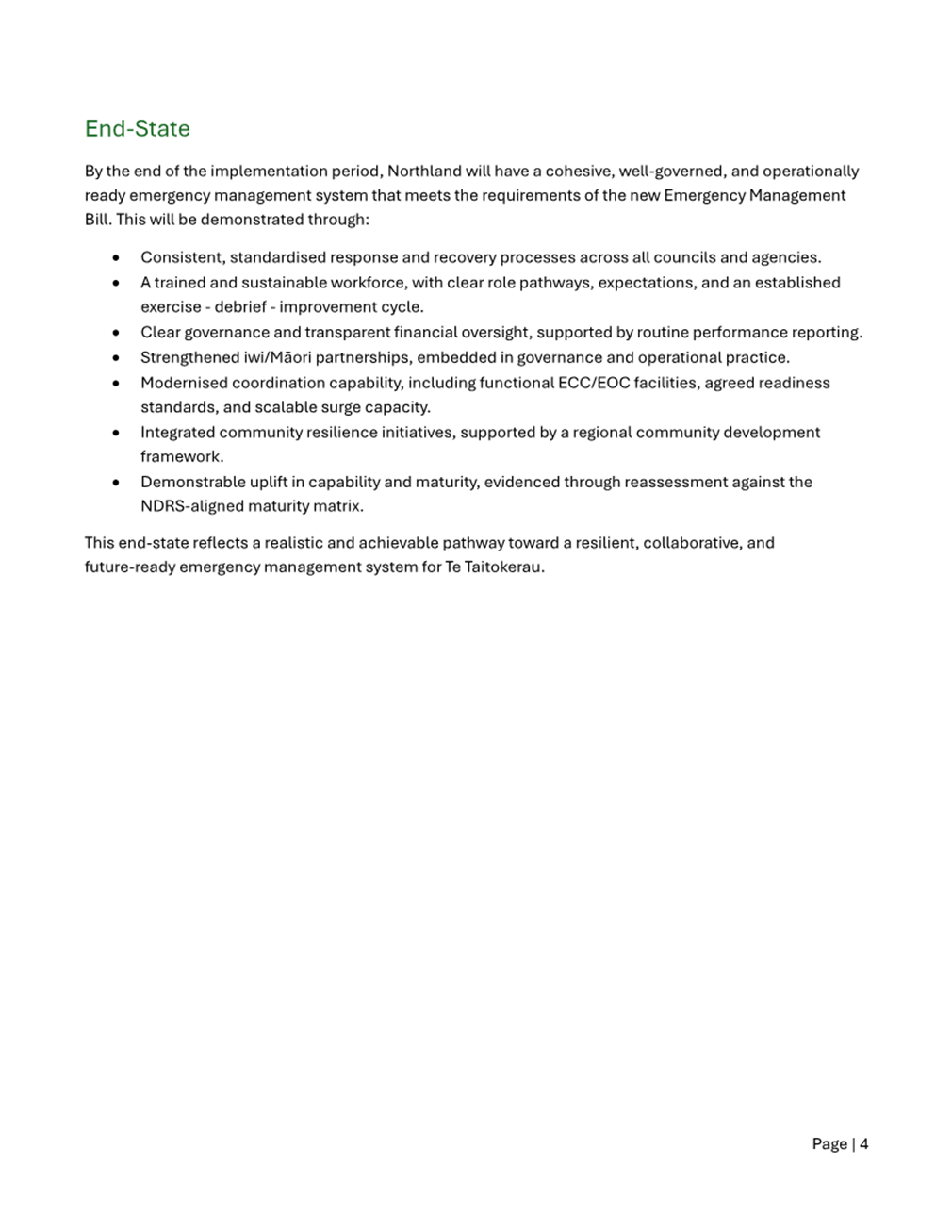
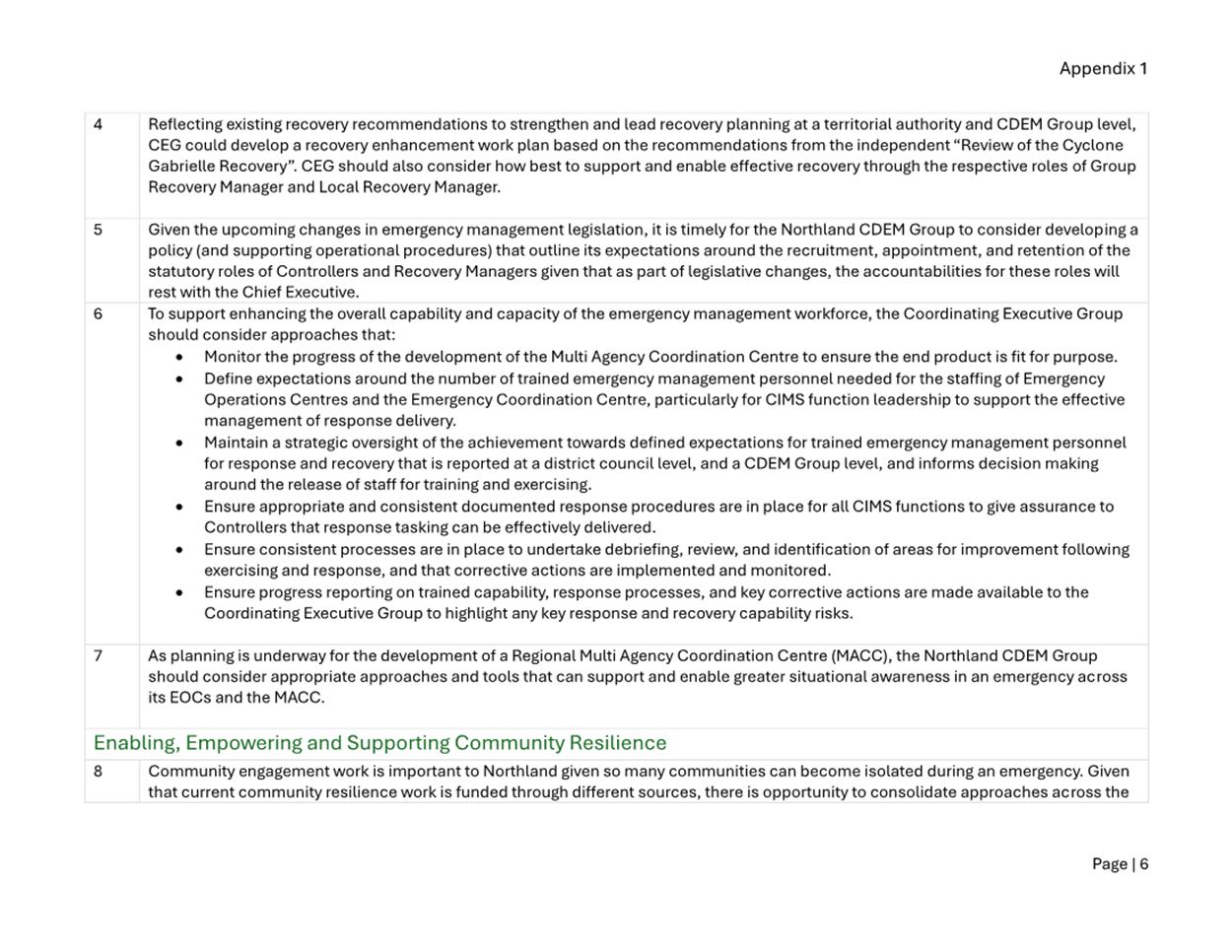
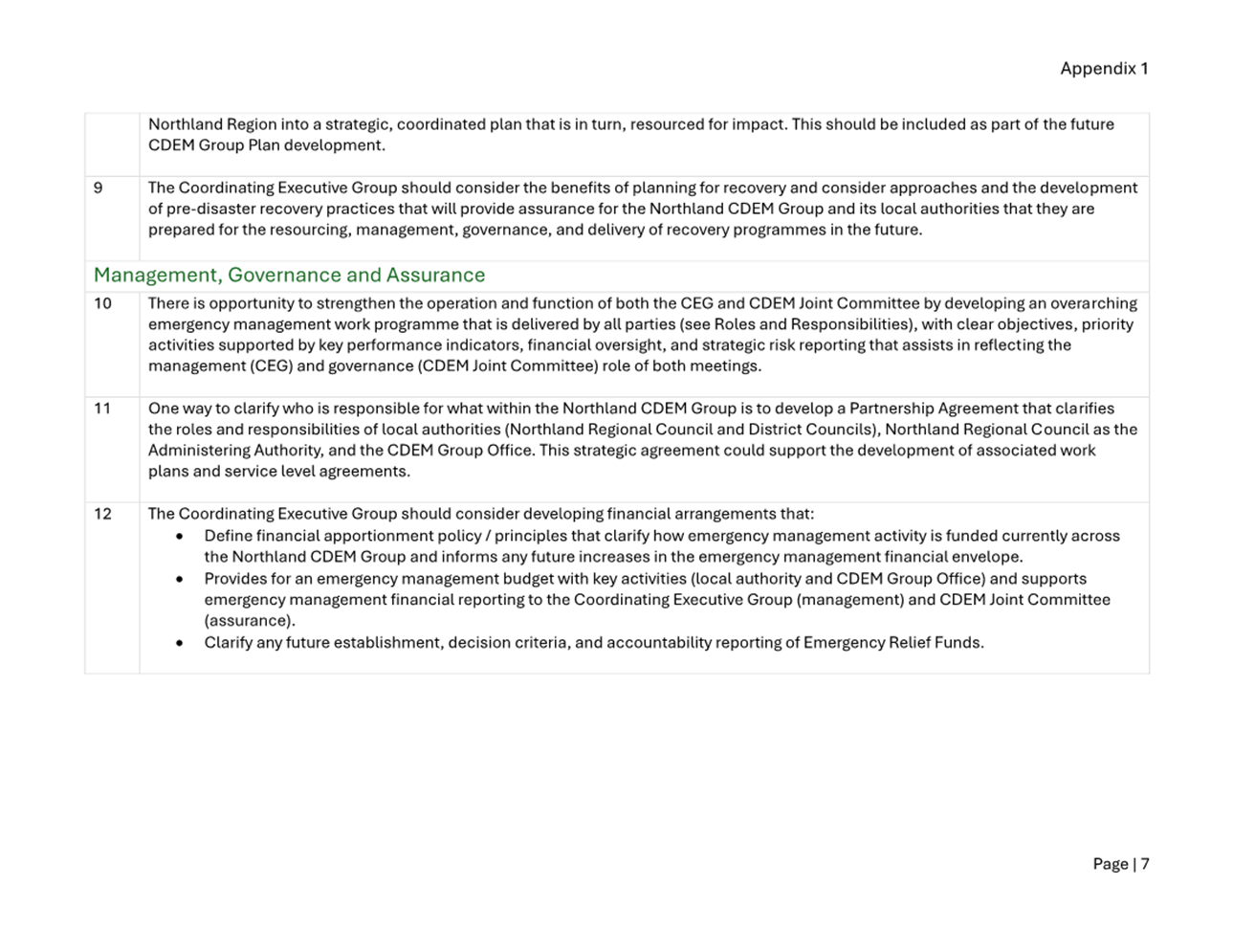
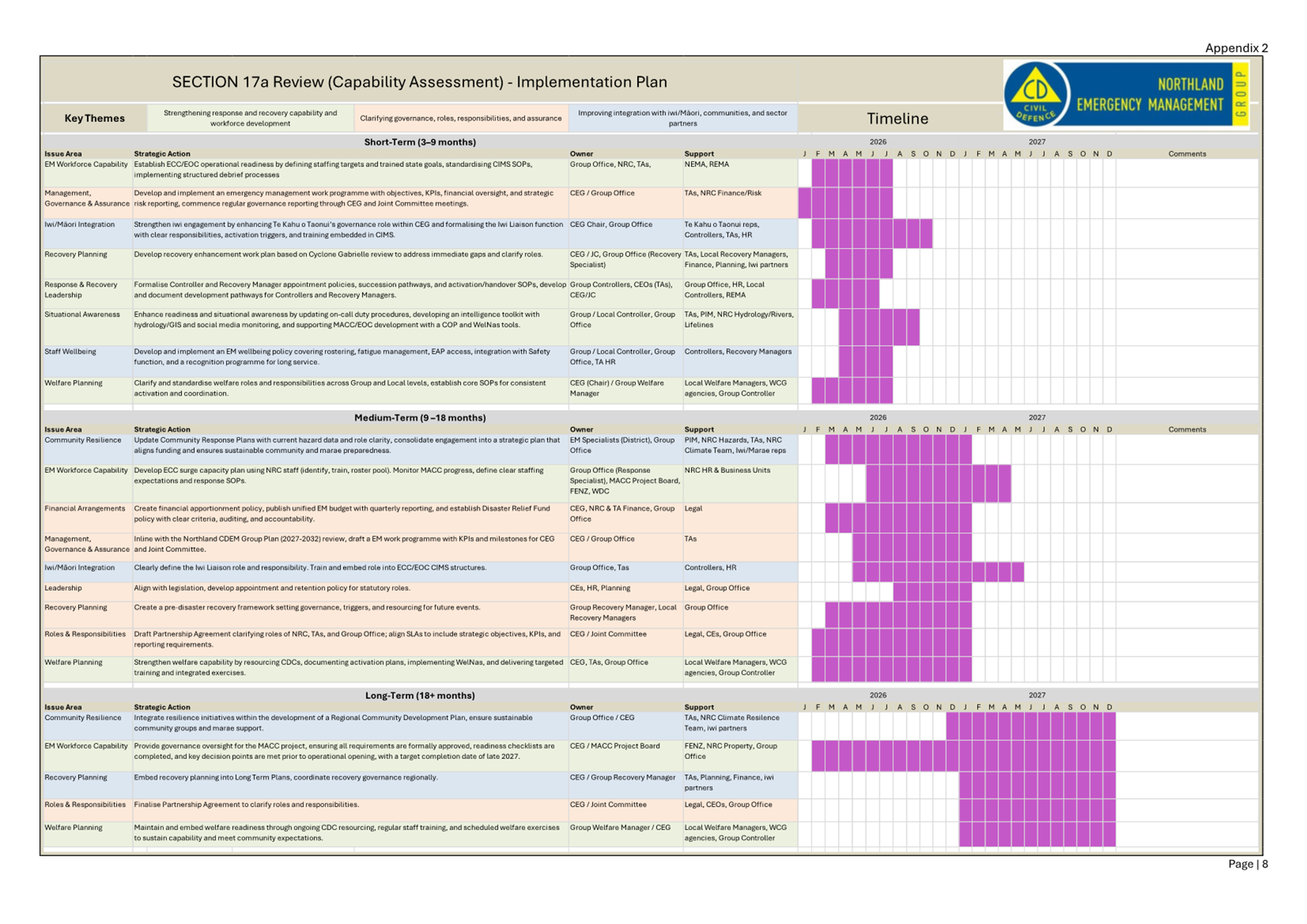
The purpose of this report is to seek approval from the CDEM Group Joint Committee to adopt the recommendations of the Section 17a review - Northland CDEM Group Capability Assessment Report (September 2025) and progress these through a staged, flexible implementation programme covering short, medium and long term actions.
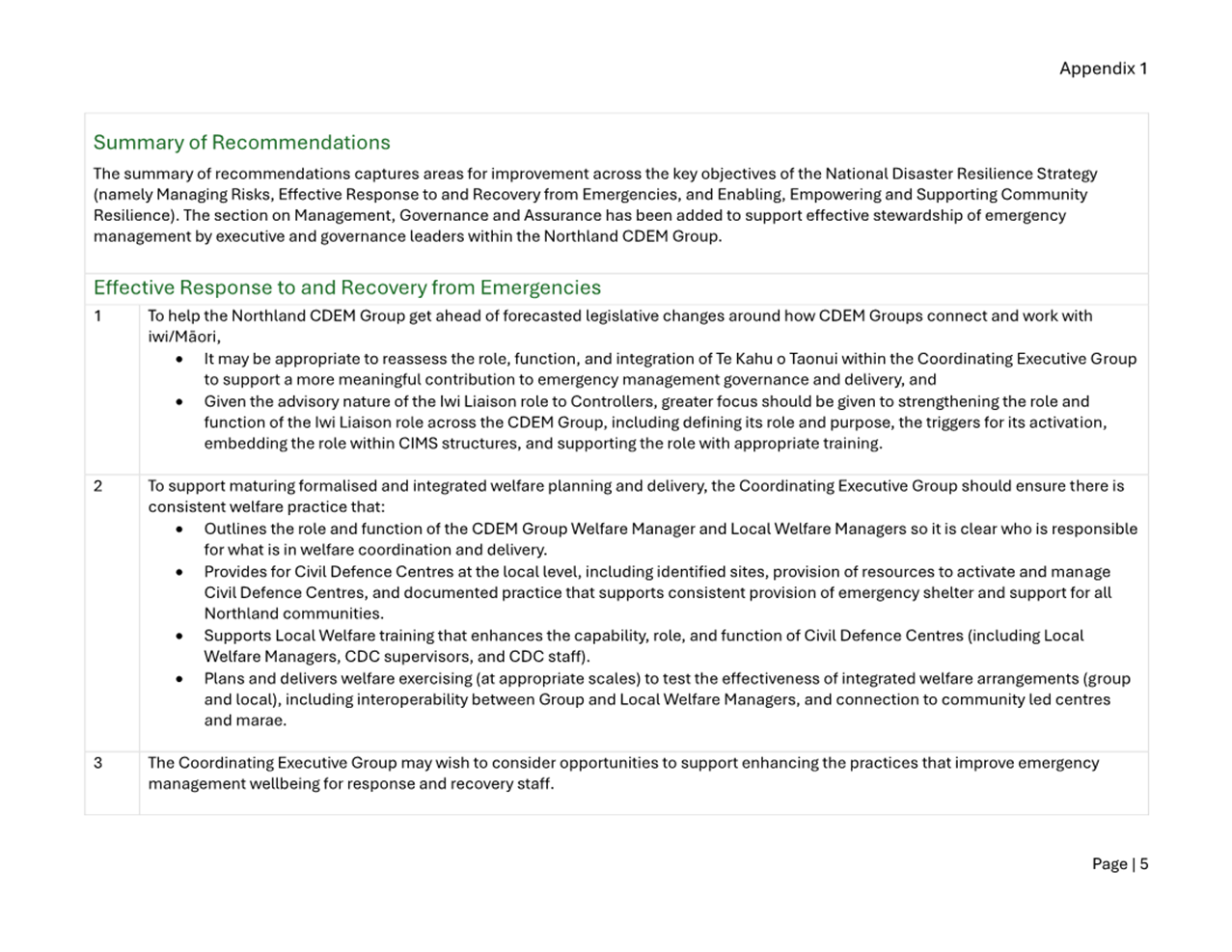
The Section 17a review included documentation reviews, 63 interviews across councils and partner agencies and assessed capability across 4 domains - risk management, response and recovery, community resilience, and governance and management. Key strengths include community engagement, marae preparedness, public information management, and maturing infrastructure resilience. Improvement areas include business continuity planning, integrated response and recovery coordination, welfare and volunteer management, statutory roles, and financial clarity.
The group office proposes a staged implementation plan to enable sequencing, resourcing alignment, and integration with upcoming emergency management legislative reform.
Critical considerations include:
· The breadth and interdependency of recommendations
· Need for clear roles, responsibilities, and governance structures
· Alignment with future legislative changes
· Resource implications and organisational capacity
29 Jan 2026 - NRC CE raised concerns about the group's capacity to deliver and the need to prioritise actions.
The group's readiness for catastrophic events was queried, referencing optimism bias. Acknowledged that while weather event response is strong, more work is needed for large-scale disaster preparedness, with suggestions for targeted training exercises.
To date, clarification of roles and responsibilities, and funding arrangements, have been prioritised aiming to inform long-term planning and budgeting before legislative reforms take effect, and to provide updates to the group and the CE forum.
1. That the report ‘Section 17a Review Update’ by Damian Rio, CDEM Emergency Manager and dated 2 February 2026, be received.
2. That the Northland CDEM Group Joint Committee note the recommendations arising from the Northland CDEM Group Capability Assessment Report (September 2025).
3. That the Northland CDEM Group Joint Committee approve a staged, flexible implementation plan incorporating short‑, medium‑ and long‑term actions as outlined in this report. (Attachment 1).
Options
|
No. |
Option |
Advantages |
Disadvantages |
|
1 |
Adopt the recommendations and approve staged implementation |
Enables structured, sequenced improvements aligned with legislative reform; strengthens governance, capability, and resilience, provides clarity for councils. |
Improvements are not aligned with legislative reforms, key areas of capability are not strengthened, and councils do not have clarity in time for longer term planning. |
|
2 |
Defer implementation |
No immediate cost or workload and actions for improvements can be included and included as part of the Northland CDEM Group Plan update. |
Significant risks remain unaddressed; lacks readiness for legislative reform; governance, welfare, and coordination gaps persist. |
The staff’s recommended option is Option 1 - Adopt the recommendations and approve staged implementation
Considerations
1. Climate Impact
The proposed implementation approach will have positive climate adaptation benefits, particularly through improved resilience planning, hazard awareness, and strengthened community readiness. While climate mitigation impacts are neutral, the programme supports adaptation by ensuring capability, infrastructure dependencies, and community vulnerabilities are incorporated into emergency management planning.
2. Environmental Impact
No direct environmental impacts arise from this decision. Indirect benefits may result from improved planning, risk reduction, and resilience strategies that support long‑term environmental outcomes.
3. Community views
Community views have been captured through the 63 interviews undertaken as part of the Capability Assessment. Community response groups, marae, partner agencies, and iwi organisations contributed perspectives that shaped the review’s findings. No further consultation is required at this stage.
4. Māori impact statement
The review identified strong marae preparedness and iwi engagement as regional strengths, and highlighted opportunities to improve formalised iwi liaison arrangements and integration of Māori perspectives in governance and response. This decision supports continued partnership development and improved representation through future implementation.
5. Financial implications
At the time of writing this report there are no known financial implications of this decision.
Resourcing requirements for implementation will be presented in the draft implementation plan at the next CEG meeting.
6. Implementation issues
· Delivery will require coordination with district councils, group office, and the Administering Authority.
· Some actions depend on national legislative timeframes and guidance.
· Capacity constraints across councils may impact delivery.
· Clear sequencing is required to avoid duplication or misalignment.
7. Significance and engagement
In relation to section 79 of the Local Government Act 2002, this decision is considered to be of low significance when assessed against the NRC’s Significance and Engagement Policy as it concerns internal governance and operational improvement processes. .
8. Policy, risk management and legislative compliance
This decision is consistent with current policy and legislative requirements. The proposed staged implementation supports risk mitigation by addressing identified capability gaps across welfare, readiness, governance, and emergency coordination functions.
Background/Tuhinga
The Section 17a review was undertaken to provide an evidence‑based understanding of emergency management capability and the effectiveness of current governance and service delivery arrangements.
The findings form a key input into the upcoming CDEM Group Plan review and preparation for new Emergency Management legislation. A structured implementation approach ensures the Group is ready to meet future statutory responsibilities and improve emergency management outcomes for communities.
Attachments/Ngā tapirihanga
Attachment 1:
Section 17a Implementation Plan ⇩
Civil Defence Emergency Management Group Meeting item: 8.1
3 March 2026
|
TITLE: |
Agency Updates |
|
From: |
Haylee Labelle, Personal Assistant Community Resilience |
|
Authorised by Group Manager/s: |
Louisa Gritt, Group Manager - Community Resilience, on 08 February 2026 |
Whakarāpopototanga / Executive summary
This report provides the opportunity for FENZ, Police and other agencies to provide an update to the CDEM
That the verbal updates from FENZ, Police and any other agencies, be received
Background/Tuhinga
Verbal update to be provided by agencies
Attachments/Ngā tapirihanga
Nil
Civil Defence Emergency Management Group Meeting item: 8.2
3 March 2026
|
TITLE: |
CEG Chair Report |
|
From: |
Kori Puckey, Emergency Management Specialist; Zach Woods, Emergency Management Communications Specialist; Rongomaiwahine Glassie, Emergency Management Specialist; Tony Devanney, Emergency Management Specialist; Bill Hutchinson, Emergency Management Specialist; Damian Rio, CDEM Emergency Manager; Kylie Cox, Welfare Coordination Group Representative; Papanui Polamalu, Emergency Management - Iwi/hapū Engagement Advisor; Laura Exton, Emergency Management Specialist – Kaipara; James Harvey, Emergency Management Specialist - Lifelines; Brendon Gray, Emergency Management Partnership Manager; Mark Trüdinger, Emergency Management Recovery Specialist; Jenny Calder, Emergency Management Response Specialist and Sarah Gauden-Ing, Natural Hazards Specialist |
|
Authorised by Group Manager/s: |
Louisa Gritt, Group Manager - Community Resilience, on 23 February 2026 |
Whakarāpopototanga / Executive summary
This report provides a summary of activities undertaken by or directly related to the delivery of the Northland Civil Defence Emergency Management Group plan over the period since the last CEG meeting in January 2026.
That the report ‘CEG Chair Report’ by Damian Rio, dated 13 February 2026 be received.
INDEX OF REPORTS
2. Northland CDEM Group Office
3. Far North CDEM Update
4. Kaipara CDEM Update
5. Whangārei District CDEM Update
6. Welfare Coordination Group Update
7. Northland Lifelines Group Update
8. CDEM Communications Update
9. Māori Relationships Update
10. Tsunami siren replacement Project Update
11. Multi Agency Coordination Centre
12. Professional Development and Engagement
13. Natural Hazards update
14. Recovery
15. Common Operating Platform
1. Activations
and Response
Southland Weather Event
On Thursday 23 October severe weather hit Southland and Otago, causing widespread damage to power networks, and impacting communication, building, three waters and roading infrastructure. Similar weather had hit the Canterbury Region the previous day.
By Friday 24 October, Canterbury, Southland and Otago were all under States of Local Emergency.
To sustain the Southland response, the National Emergency Management Agency (NEMA) coordinated the deployment of New Zealand Emergency Management Assistance Team (NZ EMAT) and surge staff from territorial authorities.
On Saturday 25 October, a Northland contingent of six personnel deployed to support Southland. This team consisted of Jenny Calder (as NZ EMAT) and five Kaipara District Council staff.
The team worked in the IMT in the Southland ECC, contributing to a coordinated response, supporting the people of the region.
Northland Severe Weather Event
On Saturday 17 January, Met Service issued a heavy rain watch for Northland which was monitored by the duty officer. The weather was more intense than predicted and Sunday morning revealed damage to homes, self-evacuations, numerous slips and road closures had occurred. Marae across the impacted areas had opened their doors providing support for a number of people.
On Monday 19 January a regional stakeholder meeting was held to understand the regional impacts of the event and as a result the Emergency Coordination Centre was established to support the WDC EOC and a wider regional response.
With a second weather event forecast to impact Northland on Wednesday 21 January, the FNDC activated on Tuesday 20 January and KDC activated on 21 January. Fortunately, the severity of the weather lessened, and impacts were less than forecast.
By Thursday, indications were that all impacts were manageable and in hand, and agencies had moved out of response mode with regional agency assets redeployed to other regions. The WDC EOC moved to a single day shift, the FNDC and KDC EOC’s moved to monitoring and the ECC stood down with staff remaining in support of the WDC EOC.
The WDC EOC transitioned to a co-led Ngātiwai and WDC recovery on 3 February 2026 and continues to be supported by EM staff.
FNDC continue to monitor weather related information that comes through to ensure people are supported and issues can be addressed.
We acknowledge the immense input into response and recovery by Ngātiwai and Marae and to support the impacted whanau and communities.
Internal operational debriefing is now underway across the teams involved, with each area commencing its own process to capture immediate, practical lessons. These early reflections are focused on identifying what worked well, where improvements are needed, and how we can continue strengthening ECC communication and coordination with partner agencies.
At the time of drafting this report, recovery activities remain ongoing, and many staff are still heavily committed to sustained recovery operations. This extended operational tempo means debriefing is necessarily occurring in phases; however, several teams have already completed hot debriefs. Insights from those sessions will be integrated into the wider review process to ensure we build on what has already been captured and avoid duplication.
2. Northland CDEM Group Office
Operational Activities
The Northland CDEM Group Office continues to deliver on its objectives through coordinated district-level implementation of the 2025-2026 work programmes. Training and capability development continued, including CIMS, controller development, EOC training, and participation in Exercise Whakahaumaru. A forecast training funding shortfall remains a key risk.
Councils delivered extensive community engagement, updated Community Response Plans and marae preparedness, advanced tsunami signage upgrades, and strengthened communications capability.
The Lifelines Group progressed major infrastructure resilience projects across electricity, transport, water, and telecommunications.
Natural hazards work advanced through updated flood modelling, early‑warning development, and compliance with new LIM hazard information requirements.
Recovery activities focused on recovery development and contributing to national recovery guidance, with Northland’s Cyclone Gabrielle Recovery Report receiving national recognition.
Progress also continues with the Multi‑Agency Coordination Centre (MACC) development.
3. Far North CDEM Update
· Community / Stakeholder Engagement - Community engagement to support and enhance Marae and Community resilience and reviews of community response plans (Northland Fijian Community, Moerewa, Rawene, Te Kura Kaupapa Māori o Te Rangi Aniwaniwa, Totara North, Far North District Council - CDEM arrangements relative to councils roading network / Regional Accessibility Strategy planning / EOC Dashboard, Far North Holdings - Bay of Islands 2025/26 Cruise Ship strategy meeting, Far North Holdings Opua Marina – Tsunami warnings process, Fire Emergency New Zealand Senior Leadership meeting, Hato Hone St John – Support Communities Initiative workshop Kaikohe, Emergency Services Group meeting, Lake Ohia CRP review, Te Hapua CRP review, Te Hapua Marae Trustee hui, Rawene Review, Taipa Review, Karikari Peninsula Review, FENZ Simulated exercise
· EOC Set-up Exercise. As part of a series of planned in house exercises, the Far North District Council CDEM Staff carried out a EOC set-up drill on 11/02/2026. The purpose of the exercise was to assist to maintain a CDEM awareness within council, refresh and familiarise staff with the location of EOC equipment, initial set-up procedures and opportunities for improvement identified as a result of the January weather event.
· Operational IT - Review of IT and updates of FNDC Emergency Operation Centre laptops.
· NEMA / Te Rarawa Collaboration – hikoi around North Hokianga with Te Runanga o Te Rarawa, NEMA & Northland CDEM
· NEMA Induction – Emergency Management Specialist Kori Puckey attended a two-day induction at Wellington NHQ for new EM staff (NCMC/NCC)
· Elected Members Workshop. Emergency Management Specialists (Damian Rio, Kori Puckey, Bill Hutchinson) attended a Far North District Council elected members workshop on 9th December. The purpose of the workshop was to carry a briefing for newly appointed Councillors and Community Board members on the structure of Civil Defence, regional and local arrangements and the role of elected members pre, during and post events.
· Professional Development – Emergency management Specialists Bill Hutchinson, Kori Pukey Alastair Wells and Nicola Smith attended a two-day Controllers training course on behalf of the Far North District Council hosted by Whangarei District Council on 11th-12th Dec
4. Kaipara CDEM Update
Activities undertaken by the Emergency Management Specialist – Kaipara relative to the 2025-2026 Work Plan as outlined in the KDC Service Level Agreement include:
· New Tsunami Evacuation Zone Boards – 9 of 10 new tsunami evacuation zone boards have been installed in the Kaipara district, with one remaining.
· Mangawhai Museum Storm Zone exhibition (December – March) – contributed content in collaboration with the museum and NRC Climate Change team to educate the community on natural disasters, how to be prepared, and what civil defence is. This included organising key KDC CDEM staff to be interviewed for a short documentary screened during the exhibition.
· Starlink practice setups (Mangawhai & Dargaville) – October sessions were well attended and strengthened staff capability to deploy Starlink units during response. These practices will be held annually.
· Controller development
o Two additional staff have been identified for the Controller development pathway. One initial induction has been completed; another will be held in the New Year.
o 4 KDC staff attended the Controller Development course in December: Jack Rudolph, Alistair Dunlop, Jenny Rooney and Siobahn Holster.
· South Island deployment – 5 KDC staff deployed to Invercargill to support their response to the South Island extreme weather event in October. They shared their experience with the wider EOC team in December. Their gained experience, confidence, and learnings have significantly increased KDC’s capability to respond to civil defence emergencies.
· Donnelly’s Crossing – attended a community group meeting in November alongside FENZ to initiate engagement and work towards a Community Response Group.
· Elected Members induction – delivered on Wednesday 3 December, introducing Elected Members to civil defence, and a ‘Guide to Governance’ for civil defence emergencies.
· Mayoral briefing – held on Friday 5 December to discuss more in-depth the mayor’s responsibilities during civil defence emergencies.
· Exercise Whakahaumaru – Kaipara District Council participated in the November regional exercise by activating and operating their Emergency Operations Centre (EOC) in Mangawhai. The activation and operation of the EOC was very successful, and was a great way to test new systems, processes and plans which have been developed as a result of key lessons identified from recent responses. Staff feedback will guide further improvements.
· Function Manager development – bi-monthly function manager hui have continued.
· EOC Induction – held in October for newly CIMS-trained staff to welcome them onto the EOC team, and to familiarise them with KDC EOC plans, systems, and processes.
· Quarterly CDEM Induction for New Staff – held in December, with 7 attendees.
· Dargaville community evacuation plan annual review hui – held on Thursday 2 October.
· EOC Staff – There are 53 staff in the KDC EOC team, a net increase of 1 staff on last quarter.
· Stakeholder relationship building – engagement with new representatives from Mangawhai Coastguard, Mangawhai Police, Dargaville Police, Te Whai Community Trust, and FENZ Kaipara.
· CRG Community Led Centre kits – completed a kit review and distributed updated items or new kits to CRG Coordinators in December.
· EMS – Kaipara professional development:
o Attended Facilitating Successful Debriefs Masterclass & Controller training.
o Achieved an “Excelling Outcome” result in the 3rd of 4 papers towards a Postgraduate Diploma in Emergency Management through Massey University.
An overview of community engagement activities conducted for this quarter can be viewed in the Community Response Planning and Marae Preparedness Planning agenda item.
5. Whangārei District CDEM Update
Recent work undertaken with the Whangarei District Council (WDC) includes the following:
· New Tsunami Evacuation Boards – 65 new tsunami evacuation boards have replaced the old evacuation boards around the Whangarei District. This is now complete.
· New Community Response Group – We are working through and engaging with a new Community Response Group (CRG) located in the Opuawhanga area (towards Whananaki North).
· Parua Bay Community Response Group (CRG) – We have engaged with the Parua Bay CRG team and currently updating their Community Plan, as well as supporting them in a weekend community open day.
· Function Lead Training - From April we have been providing the WDC EOC Function Leads with monthly training to cover all aspects of the EOC operations. This will build on their current function/EOC knowledge and focus on how the WDC EOC operates. This training has also been rolled down to the rest of the EOC team.
· EOC Staff – We currently have 58 staff in the EOC. A few more have recently completed CIMS 4 and Function training.
· Otetao Marae (Punaruku area) – We are offering support to the Otetao Marae (letter of support) in their application for some external funding to address the ongoing flooding issues and therefore increase the resilience of the marae.
· Emergency Services Day – The Whangarei Civil Defence team had a display at the recent Emergency Services day and successfully engaged with the public.
· Exercise Whakahaumaru – Whangarei District Council participated in the November regional exercise by activating and operating their Emergency Operations Centre (EOC). From a WDC perspective, the activation and operation of the WDC EOC was very successful and evidenced a smooth flowing and professional operation by the WDC staff. We have sought feedback from the EOC staff to ensure further development and progression, as well as training potentials.
· Controller Course – Four Whangarei District Council Controllers attended the two day Controller Course held in December.
6. Welfare Coordination Group (WCG) Update
The final Northland WCG meeting for 2025 was held on 4 December 2025, where The Lifelines Programme Manager introduced Space Weather and the potential impacts for Northland. WCG understood the risks posed by space weather to critical infrastructure, particularly electricity and communications, potential impacts, and current monitoring and response plans in New Zealand.
Further to this, a presentation was received from Local Welfare Manager Siobahn Holster (KDC) on her deployment to Southland in October 2025; highlighting interagency collaboration, outreach to rural communities, and the importance of local knowledge in emergency response.
A facilitated 'High-Low-Buffalo' debrief with agency representatives. Agencies shared their experiences, challenges, and lessons learned from the recent regional emergency exercise in November 2025, focusing on internal processes, communication, and the value of multi-person participation. This strategy was used as the GWM didn’t want to create “agency burnout”, as agencies have been asked to participate in the wider stakeholder debriefs. Agencies reported making improvements such as revising emergency plans, enhancing training, and planning for better backup systems and communication. The importance of involving more than one staff member in exercises was emphasised to avoid dependency on key staff during response. The discussion highlighted the value of sharing experiences across agencies, learning from each other's successes and challenges, and the need for ongoing collaboration and mutual support.
The following sub-function cluster meetings were attended by the Group Welfare Manager:
· Financial Assistance.
· Animal Welfare; and
· Psychosocial Support.
7. Northland Lifelines Group Update
Northpower hosted the Northland Lifelines Group (NLG) meeting on 14 November 2025. Key presentations included:
· Northland Regional Infrastructure Strategy – Sarah Irwin outlined work to identify regionally significant infrastructure that supports economic growth and strengthens collaboration across stakeholders.
· Northland Regional Waters CCO – Andrew Carvell provided an update on the new water services entity being formed by Far North, Kaipara, and Whangārei councils.
· 2025 National Lifeline Forum Summary – Lisa Roberts highlighted the growing national focus on embedding resilience in asset management frameworks and regulatory expectations from agencies such as the Infrastructure and Commerce Commissions.
NLG members also shared current resilience initiatives, including integrated flood modelling for Whangārei, road and bridge repairs following recent weather events, electricity and fibre network upgrades, fuel storage and pipeline resilience improvements, airport infrastructure enhancements, and ongoing maintenance and resilience upgrades on the North Auckland rail line.
The NLG continues to progress its 2025/26 work programme in alignment with its strategic business plan.
8. CDEM Communications Update
CDEM Facebook page insights, Sept 1, 2025 – Dec 1, 2025
· Page visit: 17,700
· Facebook Page followers: increased by 482
· Total FB page followers as of Dec 1, 41,735
Growth in Facebook followers remained steady during this period, with strong engagement on response-related posts and on posts about our tsunami siren testing.
The top performing post over this period was the first post about a Heavy Rain Watch for Northland from Wednesday, 12th Nov: https://www.facebook.com/civildefencenorthland/posts/pfbid0272WpbyP2XfK8HZMyh8FnJrXzu5ZnyHSQ7n2keELLFshwgzLnxxC5XXtWcpFYfqHQl with 171,588 reach.
Second was a post for the Orange Heavy Rain and Strong Wind Watch on Monday, 27th October: https://www.facebook.com/civildefencenorthland/posts/pfbid0mHED8bUWim7oyNQGeMT2UmTodQDMsHm3B2nSnw5TCjNJAPAZHFBWhwrWJRGgDKbzl with 127,765 reach.
The third and highest non-response related post was for the September siren testing on Monday, 8th September: https://www.facebook.com/civildefencenorthland/posts/pfbid02PN2DpKTh4h8AbuDuUVyewbRRLUy5sGaJBrha6mJZ2zMSGyFGqv1kVm3s23iuDEjbl with 117,090 reach.
This year’s September siren test generated higher-than-usual engagement on our Facebook channel, likely due to the transition to the new sirens and the public interest in their introduction.
Northland CDEM Web section insights, Sept 1, 2025 – Dec 1, 2025
Total page visits: 7546
· Most popular pages:
1. Listen-to-the-tsunami-siren-sounds: 1764
2. Power outages: 1097
3. CD home page: 940
Website views were relatively standard over the period. The top three pages this period are generally the most popular topics.
General
The Emergency Media Professionals’ Association (EMPA) Conference was held in Wellington on Thursday 13 and Friday 14 November 2025. This event provided an excellent opportunity to network with other emergency management communications professionals and gain updates on developments across the sector.
Representatives from each council attended to support the ongoing development of their emergency communication capability.
A highlight for Northland was winning the overall award for recovery with the Cyclone Gabrielle Final Recovery Report. This recognition showcased the collaborative communications approach behind the report. Further detail on this achievement may be included in the recovery section of this report.
The recovery report captures just some of the extensive efforts across Tai Tokerau during the 18 months following the cyclone – not only the work of Northland CDEM, but also contributions from District Councils, government agencies, non-government organisations, the business sector, marae, community groups, and more.
9. Māori Relationships Update
Over the past quarter, we have had the privilege of engaging with Tangata Whenua across Te Taitokerau. These hui have provided valuable opportunities to kōrero, share updates, and continue strengthening relationships with our communities.
Building Stronger Internal Relationships
Efforts are underway to enhance cross-team collaboration within NRC. Our successful partnership with the Rivers team has demonstrated the value of integrated approaches. We are now working to build similar relationships with:
· Climate Change & Natural Hazards Team
· Environmental Services Group
· Hills & Erosion Team
· Te Tiriti Partnerships & Engagement Team
This collaborative approach will enable us to deliver more effective and holistic outcomes for Marae and whānau.
Supporting Te Puni Kōkiri Resilience Funding Programme
Planning to support a pilot initiative aimed at enhancing Marae Resilience Planning continues. Initial funding has been allocated to Marae affiliated with Ngāti Hine and Te Roroa. We continue to support the expansion of this kaupapa to additional rohe, hapū, and whānau clusters, building on the strong foundations laid by Ngāti Hine and Te Roroa.
Renewable Energy Fund Projects
Support continues for successful applicants of the Efficient Energy Commission Agency (EECA) Community Renewable Energy Fund. We will work alongside communities to implement energy resilience initiatives, while also assisting in the development or refinement of their community response plans.
Interest Across Te Taitokerau
It is encouraging to see increasing engagement from hapū and Tangata Whenua regarding Marae Preparedness Planning. Additionally, other agencies have expressed interest in forming genuine partnerships in this space. Our overarching goal remains to empower whānau across Te Taitokerau to be confident, connected, and resilient in the face of adverse events.
10. Tsunami Siren Project Update
Work was paused over the Christmas period with the inability to get site access for many locations.
The following locations are planned for mains connections during Feb/March
|
Siren |
Name |
Address |
Area |
|
62 |
Tapeka Toilets |
End of Tapeka Road |
Russell |
|
63 |
Russell |
13 Church St |
Russell |
|
70 |
Matauri Bay Car Park |
Carpark Entrance |
Matauri Bay |
|
72 |
Tauranga Bay Camp |
51 Tauranga Bay Beach Rd |
Tauranga Bay |
|
76 |
Taupo Bay |
Opp 20 Taupo Bay Road |
Taupo Bay |
|
86 |
Wagener Holiday Park |
214 Houhora Heads |
Houhora |
|
88 |
Te Hiku o te Ika marae |
Waharua Road |
Te Hapua |
|
89 |
Waipapakauri Beach |
Opposite 519 West Coast Rd |
Waipapakauri |
|
103 |
Waimanoni |
between 924-906 SH1 |
Waimanoni |
|
Siren |
Name |
Address |
Area |
|
9 |
Waipu Cove |
801 Cove Road |
Waipu Cove |
|
12 |
Uretiti DOC Campground |
3149 SH1, Waipu |
Waipu |
|
37 |
Taurikura Bay |
2373 Whangārei Heads Road |
Taurikura |
|
38 |
Urquhart Bay |
Carpark - End of Urquhart Bay Rd |
Urquhart Bay |
An audit will be undertaken by Emalte (Aus), a company that works with Whelan warning systems to identify and quantify and issues or requirements for future support of the sirens given the closure of HSS as a business. The audit will identify what the cost implications are for ensuring the system can continue to operate as desired for the foreseeable future.
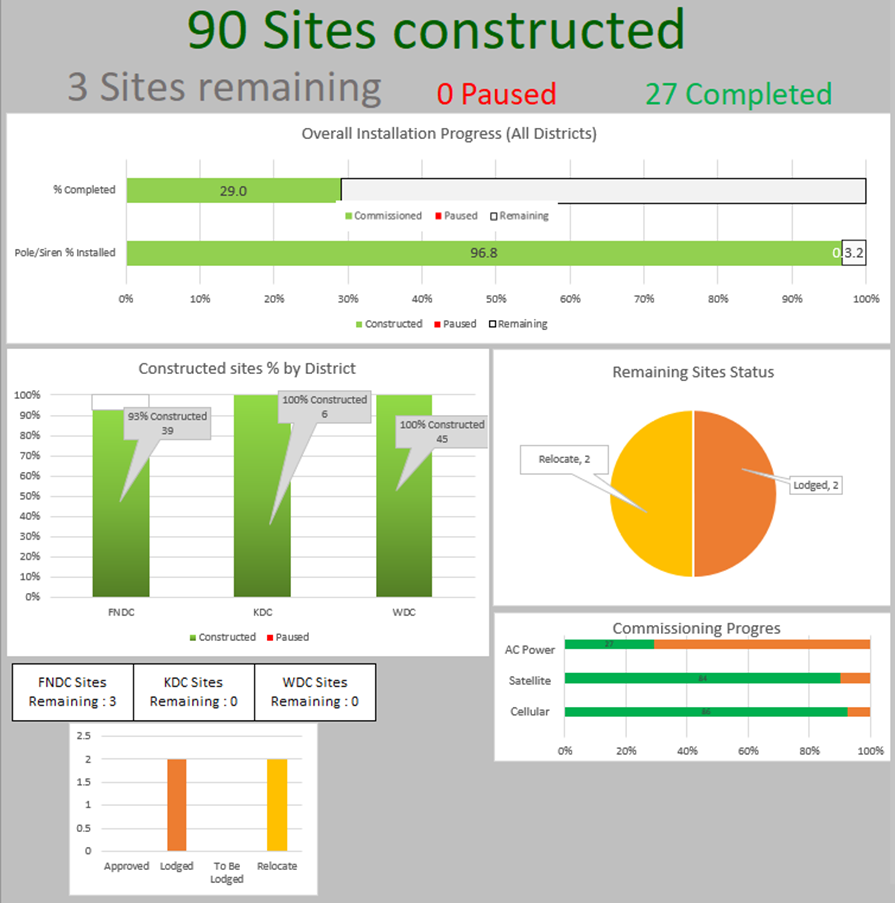
Figure 1 - Dashboard of roll-out progress TSRP
The construction process for two of the remaining sirens is about to resume. Waitangi and Rawhiti sirens are back under the resource consenting process after being delayed during discussions with Hapu. These discussions have now concluded.
The relocation of the Parua Bay siren is also back underway. We met with the Deputy Principal of Parua Bay School, she supports the relocation and is taking the proposal to the trustees. WDC also support the new location as the current lease holder.
HSS Engineering, which had closed down, has now been bought out by a German company, Hörmann Warning Systems GmbH (HWSG). This company is going to be supporting HSS equipment in the future including ours. This will require establishment of them (HWSG) as a supplier, and as us (NRC) as a current customer of theirs, but it is good news.
11. Multi Agency Coordination Centre (MACC)
The MACC project remains low‑risk and well‑governed. NRC continues to lead delivery on behalf of the CDEM Group, supported by FENZ, who are providing both the site and project management expertise. Governance arrangements and reporting structures are stable and functioning effectively.
Funding and agreements are fully secured, and the project is financially on track. All required agreements with councils and FENZ are in place, all contributions have been received, and current estimates remain within the approved budget. Key consultants - design, QS, environmental, and planning - are already engaged.
Design and consenting are progressing without issues, with timing the only moderate risk. Early site investigations found no significant constraints, and concept designs and a 3D model are now complete. A refined project timeline is pending final design confirmation, with construction expected to begin in late 2026.
12. Professional Development and Engagement
Training
The last week of CIMs and function related training for 2025 was held 3 – 6 November in Whangārei.
|
|
FNDC |
KDC |
WDC |
NRC |
CDEM |
Agency |
||||||
|
Course |
ü |
û |
ü |
û |
ü |
û |
ü |
û |
ü |
û |
ü |
û |
|
CIMS4 |
2 |
|
1 |
2 |
2 |
|
3 |
|
1 |
|
7 |
2 |
|
Function (intel) |
1 |
|
2 |
3 |
1 |
|
|
|
2 |
|
2 |
|
|
Exercise |
2 |
2 |
8 |
10 |
5 |
12 |
10 |
5 |
2 |
|
1 |
3 |
|
Controller |
2 |
|
4 |
|
4 |
|
|
|
8 |
|
|
|
Table: November training ü Trainee attended û Trainee did not attend/withdrew
While numbers attending were on par with previous courses, there were withdrawals from training due to work commitments, tangi, illness and resignations from council roles and there were several no-shows for the exercise day.
Five CIMS and function training blocks have been scheduled for 2026. Each training block is one week and consists of a 2-day CIMS course, with function training and exercises completing the week.
The Northland allocation of the forecast training fund provided through NEMA from the Tertiary Education Commission (TEC) currently sits at $72,413.00 which will cover 71% of the 2026 training costs. Due to cost increases across the board, a shortfall of $29,000 will need to be covered by the Group if there is not capacity in the wider TEC fund.
Controller training held in December supported the continued training and development of local and group and alternate controllers.
In October Jenny Calder attended the C-10 training week. A comprehensive, week-long residential course hosted by Canterbury CDEM to develop technical and soft skills of the TA staff within their region.
Both Kori Puckey and Rongomaiwahine Glassie attended the two-day NEMA Induction in Wellington in October.
13. Natural Hazards Update
Risk information is being strengthened, with updated Northland flood maps now added to the Resilience Explorer, closing previous data gaps and supporting local risk assessments. The tool is available to staff and partners to inform planning and decision‑making.
Flood modelling and early‑warning work is progressing, including establishment of a cross‑council team for a regional early flood‑warning system, finalisation of NRC’s flood‑modelling specifications, and ongoing model updates and QA work across the Wairoa, Whangārei, and Waima/Punakitere catchments. The Whangārei Urban Flood Strategy is also advancing, with a Technical Advisory Group in place and future options being developed.
Public‑facing hazard information is being improved, with overtopping modelling for the Awanui scheme completed and under peer review, and a refresh of NRC’s natural hazards website and portal underway to ensure clearer, more accessible hazard data - particularly ahead of increased LIM‑related enquiries.
Central Government Requirements including Legislative Change
New LIM hazard‑information requirements took effect on 17 October 2025, and NRC has worked closely with the region’s district councils throughout the year to ensure consistent processes for providing natural hazard data. Post‑implementation reviews are ongoing, including legal advice on the use of draft information. NRC’s position is to share draft reports with councils on request but not to publish draft hazard maps.
The Ministry for the Environment released the National Policy Statement for Natural Hazards on 18 December 2025, strengthening councils’ ability to manage risk in new developments. As the regional source of natural hazard information, NRC has a key role in enabling councils to apply these requirements through accurate and timely hazard data.
In October Earth Sciences New Zealand has just released the first national flood hazard model for Aotearoa along with a Public Flood hazard Viewer. In a separate project the Ministry for the Environment (MfE) are developing a national flood map which aims to integrate all flood modelling across New Zealand. NRC have been working to provide MfE with detailed information on our flood models that will allow them to identify ways in which this national flood map can be developed.
Regional Recovery Coordination
Continued running workshops with Local Recovery Managers to support development of the regional Recovery Framework.
National working parties and sectoral collaborations
Provided detailed feedback on NEMA’s draft Waste Management Guidelines, the Recovery Training Pathway, and the ‘Streamlining and Rationalising Central Government Emergency Funding’ discussion paper.
Attended update by the Natural Hazards and Resilience Platform about the Post-Event Science Coordination Function (representing the Group Recovery Managers/CDEM Groups). The Platform has developed a ‘minimum viable plan’ to provide science coordination in the event of emergencies over the summer holiday period and will continue development throughout 2026.
Presented at the EMPA conference about Northland’s final Recovery report, and as part of the Recovery panel.
Presented on Northland’s approach to community consultation to inform Recovery planning to the Community Wellbeing Recovery Network, Possibility Lab (the Australian Institute of Disaster Resilience’s Recovery community of practice), and the Tasmanian Department of Premier and Cabinet’s Recovery Partners Network meeting.
Regional Recovery Framework
The Regional Recovery Framework will align with the Northland CDEM Group Plan and provide the structural settings needed to address issues identified through the external review and lessons from the Cyclone Gabrielle recovery. Reflecting the sector’s shift away from generic, all‑hazards plans, the Framework will focus on the practical systems, roles, resourcing, and decision‑making arrangements required for effective recovery implementation.
Development of the Framework will be progressed through a staged and collaborative process. This includes reviewing recovery frameworks and Concept of Operations from other CDEM Groups, followed by targeted workshops with Local Recovery Managers, recovery leadership, cross‑council teams, and subject‑matter specialists contributing to the Framework’s development to refine Northland’s recovery approach. A draft Framework will then be developed, tested, and finalised, with updates provided to the CEG from April to July 2026 for review and direction.
15. Common Operating Platform (COP)
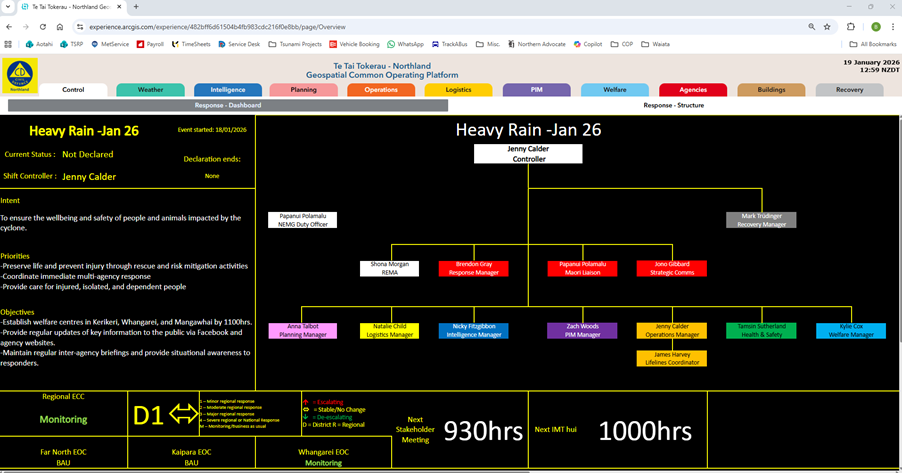
Development of the Common Operating Platform (COP) for the Emergency Coordination Centre (ECC) is underway. An initial demonstration will be provided at the next CEG meeting, with desktop testing scheduled for February and an ECC go‑live targeted for March.
Work continues to integrate the required data feeds, noting that some sources will require future capability development. Once the internal platform is established, the project will shift to building external COP functionality for partner agencies and stakeholders.
Attachments/Ngā tapirihanga
Nil
Civil Defence Emergency Management Group Meeting item: 8.3
3 March 2026
|
TITLE: |
Emergency Management Bill Submission - Retrospective Approval |
|
From: |
Damian Rio, CDEM Emergency Manager |
|
Authorised by Group Manager/s: |
Louisa Gritt, Group Manager - Community Resilience, on 23 February 2026 |
Executive summary/Whakarāpopototanga
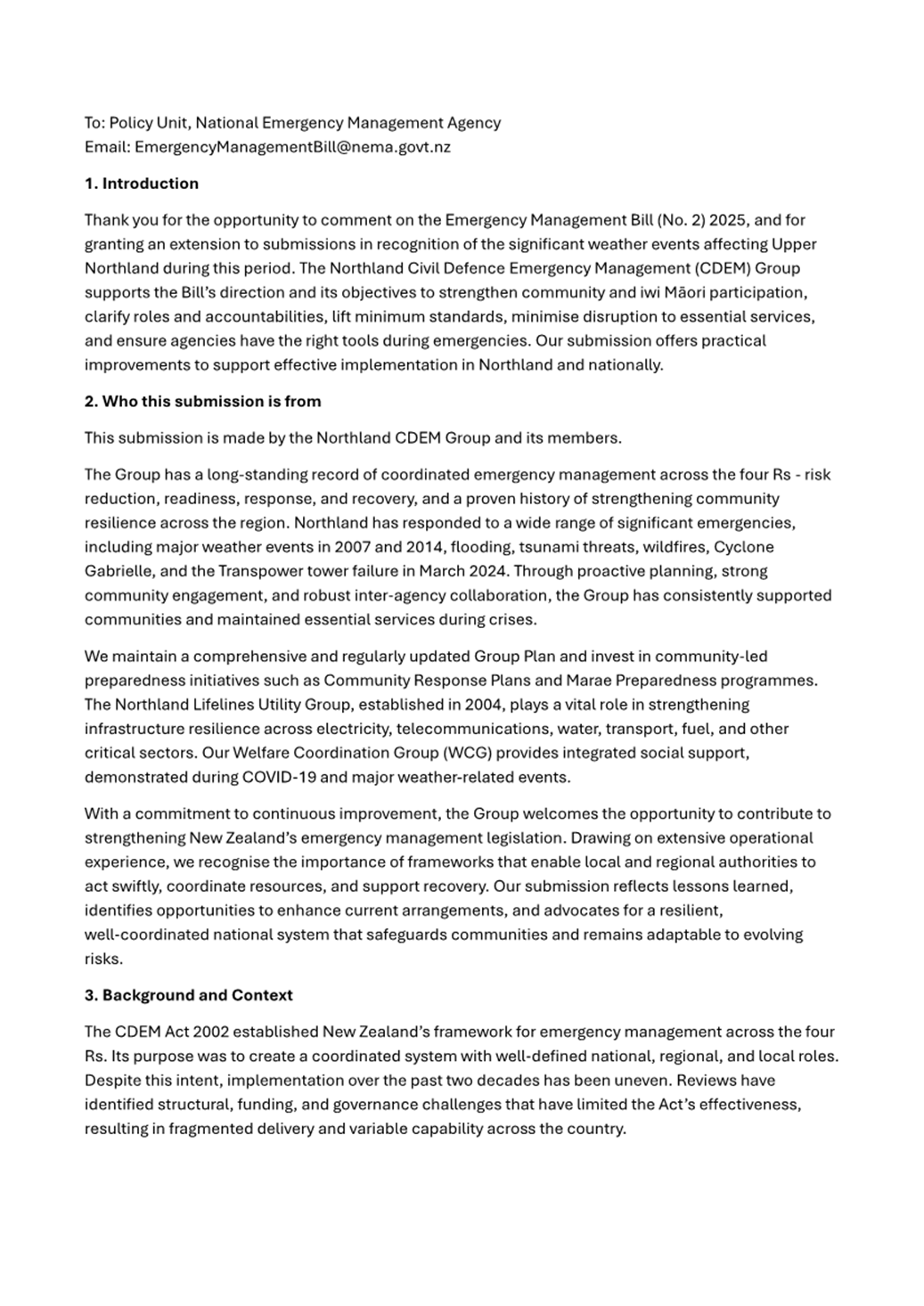
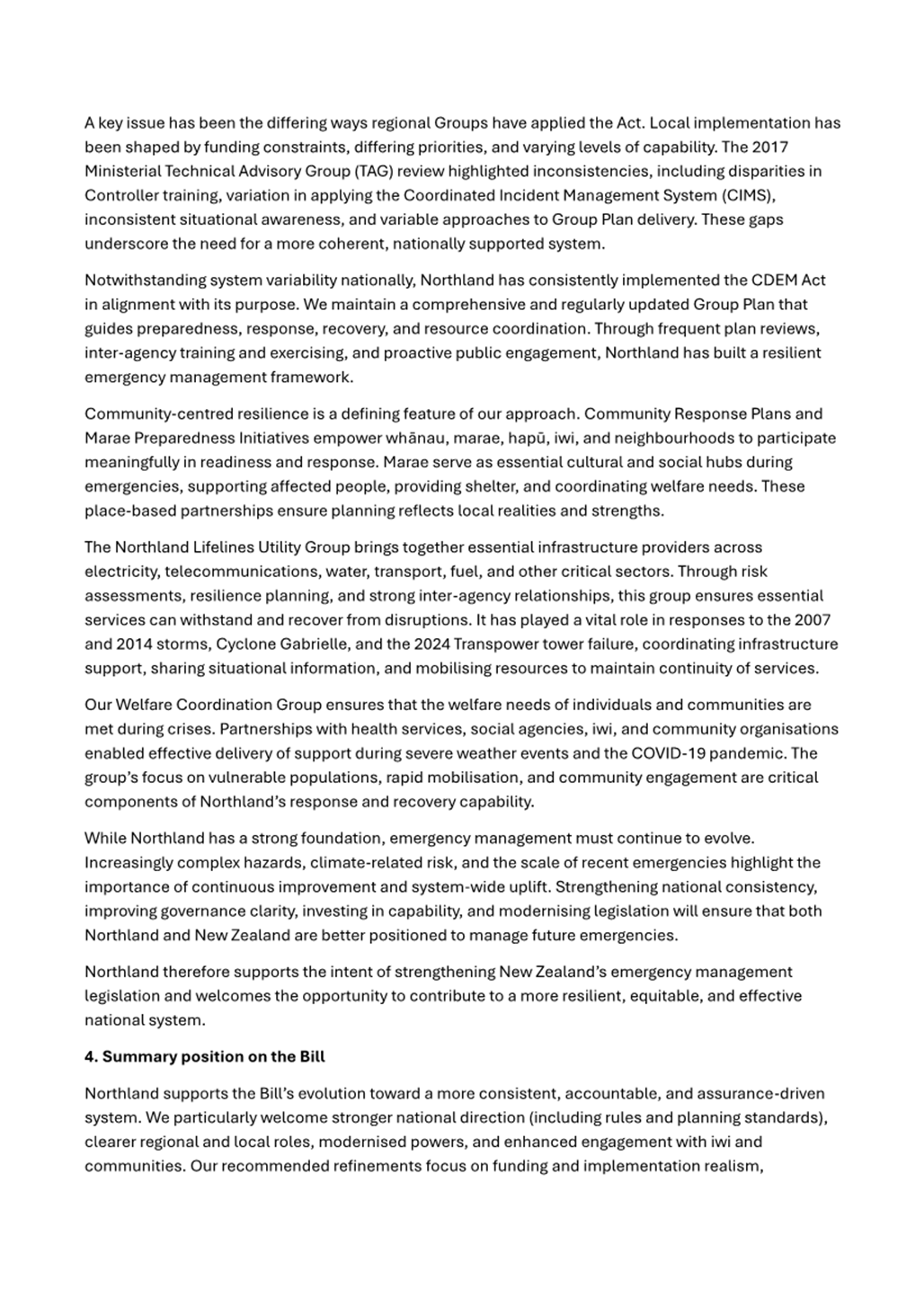
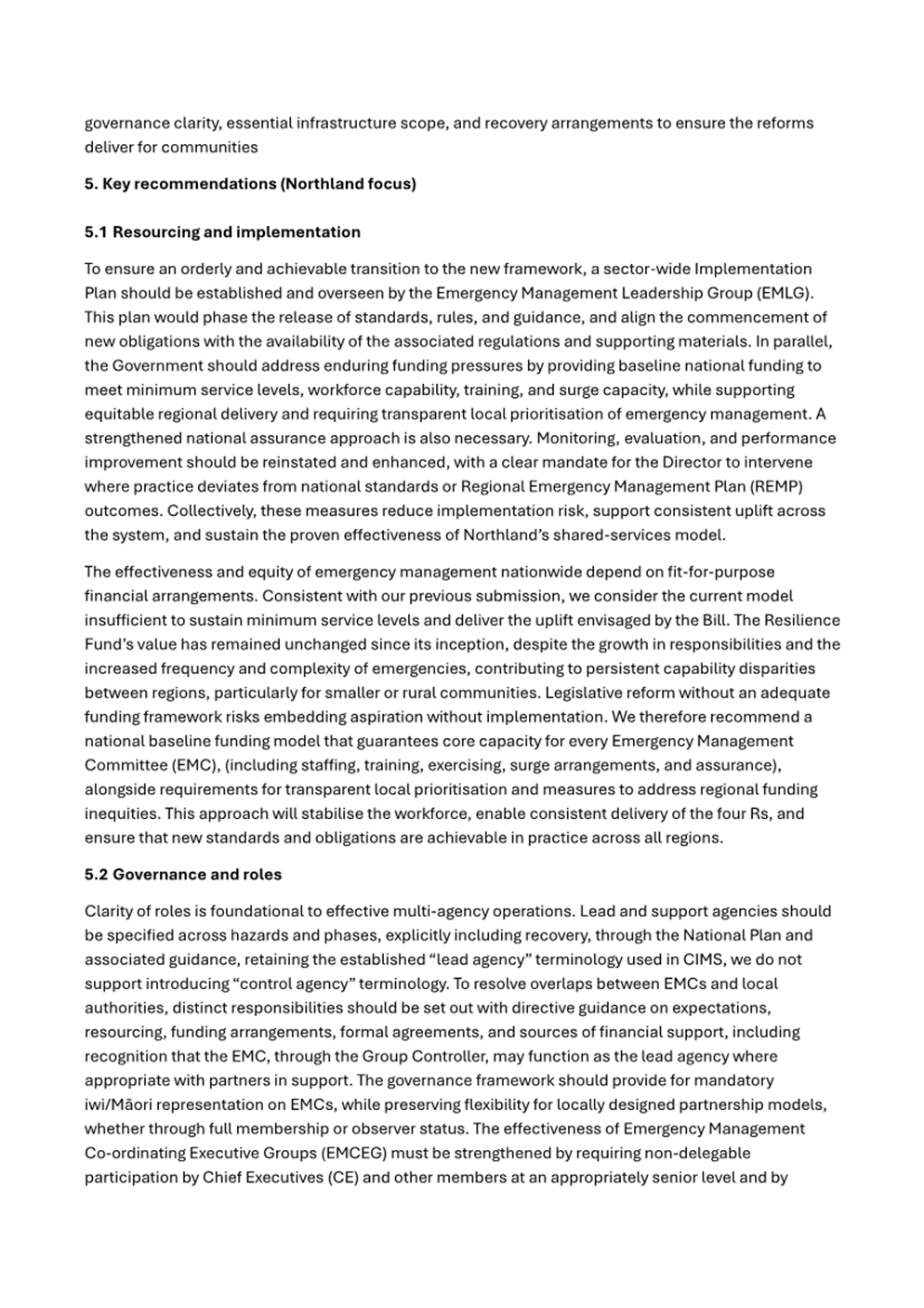
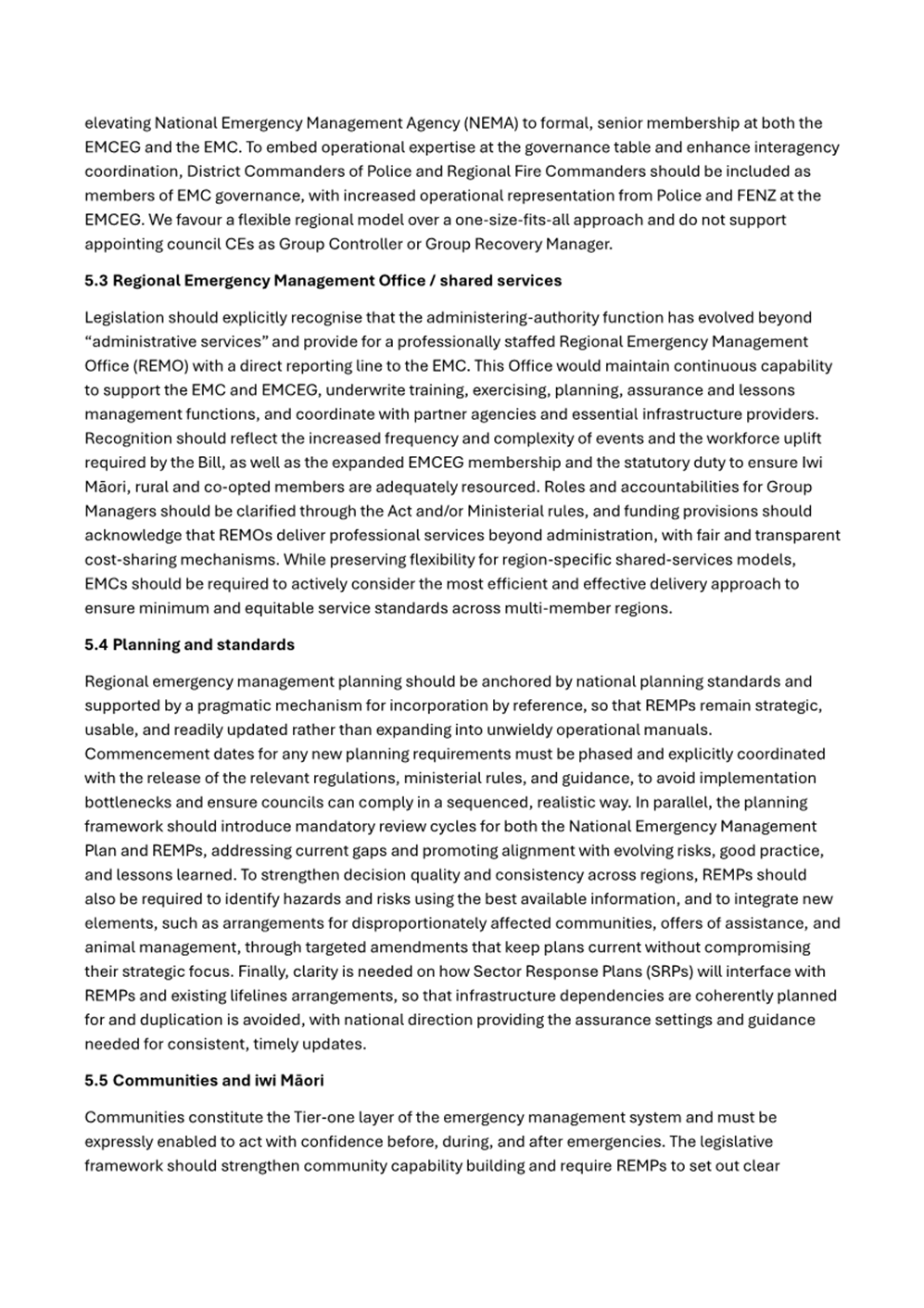
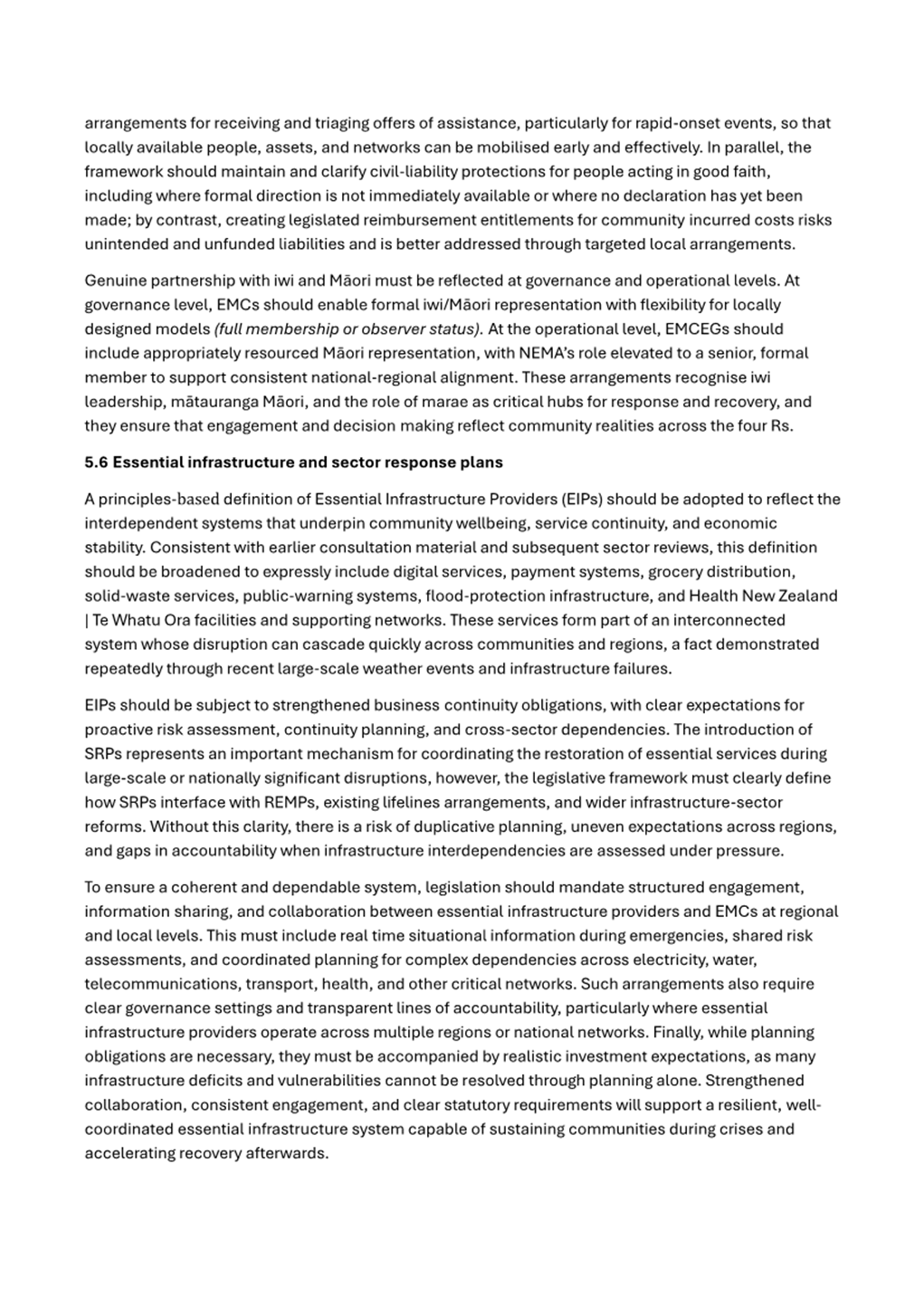
The Government is progressing new emergency management legislation to modernise and strengthen Aotearoa New Zealand’s emergency management system. The proposed Emergency Management Bill will replace the Civil Defence Emergency Management Act 2002.
Public submissions on the Bill opened on 17 December 2025, with the original closing date set for 3 February 2026.
In late January, the upper North Island experienced significant severe weather events, which placed pressure on affected communities and agencies involved in the emergency response. In recognition of these impacts and in response to requests from regional submitters the Governance and Administration Committee extended the submission deadline. The new closing date is 11.59pm, 15 February 2026.
To support Northland’s engagement in this process, Northland Civil Defence Emergency Management (NCDEM) undertook targeted consultation with the Coordinating Executive Committee, the NCDEM Group Joint Committee, partner agencies, and key stakeholders to inform the region’s submission on the Bill. The final Northland submission was provided to the Committee within the extended timeframe.
As the extended submission deadline still occurred prior to the next scheduled NCDEM Group meeting, this paper seeks retrospective approval for the submission, (see attachment)
1. That the report ‘Emergency Management Bill Submission - Retrospective Approval’ by Damian Rio, CDEM Emergency Manager and dated 16 February 2026, be received.
2. That That the Northland CDEM Group Joint Committee retrospectively approve the attached submission on the Emergency Management (EM) Bill (No2).
Options
|
No. |
Option |
Advantages |
Disadvantages |
|
1 |
NCDEM Group Joint Committee retrospectively approves the submission. |
The Select Committee overseeing the Bill will be able to take into account Northland’s submission. |
None |
|
2 |
NCDEM Group Joint Committee does not approve the submission |
None |
The submission points would need to be formally withdrawn. |
The staff’s recommended option is option 1 that the NCDEM Group Joint Committee retrospectively approves the submission.
Considerations
As this is an administrative process only. There are no material policy or legislative compliance risks associated with the CDEM Group Joint Committee lodging a submission on the government proposals or relating to CDEM Group Joint Committee retrospective approval of the submission.
Attachments/Ngā tapirihanga
Attachment 1:
EM Bill Submission ⇩
Civil Defence Emergency Management Group Meeting item: 8.4
3 March 2026
|
TITLE: |
Community Response Planning and Marae Preparedness Planning |
|
From: |
Bill Hutchinson, Emergency Management Specialist; Damian Rio, CDEM Emergency Manager; Papanui Polamalu, Emergency Management - Iwi/hapū Engagement Advisor; Kori Puckey, Emergency Management Specialist; Laura Exton, Emergency Management Specialist – Kaipara; Rongomaiwahine Glassie, Emergency Management Specialist and Tony Devanney, Emergency Management Specialist |
|
Authorised by Group Manager/s: |
Louisa Gritt, Group Manager - Community Resilience, on 23 February 2026 |
Whakarāpopototanga / Executive summary
This report provides an overview of the community resilience work being carried out by our NCDEM Emergency Management Specialists (EMS), with a specific focus on Community Response Group and Marae Preparedness Planning activities.
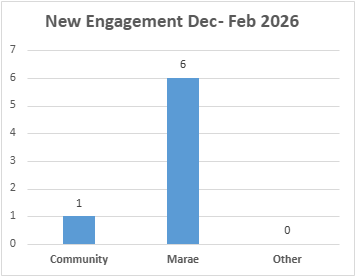
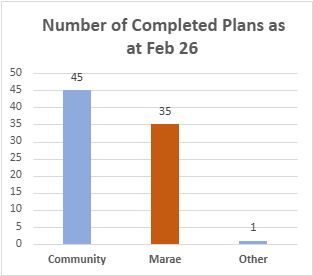
This report covers December – February of the 2025/2026 year. During this period NCDEM engaged with 6 new marae groups and 1 new community group. Additionally, there are 81 completed Community Response and Marae Preparedness Plans across Te Taitokerau as at February 2026.
That the report ‘Community Response Planning and Marae Preparedness Planning’ by Bill Hutchinson, Emergency Management Specialist; Damian Rio, CDEM Emergency Manager; Papanui Polamalu, Emergency Management - Iwi/hapū Engagement Advisor; Kori Puckey, Emergency Management Specialist; Laura Exton, Emergency Management Specialist – Kaipara; Rongomaiwahine Glassie, Emergency Management Specialist and Tony Devanney, Emergency Management Specialist and dated 132 February 2026, be received.
Background/Tuhinga
This work is a longstanding and integral part of CDEM’s approach, aligning closely with the CDEM Group Plan. Building resilient communities is essential—particularly in Northland, where many remote and isolated communities face multiple hazards. The planning process not only enhances preparedness but also fosters community cohesion and strengthens local response and recovery capabilities.
These efforts are directly in line with the Government’s response to the Report of the Government Inquiry into the Response to the North Island Severe Weather Events, which emphasised the vital role communities play in official emergency responses.
Significant work is also underway to support Marae preparedness planning, driven by initiatives such as the Northland Flood Resilient Māori Communities and Marae kaupapa and the dedicated Māori Relationships role.
Community Response Planning and Marae Preparedness Planning work undertaken
The following graphs highlight NCDEM’s engagement activity from Dec - Feb across the 2025/2026 year to date. They show new engagement requests, the status of community and marae response plans, and total engagements. This reflects the significant workload and achievements of our Emergency Management Specialists and communities, alongside their other responsibilities.
|
|
|
|
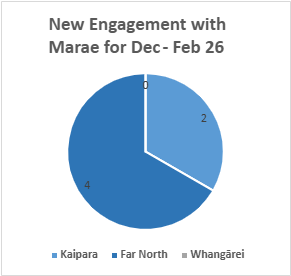
From December 2025 – February 2026, NCDEM engaged
with 6 new marae groups and 1 new community group, with the bulk of this
workload in the Far North, followed by the Kaipara District. These first-time
engagements demonstrate the constant demand from communities for support and
preparedness planning. While incredibly important, this work adds to our existing commitments with established groups and contributes to a steadily increasing workload for our Emergency Management Specialists. “Other” refers to groups outside of Community Response Groups (CRGs) & Marae, such as ethnic communities or vulnerable people groups, where their focus was response planning.
|
|
Note: Northland CDEM is engaging with communities and marae that have not previously, or not recently interacted with Civil Defence, and are now seeking to strengthen their emergency readiness capability. This includes support to develop Community Response Plans or Marae Preparedness Plans, aligned with local needs and hazard profiles.
|
|
|
|
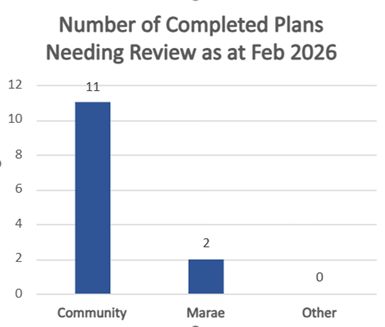
As at February 2026, there were 81 completed Community Response and Marae Preparedness Plans across Te Taitokerau. This includes any plans that are complete but identified for review. You can view the community response group map here. |
Currently, 13 Community and Marae Response Plans have been identified for review. These updates are needed either to incorporate new hazard information, such as updated tsunami evacuation zones, or to refresh outdated contact details or evacuation information. Recent work has focused on reviewing all plans for communities and marae located within tsunami evacuation zones, ensuring alignment with the latest mapping.
|
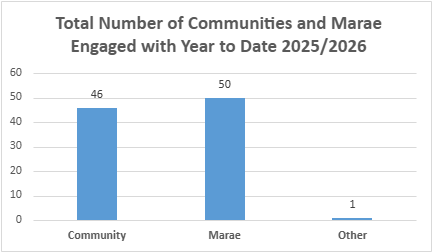
So far in the 2025/2026 year, our EM’s have engaged with a total of 97 community groups and Marae.
Note: This figure reflects the number
of unique communities engaged, not individual engagement sessions. For example,
a marae that participated in three response planning workshops is counted once.
Civil Defence Emergency Management Group
Meeting
3 March
2026
|
TITLE: |
Landslide Assessments - Correspondence |
|
From: |
Damian Rio, CDEM Emergency Manager and Jane Hickmott, Governance and Policy Manager |
|
Authorised by Group Manager/s: |
Louisa Gritt, Group Manager - Community Resilience, on 19 February 2026 |
Whakarāpopototanga / Executive summary
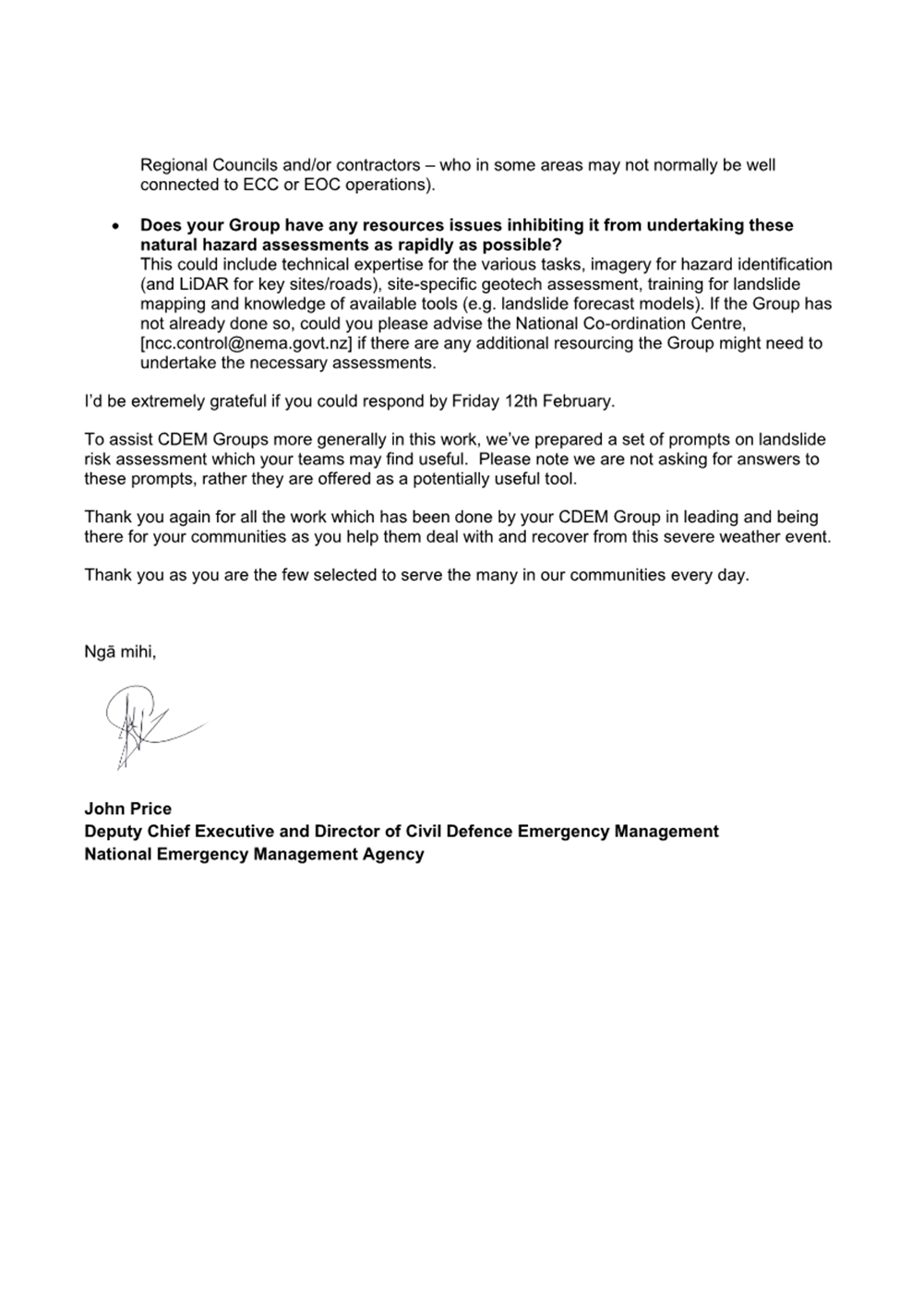
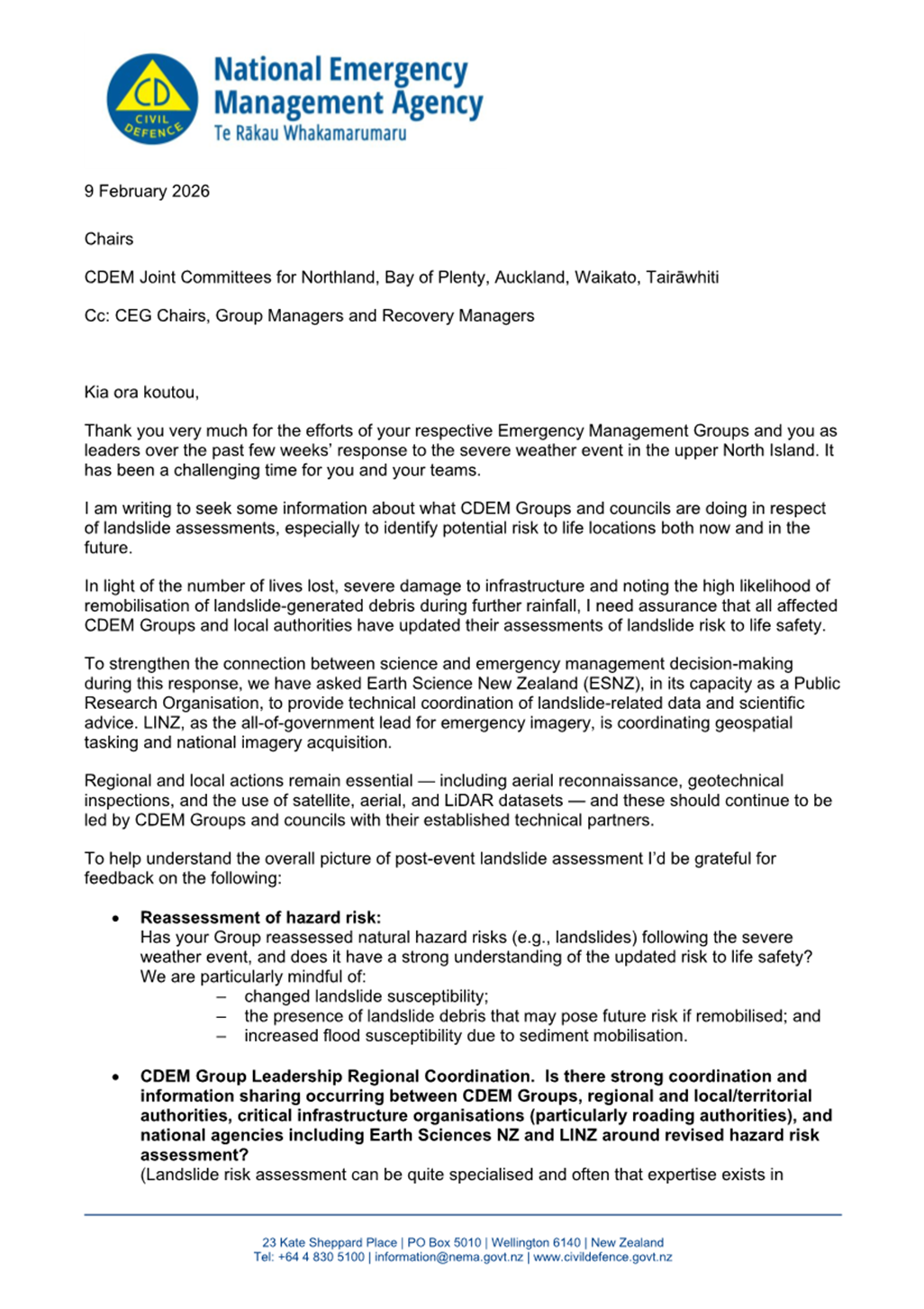
Following the severe weather event that impacted the upper North Island in January 2026, the Northland Civil Defence Emergency Management (CDEM) Joint Committee received correspondence from the National Emergency Management Agency (NEMA). The National Emergency Management Director requested information and assurance that all local CDEM Groups are actively collating, updating, and assessing landslip hazards, with particular focus on risks to life across the Northland rohe.
NEMA’s letter outlined a series of questions seeking clarity on the region’s current understanding of landslip-related risks, the status of life-safety assessments, and the arrangements in place to identify and manage emerging hazards.
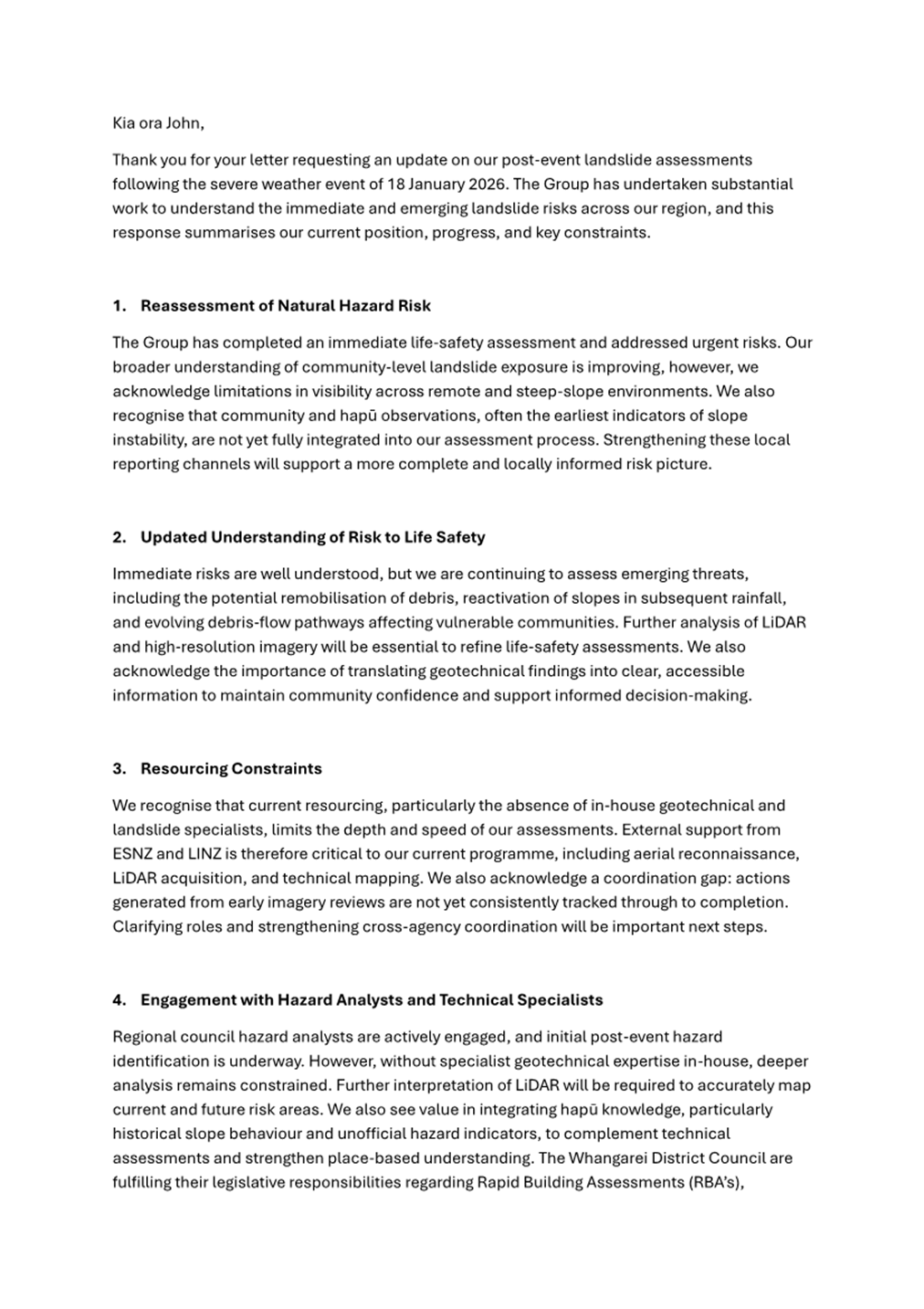
On behalf of the Joint CDEM Committee, the Deputy Chair, Councillor Stratford, signed and issued a formal response addressing NEMA’s queries. The outgoing correspondence confirms that the Group has completed immediate life-safety assessments and has addressed urgent risks identified in the aftermath of the weather event. It also notes that Northland Regional Council hazard analysts are actively engaged in ongoing hazard identification work. This includes the use of aerial reconnaissance, community reporting channels, and high‑resolution imagery to map and monitor known and emerging landslide hotspots.
The response further outlines the continuous improvement actions underway within CDEM. These include strengthening local reporting channels, improving cross‑agency coordination mechanisms, and establishing a short‑term coordination group. The purpose of this group is to connect technical specialists, operational partners, and community representatives to ensure that information is consistently shared and acted on in a timely and coordinated manner.
Collectively, the correspondence confirms that the Northland CDEM Group is maintaining active oversight of landslip risks and is undertaking structured work to support the region’s situational awareness and response capability, with a long-term focus on enhancing regional preparedness for future events.
1. That the report ‘Landslide Assessments - Correspondence’ by Damian Rio, CDEM Emergency Manager and Jane Hickmott, Governance and Policy Manager and dated 16 February 2026, be received and noted.
Attachments/Ngā tapirihanga
Attachment 1:
Incoming Correspondence ⇩
Attachment 2:
Outgoing Correspondence ⇩