|
Regional Transport Committee Wednesday 6 June 2018 at 10.00am
|
|
|
|
|


|
Regional Transport Committee Wednesday 6 June 2018 at 10.00am
|
|
|
|
|
Regional Transport Committee
6 June 2018
Regional Transport Committee Agenda
Meeting to be held in the Council Chamber
36 Water Street, Whangārei
on Wednesday 6 June 2018, commencing at 10.00am
Recommendations contained in the agenda are NOT decisions of the meeting. Please refer to minutes for resolutions.
MEMBERSHIP OF THE Regional Transport Committee
Chairman, Councillor John Bain
|
FNDC Councillor Ann Court |
Deputy Chairman Paul Dimery |
KDC Councillor Julie Geange |
|
WDC Councillor Greg Martin |
NZTA Representative Mr Peter Clark |
|
Item Page
1.0 apologies
2.0 declarations of conflicts of interest
3.0 Presentations 3
4.1 Northland Regional Land Transport Plan 2015-2018 Funding Uptake 11
5.1 Regional Walking and Cycling Strategy - Update 17
5.2 New Zealand Transport Agency Quarterly Report to Regional Transport Committee 57
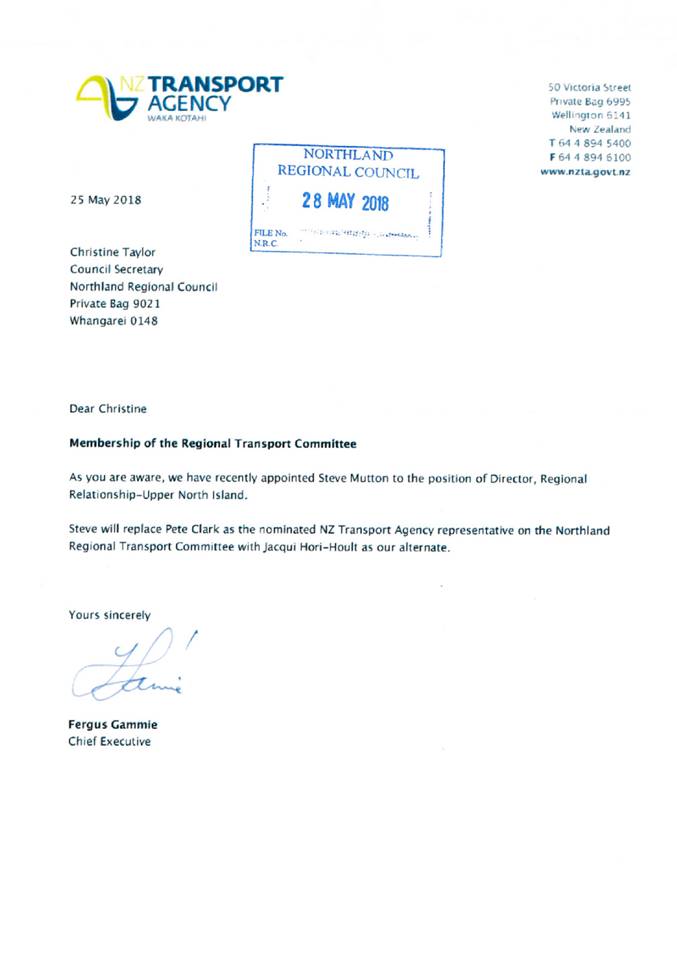
5.3 New Zealand Transport Agency Regional Transport Committee Representative 64
5.4 Northland Road Safety Action Plan Update 66
6.1 Confirmation of Minutes - Regional Transport Committee Meeting 4 April 2018 68
Regional Transport Committee item: 1.0
6 June 2018
|
TITLE: |
Presentations |
|
ID: |
A1070918 |
Executive summary
The presentations that will be presented at the meeting are listed below.
That the presentations:
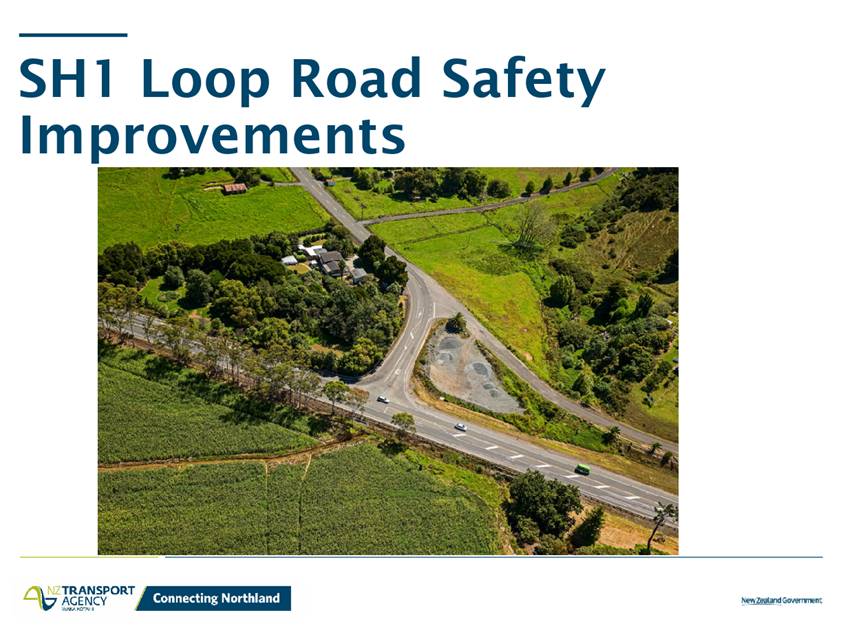
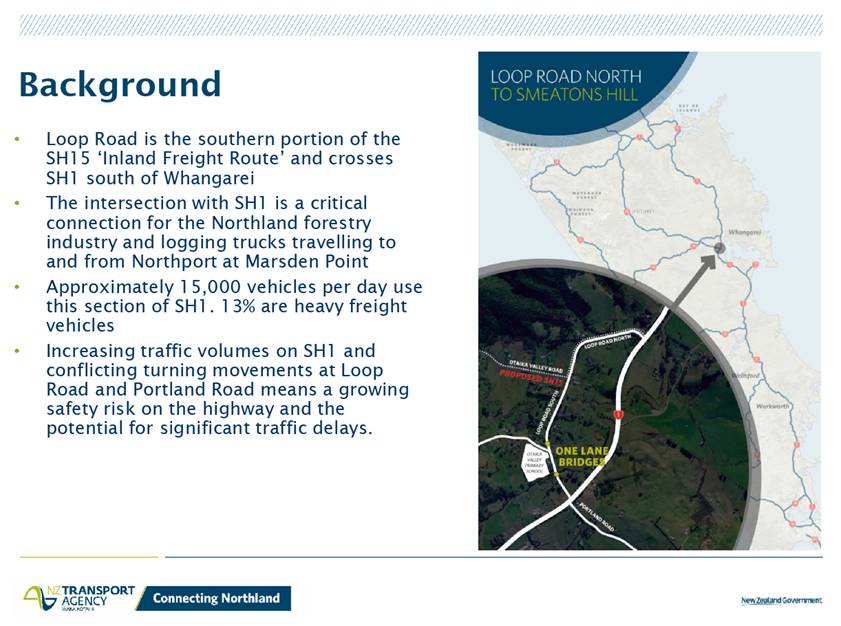
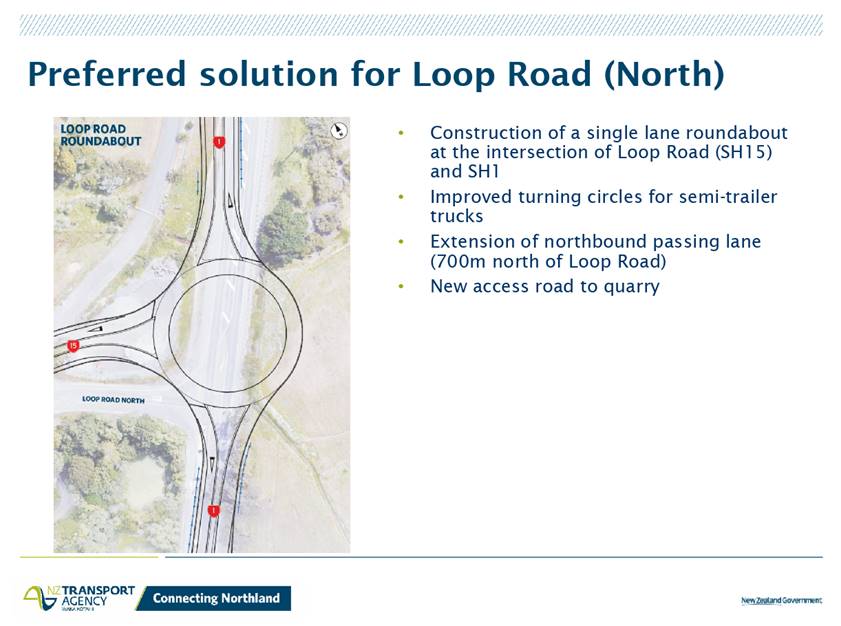
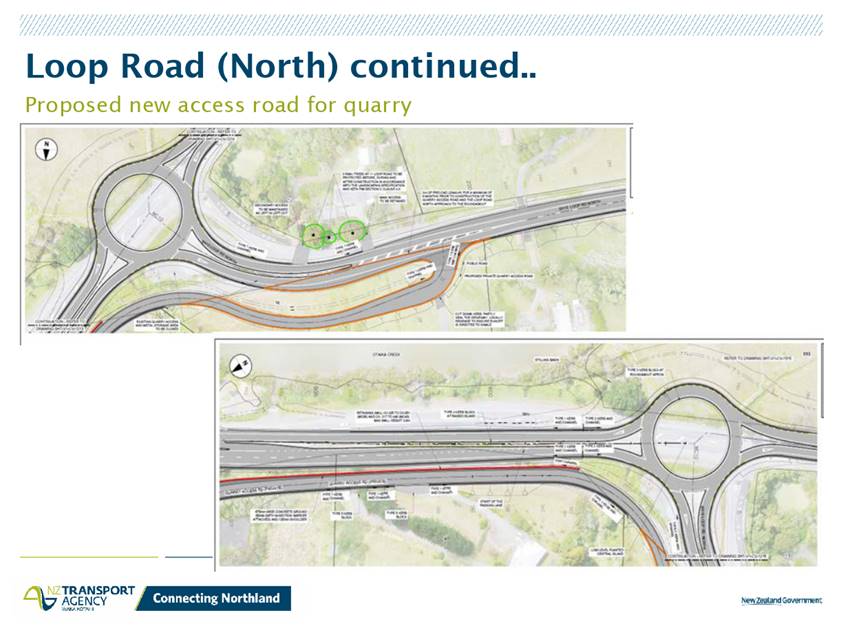
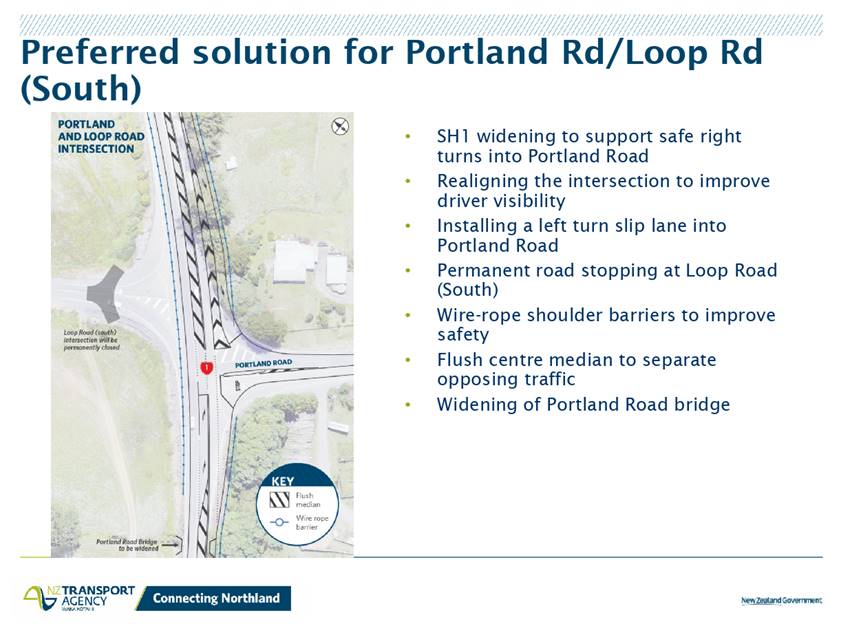
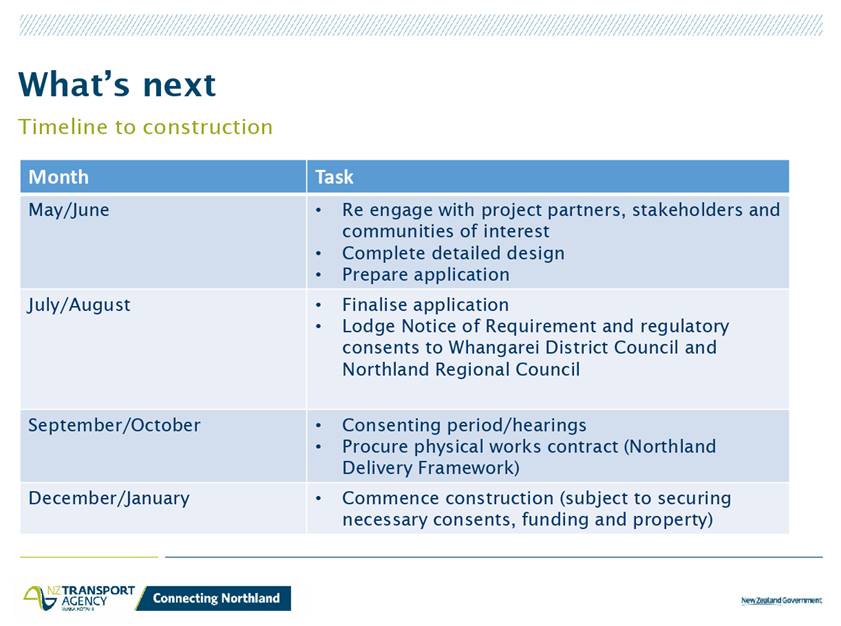
· ‘SH1 Loop Road Safety Improvements project’ by Kelly Sullivan from the New Zealand Transport Agency
· ‘Regional Road Safety Update’ by Senior Sergeant Ian Row from the New Zealand Police.
be received.
Attachments
Attachment 1: Presentation - State
Highway 1 Loop Road Safety Improvements Project ⇩ 
Authorised by Group Manager
|
Name: |
Tony Phipps |
|
Title: |
Group Manager - Customer Services - Community Resilience |
|
Date: |
30 May 2018 |
Regional Transport Committee item: 4.1
6 June 2018
|
TITLE: |
Northland Regional Land Transport Plan 2015-2018 Funding Uptake |
|
ID: |
A1070907 |
|
From: |
Chris Powell, Transport Manager |
Executive summary
The purpose of this report is to provide an expenditure update on the six-year Northland Regional Land Transport Plan 2015–2021 (RLTP) for the period 1 July 2017 to 30 April 2018.
1. That the report ‘Northland Regional Land Transport Plan 2015-2018 Funding Uptake’ by Chris Powell, Transport Manager and dated 29 May 2018, be received.
Background
Reports on the Northland Regional Land Transport Plan – Funding Uptake are tabled at each Regional Transport Committee (RTC) meeting.
These reports serve to update the RTC on the progress of funding uptake by each of the regions four approved road-controlling authorities and the Northland Regional Council. Comparisons on Budgeted Expenditure against Actual Expenditure by Activity/Programme for both the full financial year and year to date of the relevant financial year are provided.
The base information contained in the spreadsheets is sourced directly from the NZ Transport Agency’s (NZTA’s) ‘National Land Transport Plan 2015–2018 Northland’ and from the relevant subsidy claims as submitted to NZTA by the approved authorities.
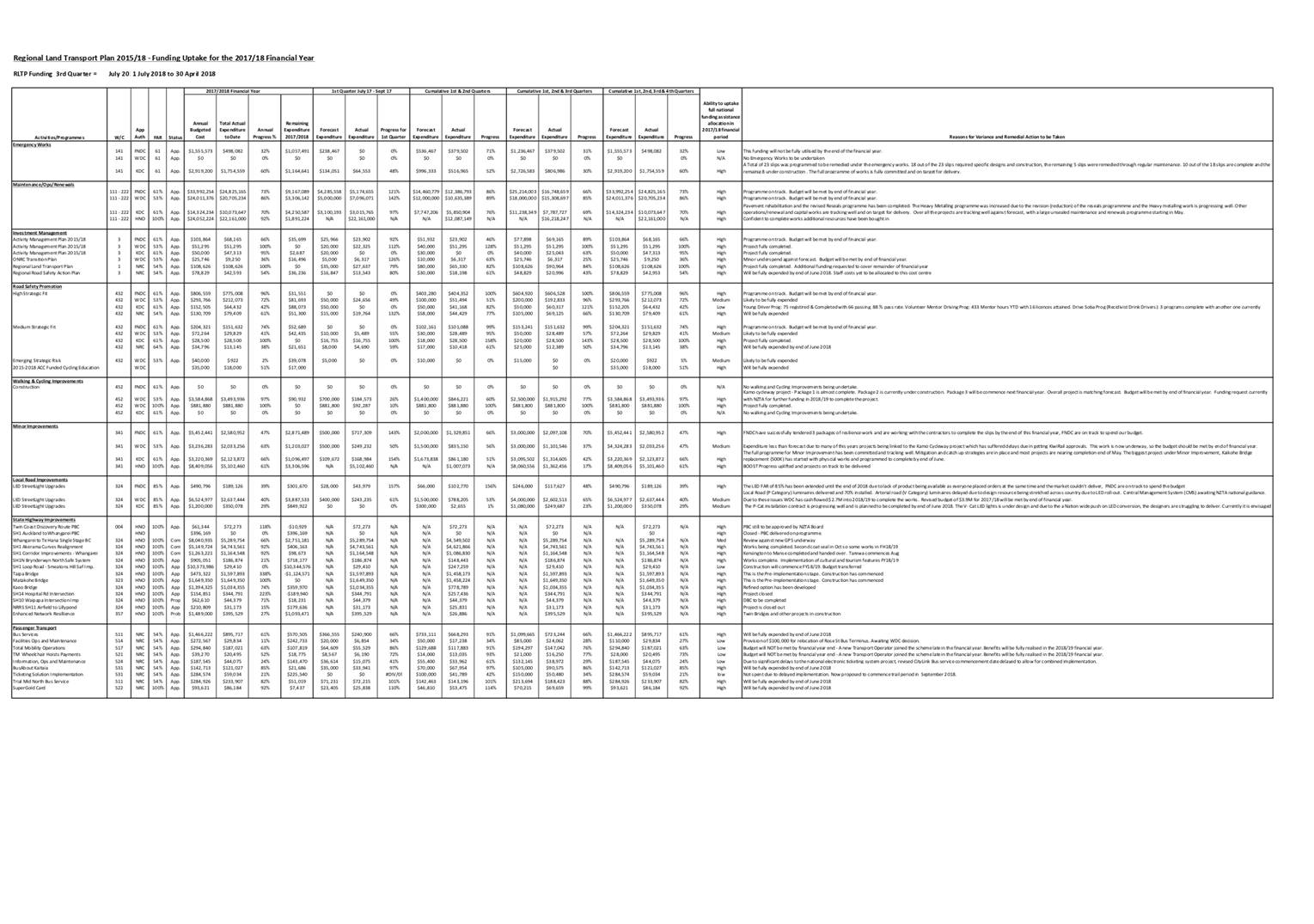
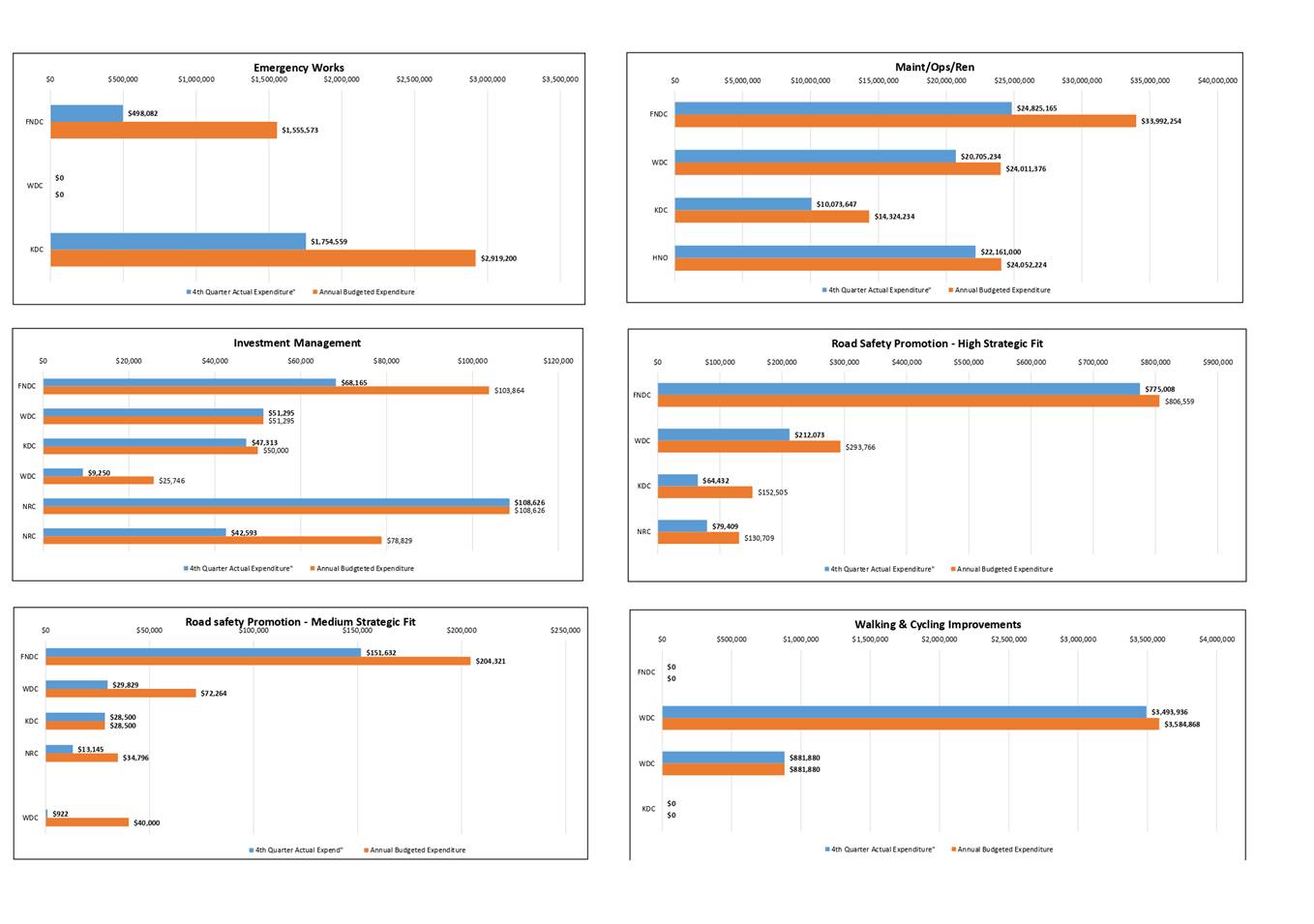
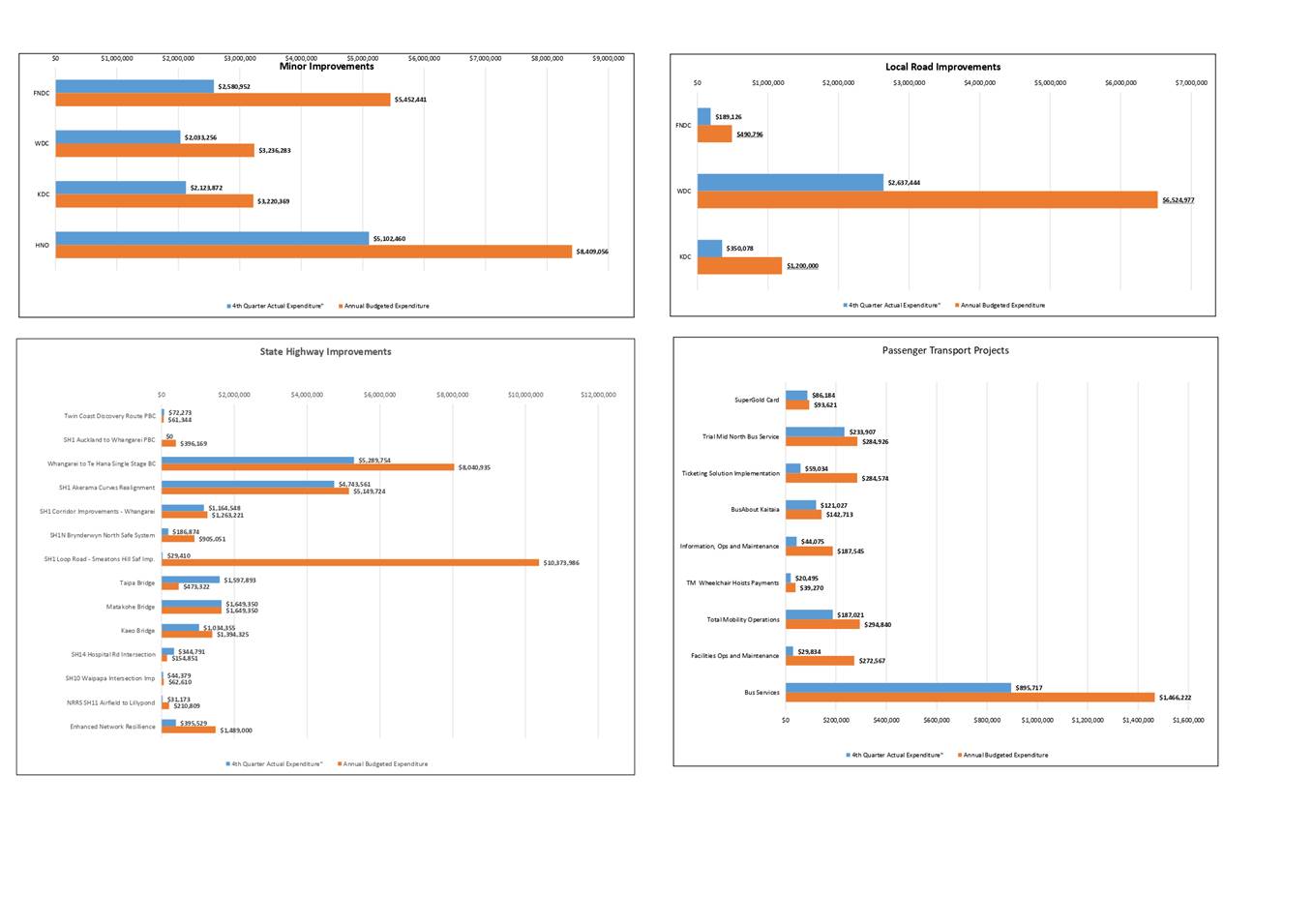
The attached spreadsheet and graphs provide the relevant information on the uptake of funding for the period 1 July 2017 to 30 April 2018 by the Northland Regional Council, Far North District Council, Whangarei District Council, Kaipara District Council and the New Zealand Transport Agency.
It is important to note that this is not the final funding uptake report for the 2017/2018 financial year. This will be tabled at the August 2018 RTC meeting.
Please also note that as the quarterly funding period and the RTC reporting periods do not align, funding uplifted to 30 April 2018 are reflected in the fourth financial quarter for ease of reporting.
The spreadsheet provided provides the following information:-
· Activity/Programme;
· Approved Authority;
· Progress of Budget/Actual Expenditure for the full Financial Year;
· Progress for the Budget/Actual Expenditure Year to Date;
· Risk of not taking up funding assistance allocation;
· Reasons for variances and remedial action to be taken.
The graphs provided reflect the Progress of Budget/Actual Expenditure for the full Financial Year.
More detailed information pertaining to individual projects can be obtained from the relevant road controlling authorities.
Attachment 1: Funding Uptake Table for
June 2018 ⇩ 
Attachment 2: Funding Uptake Graphs for
June 2018 ⇩
Authorised by Group Manager
|
Name: |
Tony Phipps |
|
Title: |
Group Manager - Customer Services - Community Resilience |
|
Date: |
30 May 2018 |
Regional Transport Committee item: 5.1
6 June 2018
|
TITLE: |
Regional Walking and Cycling Strategy - Update |
|
ID: |
A1069030 |
|
From: |
Jon Trewin, Policy Analyst and Darryl Jones, Economist |
Executive summary
The purpose of this report is to update the Regional Transport Committee on the progress of the development of the region-wide walking and cycling strategy. Attached to this agenda item is a recent draft (Attachment 1) of the strategy which has been compiled with input from Northland’s District Councils and support from Craig Wilson, a consultant with Quality Tourism Development Limited. The goal is to bring the finalised strategy to the Regional Transport Committee for approval in August 2018 to support several Provincial Growth Fund applications from district councils to be made shortly thereafter.
1. That the report ‘Regional Walking and Cycling Strategy - Update’ by Jon Trewin, Policy Analyst and Darryl Jones, Economist and dated 22 May 2018, be received.
Background
The Regional Council has been leading the development of a region-wide walking and cycling strategy in collaboration with district councils and with assistance from Craig Wilson, a consultant with Quality Tourism Development Limited. Craig’s input into the strategy has been funded through the regional council’s investment and growth reserve and was endorsed by the Regional Transport Committee at its December 2017 meeting.
Staff from the regional council and district councils have been meeting regularly for over a year and a half to share information on walking and cycling initiatives and the progress of their respective strategies.
It was felt by this group that the development of a regional walking and cycling strategy was necessary to:
- underpin and join-up the district strategies and support walking and cycling programmes and local initiatives,
- present a strategic case for connecting Northland with Auckland via the east coast,
- leverage economic and tourism opportunities from the existing infrastructure, with a strategic focus on developing Great Rides and Walks in Northland
Since December 2017, further work has been undertaken on the strategy so that it now includes:
- A vision, namely: To be one of the world’s best coastal walking and cycling destinations where our journeys and stories are as impressive and memorable as the scenery.
- Greater understanding of what the market wants from walking and cycling in Northland.
- A list of ‘easy’ and more challenging (‘avid’) cycling projects and a separate category for walks. The projects have been ranked according to scoring from a set of standard criteria.
Provincial Growth Fund
Recently Central Government has developed the Provincial Growth Fund. Walking and cycling (along with other transport projects) are eligible for funding for both feasibility studies and construction. The Northland Mayoral Forum have endorsed the development of the regional walking and cycling strategy as a means to access provincial growth funding. Central Government have also indicated that the development of such a strategy is a useful way of drawing together and supporting multiple bids for walking and cycling projects across the region. The strategy could also be used to support funding bids through other funding streams such as the National Cycleway Fund and the Tourism Infrastructure Fund.
Some early bids through the Provincial Growth Fund have been made by district council for walking and cycling projects. This includes the Waipu Trail (led by Whangarei District Council and supported by Waipu Walkway and Cycleway Trust) and the Kaihu Valley Rail Trail (led by Kaipara District Council and supported by local Iwi).
Further project bids are forthcoming, subject to their evaluation in the regional-wide walking and cycling strategy. The final strategy will be produced for the August Regional Transport Committee meeting with bids to the fund to be made shortly after, subject to approval by the committee.
Staff would be grateful for any feedback from members of the committee over the next few weeks on the draft strategy attached to guide the finalisation of the strategy.
Attachments
Attachment 1: Draft Regional Walking
and Cycling Strategy ⇩ 
Authorised by Group Manager
|
Name: |
Tony Phipps |
|
Title: |
Group Manager - Customer Services - Community Resilience |
|
Date: |
28 May 2018 |
6 June 2018
Northland Regional Walking and Cycling Strategy




Contents
Executive Summary
Background- demand for walking and cycling
Outcome 1: Development of comprehensive local and regional walking and cycling networks
Outcome 2: Regionally consistent promotion of walking and cycling opportunities through strong branding and marketing.
Outcome 3: Increased participation in walking and cycling
Outcome 4: Improving community wellbeing and economic opportunities for locals
Outcome 5: Increasing environmental sustainability
Legislative and policy context
Appendix 1: Summary table of outcomes and actions
Appendix 2: Implementation Plan
This is Northland’s first Regional Walking and Cycling Strategy. Its development has been overseen by a steering group made up of representatives from Northland Regional Council and Far North, Whangarei and Kaipara District Councils with input from the New Zealand Transport Agency, Northland Inc, the Department of Conservation and walking and cycling interest groups. The purpose of this document is to provide a strong strategic framework to support the development and implementation of district council walking and cycling strategies.
The economic future of Northland relies on strong transport networks, and walking and cycling are becoming ever more important to this mix. The region is one of the least urbanised in New Zealand meaning there is a greater reliance on private car use as well as a need to travel longer distances to reach places of employment, shopping, leisure, health and education. Walking and cycling provide positive, enjoyable, economic and healthy ways of getting around.
The overarching vision for the Regional Walking and Cycling Strategy is for Northland:
To be one of the world’s best coastal walking and cycling destinations where our journeys and stories are as impressive and memorable as the scenery.
The strategy will assist in achieving this by developing the regions’ facilities so that it becomes a walking and cycling destination for international, domestic and local users, with safe, connected and enduring walking and cycling networks and facilities that support growth and lifestyle choices.
The vision focusses on the ‘coastal’ dimension of Northland. Northland has the longest accessible coastline in New Zealand at 3200km in length with 10 natural harbours. It offers a real point of difference to the other regions of New Zealand and internationally. This does not preclude the development and promotion of other routes that are non-coastal, however the main focus is on Northland’s coastal attractions.
We have identified a series of outcomes that the strategy will help to deliver:
1. Development of comprehensive local and regional walking and cycling networks
This outcome is split into 4 parts:
· 1a) Development of a regional touring network.
This outcome will provide the ‘hardware’ needed for Northland to become a world beating walking and cycling destination. Good quality networks will encourage an uptake in domestic and international walking and cycling tourism in Northland, increase visitor spending and extend the time visitors spend in the region. The development of a regional touring network will also align with projects included in the Northland Economic Action Plan such as the Twin Coast Discovery Highway Revitilisation and the development of scenic byways.
We have identified a network of walking and cycling projects that, when fully developed, will create a comprehensive regional touring network. This will include a mix of:
o Easy Rides – these are rides for the recreational and casual cyclist and comprise mostly grade 1 and some grade 2. They include what are termed as ‘Great Rides’.
o Avid Rides/Mountain Bike Parks – these are rides for the more intrepid and adventurist cyclist and will comprise anything that is grade 3 or higher. These will include rides that are on road (such as ‘Heartland Rides’) and off road (such as mountain bike parks).
o Walks – from short half day walks to multi day hikes.
· 1b) Development of local routes
The outcome also recognises that developing local routes are important too. These will more safely connect local communities to access education and employment opportunities as well as provide health and environmental benefits.
· 1c) Development of an urban network.
Another strand to this outcome is the development of urban cycle networks. Strong urban network growth in Whangarei, connecting different areas of the growing city with the city centre, has lead to an increased uptake in walking and cycling. Other expected outcomes are a reduction in peak hour traffic congestion, increase in road safety and provide health and environmental benefits. Other built up areas in Northland could benefit from this as urban networks continue to be developed.
· 1d) Development of mountain biking.
A network of mountain biking opportunities is another key part of the mix. Although still a developing activity in Northland, evidence from other regions of New Zealand and internationally shows that it can be an important tourism drawcard. The recent opening of the Waitangi Mountain Bike Park has further increased the viability of this leisure activity in the region.
2. Regionally consistent promotion of walking and cycling opportunities through strong branding and marketing helping to attract more visitors to the region.
This outcome focusses on the ‘software’ need to provide a quality walking and cycling experience. This includes promotion from regional tourism providers with consistent messaging and opportunities to coordinate resources (for example through a single online hub for visitors).
3. Increased participation in walking and cycling.
This outcome focusses on promotion of the benefits of walking and cycling and upskilling locals to undertake these activities. This will in turn increase the uptake of walking and cycling in local communities, particularly in schools.
4. Improving community wellbeing and economic opportunities for locals.
This outcome focusses on ensuring the benefits of developing regional walking and cycling network translates into benefits for locals. This includes job creation, diversification of tourism opportunities and less tangible aspects such as community pride.
5. Environmental sustainability through spreading walkers and cyclists to less visited parts of the region and respecting sensitive ecosystems.
Some parts of the region do receive high numbers of visitors however this is putting pressure on existing infrastructure. There are additional concerns over the spread of diseases (such as Kauri dieback) to vulnerable and much treasured areas. It is important that, while seeking to increase visitor numbers, we do not put additional pressure on the environment.
A full summary table of outcomes, actions and responsible agencies is available in Appendix 1.
Background- demand for walking and cycling
The New Zealand Cycle Trail Insights Summary (August 2017) highlights just how popular walking and cycling are for New Zealanders:
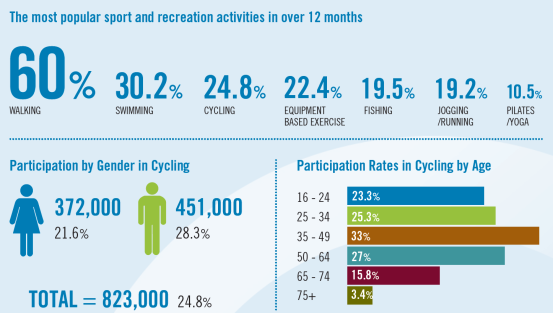
Source: Sport and Active Recreation in the Lives of Adult New Zealanders 2013/2014
In addition to these high participation rates domestically there are many international visitors who chose to include cycling and walking while on holiday in New Zealand. 73% of Holiday visitors to New Zealand participated in walking / hiking over the past three years – averaging 1.1 million visitors per year.
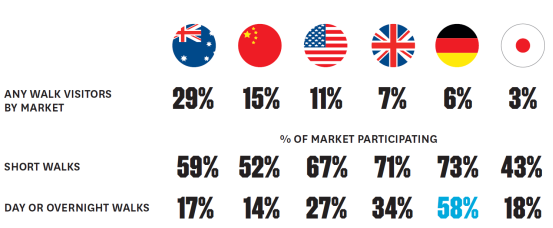
9% of holiday visitors participated in cycling during the past three years – an average of 138,000 visitors per year. Australia is the largest market for cycling experiences in New Zealand:
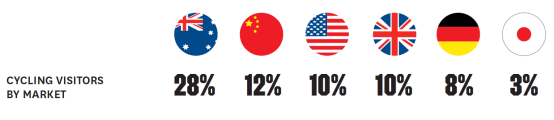
It is important to understand the various users of cycling and walking facilities and the underlying trends in each segment of the market:
|
Rider Types |
Current Trends |
|
Local recreational riders |
Growing |
|
Commuters |
? |
|
Families and couples wanting easy off-road trails |
Growing |
|
Active riders wanting multi day adventures |
Growing |
|
Avid mountain bikers |
Growing |
|
Bikepacker (ultra long distance riders) |
Growing quickly |
|
|
|
|
Walker Types |
|
|
Short walks |
Growing |
|
Day walks |
Growing |
|
Multi day walks |
Growing |
|
Epic walkers e.g. Te Araroa |
Growing |
Further research is required to better understand these trends and the opportunities for Northland to benefit from strong underlying growth in people walking and cycling in New Zealand and around the world. One key cycling trend to follow is the adoption rate of electric bikes that is drawing more people into cycling and mountain biking by effectively removing the need for hard uphill riding
Outcome 1: Development of comprehensive local and regional walking and cycling networks
1a) Development of a regional touring network
We see the following benefits tied to this outcome:
- Increase international and domestic tourism spend
- Extend time spent in the region by visitors by slowing their pace of travel
- Improve employment prospects in the region.
- Enhance Northland’s appeal as a cycling and walking destination
- Increase leverage from other initiatives in the region included in the Northland Economic Action Plan and the Provincial Growth Fund.
Current state of the regional cycling network
Northland is a region where tourism is of increasing importance. In 2016, tourism provided approximately 7000 jobs where $1,074 million was spent in the region including $794 million domestic spending and $280 million international spending[1]. At present, cycling is not a prime draw for visitors to the region however this is starting to change with the completion in 2017 of the regions only Great Ride, the Twin Coast Cycle Trail between Opua and Horeke, providing a safe largely off-road route that can be completed over several days of travel.
The region has a developing network of Heartland Rides. Heartland Rides function as back country cycle touring routes (mainly on-road) linking the Great Rides (mainly off-road trails), urban centres, transport hubs and other key tourist attractions. and, at present, there are three such rides in Northland:
- Missing Link Cycleway - the 118km Heartland Ride joins Dargaville, the end of the Kauri Coast Cycleway with Central Auckland. The Kaipara Missing Link heads southwest from Dargaville to the holiday village of Pouto Point at the mouth of the Kaipara Harbour. The missing link to this cycle tour involves a boat trip across the Kaipara Harbour. The trail then follows a surprisingly gentle route into the very centre of Auckland.
- Kauri Coast Cycleway – the 113km Heartland Ride links Rawene on the Hokianga Harbour, though to Dargaville. This route uses low volume roads, and passes through Kauri forest and secluded coastal settlements.
- Far North Cycleway – this 161 km runs from the north side of the Hokianga Harbour.along quite rural roads to Ahipara and then along 90-mile beach north to Cape Reinga.
Together these three routes link Pouto Point with Cape Reinga along the west coast of Northland and form the first 400km of the developing ‘Tour Aoteoaroa’ route from Cape Reinga to Bluff (3,000 km). Tour Aotearoa has grown to attract 600 riders in 2018 and is rapidly growing as a ‘bikepacking’ route attracting many overseas riders.
Northland’s existing heartland rides currently appeal to ‘strong and fearless’ and
‘enthused and confident’ cyclists who are comfortable travelling longer distances
on the State Highway network and/or gravelled roads relatively far from townships. The Twin Coast Cycle Trail on the other hand provides a higher level of service, suitable for all riders, with the route mostly off road or alongside road, closer to townships and services. Other areas of the region, particularly the east coast, popular with visitors, are poorly served by cycling routes.
The Northland Economic Action Plan includes amongst its projects, a plan to revitalise the Twin Coast Discovery Highway (in both the Transport / Logistics and Visitor Industry work streams). NZ Transport Agency (NZTA) and Northland Inc have partnered to develop a Programme Business Case (PBC) to collaboratively address this. The PBC considers the case for investment to address problems on the Twin Coast Discovery Highway (TCDH) to encourage visitors and locals to get off the beaten track to visit new places, try new experiences and stay longer in Northland.
NZ Transport Agency and Northland Inc are also working with local authority partners to develop a series of byways around the region that form a set of Northland Journeys. The thematic journeys function as offshoots of the main touring route and are road based journey’s primarily for vehicles although could be used by cyclists. Northland Journeys include:
- ‘Where Giants Gather’ – the journey from Whangarei Town Basin to the Whangarei Heads
- The ‘Ancient Kauri Trail’ – from Paparoa to Omapere
- ‘Into the Wide Blue Yonder – from Whangarei Falls to Tutukaka and on to Hikurangi.
- Te Ara (Coast to Coast) – connecting Waitangi with Omapere including Horeke and Rawene
- The Secret Coast (Old Russell Road) – from Whakapara on SH1 (Oakura turnoff) to Russell
- All About Islands – a set of water based journeys encouraging visitors to visit an island in the Bay of Islands.
Current state of the regional walking network
Northland is the northern starting point of the Te Araroa Trail which runs the entire length of the country from Cape Reinga to Bluff. In Northland. The trail in Northland includes use of beaches, paper roads, existing tramping tracks on public land and some crossing of private land. Some parts of the trail are quite challenging for casual walkers, although the trail is not intended for this purpose. Trail development has been driven by the Te Araroa Trust with financial assistance from funding partners such as DOC.
Northland presently does not have any nationally important ‘Great Walks’ but an application has been made to fund development of the Rakau-Mangamanga, Cape Brett Peninsula Bays Great Walk. The region also has several ‘Great Short Walks (30mins – 3hrs walking time) and a Great Day Walk (4-6hrs walking time). These were a new initiative announced by the Government in September 2017 and include:
· Mt Manaia (Great Short Walk)
· Mangawhai Cliff (Great Short Walk)
· Te Whara – Bream Head (Great Day Walk)
These walks are all on the conservation estate and managed by DOC. In addition, there are a number of other scenic walks managed by DOC of varying length and grades, as well as a series of short walks managed by district councils.
In addition to these Great Short and Day Walks there are some iconic local walks that provide visitors with access to stunning viewpoints and culturally significant locations e.g.
· Mt Parihaka in Whangarei
· Maunganui Bluff
· Waipoua Forest walks
· Te Paki Coastal Walkway
· Cape Brett Walkway
· Kerikeri Town Basin
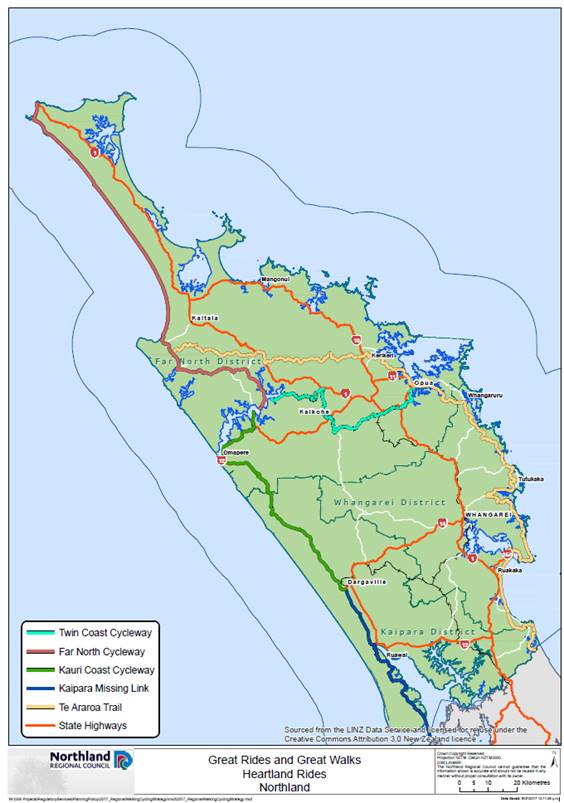
Map 1 – Existing Great Rides and Heartland Rides and the Te Araroa National Walking Trail in Northland
Opportunities to enhance the regional cycling network
Enhancing the Twin Coast Cycle Trail
Further development of the Twin Coast Cycle Trail from a visitor experience perspective is now possible given the physical trail has been completed. Exciting new itineraries that combine cycling with other attractions and other modes of transport will add to the appeal of this Great Ride and maximise the economic returns and social benefits for the communities along the route. New itineraries combining the Twin Coast Cycle Trail with cultural experiences such as marae meals and stays plus linkages to a variety of transport modes (e.g. train from Opua to Kawakawa or Long Bridge the ride to Horeke before boarding steam boat or ferry to Rawene and Kohukohu) or will make this journey even more interesting and enjoyable
It should also be noted that developing a second Great Ride in Northland, especially one that is graded easy and will appeal to a wider segment of the market, will provide potential for longer cycling itineraries and visitor stays even if these trails do not connect. Cycle tour companies across New Zealand offer a variety of ‘supported’ rides that enable visitors to ride the best sections of trails and have their luggage and often even themselves shuttled by van or bus resulting in more enjoyable and seamless experiences. Another Great Ride from Donnelly’s Crossing to Dargaville could extend Twin Coast Cycle Trail itineraries by one of two nights and expand the region’s easy ride offering to something like “The Great Rides of the North” encouraging visitors to experience both coasts as well as the ride between them.
Action 1. The New Zealand Cycle Trail Inc. and the Twin Coast Cycle Trail Trust / FNDC should plan for and support further experience and product development on the Twin Coast Cycle Trail so that appealing new itineraries are available in travel trade channels and featured by travel media to grow the appeal and economic value of the Twin Coast Cycle Trail.
Connecting Auckland to Northland via Whangarei
The existing network of Heartland Rides focusses on joining up sections of Northland’s west coast. With the development of the Auckland to Whangarei roading corridor (under the ‘Connecting Northland’ umbrella) incorporating the Puhoi-Wellsford Road of National Significance, the Port Marsden Highway Roundabout to Whangarei Expressway and future improvements to the route between Te Hana and the Port Marsden Highway Roundabout, an opportunity exists to better link the region with Auckland for walkers and cyclists as well as motor vehicles. Ideally provision will be made for walking and cycling in tandem with programmed roading improvements. Where this is not practicable, roading corridors need to ensure that land is set aside for future provision of walking and cycling routes.
The section between Port Marsden Highway Roundabout and Oakleigh is due to start construction during the 2018-2021 National Land Transport Programme period. Oakleigh to Whangarei is likely to begin construction during the 2022-2025 period. The Port Marsden Highway Roundabout to Te Hana section is likely to be completed over the next 20 years. At the same time Auckland Transport are working with community cycling groups in the former Rodney District to connect the Hibiscus Coast with Wellsford and ultimately Northland. The route is likely to be on lightly travelled roads hugging the east coast. This presents an opportunity to create a Heartland Ride spanning the length of Northland’s east coast from Auckland to Whangarei. To be viable, the connection to the Northland network will likely need to be at Mangawhai which could be an extension of a local initiative to develop an off-road cycleway between Waipu and Waipu Cove.
Action 2. WDC, KDC, Auckland Transport and the NZ Transport Agency should work together to ensure that walking and cycling considerations are incorporated into the planned roading improvements between Auckland and Whangarei.
Action 3: KDC, Auckland Transport and the NZ Transport Agency should work together to on a joint proposal to connect the developing Rodney section of the Auckland to Whangarei Heartland Ride with the Northland section at Mangawhai utlising off-road and lightly trafficked routes.
Connecting Whangarei to Bay of Islands via the East Coast
Cyclists wishing to cycle from Whangarei to the Bay of Islands (Opua, Paihia and Russell) currently have two choices – they can travel up SH1 or use the Old Russell Road. SH1, though more direct, carries a higher volume of traffic including heavy vehicles and therefore can present an intimidating option to cyclists. The Old Russell Road on the other hand is more lightly trafficked and provides scenic rest stop opportunities however currently provides little in the way of dedicated cycling infrastructure. Directly east of Whangarei is the Tutukaka Coast, part of the Twin Coast Discovery Route, but with no direct cycleway connection. Exploratory work, led by Whangarei District Council, is underway to connect Ngunguru to Whangarei with a formal cycleway connection. This could provide a logical entry point to a heartland ride running up the east coast from Whangarei to the Bay of Island’s.
Action 4. Whangarei District Council and Far North District Council should work together to develop a Heartland Ride proposal between Whangarei and Bay of Islands utilising off-road and lightly trafficked routes.
Enhancing existing connections from Auckland to Northland via Kaipara Harbour
The Kaipara Missing Link connects Helensville (and by extension Auckland) with Pouto Point where the route continues north to Dargaville via Pouto Road. This section could be enhanced by increasing the frequency and dependability (i.e. a fixed season) of ferry services across the harbour and improving wharf infrastructure at Pouto. An additional ferry service to Pahi, Ruawai or Matakohe from Helensville, bypassing the longer leg of the Missing Link Cycleway on the Pouto peninsular is also a possibility.
Action 5. Kaipara District Council and Auckland Transport should explore long term opportunities to expand chartered ferry links across the Kaipara Harbour to promote cycle based tourism as well as seeking ways to improve wharf infrastructure at Pouto Point.
North Kaipara Harbour Heartland Ride
There is currently no formal route connecting the west and east coasts of Northland to the south of the Twin Coast Cycle Trail. North of the Kaipara Harbour, recreational cyclists can use SH12, however as a state highway, the road is subject to relatively high traffic volumes including heavy vehicles. The development of a route from Dargaville to Mangawhai, could better connect townships and features in between, using off-road routes and low volume roads. The project could capitalise on sections where existing walking and cycling projects are gaining momentum (for example at the Matakohe Bridges realignment and use of Ruawai Stopbanks) to ensure connectivity.
Potential may also exist for some of this route to extend the proposed Great Ride from Donnelly’s Crossing to Dargaville further south e.g. to Ruawai, Matakohe or Paparoa which would add significantly to the scenic and cultural experience of the new Great Ride plus link with more town centres and attractions such as the Matakohe Kauri Museum and Tokatoka Peak.
Action 6: Kaipara District Council should investigate the feasibility of a Great Ride or Heartland Ride between Dargaville (or Matakohe / Paparoa should a Great Ride to these towns be deemed possible) and Mangawhai utilising off-road and lightly trafficked routes.
Utilisation of redundant rail corridors
Northland has a number of rail corridors that are no longer in use or are currently mothballed by Kikiwrail. Some of these are currently being utilised by cycleways – for example part of the Twin Coast Cycle Trail is on an old track bed. Additionally, the Kamo to Whangarei City Centre urban cycle route follows the operational rail corridor through the city. The changing rail landscape in Northland does present a number of opportunities:
- Making the Kauri Coast Cycleway off‑road and potentially even a Great Ride from Dargaville to Donnelly’s Crossing via the redundant rail corridor to help ensure this Heartland Ride is more user friendly and could cater to a broader visitor group.
- The possibility of connecting Dargaville to Whangarei via the currently disused rail corridor (a branch of the North Auckland line), connecting the west and east coasts further south than the Twin Coast Cycle Trail if and when the railway line becomes available. A decision on the decommissioning of the railway line is still to be decided. An on-rail cycling experience may also be an option on some sections of the railway track.
- Repurposing the mothballed North Auckland line north of Kauri for walking and cycling, providing a direct route from Whangarei to Kawakawa and the Twin Coast Cycle Trail. Again, this is dependent on any plans to decommission the line by Kiwirail.
Action 7: Kaipara District Council should progress the Dargaville to Donnelly’s Crossing rail corridor repurposing to an off-road cycleway and potentially also developing this route into a Great Ride extending further south to Matakohe or Paparoa, subject to the development of a viable business case.
Action 8: District Councils should liaise with Kiwirail, should rail corridors be decommissioned, for potential repurposing of redundant rail corridor for walking and cycling.
Developing off-road or low volume road alternatives to existing Heartland Rides
Northland as a relatively sparsely populated region has a number of coach roads and other back roads with low traffic volumes. These can provide alternatives to cyclists who would prefer not to use State Highways or more heavily trafficked local roads. As discussed, existing heartland rides in Northland appeal to the ‘strong and fearless’ cyclist. Using alternative routes such as coach roads will appeal however to other types of recreational cyclist such as young families or older riders. They also present an opportunity to showcase Northland’s landscape away from the State Highway network.
An immediate opportunity, worthy of further exploration exists with the Waoku Coach
Road to the east of the Waipoua Forest. This would provide a logical extension to the potential Dargaville to Donnelly Crossing off-road route as well as provide an alternative to using SH12 through the Waipoua Forest (the existing route of the Kauri Coast Cycleway).
Action 9: Kaipara District Council and Far North District Council should progress the development of the Waoku Coach Road as an alternative to using SH12, subject to the successful development of the Dargaville to Donnelly Crossing off-road cycleway.
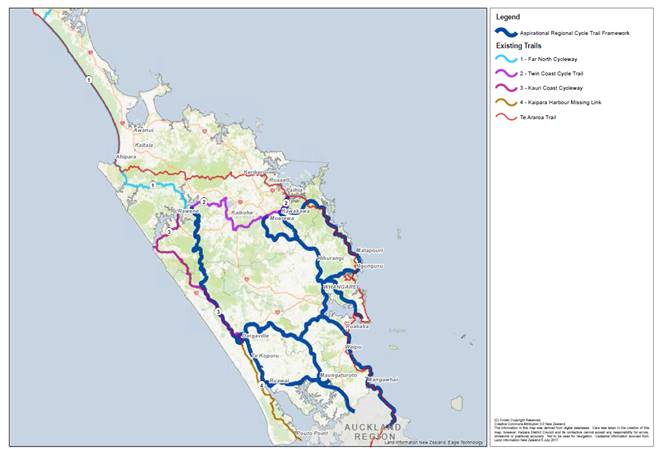
Map 2 – Aspirational network of Great Rides and Heartland Rides
Future opportunities to enhance the regional walking network
Enhance the Te Araroa Trail
The growing popularity of the trail and the fact that it crosses large parts of the region present an opportunity to improve the facilities on the route and overall visitor experience. Such improvement could include access to the trail itself, signage, parking and toilets. Dedicated funding streams such as the Provincial Growth Fund and the Tourism Infrastructure Fund provide opportunities for District Councils (and other agencies such as DOC and the trail trust) to apply for funding. The trail is of national significance and many people choose to start their journeys at Cape Reinga meaning Northland is the first impression that walkers get when using the trail.
Action 10 District Council, DOC and Northland Inc should work with the Te Araroa Trail Trust to support the development and enhancement of the national walking trail.
Investigate opportunities to develop new Great Walks
In 2017 DOC announced that they were accepting requests for new Great Walk proposals (with one being ringfenced to the North Island). Several trails are identified as having potential including the Te Paki Coastal Walkway at Cape Reinga, the Kauri Coastal Walk (Kai Iwi Lakes – Hokianga) and the Rakau-Mangamanga, Cape Brett Peninsula Trail. If either of these concepts progress, this will be a significant drawcard for tourists to the region, particularly given the proximity of these walks to Auckland compared to other Great Walks.
Action 11 District Councils and Northland Inc. should progress opportunities to develop new Great Walks (e.g. Te Paki Coastal Walk, Kauri Coast walk, Cape Brett Walk).
Promote/develop great walks and short walks in the region.
There are a number of walks in the region that may qualify for this branding. At present, the walks are limited to four tracks with none on the west coast (two are in Whangarei District, one in Kaipara and one in the Far North). There may be opportunities to expand the list to include a track on the west coast and this should be explored.
Action 12 District Councils and Northland Inc should work with DOC to promote/develop great day walks and short walks in the region.
1b) Development of local routes
We see the following benefits tied to this outcome:
- Improved safety
- Improved access to employment and educational opportunities
- Improved health, well being, social and the environment.
Current state of local district walking and cycling routes
Currently the off-road network of local walking and cycling routes in Northland is limited (with the exception of the Whangarei Urban area which is addressed separately). Communities for the most part use the local roading or state highway network when travelling by bike. Footpaths are also used however this is illegal under the NZ road code, unless designated as a shared path. Frequently, submitters to Councils cite a ‘hostile walking and cycling environment’ as a barrier. This includes having to share the road with fast moving traffic as well as complaints about the roads themselves being narrow and winding.
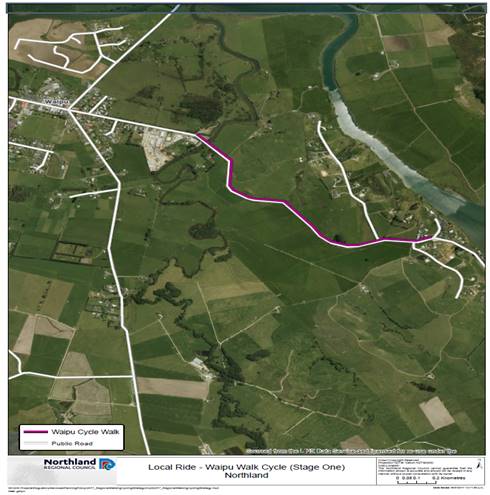
District Councils are increasingly being more proactive in helping communities to develop short local routes that connect rural areas with employment and recreational opportunities. Local community groups, with district council support, are establishing to advocate, and in some cases project manage, the development of walking and cycling routes. A good recent example is the Waipu to Waipu Cove walking and cycling track developed by the Waipu Cycling and Walkway Trust. The Waipu community fundraised for this project with donations of money, materials and volunteer hours from local business and residents as well as the gifting of private land.
Map 3: Stage 1 of the Waipu to Waipu Cove Walking and Cycling Route
Future opportunities for local district walking and cycling routes
District Councils can partner with local communities to help fundraise and develop off-road and enhanced on-road walking and cycling routes. There are significant opportunities to better connect communities, particularly those with growing populations in relatively close proximity. Examples of where access could be improved include:
- Waipu – Waipu Cove route,
- Whangarei to coastal townships such as Ngunguru, Tutukaka and the communities out at Whangarei Heads.
- Townships in the Far North (Kaikohe, Kaitaia, Taipa, Cable Bay, Coopers Beach and Mangonui).
- Marsden Point, One-Tree Point and Ruakaka area.
- Mangawhai to Mangawhai Heads.
- Kerikeri, Waipapa, Paihia, Opua, Russell (Inner Bay of Islands)
- a loop link between the Kauri Coast cycleway and Kai Iwi Lakes (Taharoa Domain);
Although off-road routes are usually the preferred solution, a package of measures including traffic calming, signage, speed restrictions and road markings can enhance the environment for on-road cycling particularly where there are constraints around off-road provision. In addition it is entirely possible, over the longer term, that these local routes may themselves become part of a wider regional network (Heartland Rides or Great Rides) as they form coherent connections.
Action 1.
District Councils should develop opportunities in partnership with local community groups to expand local walking and cycling networks. Assistance could be in the form of community grants as well as technical expertise with business case development, feasibility studies and design work.
Action 2
District Councils should consider dedicating more shared pathways for the use of pedestrians and cyclists where this is safe to do so.
Action 3
In partnership with local communities and special interest groups, develop local recreational walking and cycling tracks for the health, well being, and social development.
1c) Development of urban networks
We see the following benefits tied to this outcome:
- Reduce congestion in the urban area
- Improve health and environmental outcomes
- Increase the perceptions of safety for riders
Current state of Northland’s urban cycle network
The
only comprehensive urban network in Northland presently is in its biggest
centre, Whangarei. The Whangarei urban cycle network is currently being
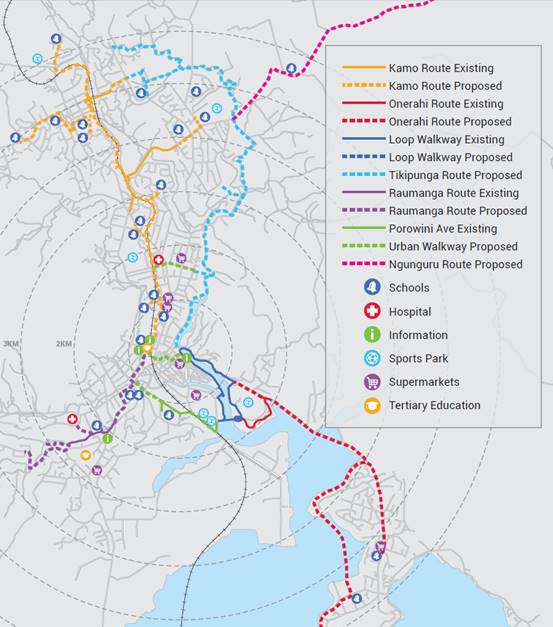
developed around five spokes: The three under development at present are
Whangarei city centre to Raumanga, Whangarei city centre to Onerahi and
Whangarei city centre to Kamo. Whangarei
District Council successfully received $2 million from the Urban Cycleways
Programme to develop the Kamo shared walking and cycling path (along with $2
million from the National Land Transport Fund). Further funding from the
National Land Transport Fund and the Urban Cycleway Programme has led to a
total funding injection of $13 million. The Onerahi to Whangarei city centre
spoke has nearly been completed with construction now underway on the Kamo to
Whangarei city centre route. A final portion of the Whangarei city centre to
Raumanga pathway is awaiting completion, subject to the completion of the
SH1/Tarewa Road intersection upgrade. Where
possible, shared paths are being developed using a high quality 3.5m wide
concrete base suitable for all-users.
Map 4: Whangarei Urban Cycleway Network
Future opportunities for Northland’s urban cycle network
In future funding rounds, the network will be expanded from the three main ‘spokes’ to include feeder routes to improve access to the network. These include spurs in Kamo and to Tikipunga as well as a longer route to Ngunguru and the Tutukaka Coast. The intention is that once the current spokes are complete, the network will span five high quality shared pathways. Other main centres in the region could benefit from similar development of high quality shared paths, replicating their success in Whangarei.
Action 1.
Whangarei District Council should consider future expansion of the Whangarei urban network beyond the completion of committed projects.
Action 2:
District councils should look at opportunities to expand walking and cycling opportunities in other main centres.
1d) Developing mountain biking.
We see the following benefits tied to this outcome:
- Increase tourism revenue from mountain biking
- Improve health outcomes
Current state of mountain biking
Northland has several designated mountain bike parks. These are:
- Glenbervie mountain bike park near Whangarei - 44 tracks and approximately 120km of track length in total. This park is on land owned by Rayonier Matariki Ltd and is managed by Whangarei Mountain Bike Club.
- Parihaka mountain bike park – 23 tracks and approximately 15km of tracks length in total. This park is on Whangarei District Council reserve land and is also managed by Whangarei Mountain Bike Club.
- Waitangi mountain bike park – currently 26 tracks (more are planned in 2017/18) and approximately 40km in track length. This park is on land owned by the Waitangi National Trust and is managed by Focus Paihia.
- A privately owned mountain bike park (Heads Up Adventures) has recent opened near Onerahi in Whangarei.
Mountain bike parks have the potential to be significant tourism earners. For example, Scion (2012)[2] estimated that the median annual recreational value of mountain bikers using the Whakarewarewa Forest in Roturua is $10.2 million (and $5.2 million from walking). The estimated recreational benefit from mountain biking is
almost five times the annual timber revenue from the forest based on indicative planted forest costs and revenues. Northland is not as well-known as a mountain biking destination but is growing in popularity, evidenced by growing ridership at Waitangi Mountain Bike Park which is reported every month. The added value from the economy comes from increased guest nights and visitor spend rather than revenue generated from the using the parks themselves (entry is free to Glenbervie and Parihaka although Waitangi encourages buying a voluntary wrist band priced at $25). In this way, the parks provide an additional activity complementing built and natural attractions and extending tourism into the shoulder seasons (around summer).
Future opportunities for mountain biking
The opening of the Waitangi Mountain Bike Park has the potential to draw more tourists to the Far North. The business case for the park suggests that its development will create 50 Full Time Equivalents (FTE) after 3 years and 168 FTE’s after 10-15 years and contribute $6.4million to the local economy over 3 years ($21 million over 10-15 years)[3] to the local economy. In the longer term, expansion at the park could see a visitor centre opened with café/toilet facilities. The park is also seeking silver star accreditation to hold competition level events which could be a big drawcard for the area.
Although Whangarei is well served by mountain bike tracks, hosting both Glenbervie and Parihaka mountain bike parks, facilities are limited (a toilet block is however to be installed at the base of Parihaka). Information and signage marketing the parks is also limited. In the future there are likely to be opportunities to improve facilities around these existing parks which will add to rider experience and generate greater awareness of the offer to the local community and to visitors.
Action 1: District Councils should consider supporting the development of mountain bike parks through community grant funding and technical support.
Action 2: In addition to promoting the Waitangi Mountain Bike Park and planning for continued track maintenance and development, potential may exist for developing beach riding experiences / tours using new mountain bike (fat tyre) technology.
Action 3: In addition, physical track development, product development will be required so that companies offer services spanning bike hire through to training camps and guided rides to make it easy for locals and visitors to enjoy the facilities more.
We see the following benefits tied to this outcome:
- Increase international and domestic tourism spend
- Extend time spent in the region by visitors by slowing their pace of travel
- Improve employment prospects in the region.
- Enhance Northland’s appeal as a cycling and walking destination
- Increase leverage from other initiatives in the region included in the Northland Economic Action Plan and the Provincial Growth Fund.
The relationship between this outcome and Outcome 1 – developing the trails themselves - is an important one as outlined by the diagram below:
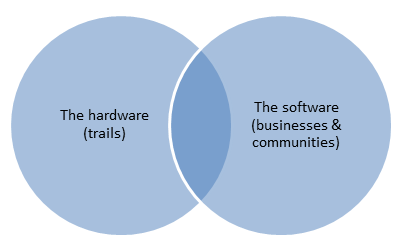
The ‘hardware’ space is filled by district councils as well as agencies such as the Department of Conservation who fund and build the infrastructure. The ‘software’ space is filled by business seeking to leverage the economic benefits of trail development. This might include large scale operators but also smaller community enterprises (for example Marae and homestay operators).
Northland has a dedicated regional tourism organisation (RTO), part of Northland Inc, a Northland Regional Council controlled organisation. This important role occupies the space in the middle and works as a bridge between council and community/business interests.
Recently, promotion by the RTO has focused on highlighting Northland’s walking and cycling trails including both district council managed trails and the Department of Conservation. The website portal highlights these as ‘Northland journeys’. The ‘journey’ aspect to promotion is important and aligns with the vision of this strategy. It is expected that going forward, there will be a strong emphasis on story-telling, promoting the unique ‘coastal’ dimension to Northland’s walking and cycling network.
What Northland presently lacks is unified walking and cycling branding. This includes everything from route signage to marketing material. Strong and unified branding will be important as regional walking and cycling routes develop. It is also a relatively inexpensive action to undertake compared to the investment in the trails themselves.
Northland has a number of advantages that allow walking and cycling to be expanded into the shoulder seasons (that is the period either side of summer). Although traditionally a summer beach destination, the weather in Northland rarely gets cold making it a viable destination for Aucklander’s (our biggest domestic market) who wish to tour earlier or later in the year. This will be an important message to convey in any promotion of the walking and cycling network.
Action 1: The RTO should work with trail developers, businesses and the community to develop unified branding and messaging.
Outcome 3: Increased participation in walking and cycling
We see the following benefits tied to this outcome:
- Improved health, social and environmental outcomes
- A modal shift for travel to work and education
Current state of walking and cycling uptake in Northland
The Northland Regional Land Transport Plan (2015-2021) describes the benefits of walking and cycling for the region:
· Not all people have cars – such as the young and elderly
· There are substantial health benefits
· They are the most environmentally friendly forms of travel
· Economic benefits – less wear and tear on roading.
· Public transport is not always available
· Walking is already a component of most trips.
· They are both popular activities for visitors.
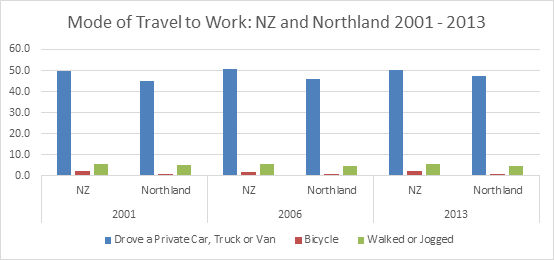
However, according to recent census data, in Northland the rates of walking and cycling versus other modes of transport are very low. A greater number of people choose to walk but, overall, the private car is much the favoured mode of transport to work. This is not dissimilar from NZ as a whole although, in Northland, the choice of cycling to work is lower than the national average. These trends have remained relatively constant over the period between 2001 -2013[4] with reliance on the private car actually increasing slightly in Northland.
Mode of transport to work – Northland (2001-2013)
More encouragingly, the 2013/14 Active NZ survey[5] (the most recent survey of its type) provides an insight into the level of participation in sports in Northland. In men, walking is the second most popular sport and recreational activity (36.4% or an estimated 19,600 people) and cycling the fifth (14.5% or an estimated 7,800 people). In women walking is the most popular (61.5% or 38,000 people) with cycling again fifth (12.6% or 8,000 people). Cycling ranked third as an activity that participants in the survey would most like to try (5.3%).
The barriers to greater uptake of walking and cycling can be summed up as follows (most of these factors are not unique to Northland and could apply also to other provincial areas):
1. Physical barriers – distance, topography and conditions, including lack of infrastructure (e.g. signage), inappropriate infrastructure (e.g. poor surfaces), unsafe infrastructure or infrastructure that does not connect the right origins and destinations.
2. Psychological barriers –anxiety about crime and fear of traffic (i.e. an individual’s common perception that it is not a safe method of travel).
3. Institutional barriers – inadequate initial and ongoing investment in infrastructure, external costs of not using private vehicles and historical neglect of pedestrian/cyclist interests in government administrations etc.
In practice, these factors overlap considerably. The lack of cycle network infrastructure in the region acts to create psychological barriers to travel in the region, particularly around fear of safety and crime. Cycling is an inherently more vulnerable form of travel, where not adequately separated from motor vehicles, with worse outcomes for riders from collisions. Historically there has been a lack of understanding on driver etiquette around cyclists. The ‘share the road’ scheme has introduced the 1.5m width for safe passing of cyclists on roads however this is not always adhered to and relies on enforcement and ongoing education.
Greater walking and cycling uptake in Northland could have significant benefits to health outcomes as the region generally fairs poorly across most indicators. For example, the region has a higher proportion of its population fall into the ‘most deprived’ category of the national index of deprivation compared with the NZ average. In 2016/17 38% were in Quintile 5 (most deprived) compared to a national average of 20% (nationally, equal proportions of the population live in each quintile). Greater deprivation can be a causal factor in worsening health outcomes including the development of comorbidities – i.e. a combination of factors leading to an early death (cancer, strokes, hypertension, heart failure, diabetes etc…)
In 2013/14, Northland had the third highest prevalence of obesity in New Zealand with 33.3% of adults obese. Northland has one of the lowest life expectancies, particularly for Maori males even when compared with national Maori population data. Northland also has one of the lowest self-ratings of good health at 87.9%. This measures a person’s perception of their health status considering physical and mental health factors[6].
Future opportunities to increase the uptake of walking and cycling in Northland
There are a number of way of encouraging behaviour change to increase walking and cycling in both every day activities such as travel to school and employment. One already discussed above is improvements to physical infrastructure such as dedicated, signed, off-road paths or on-road cycle lanes. Beyond this however there is the need to build-up the support network for walking and cycling infrastructure in the region. This includes secure storage facilities for bicycles (something which can be provided for by public funds) as well as cycle repair shops (something likely to be provided by the private sector.
Bikes in Schools is a programme led by the Bike on New Zealand Charitable Trust the purpose of which is to enable as many New Zealand children as possible to ride a bike on a regular and equal basis within the school. The package includes equipment, storage containers and tracks around the school grounds. A number of possible funding sources are suggested – local councils being one. NZ Transport Agency through the ‘National Cycle Education System’ has allocated $600,000, administered through Bike on New Zealand, who will work with local councils to identify schools to financially assist. A number of schools in Northland have benefited from the scheme.
The emerging development of electric bicycles (e-bikes) presents an opportunity to overcome some of the barriers to greater uptake of cycling, ie, distances and topography, primarily steep grades which would require a dismount for all but the fittest users. This also presents opportunities to encourage enterprising new businesses and deliver economic growth and employment opportunities. Elderly communities are seen as a major potential target audience.
Travel/journey planning is another way of encouraging walking and cycling through partnerships between district councils, district health boards, community groups and businesses. A dedicated resource in district councils would be useful to promote travel planning opportunities and would supplement work being undertaken to improve cycling infrastructure and promote school cycling.
Growing awareness of the walking and cycling routes in Northland will be required to grow participation levels within the local community and visitors to the region. An opportunity exists to promote the very best Northland has to offer so that these experiences provide a draw card for new walkers and cyclists to sample then engage in walking and cycling more often of for longer durations.
Action 1: District Councils should continue to partner with the NZ Transport Agency, local schools, the Ministry of Education and Bike on New Zealand to deliver bikes in schools.
Action 2: District Councils should consider a resource to promote walking and cycling for everyday activities – for example work and educational activities.
Action 3: District Councils and Northland Inc. should repeat or amplify in local media any positive international media stories that show how good Northland already is as a cycling and walking destination. Also investigate offering incentives for locals (perhaps supported by local businesses) to enjoy walking a riding in Northland outside the keas season.
Action 4. Consult with agencies promoting and supporting new business enterprise to promote e-bike operations
Outcome 4: Improving community wellbeing and economic opportunities for locals
We see the following benefits tied to this outcome:
- Improved employment and economic opportunity.
- Increased sense of community pride.
- Diversification of tourism opportunities
Although Northland has a number of attractions that receive high numbers of visitors including the Bay of Islands, Waipoua Forest and the Tutukaka Coast, like many popular tourist attractions, these areas are increasingly under pressure. However, there are many areas of Northland that do not see many tourists as they are simply seen as ‘off the beaten track’. This includes most of the west coast and some of the east coast (away from the popular Bay of Islands and Tutukaka coastline). Many of these areas are some of the more economically and socially deprived areas of Northland however they either lack specific attractions or the infrastructure to encourage people to visit. We feel that the development of walking and cycling routes could be a game changer for these areas and that the experience elsewhere can be replicated in Northland. This is borne out by regional and national evidence.
The development of the New Zealand Cycle Trail has had positive economic benefits in New Zealand to date. The Nga Haerenga – New Zealand Cycle Trail Evaluation Report (2014) estimated that visitors spent between $131 - $176 per person per day or between $173 - $743 per person per trip on the existing trails. 439 businesses included in the report attributed 5% of their turnover to trail business with 50 new full-time positions created. One in seven businesses also said that the capacity for their services had been expanded at some stage, approximately 1000 people have been employed on the development of the trails since construction began. More widely, $50 million of economic and social benefits have been realised with a positive cost: benefit ratio of 1:3.55. Anecdotally, the report found that the development of the trails fostered a sense of community pride. In the Northland context, it is likely that similarly positive feelings will be created as tangible pieces of infrastructure begin to take shape. In Northland, the Twin Coast Cycle Trail has attracted an estimated $400,150 in revenue from domestic tourists and $116,649 in revenue from international tourists (total visits 14,517). This was in 2015, prior to the full opening of the trail so the actual revenue and number of visitors may be higher now.
We expect walking and cycling trail development to be especially economically beneficial in Northland because the region typically has higher rates of unemployment than most other regions of New Zealand. As of March 2018, unemployment sits at 6.3% which is higher than the national average of 4.6%. This is actually a 10-year low with unemployment in the recent past being in the range of 8-9%. The development of trails is likely to provide tangible jobs for workers during the construction phase with some positions remaining long term for track maintenance. The construction of tracks is a transferable skill, the expertise of which can be exported to other regions of New Zealand.
This outcome is essentially tied to the actions implementing the other outcomes above.
Outcome 5: Increasing environmental sustainability
The main benefit tied to this outcome is that we spread visitors to other less visited parts of the region, reducing pressure on our natural assets. This is similar to what is sought Outcome 4 although seen through an environmental as opposed to economic lens.
A specific risk from high visitor numbers, particularly to the Waipoua Forest is the spread of Kauri Dieback. As of 2018, 450 sites across Northland, Auckland and Waikato have been identified as potentially affected with most in Northland. The disease is spread by people not cleaning footwear or moving off track treading onto Kauri roots. It can be a major threat to Kauri, a number of which are thousands of years old with Northland having the largest and widest Kauri trees in New Zealand. Creating new experiences, will help to spread the tourist load away from these vulnerable ecosystems. It will also provide alternatives to visitors, should tracks have to be closed to protect Kauri.
Also associated with this outcome are the wider benefits of walking and cycling in terms of reducing carbon emissions from transport and the local effects of using the road network.
Action 1: Trail development to be tied to education and infrastructure reducing the risk of transmitting pests.
Legislative and policy context
Government Policy Statement for National Land Transport Funding (GPS 2018)
The GPS sets the government priorities for central government land transport funding for a period of three years. The current GPS (2018) applies to the period 2018/19 – 2021/22. Relevant objectives and results identified for walking and cycling include:
|
Objective |
Long term (10+ year) results |
Short to medium term results (3-6+ years) |
|
A land transport system that provides appropriate transport choices.
|
Provide appropriate and accessible travel choices, particularly for people with limited access to a private vehicle. Increased safe cycling through improvement of cycle networks.
|
Dedicated cycle networks in main urban areas are expanded and completed.
Suburban routes for cyclists are improved.
Cycleway network connections, including to the New Zealand Cycle Trails are improved. |
|
A land transport system that increasingly mitigates the effects of land transport on the environment. |
Mitigation of adverse environmental effects including CO2 emissions. |
Regional and local system approaches that are evidence based are used to increasingly mitigate effects of land transport on the environment.
Significant harmful effects on people and the environment from road particulates and transport noise are reduced. |
The GPS provides a quantum of funding towards walking and cycling projects based on a range. In this funding period, the proposed funding range for walking and cycling projects (including capital expenditure and promotional activities) is between $16 - $65 million. The NZ Transport Agency has the responsibility of allocating funding through the National Land Transport Programme within this funding range. This funding can only allocated to walking and cycling projects if put forward by district councils through the Regional Land Transport Plan. A new draft GPS will be released by the Labour Government in 2018.
Regional Land Transport Plan (2015-2021)
The Regional Land Transport Plan is the region’s funding bid from that National Land Transport Fund for roading projects put forward by district councils and the NZ Transport Agency and the public transport programme put forward by the regional council. Councils can bid for a share of this funding based on the overall strategic fit of projects with funding criteria. Unless funding assistance is provided at 100% national funding, a local share for a project is usually necessary.
District Walking and Cycling Strategies
Though non-statutory documents, district councils may choose to develop walking and cycling strategies as a way of expressing a proposed walking and cycling programme. Currently all three district councils in the region have walking and cycling strategies which have either recently been reviewed or are in the process of being reviewed.
Dedicated Funding Streams
There are two specific national funding sources that can be accessed for walking and cycling projects separate to the National Land Transport Fund.
Urban Cycleway Programme
A $100 million fund to be spent between 2015/16 – 2017/18 on cycling infrastructure in main urban centres. Whangarei District Council received $3.49 million ($2 million from the Urban Cycleway fund) to develop the Kamo shared walking and cycling path in the city. Further funding may become available in future years.
National Cycleway Fund
The National Cycleway Fund supported the establishment of 19 Great Rides since 2009. Three existing trails were subsequently granted Great Ride status, taking the total to 22 Great Rides located throughout New Zealand. An additional $25 million over four years was announced at Budget 2016 for the next phase of the New Zealand Cycle Trail.
Other Funding Streams
Provincial Growth Fund
The Provincial Growth Fund, announced by the Labour Government, aims to lift productivity potential in the provinces. Its priorities are to enhance economic development opportunities, create sustainable jobs, enable Māori to reach their full potential, boost social inclusion and participation, build resilient communities, and help meet New Zealand’s climate change targets.
All provinces are eligible for funding, however, Tairāwhiti/East Coast, Hawke’s Bay, Tai Tokerau/Northland, Bay of Plenty, West Coast and Manawatū-Whanganui have been identified for early investment. The fund has three investment tiers:
1. Regional projects and capability: Support of economic development projects, feasibility studies and capability building identified by the regions.
2. Sector investment (including One Billion Trees programme): Investment in initiatives targeted at priority and/or high value economic opportunities.
3. Enabling infrastructure projects: Investment in regional infrastructure projects that will lift productivity and grow jobs.
Tourism Infrastructure Fund
Provides $25million per year for the development of tourism related infrastructure such as car parks, freedom camping facilities, sewerage, water works and transport projects. Although not specifically aimed at walking and cycling development, Councils can access the fund to develop complimentary facilities in areas subject to growth pressure from tourists.
Northland Regional Council Investment and Growth Reserve
Northland Regional Council maintains an Investment and Growth Reserve to enable it to make strategic investments that lift the long-term growth of the Northland economy. The reserve is funded by an annual input of $1.7 million from council’s investment income with additional transfers from the Community Investment Fund to both inflation-proof this annual input and to top-up the IGR if needed to support economic development opportunities that arise. The IGR used to provide operational funding to Northland Inc., fund business case assessments and invest in projects that meet the eligibility criteria.
Northland Economic Action Plan
The Northland Economic Action Plan contains 60 actions to coordinate economic development in Northland. The development of the action plan was overseen by a steering committee of district councils, the regional councils, iwi and government agencies. The logistics and transport infrastructure workstream includes several relevant projects to walking and cycling: This includes:
- Connecting Northland. A roading project that will connect Auckland to Whangarei in several stages. An opportunity exists to incorporate walking and cycling into the project.
- Twin Coast Discovery Route Upgrade – improving bridges, layovers and byway signage. Walking and cycling is likely to form part of the package of initiatives.
Appendix 1: Summary table of outcomes and actions
|
Outcomes |
Actions |
Agencies |
|
1a) Development of a regional touring network.
|
Cycle route development initiatives
1. Plan for and support further experience and product development on the existing Twin Coast Cycle Trail so that appealing new itineraries are available in travel trade channels and featured by travel media to grow the appeal of the Twin Coast Cycle Trail
2. Ensure that walking and cycling considerations are incorporated into the planned roading improvements between Auckland and Whangarei.
3. Develop a joint proposal to connect the developing Rodney section of the Auckland to Whangarei Heartland Ride with the Northland section at Mangawhai utlising off-road and lightly trafficked routes.
4. Develop a heartland ride proposal between Whangarei and Bay of Islands utilising off-road and lightly trafficked routes.
5. Support further development of the Rakau-Mangamanga (Cape Brett) Peninsula Bays cycle trail as part of the Northland Great Walk application
6. Investigate long term opportunities to expand ferry and water taxi services for walking and cycle based tourism across: - Kaipara Harbour including improvement of wharf infrastructure at Pouto Point. - Hokianga Harbour - Bay Of Islands
7. Investigate the feasibility of a heartland ride between Dargaville and Mangawhai utilising off-road and lightly trafficked routes.
8. Progress the Dargaville to Donnelly’s Crossing rail corridor repurposing to an off-road cycleway and potentially also developing this route into a Great Ride extending further south to Matakohe or Paparoa, subject to the development of a viable business case.
9. Investigate whether redundant rail corridors can be repurposed for walking and cycling.
10. Progress the development of the Waoku Coach Road as an alternative to using SH12, subject to the successful development of the Dargaville to Donnelly Crossing off-road cycleway.
Walking route development initiatives
11. Work with the Te Araroa Trail Trust to support the development and enhancement of the national walking trail.
12. Progress opportunities to develop new Great Walks (e.g. Te Paki Coastal Walk, Kauri Coast walk, Rakau-Mangamanga Cape Brett Peninsula trail).
13. Work with DOC to promote/develop great day walks and short walks in the region. |
FNDC
WDC, KDC, Auckland Transport and the NZ Transport Agency
KDC, Auckland Transport and the NZ Transport Agency
WDC, FNDC,
FNDC
KDC, WDC, FNDC private vessel charter operators and Auckland Transport.
KDC
KDC
District Councils, Kiwirail
KDC, FNDC,
District Councils, DOC, Northland Inc
District Councils (through cooperation with DOC), Northland Inc
District Councils (through cooperation with DOC), Northland Inc
|
|
1b) Development of local routes
|
1. Develop opportunities in partnership with local community groups to expand local walking and cycling networks. Assistance could be in the form of community grants as well as technical expertise with business case development, feasibility studies and design work.
2. Consider dedicating more shared pathways for the use of pedestrians and cyclists where this is safe to do so.
3. Develop local recreational walking and cycling tracks for health, well being, social and environmental benefit |
District Councils, community groups
District Councils
District Councils, community groups, special interest groups |
|
1c) Development of urban networks
|
1. Investigate future expansion opportunities in the Whangarei urban network beyond the completion of committed projects.
2. District councils should look at opportunities to expand walking and cycling opportunities in other main centres.
|
Whangarei District Council
District Councils |
|
1d) Developing mountain biking.
|
1. District Councils should consider supporting the development of mountain bike parks through community grant funding and technical support.
2. In addition to promoting the Waitangi Mountain Bike Park and planning for continued track maintenance and development potential may exist for developing beach riding experiences / tours using new mountain bike (fat tyre) technology.
|
Local mountain bike associations, district councils
FNDC, Focus Paihia |
|
2) Regionally consistent promotion of walking and cycling opportunities through strong branding and marketing helping to attract more visitors to the region.
|
1. The RTO should work with trail developers, businesses and the community to develop unified branding and messaging. |
Northland Inc, District Councils, DOC, Business, Community Groups. |
|
3) Increased participation in walking and cycling. |
1. District Councils should continue to partner with the NZ Transport Agency, local schools, the Ministry of Education and Bike on New Zealand to deliver bikes in schools.
2. District Councils should consider a resource to promote walking and cycling for everyday activities – for example work and educational activities.
3. District Councils and Northland Inc. should repeat or amplify in local media any positive international media stories that show how good Northland already is as a cycling and walking destination. Also investigate offering incentives for locals (perhaps supported by local businesses) to enjoy walking a riding in Northland outside the keas season.
4. Consult with agencies promoting and supporting new business enterprise to promote e-bike operations
|
District Councils, NZ Transport Agency, Ministry of Education, Bike on New Zealand. District Councils, Cycle shops and trail operators |
|
4) Improving community wellbeing and economic opportunities for locals.
|
No actions specifically tied to this – will be implemented through actions tied to other outcomes. |
n/a |
|
5) Increasing environmental sustainability. |
1. Trail development to be tied to education and infrastructure reducing the risk of transmitting pests.
|
District Councils, DOC, community groups. |
Appendix 2: Implementation Plan
To be included for final strategy.
6 June 2018
|
TITLE: |
New Zealand Transport Agency Quarterly Report to Regional Transport Committee |
|
ID: |
A1070928 |
|
From: |
Chris Powell, Transport Manager |
Executive summary
The New Zealand Transport Agency have provided a quarterly report to the Regional Transport Committee as per Attachment 1 which provides an update on the National Land Transport Programme, Northland Business Cases and Northland Projects.
1. That the report ‘New Zealand Transport Agency Quarterly Report to Regional Transport Committee’ by Chris Powell, Transport Manager and dated 29 May 2018, be received.
Background
Not applicable.
Attachment 1: New Zealand Transport
Agency Quarterly Report to Regional Transport Committee ⇩ 
Authorised by Group Manager
|
Name: |
Tony Phipps |
|
Title: |
Group Manager - Customer Services - Community Resilience |
|
Date: |
30 May 2018 |
Regional Transport Committee
6 June 2018
|
1. CONTENTS PAGE |
|
|
1. National Land Transport Programme |
2. 2 |
|
2. Northland Business Cases |
3. 3 |
|
3. Northland projects |
4. 4 |
1. National Land transport programme development update
· Feedback on both the draft Government Policy Statement (GPS) on land transport and draft Investment Assessment Framework (IAF) has closed.
· The final GPS will be adopted by Government before 30 June 2018. The IAF will be adapted where required to give effect to the final GPS and released as early as possible in July.
· We continue to process bids for the improvement work programmes. It’s important your business cases and assessments are developed to align with the new draft GPS and draft IAF.
· Regional Land Transport Plans are due to be submitted by 30 June 2018.
· The current 2015-18 NLTP has been extended to 31 August 2018.
· Councils will be kept up to date with changes or additional matters as they arise.
· A second GPS is expected to be released in 2019.
Draft Transport Agency Investment Proposal
· The draft Transport Agency Investment Proposal (TAIP) was released in April – it includes investment in the state highway network.
· The draft TAIP indicates what projects are likely to proceed based on the new investment criteria in the draft GPS.
· Where projects need to be re-evaluated, we’ll look at the whole transport corridor and consider what works could be undertaken to better manage safety and resilience outcomes.
· The TAIP will be finalised as part of the 2018-21 NLTP - this will be adopted by 31 August 2018.
· We expect a number of variations to RLTPs during the three-year period as we all work to deliver the Government’s new transport priorities.
· The introduction of the TAIP will require significant changes to the RLTP, which triggers Northland Regional Council’s significance policy. It is likely that a variation to the Northland RLTP will be sought by the Transport Agency in the near future.
Partnering with local government
· The Transport Agency has partnered with local government to deliver the 2018-21 NLTP.
· Two joint Transport Agency/LGNZ groups have been set-up to help identify and address possible barriers for councils to realise the opportunities in the draft GPS, in particular in the activity classes that support public transport, walking, cycling and regional improvements.
· We can assist with resources and capability, where required, to help with council-led business cases, procurement and delivery. Our investment advisers (Martin Taylor) and strategic planning leads (Denise Henigan) are available to help councils look at new co-investment opportunities.
· Steve Mutton has recently started as the Transport Agency Director of Regional Relationships, Upper North Island. Steve has more than 20 years’ experience working in critical infrastructure, including electricity, gas and roading networks, and has been with the Transport Agency since 2010.
· Visit http://www.lgnz.co.nz/equip/training/on-demand-webinars/nzta-investment-proposal/ to view the recent ‘NZTA Investment Proposal’ webinar to learn more about the draft TAIP, and the support and opportunities for local government.
Provincial Growth Fund (PGF)
· Through the Provincial Growth Fund, central government has committed to investing $1 billion per annum over three years in regional economic development. The PGF aims to enhance economic development opportunities, create sustainable jobs, contribute to community well-being, lift the productivity potential of regions, and help meet New Zealand’s climate change targets.
· By way of an update on the Waipapa Improvements project, the Transport Agency is currently finalising a Detailed Business Case, which will guide the scope and detailed design of this project. Once the Detailed Business Case has been completed, the Transport Agency will prepare a construction schedule.
· The Transport Agency is committed to keeping local stakeholders, including property owners, up to date on progress, and will make public announcements as soon as a construction schedule is confirmed.
2. northland Business Cases
· The new draft GPS on land transport sets out the Government’s new priorities for investment in the land transport system with a greater focus on safety, access, the environment and value for money. The draft GPS also indicates a shift in transport investment, with a reduction in funding available nationally for state highway improvements; increased funding for regional roading improvements, state highway maintenance and public transport; and new investment in rapid transit and rail.
· The Transport Agency has reviewed its proposed investment in state highways in line with these new priorities and national funding levels, with a focus on optimising the efficiency of the existing system where possible and managing the network where needed to address issues with safety, access to social and economic opportunities, and resilience.
Whangarei to Te Hana (SH1)
· The SH1 Whangarei to Te Hana project (which includes SH1 Whangarei to Port Marsden Highway and Port Marsden Highway to Te Hana) requires re-evaluation to better align with Government priorities. The Transport Agency will be looking at the whole transport system and considering what works could be undertaken, particularly to manage safety and resilience outcomes along that highway.
· Re-evaluation has commenced, and we will update with the estimated completion date for this re-evaluation.
Warkworth to Wellsford (SH1)
· Warkworth to Wellsford is identified as a proposed activity within the draft TAIP which means (if the draft TAIP is confirmed as currently presented) it will continue to be developed to complete the current business case and consulting phase, subject to its new alignment with the GPS priorities.
· The draft TAIP proposes to complete the work necessary for designations to be put in place for the new road alignment. This will protect the proposed route for when it is required.
· A date will be confirmed in due course for lodgement of Notice of Requirement and resource consents.
3. northland projects
Loop Road Safety Improvements (SH1)
· The Transport Agency proposes to install a single lane roundabout at SH1/Loop Road (North) to improve safety and to provide more reliable travel times.
· Improvements to the Portland Road intersection will include a widened flush median to support safe right turns and a realigned intersection to improve driver sight visibility for Portland Road traffic accessing the state highway. To improve safety at the intersection of SH1 and Portland Road, the Transport Agency is also proposing to close access to Loop Road (South).
· Lodgement of a Notice of Requirement and resource consents for the SH1 Loop Road Safety Improvements is planned for mid-year.
· Subject to gaining all necessary approvals, property and funding, construction could commence in early 2019 and will take approximately two years to complete.
Toetoe to Oakleigh (SH1) Safety Improvements
· The Transport Agency is installing a 600mm wide centreline between SH1 Toetoe Road and Oakleigh to improve safety on this corridor, primarily to reduce cross-centreline crashes.
· The centreline will be delineated with yellow no passing lines, will have ATP (rumble strips) on the yellow lines; will have raised reflective pavement parkers (cats eyes) and will have cylindrical ‘safe hit posts’ every 20m. Safe hit posts will be missed out where vehicles need to turn into access ways.
· The centreline treatment aims to reduce the likelihood of head-on crashes; prohibit ‘cross centreline’ overtaking; and reduce vehicle speed by having narrower (reduced in width by 300mm) lanes.
Dome Valley Safety Improvements (Safe Roads)
· These safety improvements through Dome Valley will make this section of State highway 1 safer for all road users.
· This stretch of road is winding with poor visibility and steep slopes. Improvements will include the addition of new right turn bays, and wider road shoulders wider so it’s safer to pull over and allow room for cyclists. There will also be the installation of flexible median safety barriers and a wide centreline to prevent head on crashes, as well as the replacement of northbound and southbound passing lanes at the top of the Dome Valley with a wide shoulder so slower vehicles have room to pull over.
· Tender is being put out in late May.
· Expected to be awarded in early August.
· Construction planned to begin late 2018/early 2019
Safe Roads – Boost Programme
· Safety improvements taking place now - including rumble strips, signage and safety barriers to SH1N Cape Reinga to Awanui, SH North Mangamuka Gorge to Rahiri, SH12 Kaikohe to Dargaville, SH14 Whangarei to Dargaville, SH12 Tokatoka to Brynderwyn, SH15 SH1N to Port.
· Rural Intersection Speed Limit Signs are being considered for SH1/Mangapai Road and SH1/Shoemaker Rd. Consultation has been undertaken and now seeking approval for this.
SH1/Tarewa Road Intersection Improvements
· A draft project update has been prepared and is planned for release next month, with a sod turning/blessing event planned for July.
· The Transport Agency will be onsite mid-August, and construction is planned to commence mid-September.
Taipa Bridge
· On the east side of Taipa River, piling of temporary staging from which the new two lane bridge will be constructed is underway.
· The first abutment piles have been poured, site access has been established, the platform is being built up and estuarine mud is now being removed.
· Potholing and topsoil striping on the township side of the river were carried out under the supervision of the project archaeologist, no confirmed finds.
Matakohe Bridges
· The Matakohe Bridges realignment project has benefited from the more predictable and typical autumn weather with good progress being made.
· Limestone continues to be cut from the local Matakohe quarry and used as subgrade for the realignment of SH12.
· Additional sediment ponds have been installed to control all water runoff, all controls are regularly audited by Northland Regional Council.
· Bridge No.1 (Parerau Stream) piling works are underway now the limestone western embankment is complete to underside of pavement.
· Bridge No.2 (Matakohe River) temporary staging installation has commenced and will continue over the coming weeks. Once in place, piling will commence.
· Earthworks either side of Matakohe River are progressing with the western side abutment/causeway having been built up 11m of the 15m finished height.
Kaeo Bridge
· The scheme is being refined following feedback from Iwi and technical assessments. An updated scheme design will be made available once it has been through internal reviews.
SH1 Akerama Realignment and Improvements
· Final surface will be laid in October, with a completion event planned for October or November.
SH1 Brynderwyn Hill
· With the main project now complete, the Transport Agency is now looking at a proposal to build a tourist lookout and incorporate a number of pou.
Network – Enhanced Resilience and Low Cost / Low Risk projects
Maintenance and Ops Spend
· For 2018/19 the Transport Agency has invested $26M in Northland on maintenance, operations and renewals. This has been the largest regional programme for this year, and one of the largest programmes Northland has seen in recent times.
SH11 Lemons Hill
· The Transport Agency is now down to the final 2,000 cubic metres of the slip to be removed. This is great progress by the team despite the challenges of weather and the complexity of this slip, and acknowledging the request from communities to provide relief by opening the highway to one lane as work continued.
· Whilst work has continued to allow for one lane access, it does impact the ability to completely remove the slip and make it safe again. The team is working towards a full opening (weather permitting) by mid-June once this slip work is completed. They will then move into completing kerb, channel, safety barrier and pavement works which cannot be repaired until all the slip material is removed.
Opononi Foreshore Resilience
· Information is being gathered to confirm the worst affected areas of the Opononi coastline. A concept will be developed with enhanced resilience works expected to commence later this year.
SH1/SH11 (Kawakawa) Intersection Improvements
· A detailed design is being developed.
SH1 Callaghans Slip
· Geotech investigation of the three slips in this area is underway and is planned to be completed by the end of June 2018.
· The next step will be to develop a remedial design.
SH12 Resilience
· The road level has been lifted at Rotu and Dakas Culverts.
· Raising the road level at Marcell’s Culvert is about to start.
SH15 Multiple Slip Sites – emergency works
· Three more slips have developed since the last weather event. Construction repair work is underway and the initial project is planned for completion in July 2018.
6 June 2018
|
TITLE: |
New Zealand Transport Agency Regional Transport Committee Representative |
|
ID: |
A1070887 |
|
From: |
Chris Powell, Transport Manager |
Executive summary
The purpose of this report is to introduce the formally nominated representative for the New Zealand Transport Agency on the Regional Transport Committee
1. That the report ‘New Zealand Transport Agency Regional Transport Committee Representative’ by Chris Powell, Transport Manager and dated 29 May 2018, be received.
2. That the formally nominated New Zealand Transport Agency Regional Transport Committee Representative Steve Mutton, Director, Regional Relationship – Upper North Island, be duly noted.
Background
Following the resignation of the New Zealand Transport Agency (NZTA) representative, Ernst Zollner in July 2017, Peter Clark was nominated as the NZTA Interim Representative on the Regional Transport Committee (RTC) pending the appointment of a permanent representative.
In a letter dated 25 May 2018, NZTA Chief Executive, Fergus Gammie confirmed the appointment of Steve Mutton, Director, Regional Relationship – Upper North Island as the NZTA Permanent Representative on the RTC with the Alternative Representative remaining as Jacqui Hori-Hoult.
See Attachment 1 for a copy of the abovementioned letter.
Attachment 1: Letter from New Zealand
Transport Agency CEO Fergus Gammie confirming representatives for Regional
Transport Committee ⇩ 
Authorised by Group Manager
|
Name: |
Tony Phipps |
|
Title: |
Group Manager - Customer Services - Community Resilience |
|
Date: |
30 May 2018 |
Regional Transport Committee item: 5.3
6 June 2018
|
TITLE: |
Northland Road Safety Action Plan Update |
|
ID: |
A1071509 |
|
From: |
Ian Crayton-Brown, Transport Projects Officer NTA and Trish Rudolph, Regional Road Safety Advisor NZTA |
Executive summary

1. That the report ‘Northland Road Safety Action Plan Update’ by Ian Crayton-Brown, Transport Projects Officer NTA and Trish Rudolph, Regional Road Safety Advisor NZTA and dated 30 May 2018, be received.
Background
Road safety progress reports are provided at each Regional Transport Committee meeting. These shared reports; along with input from the Northland Road Policing Manager, provides an overview of the progress made on both the strategic and programme outcomes for the Northland region.
Presentation:
Snr Sgt Ian Row of Northland Police will present on behalf of Northland Road Policing Manager Inspector Wayne EWERS covering recent Police road safety campaigns across Northland.
RIDS - Key focus areas – Restraints – Impairment – Distractions - Speed
This road safety update gives a rolling outline of the fatal crashes and issues for 2018 on Northlands roads.
National Road Toll for Year to Date 2018:
National Statistics – Network Performance:
This calendar year there have been 164 deaths nationally on the roads and 154 deaths at the same time in 2017.
There have been 22 weekends so far this year which has seen 73 deaths from 63 crashes. The average number of weekend deaths for the last 12 months has been 3.3 deaths.
Northland Road Toll for 2018 – Calendar Year:
Regional Statistics – Network Performance
So far, this calendar year there have been 20 deaths on Northlands roads. When comparing the same period for 2017, there were 15 deaths. This year 13 of those deaths have occurred on State Highways and 7 of those deaths on local roads.
The statistics relating to these deaths is as follows –
o 11 car or van drivers;
o 7 car or van passengers;
o 2 motorcyclists;
o 0 pedestrians;
WHAT’S ON THE RADAR
Road Safety Workshop
Planning for the road safety workshop with the Regional Transport Committee has started with NZTA and road safety partners. A suitable date has not been confirmed yet but some important announcements by the Government are expected in June so it is anticipated that a late June early July date might be appropriate for this facilitated Workshop.
Road Safety Action Planning
We have the draft Northland Road Safety Issues 2013 to 2017 Crash Data report from WSP Opus which is currently being reviewed & amended before release – some snapshots are –
o There are 3 x as many bend loss of control/head on crashes than the next highest crash movement
o 31% of injury crashes results in a fatality or serious injury
o The number of fatal & serious crashes where a restraint was not worn increased by 150% between 2013 & 2017
o Over 70% of injury crashes with ‘too fast’ identified as a factor are bend loss of control/head on crashes
o Alcohol/drugs suspected as a factor in injury crashes is generally trending upwards across Northland
Authorised by Group Manager
|
Name: |
Tony Phipps |
|
Title: |
Group Manager - Customer Services - Community Resilience |
|
Date: |
30 May 2018 |
Regional Transport Committee item: 6.1
6 June 2018
|
TITLE: |
Confirmation of Minutes - Regional Transport Committee Meeting 4 April 2018 |
|
ID: |
A1070967 |
|
From: |
Tegan Capp, Executive Assistant Customer Services - Community Resilience |
Recommendation
1. That the minutes of the Regional Transport Committee meeting held on 4 April 2018 be confirmed as a true and correct record.
Background
Councils are required to keep minutes of proceedings in accordance with the Local Government Act 2002.
Attachment 1: Unconfirmed Minutes
Regional Transport Committee Meeting 4 April 2018 ⇩ 
Authorised by Group Manager
|
Name: |
Tony Phipps |
|
Title: |
Group Manager - Customer Services - Community Resilience |
|
Date: |
30 May 2018 |
Regional Transport Committee ITEM: 6.1
6 June 2018 Attachment 1
REGIONAL TRANSPORT COMMITTEE
Minutes of the Regional Transport Committee meeting held in the Council Chamber,
36 Water Street, Whangārei, on Wednesday 4 April 2018
commencing at 10.00am
Present: Northland Regional Council
Cr J Bain, Chairman
Cr P Dimery
Kaipara District Council
Cr J Geange
Far North District Council
Cr A Court
Whangarei
District Council
Cr
G Martin
New Zealand Transport Agency
P Clarke
J Houri-Holt
In Attendance: NRC Chairman B Shepherd (arrived 10.32am)
NRC Group Manager Customer Service & Community Resilience – T Phipps
NRC Minute Taker – T Capp
NTA NRC Transport Manager – C Powell
NTA NRC Transport Projects Officer – I
Crayton-Brown
FNDC
Group Manager Infrastructure and Assets – A Finch
KDC General Manager Infrastructure – C Martin
WDC
Roading Manager –
J Devine
NTA Manager – P Thomson
NZ Police – Senior Sergeant Ian Row
13 others were in attendance
The Chairman declared the meeting open at 10:01am.
Apologies (Item 1.0)
There were no apologies to be received.
Declaration of Conflicts of Interest (Item 2.0)
The Chairman invited members to make declarations item-by-item as the meeting progressed. There were no declarations of conflict.
Draft Government Policy Statement 2018/19- 2027/28 (Item 3.1)
ID: A1048949
Secretarial Note:
· The presentation ‘Draft Government Policy Statement 2018/19 – 2027/28’ did not proceed as there were no representatives from the Ministry of Transport present at the meeting.
· The Chairman advised those present that the Draft Government Policy Statement had been released the evening prior to the meeting and that the Committee intend to meet with the Ministry of Transport to discuss its contents.
Confirmation of Minutes- 7 February 2018 (Item 4.1)
ID: A1046844
Moved (Geange/Dimery)
1. That the minutes of the Regional Transport Committee meeting held on 7 February 2018 be confirmed as a true and correct record.
Carried
Northland Regional Land Transport Plan 2015-2021– Funding Uptake (Item 5.1)
ID: A1047713
Report from Chris Powell, Transport Manager, Northland Transportation Alliance
Moved (Bain/Geange)
1. That the report ‘Northland Regional Land Transport Plan 2015-2021 – Funding Uptake’ by Chris Powell, Transport Manager, Northland Transportation Alliance, dated 21 March 2018, be received.
Carried
Secretarial Note:
· The point was raised that these tables are difficult to read and the Committee requested that the format be changed so that they are more easily legible.
Regional Land Transport Plan 2015-2021 Three Year Review- Minutes of Deliberation Meeting 26 February 2018 (Item 6.1)
ID: A1049207
Report from Tegan Capp, Meeting Secretary, Northland Regional Council
Moved (Bain/Geange)
1. That the minutes of the Regional Land Transport Plan 2015-2021 Three Year Review- Deliberation Meeting held on 26 February 2018, be confirmed as a true and correct record.
Carried
Secretarial Note:
· Councillor Court recorded her vote against this recommendation.
· Clarification was provided that at the Deliberations Meeting on 26 February 2018, Councillor Court raised the issue of priority ranking 1, 2 and 3 and this was discussed fully, resulting in the Opononi Project being moved from a ranking of 5 to a ranking of 3.
· It is to be noted that the priorities in the plan remain the same and that the priority ranking system is separate to this.
Draft Regional Land Transport Plan 2015-2021 – Three Year Review – Progress Report (Item 6.2)
ID: A1047723
Report from Chris Powell, Transport Manager Northland Transportation Alliance
Moved (Martin/Bain)
1. That the report ‘Northland Regional Land Transport Plan 2015/2021 – Three Year Review - Progress Report by Chris Powell Transport Manager and Jon Trewin Policy Analyst dated 21 March 2018, be received.
2. That the Regional Transport Committee approve the submission of the Northland Regional Land Transport Plan 2015–2021 Three Year Review to the Northland Regional Council with a recommendation that the Northland Regional Land Transport Plan 2015–2021 Three Year Review be approved and be forwarded on to the NZ Transport Agency.
3. That the Regional Transport Committee delegate the authority to the Chair of the Regional Transport Committee to approve the finalised layout and formatting of the Northland Regional Land Transport Plan 2015–2021 Three Year Review prior to it being tabled at the full Northland Regional Council meeting on 24 April 2018.
4. That the Regional Transport Committee approve the recommended method of reply to each submitter and referral of matters to the relevant road controlling authority (or other relevant authority) with the exception of the matters listed in points 5 and 6 below.
5. That the Regional Transport Committee confirm they wish to:
a. advocate for the Gateway to the North Route for the Brynderwyn’s section of the Te Hana – Whangarei improvements as proposed by the Brooks Area Community Group/ Brynderwyns Hills SH1 Alliance.
b. advocate for Central Government to proceed to the next state of the Port Marsden – Te Hana, Brynderwyns Hill section (i.e. consenting, designation and design).
It was moved that the additional recommendation be included as follows by Moved (Court/Dimery)
c. advocate
for projects that sit in the ‘other category’ to be considered
because they are of significance from a safety and resilience perspective.
Carried
It was moved that the additional recommendation be included as follows by Moved (Geange/Court)
d. advocate
for a review of the FAR rate for the Kaipara District.
Carried
It was moved that the additional recommendation be included as follows by Moved (Court/Geange)
6. That the Regional Transport Committee determine whether they wish to advocate for Central Government to review the role of rail and plan for the link through Auckland.
7. That
the Regional Transport Committee change the ranking of projects currently
ranked 6 and 7 to a ranking of 5.
Carried
It was moved that the additional recommendation be included as follows by Moved (Geange/Court)
8. The
Dust from Unsealed Roads information contained in the item tabled at the
meeting by Kaipara District Council is to be included in the Draft Regional
Land Transport Plan 2015-2021 (Review for 2018-2021) under Regional Priority 6
on page 45 of the draft.
Carried
Carried
Secretarial Note:
· The Regional Transport Committee note that the Government has only just released the Draft Government Policy Statement on Transport and would need to consider their response.
· The Committee would like to formally acknowledge and thank the staff from Northland Regional Council and the Northland Transportation Alliance for the work they have done on this review.
· The New Zealand Transport Agency advised they are revising their Draft Investment Framework to give effect to the release of the new Draft Government Policy Statement.
Northland Road Safety Action Plan Update (Item 7.1)
ID: A1048970
Report from Ian Crayton-Brown, Transport Projects Officer NTA and Trish Rudolph, Regional Road Safety Advisor, NZTA
Moved (Bain/Geange)
1. That the report ‘Northland Road Safety Action Plan Update’ by Ian Crayton-Brown, NTA Transport Projects Officer & Trish Rudolph, NZTA Regional Road Safety Advisor and dated 26 March 2018, be received.
Carried
Secretarial Note:
· The Committee The Committee was invited to attend a Road Safety Workshop jointly facilitated by NTA, NZTA & Police on road safety issues and best practice.
Northland Transportation Alliance Update (Item 7.2)
ID: A1049146
Report from Peter Thomson, Manager, Northland Transportation Alliance
Moved (Martin/Dimery)
1. That the report ‘Northland Transportation Alliance Quarterly Report’ by Peter Thomson, Northland Transportation Alliance Manager and dated 15 March 2018, be received.
Carried
CONCLUSION
The meeting concluded at 11.45am.
[1] Source: Infometrics, Regional Tourist Organisations (Year ending - March 2017)
[2] Non-timber values from Planted Forest: Recreation in Whakarewarewa Forest, Turner et al (2011), NZ Journal of Forestry.
[3] Business Case for Waitangi Mountain Bike Park, Focus Paihia
[4][4] Data taken from Statistics NZ census data
[5] Active NZ Survey (Sport NZ) 2013/14
[6] Data from Northland District Health Board