|
Huihuinga O Te Kāhui Māori O Taitokerau Thursday 11 July 2019 at 11am
|
|
|
|
|
|
Huihuinga O Te Kāhui Māori O Taitokerau Thursday 11 July 2019 at 11am
|
|
|
|
|
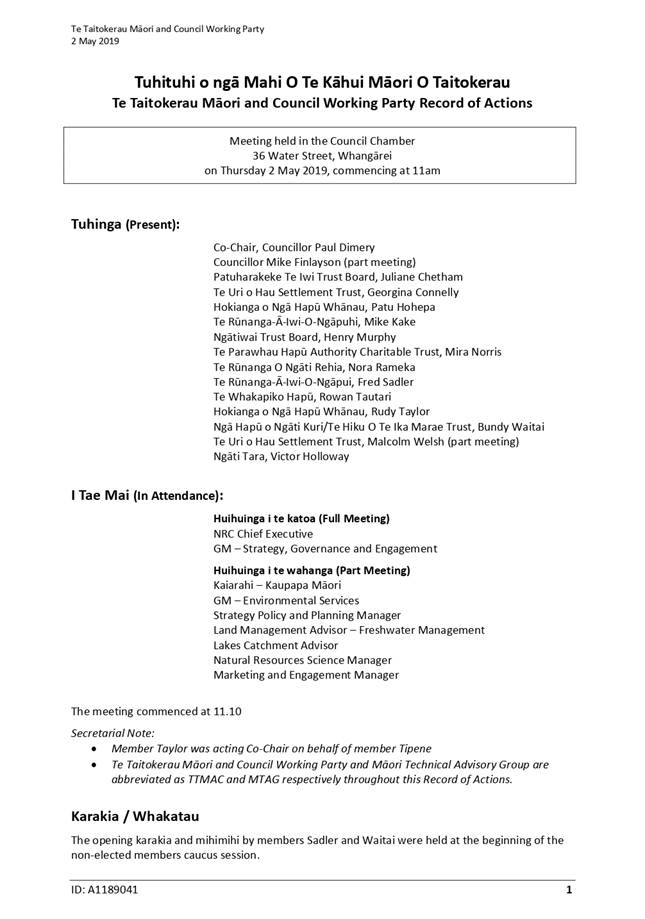
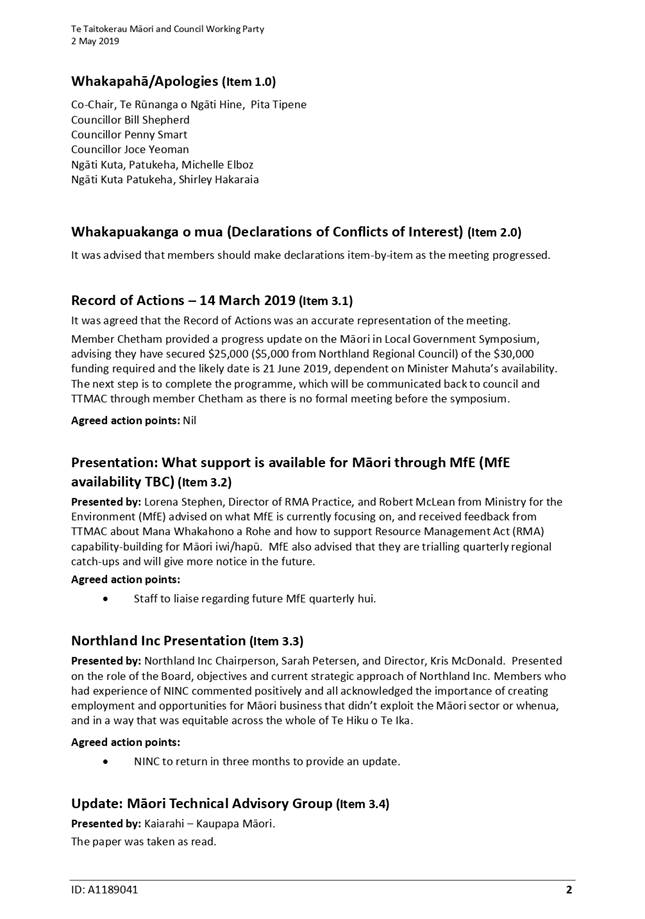
Te Taitokerau Māori and Council Working Party
11 July 2019
Rārangi Take O Te Kāhui Māori O Taitokerau
(Te Taitokerau Māori and Council Working Party Agenda)
Meeting to be held in the Council Chamber
36 Water Street, Whangārei
on Thursday 11 July 2019, commencing at 11am
Please note: working parties and working groups carry NO formal decision-making delegations from council. The purpose of the working party/group is to carry out preparatory work and discussions prior to taking matters to the full council for formal consideration and decision-making. Working party/group meetings are open to the public to attend (unless there are specific grounds under LGOIMA for the public to be excluded).
NGĀ MANA WHAKAHAERE
(MEMBERSHIP OF THE Te Taitokerau Māori and Council Working Party)
Co-Chair, Te Rūnanga o Ngāti Hine, Pita Tipene
Co-Chair, Councillor Paul Dimery
|
Councillor Mike Finlayson |
Councillor Bill Shepherd |
Councillor Penny Smart |
|
Councillor Joce Yeoman |
Patuharakeke Te Iwi Trust Board, Juliane Chetham |
Te Uri o Hau Settlement Trust, Georgina Connelly |
|
Ngāti Kuta, Patukeha, Michelle Elboz |
Ngāti Kuta Patukeha, Shirley Hakaraia |
Hokianga o Ngā Hapū Whānau, Patu Hohepa |
|
Te Rūnanga-Ā-Iwi-O-Ngāpuhi, Mike Kake |
Ngātiwai Trust Board, Henry Murphy |
Te Parawhau Hapū Authority Charitable Trust, Mira Norris |
|
Te Rūnanga O Ngāti Rehia, Nora Rameka |
Te Rūnanga-Ā-Iwi-O-Ngāpui, Fred Sadler |
Te Whakapiko Hapū, Rowan Tautari |
|
Hokianga o Ngā Hapū Whānau, Rudy Taylor |
Ngā Hapū o Ngāti Kuri/Te Hiku O Te Ika Marae Trust, Bundy Waitai |
Te Uri o Hau Settlement Trust, Malcolm Welsh |
|
Ngāti Tara, Victor Holloway |
Te Rūnanga O Ngāti Hine Jaycee Tipene-Thomas |
Te Rūnanga O Ngāti Rehia, Kipa Munro |
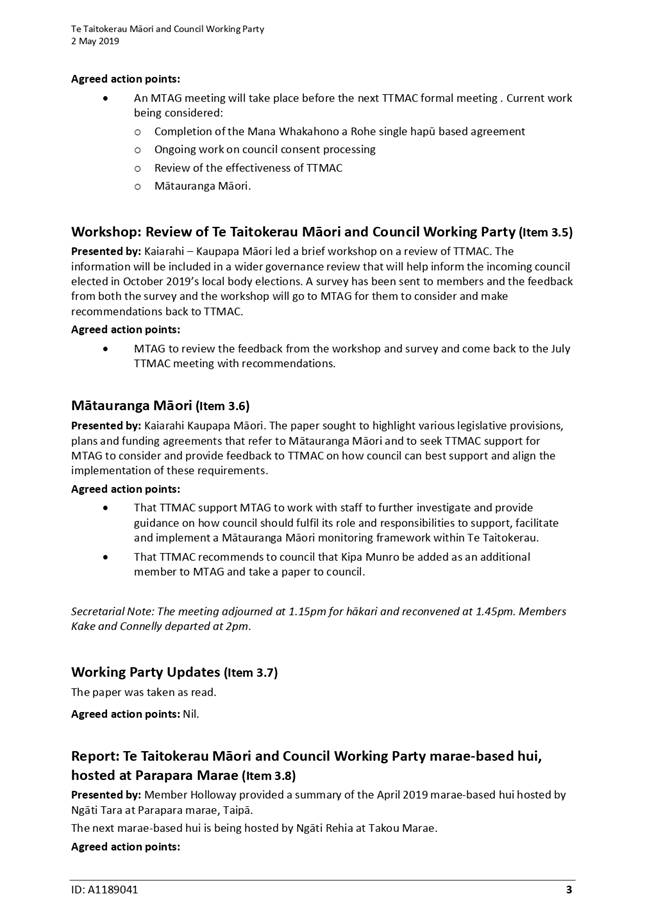
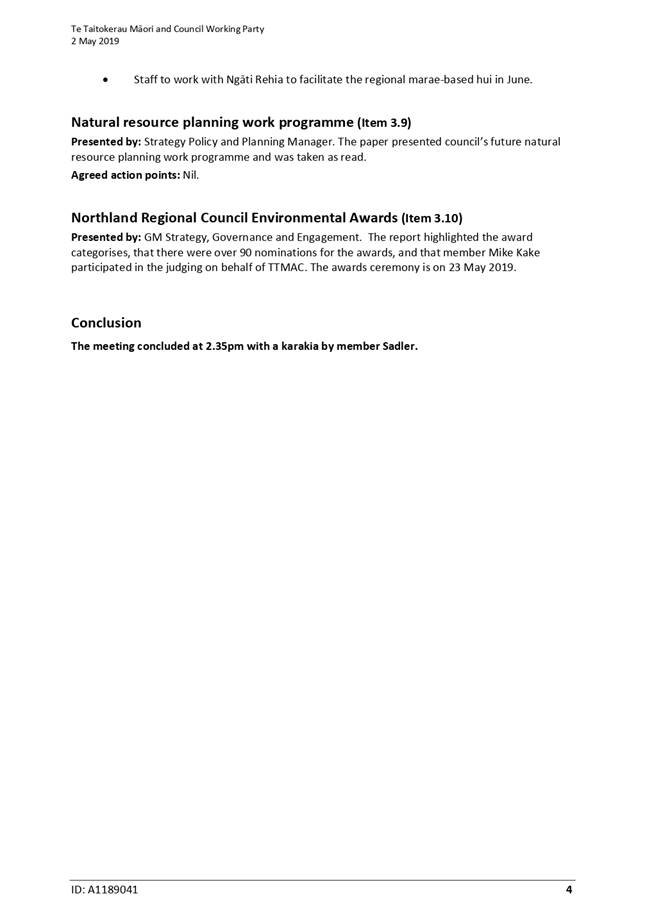
KARAKIA / WHAKATAU
RĪMITI (ITEM) Page
1.0 WHAKAPAHĀ (apologies)
2.0 WHAKAPUAKANGA O MUA (declarations of interest)
3.1 Record of Actions – 2 May 2019 3
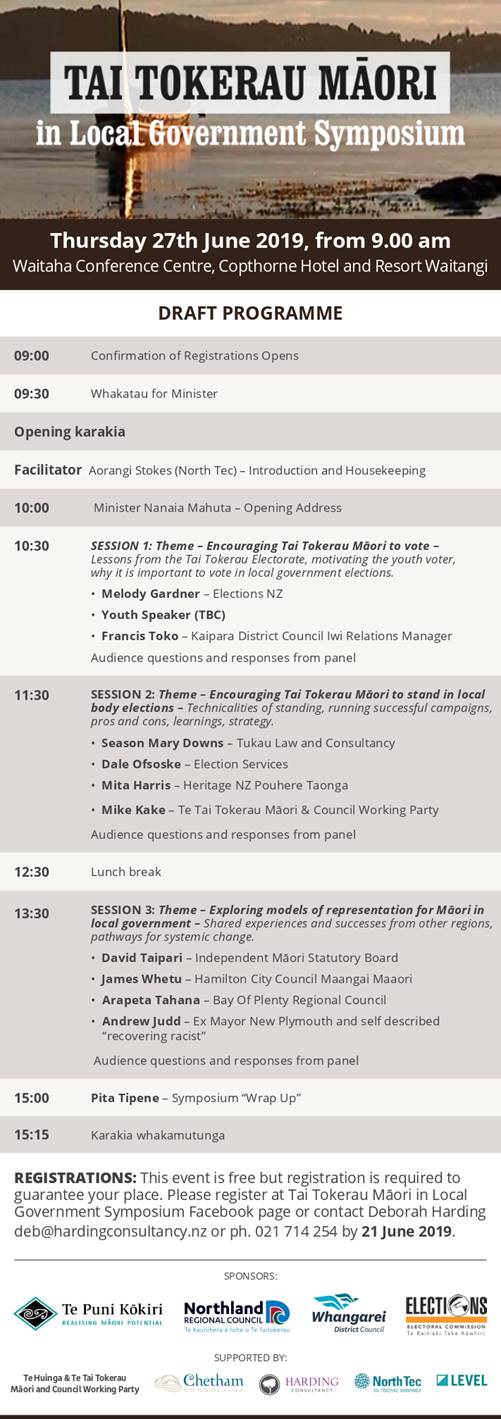
3.2 Tai Tokerau Māori in Local Government Symposium 3
3.3 Update: Local Elections 2019 3
3.4 Update: Māori Technical Advisory Group 3
3.5 Implementing the Water Quality Planning Requirements of the National Policy Statement for Freshwater Management 3
3.6 Wetland Mapping 3
3.7 Proposal to control Sydney Golden Wattle 3
3.8 Environmental Awards 2019 3
3.9 Update: Annual Plan 2019/20 | Mahere-a-Tau 2019/20 3
3.10 Working Party Updates 3
Te Taitokerau Māori and Council Working Party item: 3.1
11 July 2019
|
TITLE: |
Record of Actions – 2 May 2019 |
|
ID: |
A1203375 |
|
From: |
Sally Bowron, Strategy, Governance and Engagement Team Admin/PA |
Whakarāpopoto/Executive summary
The purpose of this report is to present the Record of Actions of the last meeting (attached) held on 2 May 2019 for review by the meeting.
Ngā tapirihanga/Attachments
Attachment 1: Record of Actions from 2
May 2019 ⇩ 
Authorised by Group Manager
|
Name: |
Jonathan Gibbard |
|
Title: |
Group Manager - Strategy, Governance and Engagement |
|
Date: |
4 July 2019 |
11 July 2019
|
TITLE: |
Tai Tokerau Māori in Local Government Symposium |
|
ID: |
A1203659 |
|
From: |
Rachel Ropiha, Kaiarahi - Kaupapa Māori |
Whakarāpopototanga/Executive summary
This report introduces Juliane Chetham who will speak to and provide a presentation on the Te Taitokerau Māori Representation Symposium held at the Copthorne Waitangi on 27 June. Please find attached the programme for the symposium.
1. That the report ‘Tai Tokerau Māori in Local Government Symposium’ by Rachel Ropiha, Kaiarahi - Kaupapa Māori and dated 17 June 2019, be received.
Attachment 1: Tai Tokerau Māori in
Local Government Symposium Programme ⇩ 
Authorised by Group Manager
|
Name: |
Jonathan Gibbard |
|
Title: |
Group Manager - Strategy, Governance and Engagement |
|
Date: |
4 July 2019 |
Te Taitokerau Māori and Council Working Party item: 3.3
11 July 2019
|
TITLE: |
Update: Local Elections 2019 |
|
ID: |
A1203648 |
|
From: |
Chris Taylor, Governance Support Manager |
Whakarāpopototanga/Executive summary
This report provides an update on the upcoming triennial elections including, but not limited to, key dates, positions available, being eligible to vote, electoral systems, candidate information meetings, the Northland joint electoral campaign and sources of information.
That the report ‘Update: Local Elections 2019’ by Chris Taylor, Governance Support Manager and dated 17 June 2019, be received.
Tuhinga/Background
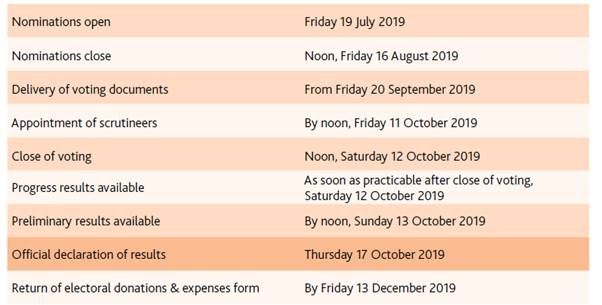
The triennial elections for elected members of all local authorities throughout New Zealand are to be conducted by postal vote concluding on Saturday 12 October 2019.
Key dates to be aware of:
Northland Regional Council positions:
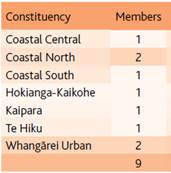
Elections are required for the nine Northland Regional Council (NRC) vacancies as follows:
Make sure you are eligible to vote!
Those eligible to vote in the election are all resident electors and non-resident ratepayer electors whose names appear on the electoral roll when it closes on Friday 16 August 2019. There are two rolls:
The Resident Roll: All parliamentary electors, including those on the Māori Electoral Roll, are automatically enrolled on the Resident Roll at the address where they live.
The Ratepayer Roll: If a person is on the parliamentary roll in one area and pays rates on a property in another area, this person may be eligible to be enrolled on the non-resident ratepayer roll.
You are encouraged if you are not, or unsure if you are, on the roll to phone 0800 ENROLNOW
(0800 367 656).
Electoral systems being used
The first past the post electoral system (FPP)will be used for the Northland Regional Council, Far North District Council and the Whangarei District Council. For the Kaipara District Council and the Northland District Health Board, the single transferable electoral system (STV) will be used (refer to the Department of Internal Affairs website www.stv.govt.nz for more information how STV works).
Candidate Information Evenings
The council must remain neutral during the election process and must not promote, or be perceived to promote, the election prospects of any candidate. However, council will be encouraging people to stand for election and encouraging everyone to vote in the elections. As part of this NRC will be hosting a candidate information evening in each of its seven constituencies for those interested in standing for elections. These sessions will run through the electoral process (the do’s and don’ts), responsibilities, expectations if elected and so forth.
The information sessions are as follows:
· Coastal Central
Wednesday 24 July 2019, 5.30 – 7.00pm
Parua Bay Hall/Community Centre, 1341 Whangārei Heads Road
· Coastal South
Thursday 25 July 2019, 5.30 – 7.00pm
Ruakaka Recreation Centre, Takutai Place, Ruakaka
· Whangārei Urban
Saturday 27 July 2019, 10 – 11.30am
Northland Regional Council Chambers, 36 Water Street, Whangārei
· Kaipara
Wednesday 31 July 2019, 5.30 – 7.00pm
Dargaville Town Hall, 37 Hokianga Road, Dargaville
· Coastal North
Thursday 1 August 2019, 5.30 – 7.00pm
Northland Regional Council Waipapa Office, Klinac Lane, Waipapa
· Te Hiku
Saturday 3 August 2019, 10 – 11.30am
The Banquet Room, Te Ahu Centre, Kaitāia
· Hokianga-Kaikohe
Saturday 3 August 2019, 1.30 – 3.00pm
Far North District Council Chambers, Kaikohe
Northland joint council electoral campaign
In 2016 the four councils ran a successful campaign called ‘True Locals’. The campaign showcased local Northlanders using strong imagery and videography. The councils have committed to continue working together with a bold and fresh approach for 2019.
The campaign objectives are to:
· Engage Northlanders and encourage people to stand as candidates
· Increase voter turn-out at local elections in October to at least 50% of eligible voters (2016 turnout was approx. 44%)
Through the use of engaging graphics and a series of attention-grabbing, humorous videos it is aimed to deliver a cross-channel integrated marketing campaign which includes press releases, radio/print advertising and social media.
The campaign will feature a cross section of locals who represent our different communities, geographies and demographics as a region.
We will focus on segments of our Tai Tokerau communities including youth, Māori, business, sporting groups etc. Strong imagery will be used, with people as the focus in an in-situ Northland setting.
Our messaging will cover topics like leadership, thriving communities, getting around, the economy, our future and our environment. A strong call to action will be included on all collateral: ‘Love your community? Lead it!’ ‘Lover your community? Show it!’
National campaign
LGNZ and SOLGM will also run a joint VOTE 2019 campaign, focusing on listening and engaging on the issues that matter to locals that will make New Zealand a better place to live, work and play. The Northland collateral will link in with this campaign where appropriate.
Be informed!
Key sources of information:
· The NRC Electoral Officer, Dale Ofsoske
Email: info@electionservices.co.nz
Phone: 0800 922 822
· The NRC elections page: www.nrc.govt.nz/elections2019
· The Northland local elections’ website https://localelections.co.nz and dedicated Facebook page.
· The NRC Governance Support Manager, Chris Taylor
Email: christinet@nrc.govt.nz
Phone: 4701224
Nil
Authorised by Group Manager
|
Name: |
Jonathan Gibbard |
|
Title: |
Group Manager - Strategy, Governance and Engagement |
|
Date: |
4 July 2019 |
Te Taitokerau Māori and Council Working Party item: 3.4
11 July 2019
|
TITLE: |
Update: Māori Technical Advisory Group |
|
ID: |
A1203632 |
|
From: |
Rachel Ropiha, Kaiarahi - Kaupapa Māori |
Whakarāpopototanga/Executive summary
The purpose of this report is to provide an update on the work of the Māori Technical Advisory Group (MTAG) who have been working on the following projects:
· Mana Whakahono a Rohe
· Resource consent processes
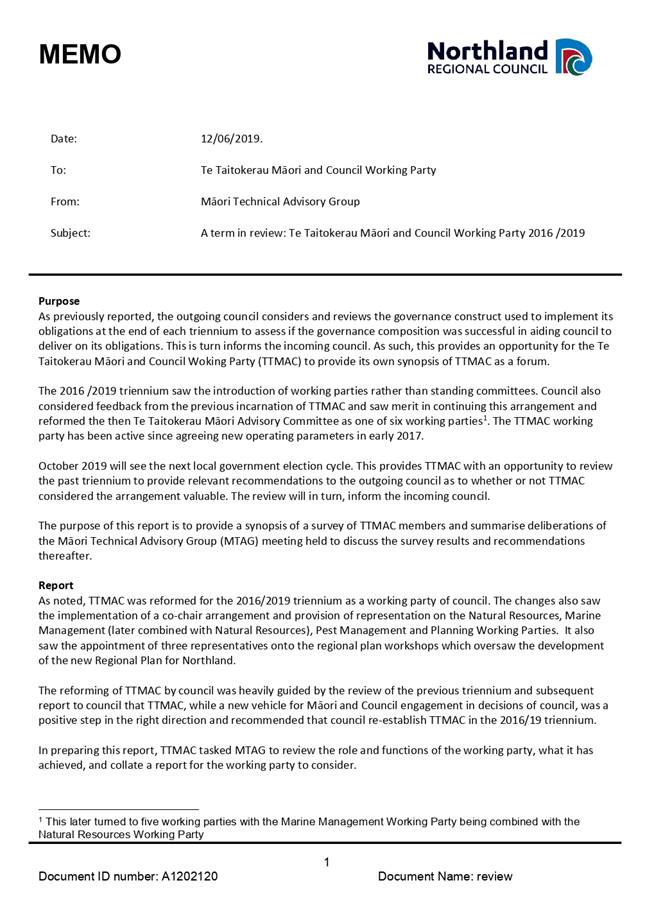
· Review of the Te Taitokerau Māori and Council Working Party 2016 – 2019.
1. That the report ‘Update: Māori Technical Advisory Group’ by Rachel Ropiha, Kaiarahi - Kaupapa Māori and dated 17 June 2019, be received.
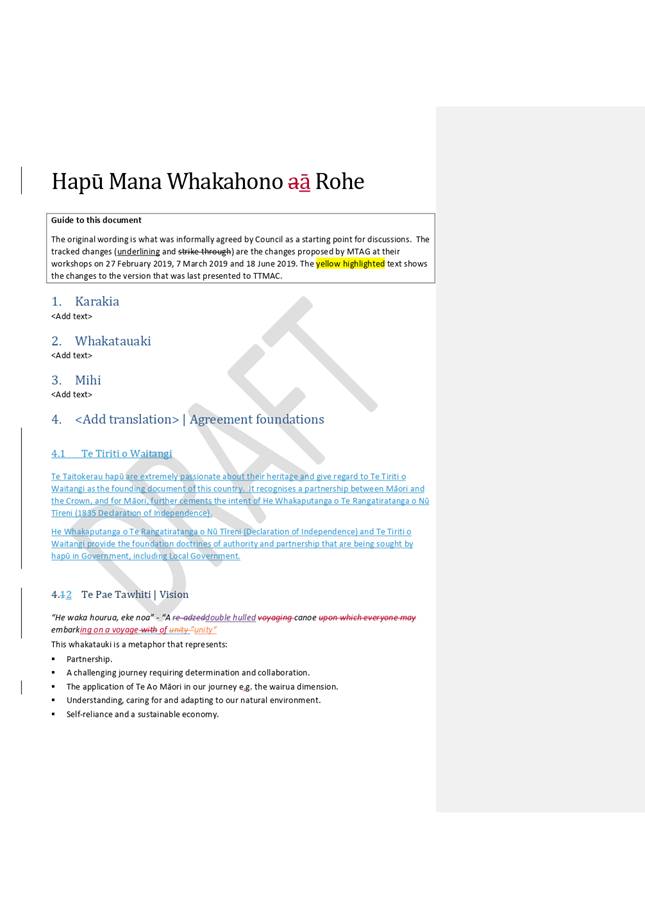
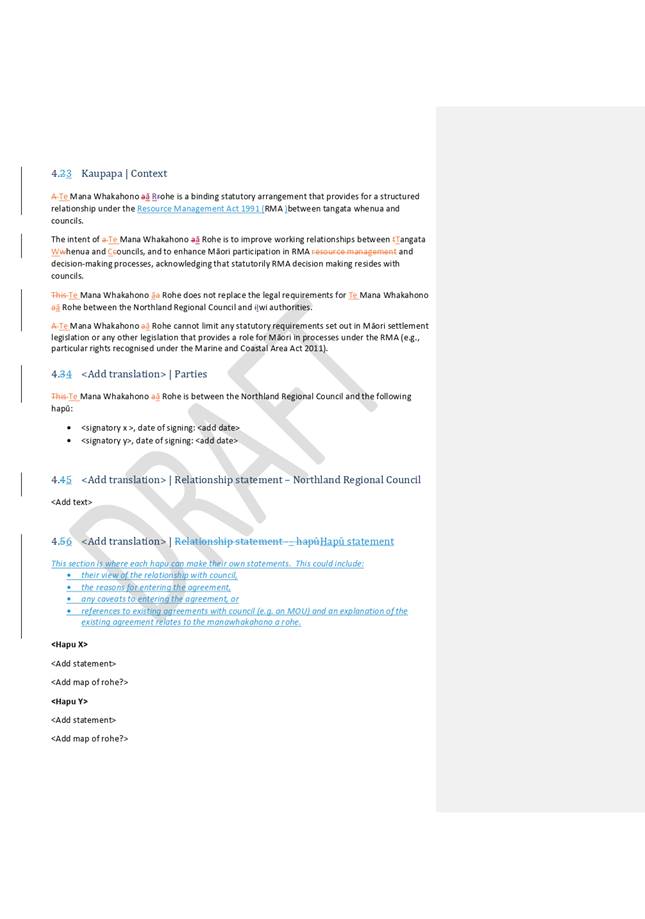
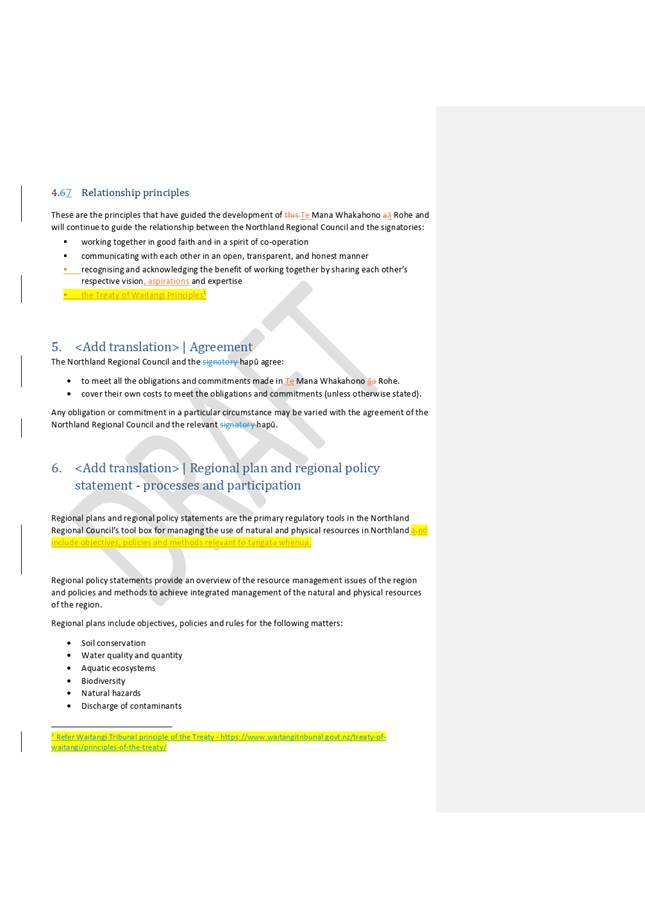
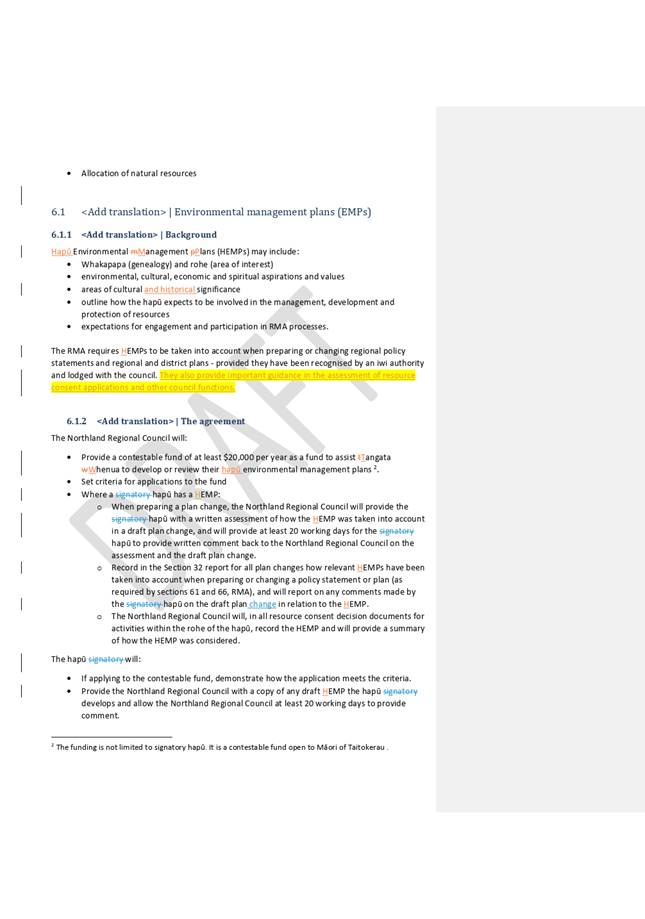
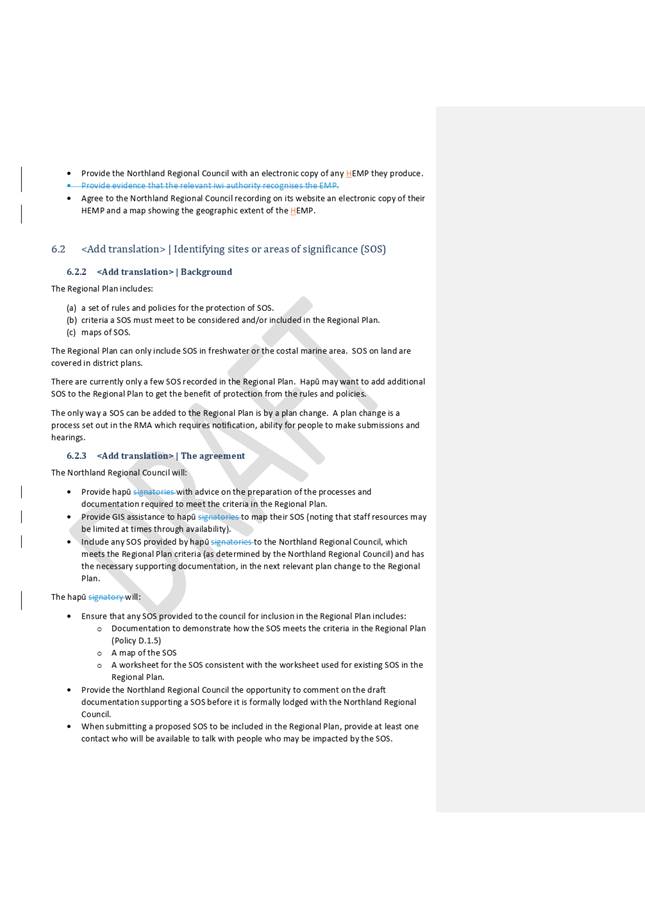
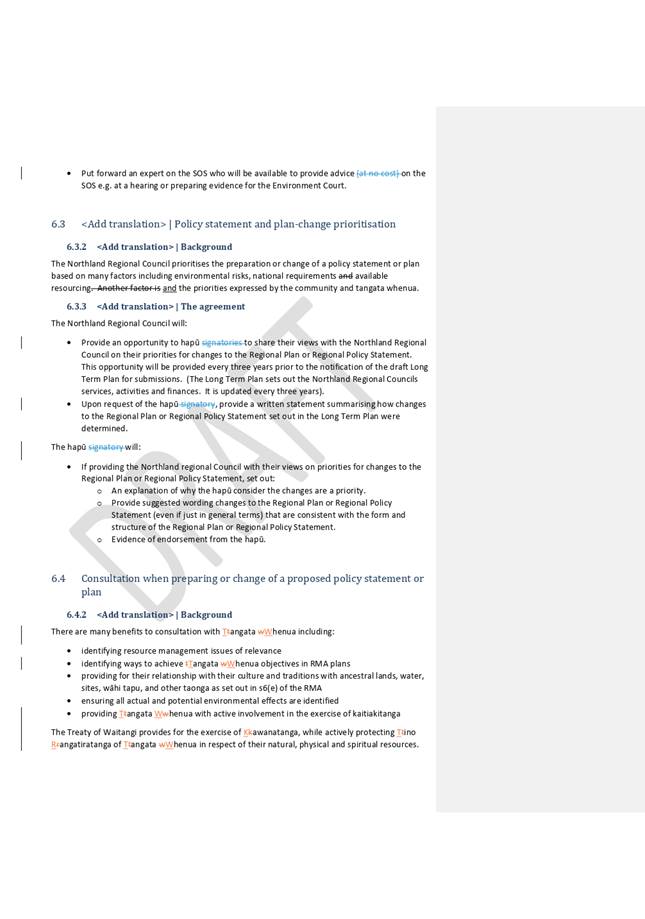
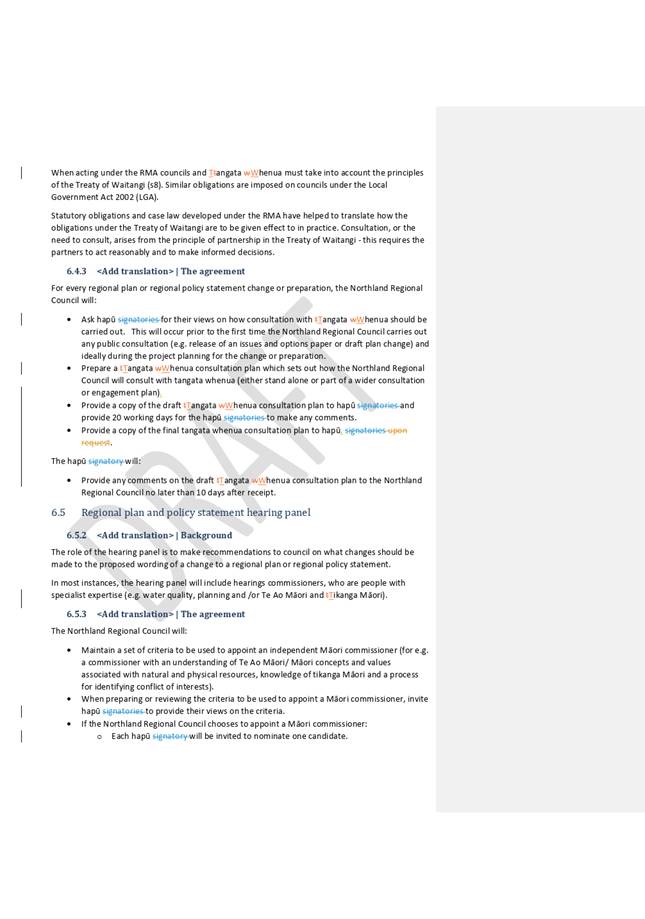
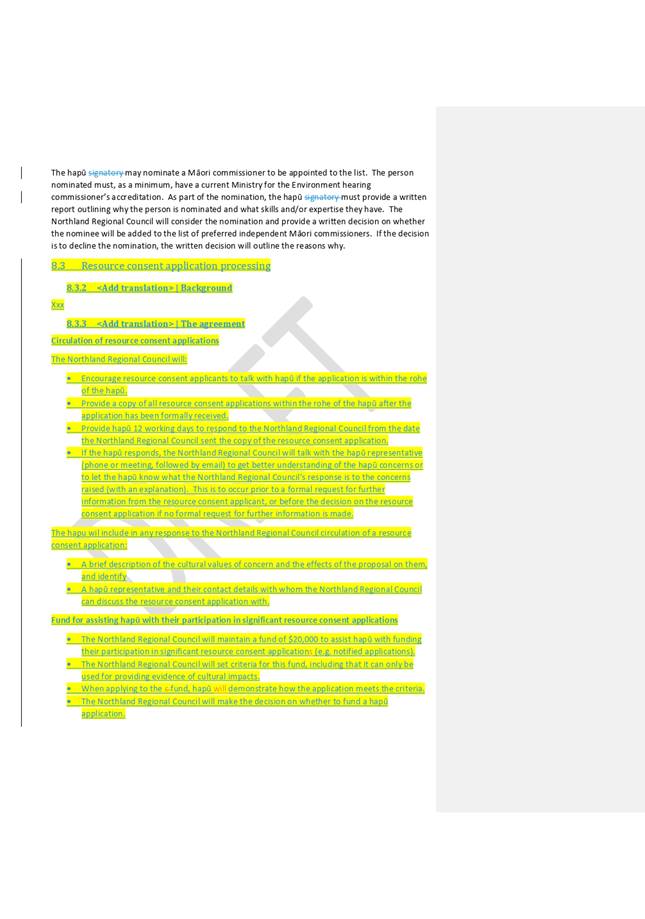
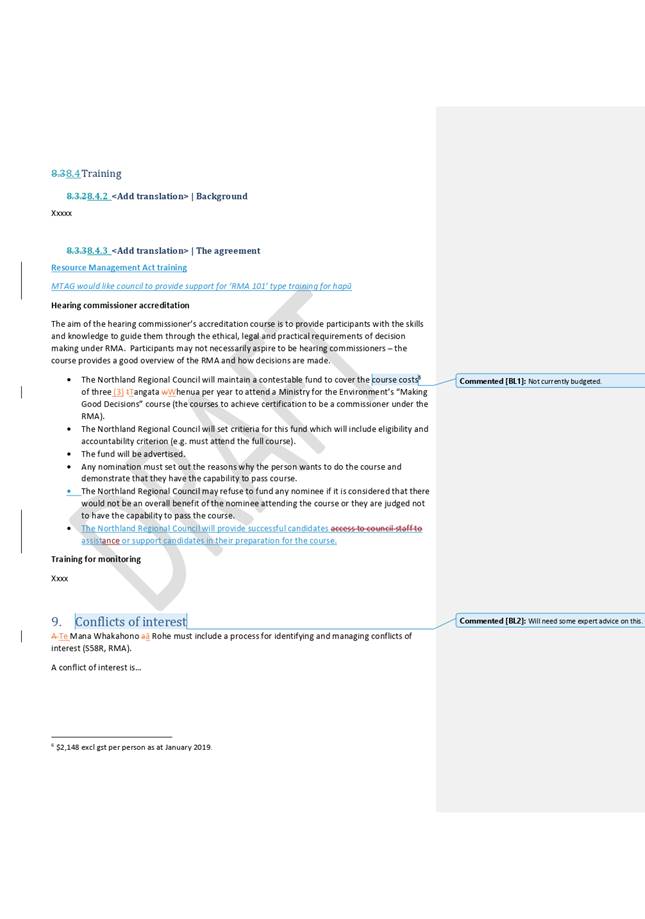
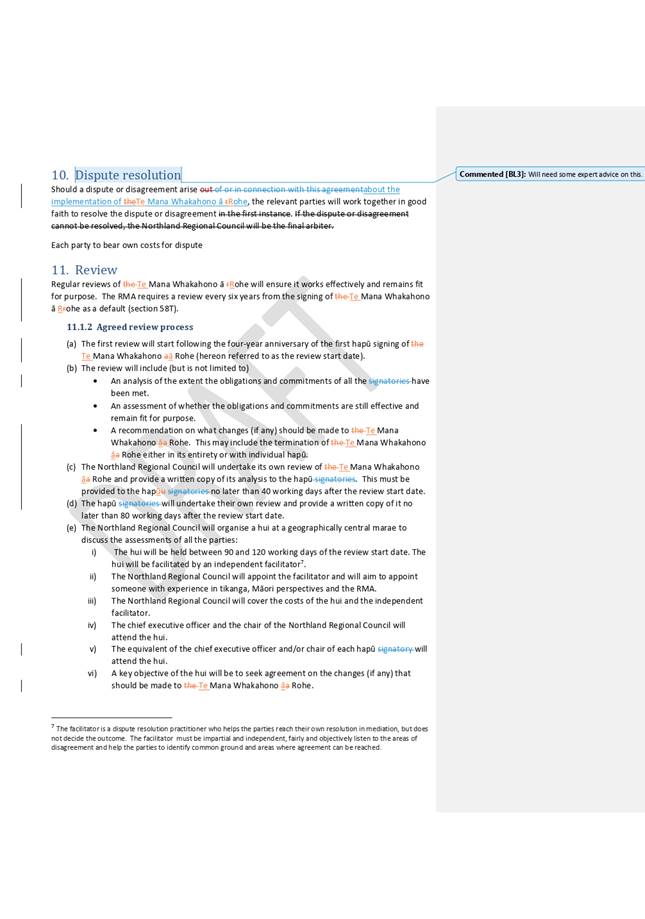
2. That the Draft Mana Whakahono a Rohe (for multiparty hapū to join) be endorsed by Te Taitokerau Māori and Council Working Party and be presented to council, with a recommendation that council adopt the multiparty agreement as the basis for which to enter into Mana Whakahono a Rohe with hapū.
3. That Te Taitokerau Māori and Council Working Party endorse the updated resource consent application form to implement Policy D.1.1 of the Proposed Regional Plan.
4. That
the report ‘A term in review: Te Taitokerau Māori and Council
Working Party
2016 / 2019’ be endorsed by Te Taitokerau Māori and Council working
Party and presented to council for consideration in its overall governance review.
Mana Whakahono a Rohe
Mana Whakahono a Rohe (MWR) is a tool within the Resource Management Act 1991 (RMA) aimed at providing an opportunity for iwi authorities to form a relationship with local authorities. The purpose of clarifying how local authorities and iwi will work together to agree ways in which tangata whenua of a MWR is (see section 58M of the RMA):
To provide a mechanism for iwi authorities and local authorities to discuss, agree and record ways in which tangata whenua may, through their iwi authorities, participate in resource management and decision-making process under the RMA.
In December 2017 council resolved to adopt criteria in regards to MWR including, only entering into MWR with iwi as provided for in section 58O of the RMA. At the time, council raised a number of concerns in regards to engaging with hapū for the purpose of establishing a MWR, these being:
· Council’s ability to resource a large number of hapū based agreements given the large number of hapū in Taitokerau
· Complexities, overlaps and inefficiencies associated with multiple inconsistent separate hapū and iwi MWR.
Council also resolved to receive further advice from TTMAC on how council could address, or mitigate these concerns, with a view of being able to progress hapū wishes to enter into a MWR agreement with council. At this point TTMAC delegated the develop of that advice to the Māori Technical Advisory Group (MTAG).
Since this time MTAG - and a subgroup of MTAG - have worked extensively on this project, providing provisional advice to TTMAC in November 2018. At this time MTAG sought direction from TTMAC that what it was developing was supported by the working party. This resulted in a recommendation to council (November) from TTMAC that council develop a template for hapū and council to use to agree an MWR. The council received this advice and considered it against its concerns it had previously identified. Council then resolved to consider further advice however, for a single MWR that multiple parties could join rather than a template. Council requested that TTMAC develop this concept further.
Since this time, MTAG have been considering and refining a single MWR (for multiparty hapū to join). This is attached for consideration by TTMAC.
It should be noted that TTMAC have worked within the constraints of council’s current position and, therefore, this option of a single MWR for multiparty hapū to join might not necessarily reflect the preferences of TTMAC members. Also, as previously expressed, TTMAC does not represent Māori, rather they provide a Māori view and advice to council, and in this case, to help council form a position on invitations to enter into MWR with hapū.
If TTMAC agree to the draft MWR, staff recommend it be presented to a workshop of council (attachment 1).
Resource consent processing
MTAG were also tasked with investigating how to increase iwi/hapū involvement in the consent processes of council. Through a number of meetings, it was identified that a potential mechanism for this was to amend the resource consent application form so that it was more in line with the requirements of Schedule 4 of the RMA, which specifies what an applicant has to include in an assessment of environmental effects (AEE).
The Proposed Regional Plan (PRP) has policy that is very directive in what a consent applicant has to provide in regard to an assessment of effects on tangata whenua and their taonga. This policy is set out below:
Policy D.1.1 (of the Proposed Regional Plan)
When an analysis of effects on tangata whenua and their taonga is required.
A resource consent application must include in its assessment of environmental effects an analysis of the effects of an activity on tangata whenua and their taonga[1] if one or more of the following is likely:
1) adverse effects on mahinga kai[2] or access to mahinga kai[3], or
2) any damage, destruction or loss of access to wāhi tapu, sites of customary value and other ancestral sites and taonga with which Māori have a special relationship[4], or
3) adverse effects on indigenous biodiversity in the beds of waterbodies or the coastal marine area where it impacts on the ability of tangata whenua to carry out cultural and traditional activities[5], or
4) the use of genetic engineering and the release of genetically modified organisms to the environment, or
5) adverse effects on tāiapure, mataitai or Māori non-commercial fisheries,[6] or
6) adverse effects on protected customary rights,[7] or
7) adverse effects on sites and areas
of significance to tangata whenua mapped in the
Regional Plan (refer I Maps|Ngā mahere matawhenua).
I_Maps_|Ngā_I_Maps_|Ngā_I_Maps_|Ngā_I_Maps_|Ngā
After receiving advice from MTG, council staff have recrafted its consent application form so that it includes a separate section requiring an assessment of effects on tangata whenua that mirrors Policy D.1.1 of the PRP, along with the other requirements of Schedule 4. This will allow council to return (not accept) applications that have not provided an assessment of effects on tangata whenua and their toanga, where one is triggered by Policy D.1.1 of PRP.
This change to the application forms will provide clear criteria to applicants on what is required which can be consistently applied by council consents staff. It is also a legally robust approach as it is based on the PRP policy. Changes will be made to council’s website to reflect the changes to the resource consent application form.
The proposed new (draft) consent application form is attached for your endorsement (attachment 2).
A term in review: Te Taitokerau Māori and Council Working Party 2016 / 2019
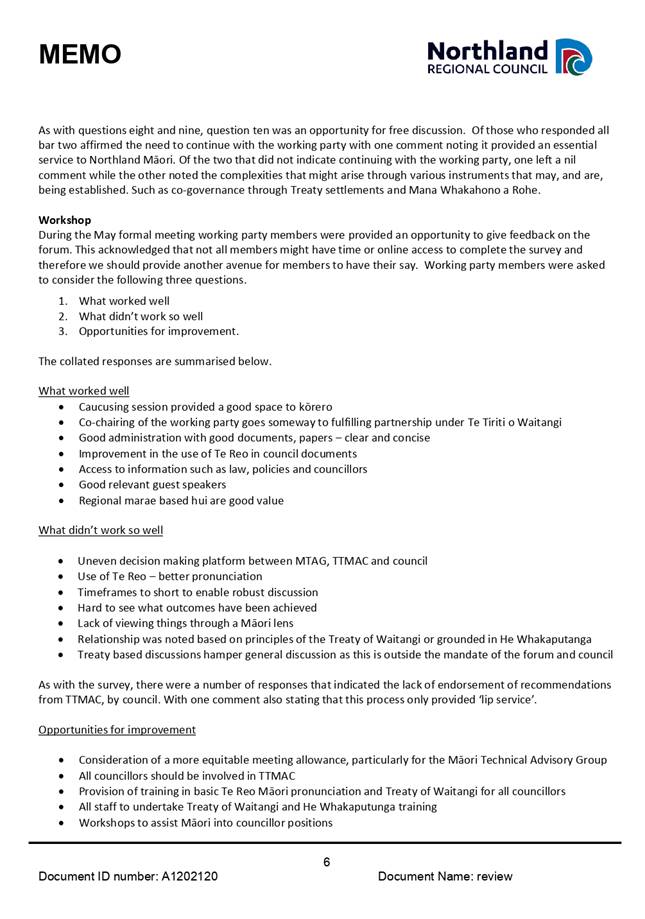
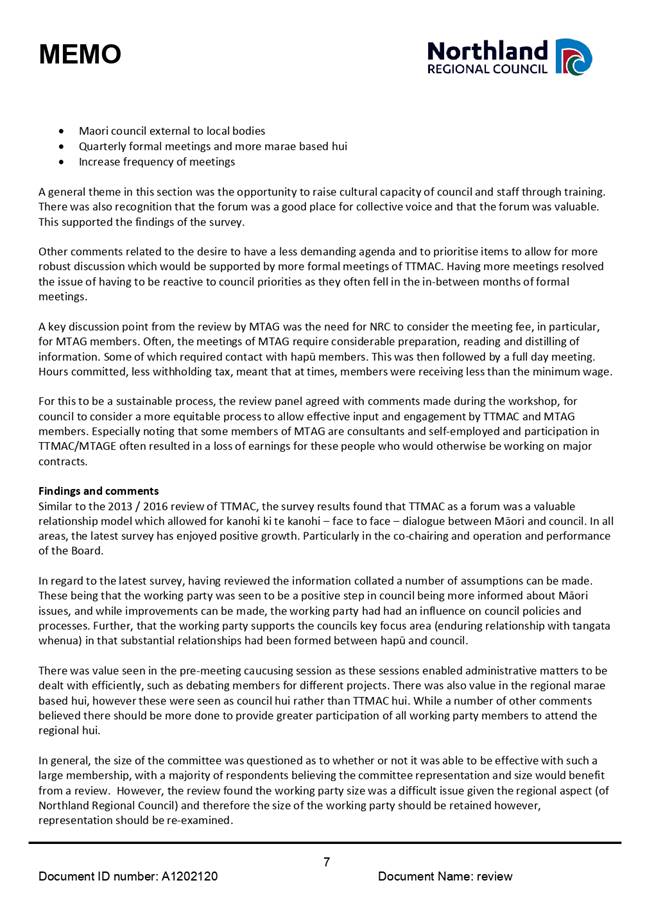
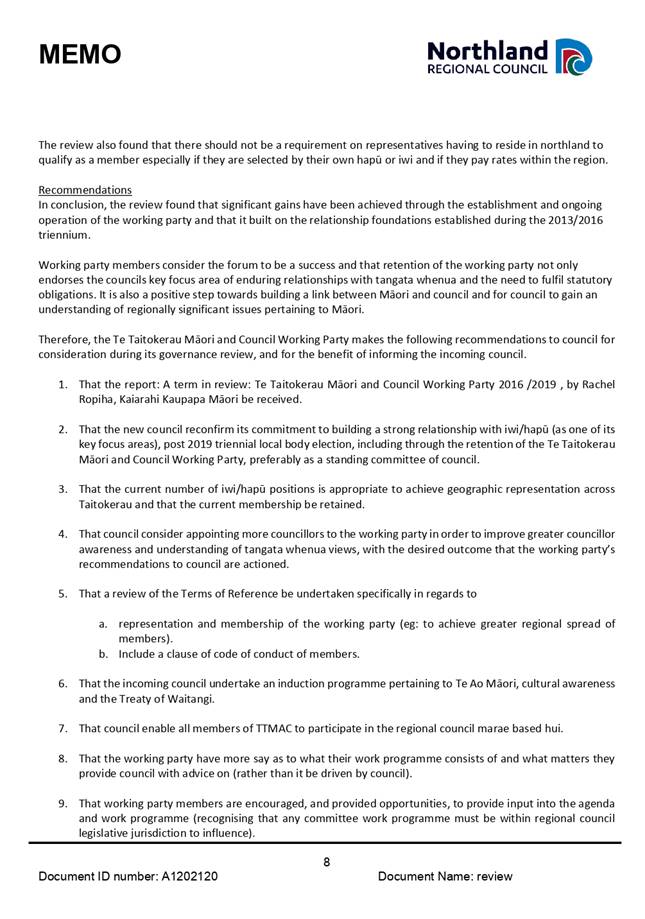
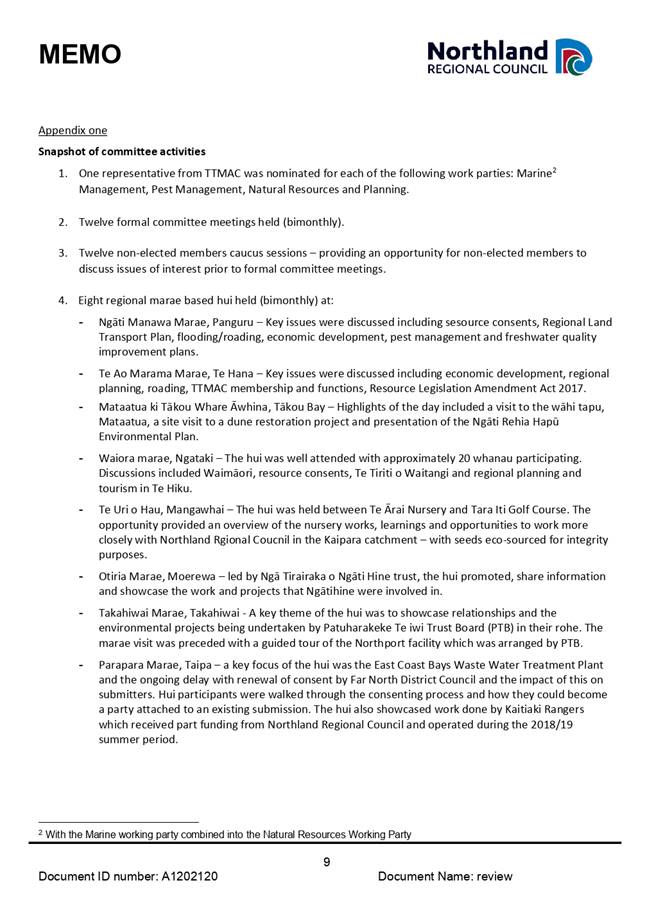
At the June meeting of TTMAC the working party agreed to proceed with a review of the past triennium with a view of informing both the outgoing and incoming council, as to the effectiveness and value of the working party.
A survey was conducted and a short feedback session was undertaken at the May formal meeting. MTAG then met to discuss the results to inform a draft report, and then again to review the report.
Almost 50% of TTMAC members completed the survey, an increase from the third who completed the survey in the previous triennium. In summary, the survey, feedback and meetings indicate that the working party was considered worthwhile and while there were still some concerns about the implementation of advice and opportunities for improvement provided, overall, it was considered that the working party was both effective and valuable.
The full report is attached for TTMAC’s consideration (attachment 3). If TTMAC endorses the final report, MTAG recommend that this report be provided to council for inclusion into their wider governance review.
Attachment 1: Draft Mana Whakahono a
Rohe ⇩
Attachment 2: Draft consent application
form June 2019 ⇩
Attachment 3: MTAG review of Te
Taitokerau Māori and Council Working Party ⇩
Authorised by Group Manager
|
Name: |
Jonathan Gibbard |
|
Title: |
Group Manager - Strategy, Governance and Engagement |
|
Date: |
4 July 2019 |
11 July 2019
Application for a Resource Consent – Resource Management Act 1991 (s.88)
Before you make an application, it is recommended that you talk or meet with a Consents Officer to discuss it. If you would like to arrange this, please phone xxxxxxxx or email request to info@nrc.govt.nz.
Under Section 88 and/or 127 of the Resource Management Act 1991, the undersigned makes this application for resource consent(s).
PART 1
1 Full name of applicant(s) (the name that will be on the consent)
Surname:
First names:
OR
If the application is being made on behalf of a trust, the Trustees must be named.
Trust name:
Trustees’ name:
OR
Company name:
Contact person:
Postal address:
Telephone (please tick preferred contact number)
Residential ( ) Business ( )
Cell ( )
Email
Please note that if email address provided, then all correspondence for this
application will be via email
2 Details of consultant or person who will be address for service of documents if different from applicant
Company name:
Contact person:
Postal address:
Telephone (please tick preferred contact number)
Residential ( ) Business ( )
Cell ( )
Email
Please note that if email address is provided, then all correspondence for
this application will be via email
3 Invoices for charges relating to this application(s) should be sent to:
Applicant Consultant
3 Name and address of owner/occupier of the site relating to application if different from applicant
Owner:
Postal address:
Residential ( ) Business ( )
Occupier:
Postal address:
Residential ( ) Business ( )
Please note: If the applicant is not the owner of the land to which the activity relates, then it is good practice to submit the application with written approval from the landowner.
4 Consent(s) being applied for from the Northland Regional Council
Insert section from current application form.
(a) Is this application to replace an existing or expired consent(s)? Yes No
If Yes:
(i) Please state the consent number(s):
(ii)....... Do you agree to surrender the existing consent once a new one has been issued?
Yes No
(b) Is this application to change a condition of an existing consent? Yes No
If Yes, please state the consent number:
(c) Please specify the duration sought for your consent(s) (only for new or renewal applications).
years months
(d) Do you also require resource consent(s) from a district council? Yes No
Type of consent required
Has it been applied for? Yes No
Has it been granted? (If Yes, please attach) Yes No
5 Applications for activities within the Coastal Marine Area (CMA)
Prior to lodging an application with the council to undertake any activity in the coastal marine area (CMA), the applicant is required under the Marine and Coastal Area (Takutai Moana) Act 2011 to circulate a copy of the application to all applicants who have applied for customary marine title in that location and seek their view on the application.
The council cannot legally accept an application to undertake an activity in the CMA unless the applicant provides evidence of this circulation occurring. A response from customary marine title applicants is not required by council.
To ensure you meet the above requirement, you are advised to contact council consents staff to get a list of all the current applicants within the area where you are proposing to apply for a consent.
Information on customary marine titles is available on the Ministry of Justice/Marine and Coastal Area Applications website.
5 Location description of activity
Site address
Legal description (legal description can be obtained from your Certificate of Title, valuation notice, or rate demand)
Map reference NZTM, (if known)
PART 2
1 Description of activity
Please fully describe the activity for which consent is being sought. It is important you fill this out correctly, as the council cannot grant consent for any activity you do not apply for.
2 Site plan
On a separate piece of good quality A4 (minimum) paper, please provide a site plan showing location of the activity, site layout, and surrounding environment in relation to property boundaries.
Please include any architectural/surveyor’s plans showing buildings or developments on the site.
If you do not have access to mapping software, we recommend you use the regional mapping system available on our website (XXXXXXX). The mapping system includes property boundary and contour layers, and allows you to carry out a property search, and view and/or print topographic maps or aerial photography.
3 Assessment of Environmental Effects (AEE)
An AEE must be provided with your application that has been completed in accordance with requirements of Schedule 4 of the Resource Management Act. As a minimum, your AEE must include the following:
· description of the environmental effects of the activity
· description of effects on tangata whenua and their taonga
· description of ways in which adverse environmental effects can be avoided, remedied or mitigated
· names of people affected by the proposal
· record of any consultation you’ve undertaken, including with affected parties (if any)
· discussion of any monitoring of environmental effects that might be required
· any relevant objectives, policies, or rules in the Regional Plans
· any relevant objectives and policies in an Iwi/Hapu Environmental Management Plan that covers the location of your application.
Please note that the Resource Management Act does not require any person, including applicants and the council, to consult with anyone. It is however best practice to do so and will allow council to make a more informed decision.
Any activity needing a resource consent will have some environmental effects. The council won’t accept an AEE that says there are no environmental effects from the activity.
Council has standard AEE forms for a selection of common activities that are available for use to make your application. These can be found on our webpage at “Forms and Fees” or can be requested from Council’s consents staff.
If your activity is not covered by one of these standard AEE forms, then you will need to complete a separate AEE at a level that corresponds with the scale and significance of the effects that the activity may have on the environment. Depending on the scale of the activity, you may need to get help from an expert to prepare your application.
4 Effects in Tangata Whenua
The Regional Plan requires that an AEE must include an assessment of the effects on tangata whenua and their taonga if one or more of the following is likely:
1) adverse effects on mahinga kai or access to mahinga kai, or
2) any damage, destruction or loss of access to wāhi tapu, sites of customary value and other ancestral sites and taonga with which Māori have a special relationship, or
3) adverse effects on indigenous biodiversity in the beds of waterbodies or the coastal marine area where it impacts on the ability of tangata whenua to carry out cultural and traditional activities, or
4) adverse effects on tāiapure, mataitai or Māori non-commercial fisheries, or
5) adverse effects on protected customary rights, or
6) adverse effects on sites and areas of significance to tangata whenua mapped in the Regional Plan (refer I Maps |Ngā mahere matawhenua).
The best way to find out what the effects of your proposal may be on tangata whenua is to contact local iwi/hapu groups (who represent tāngata whenua) and discuss your proposal with them. Council consents staff can provide a list of contact details for local iwi/hapu groups in the area of your proposal. You can then send a copy of your proposal to these groups and seek feedback from them.
If the local iwi/hapu group has an Environmental Management Plan that has been formally received by council, then will also need assess your application against the relevant objectives and policies in this plan. These plans can be accessed via council’s website or council consents staff can provide copies of relevant Iwi/Hapu Environmental Management Plans held by council.
If there is Settlement Act that covers the area of your application, then you will also need to assess the adverse effects of your activity on any “Statutory Acknowledgement Areas”. The council can provide information on statutory acknowledgement areas on request.
It is important to remember that consultation does not require reaching an agreement – it is to allow you and the council to be informed about the views of tāngata whenua. If there are concerns that cannot be resolved and you still want to go ahead with your application, you must have made a genuine attempt to consult with tāngata whenua in an open and honest manner. Their views must be recorded so they can be taken into account by the council when considering your resource consent application.
5 Persons likely to be affected
Affected persons may include neighbouring land owners and occupiers, and/or organisations such as the Department of Conservation, Land Information New Zealand (LINZ), Fish and Game Council, relevant iwi and hapū and community groups.
If you do not think there will be any affected persons, then you do not need to provide any details for this section. However, Council will make the final assessment of whether a person is affected by your proposal.
If there are persons you have identified who may be affected and you have discussed your proposal with any of these persons, please record any comments made by them and your response to them, and submit this with your application. If you have written approvals from these parties, then these should be provided as well. Council has a template written approval form that can be used for this purposes.
6 Extending timeframes
The Resource Management Act 1991 (RMA) specifies timeframes for processing resource consent applications (e.g. 20 working days for a non-notified application); however these timeframes can be extended, if necessary, with the Applicant’s agreement.
Do you agree to the Council extending RMA consent processing timeframes?
Yes, provided that I can continue to exercise my existing consent until processing of this application is completed (renewal application only).
Yes, provided that the extension is for the specific purpose of discussing and trying to agree on consent conditions.
Yes, provided that the application process is completed before
No.
7 Deposit fee
An initial minimum fee, inclusive of GST, is payable with this application. These fees can be found at Schedule of Minimum Estimated Initial Fee information . Please contact council consents staff if you need assistance with determining the correct minimum initial fee.
This initial minimum fee may be paid online, by cheque, or by eftpos at one the Regional Council’s reception desks.
Northland Regional Council’s bank account number is XXXXXXXXX. Please use the Applicant’s name as the reference. A GST invoice marked “PAID” will be issued on receipt of payment.
Unless agreed to prior to lodging your application, the council will not commence processing your application until payment is received (i.e. The statutory processing time for the application will not start)
If the costs of processing the application are greater than the initial fee, then you will be required to pay the additional reasonable costs of processing your application
Note: Annual user charges for consent holders
Holders of resource consents will in most cases be required to pay a “Minimum Annual Charge” for administration of the consent once issued. There is also likely to be additional annual charges for the monitoring of the consent, which will be dependent on the type of activity the consent is for. These charges are detailed in the Annual Charges section of the council’s Charging Policy.
Checklist
The following information must be included in your application to ensure it is accepted.
Complete all details in this application form.
Include an Assessment of Effects of the activity,
Assessment of effects on tangata whenua and their taonga.
Supply written approval from all affected parties, if any, and/or summary of consultation carried out.
Include a site plan.
Sign and date the application form.
Pay the required minimum initial fee deposit.
Include any other information you think relevant (e.g. Certificate of Title, details from the Companies Register, etc.)
If your application includes plans please provide good quality electronic ones that can be used in a consent document.
If you are applying for a coastal permit, evidence that you have circulated a copy of the application to all applicants who have applied for customary marine title in that location and have sought their view on the application.
Please be aware any unchecked boxes may result in your application being returned under s.88.
Information privacy issues
The information you provide in this application is regarded as official information. It is required under the provisions of the Resource Management Act 1991 to process this application, and to assist in the management of the region’s natural and physical resources.
The information will be held by Northland Regional Council. This information is subject to the provisions of the Local Government Official Information and Meetings Act 1987, and the Privacy Act 1993. The information you provide in this application will generally be available to the public.
1 I confirm that I have authority to sign on behalf of the party/ies named as the applicants for this consent.
2 I have read, and understand, all of the information contained on this application form, including the requirement to pay additional costs.
3 I confirm that all the information provided is true and correct and understand that any inaccurate information provided could result in my resource consent later being cancelled.
Signature....................................................................................... Date
Please note that a signature is not required if submitting application electronically.
11 July 2019
|
TITLE: |
Implementing the Water Quality Planning Requirements of the National Policy Statement for Freshwater Management |
|
ID: |
A1203645 |
|
From: |
Ben Tait, Policy Specialist - Water |
Whakarāpopototanga/Executive summary
Northland Regional Council is about to start a process to prepare a plan change to implement the water quality planning requirements of the National Policy Statement for Freshwater Management. The plan change is scheduled to be notified in 2021. The council wants to work with iwi and hapū to identify tangata whenua values and interests in fresh water, and also reflect tangata whenua values and interests in decision-making regarding the plan change.
The purpose of this report is to provide a brief overview of the freshwater quality planning requirements and seek Te Taitokerau Māori and Council Working Party’s (TTMAC) recommendations on how best to involve iwi and hapū in developing the plan change (a suggested approach is included for TTMAC consideration).
1. That the report ‘Implementing the Water Quality Planning Requirements of the National Policy Statement for Freshwater Management ’ by Ben Tait, Policy Specialist - Water and dated 17 June 2019, be received.
2. That council staff work with the Māori Technical Advisory Group to develop recommendations on:
a. how tangata whenua perspectives are sought and considered, and
b. how tangata whenua are involved in decision making
in the development of the plan change to implement the water quality planning requirements of the National Policy Statement for Freshwater Management and report this to a subsequent TTMAC meeting.
3. That council staff seek the feedback of the Māori Technical Advisory Group on the draft freshwater quality management units.
Tuhinga/Background
The National Policy Statement for Freshwater Management (NPS-FM), which was first issued by the government in 2011, and subsequently amended in 2014 and 2017, directs regional councils to manage fresh water in an integrated and sustainable way, while providing for economic growth within set water quantity and quality limits[8].
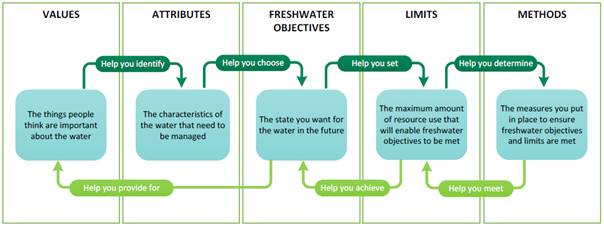
Regional councils must include freshwater objectives and limits in regional plans as well as methods (including rules) to ensure that objectives are met and limits not exceeded. The relationship between values, attributes, freshwater objectives, limits and methods is shown in Figure 1 below.
Figure 1: The NPS-FM framework from values to methods
Freshwater objectives must be set to maintain or improve the quality of water in each freshwater management unit to safeguard “compulsory values” (ecosystem health and human health for recreation).
A “freshwater management unit” is the water body, multiple water bodies or any part of a water body determined by the regional council as the appropriate scale for setting freshwater objectives and limits and for freshwater accounting and management purposes.[9] Council staff defined draft freshwater quality management units, which are largely based on the catchments of major harbours. The draft FMUs are attached to this report.
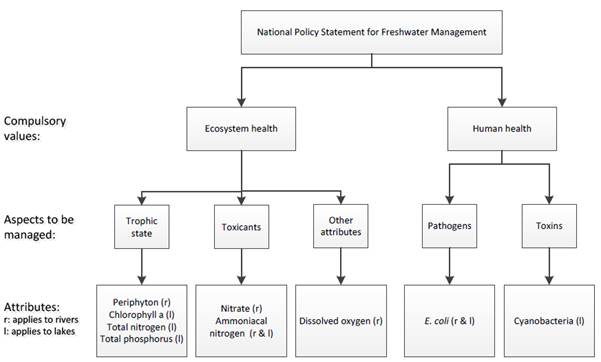
Freshwater objectives must also be formulated in numeric terms using the relevant attributes[10] in Appendix 2 of the NPS-FM and any other attributes that the council considers appropriate for each value for the freshwater body type.
Figure 2 (see following page) shows the attributes in Appendix 2 of the NPS-FM which must be used to set freshwater objectives. Note that the Government has stated that it intends to include other attributes in the NPS-FM, including attributes of fine sediment (e.g., water clarity, turbidity and deposited sediment).
Figure 2: Relationship of attributes in Appendix 2 of the NPS-FM to the compulsory values
Northland Regional Council committed to notifying a plan change in 2021 to implement the freshwater quality planning requirements of the NPS-FM. The commitment is set out in the council’s Progressive Implementation Programme[11]. The freshwater quantity planning requirements of the NPS-FM are already being implemented through the Proposed Regional Plan for Northland[12].
Council approved the following timetable for developing the plan change to implement the freshwater quality planning requirements of the NPS-FM at its 18 June 2019 meeting
1. Define freshwater management units (May – August 2019).
2. Assess and decide on an appropriate modelling tool(s) for:
a. predicting water quality in the freshwater management units; and
b. determining what catchment interventions (and costs) are needed to achieve aspirational water quality objectives (June – October 2019).
3. Provide the evidence base to underpin the plan change and any accompanying new non-regulatory initiatives (November 2019 – March 2021).
4. Draft the plan change and a RMA section 32 evaluation report (July 2020 – July 2021).
5. Notify the Proposed Water Quality Plan Change (by 31 December 2021).
6. Engage with iwi and hapū, key stakeholders and the wider community throughout the process.
It is important to note that the Government announced that it intends to issue an amended NPS-FM and a National Environmental Standard for Freshwater Management.[13] Consultation on both documents is scheduled for July-September 2019 and an amended NPS-FM and Freshwater NES are to be in force by May 2020. This means that the timetable for preparing the plan change may need to be revised after the consultation documents are released and again after they come into force.
Direction is sought from Te Taitokerau Māori and Council Working Party on how tangata whenua:
· perspectives should be sought and considered for the plan change, and
· are involved in decision making on the plan change.
Given the importance of water management to tangata whenua, it is suggested that council staff work with the Māori Technical Advisory Group to fully understand and consider all options and develop comprehensive recommendations on:
a. how tangata whenua perspectives are sought and considered, and
b. how tangata whenua are involved in decision making –
in the development of the plan change to implement the water quality planning requirements of the National Policy Statement for Freshwater Management and that these be reported to a subsequent TTMAC meeting.
In addition, it is recommended that Māori Technical Advisory Group provide feedback on the draft freshwater quality management units prior to being presented to council for their initial endorsement.
Attachment 1: Draft Freshwater Quality
Management Units ⇩ 
Authorised by Group Manager
|
Name: |
Jonathan Gibbard |
|
Title: |
Group Manager - Strategy, Governance and Engagement |
|
Date: |
4 July 2019 |
Te Taitokerau Māori and Council Working Party item: 3.6
11 July 2019
|
TITLE: |
Wetland Mapping |
|
ID: |
A1203652 |
|
From: |
James Griffin, Policy Specialist |
Whakarāpopototanga/Executive summary
In the past, many people didn't recognise the true value of wetlands and consequently nearly all of them have been converted to pasture or urban use. Only about 5% of Northland’s original wetlands remain. Wetlands help prevent flooding and improve water quality, as well as providing the necessary habitat for a number of unique species of plants and animals, many of which are now rare.
Wetland mapping has up until recently generally relied on people physically going out into the field to wetlands to map them. This can take a lot of time and access to wetlands can be difficult where they are on private land. Consequentially it is expected that a significant proportion of wetlands have not been mapped.
In May 2019 Council started a project to map wetlands across Taitokerau using a using a sophisticated GIS based sensing methodology using radiometric survey images and satellite images. (The radiometric survey information was originally collected for the purposes of identifying prospective areas for mining).
The project is about half way through and has identified hydric soils (wet areas). Vegetation sensing technology is now being used to help map wetland extent by identifying wetland vegetation.
Staff will make a presentation to Te Taitokerau Māori and Council Working Party outlining the project and current outputs.
Once wetlands are mapped, development of management options and priorities will involve staff from across council and working parties including Te Taitokerau Māori and Council Working Party.
That the report ‘Wetland Mapping ’ by James Griffin, Policy Specialist , and dated 17 June 2019, be received.
Nil
Authorised by Group Manager
|
Name: |
Jonathan Gibbard |
|
Title: |
Group Manager - Strategy, Governance and Engagement |
|
Date: |
4 July 2019 |
Te Taitokerau Māori and Council Working Party item: 3.7
11 July 2019
|
TITLE: |
Proposal to control Sydney Golden Wattle |
|
ID: |
A1203628 |
|
From: |
Don McKenzie, Biosecurity Manager and Auriole Ruka, Kaiwhakahaere Hononga Māori – Māori Relationships Manager |
Whakarāpopototanga/Executive summary
Northland Regional Council (NRC) will be applying to the Environmental Protection Authority (EPA) for approval to introduce two new insects as biocontrol agents for Sydney Golden Wattle (SGW). We are seeking the views of Te Taitokerau Māori and Council Working Party on the proposal and how best to engage tangata whenua for the purpose of informing the application to the EPA.
1. That the report ‘Proposal to control Sydney Golden Wattle’ by Don McKenzie, Biosecurity Manager and Auriole Ruka, Kaiwhakahaere Hononga Māori – Māori Relationships Manager and dated 17 June 2019, be received.
2. That the Māori Technical Advisory Group be convened to provide advice on the application.
Tuhinga/Background
Northland Regional Council (NRC) is seeking consent through the Environmental Protection Authority (EPA) to introduce two biological control agents from South Africa to control Sydney Golden Wattle which has become a significant issue in the far north.
Sydney Golden Wattle or SGW (Acacia longifolia), from Australia, has become a weed in many countries including New Zealand, South Africa and Portugal. It is a tall shrub that can sometimes grow to 10 m tall. It invades open habitats and scrub-land especially in coastal areas. The dense, shady stands displace native species, change habitats and increase the risk of fire. It is particularly invasive in dune ecosystems.
Having been widely planted as an ornamental plant in the past, SGW is now well established in the places around New Zealand and is found on Matakana Island (Bay of Plenty), Rabbit Island (Nelson), Muriwai (Auckland) and in dunes near Whanganui and Levin.
It has also become a serious problem in the Far North. Of particular concern, SGW is now well established in the nationally significant Kaimaumau Swamp and is common around the dune lakes in the surrounding area. It is also damaging new pine plantations across the Aupouri Peninsula.
SGW was once a major weed in South Africa. Two insects were introduced to reduce the seed production of the wattle. These have been so successful that SGW is no longer classed among South Africa’s top weeds. There have been no adverse economic or environmental effects recorded in South Africa. These are the two insects proposed for release here, Trichilogaster acaciaelongifoliae is a small wasp and M. ventralis is a small weevil.
The Trichilogaster acaciaelongifoliae (small wasp approx. 5mm) causes galls in flower buds that prevent flower production. Remaining buds go on to flower and set pods. The M. ventralis (small weevil approx. 5 mm) larvae destroy the seeds in those few pods that escape gall wasp attack. Galling by T. acaciaelongifoliae in South Africa is often so severe that SGW plants die. Working together, these two agents routinely suppress seed production in South Africa by over 90%.
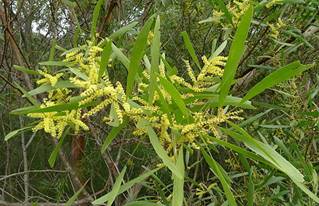
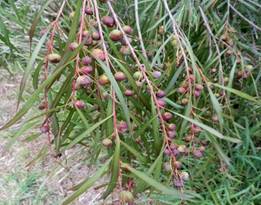 SGW flowers (left), and flowers replaced by galls
(right)
SGW flowers (left), and flowers replaced by galls
(right)
More information about SGW can be found here: https://www.landcareresearch.co.nz/__data/assets/pdf_file/0009/178974/sydney_golden_wattle_feasibility.pdf
More information about the narrow host range of the agents can be found here: https://www.landcareresearch.co.nz/__data/assets/pdf_file/0007/178972/host-ranges-agents-sydney-golden-wattle.pdf
Rīpota/Report
Richard Hill from Landcare Research has been contracted to complete the application on behalf of NRC. He has done several applications including the application to introduce control agents for the weed lantana in 2012[14]. This new application will discuss all of the likely risks, costs and benefits associated with the introduction of these two insects, including any impacts on Māori values.
The information that these agents are safe to introduce to New Zealand is strong with published evidence indicating that no native or other valued plants in New Zealand are at risk from these insects. However, the application, as noted will consider environmental, economic and social risks of introduction but none are expected to be significant.
To inform the application council is seeking thoughts from TTMAC on the proposal and input from the Māori Technical Advisory Group at the July meeting. To date the proposal for consultation with tangata whenua includes:
1. Discussions with Te Herenga
2. Consultation with the Ngai Tahu and Ngāpuhi HSNO Kōmiti.
3. A letter sent to Iwi Authorities and Treaty settlement entities in Taitokerau, specifically:
· Offering to meet with Te Hiku o Te Ika Iwi to due to invasion on Aupouri Peninsula.
· Offer to meet with Te Uri o Hau and Ngāti Whātua as well as Ngātiwai and Ngāti Manuhiri due to creeping invasion from the south.
4. Review and addressing issues raised in the report of a 2015 ERMA (now EPA) reference group https://www.landcareresearch.co.nz/__data/assets/pdf_file/0003/88338/Maori_Reference_Group_Report.pdf
5. Meeting with the Māori Technical Advisory Group
6. Provide information to interested iwi, hapū, marae, local organisations or interest groups
Council and Mr Hill now seek advice from TTMAC as to a process for engaging Māori of Taitokerau and provision of information to help inform people of both the weed and options for managing it.
Further, if any members of TTMAC have any views (for or against) on biological control, or about the introduction of insects for SGW control and wish to speak directly with Mr Hill, please contact him at hillr@landcareresearch.co.nz and he will get back to you. Alternatively, you can call him on 021 1376919.
Nil
Authorised by Group Manager
|
Name: |
Bruce Howse |
|
Title: |
Group Manager - Environmental Services |
|
Date: |
4 July 2019 |
Te Taitokerau Māori and Council Working Party item: 3.8
11 July 2019
|
TITLE: |
Environmental Awards 2019 |
|
ID: |
A1203641 |
|
From: |
Natasha Stubbing, Marketing and Engagement Manager |
Whakarāpopototanga/Executive summary
In March this year the Te Taitokerau Māori and Council Working Party (TTMAC) received a report on the inaugural Northland Regional Council Environmental Awards. At this meeting TTMAC was invited to nominate a person to be included in the judging panel.
This report provides a summary of the awards and winners of each category.
1. That the report ‘Environmental Awards 2019’ by Natasha Stubbing, Marketing and Engagement Manager and dated 17 June 2019, be received.
Tuhinga/Background
The inaugural 2019 Northland Regional Council Environmental Awards was a huge success, with 93 nominations received from across Northland in the eight categories. The awards, designed to recognise and celebrate kaitiakitanga in action, highlighted the ‘can-do’ attitudes and remarkable contributions large numbers of Northlanders from all walks of life are making to help our environment thrive. Guests representing the 39 finalists shortlisted in the eight award categories attended the celebration and announcement of the winners at Barge Showgrounds Event Centre on 23 May.
The initial 93 nominations were shortlisted to 39 finalists by a four-member judging panel which included TTMAC member, Mike Kake. With the panel awarding the Supreme Award/He Tohu Matua to Comrie Park Kindergarten – who also won the winner of the Environmental action in education category. The kaupapa of environmental sustainability is embedded in the heart of the Matarau-based kindergarten who aim to grow and develop lifelong learners through its philosophy of ‘Ngā Kākano Āpōpō– The Seeds of Tomorrow’.
Of special mention is Noho Taiao Te Rarawa Anga Mua who came a close second in the judging of the Supreme Award. The judging panel noted Noho Taiao as an ‘exceptional project’ for their unique, marae-based initiative that uses cultural identity linked to science to inspire and empower young Maori. Using Mātauranga Māori, it also supports job enrichment for students in environmental sciences. It was this inspirational mahi that saw Noho Taiao winning the Kaitiakitanga award.
A full list of finalists in each category is available from council’s website at www.nrc.govt.nz/environmentalawards but the winners of each category were:
· Environmental action in the community; Friends of Matakohe-Limestone Island Society (FOMLI)
· Environmental action in pest management; Puketotara Landcare Group
· Environmental action in education; Comrie Park Kindergarten
· Environmental action in water quality improvement; Whitebait Connection
· Environmental action in industry; Hancock Forest Management NZ - Northland Office
· Environmental leadership; Iwi Te Roroa – Waipoua Forest
· Environmental innovation; Steve Allan
· Kaitiakitanga; Noho Taiao, Te Rarawa Anga
There has been a lot of positive feedback from the community on the awards and appreciation for having their work acknowledged. Since the awards, council has d showcased the winners, highly commended and finalists in an eight-page spread in the Northern Advocate on 26 June. A copy of this has been provided with this agenda. Moving forward, it is hoped that these awards will become an annual event.
Nil
Authorised by Group Manager
|
Name: |
Jonathan Gibbard |
|
Title: |
Group Manager - Strategy, Governance and Engagement |
|
Date: |
4 July 2019 |
Te Taitokerau Māori and Council Working Party item: 3.9
11 July 2019
|
TITLE: |
Update: Annual Plan 2019/20 | Mahere-a-Tau 2019/20 |
|
ID: |
A1203650 |
|
From: |
Kyla Carlier, Corporate Planning Manager |
Whakarāpopototanga/Executive summary
Council adopted the Annual Plan 2019/20 | Mahere-a-Tau 2019/20 on 4 June 2019. This plan identifies changes to council’s activities and budgets, from what was previously approved in the Long Term Plan 2018-2028, for the financial year beginning 1 July 2019.
Only minor changes were proposed in this annual plan. Adoption followed a process of public consultation, and one additional change was made as a result of consultation.
1. That the report ‘Update: Annual Plan 2019/20 | Mahere-a-Tau 2019/20’ by Kyla Carlier, Corporate Planning Manager and dated 17 June 2019, be received.
Tuhinga/Background
Last year council adopted its Long Term Plan | Te Mahere Roa 2018-2028 which set out ambitious new programmes of work for pest management, looking after water, and flood protection, along with numerous other areas of development to support and advance community aspirations and council activities.
The Long Term Plan included a detailed budget for the 2019/20 year, however council revisits its budget annually to respond to any unforeseen or urgent circumstances that have arisen. Any required changes are identified and approved through the annual plan process.
Council has completed the process of developing the Annual Plan 2019/20 | Mahere-a-Tau 2019/20, with its adoption on July 4. Given that this annual plan follows an ambitious long term plan, council were looking to make only minor changes to budgets and programmes of work.
The following new spending was proposed, and subsequently approved:
• Helping our computer systems cope with the extra workload ($377,500);
• Buy vital water monitoring gear ($37,800);
• Keeping the Northern Transportation Alliance ticking along ($65,000);
• Replacing the engines on the Waikare a year earlier than planned ($110,000).
The annual plan process included a month-long period of public consultation, with the proposals set out in a simple consultation document, and feedback invited online, via email, and hardcopy. Members of the community were provided an opportunity to talk directly to councillors if they wished to. The consultation process was carried out in tandem with consultation on council’s proposed User Fees and Charges 2019/20, as is standard practice. The User Fees and Charges proposed minor updates, and more significant changes to the structure of fees for water permits.
30 submissions were received during the consultation period, and four parties spoke to councillors at a councillor/community meeting held on 10 April in Whangārei. The feedback received during the process can be found on council’s website: www.nrc.govt.nz/annualplan2019
A deliberations meeting was held on 7 May, where council considered all feedback received and made a decision on each of the proposals. At this time, they resolved to approve all of the proposed spending, and the addition of $20,000 to fund a scoping study of the health of the Hokianga Harbour. The additional funding was in response to several submissions received during the consultation process that raised concerns about the health of the Hokianga harbour, and requesting funding for a study involving tangata whenua and other key stakeholders.
The Long Term Plan budgeted a 7.9% rate increase for the 2019/20 financial year, which was proposed to increase to 8.6% in order to achieve the proposed new work. Higher-than-forecast regional growth (more ratepayers), means that all of the new work has been able to be incorporated at no additional cost to individual ratepayers. As a result, the total 2019/20 budgeted rates increase is now lower than budgeted, dropped from 7.9% to 7%.
The final Annual Plan 2019/20 | Mahere-a-Tau 2019/20 is available on council’s website www.nrc.govt.nz/annualplan2019
Nil
Authorised by Group Manager
|
Name: |
Jonathan Gibbard |
|
Title: |
Group Manager - Strategy, Governance and Engagement |
|
Date: |
24 June 2019 |
Te Taitokerau Māori and Council Working Party item: 3.10
11 July 2019
|
TITLE: |
Working Party Updates |
|
ID: |
A1203607 |
|
From: |
Sally Bowron, Strategy, Governance and Engagement Team Admin/PA |
1. That the report ‘Working Party Updates’ by Sally Bowron, Strategy, Governance and Engagement Team Admin/PA and dated 17 June 2019, be received.
Rīpota/Report
Pest Management Working Party (Chair: Cr Mike Finlayson)
The Pest Management Working Party met on 18 April 2019. The topics for discussion included:
· Community Engagement on Marine Biosecurity;
· Predator Free Northland PF2050 – Expression of Interest; and
· Pig Control on Private Land Surrounding Northland’s Kauri Forests.
Following discussion, the Pest Management Working Party provided advice on the following next steps:
· NRC to continue to work and explore options with Papa Taiao Earthcare, a community group based in the Far North to see how NRC can increase community pest monitoring and link with Enviroschools.
· Staff to look into the option of using freshwater sites e.g. moorings in rivers for marine pest management control.
· Staff to provide an update on Predator Free Northland PF2050 at the next meeting of the Pest Management Working Party.
· Staff to continue to liaise with Ministry of Social Development to discuss youth training schemes.
Reports from the 12 June Natural Resources Working Party (attended by member Murphy) and the 5 June Planning Working Party (attended by member Holloway) will be reported at the next formal meeting.
Authorised by Group Manager
|
Name: |
Jonathan Gibbard |
|
Title: |
Group Manager - Strategy, Governance and Engagement |
|
Date: |
4 July 2019 |
[1]An analysis of effects on tangata whenua and their taonga may be necessary in circumstances not outlined in this policy – it will depend on the circumstances.
[2]Food and places for obtaining natural foods and resources. The work (mahi), methods and cultural activities involved in obtaining foods and resources.
[3]This includes, for instance, kai awa (river food) kai repo (swamp food) and kaimoana (sea food).
[4]This includes, for instance, impacts on the quality of water used for ceremonial purposes.
[5] This includes, for instance, use of rongoa (medicinal) plants, and uses for raranga (weaving).
[6]Māori non-commercial fisheries are defined in the Fisheries Act 1996.
[7]As defined by the Marine and Coastal Area (Takutai Moana) Act 2011.
[8] A “limit” is the maximum amount of resource use available, which allows a freshwater objective to be achieved.
[9] See the following guidance for more information: http://www.mfe.govt.nz/sites/default/files/media/Fresh%20water/guide-to-freshwater-management-units_0.pdf
[10] See the following guidance for more information: http://www.mfe.govt.nz/sites/default/files/media/Fresh%20water/a-draft-guide-to-attributes.pdf
[11]https://www.nrc.govt.nz/media/9590/northlandregionalcouncilsprogrammeforimplementingthenationalpolicystatementforfreshwatermanagementmarch2018.pdf
[12] Council is likely to progress a plan change in the future to set catchment specific water quantity limits on a prioritised catchment basis. This work, and the seeking of advice regarding the involvement of tangata whenua in the plan change, will be brought to a future TTMAC meeting.
[14] Information pertaining to the lantana application can be found here https://epa.govt.nz/database-search/hsno-application-register/view/APP201171