|
Civil Defence Emergency Management Group Meeting Tuesday 4 June 2024 at 11.30am
|
|
|
|
|
|
Civil Defence Emergency Management Group Meeting Tuesday 4 June 2024 at 11.30am
|
|
|
|
|
Civil Defence Emergency Management Group Meeting
4 June 2024
Civil Defence Emergency Management Group Meeting Agenda
Meeting to be held in the Council Chamber
36 Water Street, Whangārei
on Tuesday 4 June 2024, commencing at
Recommendations contained in the agenda are NOT decisions of the meeting. Please refer to minutes for resolutions.
MEMBERSHIP OF THE Civil Defence Emergency Management Group Meeting
Chairperson, FNDC Deputy Mayor Kelly Stratford
|
WDC Mayor Vincent Cocurullo |
FENZ Representative Wipari Henwood |
KDC Councillor Gordon Lambeth |
|
Councillor Geoff Crawford |
NEMA Representative Mike Gillooly |
NZ Police Representative Superintendent Matt Srhoj |
KARAKIA / WHAKATAU
RĪMITI (ITEM) Page
1.0 Ngā Mahi Whakapai/Housekeeping
2.0 Ngā Whakapahā/apologies
3.0 Ngā Whakapuakanga/declarations of conflicts of interest
4.0 Ngā Whakaae Miniti / Confirmation of Minutes
4.1 Confirmation of Minutes - 5 March 2024 3
5.1 Receipt of Action Sheet 9
6.1 National Emergency Management Agency (NEMA) update 11
6.2 Government Inquiry into the North Island Severe Weather Events: Key Findings 15
7.1 Membership and appointments - Northland CDEM Group 19
7.2 Coordinating Executive Group chairs report 23
7.3 Update on the Te Taitokerau Resilience Action Plan 43
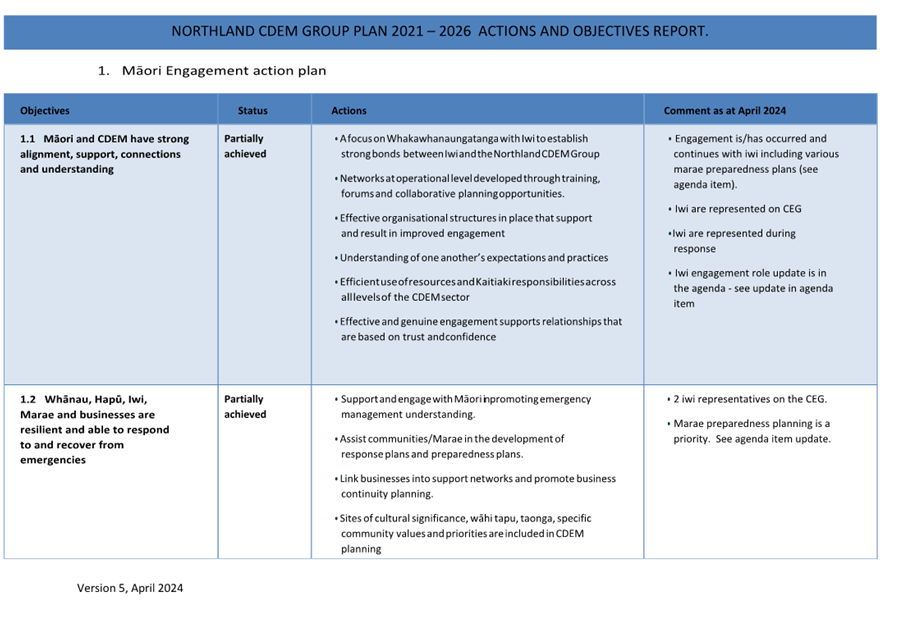
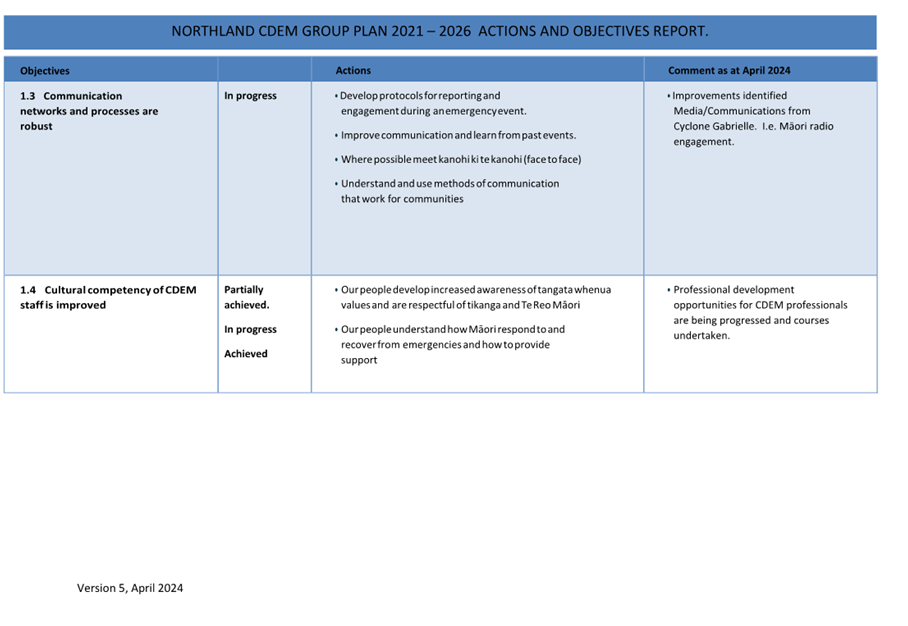
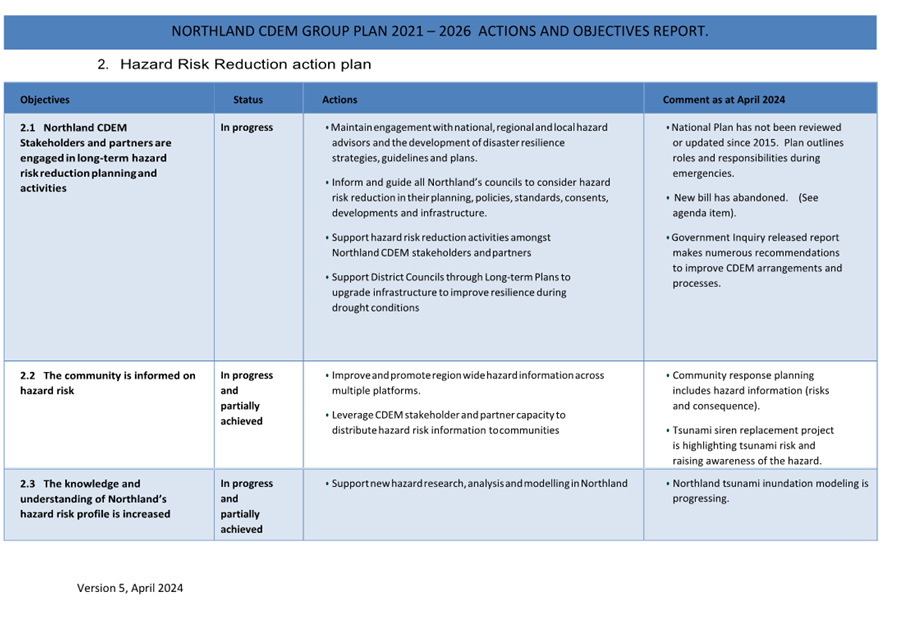
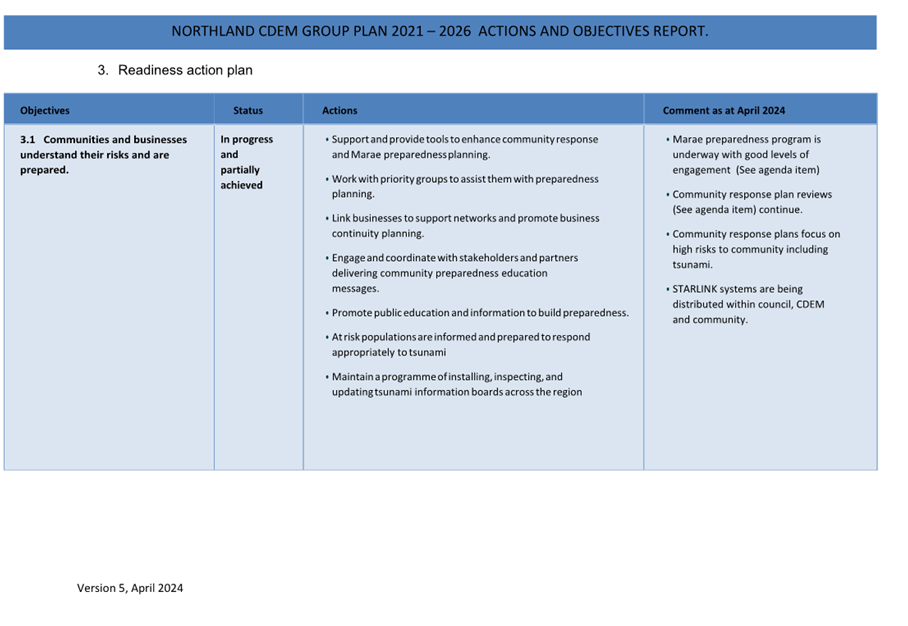
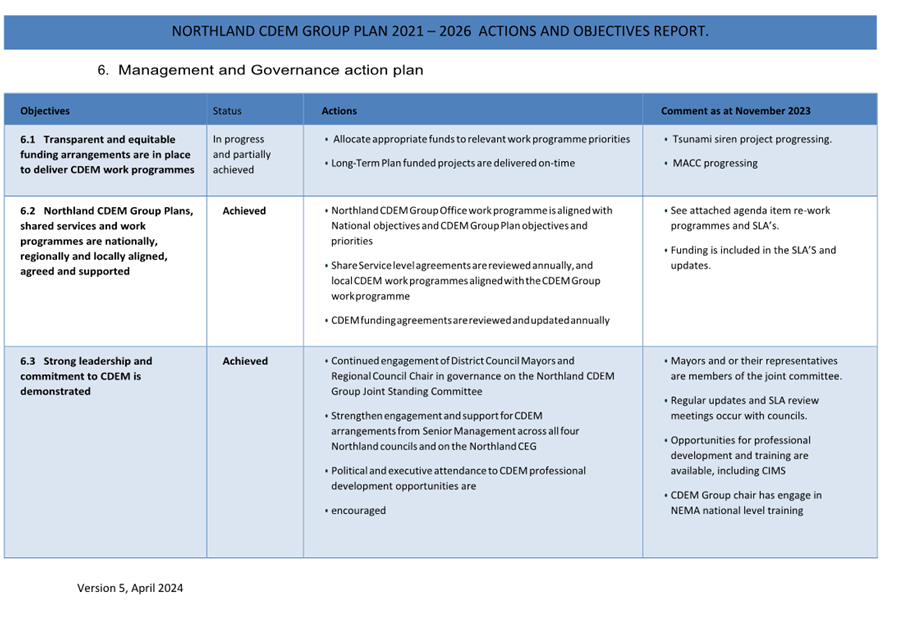
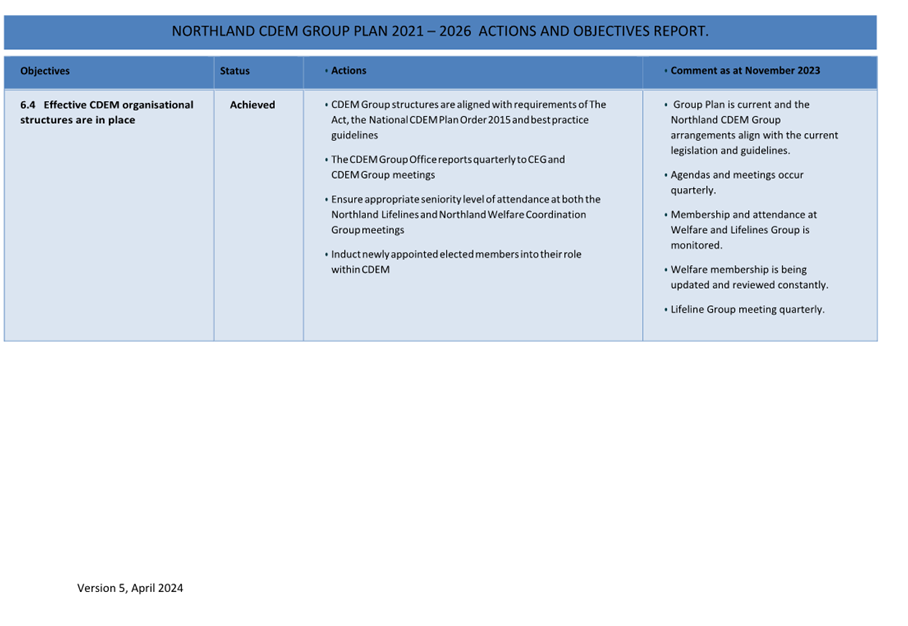
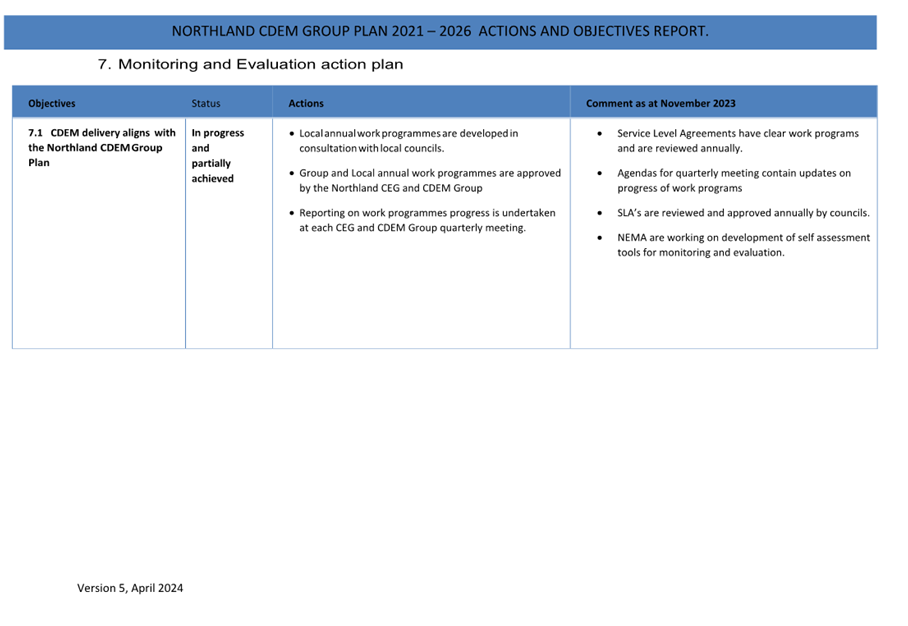
7.4 Northland CDEM Group plan 2021 - 2026 report on objectives and actions 49
Civil Defence Emergency Management Group Meeting item: 4.1
4 June 2024
|
TITLE: |
Confirmation of Minutes - 5 March 2024 |
|
From: |
Gavin Dawson, Governance Specialist |
|
Authorised by Group Manager/s: |
Louisa Gritt, Group Manager - Community Resilience, on |
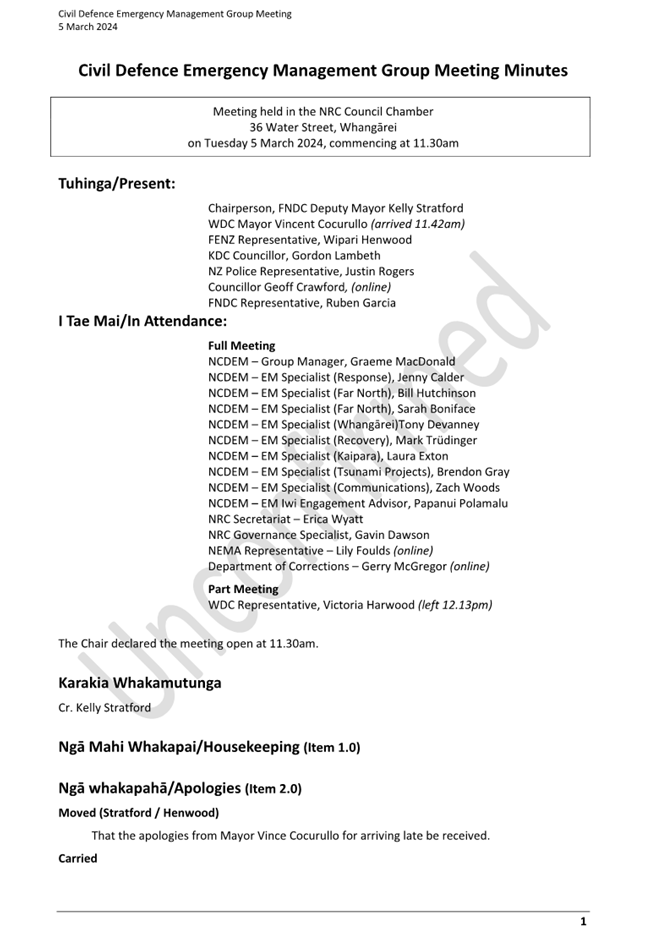
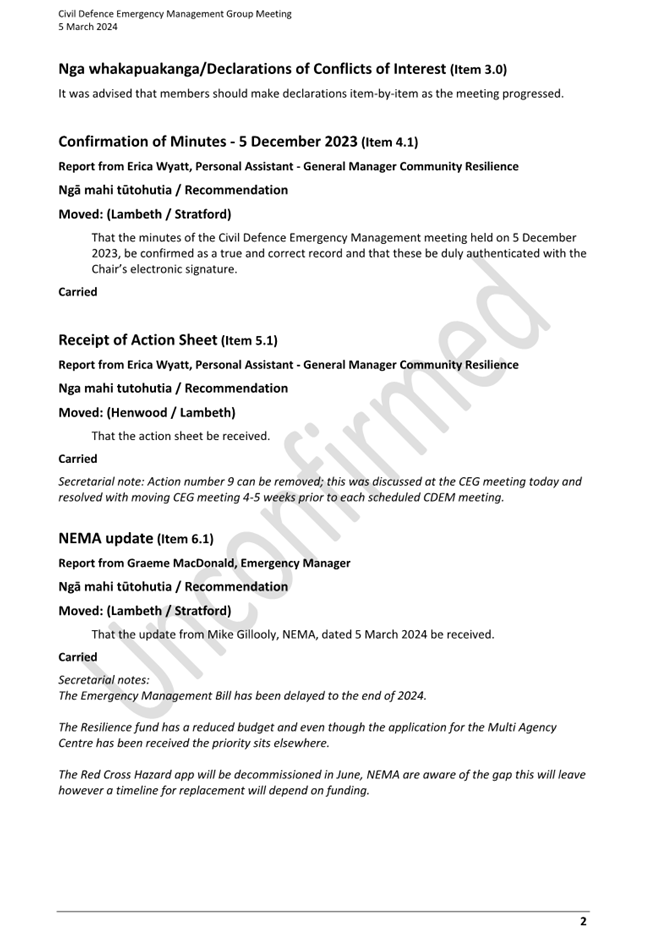
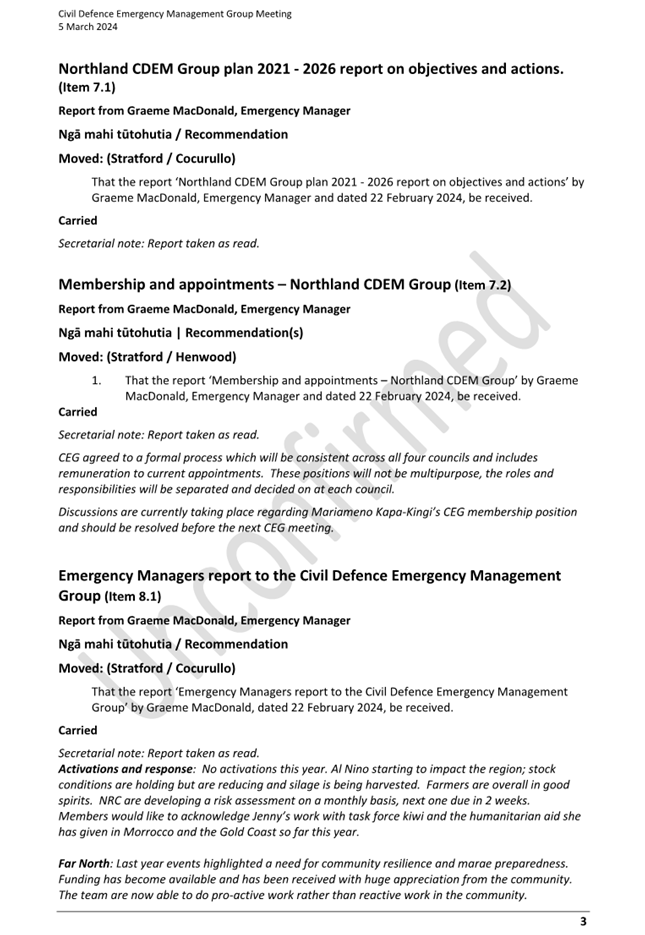
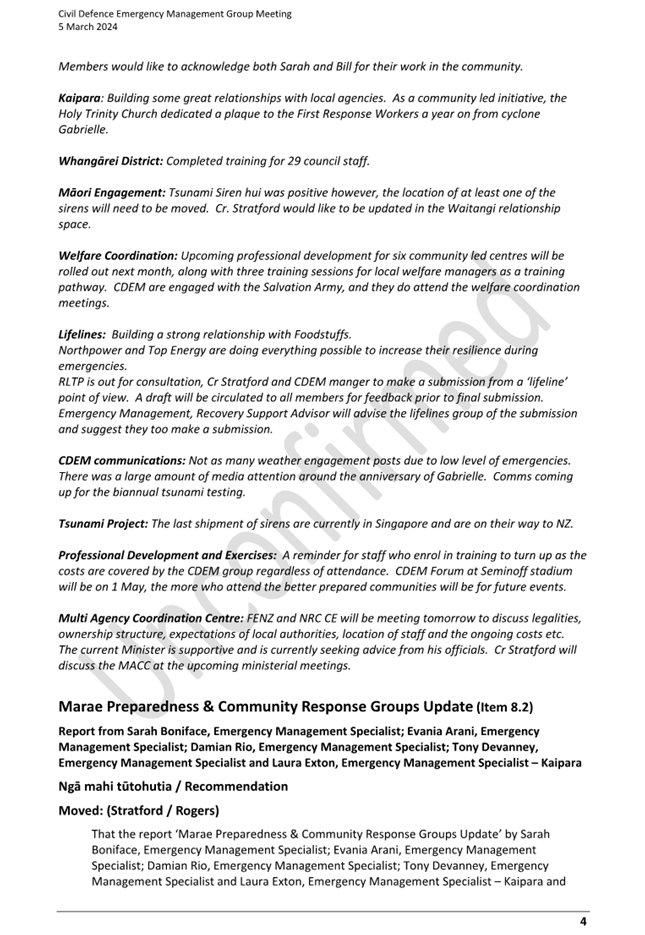
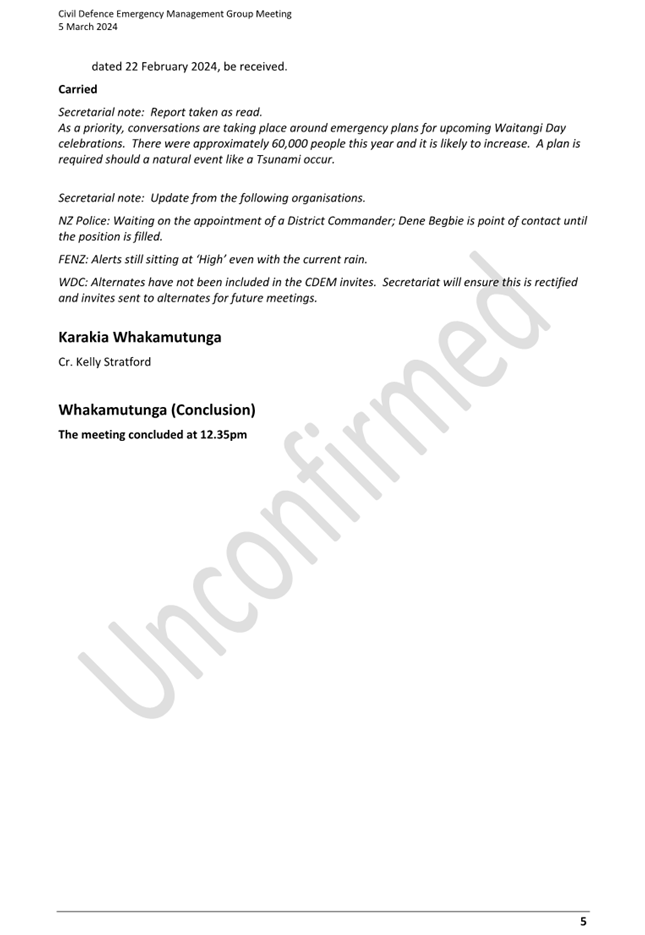
That the minutes of the Civil Defence Emergency Management Group Meeting held on 5 March 2024, be confirmed as a true and correct record and that these be duly authenticated with the Chair’s electronic signature.
Attachments/Ngā tapirihanga
Attachment 1: Minutes 5 March 2024 ⇩ 
4 June 2024
|
TITLE: |
Receipt of Action Sheet |
|
From: |
Gavin Dawson, Governance Specialist |
|
Authorised by Group Manager/s: |
Louisa Gritt, Group Manager - Community Resilience, on 24 May 2024 |
Whakarāpopototanga / Executive summary
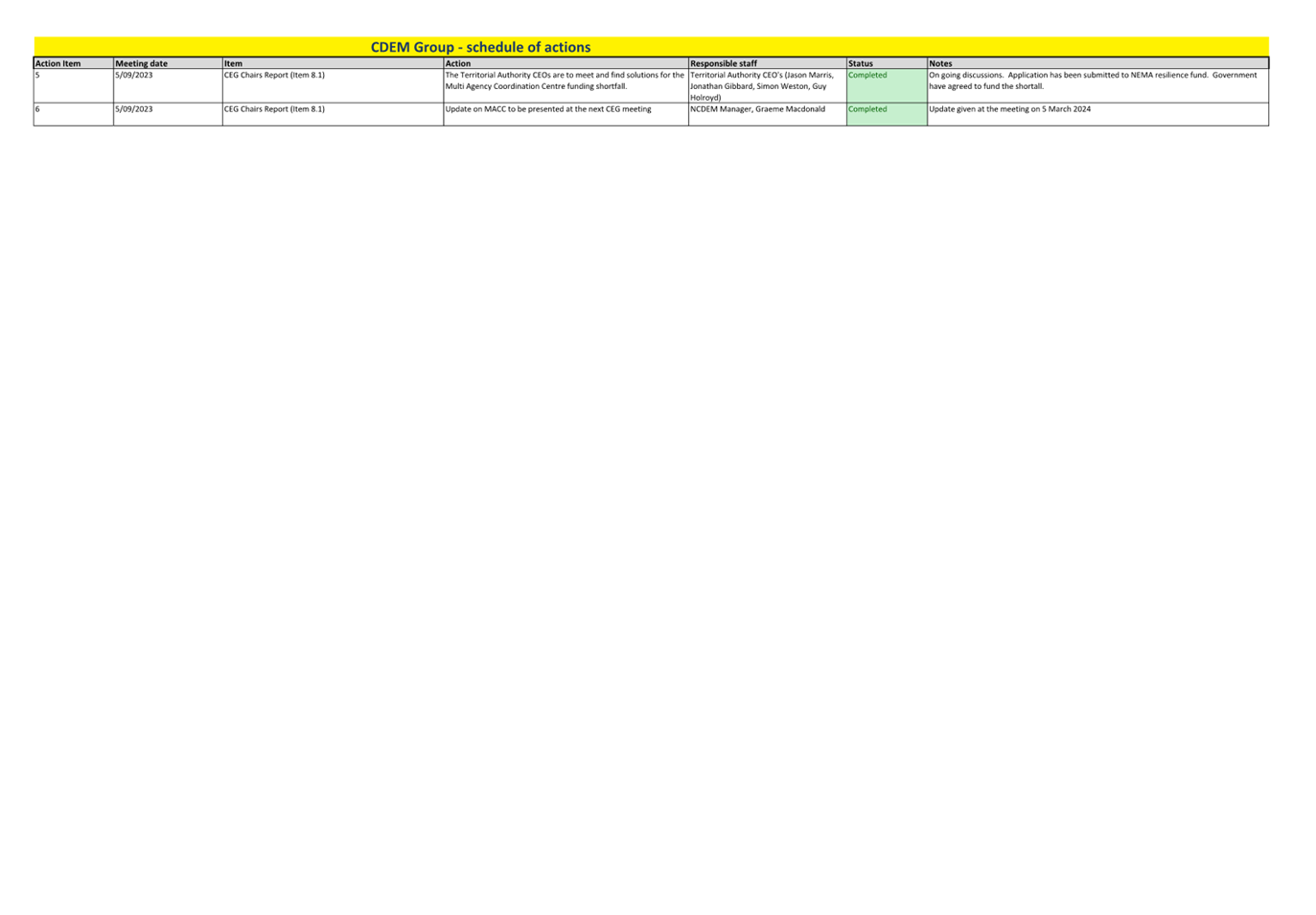
The purpose of this report is to enable the meeting to receive the current action sheet.
That the action sheet be received.
Attachments/Ngā tapirihanga
Attachment 1: Action Tracker ⇩ 
Civil Defence Emergency Management Group Meeting item: 6.1
4 June 2024
|
TITLE: |
National Emergency Management Agency (NEMA) update |
|
From: |
Mike Gillooly, NEMA representative |
|
Authorised by Group Manager/s: |
Louisa Gritt, Group Manager - Community Resilience, on 23 May 2024 |
Whakarāpopototanga / Executive summary
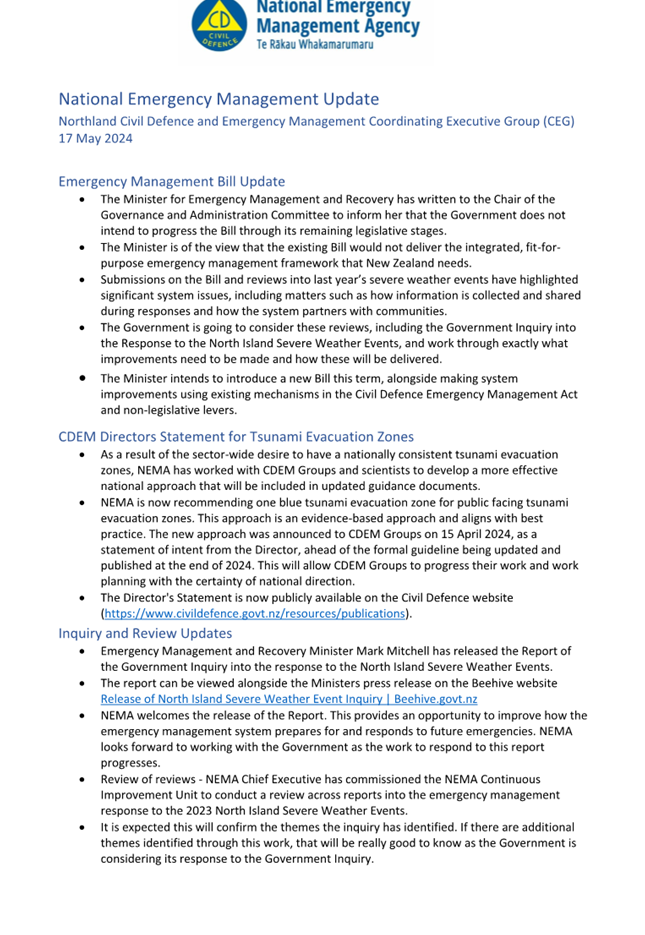
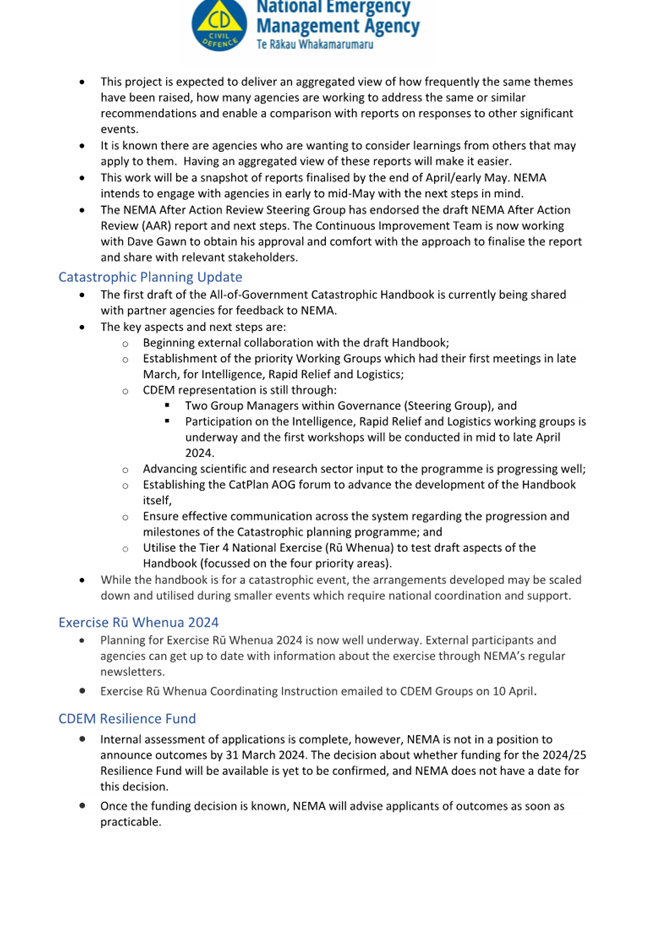
Attached for the information of the group is an update from the National Emergency Management Agency (NEMA).
That the report ‘National Emergency Management Agency (NEMA) update’ by Mike Gillooly, NEMA representative and dated 21 May 2024, be received.
Attachments/Ngā tapirihanga
Attachment 1: National Emergency
Management Agency (NEMA) update ⇩ 
4 June 2024
|
TITLE: |
Government Inquiry into the North Island Severe Weather Events: Key Findings |
|
From: |
Graeme MacDonald, Emergency Manager |
|
Authorised by Group Manager/s: |
Louisa Gritt, Group Manager - Community Resilience, on 23 May 2024 |
Whakarāpopototanga / Executive summary
The Report of the Government Inquiry into the Response to the North Island Severe Weather Events (the Inquiry), led by Sir Jerry Mateparae, provides a sobering analysis of New Zealand's emergency management system. In the wake of the devastating storms of early 2023, the Inquiry identified critical shortcomings and emphasized the need for a system that truly prioritises people and communities.
Effectively the Inquiry concluded that the New Zealand emergency management system is not fit for purpose and said that “As a country, we are not ready to respond to large-scale emergencies. Significant changes to the design, funding and operation of our emergency management systems are needed.”
The full report, including the Executive summary and full recommendations is available at
https://www.dia.govt.nz/diawebsite.nsf/Files/Government-Inquiry-into-Severe-Weather-Events/$file/Report-of-the-Government-Inquiry-into-the-Response-to-the-North-Island-Severe-Weather-Events.pdf
1. That the report ‘Government Inquiry into the North Island Severe Weather Events: Key Findings ’ by Graeme MacDonald, Emergency Manager and dated 22 May 2024, be received.
2. That the Emergency Manager provides a report on the recommendations from the ‘Report of the Government Inquiry into the Response to the North Island Severe Weather Events’ to the next meeting of the group outlining what actions can be implemented in Northland in the immediate term ahead of the government’s decisions on the recommendations.
Background/Tuhinga
This summary highlights the key findings of the Inquiry and outlines the crucial role of local councils in building a more resilient future.
The Inquiry found that:
“Underlying the issues experienced during the response were several factors, including:
• a lack of focus on and investment in readiness planning, activities, equipment, and supplies
• limited emergency management experience, capacity, and capability, including experience managing large-scale events
• councils not prioritising emergency management as a core function
• a lack of shared situational awareness across councils, National Emergency Management Agency (NEMA), and emergency responders
• communities and key organisations not being involved in planning activities
• an ad-hoc approach to bringing in expertise from around the country, and
• a significant mismatch between community expectations about what the emergency management response should offer and what it is able to deliver.”
Council Responsibilities and Recommendations
The Inquiry considered alternative approaches and options for the delivery of emergency management; however, it has recommended that emergency management delivery remain within councils.
Local councils are at the forefront of emergency management efforts. The Inquiry emphasizes the need to empower and equip councils to effectively serve their communities.
The following is a breakdown of key council responsibilities outlined in the report:
· Risk Management and Planning: Councils are responsible for assessing local risks, developing comprehensive emergency plans, and conducting regular risk assessments. These plans should involve community stakeholders and account for local vulnerabilities.
· Public Education and Awareness: Raising public awareness about potential risks and preparedness measures is crucial. Councils should develop and deliver targeted education campaigns, utilizing various communication channels to reach diverse populations.
· Community Engagement and Empowerment: Building strong relationships and fostering collaboration with community groups is essential. Councils can facilitate workshops, training programs, and exercises to equip communities to respond effectively in an emergency. Engaging with Iwi/Māori communities is particularly important to respect cultural protocols and incorporate traditional knowledge in planning and recovery.
· Infrastructure Management and Development: Councils are responsible for ensuring critical infrastructure (e.g., roads, bridges, communications networks) is resilient to natural hazards. They should prioritize infrastructure upgrades and maintenance to withstand extreme weather events.
· Emergency Response and Recovery: During emergencies, councils play a critical role in coordinating emergency services, shelters, evacuation plans, and resource allocation. Additionally, leading long-term recovery efforts, facilitating access to financial assistance and rebuilding infrastructure falls under their purview.
· Data Sharing and Communication: Effective information sharing across agencies and with the public is paramount. Councils should invest in robust communication systems and protocols for sharing real-time data during and after crises. This includes utilizing local media and ensuring accessibility of information for all residents, including those with disabilities or limited language skills.
Recommendations for Strengthening Council Capacity:
The Inquiry recognises the need to empower and resource local councils for effective emergency management.
Key recommendations outlined in the report include:
· Increased Funding: Increased central government funding is needed to support local councils in their emergency preparedness and response efforts. This includes funding for infrastructure upgrades, public education campaigns, and emergency stockpiling.
· Improved Coordination and Collaboration: Stronger collaboration and information sharing between central and local government is crucial. Regular joint workshops, drills, and improved communication protocols will facilitate a more unified response.
· Legislative Review: A review of the Civil Defence Emergency Management Act 2002 is recommended to clarify roles and responsibilities, streamline processes, and ensure councils have the necessary legal authority to effectively manage emergencies.
· Capacity Building: Investing in training and development programs for council staff responsible for emergency management will enhance their preparedness and response skills.
Moving forward
The Inquiry made a number of recommendations, some are relevant to the work that we do in Northland, and others relate to the wider emergency management sector.
The Department of Prime Minister and Cabinet is evaluating the recommendations and will initially report to cabinet in June.
The Emergency Managers Special Interest Group made up of the 16 CDEM Group Managers meet in Wellington on 21, 22 & 23 May to consider the inquiry, the recommendations, and to develop an initial response to the inquiry at the request of DPMC. The Minister of Emergency Management also meet face to face with the SIG to hear initial feedback from the group.
Conclusion:
The North Island Severe Weather Events Inquiry serves as a wake-up call for New Zealand's emergency management system. By acknowledging the systemic shortcomings and strengthening local council capacity, the country can build a more resilient and community-centered approach. Increased funding, improved communication, and fostering community ownership are critical for ensuring the safety and well-being.
The Northland CEG considered this agenda item at its recent meeting and have asked the Emergency Manager to provide a report that outlines the recommendations from the inquiry together with an outline of whether the recommendations are relevant to Northland and if so what our approach to the recommendations will be. This is being done ahead of the government’s deliberation of the inquiry recommendations and any decisions on implementation or otherwise. Our approach is based upon the premise that there are some recommendations that can be acted upon immediately and in the short term ahead of any decisions.
Attachments/Ngā tapirihanga
Nil
Civil Defence Emergency Management Group Meeting item: 7.1
4 June 2024
|
TITLE: |
Membership and appointments - Northland CDEM Group |
|
From: |
Graeme MacDonald, Emergency Manager |
|
Authorised by Group Manager/s: |
Louisa Gritt, Group Manager - Community Resilience, on 23 May 2024 |
Whakarāpopototanga / Executive summary
This report provides an up-to-date list of members and key appointments for the Northland CDEM Group. The list of key appointments is available on the Northland CDEM Group plan webpage. Key appointments are also referenced in the group plan.
1. That the report ‘Membership and appointments - Northland CDEM Group’ by Graeme MacDonald, Emergency Manager and dated 21 May 2024, be received.
2. That the CDEM Group appoints Kylie Cox, as an alternate Group Welfare Manager and Jack Rudolph as a Local Controller for Kaipara District council area.
Tuhinga | Background
Membership of the Northland Civil Defence Emergency Management Group:
Ÿ Councillor Stratford FNDC - Chair of CDEM Group
Ÿ Councillor Crawford NRC
Ÿ Mayor Cocurullo Mayor, WDC
Ÿ Councillor Lambeth KDC
Ÿ Wipari Henwood Commander, Fire and Emergency NZ
Ÿ Superintendent Matt Srhoj Northland Police District Commander
Ÿ Mike Gillooly NEMA (observer)
Membership of the Coordinating Executive Group:
Ÿ Jonathan Gibbard CEO, NRC
Ÿ Ruben Garcia FNDC delegated representative
Ÿ Simon Weston CEO, WDC – Chair of CEG
Ÿ Jason Marris CEO, KDC
Ÿ Wayne Ewers Inspector, NZ Police
Ÿ Graeme Quensell Assistant Area Commander, Fire and Emergency NZ
Ÿ Paula Martin Northland Health
Ÿ Ben Lockie St John Ambulance
Ÿ Mike Gillooly NEMA (observer)
Ÿ Liz Philips Interim MoH Representative
Ÿ Russell Watson Northland Lifelines Group
Ÿ Evania Arani Northland Welfare Coordination Group
Ÿ Hone Dalton Iwi Representative
Ÿ Snow Tane Iwi Representative
Group Controllers:
Ÿ Graeme MacDonald
Ÿ Alistair Wells
Ÿ Calvin Thomas
Ÿ John Burt
Ÿ Simon Weston
Ÿ Victoria Harwood
Ÿ Louisa Gritt
Ÿ Jenny Calder
Local Controllers for the Whangārei District:
Ÿ Calvin Thomas
Ÿ Simon Weston
Ÿ Victoria Harwood
Local Controllers for the Kaipara District:
Ÿ Alistair Dunlop
Ÿ John Burt
Local Controllers for the Far North District:
Ÿ Alistair Wells
Ÿ Ken Ward
Group Welfare Managers:
Ÿ Evania Arani
Ÿ Chris McColl
Ÿ Raewyn Smythe
Local Welfare Managers for the Whangārei District:
Ÿ Paula Urlich
Ÿ Toby Hoey
Ÿ Kate Biddlecombe
Local Welfare Managers for the Kaipara District:
Ÿ Jenny Rooney
Local Welfare Managers for the Far North District:
Ÿ Kirsty Roper
Ÿ Kara-Mia Rogers
Ÿ Ange Simonsen
Group Recovery Managers:
Ÿ Graeme MacDonald
Ÿ Jenny Calder
Ÿ Mark Trudinger
Local Recovery Managers:
Ÿ TBA (WDC)
Ÿ Andy Dowdle (FNDC)
Ÿ Glynis McCarthy (KDC)
New Appointments
The following are recommendations for new appointments to be made by the CDEM Group -
Alternate Group Welfare Manager appointment
Kylie Cox (Northland CDEM – EM Recovery Support Advisor).
· Over 10 years’ experience as a local welfare manager for the Far North District Council.
Local Controller role for the Kaipara District Council
KDC have identified Jack Rudolph to be appointed by the CDEM Group as a Local Controller for the Kaipara District Council. Jack’s experience and skills include:
· Current Iwi Liaison Manager, KDC.
· Strong relationships with iwi, hapū and marae within the district.
· CIMS4 training completed.
· All CIMS Function trainings completed.
· Over 42 years working in leadership, management and command with the Royal New Zealand Navy. This includes proven experiencing engaging, liaising, and coordinating with multiple government agencies and Māori communities, groups and organisations.
· Experience, skills and knowledge can be utilised to provide better outcomes for Māori and community wellbeing.
· NZDF and RNZN Command, Management and Leadership promotion courses for all ranks from Ordinary Seaman to Warrant Officer, and Commissioned for Rank (CFR) to Lieutenant, RNZN.
· Current member of the Royal New Zealand Navy Reserves.
· Worked as Iwi Liaison in the KDC Dargaville Incident Control Point during the Cyclone Gabrielle, coordinating with local operators and iwi to provide outreach and welfare support to isolated communities in the area.
Local Recovery Manager Appointments
· On 14 April Whangarei District Council advised that they were in the process of making an appointment to the vacant Local Recovery Manager role.
Attachments/Ngā tapirihanga
Nil
Civil Defence Emergency Management Group Meeting item: 7.2
4 June 2024
|
TITLE: |
Coordinating Executive Group chairs report |
|
From: |
Graeme MacDonald, Emergency Manager and Brendon Gray, Emergency Management Specialist - Tsunami Projects |
|
Authorised by Group Manager/s: |
Louisa Gritt, Group Manager - Community Resilience, on 23 May 2024 |
Whakarāpopototanga / Executive summary
This report provides a summary of activities undertaken by or directly related to the delivery of the Northland Civil Defence Emergency Management Group plan over the period since the last CEG meeting in March 2024.
That the report ‘Coordinating Executive Group chairs report ’ by Graeme MacDonald, Emergency Manager and Brendon Gray, Emergency Management Specialist - Tsunami Projects and dated 22 May 2024, be received.
Page
1. Activations and response 23
2. CDEM Group 24
3. Far North CDEM Update 24
4. Kaipara CDEM Update 25
5. Whangārei District CDEM Update 26
6. Council CDEM Roles, Responsibilities, and Remuneration Alignment Update 26
7. Welfare Coordination Group Update 27
8. Northland Lifelines Group Update 27
9. CDEM Communications Update 28
10. Tsunami Project and plan 29
11. Community Response Planning and Marae Planning update 30
12. Cyclone Gabrielle recovery 32
13. Multi Agency Coordination Centre 32
14. Professional Development and Engagement 33
1. Activations and response
No response activations or
deployments have occurred in the last quarter.
2. CDEM Group
The NEMA National Controller, Wendy Wright, visited the Northland region on 29, 30 April and 1 May. She visited Kaipara, Whangarei, Far North District Councils and the Northland Regional Council meeting with Mayors, elected representatives and Chief Executives. The purpose of the meetings was to provide introductions and establish relationships and included discussions on the recent reviews, legislation updates and NEMA’s role in emergencies.
The CDEM Group Manager attended the National Group Managers Special Interest Group meeting and National Group Managers Leadership Group meeting. Both meetings focused on the Government Inquiry recommendations. A separate report is attached regarding the Government Inquiry into the North Island Weather events.
Recruitment is underway to fill the vacancy of Recovery Support Specialist, as Kylie Cox will move into the Emergency Management Specialist - Kaipara role whilst Laura Exton takes leave without pay for 6 months.
Sarah Boniface, Emergency Management Specialist has resigned to take up a role in the health sector. Sarah’s contribution to the CDEM Sector over the past 5 years has been of a very high standard, as she has established herself as a leader in Emergency Management in the Northland region, particularly in the Far North. Sarah will continue to be involved in emergency management in Northland with the health sector.
A letter was received from Te Tira Ārai Urutā I The Royal Commission of Inquiry into COVID-19 Lessons, formally thanking the Northland CDEM Group for engaging with them last February. The chair express his thanks for discussing our experiences and insights from the pandemic. He commented that our insights, reflections, and perspectives were of great value, and that they will contribute to the shaping of the final report and help to inform future pandemic preparedness.
3. Far North CDEM Update
Emergency Management Specialists - Far North – Bill Hutchinson and Sarah Boniface
Activities undertaken by the Far North Emergency Management Specialists have focused on community engagement to support and enhance Marae and community resilience and reviews of response plans.
Community engagement activities are laid out in 11. Community Response Planning and Marae Planning update.
The bi-annual tsunami alarm test was carried out at the change of day light saving on 7 April. All of the alarms sounded as per their operating specification; however, faults were reported with some of the strobe lights on alarms in the Russell and Houhora communities. Due to the alarm replacement program now underway, a decision has been made not to replace the lights (at an approximate cost of $500.00 each) to reduce unnecessary expenditure of council funds.
Note: There will be an overlap of the new and existing alarms as part of the replacement program. During this time when tests are undertaken, if an alarm does not sound, it will be replaced with a new unit which include an operational strobe light.
Other activities undertaken have been relative to the 2023-2024 Work Plan as outlined in the Far North District Council Service Level Agreement.
4. Kaipara CDEM Update
Emergency Management
Specialist - Kaipara – Laura Exton
Activities undertaken by the Emergency Management Specialist (EMS) -
Kaipara have been relative to the 2023-2024 Work Plan as outlined in the
Kaipara District Council Service Level Agreement. It has focused on the
continued execution of KDC’s Actions for Improvement plan (post Cyclone
Gabrielle), and community engagement.
Community engagement activities are laid out in 11. Community Response Planning and Marae Planning update.
The bi-annual tsunami siren alarm testing was conducted at the change of daylight saving on 7 April 2024. The test for the Kaipara District went well – the only fault reported across the district was already known and being worked on by Northpower.
A training session introducing EOC leadership staff to NEMA and the national emergency management environment was held on Wednesday 10 April, to help staff understand the industry they work in.
CIMS training week was held in
Dargaville Monday 4 March - Friday 8 March, including an EOC Exercise on the
Friday. The exercise was a success, with feedback from staff saying they felt
much more confident working in a CIMS response environment now than they did
post-cyclone.
|
|
|
|
|
Recruitment continues for the KDC Emergency Operations Centre team. Currently 42% of KDC’s FTEs are CIMS-trained and identified as members of this team. A focus is on recruitment and development for key roles such as Local Welfare Manager and Local Controller.
5. Whangārei District CDEM Update
Emergency Management Specialists - Whangārei –
Tony Devanney and Damian Rio
WDC EOC progressing well with ICT, policy, procedures re-new and review. There is still work to do on the WDC Kete/SharePoint file System, as well as setting up Teams for an event. New CIMS vests ordered. Phone systems set up and tested. Function email systems tested. Once a number of staff completed the upcoming Function training in May we will ‘test’ each Function in the EOC and run an exercise later in the year.
We have scheduled 18 courses in the Whangarei area this year with a number of CIMS4 courses and numerous Function courses (they are open to all Northland and stakeholders).
The annual Tsunami Board checks are completed. The National inundation modelling is underway and will progress in the second half of the year with the possibility of using the Tauranga modelling.
It is nearly time to negotiate the Service Level Agreements with the Councils, where currently we will review the current SLA and potentially fine-tune it.
A Tsunami Maritime Plan has been reviewed and renewed for the NRC. Along with some other reviewed plans, the Whangarei Evacuation Plan has been updated. (Still waiting on the disabilities team to provide information for the plan).
6. Council CDEM Roles, Responsibilities, and Remuneration Alignment Update
The Coordinating Executive Group (CEG) has agreed on a proposal to ensure alignment across all four Northland Councils in the way that councils recognise CDEM roles, responsibilities, and remuneration.
The following items have been approved by the CEG:
1. Agrees to include the following
wording in all Council job descriptions:
"As a Council employee, you may be called upon to assist in the
response and recovery efforts during civil defence emergency events. Additionally,
you may be required to participate in relevant emergency management training to
maintain Council's readiness."
2. Agrees that all Councils will implement an EOC Endorsement Form currently used by the Whangārei District Council.
3. Agrees that a standardised, regionally consistent job description (1-2 pages) for the roles of Controller, Welfare Manager and Recovery Manager are to be be developed by the CDEM Group and implemented by Councils.
4. Agrees that fair remuneration (as outlined below) be set for staff officially appointed to the following key CDEM roles:
§ Controller at $2,500 per annum
§ Welfare Manager and Recovery Managers at $1,000 per annum
5. Delegates the CDEM Group Manager to implement the above resolutions by way of 2024-2025 Council CDEM work programmes.
Standardised, regionally consistent job descriptions (point 3) are currently being developed.
This package will be implemented for the 2024-2025 Council CDEM work programmes.
7.
Welfare Coordination Group
Group Welfare Specialist – Evania Arani
The next Welfare Coordination Group (WCG) meeting is scheduled for 06 June 2024. The content for the agenda is still to be confirmed but the main focus for the meeting will be around the disability sector.
Engagements
The Group Welfare Specialist has met with or attended meetings or events with the following agencies over the past three months:
· Red Cross
· Taiaho
· NEMA – Welfare Contact
· MBIE TAS
· WDC – Disability Advisory Group
· Northable
· Volunteering Northland
· MSD
· Animal Welfare Sub-Function Group
· Financial Assistance Sub Function Group
WelNAS
The WelNAS needs assessment tool is nearing completion with only minor tweaks being made to dashboards. We are aiming to have this project complete and ready to roll out at a Needs Assessors training that has been scheduled for Local Welfare Managers and Welfare staff in June.
LWM’s Training Plan
A welfare training plan for 2024/25 has been developed and circulated to Local Welfare Managers. The training plan consists of an introduction to Welfare (Takatu), Intermediate Level Welfare Function, Civil Defence Centre, Privacy Commission and Mental Health 101 training.
Welfare Training
Over the past 3 months a priority has been coordinating training for staff who work in the welfare function as well as helping to deliver training out to some of our community response groups. More details, including numbers of attendees, have been reported in this report under 14. Professional Development and Exercises.
8. Northland Lifelines Group Update
A Northland Lifelines Group meeting was held on Friday 22 March 2024. The group received a presentation from Meridian Energy regarding their latest development project - Project Ruakākā BESS. The group found this presentation very informative. Work continues on the Draft Severe Weather Plan which has been reformatted and now has a strong emphasis on the 4Rs. Agencies are currently reviewing our critical infrastructure list across the region.
Engagement
The Lifelines Programme Manager has attended the following meetings over the last 3 months:
· Regional Lifelines Group Programme Managers quarterly hui
· Regional Lifeline Utility Coordinator quarterly hui
· Auckland Lifelines Group Steering Committee
· NRC Natural Hazards team regarding the proposed NRC risk portal
Work continues to strengthen and enhance relationships with all members of the group.
9. CDEM Communications Update
CDEM Facebook page insights, February 1 2024 – May 1 2024
Ÿ Page visits: 9,400
Ÿ Facebook Page followers: increased by 112
Ÿ Total Facebook page followers as of 1 Feb 2024: 38,058
Our top performing post was for a combined heavy rain, strong wind, and severe thunderstorm watch on April 11, which had reach of approximately 26,142: https://www.facebook.com/civildefencenorthland/posts/pfbid02FVPsiQZAAWHoeZ2Adk5QDBfRUErBUH1MUFqzwWjwmjb8SHFhb4JusXZj9hH84vpAl
While we don’t normally do posts for weather watches (public communication usually starts at warning level), the combination of three watches at once, plus the public attention this weather system had gathered from its impacts in the South Island, warranted a post to address public concerns around this event and any potential impacts to the region.
Apart from weather related posts, our next best performing posts were related to:
Tsunami Siren testing, with one post having an estimated reach of 23,700: https://www.facebook.com/civildefencenorthland/posts/pfbid02qR9F65NPXXknKhT81ixqZAfrwpLZEEDdUQDwvmxiJ5MZzAptvE3mHVVmNmwuuYsCl
Promotion of the Cyclone Gabrielle Appeal Trust Fund with an estimated reach of 18,825: https://www.facebook.com/civildefencenorthland/posts/pfbid0LHE5byrsXhnr2qqkbDSZ9j6t3bYjVZLCNRxgtGUVFyVpdYv2GxeDtBxiADCU3Pchl
An update on SH1 State Highway 1 over the Brynderwyn Hills, sharing NZTA’s post around the slip that has delayed the reopening with 16,426 estimated reach: https://www.facebook.com/civildefencenorthland/posts/pfbid0prP3iVrAT1Xap9gadpjjjZNkNxnDPCyGz3XSgEhEeKePMDd2DmbdMBB2s5PzLJKNl
Engagement on posts remains steady overall and follower numbers are also steadily increasing.
Northland CDEM Web section insights, February 1 2024 – May 1 2024
Ÿ Total page visits: 11,487
Ÿ Most popular pages:
1. Listen to the tsunami siren sounds: 4942
2. Tsunami warnings how to get ready: 686
3. Northland tsunami siren replacement project: 619
The website view numbers remain consistent across both the number of total views and the most popular links used – with siren testing and promotion of the tsunami siren replacement project likely contributing to these being the most viewed pages.
Communications – Tsunami siren replacement project
With the rollout of the sirens now underway, communications around the project have ramped up accordingly. Communications on the project to date have consisted of media releases, social media, print ads/public notices, website updates, flyers to residents, as well as providing this information to our district council partners to share on their channels.
The goal of these communications is to keep our communities informed about the project, so they know what these new sirens are, and the importance of them being placed in their community.
Due to the number of sites and amount of information, all communications are geared towards providing general information about the project, while also sending people to the webpage so they can get any specific information they want to know about their area or the sirens.
Some further reactional communications were required, as two sites were put up ahead of schedule and most of our planned communications.
Please see the Tsunami Project and plan section for further details.
The next lot of communications will focus on providing key information to our elected members and community groups to enable them to have better conversations around the project and better support it. More general communications and updates on the rollout will follow through the usual channels.
Please note that in conjunction with the project communications the team have been conducting community engagement, largely focused on landowners, leaseholders, the local CD groups, local hapū and other community groups in our networks.
10. Tsunami Project and plan
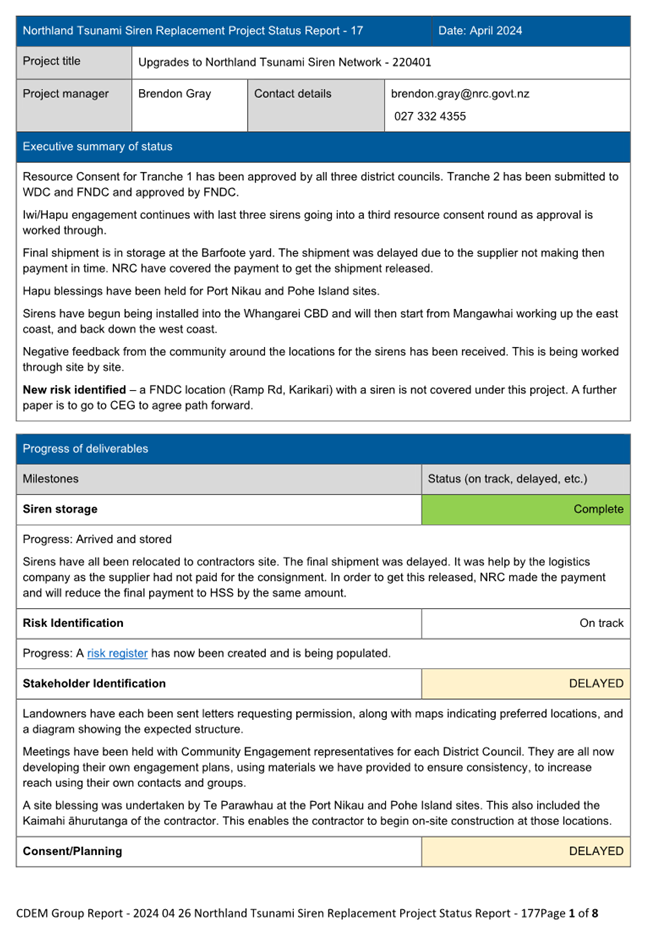
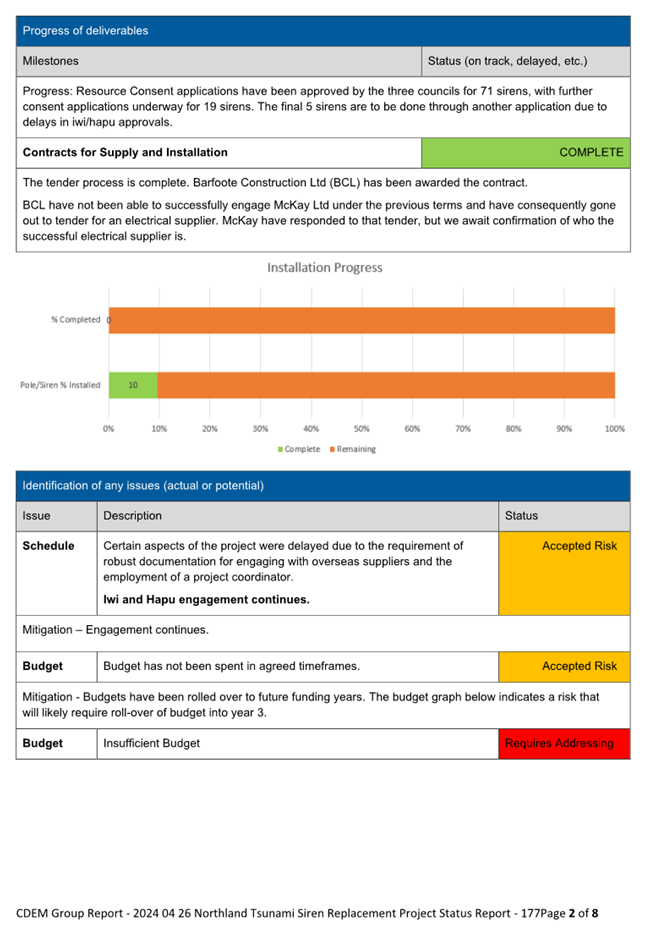
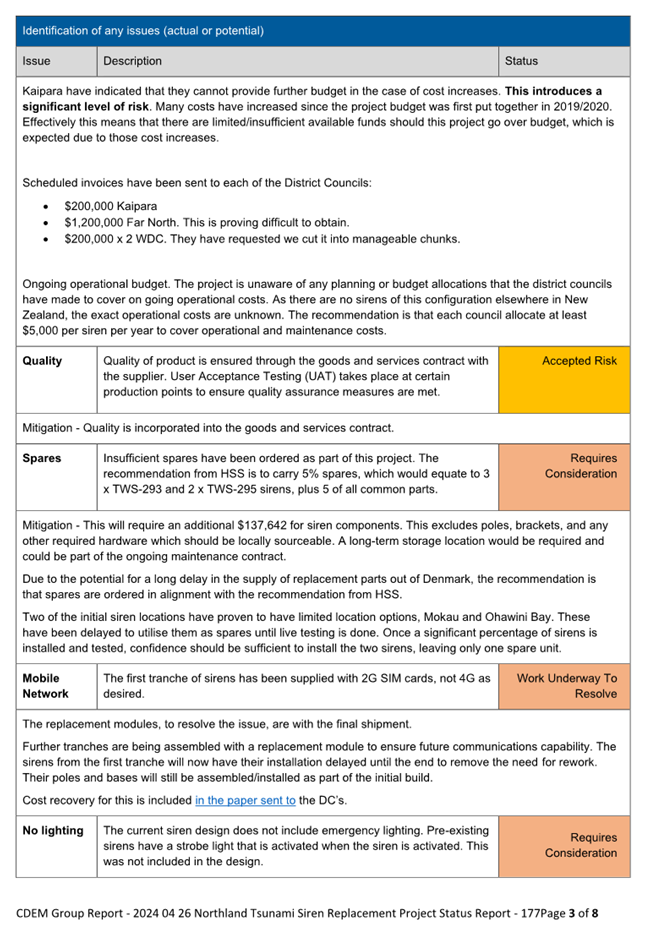
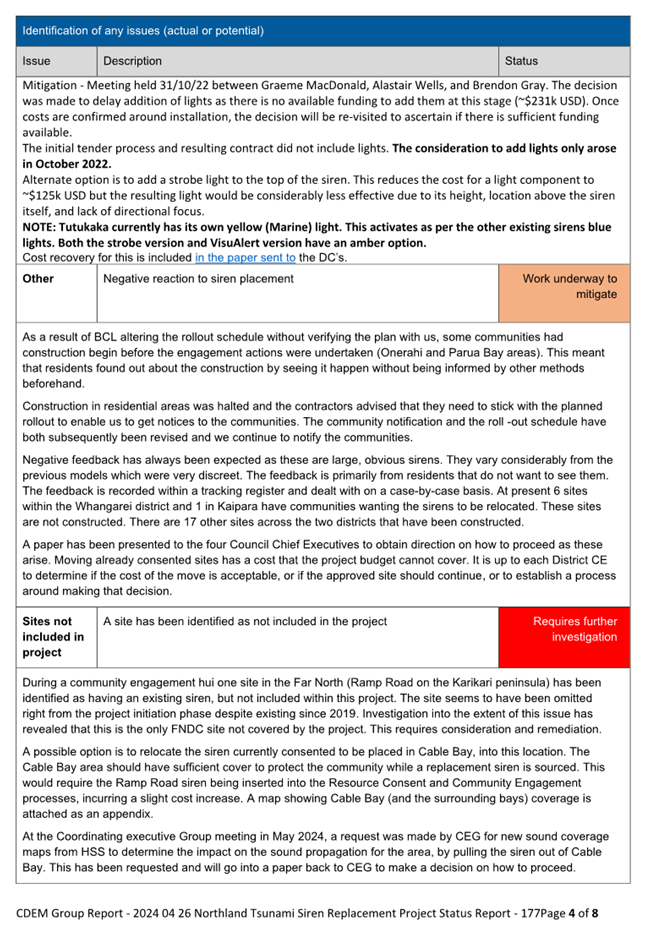
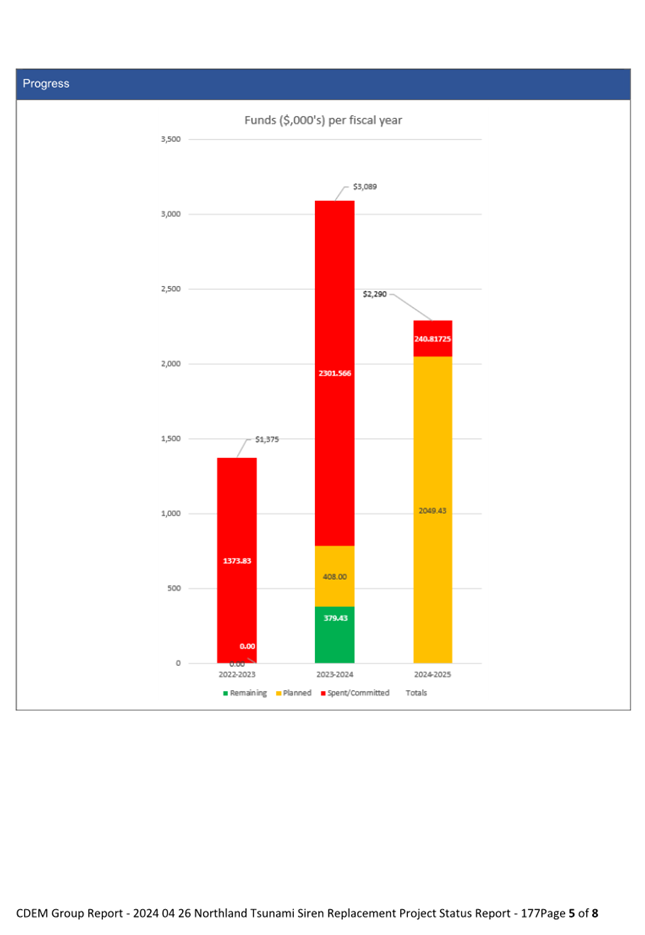
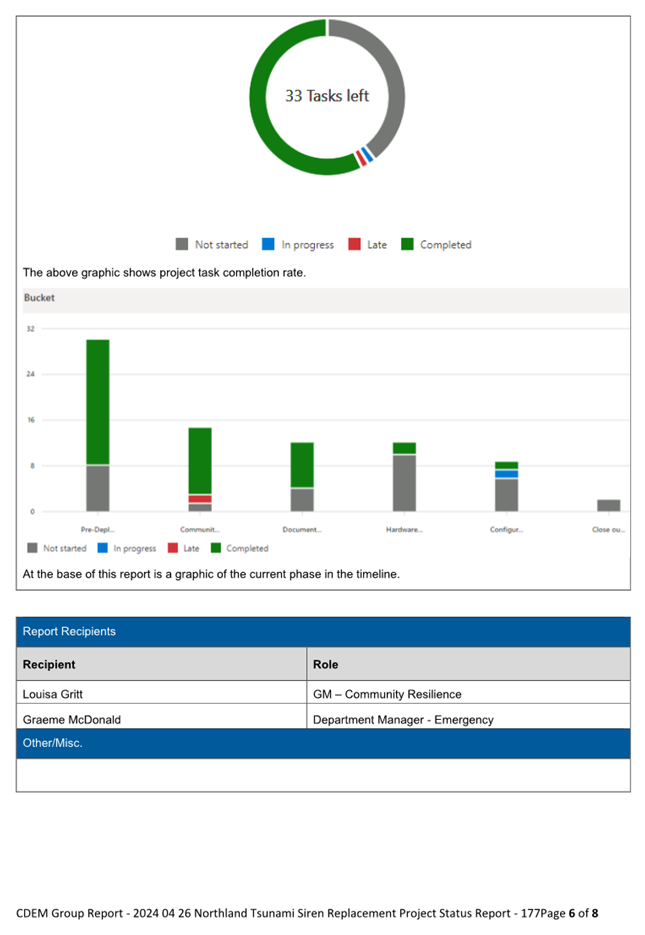
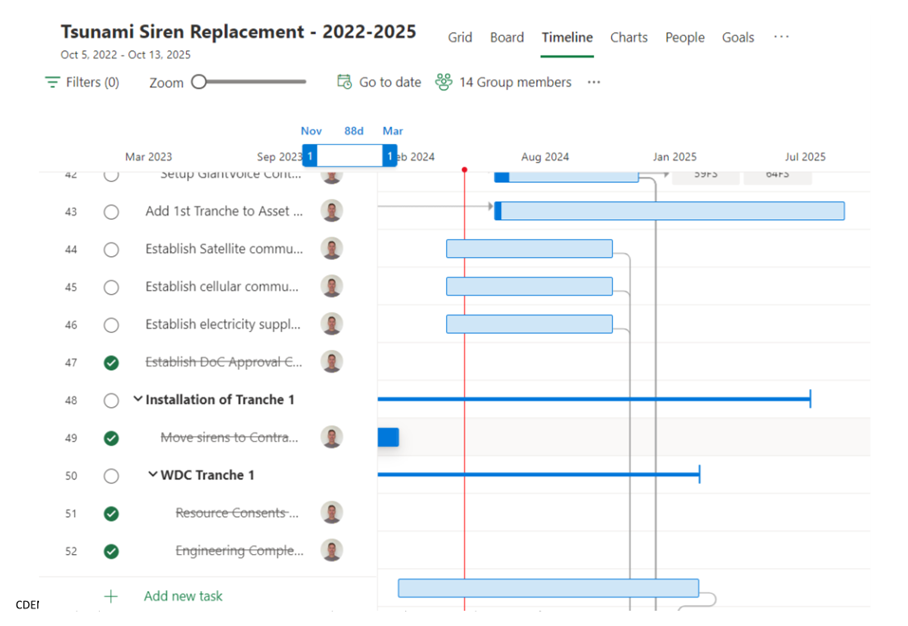
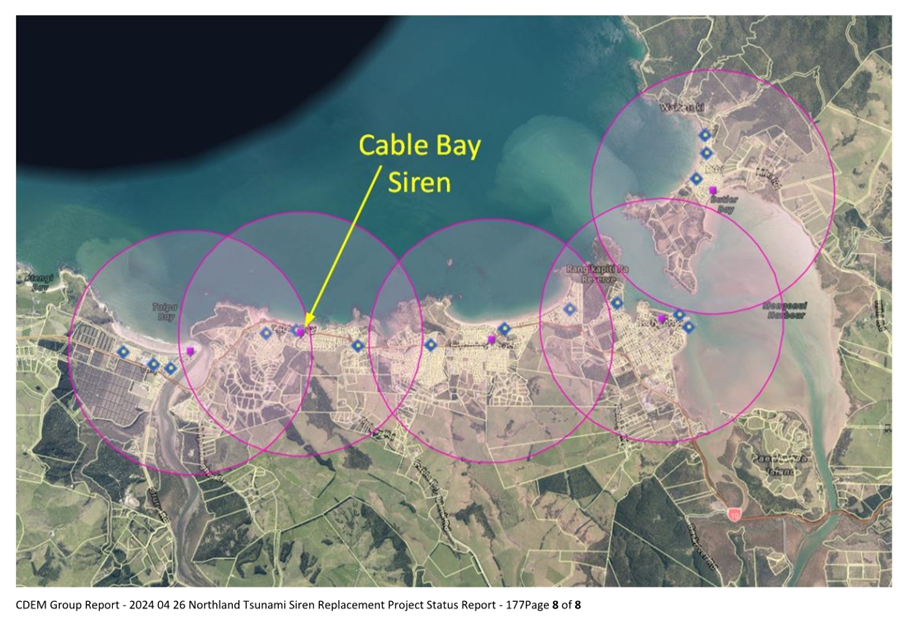
Communities have been raising concerns about the location of the sirens, in particular in the Whangarei district. Unfortunately, the contractor erected the siren in Parua Bay ahead of schedule and ahead of the planned community communications roll out. The team have been responding to inquiries as well as meeting with communities that are concerned. Briefs have been prepared for NRC councillors so that they can response to questions from their communities and these will be supplied to district councils should they wish to do something similar. The attached project report provides further detail on the project progress. At this stage our highest risk is around community engagement.
Tsunami Inundation Modelling Project
Initial models have been created (blocked out) for the Northland coastline, at roughly 60 grided areas, and trial model runs have begun on the Ahipara area as a starting point.
The preliminary report has three scenarios run at magnitude 9.1:
· Southern Vanuatu,
· Southern Tonga-Kermadec, and
· Puysegur Trench.
Each scenario results in Tsunami Amplitude, Current Speed, Overland Flow Depth and Overland Flow Speed maps being created. Further scenarios will be run at lower magnitudes.
Further models are expected in June. Following the availability of the models, they will be imported into GIS layers.
11. Community Response Planning and Marae Planning update
Emergency Management Specialists - Far North, Whangārei, Kaipara and Emergency Management - Iwi Engagement Advisor
Total number of plans per district, including marae preparedness plans
Far North District – 35
Whangārei District – 17
Kaipara District – 12
Community engagement activities
undertaken by each district’s Emergency Management Specialist for the
last reporting period are laid out below.
Total number of plans reviewed, created or updated per district (including marae preparedness plans)
Far North District
· Rangitane, Doves Bay and Opito Communities has also been completed
· Taupo
Bay
Whangārei District
· Waipu
Kaipara District
· Nil
Community and Māori engagements per district
Far North District
· Engagement with:
o Te Hapua
o Taupo Bay
o Rangitane Community
o Motuti Marae
o Karikari
Peninsula
· Attended Community Response Group (CRG) and/or community meetings in:
o Ngati Kahu Runanga
o Taipa marae
o Haititiamarangai
marae
Whangārei District
· Engagement with,
o Te Aroha Marae
o Te Parawhau
o Ngāti Kahu o Torongare hapu
o Kaikou Marae
o Tau Henare Marae
o Korokota Marae
o Ngatiwai Trust Board
o Māori Women’s Welfare League
o Whakapara Community Hall Trust
· Flood Resilient Māori Communities and Marae - Initial engagement with Marae,
o Mokau Marae
o Otetao-Reti Marae
o Ngatiwai
Marae
· Attended Community Response Group (CRG) and community meetings in:
o Oakura CRG
o Whakapara CRG
o Tutukaka Coast CRG
o Whangarei Heads CRG
o Te Waiariki CRG
o Pipiwai CRG
o Parua Bay CRG
o Tamaterau/Waikaraka CRG
o Onerahi CRG
o Waipu/Langs Beach CRG
o Whananaki CRG
Kaipara District
· Engagement with:
o All existing CRG groups
o Matatina & Pananawe marae
o Te Houhanga o Rongo marae
o Te
Uri o Hau Environs
· Attended Community Response Group (CRG) and/or community meetings in:
o Dargaville
o Kaiwaka
o Kaipara Police Hapū
12. Cyclone Gabrielle recovery
· Continued to coordinate the Ngā Manga Atawhai project. This project has now processed 2110m3 of wood, met its target of 120 trees during March and April, and distributed free firewood to more than 100 households.
· Met with the Minister for Rural Communities and Associate Minister of Agriculture, Mark Patterson, about Ngā Manga Atawhai.
· MBIE have confirmed that the following marae and community sites will receive funding for stand-alone solar power systems via the Community Resilience Programme:
o Parirau Marae
o Terenga Paraoa Marae
o Haitaitaimarangi Marae
o Maiteihe Marae
o Holy Trinity Anglican Church
o Motuti Marae
o St John's Hall Kaiwaka
o Korokota Marae
o Te Aroha Marae
o Matihetihe Marae
o Oturu Marae
· Began work on the ‘final’ Cyclone Gabrielle report for Northland. This will be prepared once the DIA funding is acquitted after 30 June, and most of the directly-delivered recovery projects are complete. Following the style of the Regional Recovery Report and the community consultation / stories of community resilience document, the final report will be a public document, showcasing the work not only of NCDEM, but also the Councils, iwi, government agencies, and communities.
· The Tsunami Projects specialist, assisted by the District Council EMSs, has sourced and packaged the Starlink systems for Northland’s District Councils, which should go out in May.
· Welfare Manager began the Community-Led Centre training for community organisations.
· Continued coordinating the all-of-Councils FOSAL monthly meetings.
· Have been invited to present at this year’s EMPA (Emergency Media Professionals’ Association) conference and National Lifelines Forum.
· As reported at the December CEG and Group meetings, the lessons identified/debrief and exit strategy will be prepared once the main recovery deliverables have been met. Given the District Council CEOs have requested an extension of decision-making re FOSAL until 31 October, the exit strategy will need to be prepared before then, and signed off once FOSAL operational arrangements are in place.
13. Multi Agency Coordination Centre
A meeting was held on Friday 10 May with FENZ representatives to discuss establishment of the project including:
1. Establishing the governance group, membership and meeting frequency, and reporting
2. High level project timelines
3. First draft of key terms and project implementation.
Since the meeting was held after the agenda preparation a verbal update will be provided.
14. Professional Development and Engagement
Exercise Rū Whenua
Planning for Exercise Rū Whenua, a Tier 4 (National) exercise spread over 3 days (12 June, 26 June and 10 July) continues. Key stakeholders have been advised and will be included in the exercise opportunity.
The aim of the exercise is to improve New Zealand’s ability to respond to and recover from a significant destructive event.
Whilst this scenario is based on the South Island Alpine Fault Earthquake response (SAFER) framework and NEMA’s response in national coordination, this is an opportunity for Northland to provide a coordinated response and to plan for and manage concurrent events.
Northland CDEM will be
participating in the exercise and as per standard operating procedure, will
call a multi-agency teleconference on the morning of 12 June to coordinate
Northlands response to the event.
Day 1 – 12 June
The Group ECC will be activated, however no EOC activations will be required.
The Group ECC will:
· be seeking relevant information from councils and other agencies though BAU channels to identify deployable capability,
· be requesting status reports from partner agencies and stakeholders,
· be providing SITREPS to NEMA, (including offers of support and deployable capability as above), and
· conducting planning to respond to concurrent events and to support the national response.
Timings will be advised for:
· National Warning System (Exercise event notification),
· ECC teleconferences, and
· Status Report ‘due’ timings.
Day 2 - 26 June
The ECC will not be
activated. This is a tabletop exercise, and it is not yet clear what
input from agencies will be required and how this exercise will incorporate the
regional groups.
Day 3 – 10 July
The ECC will not be activated. This is a tabletop exercise to be held in Wellington.
Northland Emergency Management (EM) Forum
Northland CDEM hosted the annual EM Forum on 1 May at Semenoff Stadium. With over 280 registered delegates from across the rohe, this was the biggest audience since pre-covid.
Guest speakers provided insights into a variety of EM related topics including leadership, community coastal impacts, business continuity, cordon management, power connections during major storm event, media campaigns that change mindsets, regional updates, and preparedness work in the disability sector.
We’d like to acknowledge
the staff from our supporting agencies and sector partners who presented.
Sharing information, learnings and knowledge allows us all to improve how we
support our communities before, during and after an event, as well as
strengthening relationships with agencies and our community partners, including
marae and community response groups.
In the last quarter we have hosted a number of training sessions, including specialised training for community groups and Council staff in the space of both Community Led Centre (CLC) and Civil Defence Centre’s (CDC).
Following the EM Forum, we had Al Lawn, a controller from Selwyn District Council, share his knowledge during a Controllers Workshop well attended by controllers from across the councils as well as CDEM staff.
Attendance is noted in the table below:
|
Training |
Attendees |
||||||
|
FNDC |
KDC |
NRC |
WDC |
CDEM |
Agency |
Community |
|
|
CIMS4 |
|
9 |
1 |
28 |
|
4 |
|
|
CIMS Function |
|
10 |
|
|
2 |
|
|
|
Welfare Function (Intermediate level) |
3 |
4 |
2 |
7 |
5 |
|
|
|
CDC |
2 |
4 |
0 |
8 |
5 |
|
|
|
CLC |
|
|
|
|
|
|
50 |
|
Controller workshop |
2 |
2 |
|
2 |
11 |
|
|
As we continue to develop and maintain skills of the staff who work in the EOC space, we cannot stress the importance of council staff being released from their BAU to complete this training.
CDEM staff continue to take opportunities to attend NRC courses and online forums where possible to continue gaining knowledge and learning.
Attachments/Ngā tapirihanga
Attachment 1: Tsunami Siren Replacement
Project Status Report ⇩ 
4 June 2024
|
TITLE: |
Update on the Te Taitokerau Resilience Action Plan |
|
From: |
Louisa Gritt, Group Manager - Community Resilience |
|
Authorised by Group Manager/s: |
Louisa Gritt, Group Manager - Community Resilience, on 23 May 2024 |
Whakarāpopototanga / Executive summary
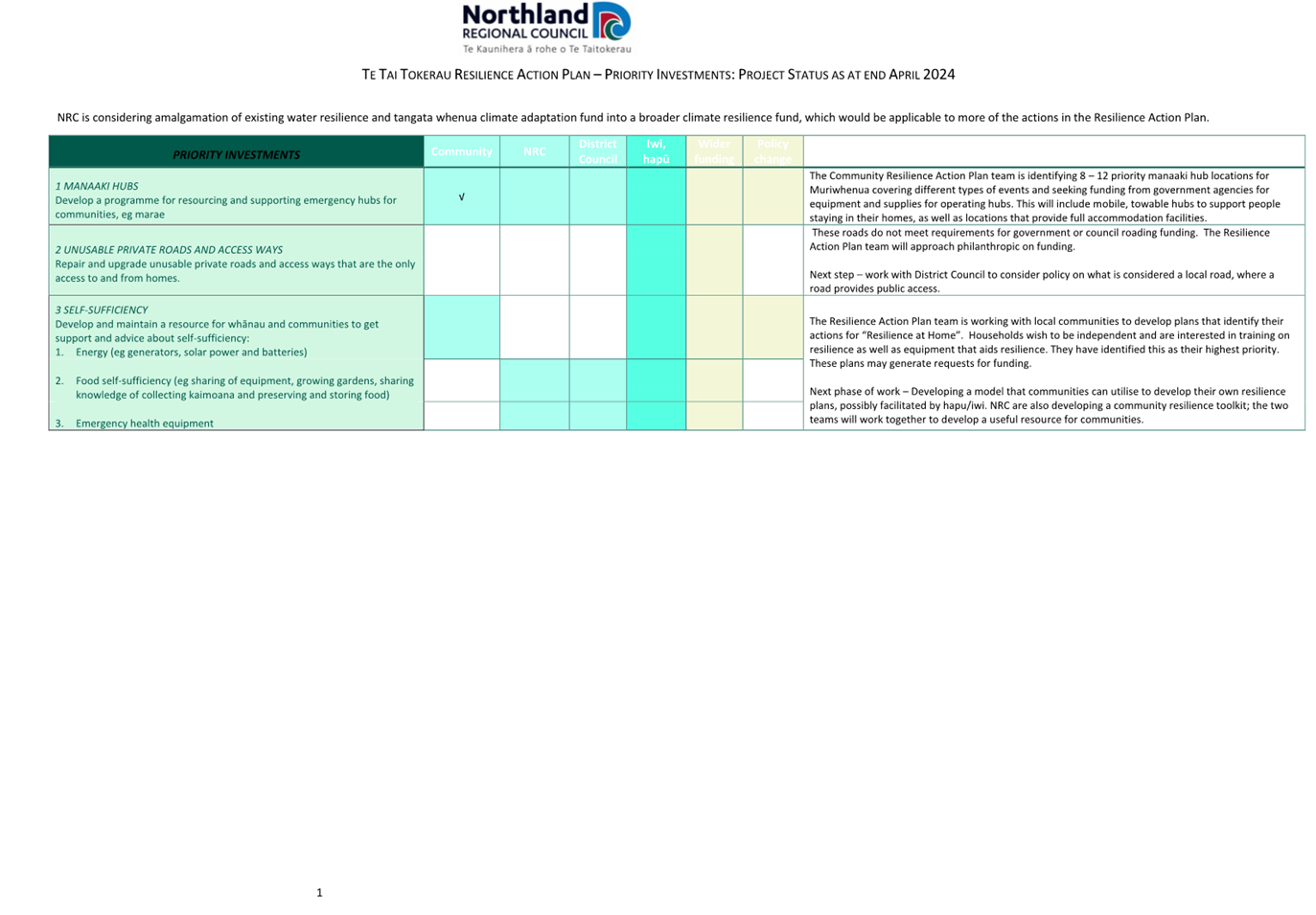
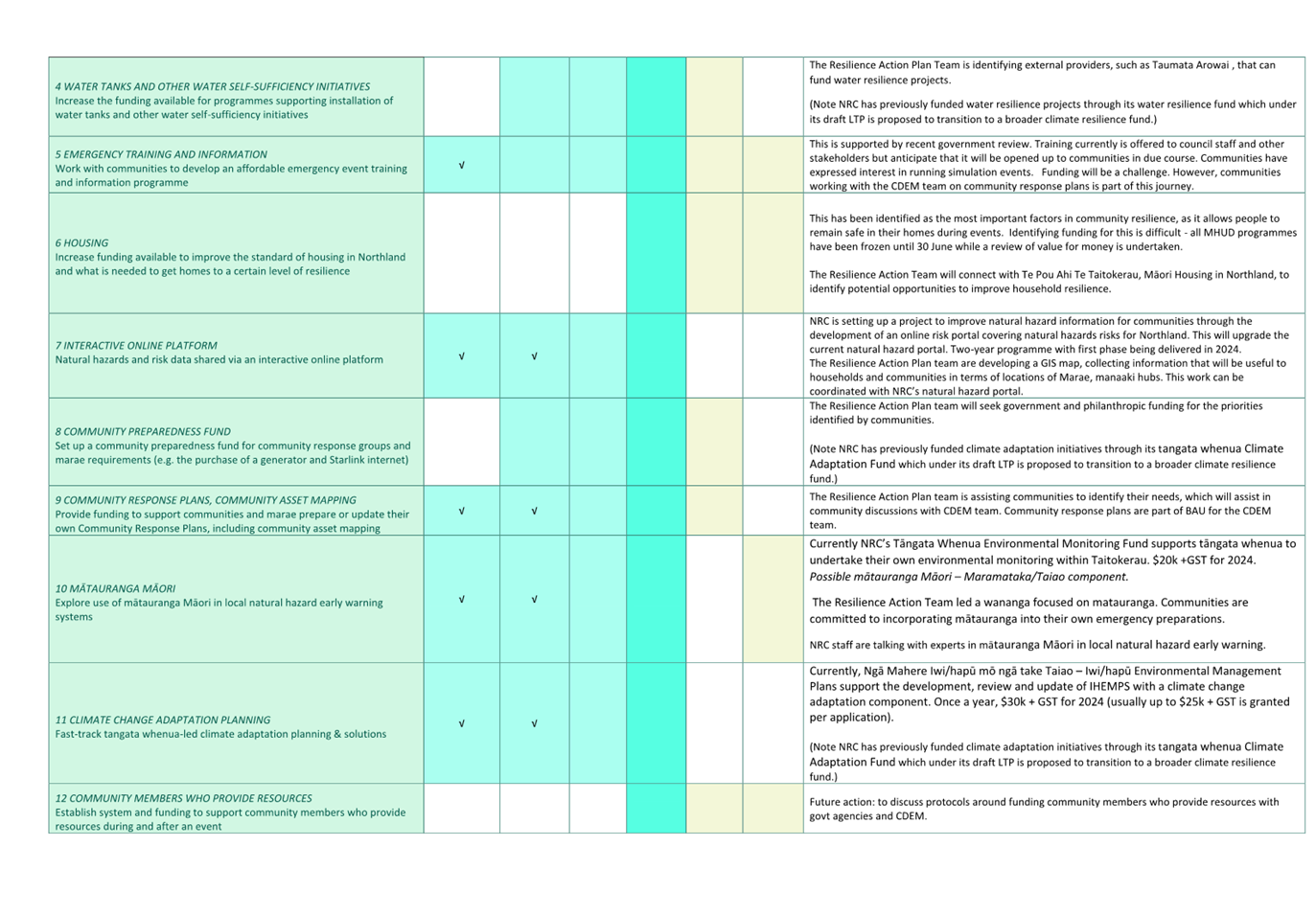
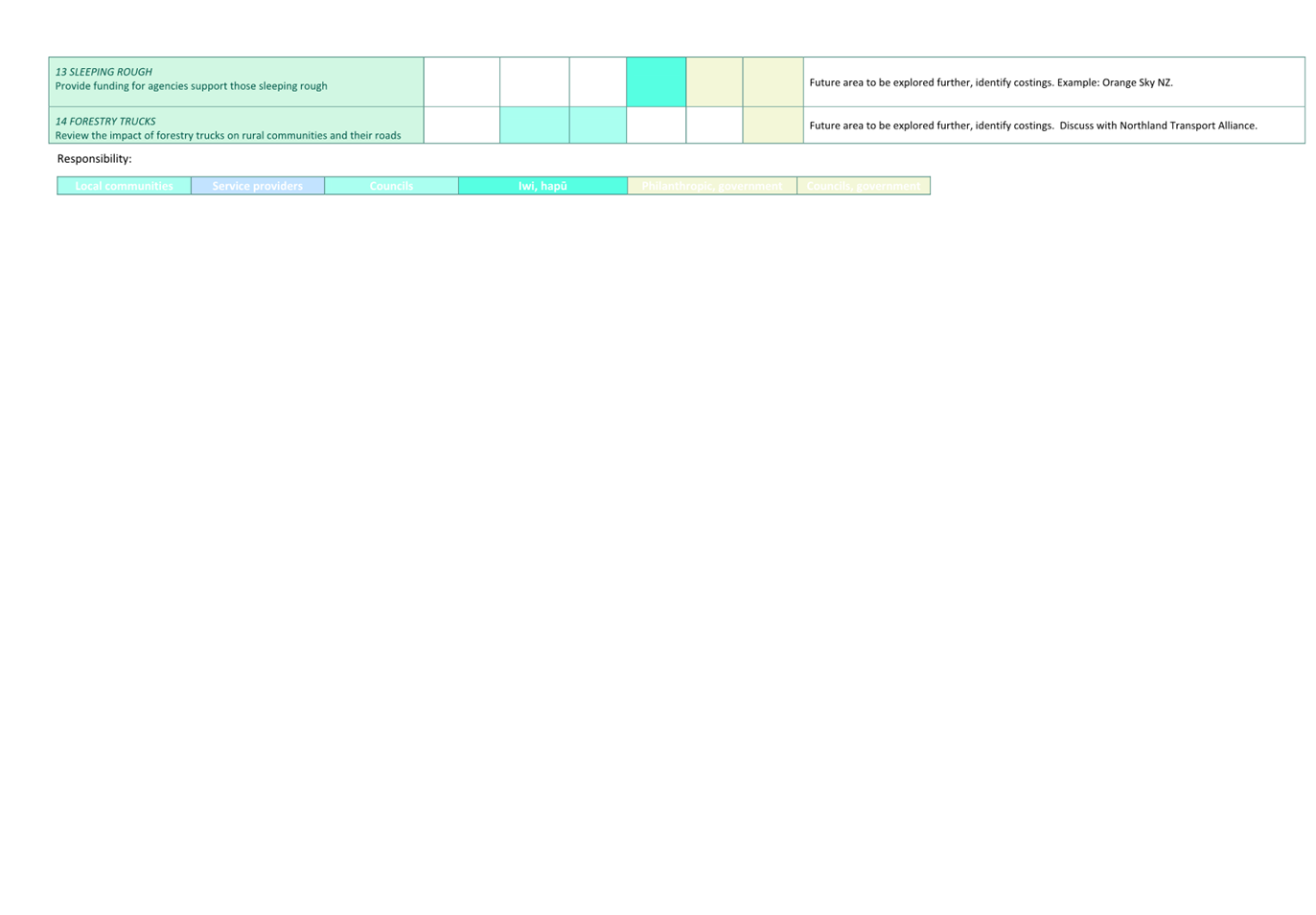
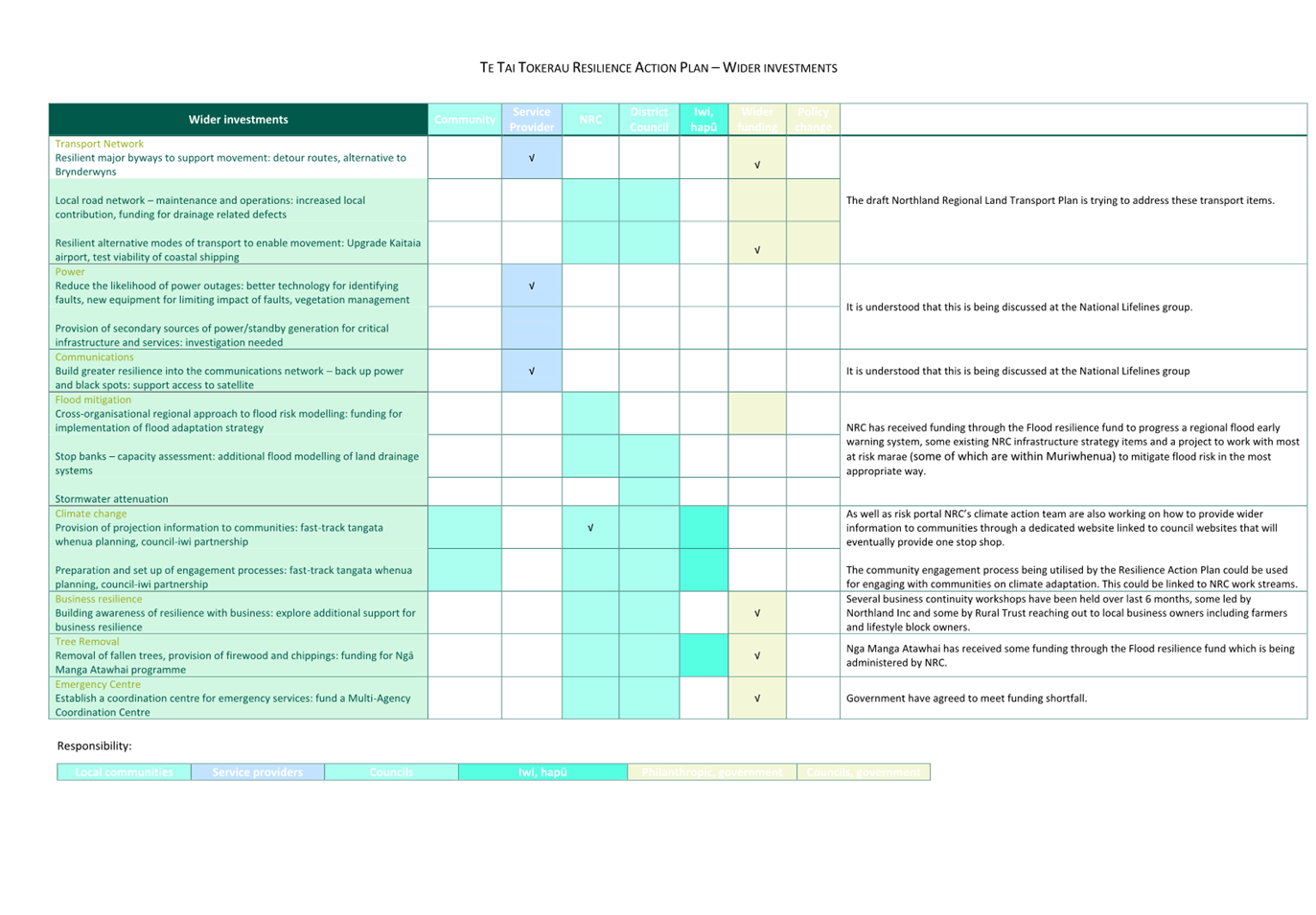
This item provides an update on actions that were identified through the development of the Te Taitokerau Resilience Action Plan.
That the report ‘Update on the Te Taitokerau Resilience Action Plan ’ by Louisa Gritt, Group Manager - Community Resilience and dated 22 May 2024, be received.
Background/Tuhinga
During 2023, Northland developed the Te Tai Tokerau Resilience Action Plan, to address the impacts of the 2023 cyclones and to enhance community self-reliance. The Plan identified the actions required to build regionwide resilience and community resilience in the face of natural hazard events. The priority for the plan was on understanding the challenges faced in remote communities and how community self-reliance could be enhanced. Community resilience will become increasingly important as climate change drives more frequent natural hazard events and self-reliance becomes a necessary part of life for remote communities.
The Te Tai Tokerau Resilience Action Plan identified actions that could be made by government and others, including actions that would support community resilience. Northland Regional Council and the Te Tai Tokerau Māori Advisory Committee have endorsed the development of a community-based resilience action plan, based on the Te Tai Tokerau Resilience Action Plan approach and priorities. This project entails working with Muriwhenua communities in the Far North who wish to formulate a community planning approach to building resilience. This approach is to be subsequently rolled out to other remote communities in Northland.
Thie Resilience Action Plan team and NRC’s CDEM and Climate Adaptation teams are working together to support communities in building their resilience.
Attached in a status update on progress against the Te Tai Tokerau Resilience Action Plan, describing the actions being undertaken by NRC staff and through the Resilience Action Plan team.
Next Steps:
NRC to continue to work with Resilience Action Plan team to progress items collaboratively where appropriate.
Attachments/Ngā tapirihanga
Attachment 1: Te Tai Tokerau Resilience
Action Plan ⇩
4 June 2024
|
TITLE: |
Northland CDEM Group plan 2021 - 2026 report on objectives and actions
|
|
From: |
Graeme MacDonald, Emergency Manager |
|
Authorised by Group Manager/s: |
Louisa Gritt, Group Manager - Community Resilience, on 23 May 2024 |
Whakarāpopototanga / Executive summary
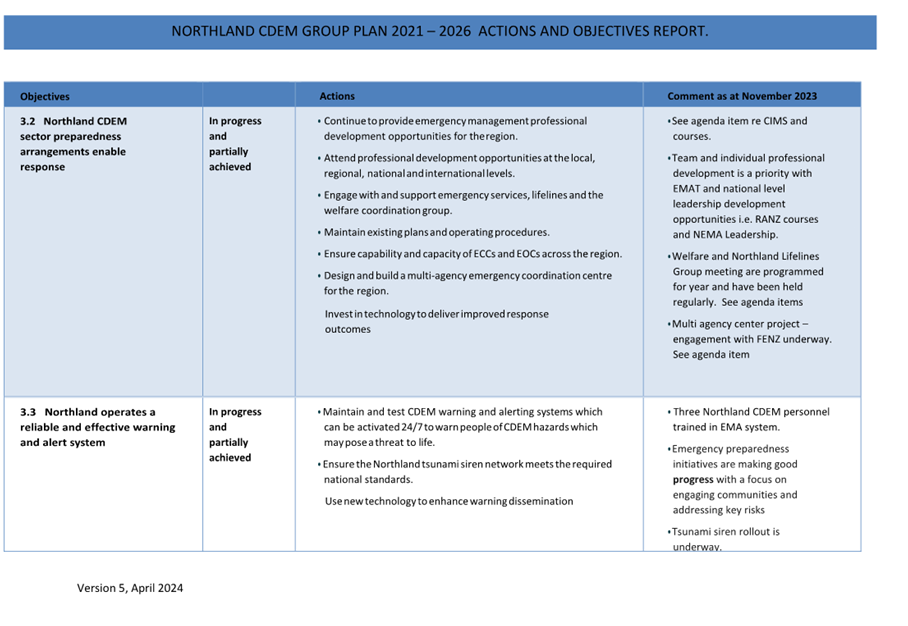
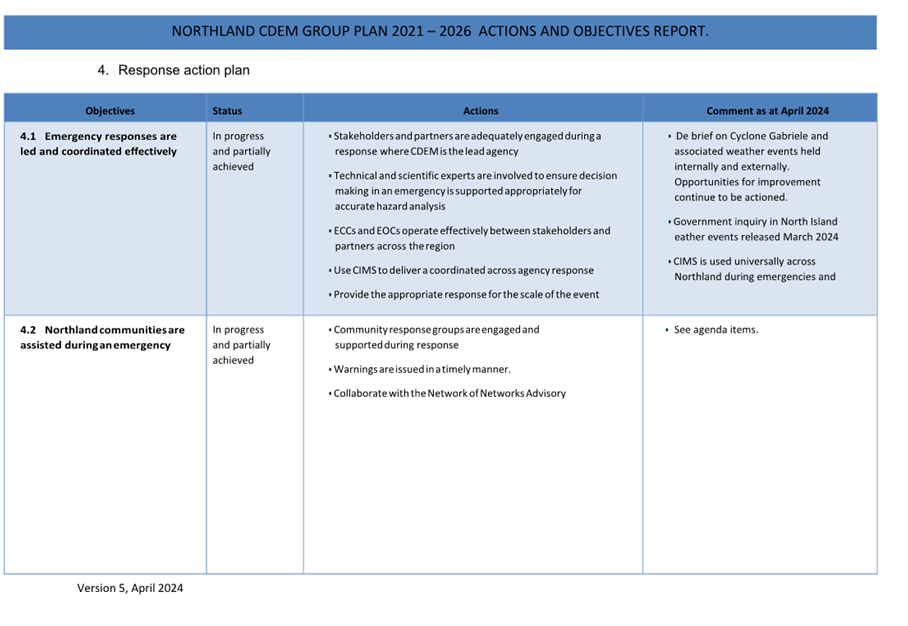
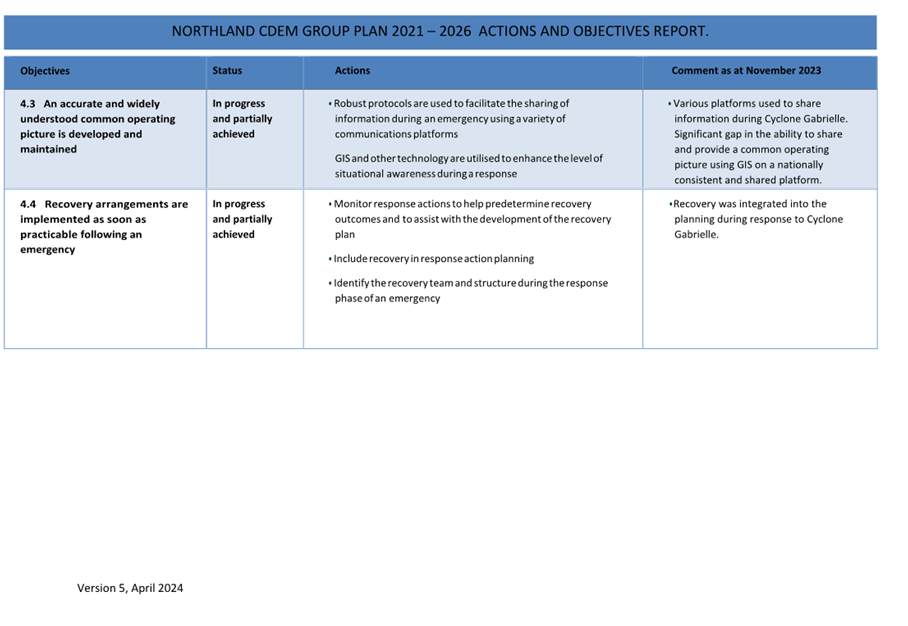
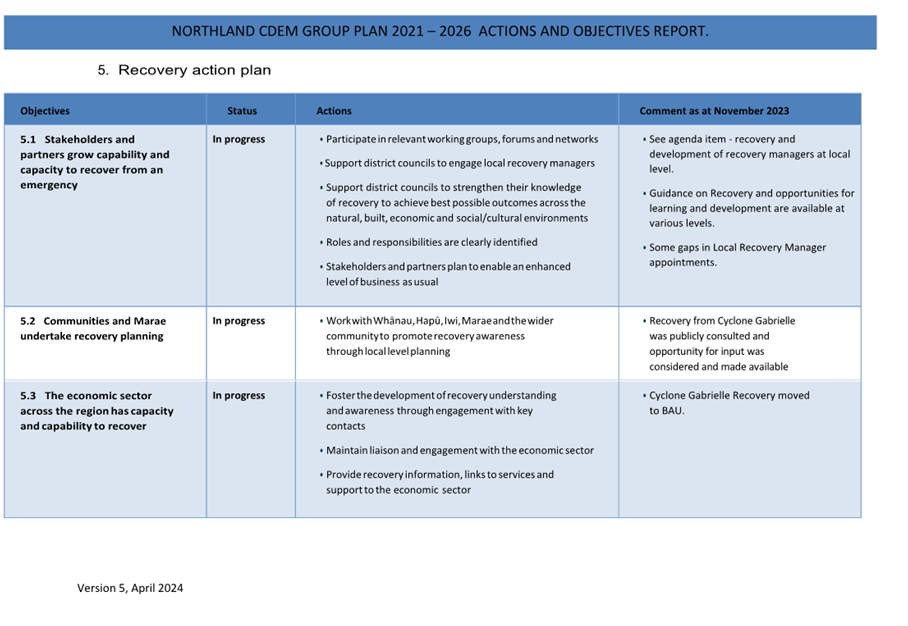
This item provides an update on progress to implement the Objectives and Actions in the 2021 – 2026 Northland CDEM Group plan. (See attached table).
The Northland Civil Defence Emergency Management Group Plan 2021 -2026 was approved by the joint committee in December 2021. The plan is available at https://www.nrc.govt.nz/media/luegn0l3/northland-civil-defence-emergency-management-group-plan-2021-2026.pdf)
The Plan is the statutory reference for the Northland CDEM Group and outlines the arrangements for CDEM within the Group’s jurisdiction over a five-year period.
The plan outlines the strategic direction of CDEM engagement, participation, planning, collaboration, response coordination, recovery, CDEM management and governance and how CDEM provides resilience to the people of Northland.
That the report ‘Northland CDEM Group plan 2021 - 2026 report on objectives and actions
’ by Graeme MacDonald, Emergency Manager and dated 22 May 2024, be
received.
Attachments/Ngā tapirihanga
Attachment 1: Northland CDEM Group Plan
update ⇩