|
Huihuinga O Te Kāhui Māori O Taitokerau
– Te Ruarangi
|
|
|
|
|
|
Huihuinga O Te Kāhui Māori O Taitokerau
– Te Ruarangi
|
|
|
|
|
Te Taitokerau Māori and Council Working Party
13 March 2025
Rārangi Take O Te Kāhui Māori O Taitokerau
(TE RUARANGI)
Meeting to be held in the Council Chamber
36 Water Street, Whangārei and via audio visual link
on Thursday 13 March 2025, commencing at 9.30am - 3.00pm
Please note: working parties and working groups carry NO formal decision-making delegations from council. The purpose of the working party/group is to carry out preparatory work and discussions prior to taking matters to the full council for formal consideration and decision-making. Working party/group meetings are open to the public to attend (unless there are specific grounds under LGOIMA for the public to be excluded).
NGĀ MANA WHAKAHAERE
(MEMBERSHIP OF TE RUARANGI)
Heamana Tokorua (Co-Chairs):
Tui Shortland, Councillor and Pita Tipene, Te Rūnanga o Ngāti Hine
Abe Witana, Te Rūnanga o Te Rarawa
Alan Riwaka, Te Rūnanga O Ngāti Whātua
Amy Macdonald, Councillor
Aperahama Edwards, Ngātiwai Trust Board
Delilah Te Aōrere Parore-Southon, Te Roroa
Geoff Crawford, Councillor (NRC Chair)
Georgina Curtis-Connelly, Te Uri o Hau Settlement Trust
Geraldine Baker, Kahukuraariki Trust Board
Jack Craw, Councillor
Janelle Beazley, Te Rūnanga-Ā-Iwi-O-Ngāpuhi
Joe Carr, Councillor
John Blackwell, Councillor
Juliane Chetham, Patuharakeke Te Iwi Trust Board
Lynette Wharerau, Te Whakaminenga O Te Hikutu Hapu-Whanau
Mahue Greaves, Ngāti Tara
Marty Robinson, Councillor
Michelle Elboz, Ngāti Kuta
Mike Kake, Ngāti Hau
Mira Norris, Te Parawhau Hapū Authority Charitable Trust
Niki Conrad, Te Rūnanga Nui o Te Aupōuri
Nora Rameka, Te Rūnanga O Ngāti Rehia
Nyze Manuel, Te Rūnanga O Whāingaroa
Peter-Lucas Jones, Councillor
Rick Stolwerk, Councillor
Te Waiāriki, Ngāti Korora, Ngāti Takapari Hapū Iwi Trust (vacancy)
Rowan Tautari, Te Whakapiko Hapū
|
Commonly used terms and abbreviations |
|
|
AP |
Annual Plan |
|
CEO |
Chief Executive Officer |
|
CPCA |
Community Pest Control Areas |
|
DOC |
Department of Conservation |
|
FNDC |
Far North District Council |
|
GIS |
Geographic Information System |
|
IHEMP |
Iwi/Hapū Environmental Management Plan |
|
ILGACE |
Iwi and Local Government Chief Executives Forum |
|
KDC |
Kaipara District Council |
|
LAWA |
Land, Air, Water Aotearoa |
|
LEA |
Local Electoral Act 2001 |
|
LGA |
Local Government Act 2002 |
|
LGNZ |
Local Government New Zealand |
|
LIDAR |
Light detection and ranging |
|
LTP |
Long Term Plan |
|
MBIE |
Ministry of Business, Innovation & Employment |
|
MfE |
Ministry for the Environment |
|
MOT |
Ministry of Transport |
|
MPI |
Ministry for Primary Industries |
|
MTAG |
Māori Technical Advisory Group (a sub-group of Te Ruarangi) |
|
NES |
National Environmental Standards |
|
NINC |
Northland Inc. Limited |
|
NIWA |
National Institute of Water and Atmosphere |
|
Non-elected member (Te Ruarangi) |
One of the up to twenty-one appointed iwi and hapū members from Te Taitokerau. Members are appointed in accordance with the Terms of Reference. |
|
NPS |
National Policy Statement |
|
NPS-FM |
National Policy Statement for Freshwater Management |
|
RMA |
Resource Management Act 1991 |
|
RP |
Regional Plan |
|
Te Ruarangi caucus |
Comprises the non-elected iwi and hapū members of Te Ruarangi |
|
TKoT |
Te Kahu o Taonui (Iwi Chairs) |
|
TOR |
Terms of Reference |
|
TPK |
Te Puni Kōkiri (Ministry of Maori Development) |
|
TTMAC |
Taitokerau Māori and Council Working Party (former name of Te Ruarangi) |
|
TTNEAP |
Tai Tokerau Northland Economic Action Plan |
|
TWWAG |
Tāngata Whenua Water Advisory Group |
|
WDC |
Whangarei District Council |
KARAKIA / WHAKATAU
RĪMITI (ITEM) Page
1.0 Ngā Mahi Whakapai/Housekeeping
2.0 NGĀ WHAKAPAHĀ/apologies
3.0 NGA WHAKAPUAKANGA/declarations of interest
4.1 Record of Actions – 13 February 2025 4
4.2 Receipt of Action Sheet 10
4.3 Tāiki ē - Report on Priority Actions 14
ECONOMIC DEVELOPMENT
4.4 Northland Inc Limited: Statement of Intent 2025/26 - Draft from Northland Inc 16
4.5 Te Rerenga Strategy values and principles and working in partnership with tangata whenua 52
CAPACITY AND CAPABILITY
4.6 Resource Consent Review Report - 12-month Action Plan 57
4.7 Guidelines for appointment of Māori commissioners 76
WATER / MARINE
4.8 Update on Marine Protected Areas 81
MĀORI REPRESENTATION
4.9 Central Government Legislative Changes 96
4.10 Fast-track Approvals Act 113
REPORTS FOR NOTING
4.11 Chief Executive’s Report to Council 121
13 March 2025
|
TITLE: |
Record of Actions – 13 February 2025 |
|
From: |
Sally Bowron, Strategy, Governance and Engagement Team Admin/PA |
|
Authorised by Group Manager/s: |
Auriole Ruka, Pou Manawhakahaere - GM Governance and Engagement, on 06 March 2025 |
Whakarāpopototanga / Executive summary
The purpose of this report is to present the Record of Actions of the last meeting (attached) held on 13 February 2025 for review by the meeting.
Attachments/Ngā tapirihanga
Attachment 1: Unconfirmed record of
actions - 13 February 2025 ⇩ 
13 March 2025
|
TITLE: |
Receipt of Action Sheet |
|
From: |
Sally Bowron, Strategy, Governance and Engagement Team Admin/PA |
|
Authorised by Group Manager/s: |
Auriole Ruka, Pou Manawhakahaere - GM Governance and Engagement, on 06 March 2025 |
Whakarāpopototanga / Executive summary
The purpose of this report is to enable the meeting to receive the current action sheet.
That the action sheet be received.
Attachments/Ngā tapirihanga
Attachment 1: Action sheet ⇩
13 March 2025
|
TITLE: |
Tāiki ē - Report on Priority Actions |
|
From: |
Kim Peita, Māori Relationships Manager and Auriole Ruka, Pou Manawhakahaere - GM Governance and Engagement |
|
Authorised by Group Manager/s: |
Auriole Ruka, Pou Manawhakahaere - GM Governance and Engagement, on 07 March 2025 |
Whakarāpopototanga/Executive summary
The purpose of this report is to provide the monthly update progress report on the 31 current actions in Tāiki ē NRC Te Tiriti Strategy and Implementation Plan (Tāiki ē), in council’s commitment to accountability on what is being achieved across the key priorities.
Please note the only change since last meeting held on 13 February is noted in Action 29 and refers to the workshop held on 20 February regarding “Future principles and process of investment in partnership with council and Te Tiriti partners”.
1. That the report ‘Tāiki ē - Report on Priority Actions’ by Kim Peita, Māori Relationships Manager and Auriole Ruka, Pou Manawhakahaere - GM Governance and Engagement and dated 26 February 2025, be received.
· Recommendations should identify all decisions that are needed.
· If only one recommendation do not number.
· Write the option out in full, rather than referring to an option in the report. Set out clear options for councillors to decide between if necessary.
· Recommendations must be within the power of the meeting to make the decision.
· Avoid redundant or unnecessary statements and acronyms.
· If a report is proposed, recommend a realistic date and state to which committee the proposed report back is to be made.
· If it is deemed that there is high risk associated with a decision then include recognition of risk in the resolution.
Tuhinga/Background
Tāiki ē (NRC Te Tiriti Strategy and Implementation Plan) lists 31 actions and timeframes. The actions have been ranked by priority according to their ability to give effect to Te Kaupapa – Mission.
Priority 1
· the action(s) has the potential to have a significant impact and should be the top priority in terms of work and resourcing.
· Underway – the action(s) is actively being implemented, with further work required OR
· Commence within 12 Months - action has commenced within 12 months of adoption of the Implementation Plan (e.g., by 26 July 2023 and there is a commitment to a completion date.
Priority 2
· the action(s) has the potential to have a moderate impact and should be progressed after High priority actions have commenced.
· Years 1 – 3 – action to be completed within 3 years of adoption of the Implementation plan (e.g., by 30 June 2025).
Priority 3
· action(s) have comparably less impact and should be progressed after High and Medium priority actions have commenced.
· Years 3 – 10+.
Actions are numbered from 1 to 31, with indications of whether budget allocation is required or already in place. This will guide the NRC in seeking funding through the Annual Plan or Long-Term Plan for implementation. If unbudgeted actions do not receive future funding, they will require further discussion with TTMAC to determine next steps.
Attachment 1:
Tāiki ē report on priority actions ⇩
13 March 2025
|
TITLE: |
Northland Inc Limited: Statement of Intent 2025/26 - Draft from Northland Inc |
|
From: |
Darryl Jones, Economist and Emmanouela Galanou, Economic Policy Advisor |
|
Authorised by Group Manager/s: |
Auriole Ruka, Pou Manawhakahaere - GM Governance and Engagement, on 06 March 2025 |
Whakarāpopototanga/Executive summary
The purpose of this report is to seek the views of Te Ruarangi on the draft Northland Inc Statement of Intent (SOI) 2025/26 (Attachment 1). This has been received from Northland Inc along with a covering letter (Attachment 2). These views will be considered by council at a workshop on 19 March when it discusses its feedback to the Joint Regional Economic Development Committee (JREDC) on the draft SOI 2025/26.
JREDC is responsible for providing comment to Northland Inc on the draft SOI 2025/26 from all four shareholder councils. This will be done at the JREDC meeting on Tuesday 29 April 2025. The draft SOI 2025/26 has been prepared by Northland Inc with consideration given to a letter of expectations sent by the shareholders in December 2024 (Attachment 3).
Representatives from Northland Inc, including Chair Suzanne Duncan, will be in attendance to provide comment and answer any questions.
That the report ‘Northland Inc Limited: Statement of Intent 2025/26 - Draft from Northland Inc’ by Darryl Jones, Economist and Emmanouela Galanou, Economic Policy Advisor and dated 27 February 2025, be received.
Tuhinga/Background
Northland Inc is a council-controlled organisation that is currently jointly and equally owned by the four local authorities in Northland: Northland Regional Council (NRC), Far North District Council (FNDC), Kaipara District Council (KDC) and Whangarei District Council (WDC). WDC, who only became a shareholder in September 2024, will be reviewing its ownership position in December quarter 2025. This review was an integral part of WDC’s decision to become a shareholder taken during its Long Term Plan 2024-2034 deliberation.
All responsibilities, duties and powers of a local authority as a shareholder in Northland Inc are, as far as legally possible, delegated to the JREDC. This includes involvement in the development of the SOI. The purpose of an SOI is to:
a) state publicly the activities and intentions of the council-controlled organisation for the year and the objectives to which those activities will contribute; and
b) provide an opportunity for shareholders to influence the direction of the organisation; and
c) provide a basis for the accountability of the directors to their shareholders for the performance of the organisation.
Figure 1 sets out the process that will be followed for the development of Northland Inc’s SOI 2025/26. Under the Local Government Act 2002 (section 64 and Schedule 8), a council-controlled organisation such as Northland Inc must deliver to its shareholder an annual SOI, with financials covering a three-year period. Mandatory content requirements include objectives, activities, Key Performance Indicators (KPI) and financials. Under the LGA 2002, a draft SOI is required to be provided for shareholder comment by 1 March and the final SOI by 30 June each year.
Figure 1. Process for developing Northland Inc’s SOI 2024/25
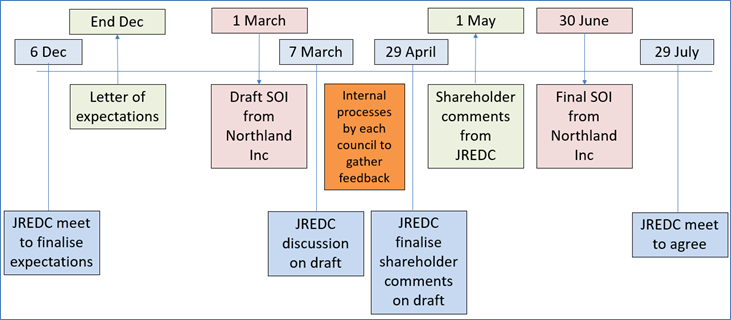
The JREDC received and discussed the draft SOI 2025/26 at its meeting on Friday 7 March. The process is now in the phase shown by the orange box in the diagram, i.e. each individual council is undertaking its own internal processes of gathering feedback on the draft SOI. For NRC, this involves discussion with Te Ruarangi at this meeting, and a council workshop discussion on Tuesday 19 March. Staff will then work with NRC’s representatives on the JREDC (Chair Geoff Crawford and Deputy Chair Tui Shortland) to determine feedback into shareholder comments. Feedback from all four councils will be considered by the JREDC at its meeting on Tuesday 29 April, with the legislative requirement to provide shareholder comment by 1 May.
In addition to these legislative requirements, the JREDC has adopted a “best practice” of providing a letter of expectations to assist Northland Inc develop the annual SOI. This letter is usually provided in December. JREDC has also followed a custom of seeking major changes to Northland Inc’s SOI every three years to align with council’s Long-Term Plans, and minor changes/tweaks in the other two years. This has been done to provide certainty of direction to the operation of Northland Inc and in recognition that it can take time to implement changes in objectives and activities.
As major changes were made to Northland Inc’s SOI 2024/25 (aligned with development of respective councils’ Long Term Plan 2024-2034), only minor changes were requested in relation to the SOI 2025/26 in the letter of expectations. Northland Inc’s current SOI 2024/25 is available online at https://www.nrc.govt.nz/media/a2io4mra/northland-inc-soi-2024-2025-final.pdf.
The following points are provided to assist Te Ruarangi consideration.
· The current vision of Northland Inc recognises the value of he tangata (people), he taiao (environment) and he ōhanga (prosperity for all).
· Māori Economic Development is specifically identified as a work area for Northland Inc (Enabler 2, pp 16-17 of Attachment 1).
· There are elements within the other eight work areas that are also relevant to Māori economic development aspirations, e.g., tourism and destination management and environmental sustainability.
· In its accompanying letter (Attachment 2), Northland Inc comments that it’s SOI aligns with Te Rerenga, Taitokerau Economic Wellbeing Pathway. The JREDC asked Northland Inc, in its letter of expectations, to reflect on this when preparing the draft SOI.
Attachment 1:
Draft Northland Inc SOI 2025/26 ⇩
Attachment 2:
Accompanying letter from Northland Inc to JREDC regarding draft SOI 2024/25 ⇩
Attachment 3:
Letter of expectations from JREDC (shareholders) to Northland Inc for SOI
2025/26 ⇩
13 March 2025
|
TITLE: |
Te Rerenga Strategy values and principles and working in partnership with tangata whenua |
|
From: |
Sally Bowron, Strategy, Governance and Engagement Team Admin/PA |
|
Authorised by Group Manager/s: |
Auriole Ruka, Pou Manawhakahaere - GM Governance and Engagement, on 07 March 2025 |
Whakarāpopototanga/Executive summary
The purpose of this report is to summarise the key discussion points and actions from the Te Ruarangi workshop held on 20 February 2025. The workshop provided an opportunity to explore future principles and processes of investment in partnership with tangata whenua to assist and guide council when responding to economic development opportunities or ‘deals’ on behalf of the region.
In summary, it was agreed that the Te Rerenga strategy provides a solid basis as an economic approach and has sufficient Te Tiriti foundations and safeguards to guide collective decision making and collaboration. While the workshop was brought about by a discussion regarding Regional Deals, the workshop was the beginning of a deeper dive as Te Ruarangi to ‘make the waka go faster’ in economic terms whilst balancing it with other values that are articulated in core documents such as the Te Ruarangi terms of reference and Tāiki ē.
That the report ‘Te Rerenga Strategy values and principles and working in partnership with tangata whenua’ by Sally Bowron, Strategy, Governance and Engagement Team Admin/PA and dated 28 February 2025, be received.
Tuhinga/Background
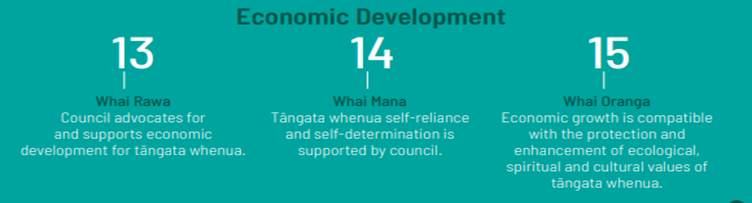
Economic development is one of the five key focus areas set out in Tāiki ē.
This workshop was a follow-up action from the Regional Deals paper presented at the TTMAC meeting on 13 February 2025.
Sixteen members met for the Regional Deals workshop, supported by the CEO, senior staff and the Economic Development team. Key discussion points included:
· The importance of balancing culture, environment and growth.
· Clarity needed on governance roles and principles for the regional deals, similar to council's investment strategy, such as avoiding investments in arms and gambling.
· It would be beneficial to have a flowchart or standard operating procedure (SOP) to ensure consistency when applying the high-level goals in Tāiki ē.
· Concerns were raised about how shared goals are determined and assessed for consistency with iwi/hapū interests.
· The process for the Statement of Intent (SOI) for Northland Inc was explained, and the need for timely input and coordination of council schedules.
· An annual work plan and orientation was proposed.
· Concerns about the fast-tracked process for the regional deals and the need for broader engagement with iwi/hapū was discussed.
· That Te Rerenga be used as a baseline for regional deals was emphasised and the need for transparency in economic development projects.
· It was suggested that an Economic development summit, similar to Wānanga Waiora, be developed involving iwi/hapū and industry sectors, possibly around the time of Northland Inc’s Annual General Meeting.
· The significance of spatial planning and the need for a forum for SMEs in the north was highlighted.
Actions:
· Staff to review the timing of the Statement of Intent (SOI) to ensure there is sufficient time for input moving forward
· Staff to work with Northland Inc to consider what an economic development summit may look like and ensure clarity on objectives and focus on key industries. Support the implementation of Te Rerenga and avoid being too broad.
· Staff to consider a process to work on an annual economic development workplan for Te Ruarangi and this could be also part of an orientation for the new council in the next triennium.
· Staff to look at what safeguards exist when reviewing the SOI.
· Staff to establish a feedback loop after JREDC’s meeting about the submission. (The final outcome of who is selected for a regional deal will not be known until mid-2025, and there will be time pressure to act before the elections in September.)
· Co-Chairs to raise concerns with JREDC members about the feedback given about the regional deals process by both TTMAC and Te Kuaka.
Attachment 1:
Memo for the workshop held on 20 February 2025 ⇩
Attachment 2:
Te Rerenga - Our Future statement ⇩
13 March 2025
|
TITLE: |
Resource Consent Review Report - 12-month Action Plan |
|
From: |
Colin Dall, Pou Whakaritenga - Group Manager Regulatory Services and Auriole Ruka, Pou Manawhakahaere - GM Governance and Engagement |
|
Authorised by Group Manager/s: |
Auriole Ruka, Pou Manawhakahaere - GM Governance and Engagement and Colin Dall, Pou Whakaritenga - Group Manager Regulatory Services, on 06 March 2025 |
Whakarāpopototanga/Executive summary
The purpose of this item is to present an update to the council on the 12-month Action Plan, which is
based on the recommendations from the report “Tāiki ē – Regulatory Services Review – Resource
Consent Process.” This presentation will also provide an update on the actions currently underway.
This significant work programme is being guided by the Māori Technical Advisory Group (MTAG), and
efforts are in progress to develop tools that will make information more accessible for iwi, hapū, and
key stakeholders.
David Badham, Barker and Associates will be presenting an update for Te Ruarangi to ensure there is ongoing reporting back and accountability in regard to a significant project that aims to make the resource consents process more accessible for iwi and hapū, stakeholders and communities.
1. That the report ‘Resource Consent Review Report - 12-month Action Plan’ by Colin Dall, Pou Whakaritenga - Group Manager Regulatory Services and Auriole Ruka, Pou Manawhakahaere - GM Governance and Engagement and dated 6 March 2025, be received.
2. That Te Ruarangi be provided with updates on progress of the 12-month implementation plan to give effect to the Report and recommendations.
Tuhinga/Background
The Tāiki ē – Regulatory Services Review – Resource Consent Process (the RC Report) was prepared by Barker & Associates (B&A) to review council’s resource consenting process in alignment with the requirements of Action 9 of Tāiki ē. The RC Report provided an in-depth analysis of the resource consent determination process, with a particular focus on how and when iwi and hapū are engaged prior to lodgement, during lodgement, and post-decision-making. It highlighted key issues and findings, alongside 11 key preliminary recommendations for improvement.
The final draft was endorsed by Te Taitokerau Māori and Council Working Party (TTMAC) on 12 September 2024. It was then presented to the Audit, Finance and Risk Committee whose key feedback included support for the Report, with emphasis on the importance of the iwi and hapū contact database, confidentiality of contact details, and the use of cultural impact assessment templates.
Since the Report’s release and its endorsement by NRC and Te Ruarangi (previously called TTMAC), NRC staff and B&A consultants have been preparing a 12-month Action Plan to implement the recommendations, with Māori Technical Advisory Group (MTAG) oversight. The Action Plan was presented at MTAG’s 23 January meeting and their feedback incorporated into the Action Plan.
During this process, overlaps and synergies were also identified with similar initiatives being undertaken by Te Kahu o Taonui. Te Kahu o Taonui has undertaken engagement with Taiao Practitioners to assess their ability to participate and respond effectively and efficiently to resource consents from FNDC. It was identified that their input and participation is hampered by a range of process and system issues, including but not limited to the following:
· Volume of resource consents
· Statutory timeframes
· Section 36A requirements[1]
· Cost recovery
· Relationships
· Cultural competency
· The understanding and application of iwi/hapū environmental management plans
· The consideration of sites of cultural significance
· Hard and soft infrastructure; and
· Capability and capacity.
Attachment 1:
2025 03 05 council workshop Tāiki ē – RCR Action Plan ⇩
13 March 2025
|
TITLE: |
Guidelines for appointment of Māori commissioners |
|
From: |
Colin Dall, Pou Whakaritenga - Group Manager Regulatory Services and Auriole Ruka, Pou Manawhakahaere - GM Governance and Engagement |
|
Authorised by Group Manager: |
Auriole Ruka, Pou Manawhakahaere - GM Governance and Engagement and Colin Dall, Pou Whakaritenga - Group Manager Regulatory Services, on 06 March 2025 |
Executive summary/Whakarāpopototanga
The purpose of this report is to present the recently council-approved guidelines for selecting RMA consent hearings commissioners and to seek feedback, particularly on the guidelines for selecting Māori commissioners.
The guidance framework was amended in line with requests from the Audit, Risk and Finance Committee and was formally adopted by council at its meeting on 10 December, 2024. The guidance framework is set out in the Background/Tuhinga section of this report.
Should Te Ruarangi propose changes to the guidelines, then it is recommended that staff work with the Māori Technical Advisory Group (MTAG) to develop and draft the changes for the Audit and Risk Committee’s consideration.
1. That the report ‘Guidelines for appointment of Māori commissioners’ by Colin Dall, Pou Whakaritenga - Group Manager Regulatory Services and Auriole Ruka, Pou Manawhakahaere - GM Governance and Engagement and dated 6 March 2025, be received.
2. That Te Ruarangi provides feedback to the guidance framework for selecting and appointing RMA Consent Hearings Commissioners as set out in the Background/Tuhinga section of this report.
3. That should Te Ruarangi propose changes to the guidelines then that staff work with the Māori Technical Advisory Group (MTAG) to develop and draft the changes for the Audit and Risk Committee’s consideration.
Background/Tuhinga
RMA hearing commissioners should have the skills/qualifications that would enable a robust consideration and assessment of the activities for which consents are sought and their effects.
At its 23 July 2024 meeting, the council approved a list of RMA hearing commissioners for delegated staff to use to arrange/select and appoint commissioners for consent hearings. The council also requested that a guidance framework be developed for that purpose to make the process more transparent.
The Group Manager Regulatory Services developed the requested guidance framework which was presented to the Audit, Risk and Finance Committee for its consideration at its 28 August 2024 meeting. The committee requested further details be included in the framework. A revised framework including those details was presented to the committee at its 18 November 2024 meeting. The committee supported the amended version subject to:
GM Regulatory Services to amend point 6 page 93 of the guidelines to make explicit reference to the requirements of Treaty settlements regarding appointment of Māori commissioners with a footnote of what those settlements are. Amendment to be made to Guidelines before going to council.
The guidance framework has been amended in line with this request and is set out immediately below:
|
Steps and Factors |
Responsible Officer(s) |
|
1. Check if the consent applicant or a submitter has requested the council to use independent hearings commissioners. If so, only commissioners who are not members of the local authority can be appointed to hear and determine a consent application.
|
Consents Manager |
|
2. Identify the issues that have been raised in submissions. |
Reporting officer & Consents Manager |
|
3. For hearings which the Northland Regional Council is the lead consent authority, determine whether a single commissioner would be sufficient to hear and determine the consent application or if more than one commissioner would be appropriate based on the: i. range and type of activities requiring consent, ii. issues raised in the staff report and/or submissions, and iii. number of submitters wishing to be heard. More than a single commissioner should be appointed when there are many submitters and a wide range of issues raised.
|
Consents Manager |
|
4. For a Joint Hearing with a District Council where the District Plan is the primary consideration for the application, it is likely that the District Council will be lead consent authority and would be administering the hearing process for both councils. If only a single commissioner is required, then the selection of that commissioner lies with the District Council.
|
|
|
5. If complex technical issues are raised, then would need to identify a commissioner that has knowledge/experience regarding those issues. The guidelines for use of Māori commissioners contained in the Quality Planning website - https://www.qualityplanning.org.nz/node/680 (included below) will also be used to assess if an additional commissioner with knowledge/experience in Māori cultural issues is required. If it is determined that only a single commissioner is required, then the commissioner should have significant experience in RMA planning matters and our regional plan framework. Where more than one commissioner is required then one of commissioners must be appointed to chair the commissioner panel and hold a current chair certification.
|
Consents Manager (may be discussed with Group Manager Regulatory Services) |
|
6. If the consent application is within the rohe of a hapū or iwi that has signed a Mana Whakahono ā Rohe, or the hapū or iwi have Treaty Settlements/Statutory Acknowledgements[2], then the requirements of that agreement or Treaty Settlement regarding consent hearings and Māori commissioners need to be followed.
|
Consents Manager |
|
7. Select potential commissioner(s) from council approved list of commissioners. |
Consents Manager |
|
8. After selecting potential commissioners: i. Determine their availability and if they have any conflicts of interest. A potential commissioner with a conflict of interest would be given no further consideration. ii. Contact the consent applicant to determine hearing dates. This can become an iterative process when there is more than one commissioner required and/or the consent applicant is relying on multiple people to give evidence/support their application at the hearing. iii. After the above have been completed, recommend approval of the commissioner(s) to Group Manager Regulatory Services or Chief Executive Officer if the former is on leave or has a conflict of interest in relation to the consent application or a hearing commissioner.
|
Consents Manager |
|
9. Approval of the commissioner(s) and the delegation of all relevant functions, powers and duties required by them. |
Group Manager Regulatory Services or Chief Executive Officer
|
|
10. Approved commissioners sent standard contract for commissioner services for their signature.
|
Consents Manager |
|
11. Copy of signed contract added into the council’s document management system. |
Consents and Hearing Administrator |
Use of Māori commissioners – Resource consent applications – Quality Planning Website
Where formal relationships and mechanisms between local authorities and iwi, or between the Crown and iwi, confer particular resource management functions and responsibilities on iwi, these must be adhered to. For example, Mana Whakahono a Rohe, iwi participation arrangements, memoranda of understanding, co-management agreements.
There are circumstances when Māori commissioners should be considered, such as for applications involving:
· any water-based issue (i.e. involving rivers, lakes, wetlands, groundwater, estuaries, harbours and coasts) such as:
o wastewater discharges to waterbodies
o taking of water
o inter-catchment water diversions
o large scale construction in waterways and the coastal marine area
o landfill developments
o use of geothermal resources
· developments near taiāpure and mātaitai
· developments that may impact on iconic waterbodies (e.g. Taupō-nui-a-Tia (Lake Taupo), Waikato River, Whanganui River and Te Waihora (Lake Ellesmere))
· proposals that are likely to affect marae, papakāinga, kōhanga reo, kura kaupapa Māori or other Māori institutions.
· proposals that may affect urupā (burial grounds), wāhi tapu (sacred sites), wāhi tupuna (ancestral sites) that are documented and/or known only to Māori (sometimes known as ‘silent files’),
· any use or development that may affect mahinga kai, (culturally significant resources used in medicine, weaving, carving, art, ornamentation or other customary usages)footnote
· activities or issues likely to affect Māori ownership or management of resources including Māori land, reserves, statutory acknowledgments, mataitai and taiapure.
· development in the vicinity of iconic natural features such as maunga and awa.
· proposals associated with specific activities or issues that are identified in iwi management plans.
· proposals based on Māori values, customary usages, practices and beliefs, for example:
o facilities associated with marae-based education and training in Māori language, arts and culture.
o wānanga (e.g. Te Wānanga o Aotearoa, Te Wānanga o Raukawa, Te Whare Wānanga o Awanuiarangi)
o use of land/sites and activities on the surface of water associated with the expression of Māori culture, such as:
§ performing arts (e.g. kapa haka)
§ sports events (e.g. waka ama)
§ festivals, exhibitions and celebrations (e.g. Te Hui Ahurei a Tuhoe, Parihaka Peace Festival, Paihia Matariki Festival)
§ tourism developments for example:
§ restored/model Māori villages
§ Te Wairoa buried village, Whakarewarewa thermal village, Tamaki Māori Village, Mitai Māori Village.
§ Māori art and craft centres
§ New Zealand Arts and Crafts Institute, art galleries
§ operations or venues offering Māori cultural experiences
§ Te Puia heritage park, Whakarewarewa geothermal valley, Whanganui River waka tours, marae-based tourism
· special reserves for culturally significant resources, for example:
o tōtara trees - carving, construction, medicinal
o kahikatea (white pine) – construction
o kōwhai tree - medicinal, construction
o harakeke (flax) - textiles, construction, medicinal
o tī kōuka (cabbage tree) - textiles, medicinal
o pīngao (sand sedge) - textiles, ornamentation
o remnant karaka groves – food
o hīnau trees – food
o kawakawa (pepper tree) – medicinal
o kōkōwai (red orche) - ornamentation, construction
o mānuka (tea tree) - tools, construction, medicinal
o pounamu (greenstone) - tools, ornaments
o raupō (bulrush) - construction, textiles
o tūhua (argillite) – tools
o matā (obsidian) – tools
o tītī (sooty shearwater or mutton bird) – food
o kererū (wood pigeon) – food
o tuna (freshwater eel) – food
o korokoro (lamprey) – food
o tohorā (whales) - tools, food, ornamentation
Note: Pounamu resources are owned and controlled by Ngāi Tahu.
· Proposals in communities that have a high Māori population and that identify strongly with Māori cultural and spiritual values e.g. papakainga and marae-based communities, and other special communities and locations) including:
o Rātana (Rātana Church-based township)
o Ruatahuna (Ngāi Tūhoe/Ringatū)
o Parihaka (Whiti & Tohu movement)
o Ngāruawāhia (Kīngitanga)
o Whakarewarewa (traditional & natural heritage)
o Waitangi (Treaty of Waitangi)
· Proposals likely to be of significant interest to, and attract submissions from, Māori.
Attachments/Ngā tapirihanga
Nil
13 March 2025
|
TITLE: |
Update on Marine Protected Areas |
|
From: |
Nicola Hartwell, Kaiwhatahaere Moana Ora |
|
Authorised by Group Manager/s: |
Don McKenzie, Pou Tiaki Pūtaiao - GM Biosecurity, on 06 March 2025 |
Whakarāpopototanga/Executive summary
This report provides an overview of the Rāhui Tapu/Marine Protected Areas currently being managed under the Resource Management Act in Te Taitokerau. Information contained in this report has also been compiled in anticipation of a future Te Ruarangi workshop on the process for a plan change as it relates to Northland Regional Council’s marine protected areas.
1. That the report ‘Update on Marine Protected Areas’ by Nicola Hartwell, Kaiwhakahaere Moana Ora and dated 26 February 2025, be received.
2. That TTMAC note the information contained in this report.
3. That staff bring a further update on implementation progress to a future meeting.
4. That staff provide a paper on fishing control legislative provisions following conclusion of the law reform process.
Tuhinga/Background
The Rāhui Tapu/marine protected areas were included in the Proposed Regional Plan for Te Taitokerau following a decision of the Environment Court in May 2023, and receiving approval from the Minister for the Environment in November 2023.
A Project Plan was developed with input from mana moana hapū identifying three main workstreams: Communication and Public Engagement; Compliance Monitoring; and Ecological Monitoring, underpinned by Taiki ē, NRC’s Te Tiriti Strategy and Action Plan. The annual report for FY2023/24 is Attachment 1 to this item.
Funding of $257,000/annum plus one FTE has been applied to the two Rāhui Tapu marine protected areas at Mimiwhangata (covering an area of approximately 55km²) and Maunganui Bay to Oke Bay (covering an area of approximately 6km²). Staff are liaising with NZ Fisheries on regulation of the Ngā Au o Morunga Mai Rākaumangamanga Protection Area due to its commercially focussed restrictions.
Update on implementation activities 2024/25
Staff have continued to work with hapū representatives on Rāhui Tapu implementation activities. An annual work plan has been circulated to Rāhui Tapu hapū representatives, and staff are awaiting feedback on the Annual Work Plan.
Following is an update on activities that have occurred under each workstream for FY2024/25, and the activities planned for FY 2025/26 as proposed in the Annual Work Plan.
Communications and engagement
A communications plan was set in August 2024 following hui with Rāhui Tapu hapū representatives. The plan applied a heavy focus on communications and engagement leading into and during the 2024/25 summer break, and numerous channels have been used to communicate Rāhui Tapu rules:
· Huaki publication November 2024 - 'Summer patrols to protect sensitive marine areas' - Story focussing on warrant officer patrols and the partnership with hapū.
· NRC newsletters - The 'Summer patrols' story also ran in two of NRC's newsletters - CoastCare in November and the TTMAC Panui in December.
· Media:
o Northern Advocate November 2024 - "Commercial fisher caught as council clamps down on rahui tapu rulebreakers". This story was also picked up by RNZ on 19 Nov.
o Northern Advocate December 2024: "Summer brings fresh concerns over Northland's vulnerable marine environment" for which we provided comment.
· Dive Pacific Magazine - Advert ran in Dive Pacific.
· Gateway Magazine:
o half of a double-page NRC spread with a map and a blurb showing the MPAs and the caulerpa CAN.
o request to the publishers to correct outdated information indicating the marine protected areas are fishing sites.
· Rating info sheet - item in the January rating info sheet that goes out across the region in collaboration with district councils.
· Poster, event coreflute, and flyer update - worked with hapū to update the marine areas flyer and created a poster for display around the local communities. We also updated the event coreflute in line with hapū input.
· Social media:
o October – promotional video of Rāhui Tapu.
o December - summer patrols would be out and about.
· Radio:
o December breakfast slot on More FM for Chair Crawford, used this to promote Rāhui Tapu / marine protected areas.
o More FM's pre-event promotion package for Whangarei A&P Show.
o Twice-daily slot on Russell Radio continues, although we made a change for one of these slots to talk about the caulerpa CAN.
· NRC’s Good to Go campaign: MPAs were part of the multi-channel Good to Go campaign that ran over summer.
· Website: Minor updates to website as needed, most notably the addition of marine protected areas breach reporting form.
· Additional signage – placed at Oke Bay.
Activities planned for 2025/26
Some items identified in the 2024/25 communications plan are in preparation, largely surrounding social media engagement and delivery of NRC’s Enviroschools ‘healthy marine environments’ programme. Staff have indicated to Rāhui Tapu hapū representatives that another ‘communications hui’ will be held in or around June 2025 to set the plan for the 2025/26 summer season.
The Annual Work Plan also proposes a full signage review, including updating the ‘Fish Forever’ signs in place at Maunganui Bay to reflect regional council rules.
Compliance / Regulation
In October 2024 NRC recruited eight casual employees to perform on-water regulation of the Rāhui Tapu (RMA warranted officers). Seven of the RMA warranted officers whakapapa to mana moana hapū. The RMA warranted officers received comprehensive training in November 2024 and commenced on-water mahi in December.
Vessels and skippers for on-water surveillance have been sourced using:
· Hapū preferred suppliers identified through a closed tender process;
· NRC’s maritime team;
· Collaboration with the Department of Conservation and NZ Fisheries, where the RMA warranted officers also gained an understanding of central agency compliance processes.
There was a heavy on-water presence in the Rāhui Tapu between October 2024 and February 2025. The focus has largely remained on education, however regulatory processes have been developed and warrants are now being exercised to require the provision of identification from individuals witnessed actively fishing. In circumstances where there is evidence supporting a breach of the Rāhui Tapu rules, staff intend to issue formal notices. An abatement notice was issued to a commercial operator in November 2024 following notification from NZ Fisheries that its gear was engaged in the Rākaumangamanga Rāhui Tapu. Investigations are underway for two other potential breaches by recreational fishers.
A breakdown of vessel trips, approaches, and numbers of individuals witnessed fishing is set out in the schedule below:
|
On-water trips # |
Fishing |
Not Fishing |
Total vessel approaches |
|
|
Oct-24 |
3 |
1 |
3 |
4 |
|
Nov-24 |
5 |
4 |
4 |
|
|
Dec-24 |
6 |
1 |
33 |
34 |
|
Jan-25 |
6 |
6 |
36 |
42 |
|
Feb-25 |
7 |
5 |
42 |
47 |
|
Total |
27 |
13 |
118 |
131 |
|
Rākaumangamanga Rāhui Tapu |
|
|
|
|
|
Oct-24 |
4 |
1 |
1 |
|
|
Nov-24 |
5 |
2 |
27 |
29 |
|
Dec-24 |
10 |
1 |
96 |
97 |
|
Jan-25 |
10 |
3 |
62 |
65 |
|
Feb-25 |
12 |
40 |
40 |
|
|
Total |
41 |
6 |
226 |
232 |
|
Total (both Rāhui) |
68 |
19 |
310 |
363 |
Activities planned for 2025/26
The on-water surveillance schedule continues through to June 2025 with a focus on weekends and public holidays.
The Annual Work Plan proposes the following activities:
· Boundary markers – investigate, discuss, plan and budget for placement of boundary markers;
· Resource scheduling of on-water surveillance activities;
· Develop regulatory framework, including processes around customary take;
· Refine regulatory processes with learnings from 2024/25 season.
Ecological monitoring
Staff understand there is agreement in principle with mana moana hapū to undertake baseline ecological monitoring of both Rāhui Tapu with a focus on key indicator species, tāmure/snapper, kōura/crayfish, and kina. Planning is underway for the following activities to occur between March and May 2025:
Mimiwhangata Rāhui Tapu
Tāmure survey – to be led by Vince Kerr, marine ecologist, with a focus on building hapū capability. Hapū kaitiaki will be involved at every stage of this monitoring, including on-water data collection, analysis and recording of results, and report writing.
Kōura survey – The University of Auckland have indicated they will be able to undertake kōura monitoring using historical transects and methodology to build comparative datasets. The University of Auckland will also be undertaking kōura monitoring using random transects, which is outside the scope of hapū/NRC identified priorities, but will nevertheless provide valuable data to measure the ongoing health of Mimiwhangata Rāhui Tapu. It is intended that hapū kaitiaki will be onboard to observe the kōura survey.
Rākaumangamanga Rāhui Tapu
A hui was held with Rākaumangamanga Rāhui Tapu representatives on 4 March to discuss and set 2025 baseline ecological monitoring activities. Details are still to be finalised, however staff are planning kōura and tāmure surveys to be undertaken this summer season, drawing on specialist advice from the University of Auckland and Adam Smith (Sea Through Science) respectively. Staff are also investigating water quality, water temperature and noise level monitoring to occur alongside the surveys. Staff intend to onboard two kaimahi as casual employees who will be involved with the monitoring activities.
Activities planned for 2025/26
In addition to undertaking baseline monitoring identified above, the Annual Work Plan proposes the development of broad ecological monitoring plans with mana moana hapū covering priority species, western methodology, mātauranga, and building hapū capability.
Kōura/crayfish quota management
The Environmental Law Initiative bought judicial review proceedings against the Minister for Oceans and Fisheries relating to the Minister’s 2023 kōura/crayfish total allowable catch decision. The High Court has recently issued its judgment on those proceedings (The Environmental Law Initiative v Minister for Oceans and Fisheries [2025] NZHC 177 (14 February 2025) declaring the Minister’s decision unlawful. The judgment will impact future decision making around CRA1 and total allowable catch for kōura and staff will be keeping a close eye on how this develops.
Law Reform
Staff had input into the regional sector submission on the proposed law reform surrounding regional council ability to include fishing controls in planning instruments. The regional sector submission opposed in part the proposed reform, providing the following recommendations:
• Generally: Instead of proceeding with the proposals, rely on existing processes and practices which are evolving in a mutually collaborative way, at less cost and risk for interested parties, and without the additional complexity introduced by sub-processes within a regional planning construct. If this is not an option, then the following recommendations were suggested to moderate approach and achieve some efficiencies and improvements in clarifying procedural steps.
• Evaluation Reports (proposed section 32(2A)):
Consider the need for the proposed new requirements for preparing and publishing evaluation reports that control fishing where generalised section 32 requirements may suffice, and provide flexibility to consider matters through alternative means (e.g., guidance).
Consider amending proposed new 32(2A)(b) to examine the provisions of any regional policy statement, regional plan, or proposed regional plan under the RMA, and the nature and extent of those measures in meeting objectives to address biodiversity issues in the coastal marine area.
• Requirements for Rules (proposed section 71):
Amend section 71(2)(a) to provide a level of flexibility on the final nature and extent of the fishing rules adopted from those proposed and notified.
Amend section 71 (2)(b) to clarify the intent of “the rule applies within an area to which a notified rule applies.
Seeking deletion of section 71(5) requiring Director-General (MPI) concurrence on a fishing impact assessment, while relying on existing Ministerial procedural notifications already in place, and collaborative development of proposal as a result of the section 32 assessment.
• Pre-notification requirements (proposed Schedule 1, clause 4B): amend to reflect that the Director-General's decision to provide concurrence (or not) is cognisant of timeframes that the council may be working to for broader purposes in reviewing the regional coastal plan provisions, and specifying a maximum timeframe to provide the decision to concur or not to concur with the fishing assessment.
• Submissions on rules enlarging or adding area(s) (proposed Schedule 1, clause 6B): amend to recognise that some enlargement or addition of another area, where modest and reasonable, and within the ambit of the rationale for the fishing closure, may be entertained.
• When rules have legal effect (proposed section 86B):
Amend to reflect that a rule described in subsection (3)(b) or (c), to the extent that it is a rule that controls fishing in a coastal marine area, will have legal effect after 20 working days.
Include a subsection clarifying whether ‘rules that relate to water’ include all activities in the coastal marine area.
Next steps surrounding addition of new Marine Protected Areas
Given proposals for law reform remain under consideration, the process for introducing new fishing controls/marine protected areas is uncertain. Staff suggest we wait for clarity around legislative provisions before embarking on a process for consideration of new marine protected areas. Once there is certainty surrounding regional council’s role, a project plan and budget may be considered for the next annual plan.
Attachment 1:
Rahui Tapu Project Report 2023-24 ⇩
13 March 2025
|
TITLE: |
Central Government Legislative Changes |
|
From: |
Julian Hansen, Kaiārahi Kaupapa Māori - Senior Māori Technical Advisor; Ruben Wylie, Pou Tiaki Taiao and Tami Woods, Policy and Planning Manager |
|
Authorised by Group Manager/s: |
Auriole Ruka, Pou Manawhakahaere - GM Governance and Engagement, on 06 March 2025 |
Whakarāpopototanga/Executive summary
The purpose of this report is to provide an overview of recent, currently progressing, and upcoming central government legislative changes that are relevant to Northland Regional Council (NRC) and tangata whenua partners. NRC has made submissions, or has contributed to regional sector submissions, on a number of Bills or discussion documents. A summary report of these legislative changes is provided in the attachment to this report.
That the report ‘Central Government Legislative Changes’ by Julian Hansen, Kaiārahi Kaupapa Māori - Senior Māori Technical Advisor; Ruben Wylie, Pou Tiaki Taiao and Tami Woods, Policy and Planning Manager and dated 25 February 2025, be received.
Tuhinga/Background
Not applicable.
Attachment 1:
Central government legislative changes update - 17 February 2025 ⇩
13 March 2025
0.7
|
TITLE: |
Fast-track Approvals Act |
|
From: |
Tami Woods, Policy and Planning Manager and Julian Hansen, Kaiārahi Kaupapa Māori - Senior Māori Technical Advisor |
|
Authorised by Group Manager/s: |
Ruben Wylie, Pou Tiaki Taiao, on 06 March 2025 |
Whakarāpopototanga/Executive summary
The purpose of this report is to seek nominations of iwi and hapū members of Te Ruarangi to participate in council workshops relating to applications that are being processed under the new Fast-track Approvals Act.
1. That the report ‘Fast-track Approvals Act’ by Tami Woods, Policy and Planning Manager and Julian Hansen, Kaiārahi Kaupapa Māori - Senior Māori Technical Advisor and dated 26 February 2025, be received.
2. That Te Ruarangi nominate two members and one alternative representative to be involved in council workshops relating to Fast Track Approval proposals.
Tuhinga/Background
The Fast-track Approvals Act 2024 (the Act) came into force on 23 December 2024. The Act establishes a permanent fast-track regime for significant development and infrastructure projects that would deliver regional and national benefits.
The Act includes eleven Listed Projects in Northland. These are infrastructure and development projects that can apply directly for consideration by an Expert Panel. The Act also provides a pathway for other applications to be referred to an Expert Panel through the Minister of Infrastructure.
Applications can be lodged with the Environmental Protection Agency from 7 February 2025.
There are various points in the Fast-track process when Northland Regional Council will be engaged by the Environment Protection Authority or the applicant for consultation, comments, feedback or information to inform the Fast-track approval process. The council will also be asked to nominate a person to the Expert Panel (in conjunction with relevant district councils) when the council is a relevant local authority.
Similarly, relevant tangata whenua entities as specified in the Act must be consulted by the applicant in the pre-application phase, or invited by the Expert Panel to comment on the substantive application(s). The opportunities for engagement with tangata whenua in the fast-track process are somewhat more limited than those for local authorities. For more details, please refer to the Attachment.
To support the council with responding to the consultation and engagement points in the process, staff plan to hold workshops to provide the opportunity for councillors to further understand proposals; consider whether to support, oppose or take a neutral stance on a proposal; seek expert advice; and consider potential nominations to the Expert Panel.
Council invites Te Ruarangi to nominate two members and an alternative from Te Ruarangi to participate in the workshops. Joint workshops are proposed in the interest of efficiency and in accordance with council’s Te Tiriti partnership commitments.
Tangata whenua Involvement
The Fast-track Approvals Act requires applicants to consult with relevant iwi authorities, hapū, and Treaty settlement entities before lodging applications.
Once an application is accepted comments on an application must also be invited by the Expert Panel via the Environment Protection Agency (EPA) from:
• any relevant iwi; and
• any relevant Treaty settlement entities, including:
· an entity that has an interest under a Treaty settlement within the area to which the substantive application relates; and
· an entity operating in a collective arrangement, provided for under a Treaty settlement, that relates to that area; and
• any protected customary rights groups and customary marine title groups whose protected customary rights area or customary marine title is within the area; and
• any applicant group under the Marine and Coastal Area (Takutai Moana) Act 2011; and
• the tangata whenua of any area within the area to which the substantive application relates that is a taiāpure-local fishery, a mātaitai reserve, or an area that is subject to bylaws or regulations made under Part 9 of the Fisheries Act 1996;
• the owners and occupiers of adjacent land and the land to which the substantive application relates.
Nominations to Expert Panel, and membership criteria
The membership of Expert Panels is specified in Schedule 3, s3 of the Act. The panel convenor may appoint up to four persons to be members, with some flexibility for exceeding that number at the discretion of the panel convenor, if specific circumstances justify it. In terms of skills and experience of panel members, Section 7 of that schedule specifies that the members of the panel must collectively have:
· knowledge, skills, and expertise relevant to the approvals sought in the substantive application; and
· expertise in environmental matters;
· and must include at least one member who has an understanding of te ao Māori and Māori development.
The Act also specifies that a person is not ineligible for appointment as a panel member only because that person is a member of a particular iwi or hapū (including an iwi or a hapū that is represented by an iwi authority that must be invited by the panel to comment on the application). It should be noted that it is not a requirement under the Fast-track Approvals Act for an Expert Panel member to be an accredited Hearing Commissioner under the RMA, although this may be a useful qualification in certain circumstances.
Potential candidates for nomination to an Expert Panel would be discussed at the joint workshops held on a specific substantive application. Councillors and Te Ruarangi representatives will need to consider the expertise that is relevant to a specific Fast-track application.
Council’s submission on the Fast-track Approvals Bill pointed to major concerns that iwi and hapū participation in decision-making would be severely limited under the legislation. This remains the case in the final Act. Te Ruarangi may wish to consider requesting MTAG provide advice on other options that that could mitigate some of the shortcomings in the legislation as they relate to iwi and hapū involvement.
Attachment 1:
Fast track process ⇩
13 March 2025
CC
|
TITLE: |
Chief Executive’s Report to Council |
|
From: |
Jonathan Gibbard, Tāhūhū Rangapū - Chief Executive Officer |
|
Authorised by Group Manager/s: |
Jonathan Gibbard, Tāhūhū Rangapū - Chief Executive Officer, on 18 February 2025 |
The Chief Executive Officer’s monthly report to council is provided for members information so they can get a broad view of activity across council.
Ngā mahi tūtohutia / Recommendation
That the report ‘Chief Executive’s Report to Council’ by Jonathan Gibbard, Tāhūhū Rangapū - Chief Executive Officer and dated 28 February 2025, be received.
4.11.1 Highlights
land management
Engagement
In late 2024, The Land Management team supported tamariki of Mōtatau School in their freshwater kaitiaki mahi through an event involving NRC, Mountains to Sea Conservation Trust, and local landowner Waipapa Ahuwhenua Trust. The Land Management team taught thirty-five children to use the council’s Stream Health Monitoring Assessment Kits to test water quality in waterways on the Ahuwhenua Trust’s property in Opahi. The kits can be used to check nitrogen and phosphorous levels, water clarity, and the types and quantity of fish and insects present.
The initiative was the brainchild of Waipapa Ahuwhenua Trust farm manager Riki Ngakoti, who wanted to equip the kids to be the freshwater kaitiaki of tomorrow as part of the trust’s commitment to environmental kaitiakitanga. Riki said it was good to see what could be achieved through collaboration. “I loved that this was once just a conversation between hapū and NRC that was brought to fruition by a collaborative group partnership between Whitebait Connection, NRC and the hapori of Ngāti Hine.”
Mōtatau School principal Donna Adams said the field trip was a great fit with their localised curriculum, “Everyone was engaged throughout the day. Having the equipment and resources available to use was a game changer because it made them feel like real scientists and data gatherers,” she said.
|
|
|
|
Above: School tamariki field trip to learn how to test the health of freshwater |
Above: Using the Stream Health Monitoring Assessment Kits |
4.11.2 Corporate Services
Fraud, Corruption and Dishonesty Statement
There are no new fraudulent investigations to report or any new incidents or suspected incidents of fraud at this time.
Technology Program updates
As part of the broader Information Technology work programme, the major components is the workstream that necessitate concentrated attention and dedicated effort over the forthcoming three-month period are as follows:
· Technology One CiA upgrade
· HCM and Assets replacement
· IRIS Next Gen Product Acceptance Testing
· Website rebuild
· GIS Experience Builder upgrades
· Document Retention and Disposal setting configuration in Sharepoint.
These workstream items are in addition to providing the general operational support to staff across all systems.
4.11.3 Regulatory Services
Current Legal Proceedings
|
Department |
Description |
Status |
|
Consent decision appeal |
Site development works for a subdivision at Dip Road, Kamo |
Environment Court declined WDC consent and “cancelled” NRC consent. Applicant has appealed both decisions to the High Court. No further involvement of NRC in these proceedings. |
|
Consent decision appeal |
Proposed port expansion project to include reclamation and port activities |
The applicant is in discussions with parties attempting to resolve the appeal. The applicant is to provide the Court with a final report on progress with resolving the appeal by 17 April 2025. |
|
Consent decision appeal |
Removal of natural wetland and earthworks in flood zone for solar farm, Ruakākā |
The Environment Court issued a consent order granting the consents on 23 January 2025. |
Consents in Process
|
25 November to 31 December 2024 |
|
January 2025 |
|
|
Ÿ Moorings |
1 |
Ÿ Coastal Permits |
8 |
|
Ÿ Coastal Permits |
21 |
Ÿ Land Discharge Permits |
2 |
|
Ÿ Land Discharge Permits |
5 |
Ÿ Land Use Consents |
12 |
|
Ÿ Land Use Consents |
65 |
|
|
|
Ÿ Water Takes |
8 |
|
|
|
Ÿ Bore Consents |
15 |
|
|
Thirteen applications were received between 25-30 November 2024.
Thirty-seven applications were received in December 2024.
Twenty-two applications were received in January 2025.
Of the 104 applications in progress at the end of January 2025:
Ÿ 30 were received more than 12 months ago;
Ÿ 6 were received between 6 and 12 months ago (most awaiting further information from the applicant);
Ÿ 68 less than 6 months.
Appointment of Hearing Commissioners
§ No commissioners were appointed in December 2024 and January 2025.
Consents Decisions and Progress on Notified Applications in Process, Objections and Appeals
The current level of notified application processing activities at the end of January 2025 is (by number):
|
Ÿ Progress on Applications Previously Notified |
5 |
|
Ÿ Appeals/Objections |
3 |
COMPLIANCE MONITORING
The results of compliance monitoring for the period 22 November 2024 to 31 January 2025 (and year-to-date figures) are summarised in the following table and discussed below.
|
Classification |
Total |
Full compliance |
Low risk non-compliance |
Moderate non-compliance |
Significant non-compliance |
|
Air Discharge |
37 |
33 |
4 |
0 |
0 |
|
Bore Consent |
5 |
4 |
1 |
0 |
0 |
|
Coastal Discharge |
31 |
22 |
2 |
7 |
0 |
|
Coastal Permit |
93 |
78 |
13 |
2 |
0 |
|
FDE - Discharge permit |
1 |
1 |
0 |
0 |
0 |
|
FDE - Permitted activity |
2 |
1 |
0 |
1 |
0 |
|
Land Discharge |
113 |
91 |
11 |
10 |
1 |
|
Land Use Consent |
78 |
73 |
5 |
0 |
0 |
|
Water Discharge |
96 |
50 |
16 |
29 |
1 |
|
Water Permit |
39 |
38 |
0 |
1 |
0 |
|
Water Take |
162 |
122 |
37 |
3 |
0 |
|
Total |
657 |
513 |
89 |
53 |
2 |
|
Percentage |
|
78.1% |
13.5% |
8.1% |
0.3% |
|
Year to date |
3593 |
2752 |
400 |
379 |
62 |
|
Percentage |
|
76.6% |
11.1% |
10.5% |
1.7% |
Municipal wastewater treatment plant compliance/enforcement
|
WWTP/Consent Status |
Compliance for last 12 months |
Compliance for last 3 months |
Enforcement Action/Response |
|
Ahipara Expires 2033 |
|
|
Under ANs (reissued in September 2022). New SCUV unit commissioned in September 2024 and has resulted in improved consent compliance (reduced FC concentrations). Compliance is based on median FC concentrations of 12 consecutive samples and so it will take several months before compliance is achieved should the SCUV continue to significantly reduce FC concentrations. |
|
Kohukohu Expires 2026 |
|
|
Under AN September and October 2024 sample results exceeded RC limits for FC and ammoniacal nitrogen. Subsequent investigation indicated that sampling method used by the contractor wasn’t best practice and has been changed. Appears to have rectified the issue. |
|
Taipā Expires 2029 |
|
|
Moderate non-compliances for FC exceeding 85th percentile and TN exceeding RC limits. Remedial actions being undertaken by CH. |
|
Opononi & Omāpere Expires 2027
|
|
|
Under ANs Issues addressed in replacement consent. |
|
Whatuwhiwhi Expires 2025 |
|
|
Moderate non-compliances for TSS exceeding RC limits. |
|
Paihia Expires 2034 |
|
|
Under AN Moderate non-compliances due to ammoniacal nitrogen exceeding RC limits.
|
|
Rāwene Expired 2023 (replacement consent being processed) |
|
|
Issues will be addressed in replacement consent. |
|
Kaitāia Expired 2021 (replacement consent being processed) |
|
|
Under AN (for reticulation overflows). Ongoing works on reticulation system. Issues will be addressed in replacement consent. |
|
Kawakawa Expires 2036 |
|
|
Moderate non-compliance due to 90th percentile for E Coli being exceeded in historic sample. Has been trending downwards since. |
|
Kaikohe Expired 2021 (replacement consent being processed but also listed Fast-track proposal) |
|
|
Under AN Issues will be addressed in replacement consent. |
|
Kaiwaka Expires 2049 |
|
|
Moderate non-compliances for FC exceeding RC limits and high discharge volumes. Recent results showed improved compliance. |
|
Russell Expired 30 April 2024 (replacement consent being processed) |
|
|
Under AN Significant non-compliance currently being addressed. Recent results showed improved compliance. |
|
Dargaville Expires 2043 |
|
|
Under ANs Plant performance issues addressed in replacement consent. Abatement notice issued in September 2024 regarding non-compliance with consent reporting requirements. Recent results showed full compliance. |
|
Hikurangi Expires 2025 |
|
|
Under AN Abatement notice issued in July 2024 as sample results are consistently exceeding RC limits (TSS, BOD, EColi). |
|
Hihi Expired 2022 (replacement consent being processed) |
|
|
Moderate non-compliance in August, remedial action was taken but compliance still variable. |
|
Maungaturoto Expires 2032 |
|
|
Under AN; IN issued September 2024 Moderate non-compliances for water quality parameters exceeding RC limits. |
|
Te Kopuru Expires 2044 |
|
|
Moderate non-compliance for E.Coli and TSS exceeding RC limits (median and 90th percentiles). |
|
Rangiputa Expires 2032 |
|
|
Moderate non-compliance due to sampling not being undertaken as required by RC. |
|
Glinks Gully Expires
|
|
|
None currently. |
|
Ruakaka Expires 2046 |
|
|
Moderate non-compliance for ammoniacal nitrogen in three bores exceeding RC limits. Awaiting report from CH. |
|
Mangawhai Expires 2042 |
|
|
Under ANs; IN issued September 2024 Extensive work being undertaken to address odour issues. Abatement notice and infringement notice issued in September 2024 regarding non-compliance with monitoring requirements. |
|
Kaeo Expired 2022 (replacement consent being processed) |
|
|
Non-compliance is for inflow meter and rain gauge non-reporting as required by RC. |
|
Waipū Expires 2030 |
|
|
Moderate non-compliance for flows exceeding RC limit on multiple occasions. |
|
Tutukaka Expires 2044 (replacement consent issued November 2024) |
|
|
None currently. |
|
Whangārei City Expired 2022 (replacement consent conditions being finalised) |
|
|
Under AN for odour from plant. Issues will be addressed in replacement consent. |
|
Portland Expired 31 May 2024 (replacement consent being processed) |
|
|
None currently. |
|
Oakura Expires 2025 |
|
|
None currently. |
|
Ngunguru Expires 2035 |
|
|
None currently. |
|
Kerikeri Expires 2036 |
|
|
None currently. |
|
Waiōtira Expires 2030 |
|
|
None currently. |
|
Compliance Status |
|
|
|
Full compliance |
|
|
|
Low risk non-compliance |
|
|
|
Moderate non-compliance |
|
|
|
Significant non-compliance |
|
|
Farm dairy effluent (FDE) monitoring
FDE inspections commenced on 6 August 2024 and all farms have now been completed. NRC staff and the FDE contractor visited 691 farms this monitoring season (23 less than last year). Comparisons of this season’s results with last year are given in the tables below. The results are very similar.
Consented farms
|
Full Compliance |
Moderate Non-Compliance |
Significant Non-Compliance |
|||
|
This Year |
Last Year |
This Year |
Last Year |
This Year |
Last Year |
|
348 |
352 |
135 |
157 |
37 |
33 |
|
67% |
65% |
26% |
29% |
7% |
6% |
Non-consented farms
|
Full Compliance |
Moderate Non-Compliance |
Significant Non-Compliance |
|||
|
This Year |
Last Year |
This Year |
Last Year |
This Year |
Last Year |
|
133 |
137 |
26 |
21 |
12 |
14 |
|
78% |
80% |
15% |
12% |
7% |
8% |
ENFORCEMENT
Abatement Notices, Infringement Notices and Formal Warnings
The following table gives the total numbers of abatement and infringement notices, and formal warnings issued between November 2024 and January 2025:
|
Court Cases Update
|
Litigation |
Next Court Event/Action |
|
Prosecution District Court Discharge of sediment. Now Crown case. |
On 4 November 2024, the Crown filed submissions opposing the defendant’s application to dismiss the charge. Two of the defendants have now filed application for costs. The Crown will respond to the applications for costs respectively. A pre-trial hearing commenced on 22 January 2025 to determine the application to dismiss the charge. Waiting on the judge’s decision. |
|
Prosecution District Court Discharge of raw farm dairy effluent to a stream; wastewater washed into stream; and overflow from pond. Now Crown case. |
On 4 November 2024, the Crown filed final evidence and formal witness statements to the District Court. The jury trial date has not yet been scheduled. |
|
Prosecution District Court Earthworks including: construction of tracks, earthworks and vegetation removal in and near wetland; stream crossings; discharge of sediment; and damming and diversions of tributaries. |
The defendant was sentenced on 29 November 2024 on six charges. Sentence outcome was a fine of $4,000 and 250 hours community work. An enforcement order was also issued by the court requiring remedial works. Case closed. |
|
Interim Enforcement Orders Environment Court Discharge to air from the manufacturing of Asphalt and open burning |
On 12 July 2024, NRC filed an application for interim enforcement orders to prohibit the discharge to air from the manufacturing of asphalt and cease open burning on a property in Kerikeri. A judicial conference was held on 25 July 2024. The respondents agreed to an undertaking in terms of the orders sought. They have subsequently lodged a consent application to authorise the air discharge. The Court may convene a conference after 16 March 2025 to address remaining issues. |
|
Abatement notice appeal Environment Court Stock pugging in a natural wetland |
On 3 October 2024, an appeal was filed against an abatement notice in relation to the cessation of stock pugging in a natural wetland. A judicial conference was convened on 9 October 2024, in which the Judge directed NRC to submit expert reports to support NRC position that the wetland in question is a natural wetland. The abatement notice appeal was subsequently withdrawn and on 20 January 2025 the court issued Enforcement Orders, which required wetland remediation works. |
|
Abatement notice appeals Environment Court Discharge of raw farm dairy effluent and contaminants from silage storage |
On 24 October 2024, appeals were filed against two abatement notices, each pertaining to two separate farms but both owned by the same appellant. The first abatement notice addresses the discharge of contaminants associated with the making or storage of silage, while the second relates to the discharge of farm wastewater into a waterway. In the first judicial conference on 15 November 2024, NRC advised the Court that it intended to file an application for enforcement orders. The Judge has set out the deadlines for both parties to file and serve evidence. A period for hearings on both the abatement notice appeals and enforcement orders is tentatively scheduled for the weeks of 5 and 12 May 2025, with a 10-day hearing in Whangārei. |
4.11.4 Environmental Services
CoastCare
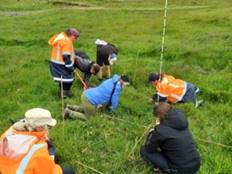
In December the CoastCare and Coastal science team undertook dune monitoring in the Far North. Dune vegetation transects at Ahipara, Puheke, and Waipapakauri were measured as part of an annual programme. In addition, tracking cards, for pest and native species, were placed and recovered at all these sites. Dune monitoring was also done at sites across Bream Bay.
CoastCare staff organised and attended a vehicles on beaches advocacy day at Tip Road on 21 December, with staff from the Regulatory Services team, Department of Conservation and Whangarei District Council. Staff talked to people as they drove on to the beach, to explain the rules and hand out maps showing the vehicle exclusion areas whilst other staff patrolled the beach. The sign indicating the start of the no vehicle area was replaced, as it had been removed by vandals.
On 15 January the CoastCare team took part in a school holiday education event run by Te Rawhiti Young Kaitiaki programme. Information was shared about dune systems and how to protect them and interactive activities ran on monitoring dune fauna.
|
|
|
Above: NRC CoastCare staff with participants of the Te Rawhiti Young Kaitiaki programme, at Elliot’s Beach |
Wetlands
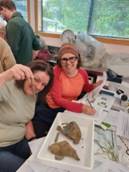
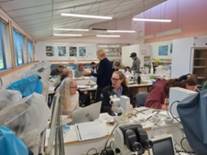
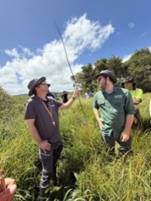
The second annual wetland training workshops run during November by Biodiversity and Bev Clarkson for NRC staff, KMR and Patuharakeke, was wrapped up early in December with participants completing an internal ‘exam’. Participants averaged 85% on their exams, and gained valuable knowledge and experience about identifying, monitoring and preserving wetlands.
NATURAL RESOURCES
Hydrology
December 2024
Rainfall
· Northland averaged 61mm of rain in December 2024 with rainfall exceeding 100mm in the Bay of Islands/Kāeo area and lower falls around 30mm in the area from Kai Iwi/Dargaville through to Whangarei.
· The regional average was 58% of normal expected rainfall, with Aupōuri Peninsula and Bay of Islands getting more than normal (>100%) with most of the region at 50% or lower.
River levels
River flows in most of Northland’s primary monitored catchments ranged from “Below normal” to “Extremely low” for December.
Groundwater
Most aquifers were reported as having below normal levels in December. Russell was near normal and Aupōuri and Taipā marginally below normal levels.
January 2025
Rainfall
· Early showers in January and a rain event on 20 and 21 January brought reasonable rain to the east coast from Taipā to north of Whangarei. Western and southern areas from Kaitaia south to Pōuto Point remained relatively dry in comparison.
POLICY AND PLANNING
During December, central government released four Bills (or proposed Bill), that impact on Northland Regional Council and Te Taitokerau.
The Table below outlines the Bills, closing dates for submissions, the select committee considering the Bills and the approach to feedback.
|
Bill |
Submission closing date |
Select Committee |
NRC input |
|
Proposed Regulatory Standards Bill |
13 January |
N/A Bill to be introduced later in 2025 |
Regional Sector submission |
|
Resource Management (Consenting and Other System Changes) Amendment Bill |
10 February |
Environment Committee |
Regional Sector submission |
|
Gene Technology Bill |
17 February |
Health Committee |
NRC submission |
|
Local Government (Water Services) Bill |
23 February |
Finance and Expenditure Committee |
Regional Sector submission |
Future Development Strategy for Whangarei
In 2024 the Joint WDC and NRC Working Group heard submissions and considered amendments to the Draft Futured Development Strategy. Since that time staff have been amending the FDS in line with the Working Groups Direction. The FDS is nearing completion and will be presented to WDC and NRC in April for potential adoption.
NRC Appeal to Whangarei District Council: Plan Change 1 (Natural Hazards)
NRC lodged submissions and further submissions on Plan Change 1 to the Whangarei District Plan relating to Natural Hazards. Following the hearing and deliberations, a decision was received on the 4 December 2024. Most aspects of the decisions align with NRC policy; however, staff have some concerns with regard to provisions for development in hazard areas. An appeal has been lodged seeking amendments to better align with the Regional Policy Statement and national direction.
4.11.5 Biosecurity
INCURSIONS
Gold Clam
Over the past two summers, efforts to strengthen gold clam awareness have included eDNA surveillance across ten lakes, new signage, targeted social media campaigns, and awareness sessions.
Staff also continued with Biosecurity checks at Lake Taharoa inspecting all watercraft and surveying visitors on freshwater biosecurity. As of 21 January 2025, 578 visitor surveys have been completed. While fewer visitors brought watercraft, the majority still came from Northland and Auckland, followed by Waikato. Notably, some Auckland visitors had recently travelled to Waikato or Rotorua, reinforcing the need for inter-regional biosecurity measures. The use of powered watercraft (boats, jet skis etc.) continued to be a preferred activity — these vessels pose the highest risk of accidental introduction of gold clams which highlights the importance of targeted interventions.
Council has signalled support for stronger biosecurity measures. Staff propose a phased approach, balancing immediate action with long-term planning to manage risks, engage stakeholders, and ensure a sustainable biosecurity strategy.
|
Kaimahi from Te Roroa, Te Kuihi and NRC received a gift from a grateful visitor coming through the check point at Lake Taharoa. |
|
Wallaby
Wallaby reports continue to be received, particularly over the summer months. For the current financial year, seven suspected wallaby reports have been recorded. Five reports were investigated using trail cameras and/or thermal drone surveillance however no evidence of wallabies has been found, including the most recent report from Christmas.
Community Engagement & Awareness
Wallabies will be a key theme at our Northland Field Days event later this month. Sightings often occur at night, and misidentifications are common, with wallaby lookalikes frequently reported.
To help the public differentiate species, staff will provide information packs.
|
|
Example from the Tipu Mātoro Wallaby? Not Wallaby! Quick ID Guide
|
Predator Free
Whangārei
The field team have had a busy month reinstating the leghold trap network that was shut down over the Christmas Break. The fifty traps installed along the Parua Bay barrier zone have regularly caught possums over the 100 nights they have been set and 120 possums have been caught to date.
The Nook project area (686 ha) moved from the initial knockdown stage to mop-up, where the frequency of checking is extended on the back of reduced possum numbers. An additional 500ha of coastal farmland has moved into the knockdown phase utilizing new artificial intelligence (AI) equipped traps. This coastal whenua is a critical area that forms the remaining possum corridor down into the elimination zone. We will have a keen eye on the results of these devices as they automatically transmit their data, with 42 possums removed since early January.
Pēwhairangi (Bay of Islands)
Ngati Rehia kaimahi have been working across 450ha of whenua Māori and have deployed bait stations and traps across 80% of the four blocks within their rohe. Their enhanced suppression mahi is focused on preventing predators entering the Purerua-Mataroa Peninsula elimination zone. Kiwi Coast deactivated their traps and removed toxin from bait stations to minimize human risks over the busy Christmas season. January has been spent reinstating these devices and continuing cat surveillance across the Purerua landscape.
Russell Landcare Trust kicked off 2025 with an event to train volunteer community members. The session included a hands-on practical demo and focused on increasing their volunteer numbers. It resulted in every attendee signing up for a trapline!
Rakaumangamanga
The use of toxins on the Cape Brett peninsula paused over January to enable an update of their Arc GIS reporting platform and to minimise human risk because of an increase in people walking the lighthouse track over the holidays. Priority is now the reinstatement of toxins into the 1,651 bait stations, with a pause in trapping across the 2,561 traps. Since July 2024, 475 ship rats and 285 possums have been caught in traps. Experienced trapper and ahi kā, Rana Rewha, has been appointed as the new project manager.
MARINE BIOSECURITY
Caulerpa surveillance at Mauitaha, Lady Alice, and Whatupuke Islands at the Hen & Chickens.
A potential sighting of exotic Caulerpa was reported by a member of the public at Mauitaha/West Chicken Island. The NRC dive team, along with DOC's skipper and vessel, responded to survey the area to confirm the presence or absence of exotic Caulerpa. No exotic Caulerpa was found at the site; only the native Caulerpa flexilis and sea lettuce (Ulva sp.) were observed, both of which are commonly mistaken for exotic Caulerpa.
Additionally, three other popular anchorages at Lady Alice and Whatupuke Islands (part of the Marotere/Chicken Islands group) were surveyed, with no Caulerpa detected at any of these sites. This rapid and effective collaboration between NRC and DOC was a good example of how both institutions can pool resources to provide an improved response.
|
|
NRC divers with DOC skipper |
Hull Surveillance
The 2024/2025 hull surveillance program commenced in December with a training session at Marsden Cove Marina, where NRC marine biosecurity officers provided pest species identification training and introduced the Level of Fouling (LoF) system to divers from Commercial Dive Specialists (CDS). Hull inspections were subsequently conducted across Marsden Cove, Whangaroa Harbour, Whangārei Harbour, and Tutukaka Harbour. In December, 225 vessels were surveyed.
Mediterranean fanworm (Sabella spallanzanii) was detected on 22 vessels, while other notable detections included Clavelina (24 vessels) and Styela sea squirt (Styela clava, 11 vessels). All these detections occurred in locations with known established populations.
In January, hull surveillance efforts expanded with divers from NRC, NIWA, and CDS inspecting 821 vessels across Mangonui, the Inner and Outer Bay of Islands, Kerikeri, Whangārei, Tutukaka, and Whangaroa. There was a notable increase in Mediterranean fanworm detections, with an additional 100 vessels found carrying the pest, bringing the total to 122. Once again, these detections occurred in locations with known established populations. Staff are continuing to work with vessel owners to ensure they clean their vessels before moving to unaffected areas.
In addition to hull surveillance, all contractors have been instructed to engage with boaties to discuss the rules around the Controlled Area Notice (CAN), distribute brochures, and highlight the risks associated with exotic Caulerpa. Contractors also surveyed approximately 200 vessels at anchor, most of which had individuals onboard. As part of on-water surveillance, Caulerpa monitoring has been incorporated into routine activities, including inspecting anchors and topside gear where possible, as well as conducting seabed searches in popular anchorages. Of the approximately 200 vessels at anchor, 84% were classified as LoF 2 or lower, representing a clean and compliant moving fleet in line with marine pathway rules.
With over half of the target vessels now surveyed, the program will continue focusing on high-risk areas to monitor biofouling and limit the spread of marine pests.
Hull surveillance to 04 Feb 2025
|
Hull Surveillance Programme Results |
Total this period |
Total |
|
Pathways Plan Compliance if Moving* |
|
|
|
Number of vessels surveyed this period |
1046 |
1046 |
|
% Pathways Plan Compliance if Moving (all vessels) * |
53.8% |
53.8% |
|
Vessels found with Marine Pests |
|
|
|
Sabella spallanzanii (fanworm) |
122 |
122 |
|
Styela clava (clubbed tunicate) |
69 |
69 |
|
Undaria pinnatifida (Japanese kelp) |
0 |
0 |
|
Eudistoma elongatum (Australian droplet tunicate) |
15 |
15 |
|
Pyura doppelgangera (sea squirt) |
0 |
0 |
* This is the percentage of vessels surveyed that complied with the acceptable level of ‘light fouling’ as defined in the Marine Pathway Plan. Note: actual compliance is higher given not all these vessels will move from one designated place to another.
4.11.6 Governance And Engagement
Te Tiriti Partnerships
Mana Whakahono ā Rohe ageement with Ngāti Hine
On 12 December 2024, Te Rūnanga o Ngāti Hine and NRC signed a Mana Whakahono ā Rohe (MWAR) agreement at Ōtiria Marae. This is the fourth such agreement that NRC has signed, and is an individual iwi MWAR that is substantively the same as NRC’s multi-hapū MWAR with Patuharakeke, Ngāti Rēhia, and Te Parawhau ki Tai.
Ngāti Hine Deputy Chair and TTMAC Co-Chair Pita Tipene said the event marked an important milestone for Iwi-Council relations and will further support our integrated efforts as rangatiratanga and kāwanatanga working in earnest together for the benefit of our environment as envisaged by Te Tiriti o Waitangi.
This was a significant milestone to achieve the commitments of Taiki e and further developing the parties working relationship.
The Mana Whakahono ā Rohe agreement helps to develop greater mutual understanding of the parties expectations and aspirations across a range of resource management issues and will be a significant step in the practical realisation and implementation, through partnership, of those aspirations.
|
|
Signing the Mana Whakahono ā Rohe: Chair Northland
Regional Council, Geoff Crawford and Deputy Chair, Tui Shortland. |
Economic Development
· Regional Deals – Supporting development of a Regional Deals Light-Touch Proposal (submission due 28 February) including drafting of content and facilitation of workshops with elected members (two with the Joint Regional Economic Development Committee and one with council).
· Council investments – Concluded review of conditions precedent in relation to the provision of funding under the subscription agreement for the Mid North Water Scheme, and funding provided in line with council’s commitment
· Joint Regional Economic Development Committee – Provided agenda material and support for the December meeting, which featured representation from Infometrics, Channel Infrastructure, the Infrastructure Commission, and Kānoa (MBIE).
· Northland Inc – Collaborated with the HR team to commence the appointment process for a new director to the Northland Inc board commencing 1 July 2025. Key committee meetings are scheduled for March and April 2025, with the preferred candidate expected to be notified in May 2025.
· Northland Economic Quarterly e-newsletter – Issue 44 distributed and available online at https://www.nrc.govt.nz/your-council/online-services/enewsletters/. The annual section focused on selected primary industries while the spotlight section examined the 2023 deprivation index.
Community Engagement
Tū i te ora Scholarship
Applications for the sixth round of scholarships opened on Monday 9 December 2024. Six scholarships are available – each include $4000 plus paid work experience at council next summer. Promotions have included social media, bus back, posters, email newsletter, radio advertisements and uploading info to national scholarship websites.
Whakamānawa ā Taiao – Environmental Awards
Entries for the sixth Environmental Awards opened on Wednesday 15 January. Promotions have included social media, bus back, posters, email newsletter, and radio advertisements. An info session for staff to learn more about the awards and how they can help drive entries is set to take place. Applications close Sunday 30 March.
Good to Go
We relaunched the digital advertising campaign to promote the Good to Go Hub, following the success of last summer’s digital advertising. The hub contains info on key biosecurity concerns, including exotic caulerpa and freshwater gold clam, and boating safety rules and tips. Ads ran from mid-December to early February, with both visitors and locals targeted based on their location and relevant online behaviour (e.g., interest in water-based activities).
Whangarei A&P Show (7 December)
Staff from Biosecurity (partnerships, incursions, pest plants), Predator Free, Biodiversity, Policy (RPMP), and Compliance attended this large A&P show. Our display featured several interactive games and a trap giveaway from Tiakina, which attracted visitors of all ages. Throughout the day, we engaged with approximately 400 people, and the feedback was overwhelmingly positive.
Kaikohe A&P Show (18 January)
Staff from biosecurity, biodiversity and policy team attended this small rural A&P show. Feedback from staff in attendance was positive with people keen to chat about pests and weeds.
Supporting the business
Throughout December and January, the Community Engagement team provided a variety of support and services to help the business achieve the following:
|
|
· Marine Biosecurity: A digital campaign to inform visitors and locals about the CAN location and rules and encouraging people to report sightings of Caulerpa outside the known area ran from mid-December to early February. Ads ran across Facebook, Instagram, MetService, SwellMap and messaging was displayed on digital screens at 12 marina/boat club sites across the region. Alongside this, we produced flyers and posters for hapū to display and distribute at the Waitangi Day Festival.
· Marine protected areas: Support for the summer awareness campaign and patrols. Media liaison and coverage through various communication channels.
· Biosecurity: Created flyers, posters, signage and social media content to raise awareness of sea spurge and encourage the public to report sightings.
· Pest plan: information and promotional activity to encourage engagement with this plan review.
· Biodiversity: Created new coreflute education posters for CoastCare events, as well as providing media support with an enquiry from the Northern Advocate that resulted in a lead story in the paper/on the NW website. We also produced content for and facilitated the promotion of an internal wetlands workshop and material for World Wetlands Day on 1 February.
· Climate change: support for summer events presence, collateral and signage development.
· Transport: Supported the CityLink team with the bus services move from Rose Street to Vine Street, whilst Rose Street bus hub is redeveloped. We produced content and collateral, provided website and social media updates, posters and signage.
· The National Ticketing Solution / Motu Move national project is continuing, with CE support in attending national Marketing meetings and enabling BeeCard with the update of terms and conditions in preparation for the roll-out (Northland anticipated in late 2025/early 2026).
Media liaison
In total 11 Northland Regional Council media releases were created and distributed throughout Te Taitokerau and beyond during December and January. Topics included:
· Entries open for Whakamānawa ā Taiao – Environmental Awards
· Water conservation urged as dry summer continues
· Summer checks to keep gold clam out of Kai Iwi
· NRC on track to receive its first-ever professional working possum dog
· Ngāti Hine, NRC sign first-ever Iwi-Council resource management agreement in Taitokerau Northland
· Applications open for Tū i te ora Scholarships
· Regional pest plan under review
A number of media enquiries were also received and responded to during December and January. Combined, this activity helped generate 182 items mentioning Northland Regional Council as reported by media monitoring agency Truescope.
Content creation and storytelling
· Kohinui ‘bioblitz’ uncovers thriving indigenous species
· Pilot programme for Honorary Enforcement Officers
· NRC scholarship recipient says council great place to kickstart career
· Biosecurity alert: Madagascar ragwort
· Summer water supply and storage – what are the rules?
· Teaching tamariki to become freshwater kaitiaki of the future
· Flexible funding approach supports farm trust to protect te taiao
· Summer patrols to protect sensitive marine areas
· Changes to stock exclusion regulations
· Mokomoko (lizard) monitoring pilot workshop
Digital engagement
Overall performance across social media platforms:
|
Profile |
Audience |
Net audience growth |
Published posts |
Impressions |
Engagements |
Engagement rate (per impression) |
Video views |
|
Reporting period 1 – 31 Jan |
20,802 ↑5.8% |
1,145 ↑754.5%
|
23 ↓64.4%
|
556,746 ↑109.4%
|
4,653 ↓60.8%
|
0.8% ↓81.4%
|
26,767 ↑100.7%
|
|
Compare to 1 – 31 Dec |
19,662 |
134 |
65 |
265,895 |
11,856 |
4.4% |
13,340 |
|
|
14,690 |
908 |
10 |
321,377 |
4,185 |
1.3% |
16,583 |
|
|
3,296 |
34 |
3 |
2,709 |
205 |
7.6% |
21 |
|
|
2,256 |
200 |
9 |
232,660 |
214 |
0.1% |
6,100 |
|
YouTube |
560 |
3 |
1 |
N/A |
49 |
N/A |
4,063 |
Top three posts reaching the most people:
Tāngata Whenua Environmental Monitoring Fund, ‘day in the life’ reel of a summer intern promoting the Tū i te ora Scholarship and, a Northern Advocate article about CoastCare and seed collection time.
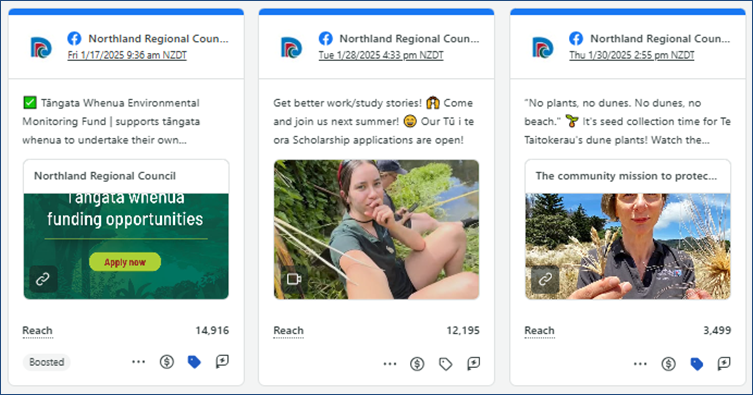
*Reach: total number of people who saw the content.
Sentiment: There was a significant amount of negative sentiment received on the tāngata whenua environmental funding post. Key themes included a lack of understanding around how funds are distributed, funding opportunities perceived as racism and the collective benefits provided by funding and how tāngata whenua contribute to these outcomes.
|
Number of times the post has been displayed to users |
30,287 |
|
Number of people who have seen the post |
12,913 |
|
Reactions |
126 (70 likes, 25 angry, 24 hearts, 3 wow, 2 care, 2 laugh) |
|
Number of comments made on the post |
238 |
|
Number of times the post has been shared |
45 |
|
Saves |
10 |
Staff monitored and responded to engagements and are doing so by:
· Enforcing the terms of use.
· Allowing the online community to self-moderate where our terms of use have not been breached.
· Developing pre-prepared responses.
· Checking-in on the wellbeing of kaimahi.
· Reporting comments through the Harmful Communications process.
eNewsletters distributed during this period:
· CoastCare Te Taitokerau: Subscribers: 377 Open-rate: 57.8%
· Tū i te ora scholarship 2025: Subscribers: 2,324 Open-rate: 39.3%
· Taumata Taiohi | Platform of the youth: Subscribers: 278 Open-rate: 13.4%
· Our Northland: Subscribers: 1,565 Open-rate: 59.7%
· Hills to Harbour: Subscribers: 612 Open-rate: 51.1%
· Economic Quarterly: Subscribers: 311 Open-rate: 30.4%
· TTMAC Pānui: Subscribers: 534 Open-rate: 49%
· Whakamānawa ā Taiao – Environmental Awards 2025: Subscribers: 534 Open-rate: 34.5%
Website Audit Report results
The 2024 Website Audit is conducted by ALGIM (Association of Local Government Information Management). ALGIM provides leadership to the local government sector through best practice toolkits, advocacy, research and auditing of digital services.
The NRC website ranked 2nd out of 80
organisations (up from 7th last year, and just 0.3% behind the 1st site). In
comparison to other regional councils, NRC again ranked top regional council
website and achieved 1st ranking in performance, accessibility, and
best practices. Overall, NRC scored 93% (up by 10% last year) and above the
national average of 73%.
Top three website pages:
|
Key Performance Indicators |
Sep-24 |
Oct-24 |
*Nov-24 |
Dec-24 |
Jan-25 |
|
WEB |
|
|
|
|
|
|
# Visits to the NRC website |
37,942 |
36,043 |
35,982 |
36,247 |
54,737 |
|
E-payments made |
33 |
39 |
9 |
16 |
13 |
|
# subscribed web alerts (cumulative) |
1,631 |
1,633 |
1,642 |
No data |
1,655 |
|
# subscribed to eNewsletters (cumulative) |
5,554 |
5,552 |
5,553 |
No data |
5,526 |
|
CDEM SOCIAL MEDIA (CUMULATIVE) |
|
|
|
|
|
|
# CDEM Facebook fans |
36,823 |
36,826 |
36,786 |
No data |
36,907 |
|
# CDEM Overall Facebook Reach (30D) |
65,820 |
21,672 |
4,839 |
No data |
144,764 |
* Short reporting month (completed 25 November).
No data due to Christmas break.
Education
Te Rawhiti Young Kaitiaki Summer Programme
Council supported the Te Rawhiti young kaitiaki summer holiday programme with advice and by leading interactive sessions. The sessions covered introduced species, dune care, tracking tunnels and a beach clean-up.
Facilitating Enviroschools communities
Despite the school holidays, during December and January Enviroschools Facilitators visited or held specific online interactions with over 60 enviroschools’ communities.
Local Government Official Information Requests (LGOIMA)
In December 2024, we received 29 LGOIMA requests, followed by 23 in January 2025. Overall, LGOIMA requests have shown an upward trend each year. We received a total of 139 requests in 2022, 310 in 2023, and 368 in 2024. Notably, in 2024, only three LGOIMA requests were not answered within the statutory timeframe, an improvement from the seven in 2023 (as previously reported in the CE’s reports).
|
|
|
4.11.7 Community Resilience
Rivers
Upper Kawakawa Catchment Nature Based Solutions to Flooding
A framework is being created for the Taumarere catchment to look at suitable sites for nature based restoration projects that will have a positive impact on flood reduction, sediment and ecoli reduction and habitat restoration. This framework will allow us to choose a site for NBS implementation, see what funding is available and what monitoring is required and provide rough order costings to result in ’shovel ready’ project sites. We are still working collaboratively with Ngati Hine and the Taumarere Business Case.
Kaeo Stage 2
The resource consent application was submitted before Christmas break 2024. We are waiting for a review of the valuation to come in before sending an offer to the landowners for purchase of the properties to construct the new channel. The planners have requested we get an archaeological authority for the project due to the proximity to registered sites of significance.
We have adjusted the new channel and deflection bank slightly. The deflection bank has been reduced in length to chainage 440 on recommendation from a peer review to reduce the length so the bank is perpendicular to the flow of the floodplain. We have adjusted the new channel position to avoid having to remove established trees on the farmland.
|
|
|
Current alignment of Kaeo Stage 2 |
Matangirau Floodway
We are finishing up the last of the six agreed jobs in Matangirau this week. Benching along the Towai stream on the right hand bank, gravel extraction from the river and under the bridge.
Further Otiria Works
We have met with KiwiRail and the local residents, everyone agreed on a scope of drainage works and now the engineers are completing the detailed design which will involve upgrading existing stormwater assets around the rail yard and Otiria Marae.
Kawakawa Deflection Bank
We have applied to update the plans for the Kawakawa Deflection Bank resource consent to include laying back the right hand bank of the Waiomio Stream on a 1:4 batter. This work is likely to be completed by the end of April.
|
|
|
|
Transport
Regional Public Transport Plan 2021/2031 Review
In accordance with the requirements of the Land Transport Management Act 2003, following the successful completion and implementation of the Regional Land Transport Plan 2021/2027 Three Year Review, staff have commenced work on the review of the Regional Public Transport Plan 2021/2031 (RPTP). This review ensures alignment with the Government Policy Statement on Land Transport 2024.
Once the draft RPTP is completed, it will be presented to the Regional Transport Committee (RTC) for comment and approval before being released for public consultation. Following consultation, staff will submit the final draft to the RTC for further review and endorsement before seeking final approval from Council.
Passenger Transport Private Revenue Increase
Throughout December 2024 and January 2025, NZ Transport Agency Waka Kotahi (NZTA) and NRC have continued dialogue on the Government’s directive to increase private share revenue on council- contracted public transport services.
Due to delays resulting from discussions between local government and the Minister of Transport, the Minister has agreed that councils may maintain their budgeted farebox revenue for the 2024/2025 financial year, with fare increases to commence from the 2025/2026 financial period onwards.
Please note that both the Total Mobility Scheme and the Community Connect Concessionary Fares Scheme are not included in this directive.
Whangarei T2 Lane Progress Update
The Whangārei District Council has advised that the completion date for the Kamo to Bank Street T2 lane has been revised from 1 May 2025 to 26 May 2025. This adjustment ensures that the full enforcement measures are in place before the lanes become operational. However, this date remains subject to change based on project circumstances.
Rose Street Bus Hub
As of 28 January 2025, following a technical delay, the Rose Street bus hub has been officially relocated to Vine Street. The CityLink liaison officer is now stationed in the Vine Street car park in a portacom, which includes temporary restroom facilities for passengers. The Whangarei District Council is currently sourcing temporary bus stop seating for passengers, as construction of the Rose Street building is expected to take approximately 7–8 months.
|
|
|
CityLink temporary office |
Beach Buses – New Summer Routes
Following overwhelming community feedback, the Summer Beach Bus Service was revised, replacing Ruakaka Beach and Oceans Beach with new routes to Ruakaka and Waipū Cove and Ngunguru and Matapouri Beach. This service operated Fridays and Saturdays throughout the school holidays. Services operate from Friday, 27 December to Friday, 31 January, and Saturday, 28 December to Saturday, 1 March.
Passenger uptake started slowly due to bad weather, but as the weather has settled, ridership has seen increased patronage.
|
|
|
Beachgoers catching the bus on school holidays from Rose Street. |
Total Mobility Scheme (TM)
Total Mobility Trips and client travel for December 2024:
· Whangarei – 1,800 clients undertaking 3,307 trips
· Far North – 343 clients undertaking 257 trips
Total Mobility Trips and client travel for January 2025:
· Whangarei – 1,804 clients undertaking 3,179 trips
· Far North – 363 clients undertaking 264 trips
Whitelisting Total Mobility cards
Work continues nationally to introduce the” Whitelisting” of TM cards. On the present system, cancelled cards can still be used through the taxi vehicles onboard card reader which allows holders of these cancelled cards to still get discounted travel.
Civil Defence Emergency Management
About 3am on 26 January 2025, a tornado occurred in the Mangawhai Village, causing extensive damage to properties, fallen trees and downed power lines. While no fatalities occurred, two people were hospitalised with serious injuries. The Kaipara District Council activated their Emergency Operations Centre (EOC) and were supported by the Northland Civil Defence Emergency Management Group
The tsunami siren replacement project continues on-track with work also being done to replace tsunami information boards throughout Northland with new inundation maps as a result of updated tsunami modelling being done.
The Multi-Agency Emergency Coordination Centre (MACC) Heads of Agreement between councils, that addresses funding, is in execution copy and is to be signed by all four council’s Chief Executives. The MACC Heads of Agreement and the Development Agreement between council and Fire and Emergency NZ, that address leases and design, are currently being negotiated before they are presented for council approval, likely to be sought at the March 2025 meeting.
Climate and Natural Hazards
Climate Change Commission comes to Northland
The climate change commission is planning a visit to Northland in March as they gather evidence to inform the government on shaping the National Adaptation Plan due out this year. They are keen to understand climate risks, as well as enablers and barriers to effective adaptation in a Northland Context. The climate team is looking forward to hosting them and to be able to put forward the unique challenges and opportunities we face here in Northland.
You can read more about the specific assessments they are undertaking as part of their adaptation work programme here:
· the Government's progress in planning for, and adapting to, the impacts of climate change, and
· the climate risks that Aotearoa New Zealand is already experiencing and will experience in the future.
·
Climate Action Conference
Climate Action staff are helping to shape the annual Climate Action Conference run by the Climate Action te Taitokerau Trust. The conference will run over 21/22 March and will be a mix of presentations, panel discussions and workshops. The theme for this year is Climate and Economy and the kaupapa is to promote how healing the climate and building prosperity are synergistic. The two main areas of the economy that will be focussed on are kai and energy.
Engagement
The Climate Action and Natural Hazard Team started a busy summer of public engagement at the Paparoa A&P Show.
|
|
NRC staff member plays NIWA River Game with visitors to the Paparoa A&P Show. This game enables people to experience the impacts of flooding in a safe environment and for the facilitator to discuss adaptation options |
|
|
|
|
|
|
A show visitor plays with the Climate Team’s new wave tank. An interactive display that demonstrates how nature-based solutions (mangroves, salt marshes, dune planting) can protect homes and infrastructure on the coast. |
Climate Resilient Communities Fund – Kia Manawaroa Te Taitokerau!
The first round of Climate Resilient Communities Funding is being contracted to twenty-two projects across Te Taitokerau, with recipients eager to get on with the mahi.
Of the twenty-two projects, six directly focused on building kai resilience for the region. These include on the ground community-led mahi that aims to educate and empower communities to grow their own kai and projects that identify and strengthen food support networks and develop a strategy for how the region can become self-sufficient in food production and distribution.
Four projects supported water supply investigations to future proof water resilience and water tanks in vulnerable communities. This extends the water resilience mahi NRC previously supported through the Water Resilience Fund which has now been replaced with this Climate Resilient Communities Fund.
Three rural marae will receive funding to support the installation of solar panels, improving energy resilience and benefiting the wider community in times of need.
Funding will support four projects that look to nature-based solutions to build resilience to the changing climate, recognising how restoring wetlands, river margins and coastal dune systems can enhance protection from weather events, increase carbon sequestration and support our indigenous biodiversity.
Three other projects aim to build resilience across multiple impact areas looking holistically at how our resilience could be improved as the climate changes, and two planning projects have been funded that will help the respective communities understand how climate change could impact them and to formulate specific plans to reduce these impacts.
While this mahi gets underway, learnings from the first round of funding are being used to revise fund guidelines and process for the second tranche. We will now be able to provide actual examples of the types of projects this funding supports, all aimed at making this pūtea more accessible for those communities wanting to undertake climate resilience mahi that benefits our region. Round two is set to open on 28 April 2025.
Response to round one was overwhelming, with 96 applications requesting $3.2 million from the $600,000 budget. It is expected that round two, due to open on April 28th will also be popular with many worthy projects missing out in the first tranche, however the budget increase to $1million in July 2026 will help to alleviate this pressure.
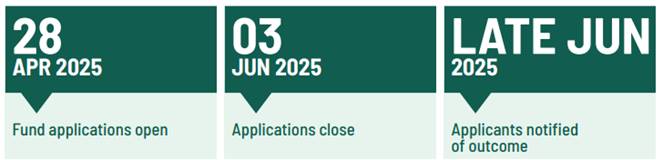
Fresk Workshop with ELT
We ran a second Climate Fresk Workshop at the end of December which brought together the Executive Leadership Team and staff members in an inspiring and thought-provoking session. The workshop aimed to educate participants on the science behind climate change and empower them to take meaningful action toward a more sustainable future.
During the workshop, attendees engaged in collaborative activities that highlighted the importance of sustainable practices. Committing to live and lead in a more environmentally friendly manner. Some of the actions that were committed to included choosing to use and encouraging others to use more sustainable transport, reviewing internal policies that would encourage more sustainable procurement choices and using our network of connections to advocate for region wide change initiatives.
By holding ourselves accountable to the actions we have set, staff can ensure that our commitment to environmental responsibility becomes a core part of our company culture.
|
|
|
Staff discussing cause and effect during the workshop |
Rangaunu Harbour Future Coasts
The week of 9 – 13 December, Climate Action Interns joined a team of NIWA Estuarine Ecologists and Scientists up at Rangaunu Harbour to install monitoring equipment for the Future Coasts programme. The programme seeks to gain a clearer understanding of the consequences of sea level rise to Aotearoa’s coastal lowlands and promote the benefits of mangroves and coastal wetlands as part of the climate response.
One focus of the ongoing research is examining changes in wetland surface elevation, measured using Rod Surface Elevation Tables (RSETs). This is an important factor in assessing the impacts of sea-level rise (SLR), especially when considering scenarios where, for example ground levels may drop by 20 cm while sea levels rise by 10 cm, resulting in a net elevation change of 30 cm. Rangaunu Harbour is the northernmost site for the programme, so NIWA is intrigued to find out how this wetland changes in the future.
|
|
|
Signage explaining RSET use.
|
Staff joined the NIWA team and found their roles working on sediment coring and ingrowth/decomposition bag installations. The coring will provide the team at NIWA with vital information on sedimentation and carbon sequestration levels of the mangroves, saltmarshes, and seagrass in the coastal wetlands. NIWA is working on Blue Carbon science and economics, promoting the transition from pasture back into wetland, for carbon sequestration. It was amazing to see the direct impact this week of work will have on climate change science in Aotearoa New Zealand going forward.
|
|
|
Climate Interns working on cores in dense mangrove |
|
|
|
|
Figure 3: Teamwork makes the dream work. |
Climate Interns dividing blue carbon core into 5cm intervals. |
Following on from the initial fieldtrip, in January, our new Natural Hazards Analyst assisted the NIWA team with the first RSET surveys and contributed to the installation of dendrometers on mangrove and manuka tree trunks to measure tree growth rates. They also installed mesh mats, feldspar sections and nylon pin arrays to track sediment accumulation across the mangrove, salt marsh, manuka and pasture sites. These were installed as sediment supply and tracking is important in understanding the resilience of coastal wetlands, particularly in relation to sea level rise. For example, when mangroves receive sufficient sediment, they are able to gain enough elevation to be resilient against future sea level rise. But in sediment poor systems, mangroves are forced to retreat inland, leading to issues like inundation, saltwater intrusion and the loss of productive agricultural land.
With all the logistical and site preparations now complete, staff will accompany the NIWA team to the Rangaunu Harbour sites every 3 months to conduct subsequent surveys, continue monitoring the sites and removing the decomposition bags at either 6 or 12 months.
|
|
Distributing the Feldspar at one of the Rangaunu Harbour pasture sites |
|
|
|
Natural Hazards
Work continues on the early Flood Forecasting tool with the consultants demonstrating an early version of the tool to the project team in late January. Work on the Wairoa Flood model has continued over the last two months with this project on track. These two projects were funded by Central Government as part of the post Gabrielle Recovery.
NRC are partnering with Whangarei District Council to investigate options for flood mitigation for urban Whangarei. A two-step tender process is underway to identify an organisation (or consortium) to undertake technical assessments. The first step (Registration of Interest) closed mid-December and received 10 applications. The project team reviewed these and shortlisted three suppliers to tender for the project. That tender will be released in early February. A Memorandum of Understanding between WDC and NRC for this work is in development.
NZ Agriculture and Climate Change Conference
Our Zero Carbon Advisor attended the conference, hosted by New Zealand Agricultural Greenhouse Gas Research Centre, and including a wide range of stakeholders including Fonterra, Woolworths, AgResearch, LIC, MPI, and farmers from around the country.
Some of the key messages included the demand-driven shift, where consumers are now expecting that products are produced and sourced sustainably. This is trickling down the supply chain, where big international players such as Mars and Nestle are working with Fonterra to ensure New Zealand dairy products are keeping up with these trends to remain sellable.
Farmers that are working to reduce their emissions look at it from an efficiency perspective and find that what is good for the planet is also good for the wallet. Technology is advancing quickly and ranges from methane inhibitors to selective breeding, where the stack-ability of these technologies is also being investigated so the range of solutions can complement each other.
Maritime
12 maritime incidents were reported in December, and 26 in January. 9 were derelict or abandoned vessels, and the rest related to mooring piracy, grounding, collisions and offences such as speeding. Routine battery changes were undertaken for 5 aids to navigation in the Kerikeri Inlet.
11 cruise ships in December and 14 in January arrived in the Bay of Islands as scheduled with one cancellation. 17 skipper assistance trips were completed supporting the work of our Biosecurity, Compliance and Water Quality teams totalling 99 on-water hours.
During the festive period the team conducted 36 on-water patrols across the Bay of Islands, Whangaroa, Tutukaka Coast, Mangawhai and Kai Iwi Lakes. Patrols are carried out in popular areas with a focus on education and enforcing navigational safety rules to help ensure people are kept safe on the water and encourage good maritime practices.
Early January was quite windy which kept people off the water or at anchor reducing the number of usual incidents. Work is ongoing on the draft of the new navigational bylaws with in depth feedback from Maritime NZ and a subsequent meeting to discuss changes.
The below chart is a 2024 summary of activity.
|
2024 Maritime Activity |
|
|
4.11.8 KAIPARA MOANA REMEDIATION
Earthshot Prize 2025
Kaipara Moana Remediation’s nomination for the Earthshot Prize 2025 is now public (see here). We are one of only four initiatives selected to go through as the national candidates for this Prize, and one of only two initiatives focused on large-scale nature restoration (the other is the Predator Free Wellington project). International due diligence processes are now starting with further stage-gating likely around April/May.
KMR / Horticulture NZ Partnership
KMR has formalised a partnership with Horticulture New Zealand (HortNZ), the national organisation representing the interests of New Zealand's 4,500+ commercial fruit and vegetable growers. The partnership will be publicised on 19 February in Dargaville as part of a national series of Vegetable Research Roadshows.
The collaboration centres on Northland’s kūmara sector, and involves growers registered in the Growing Change project. The project augments KMR activities by working with growers to improve sediment and erosion control management practices while enhancing on-farm biodiversity and supporting grower compliance with New Zealand Good Agricultural Practice (NZGAP) scheme EMS (Environmental Management System) Add-on requirements. A key outcome from the KMR/HortNZ pilot is to help growers achieve measurable environmental improvements while supporting sustainable horticulture in line with market and consumer preferences.
Delivery
On 31 December 2024, KMR reached the milestone of being fully operational for three years. Now a mature programme, KMR has delivered the following results on the ground (as at 31 December 2024):
Jobs & Skills
· 350,000 hours of new work – a year’s work for over 225 people
· Over $20 million has invested in a diverse range of restoration projects
· 47 local businesses and nurseries are accredited to supply KMR
· 184 people trained and mentored, many from local iwi/hapū
Engagement & Participation
· 1,131 landowners/groups have expressed interest in KMR
· 750 plans have been completed with landowners/groups
· 92 plans are in development
· 74 projects led by hapū, marae, community groups, catchment groups and other collectives
Nature & Resilience
· 2.02 million plants are in the ground or contracted to plant
· 892 hectares are planted or contracted, or regenerating into native forest
· 885 km of fencing are completed or contracted – the same distance as from Cape Rēinga to Auckland and back
· 130,000 hectares are managed under KMR plans.
Attachments/Ngā tapirihanga
Nil
[1] s.36A of the RMA identifies that there is no duty to consult about RC applications and notices of requirement.
[2] Existing Treaty Settlements in Northland – Te Uri o Hau Claims Settlement Act 2002; Te Roroa Claims Settlement Act 2008; Ngati Manuhiri Claims Settlement Act 2012; Te Rarawa Claims Settlement Act 2015; Ngati Kuri Claims Settlement Act 2015; Te Aupōuri Claims Settlement Act 2015; NgaiTakoto Claims Settlement Act 2015; Ngati Pukenga Claims Settlement Act 2017; Ngatikahu ki Whangaroa Claims Settlement Act 2017. Details of existing Statutory Acknowledgements – https://www.nrc.govt.nz/resource-library-summary/plans-and-policies/statutory-acknowledgements/statutory-acknowledgements-in-northland/#Statutory%20Acknowledgements%20in%20Northland%20%E2%80%93%20Te%20Ture%20Whakamana%20ng%C4%81%20Iwi%20o%20Taitokerau
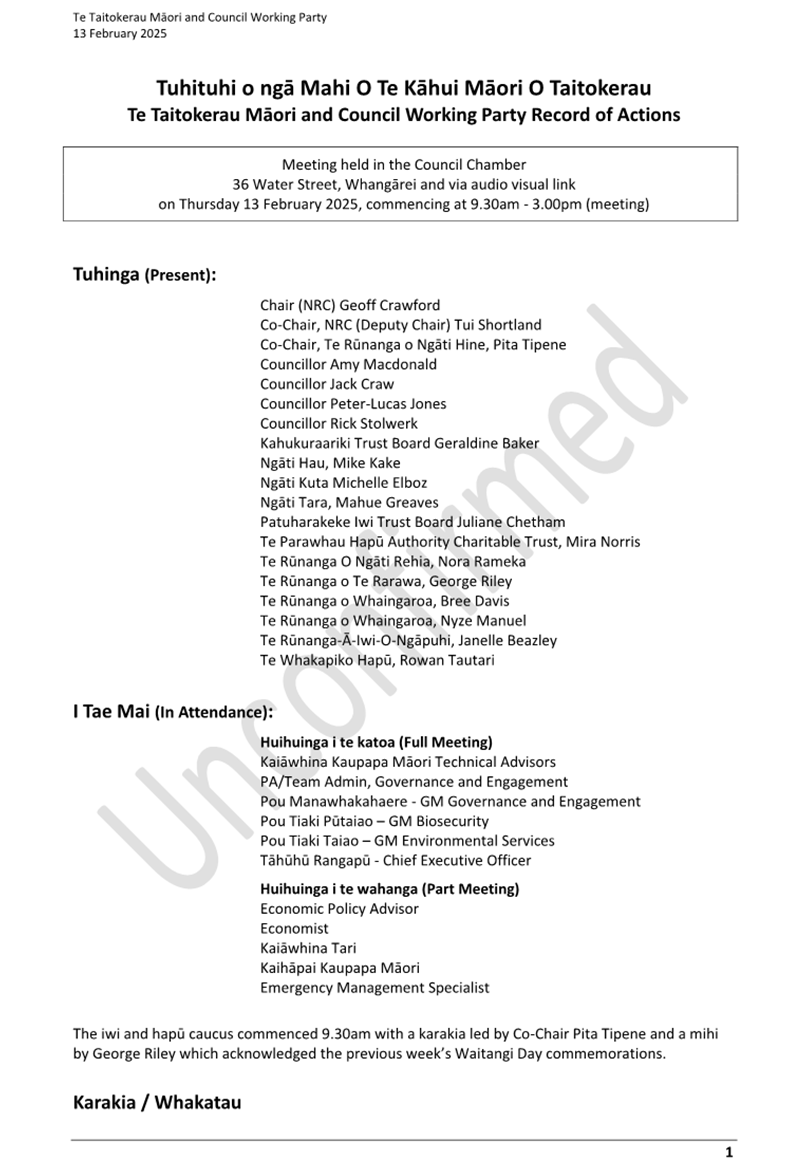
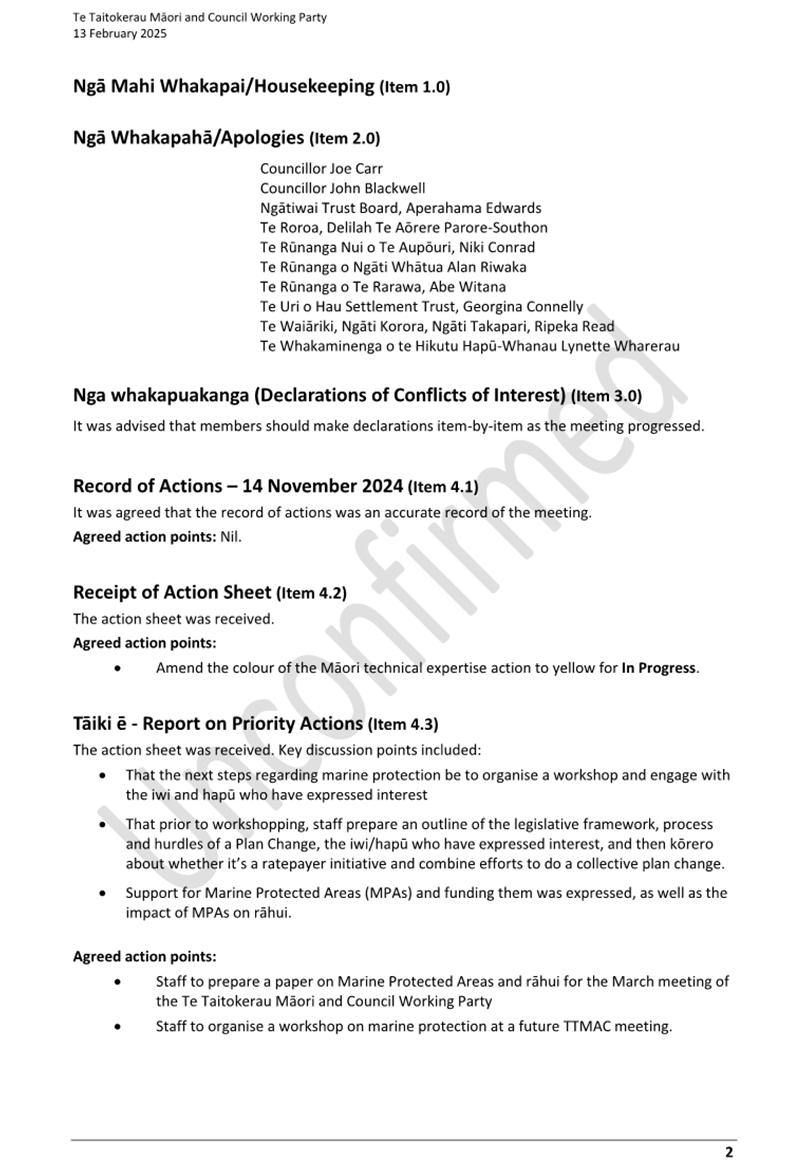
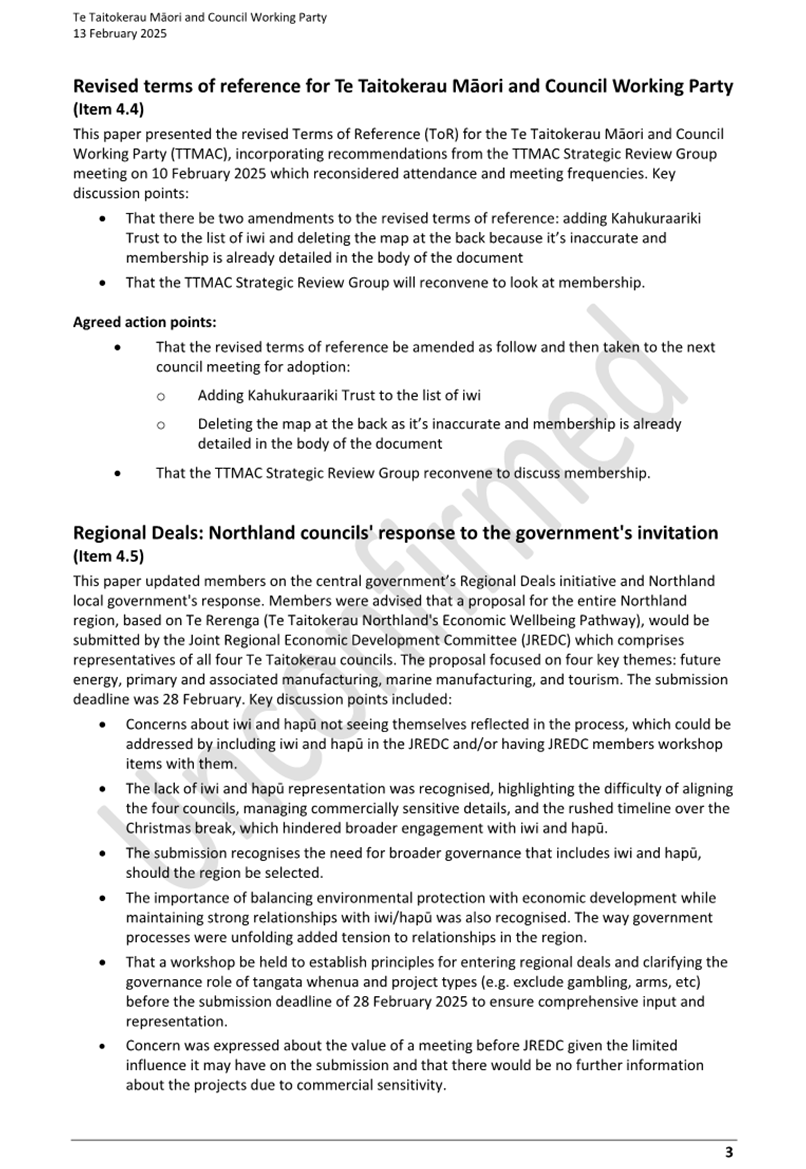
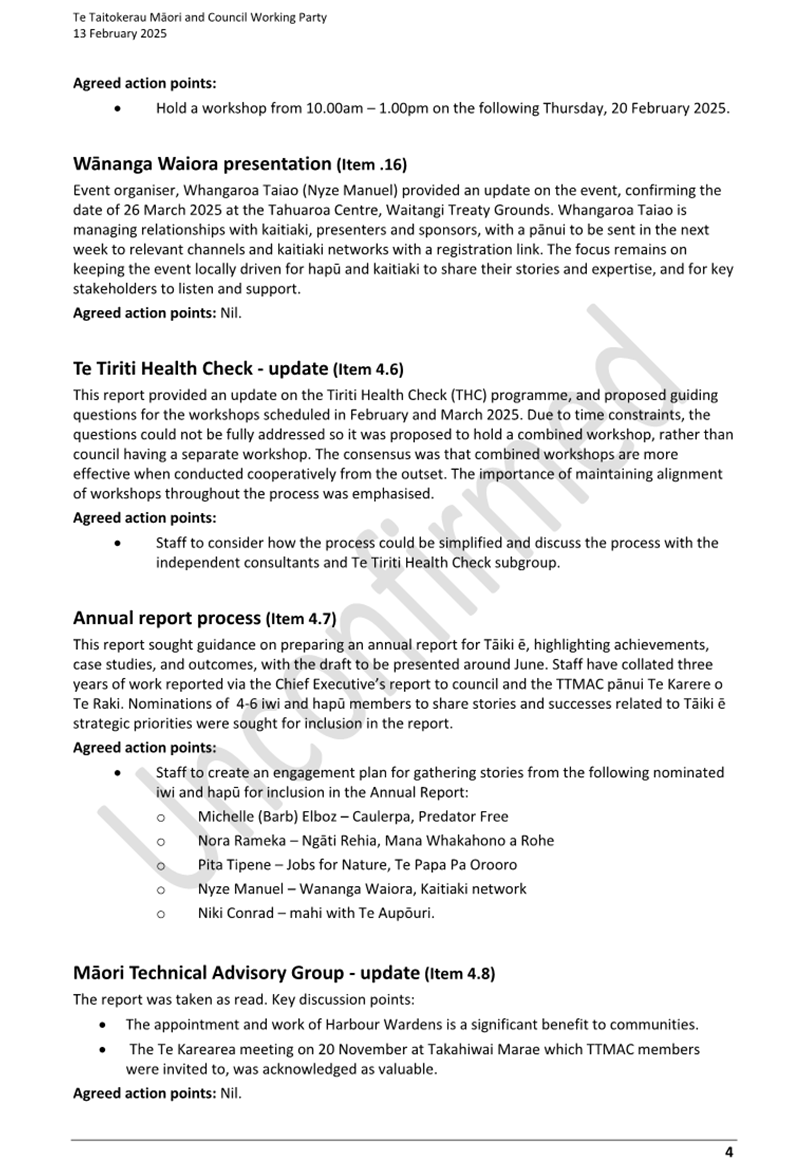
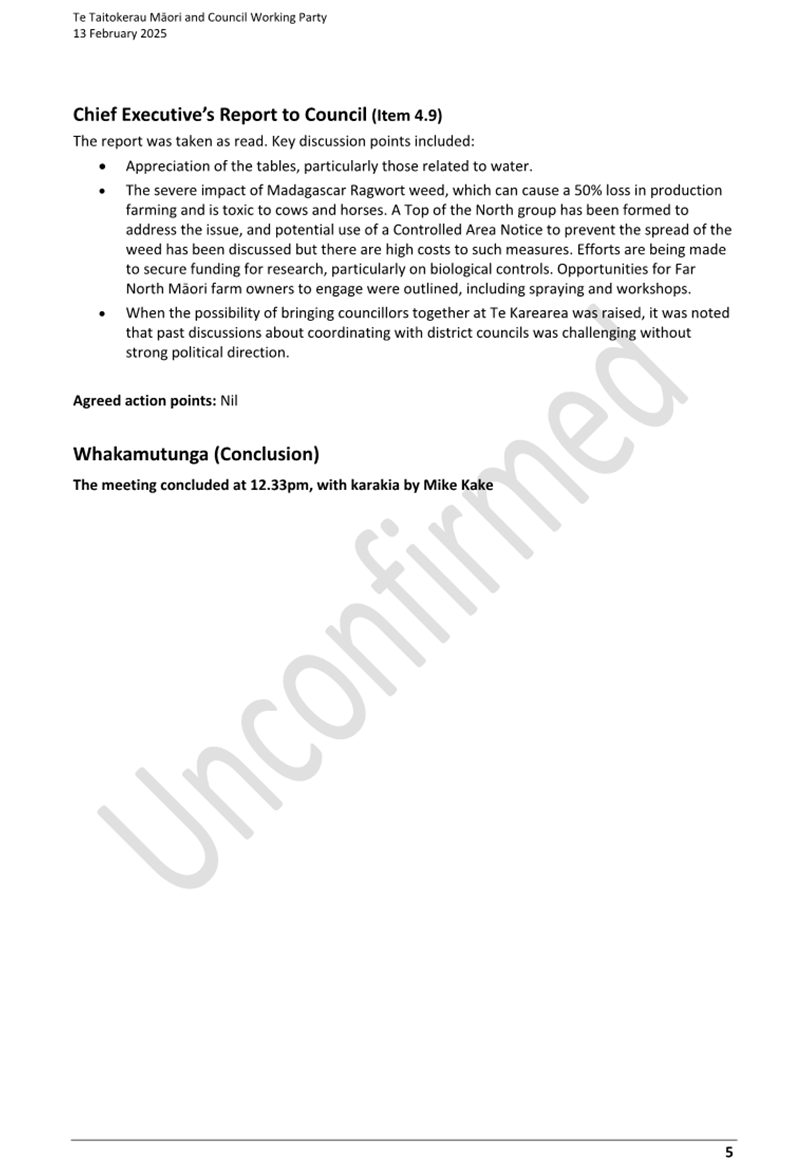
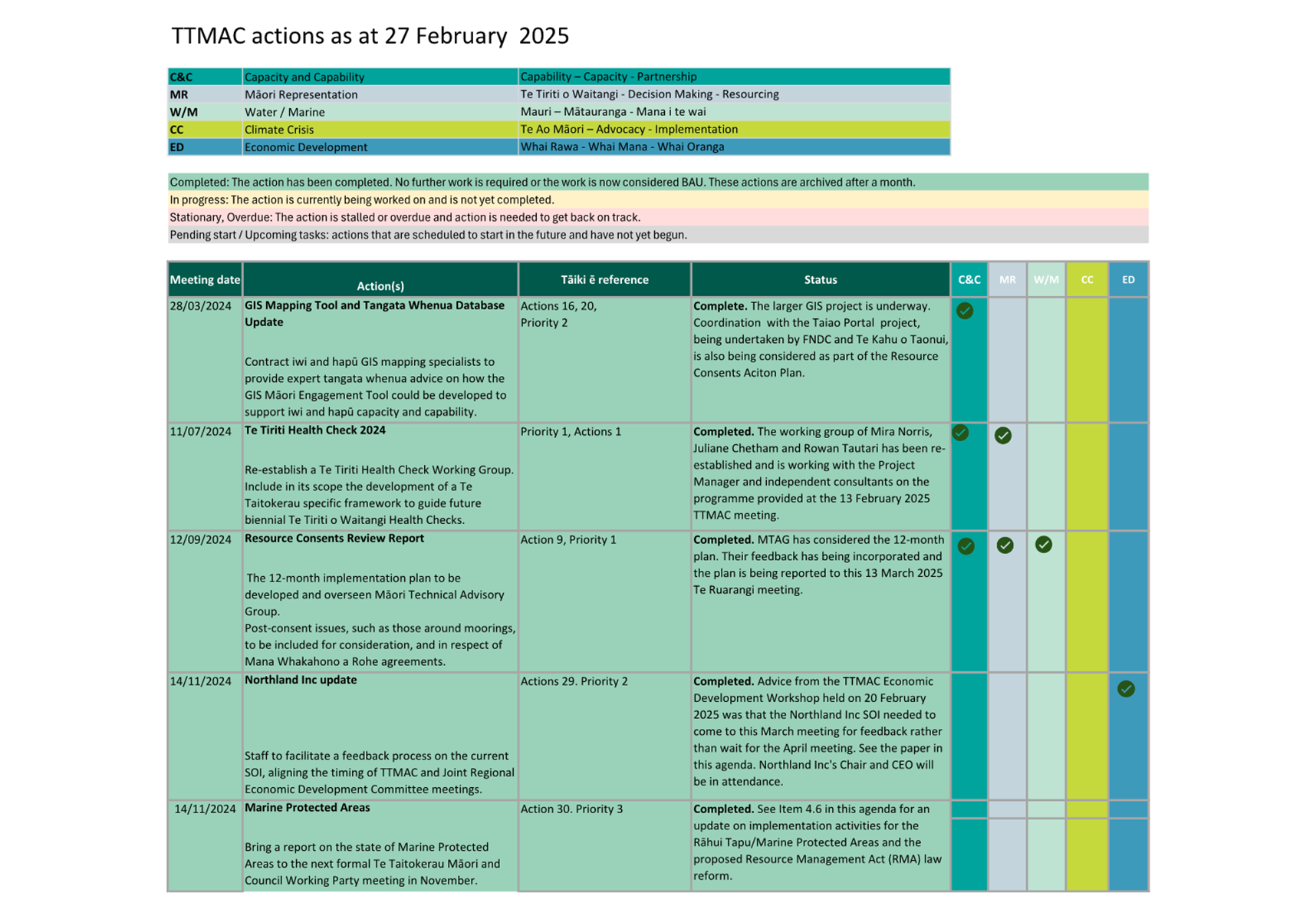
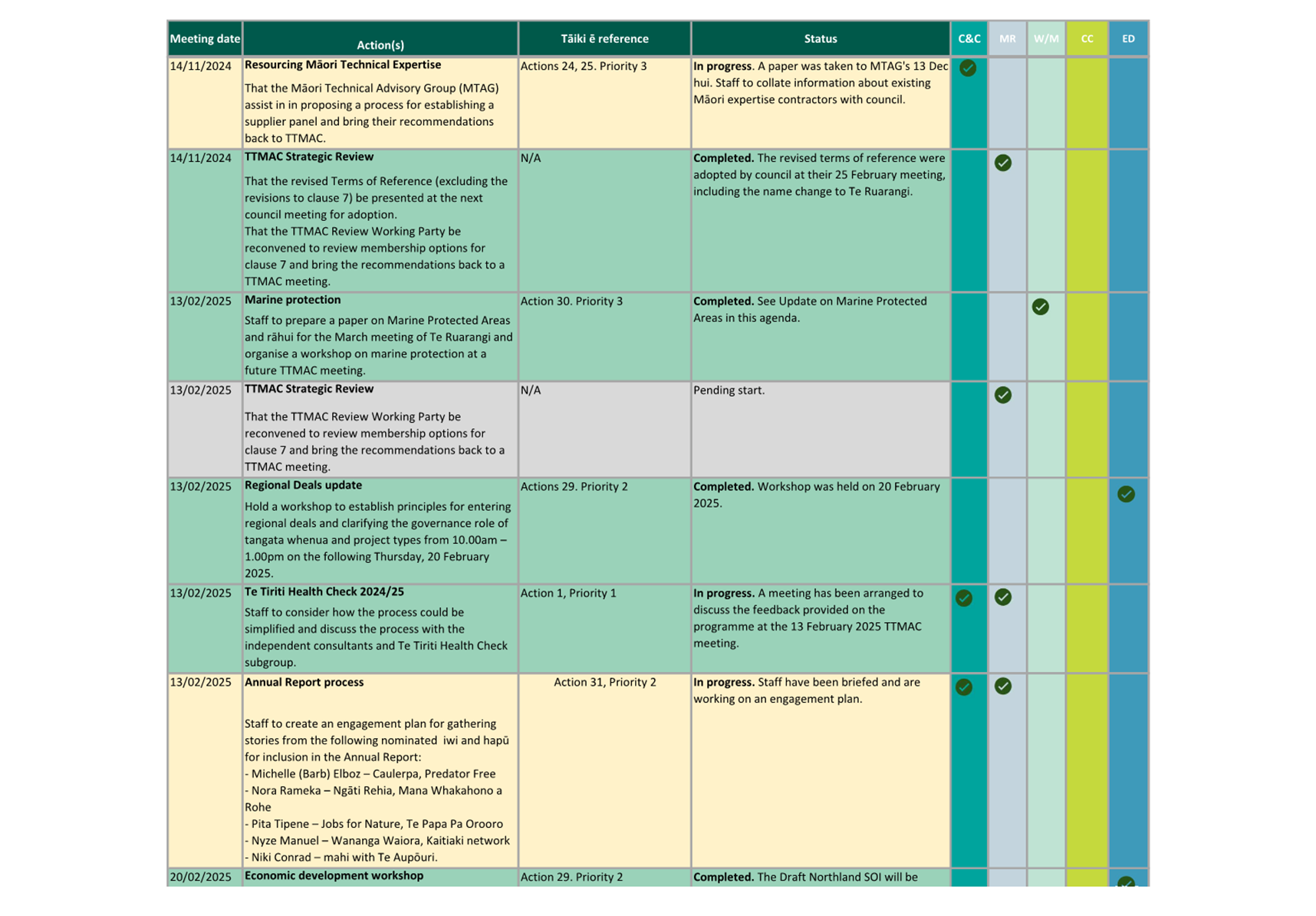
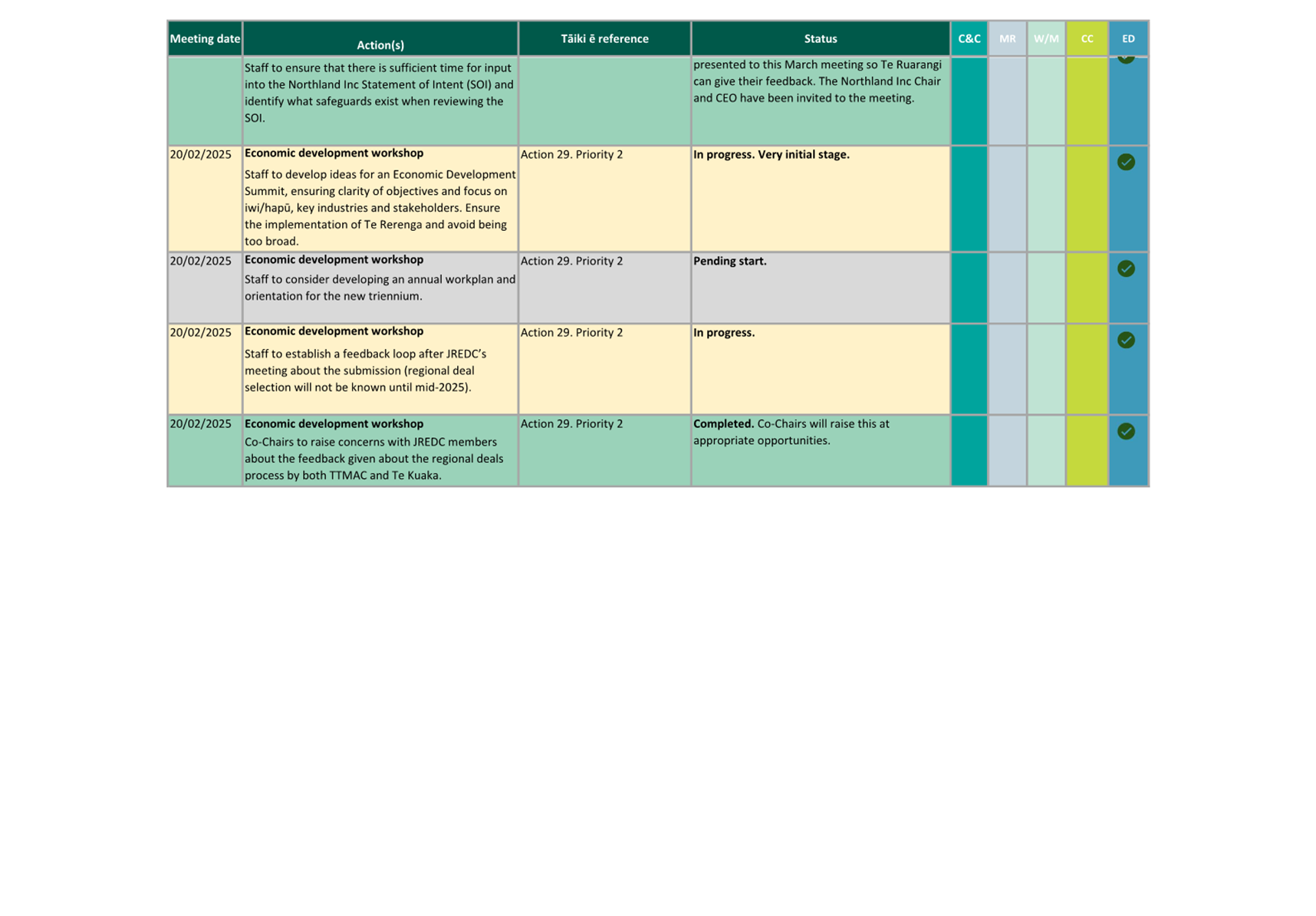
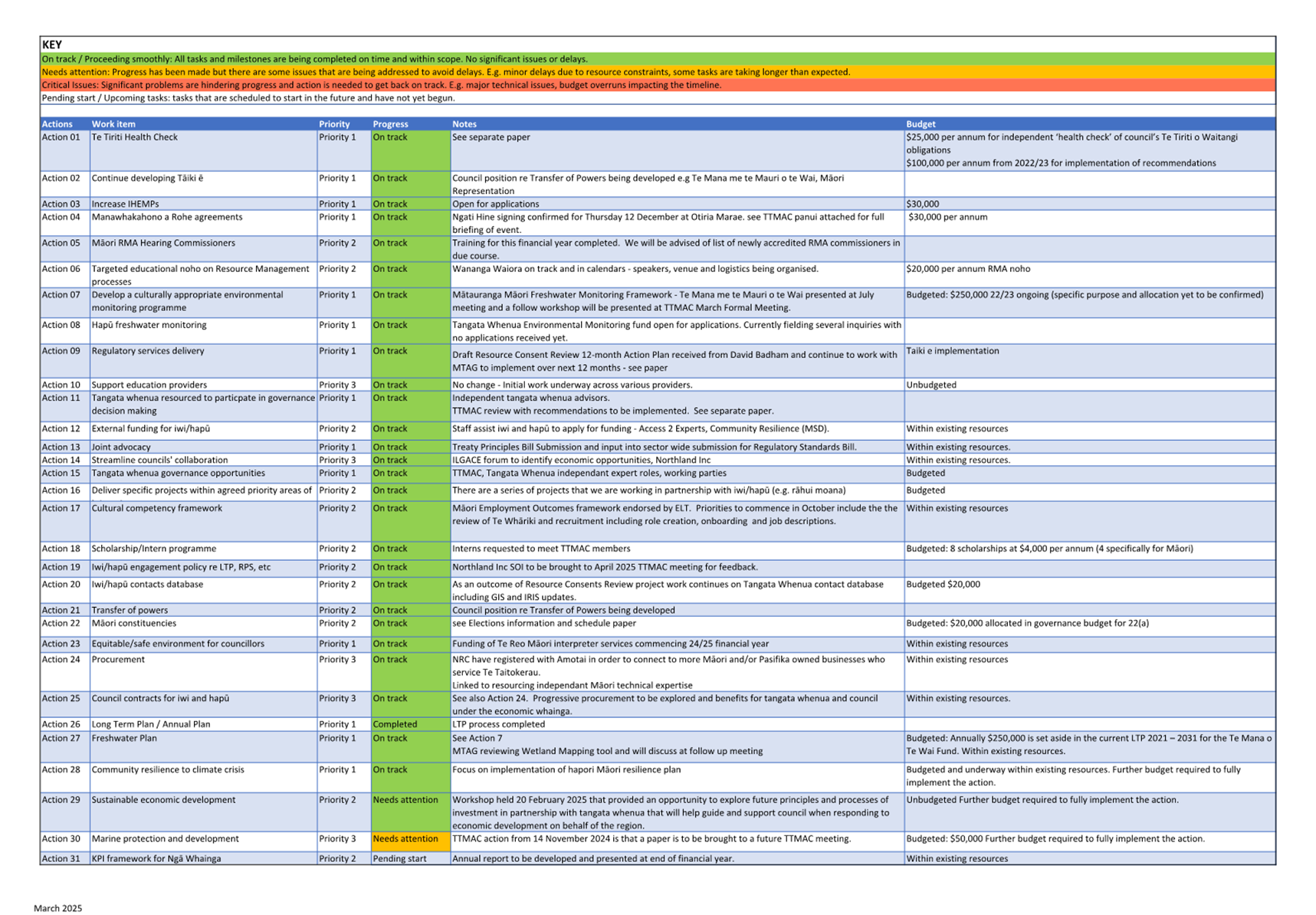
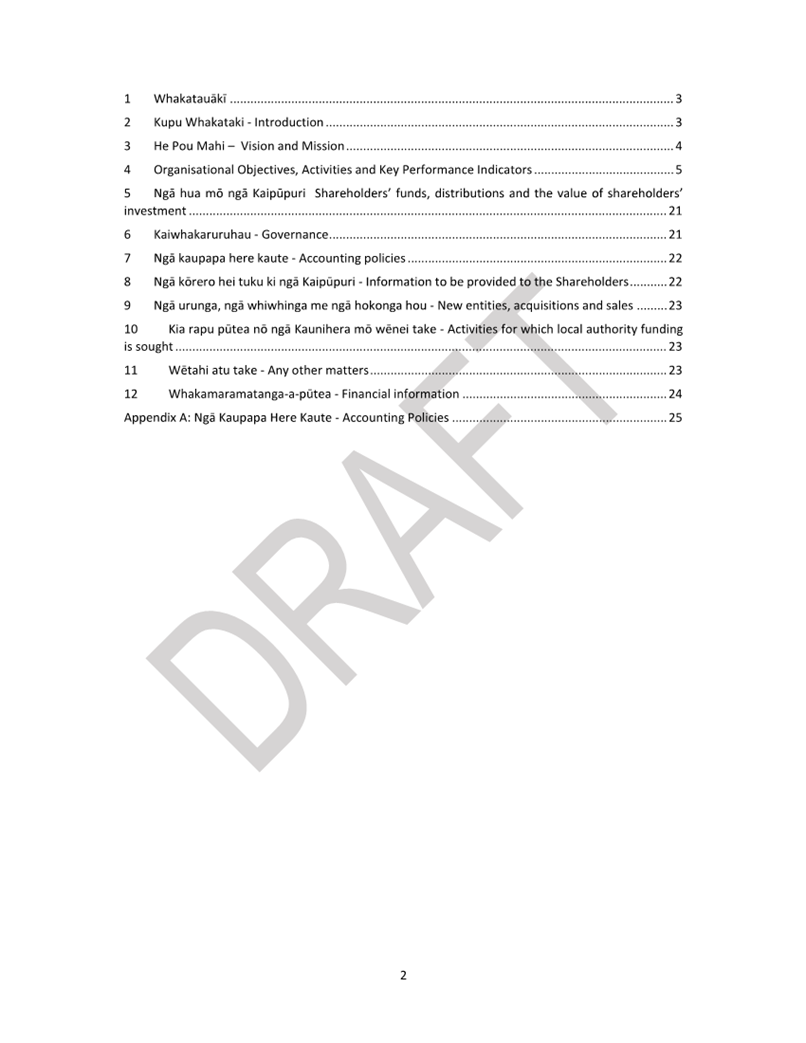
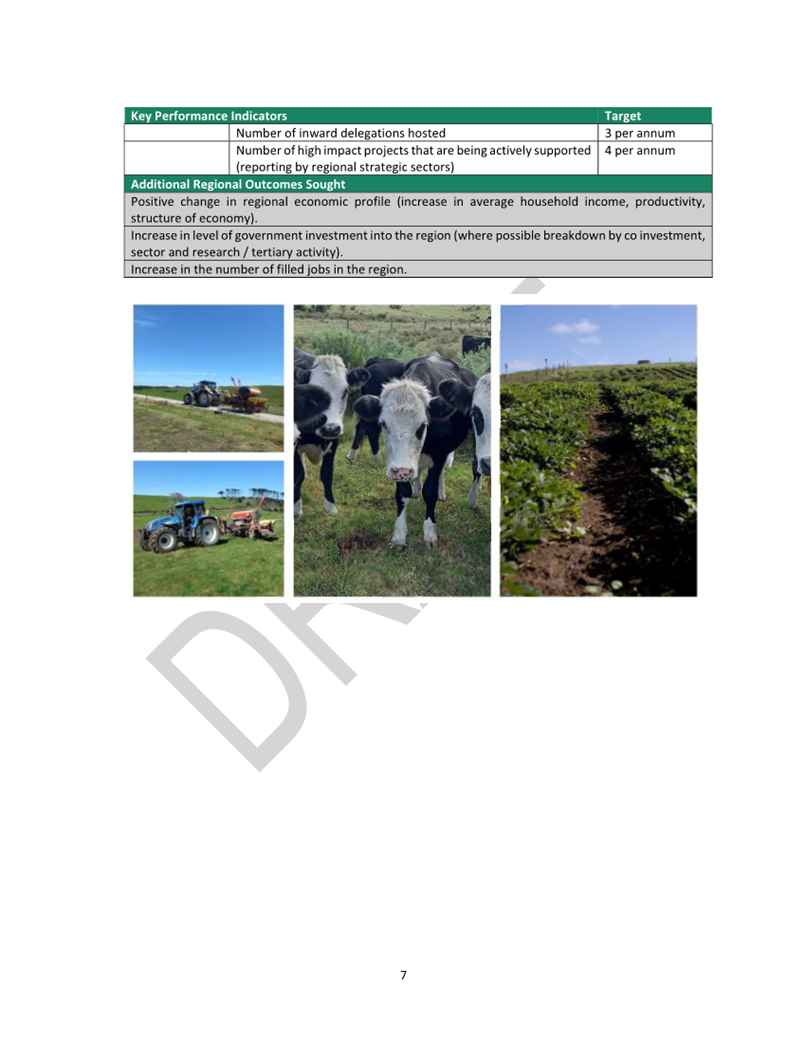
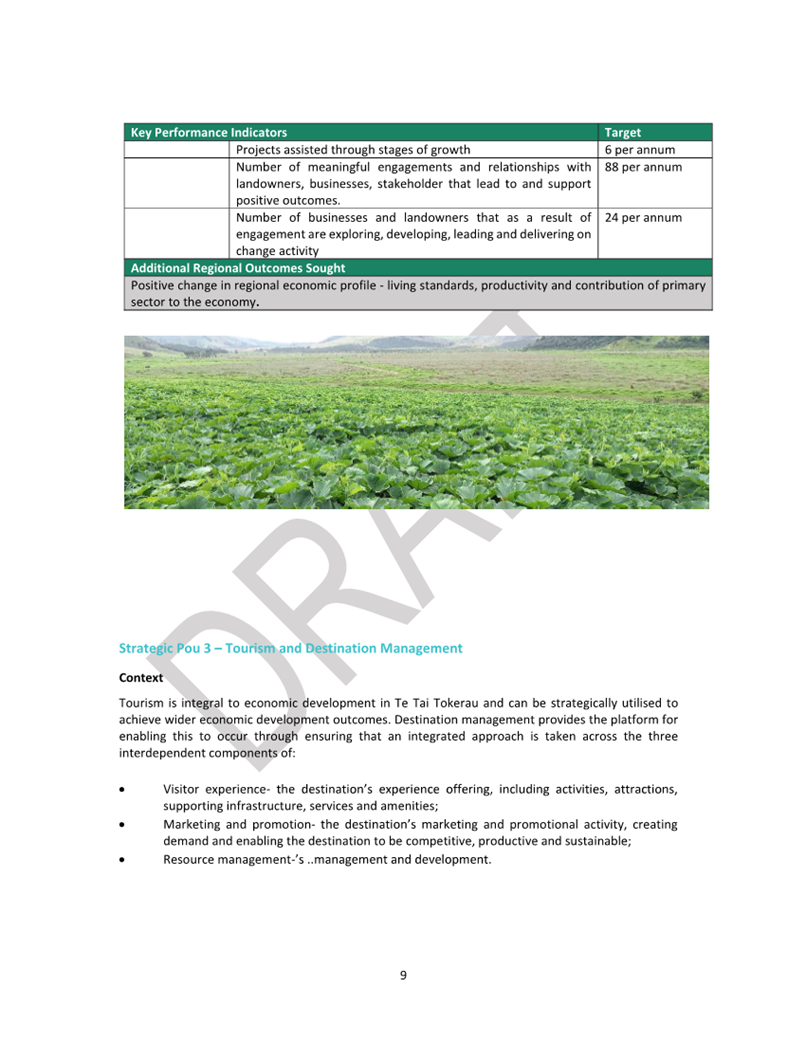
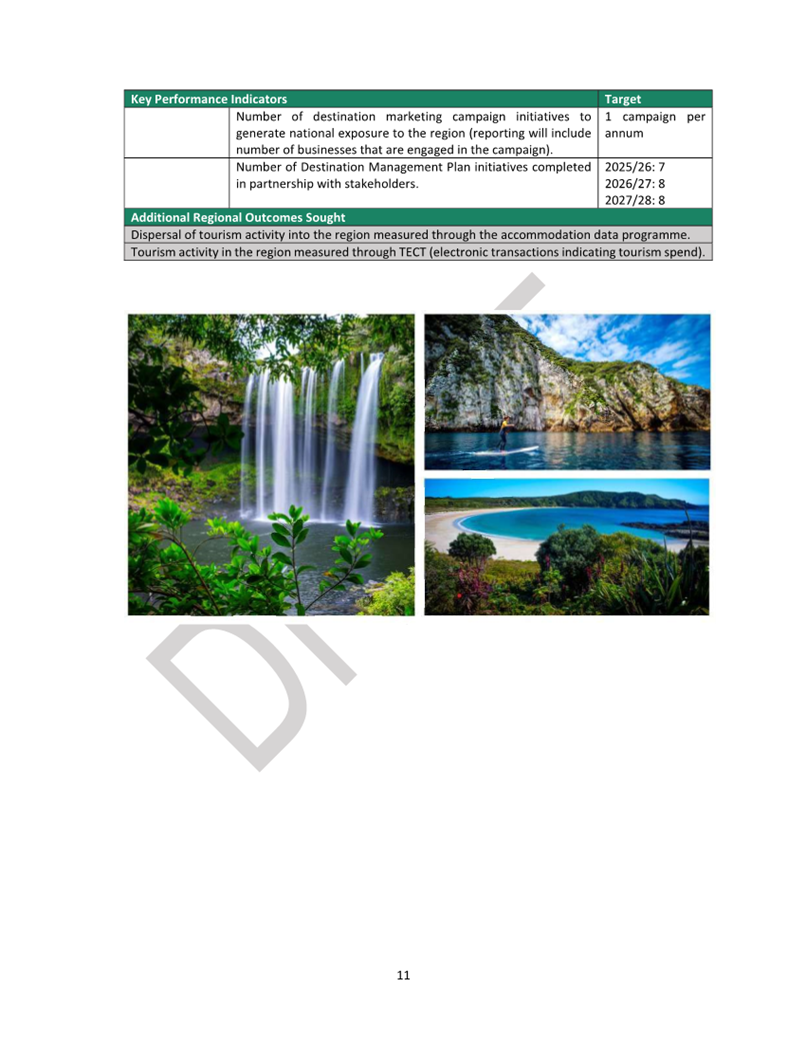
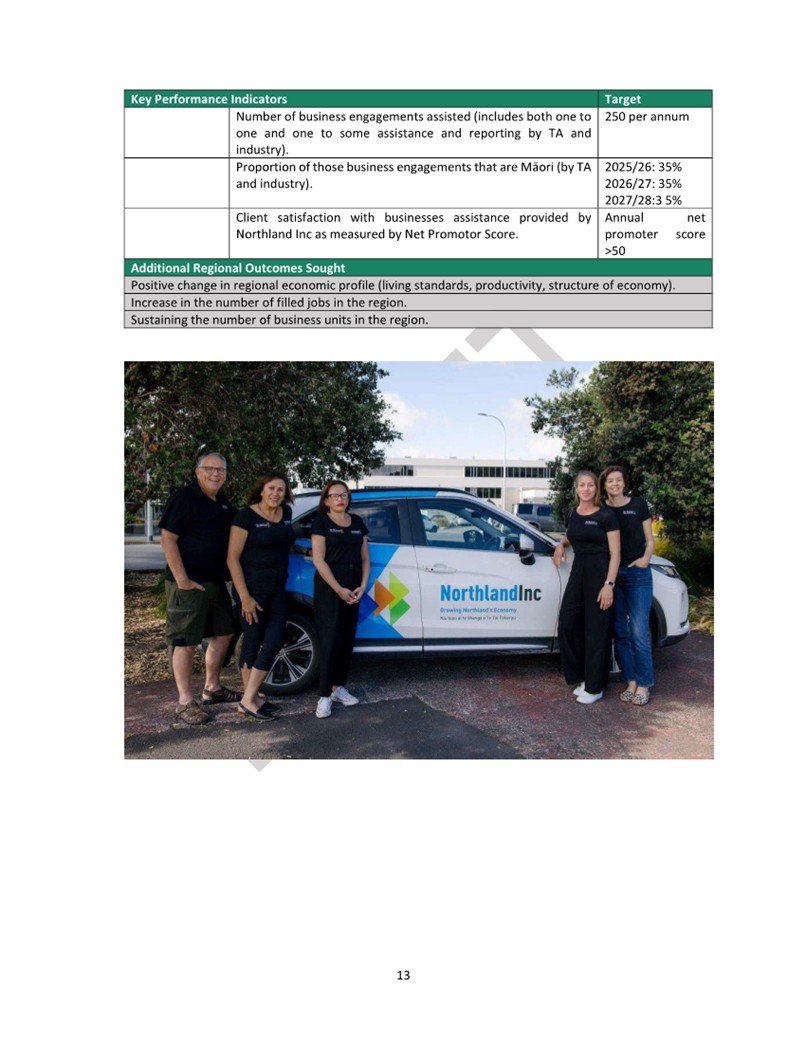
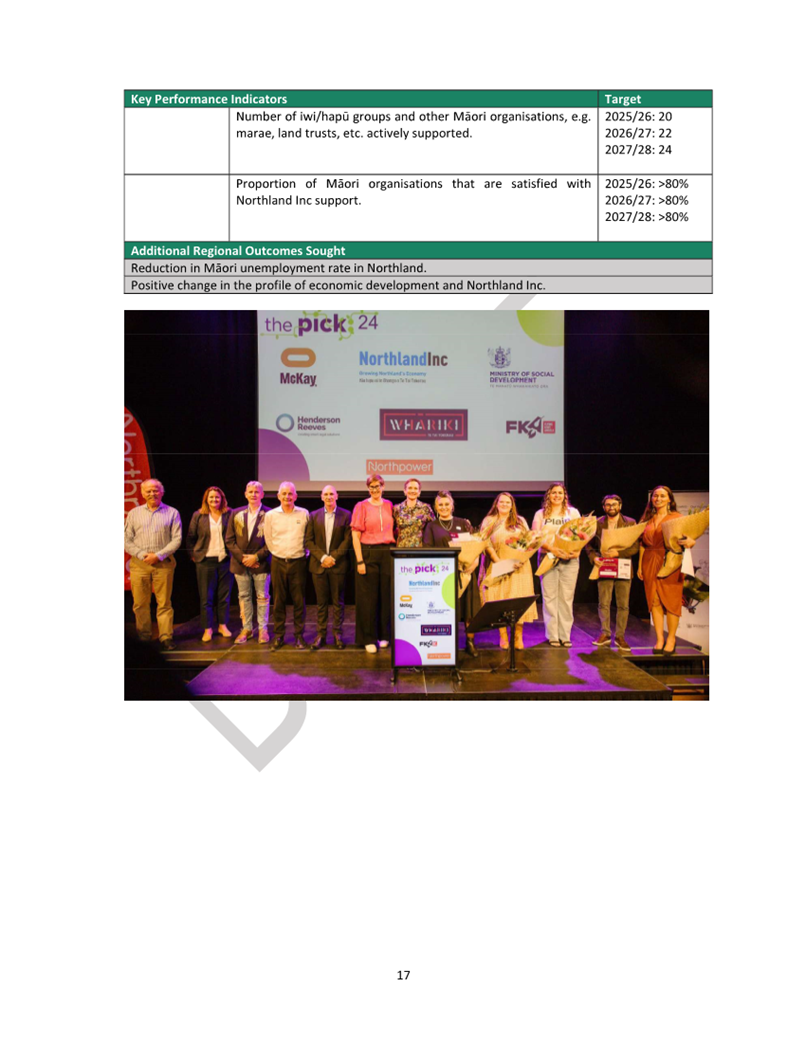
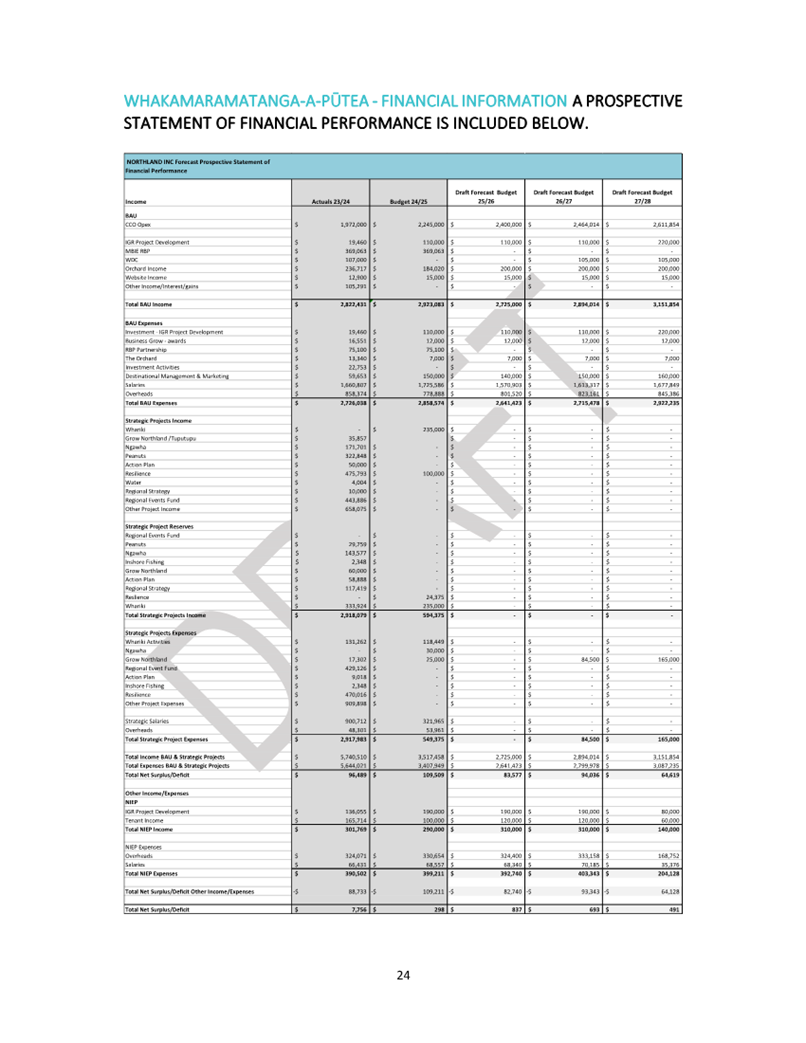
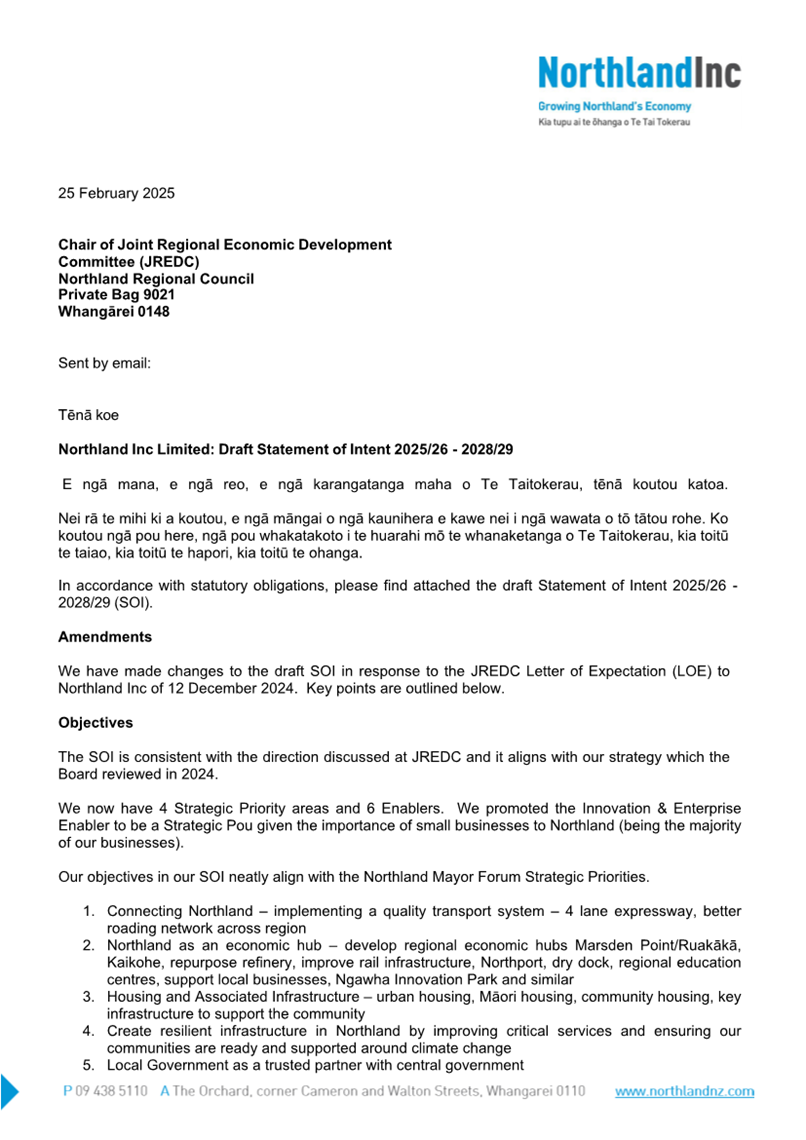
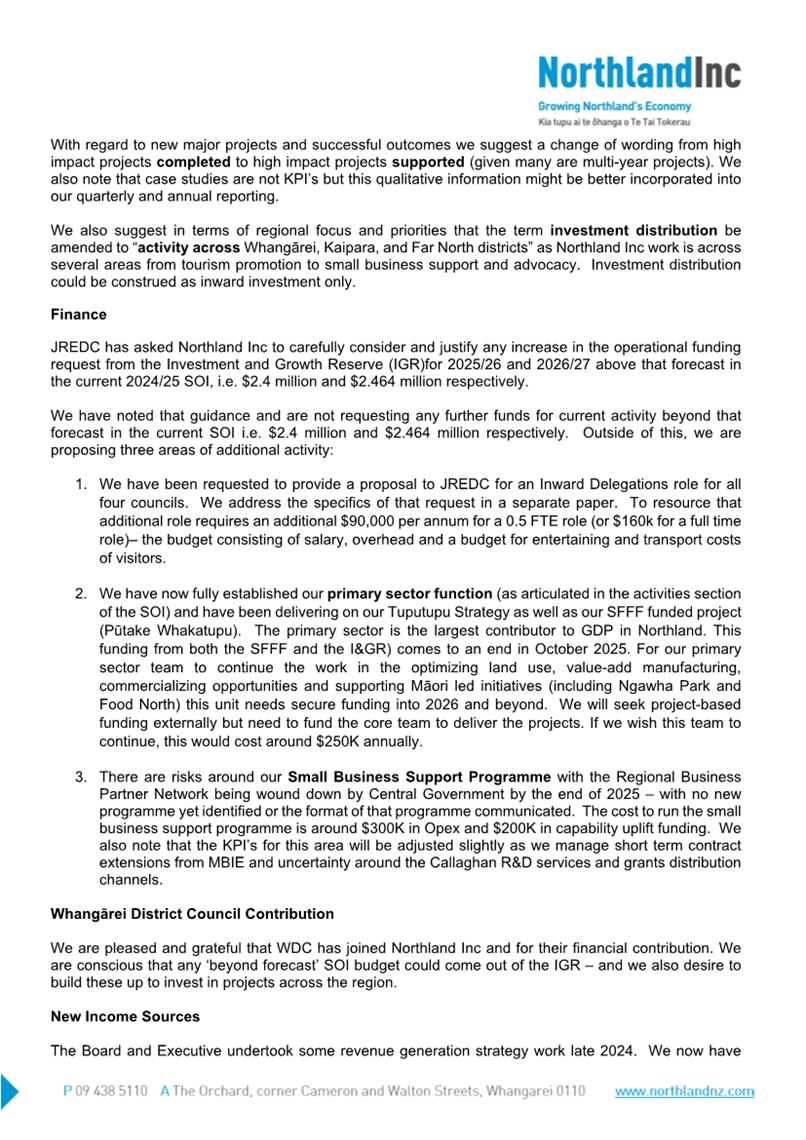
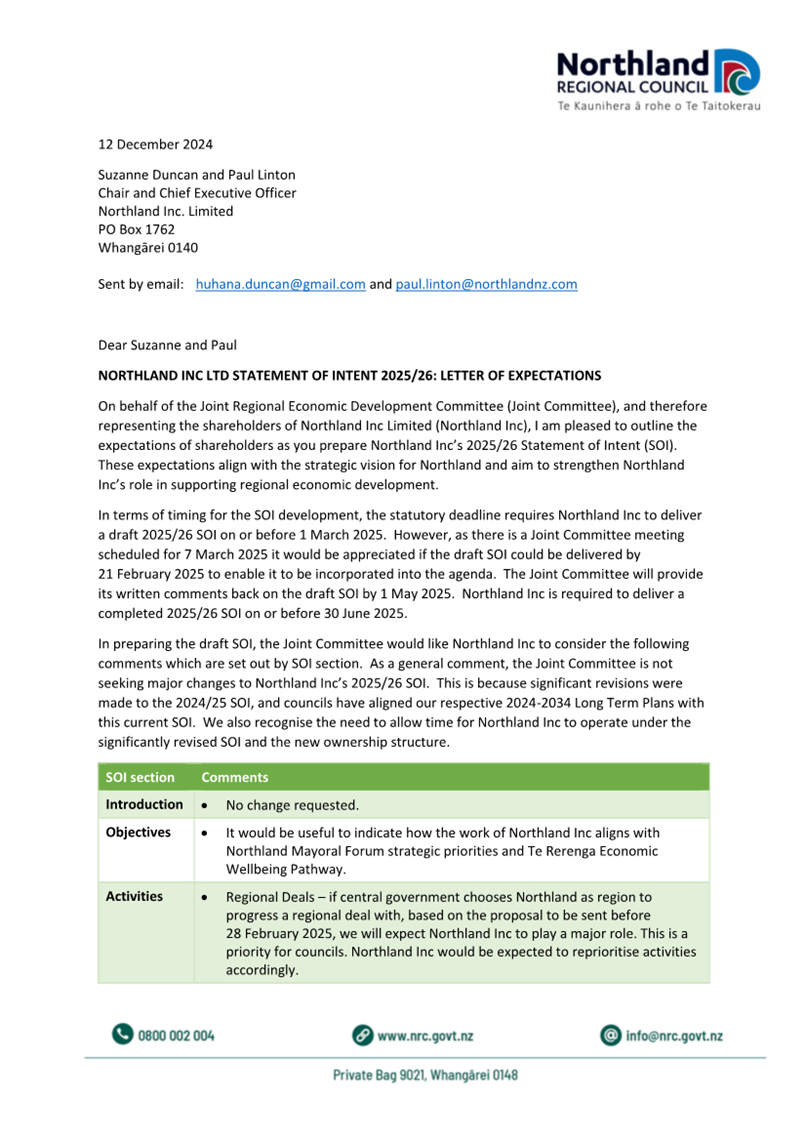
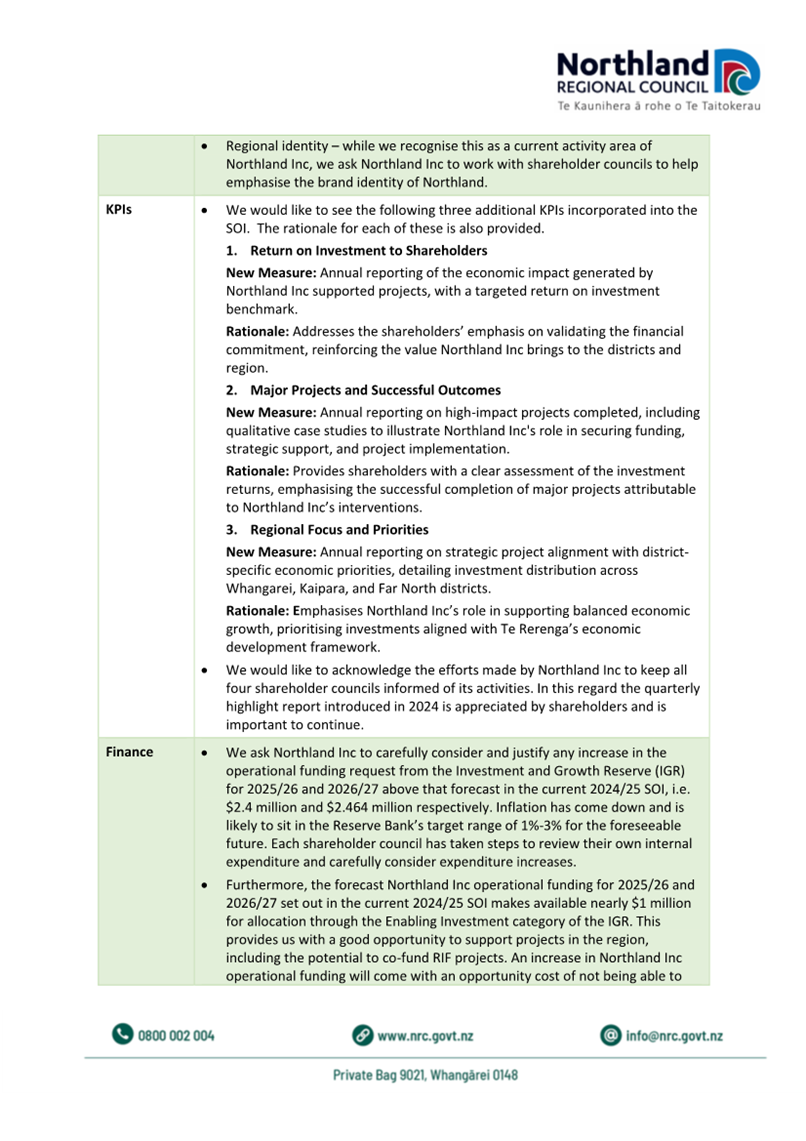
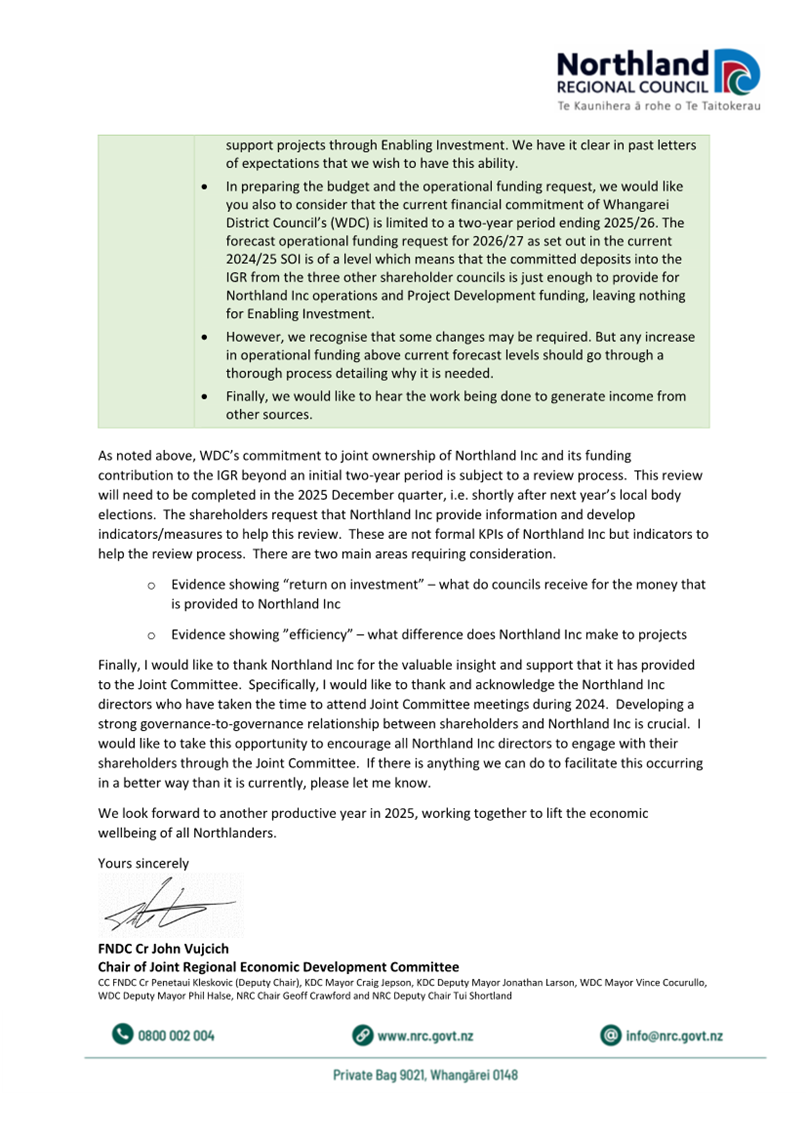
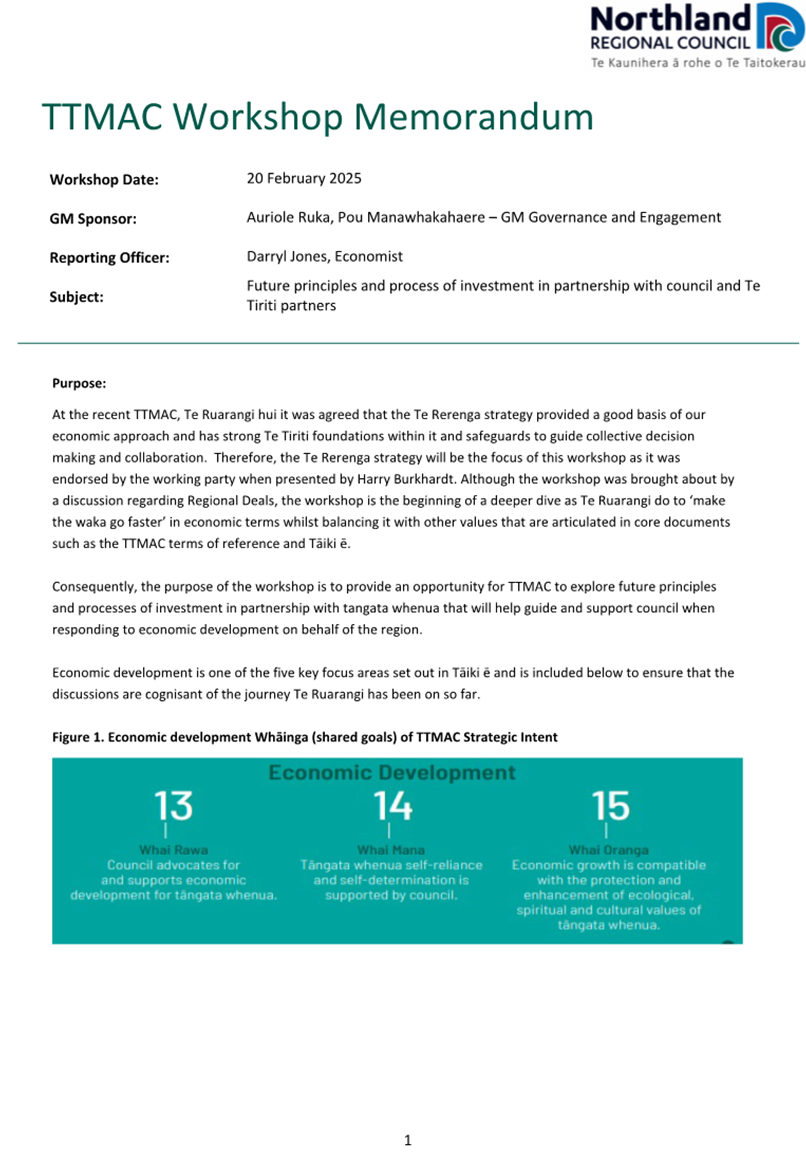
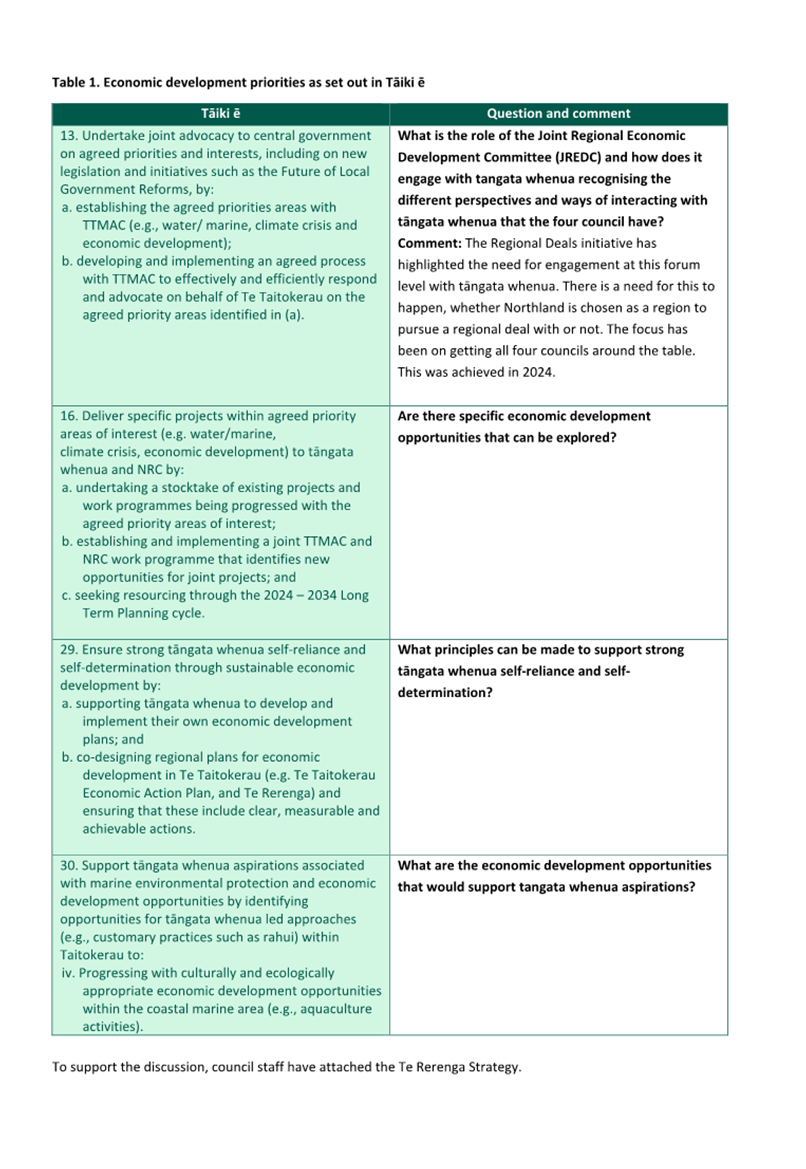
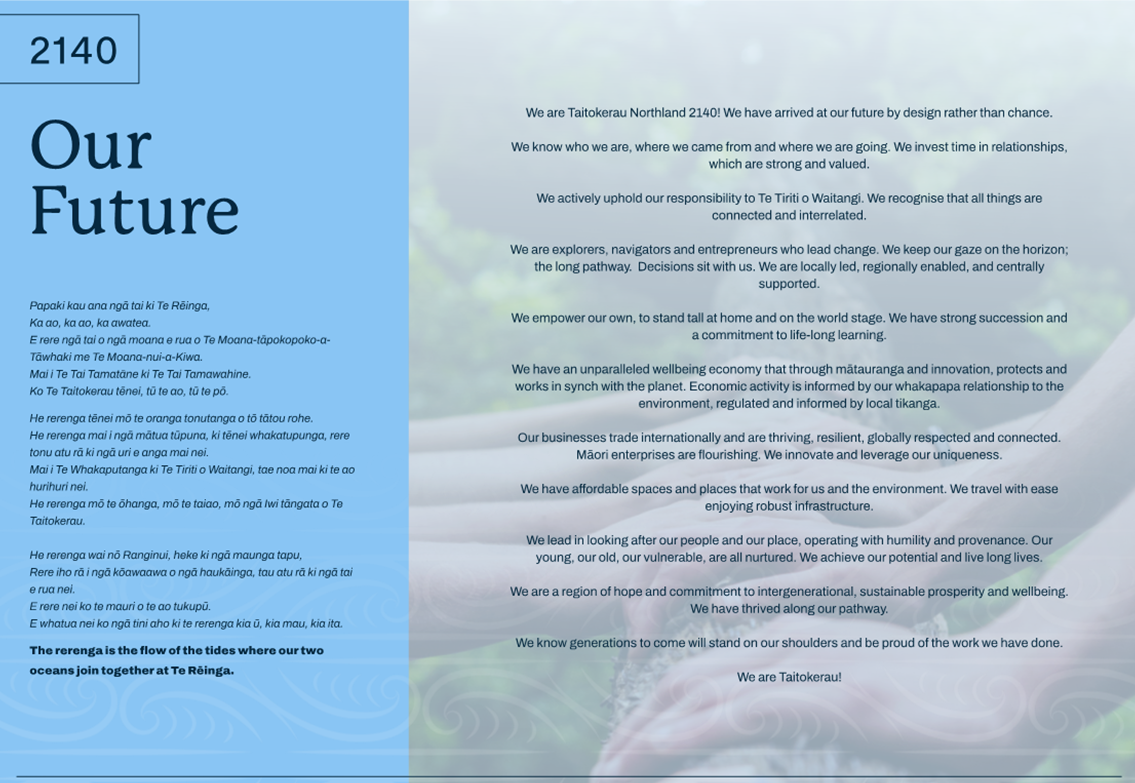
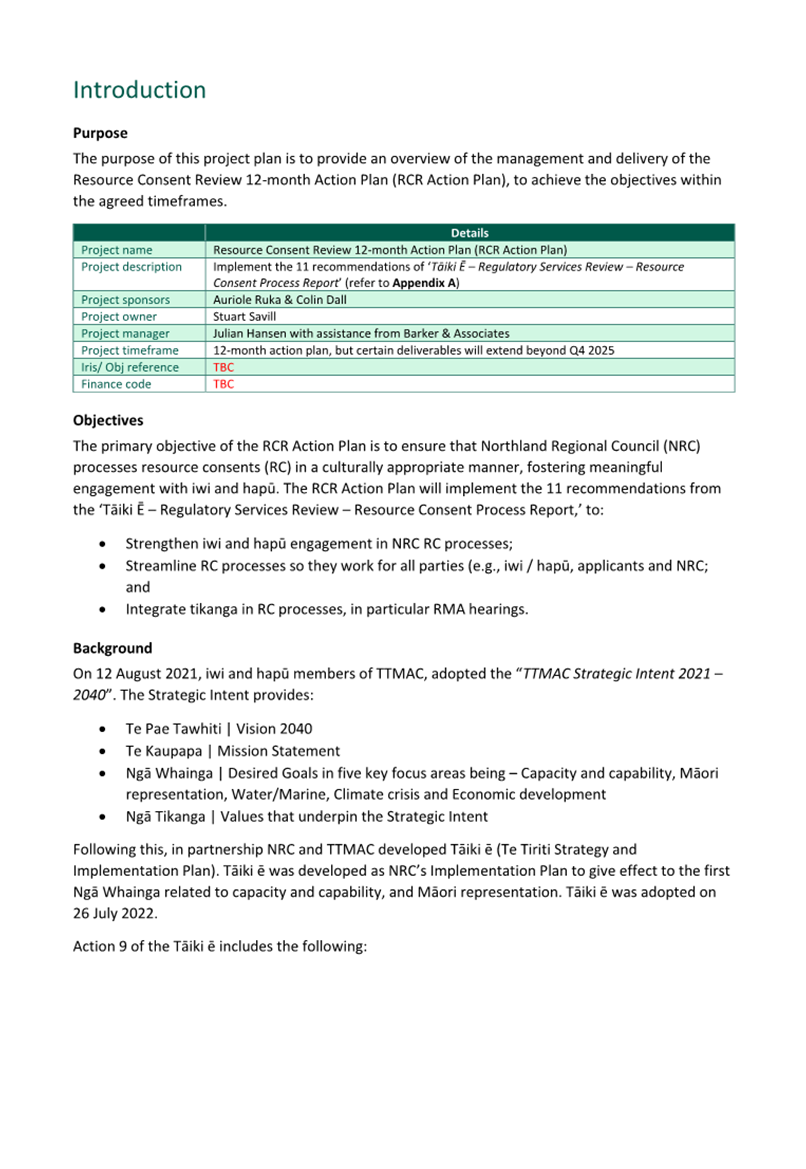
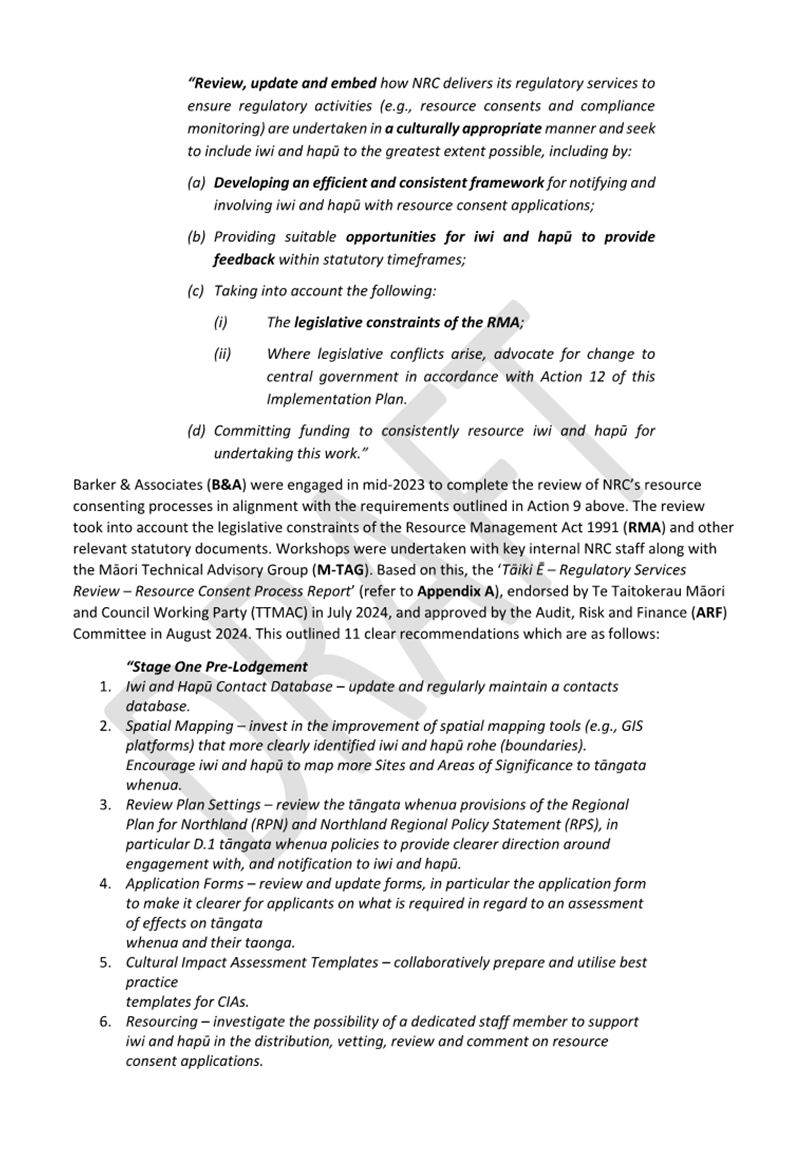
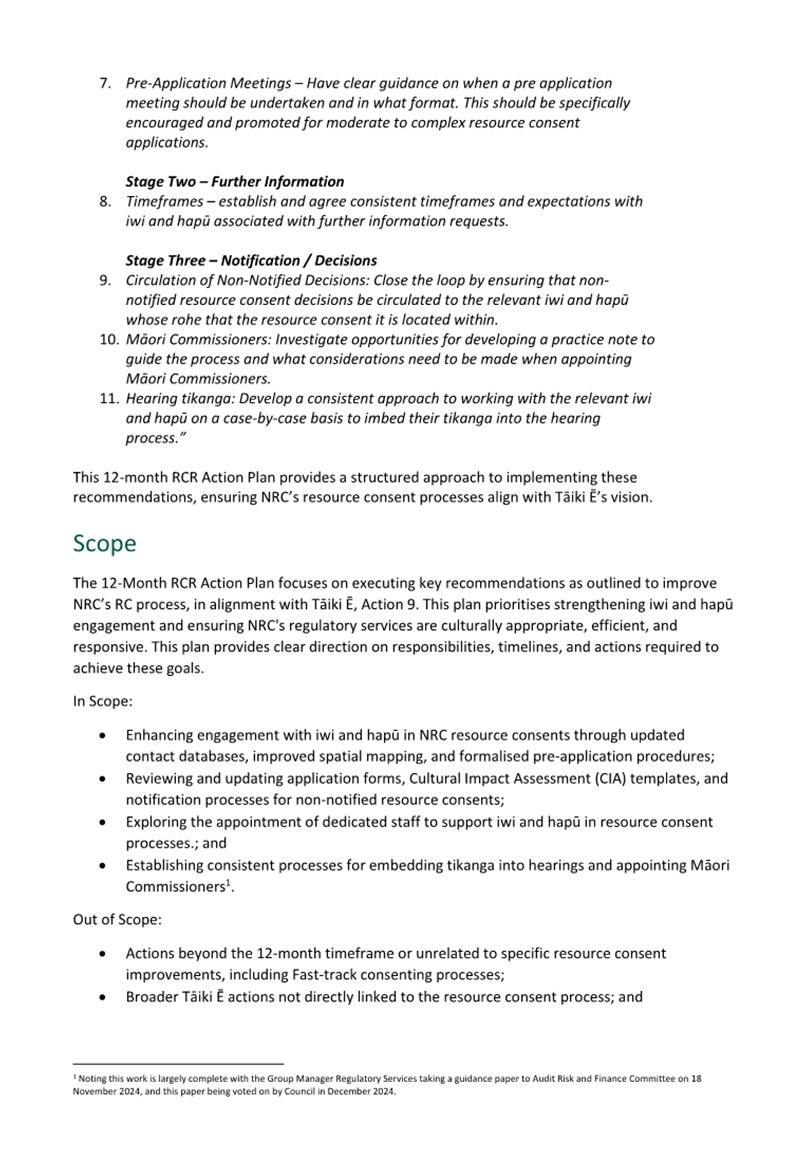
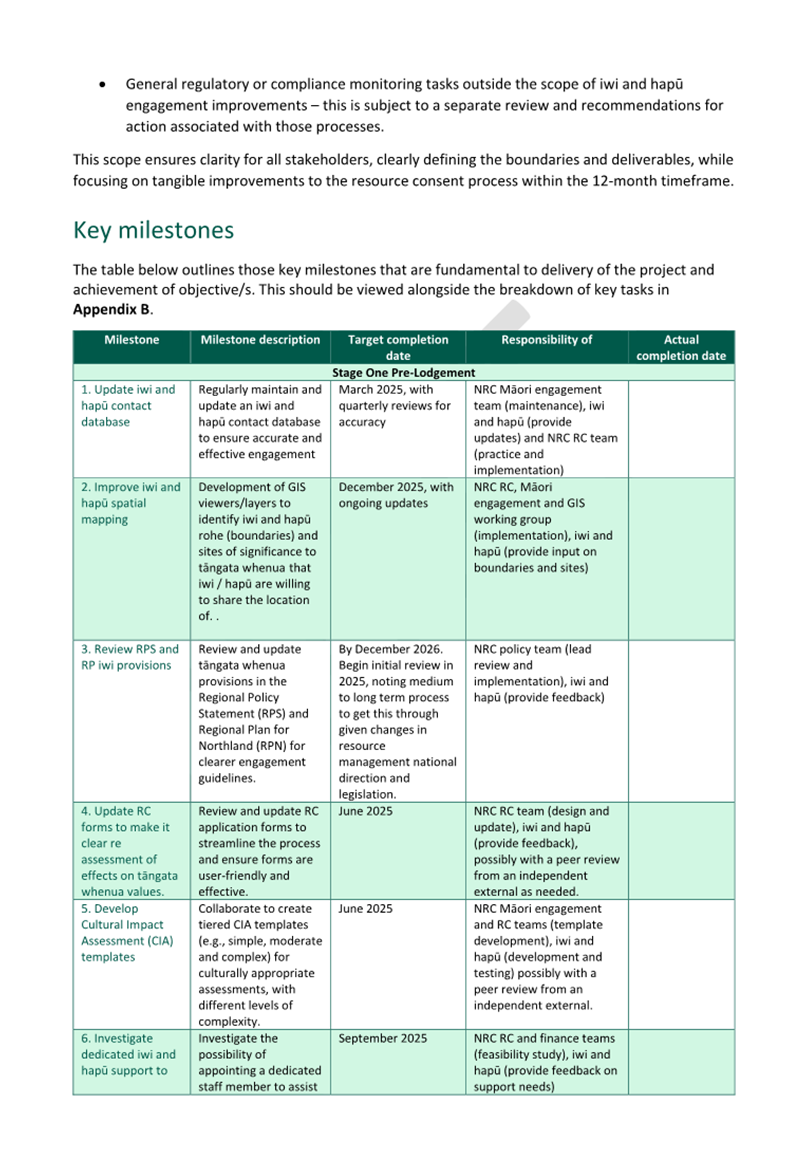
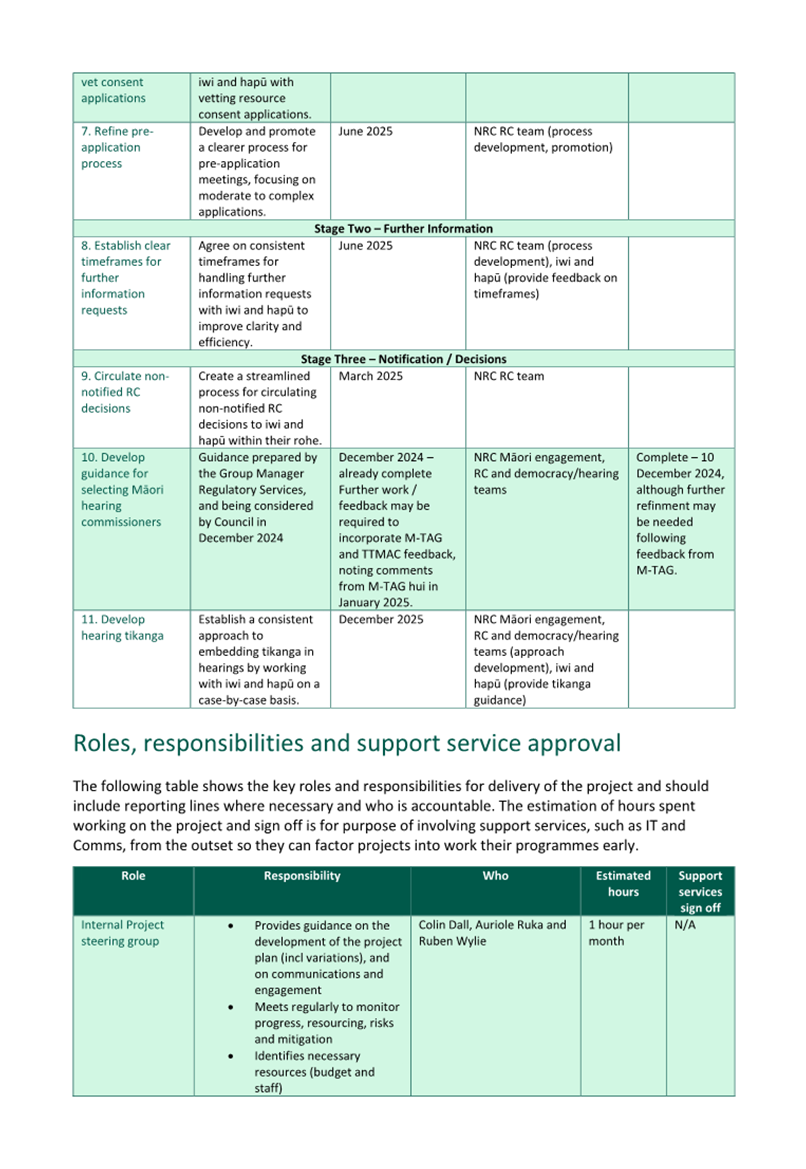
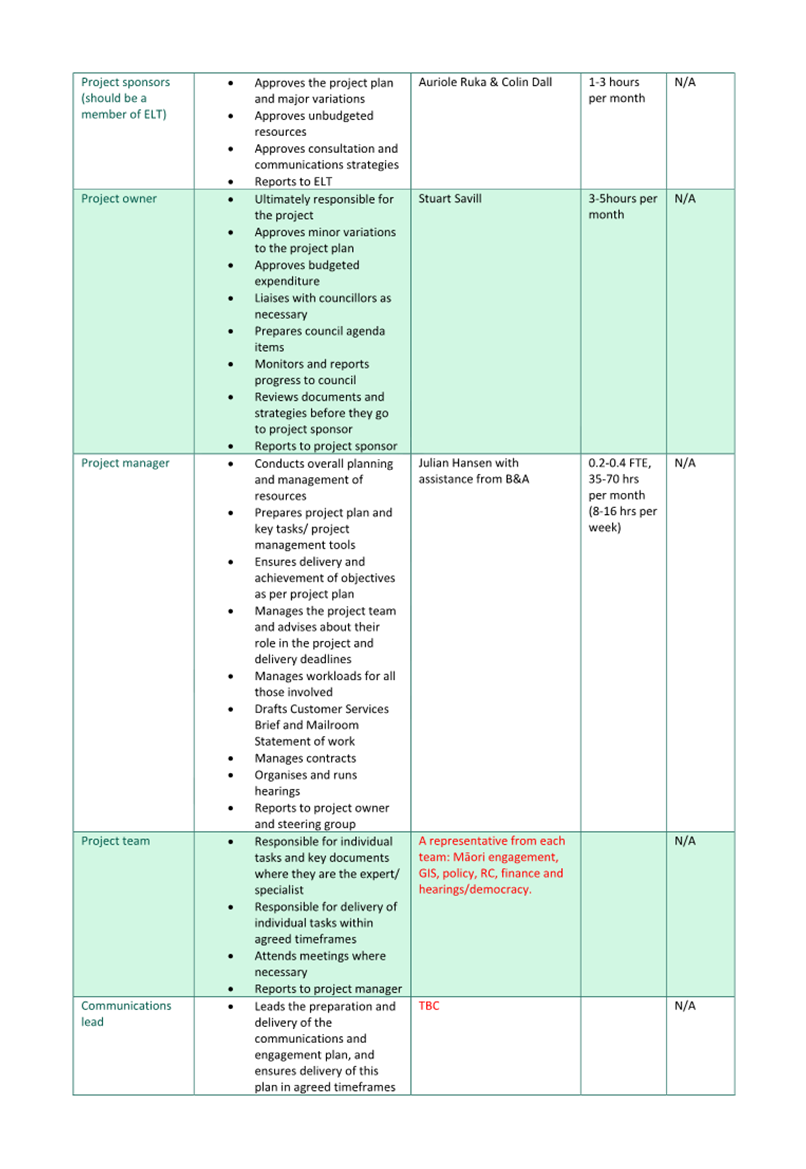
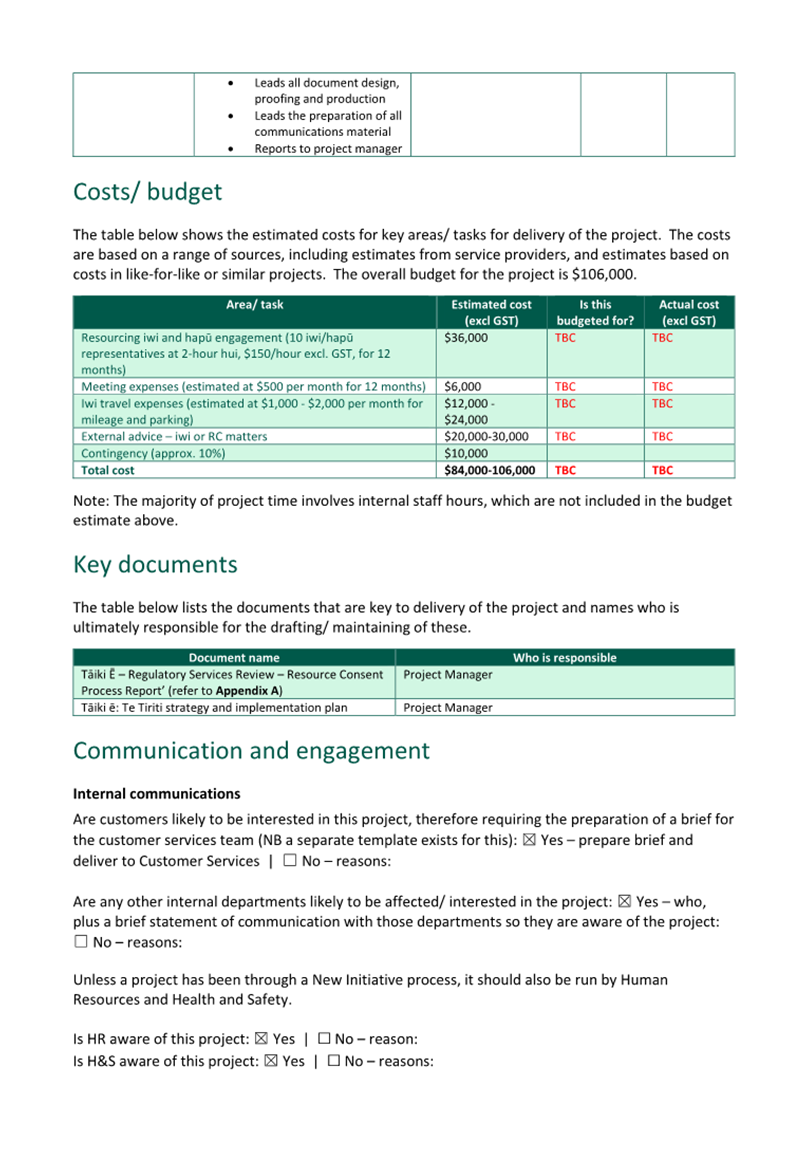
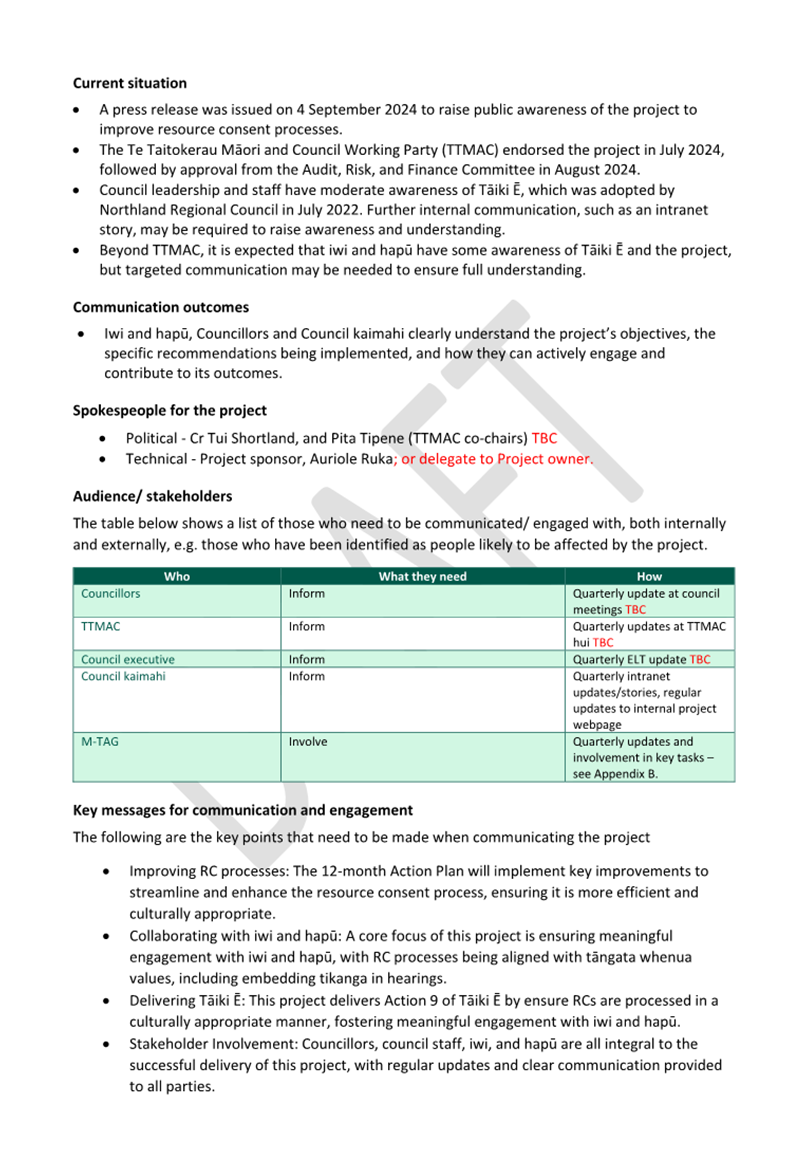
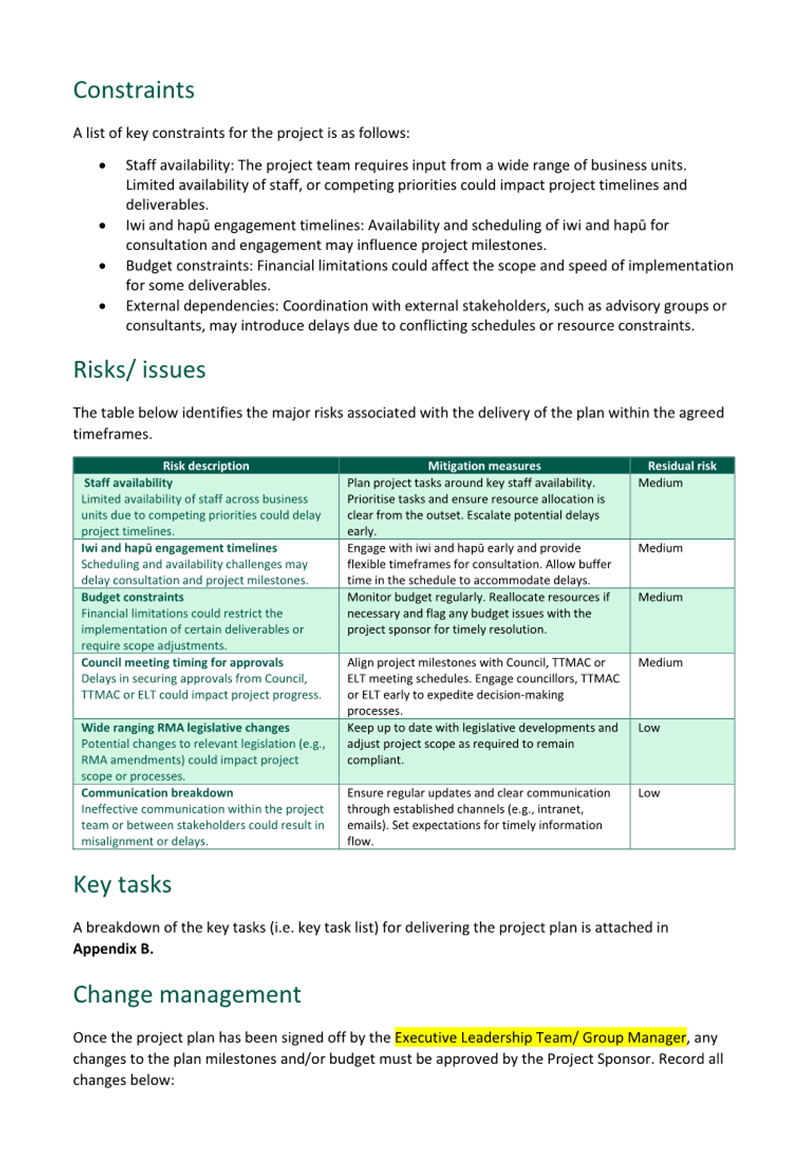
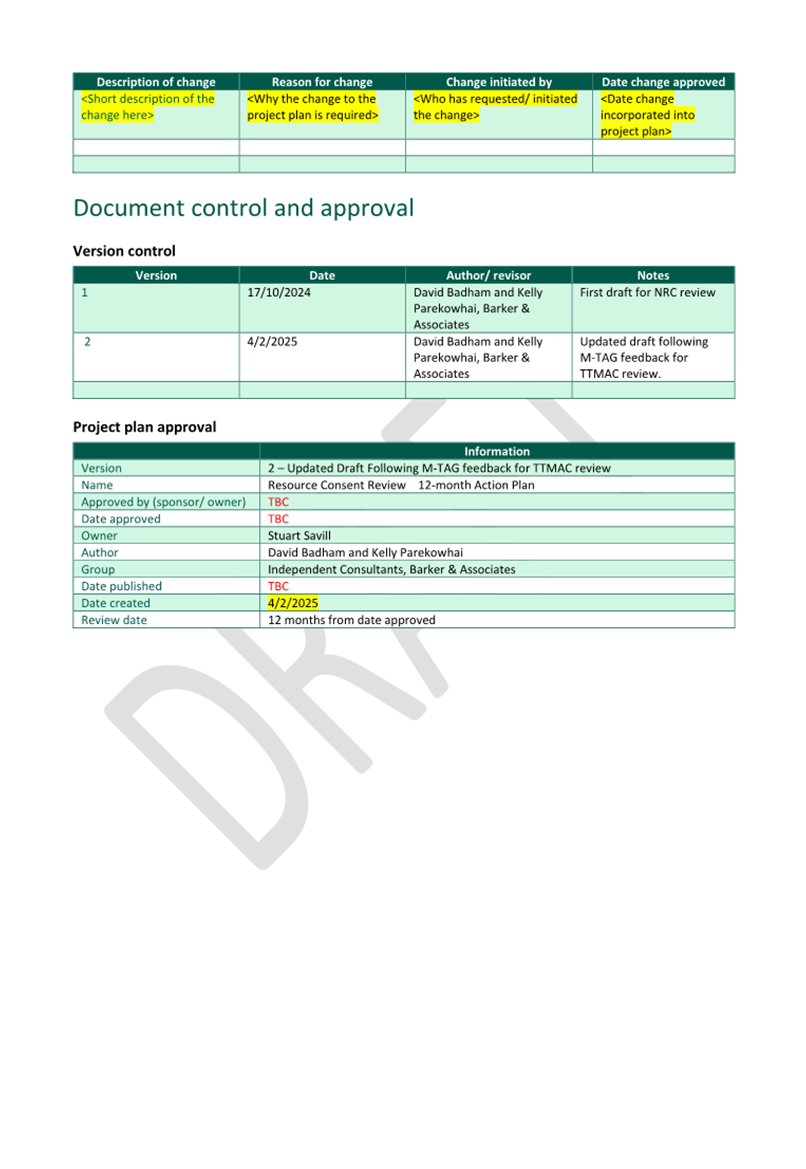
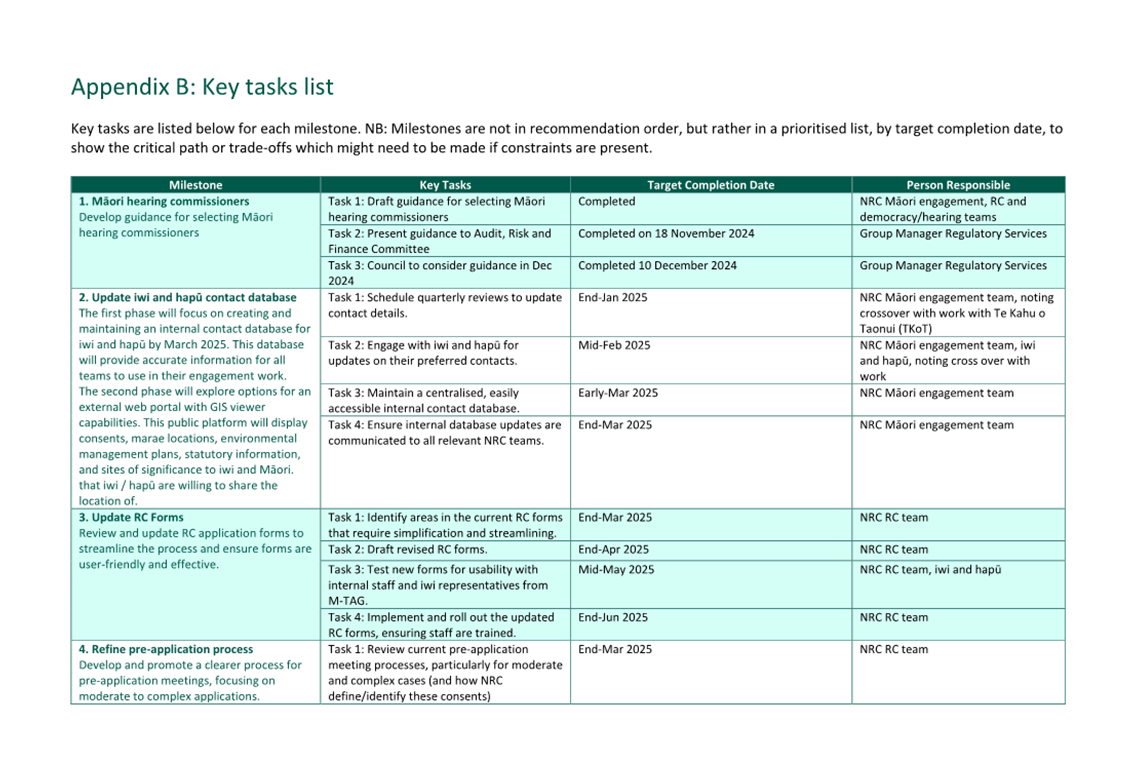
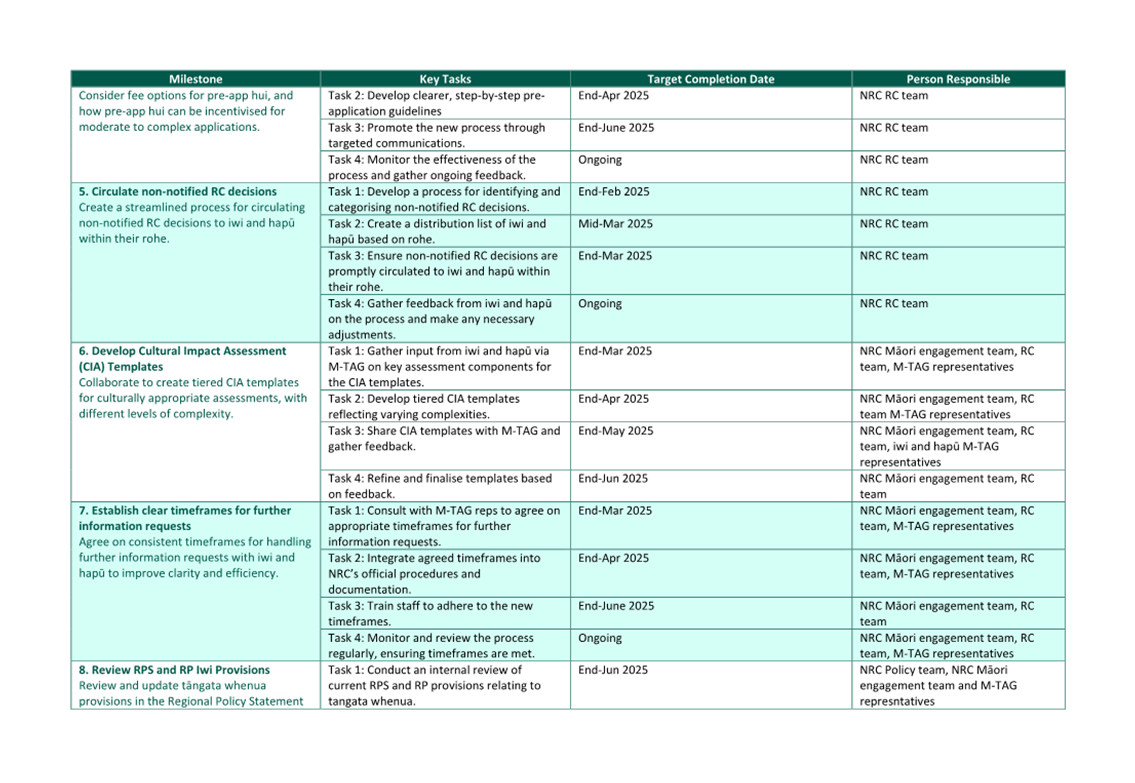
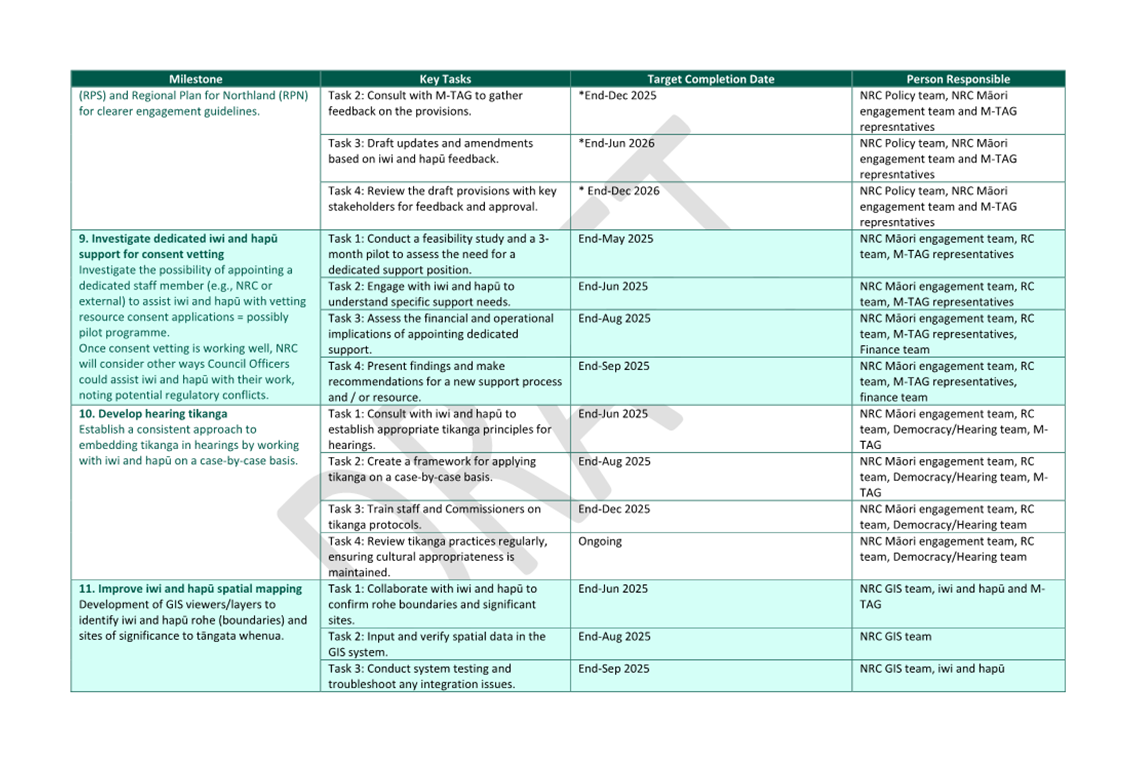
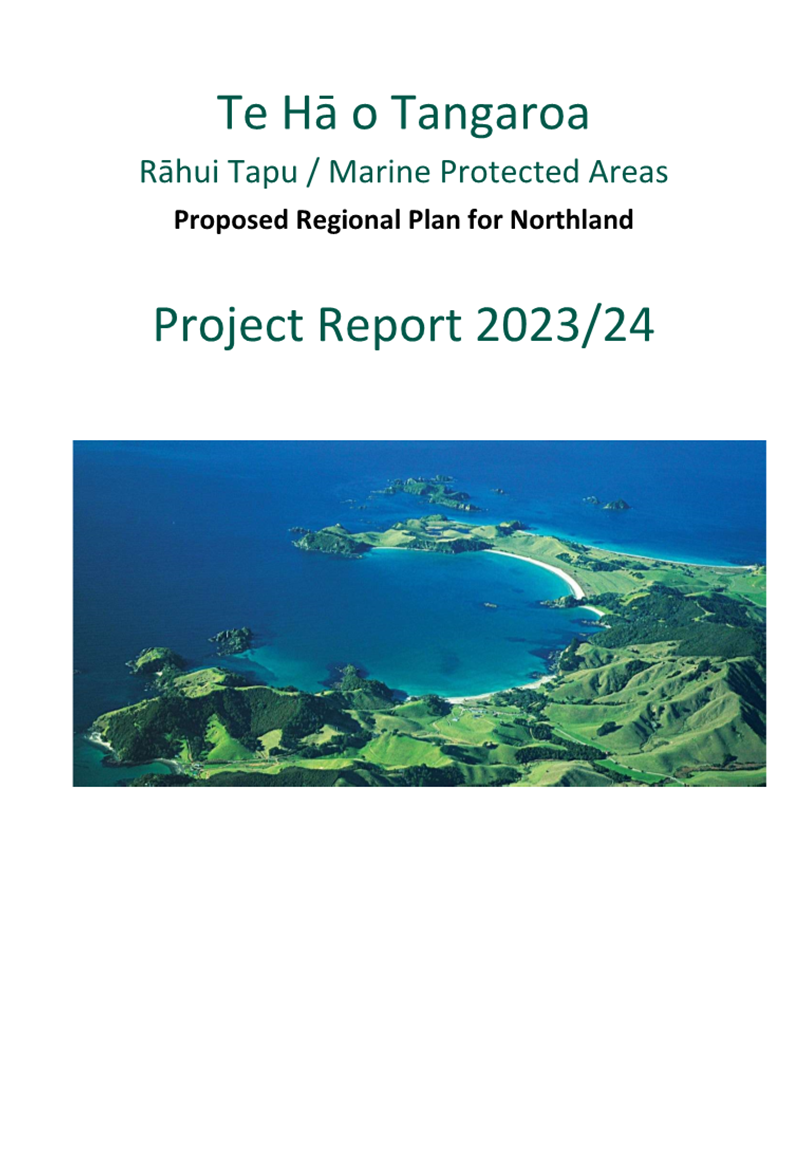
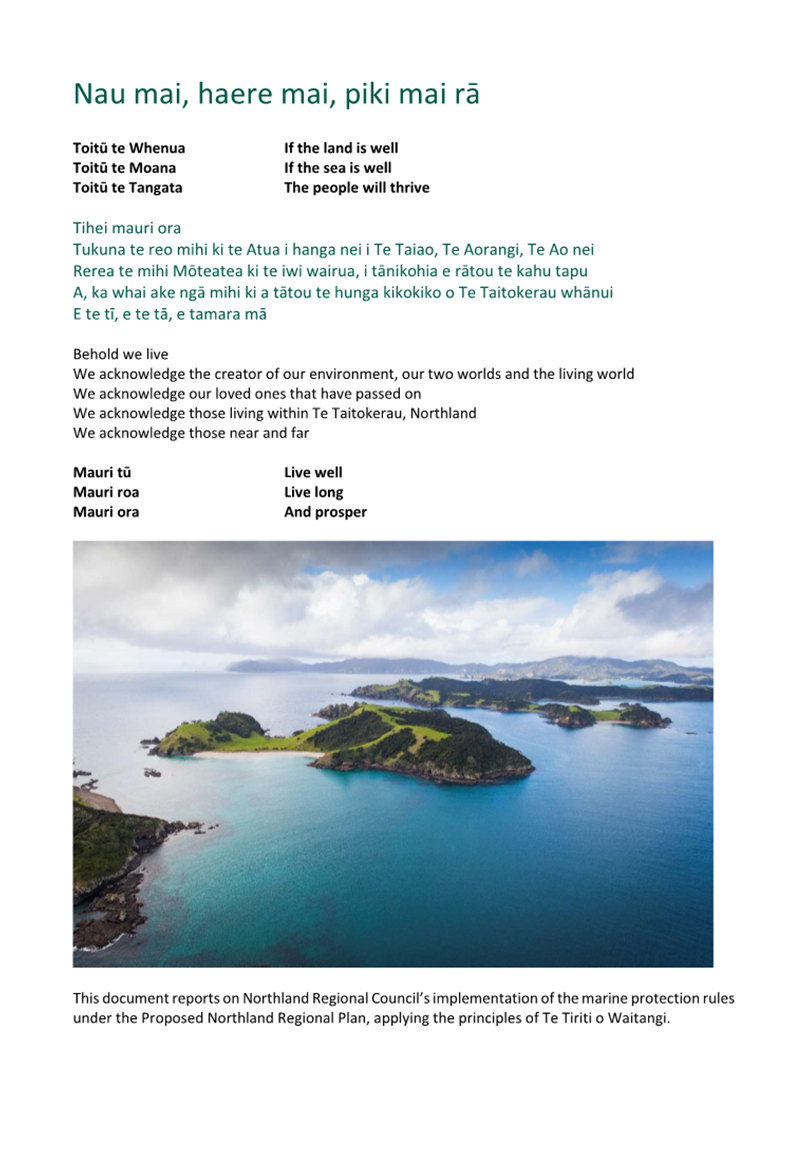
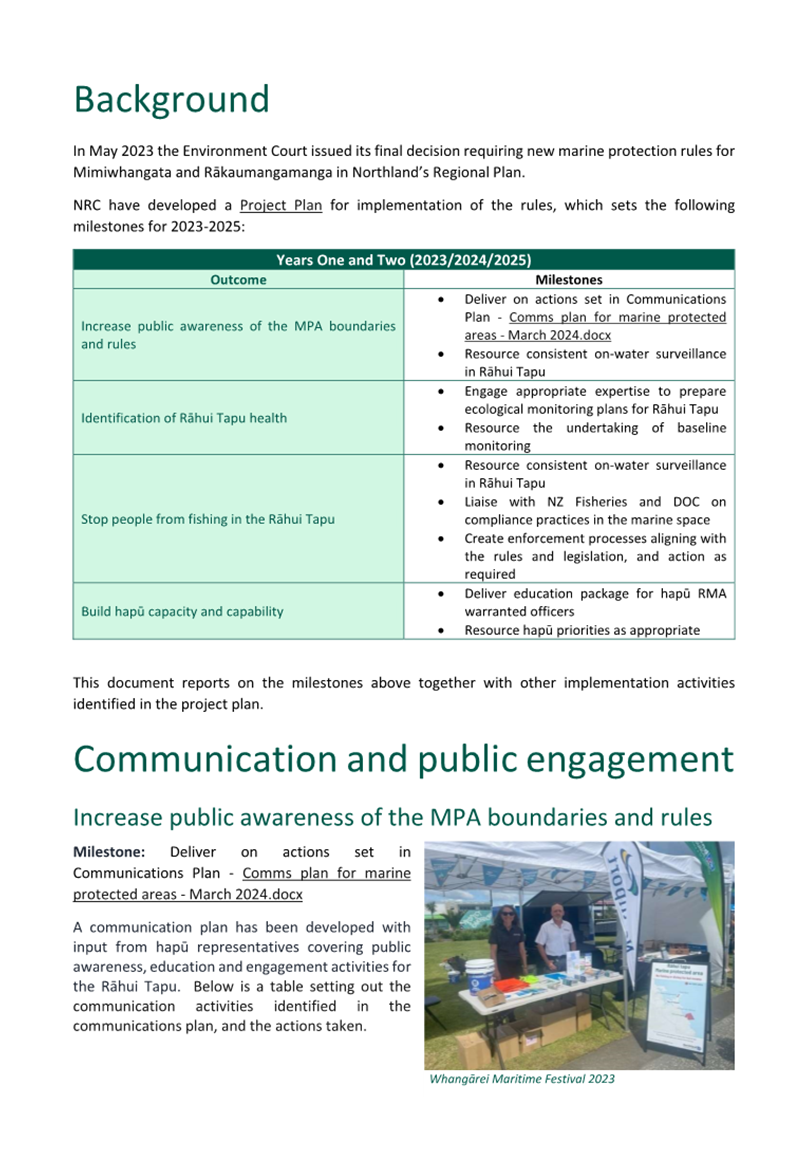
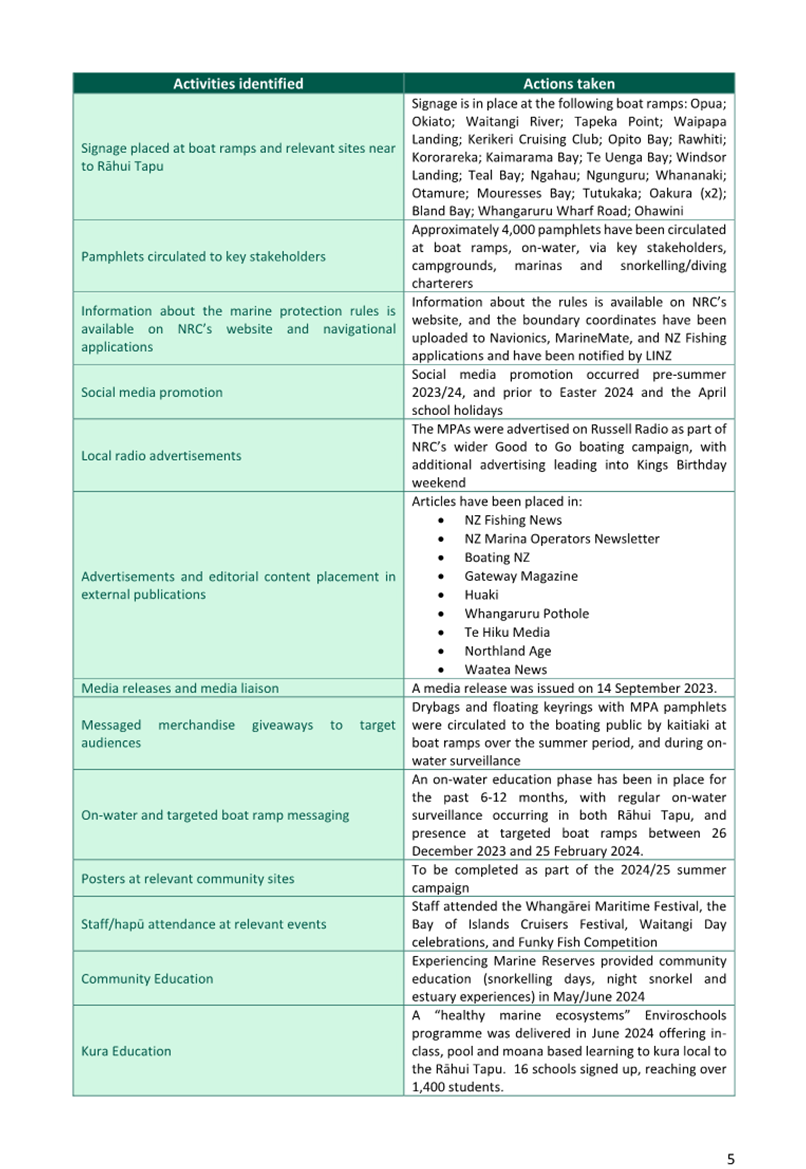
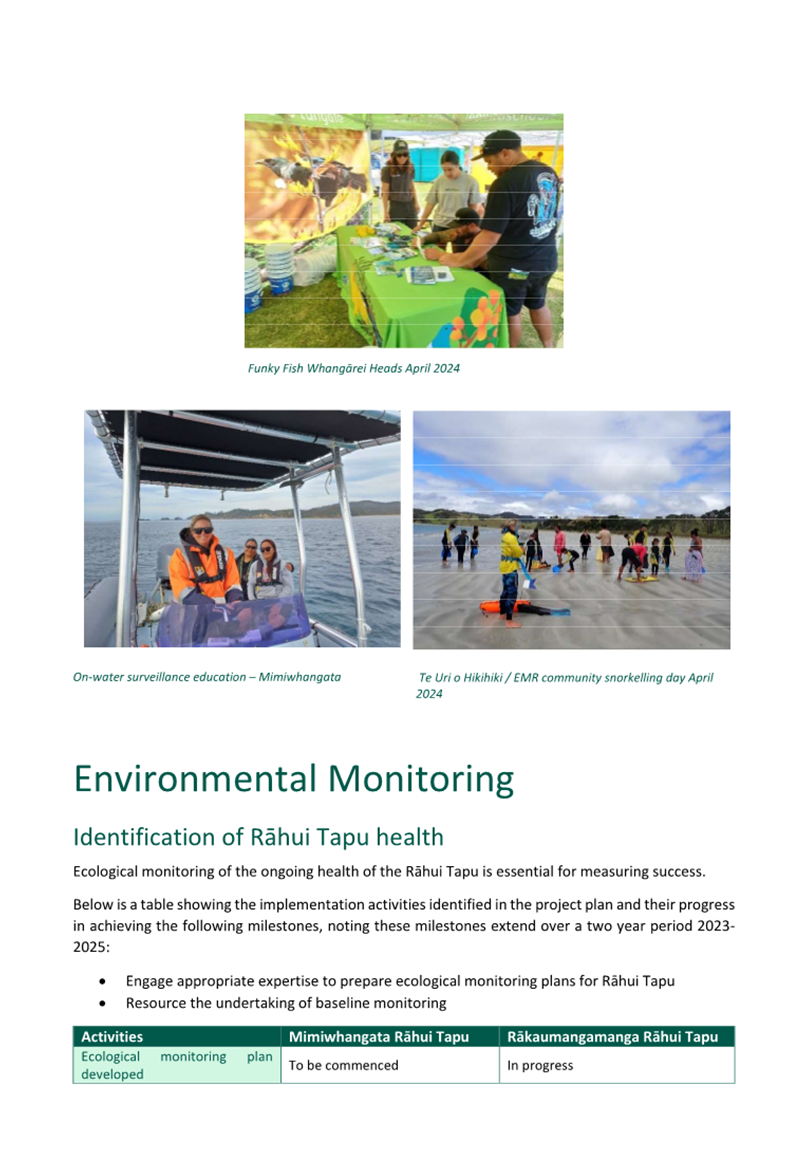
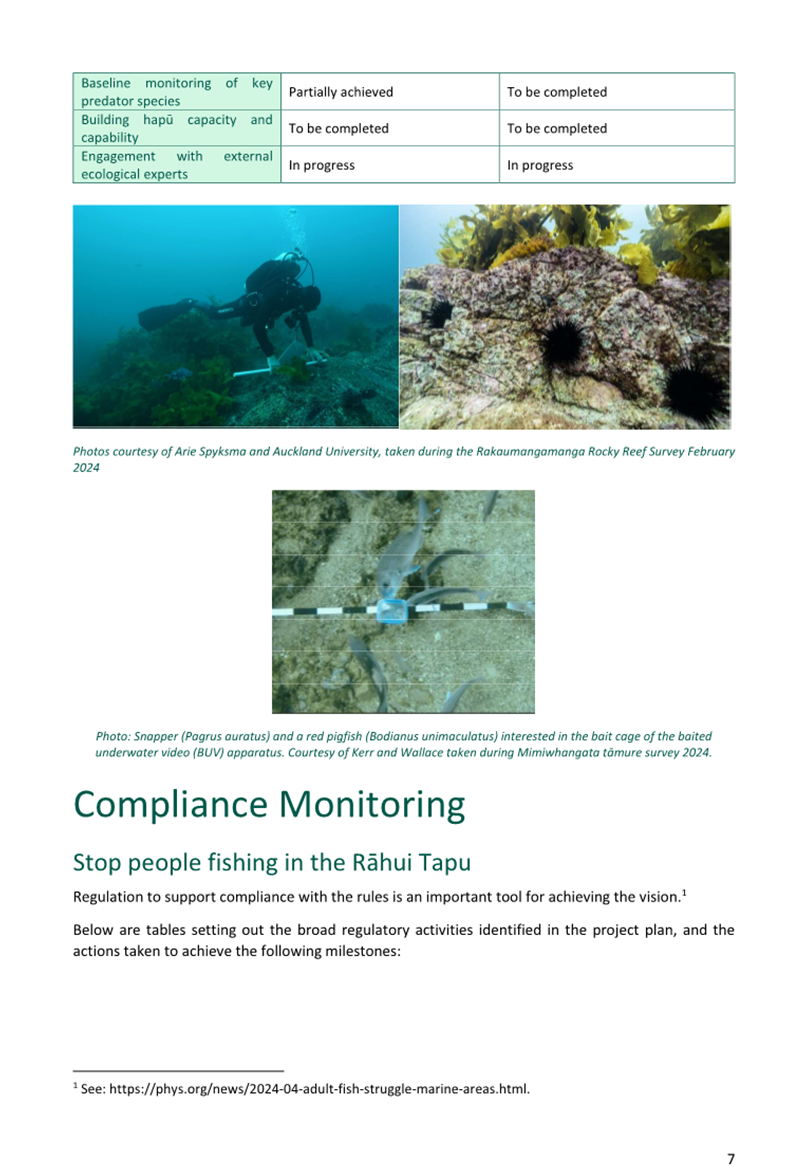
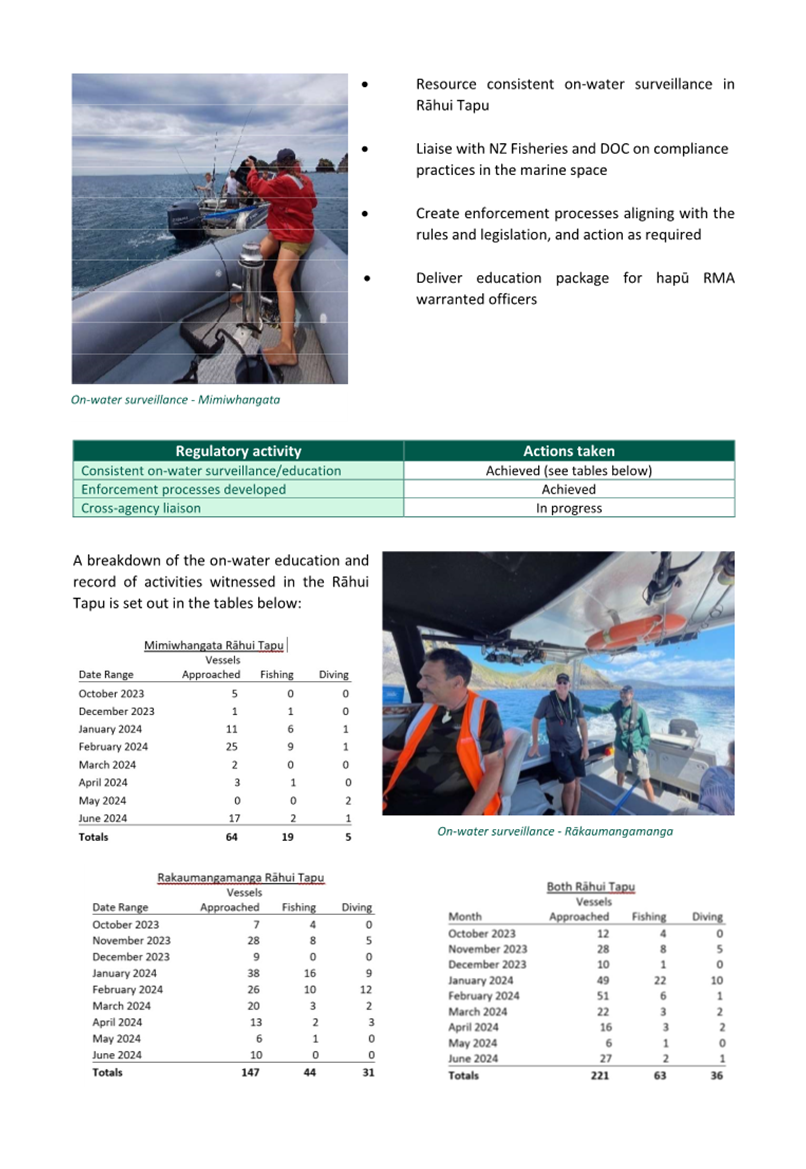
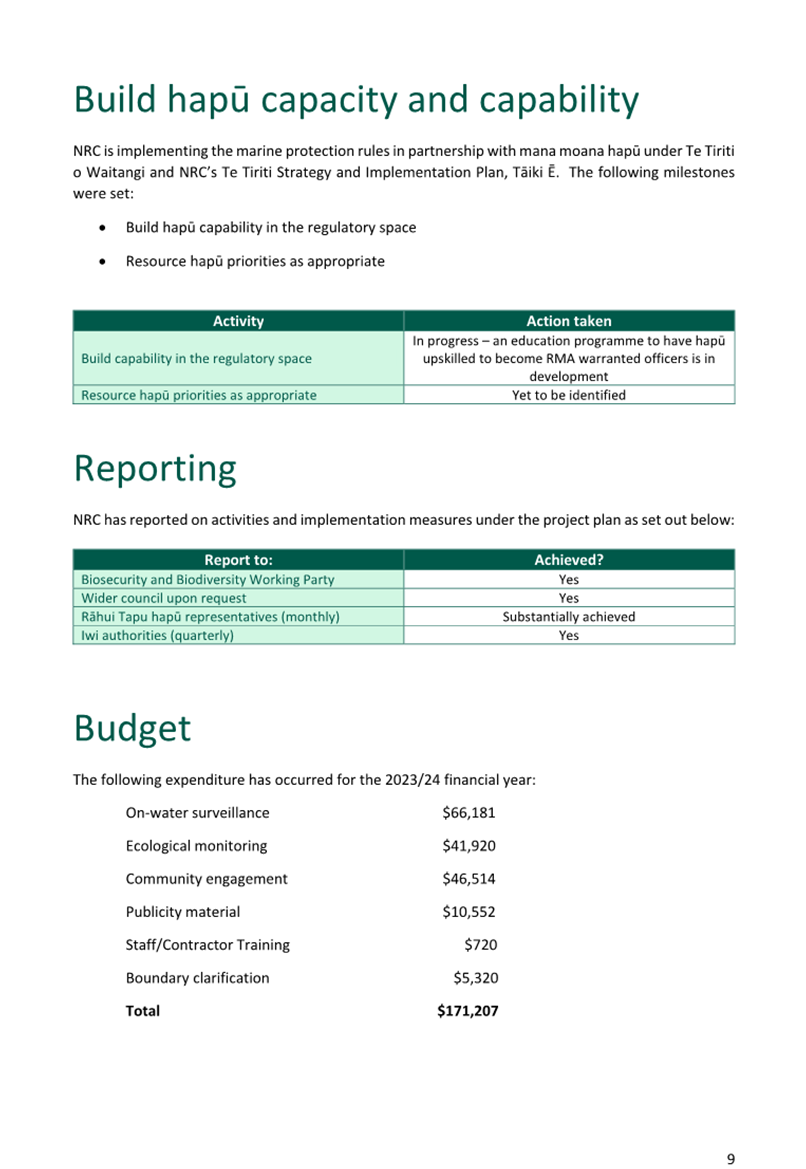
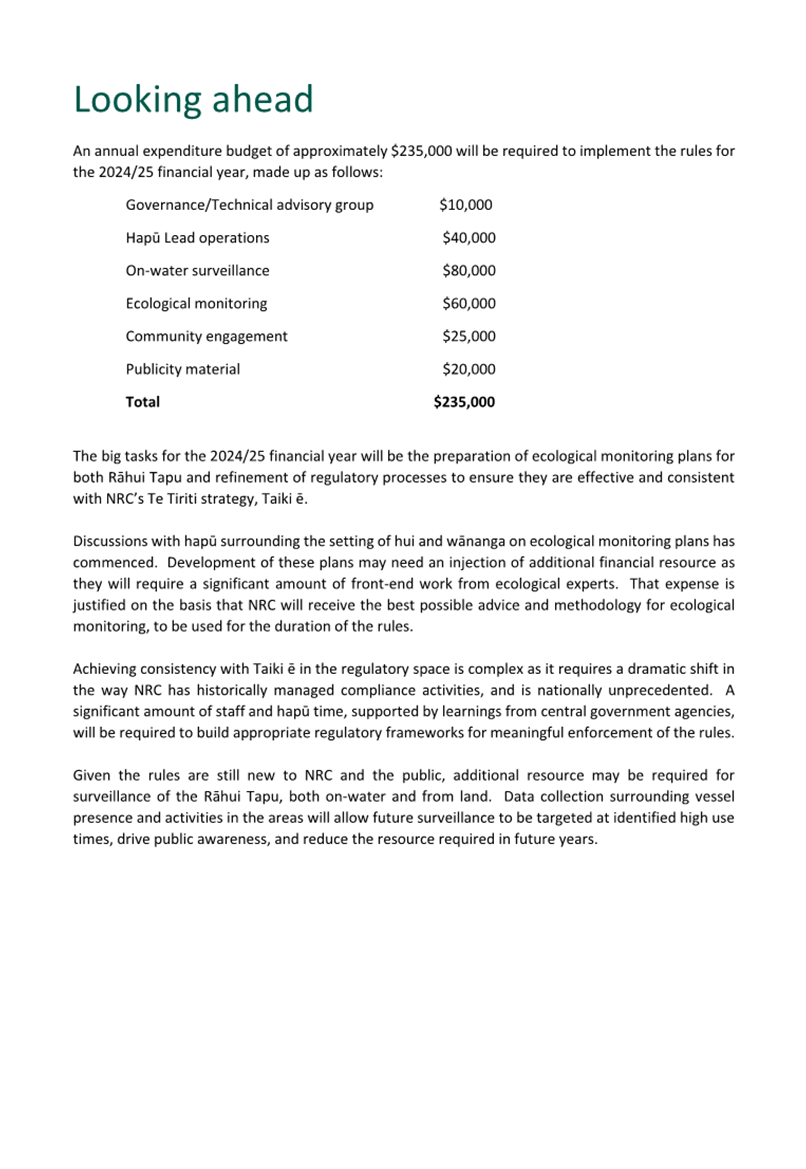
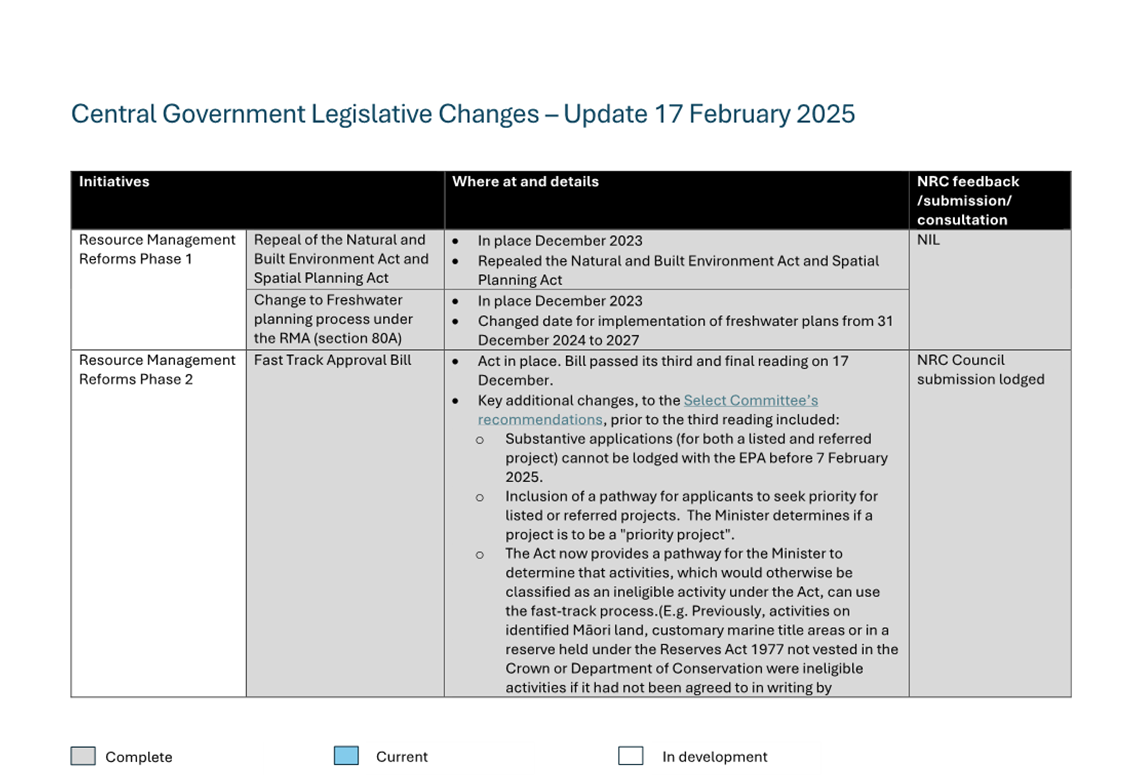
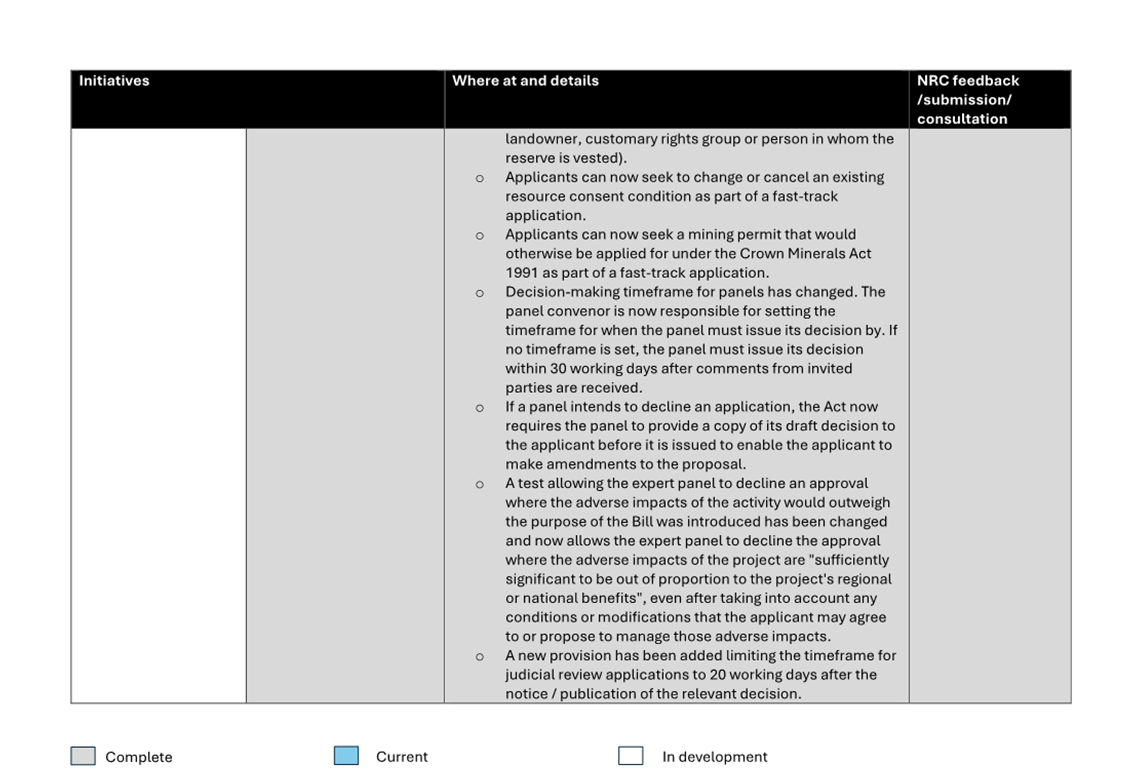
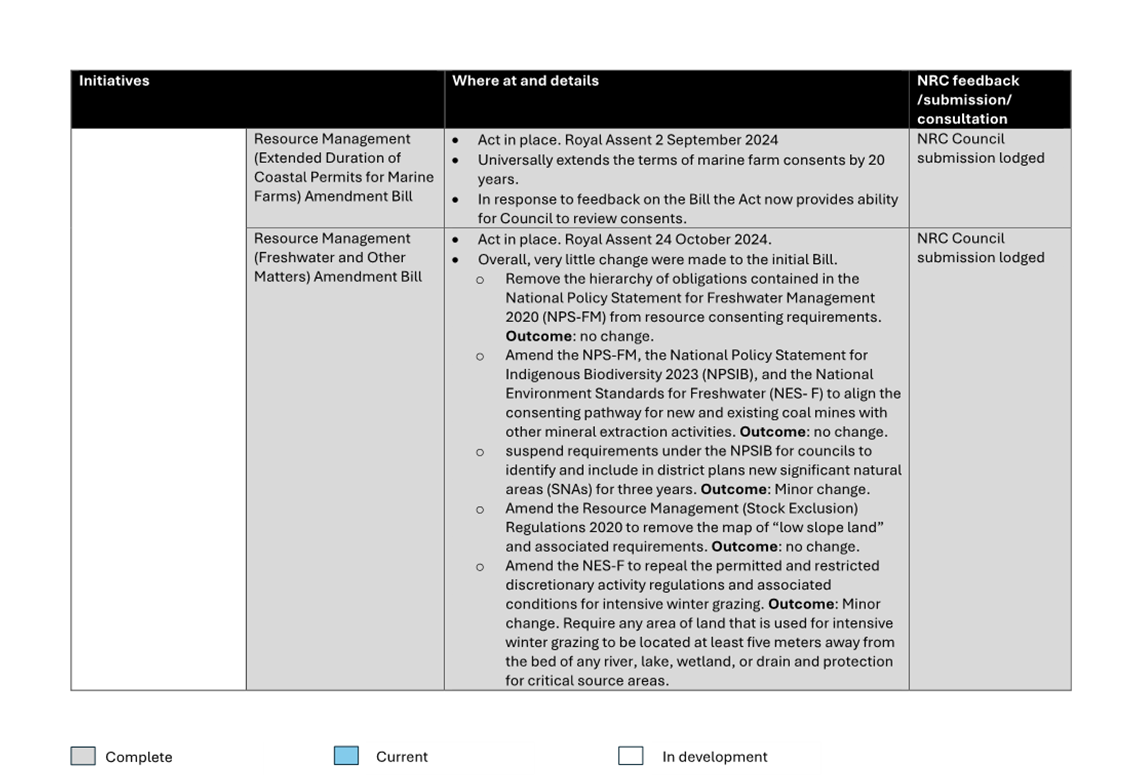
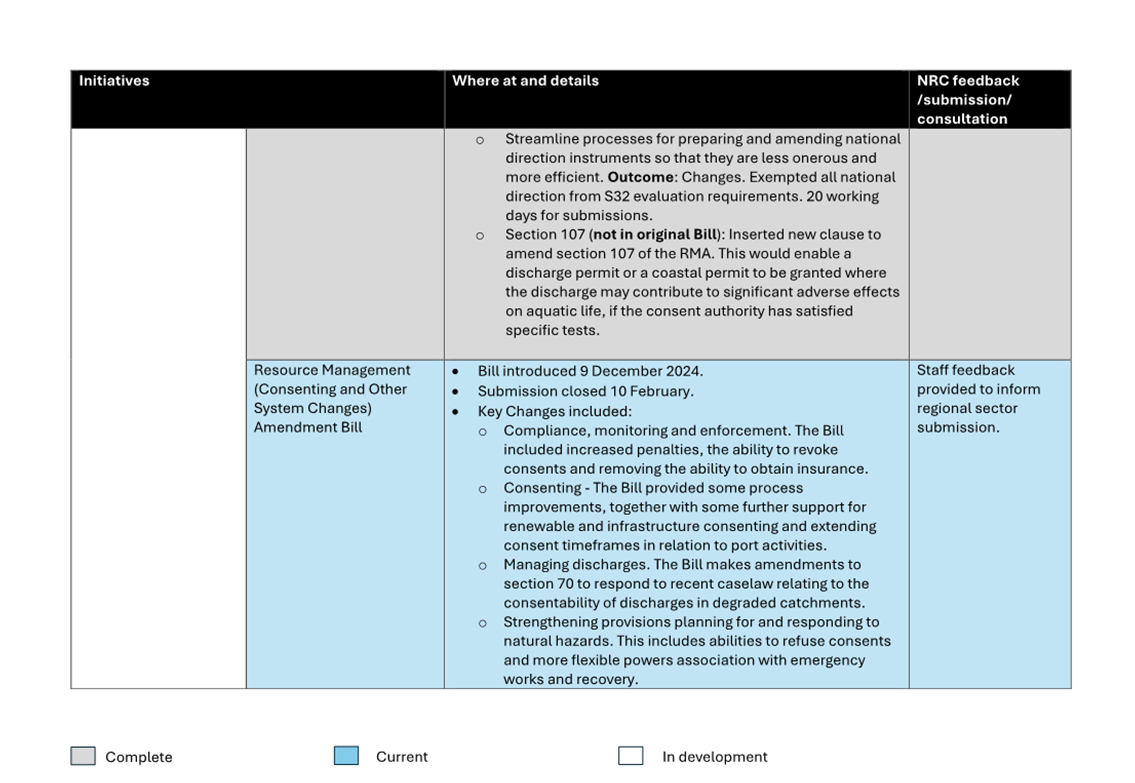
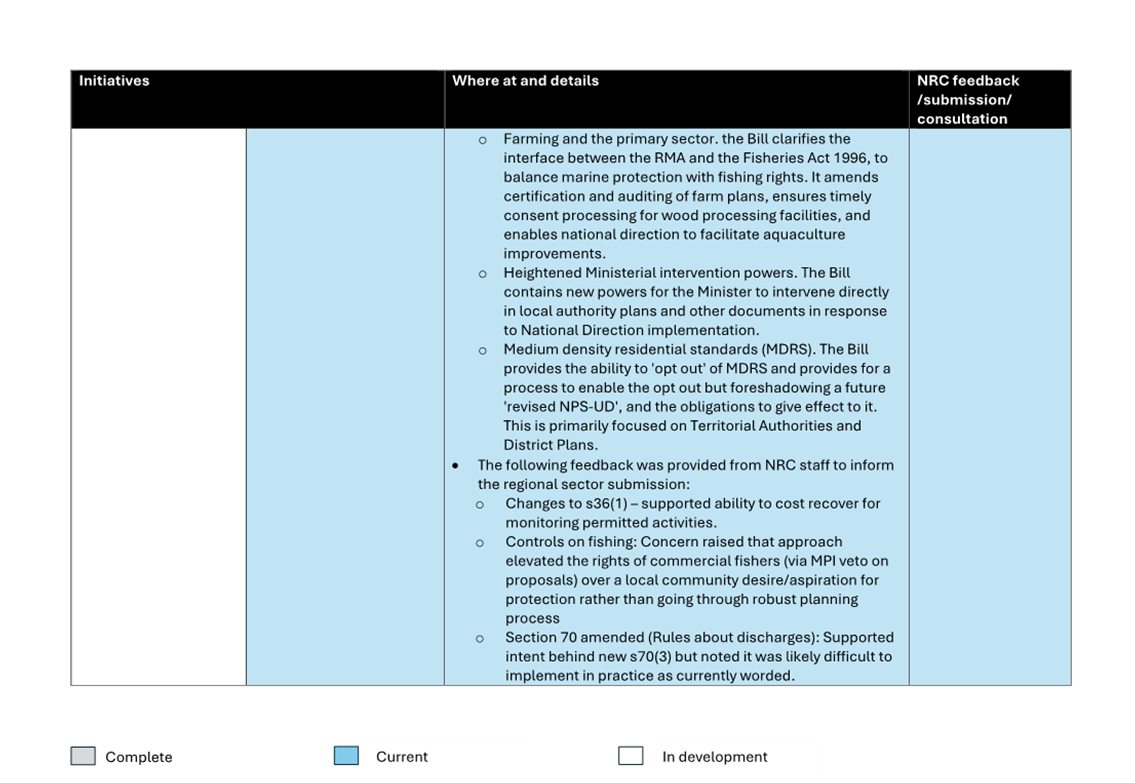
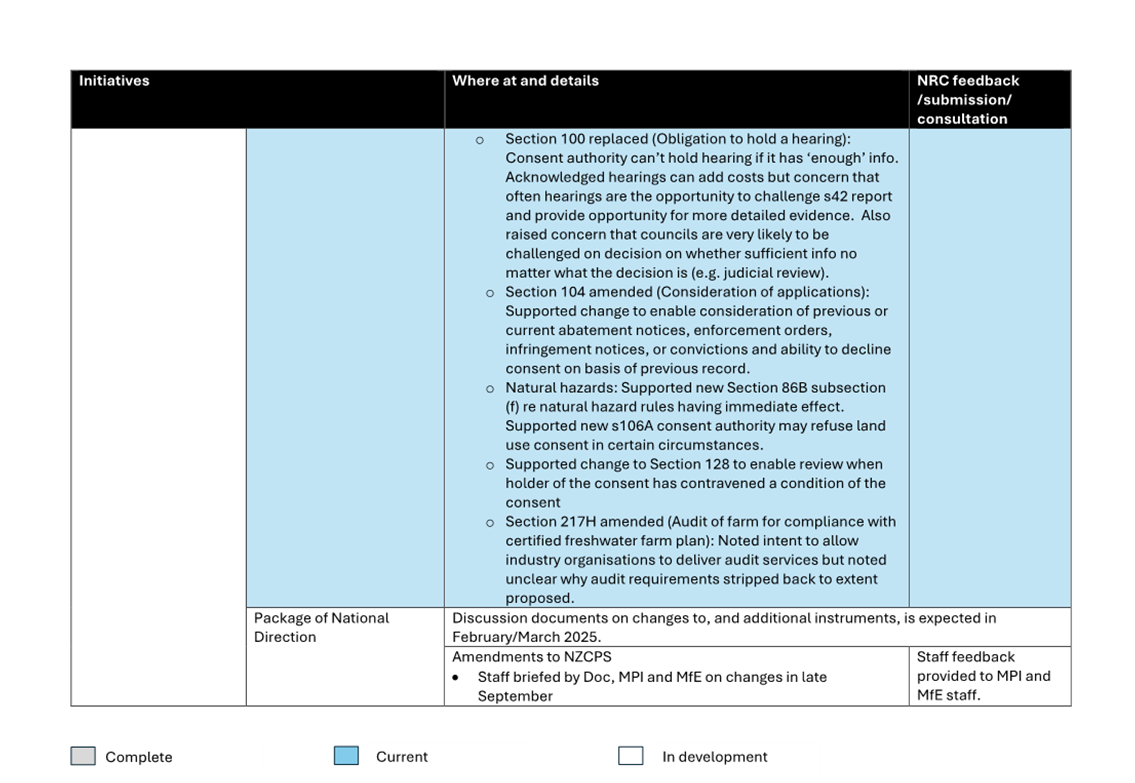
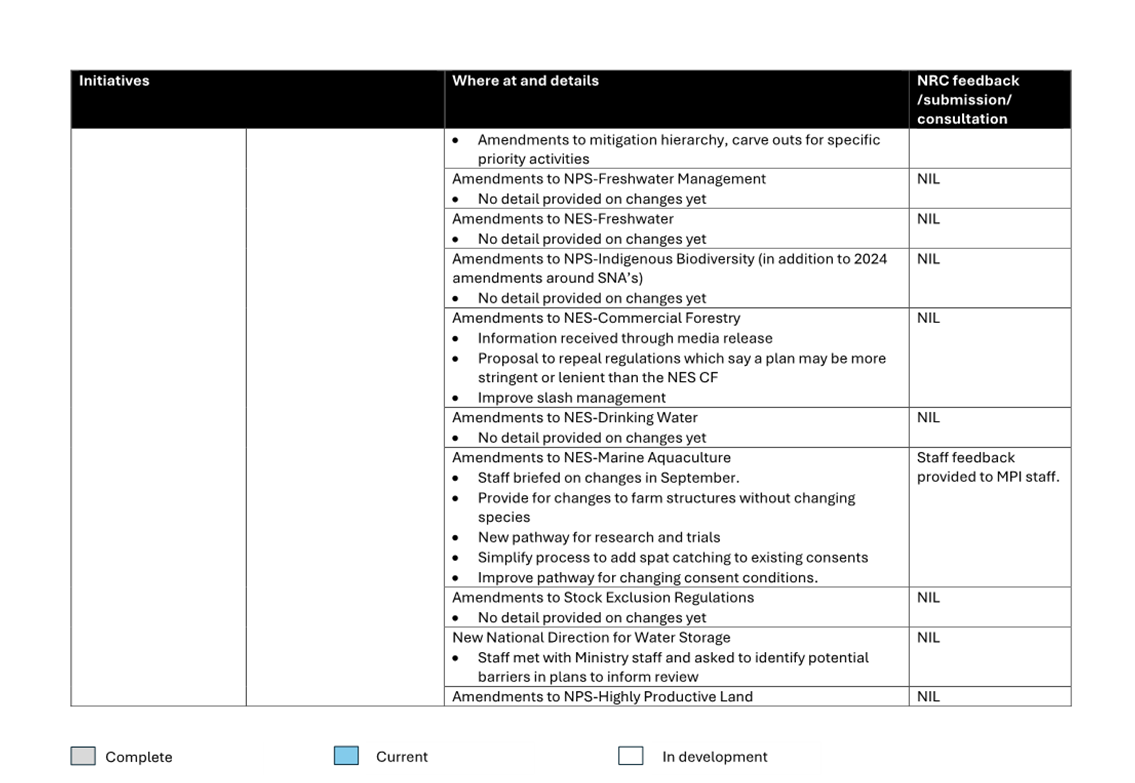
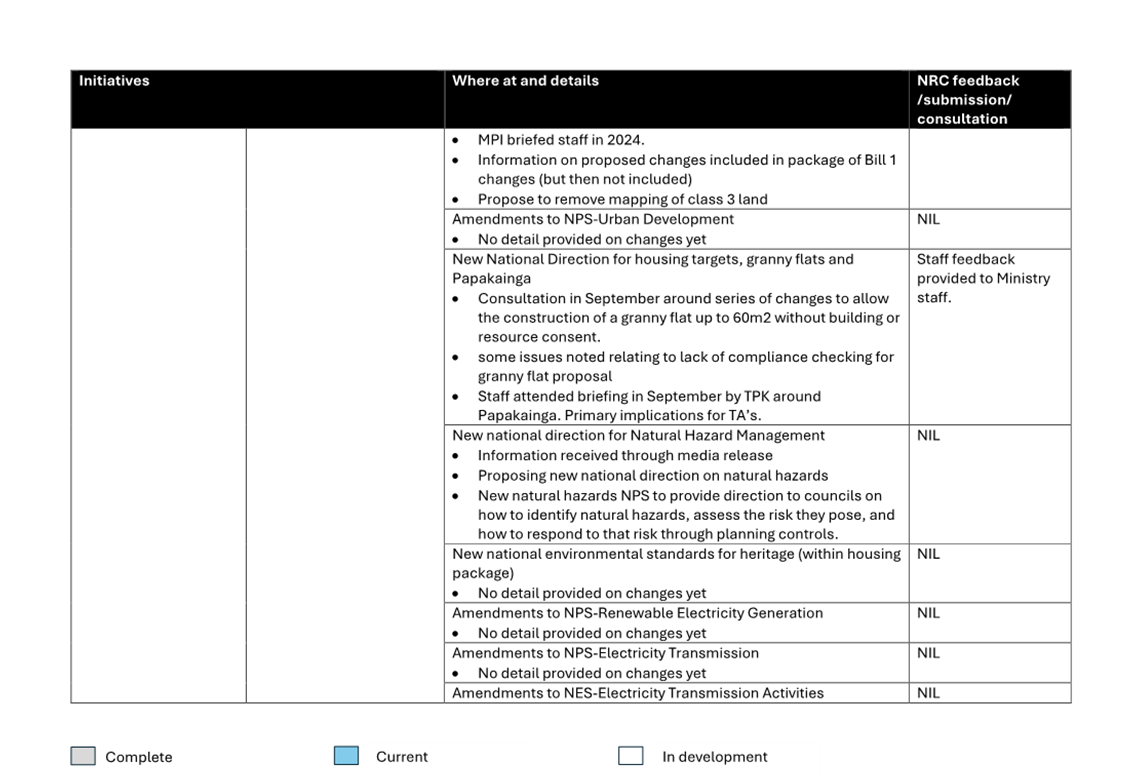
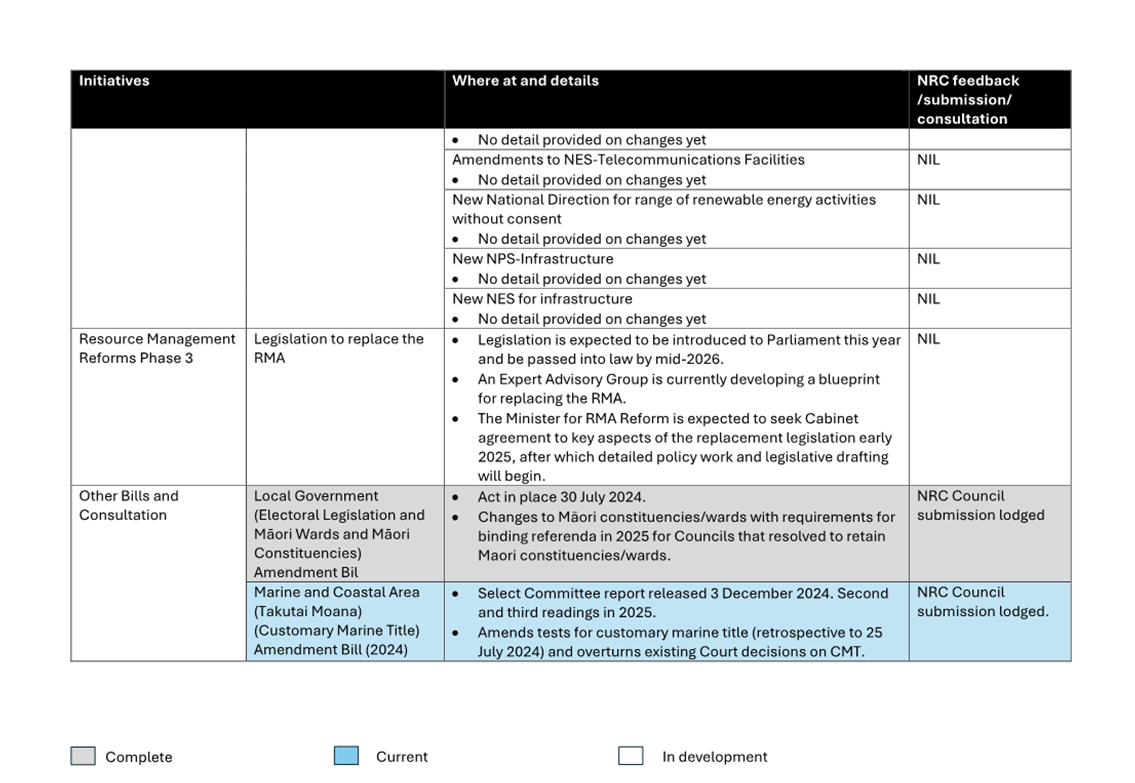
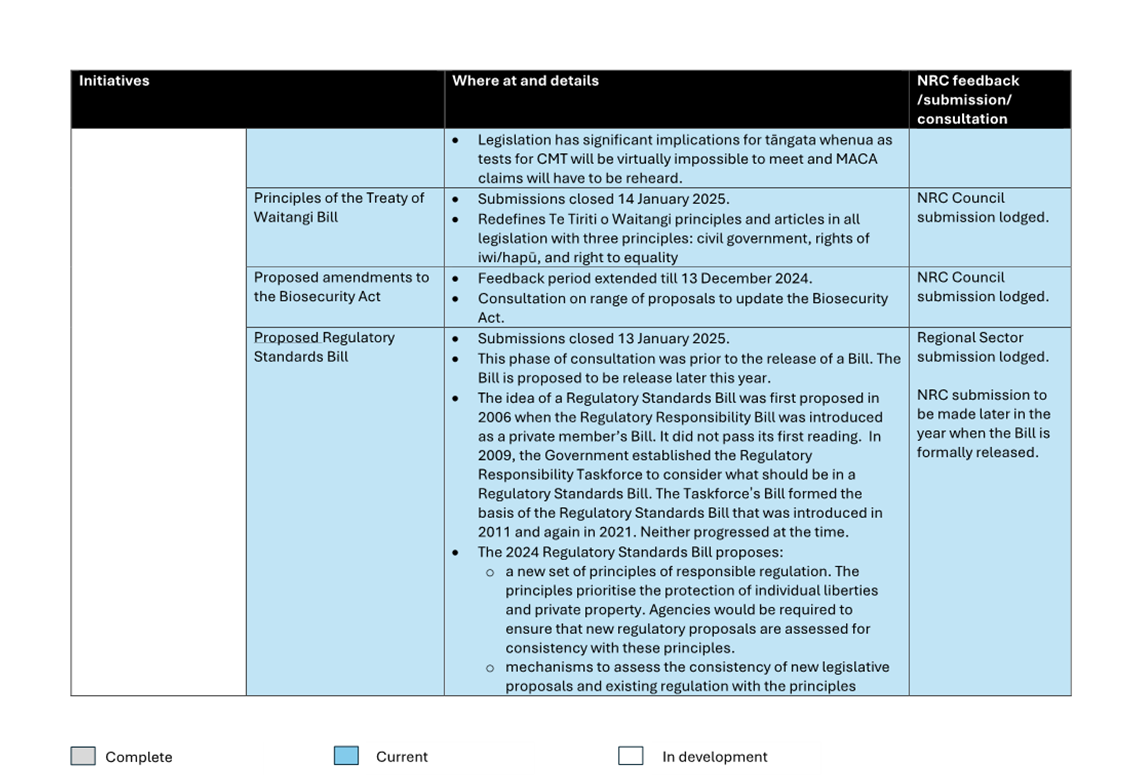
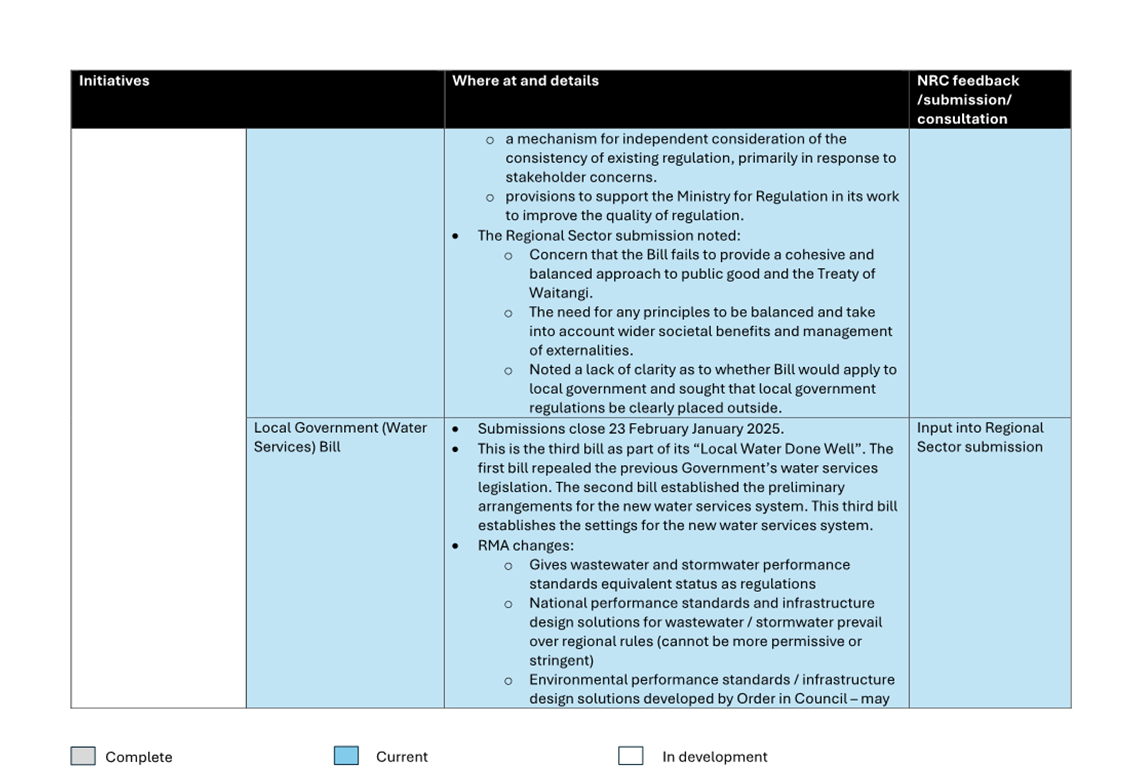
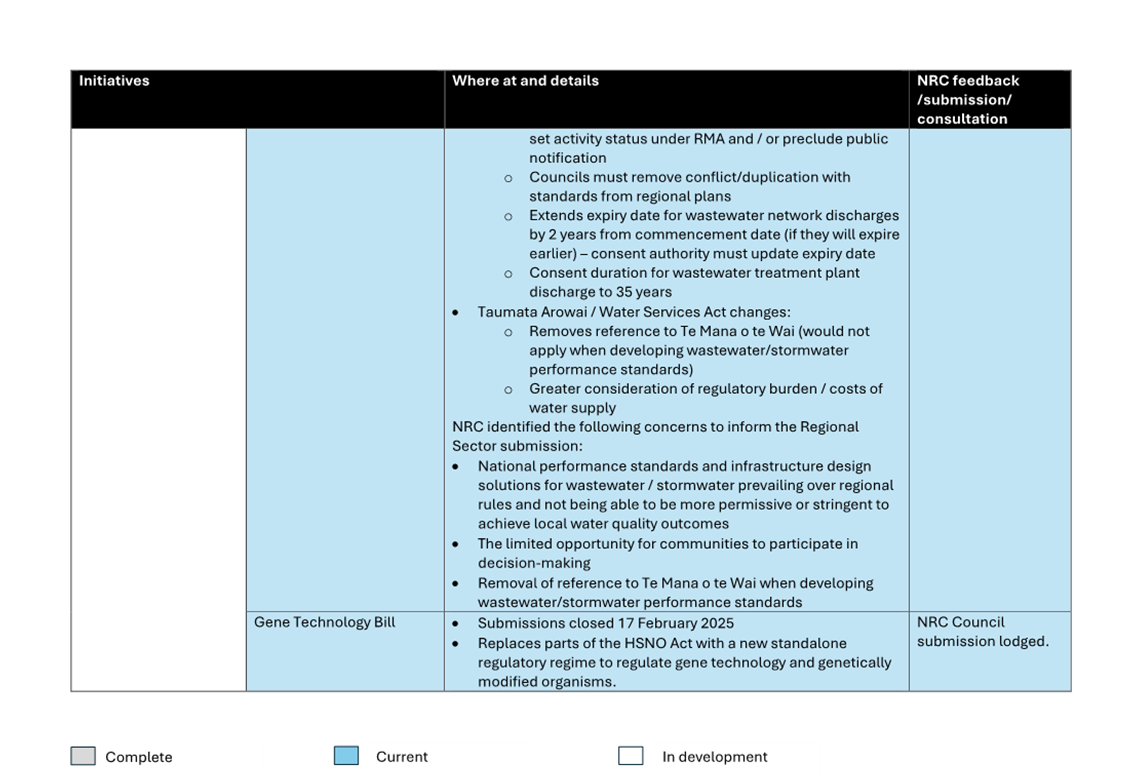
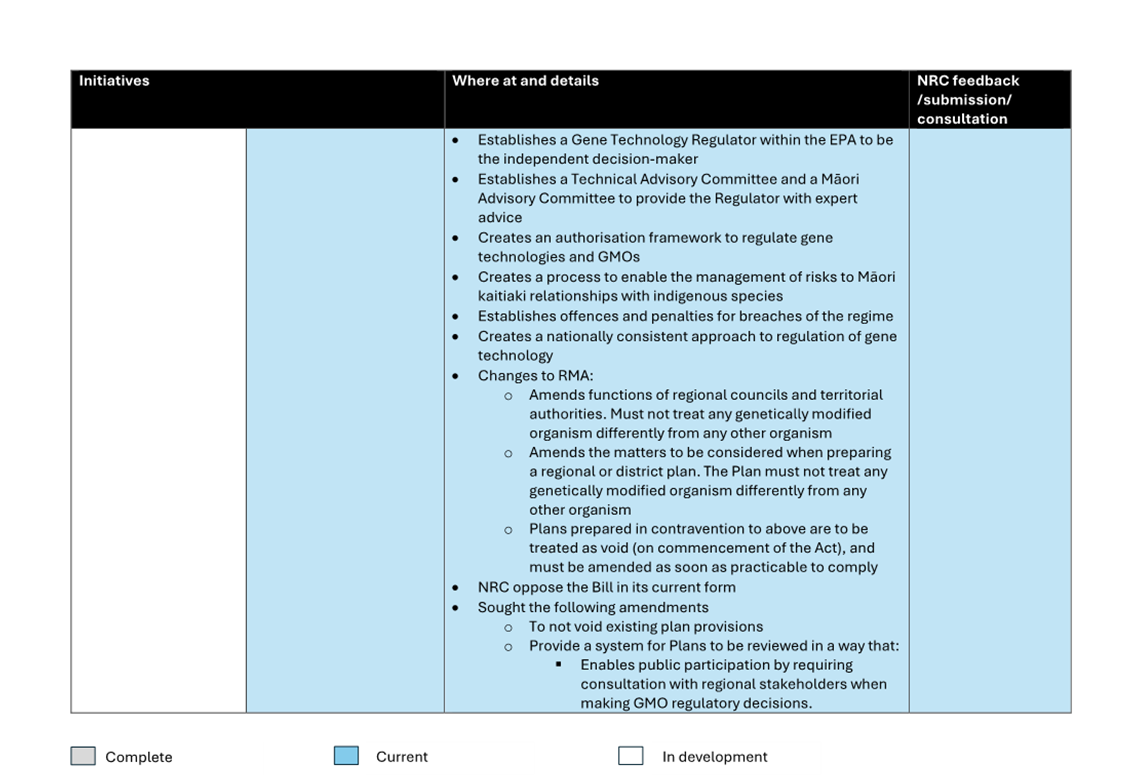
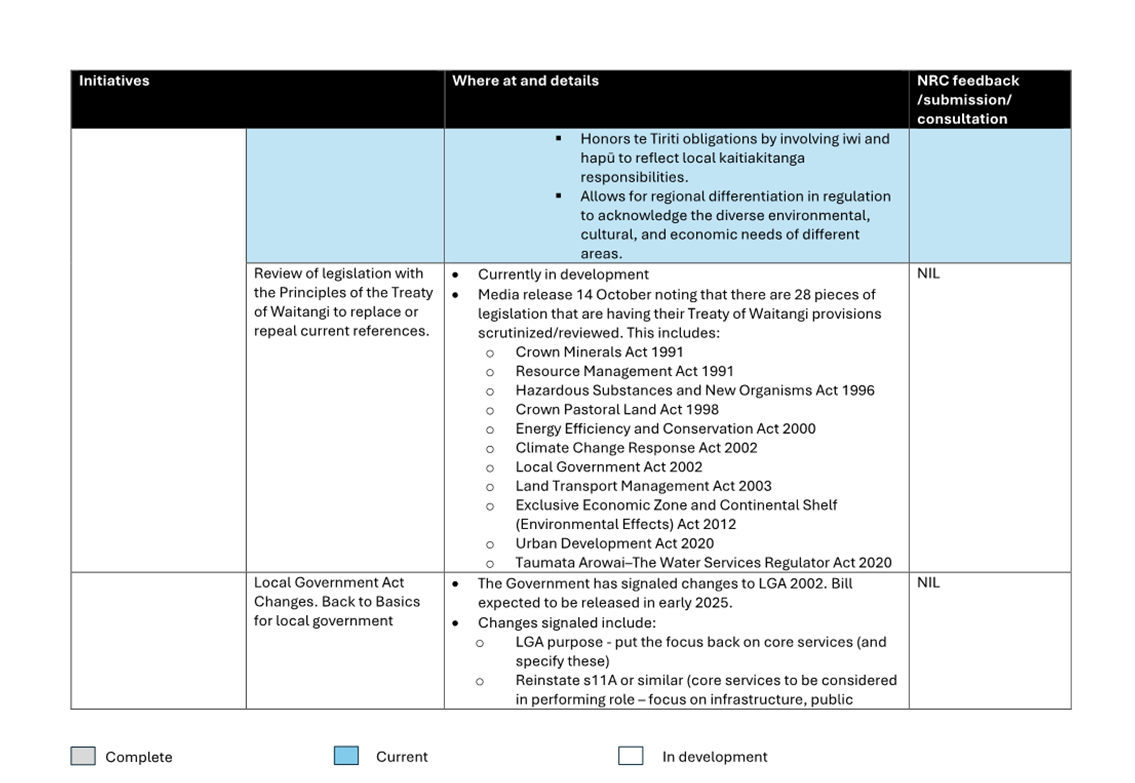
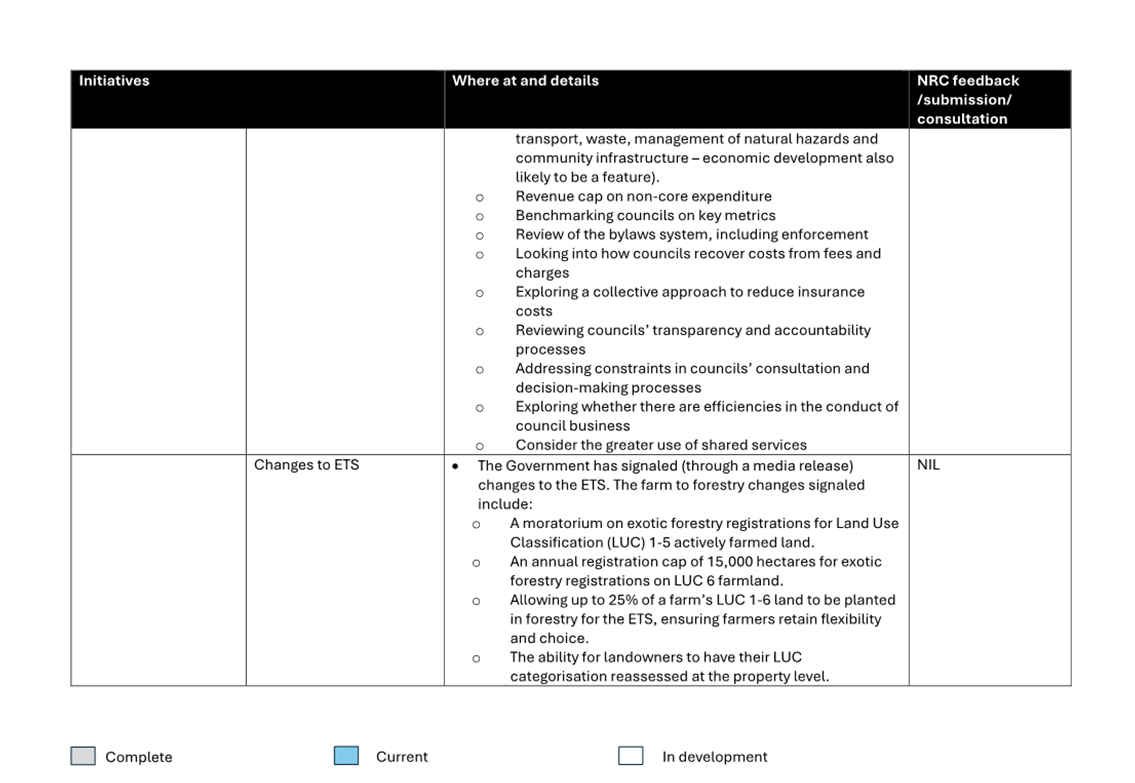
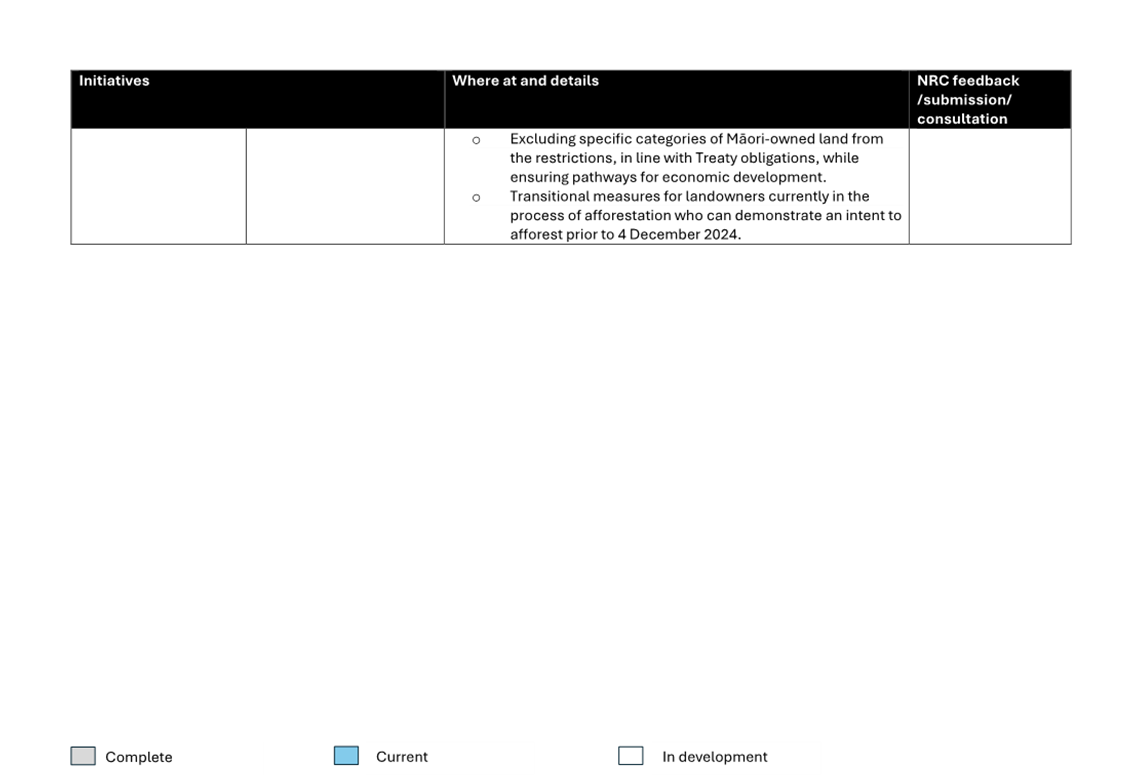
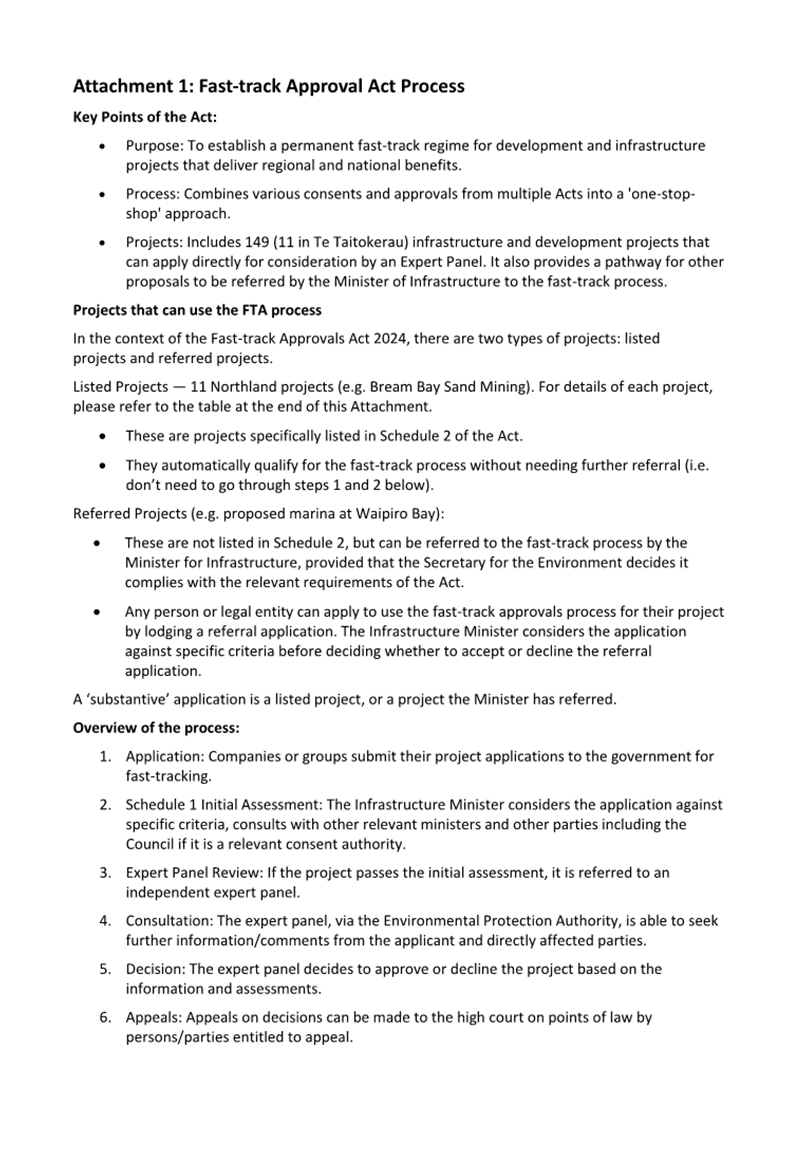
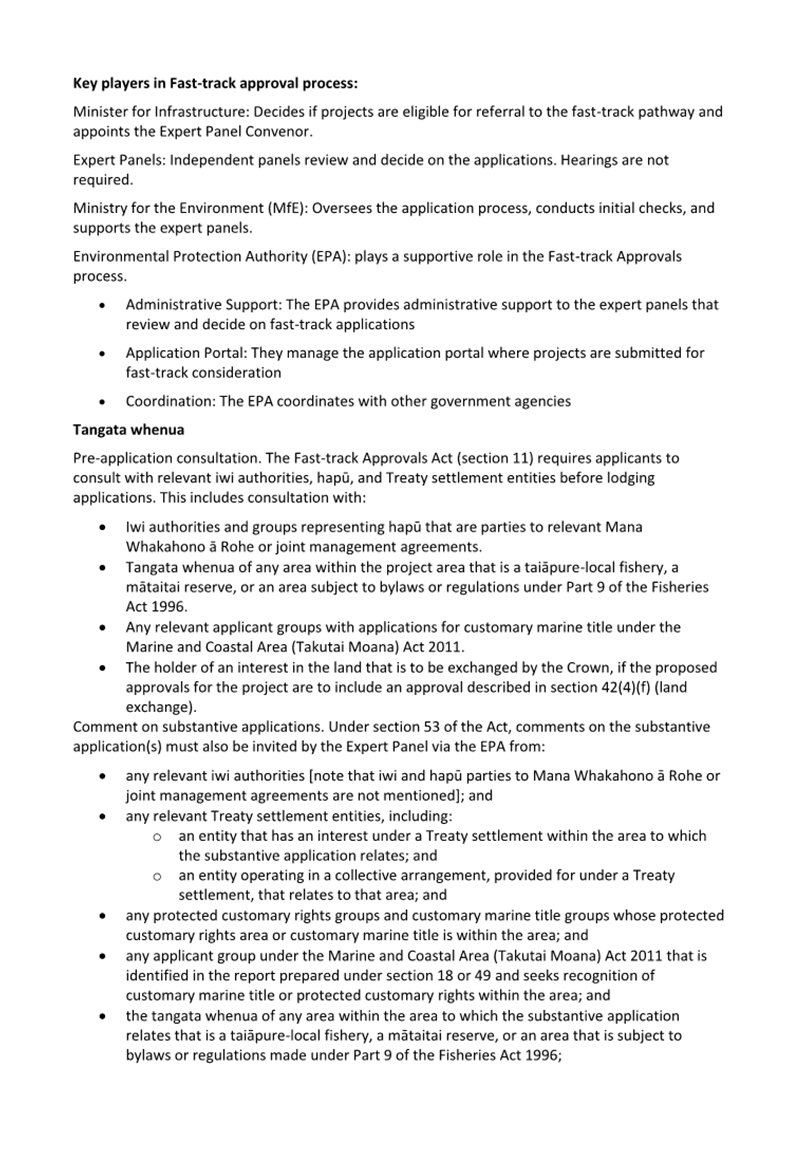
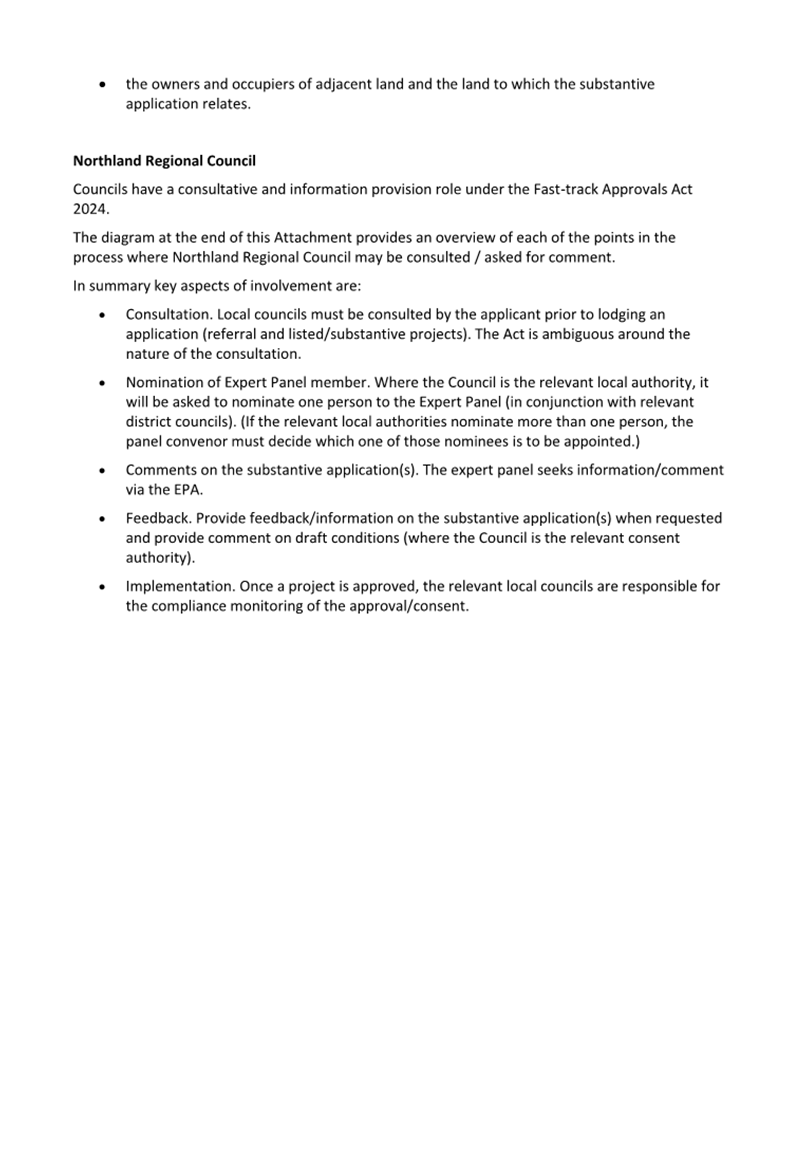
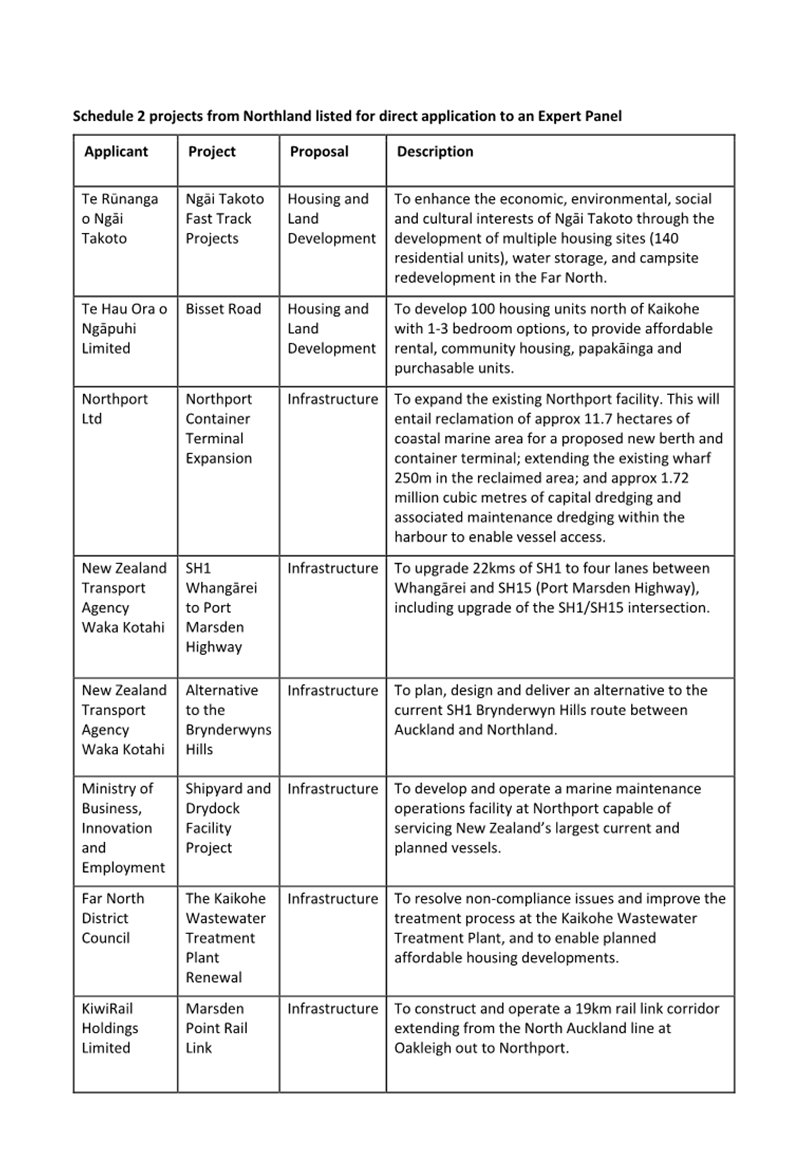
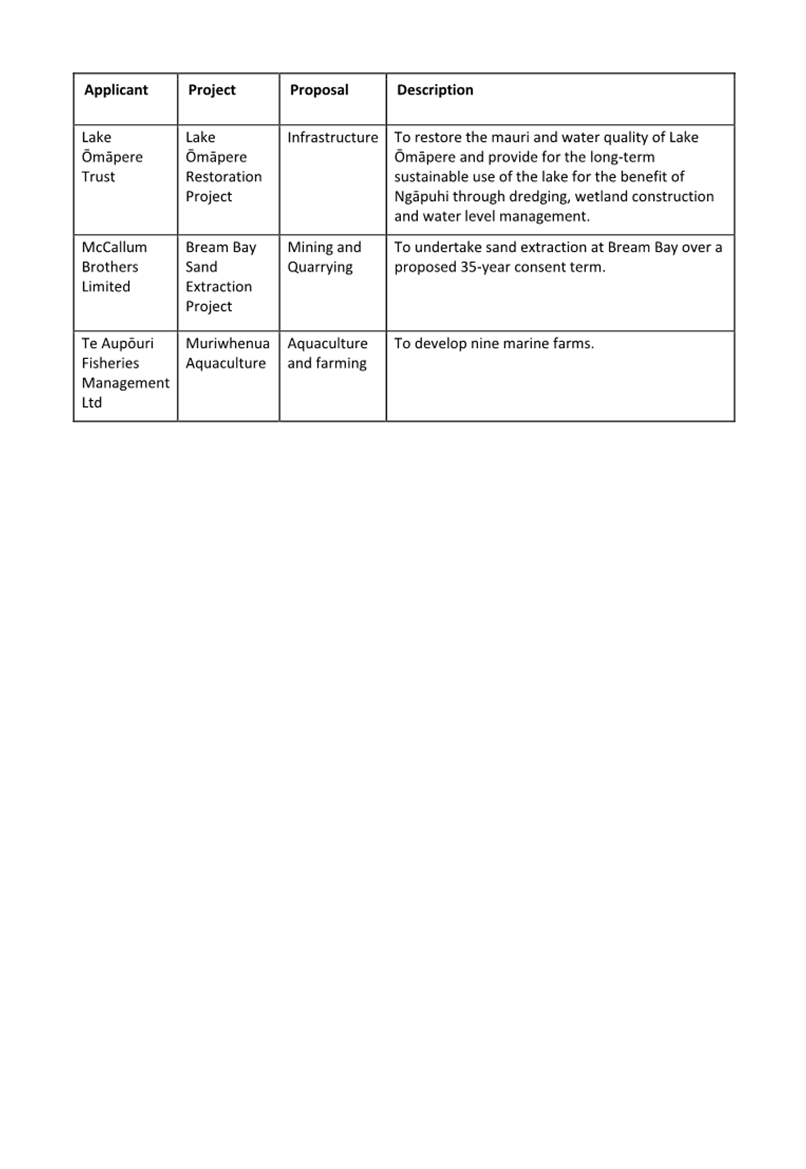
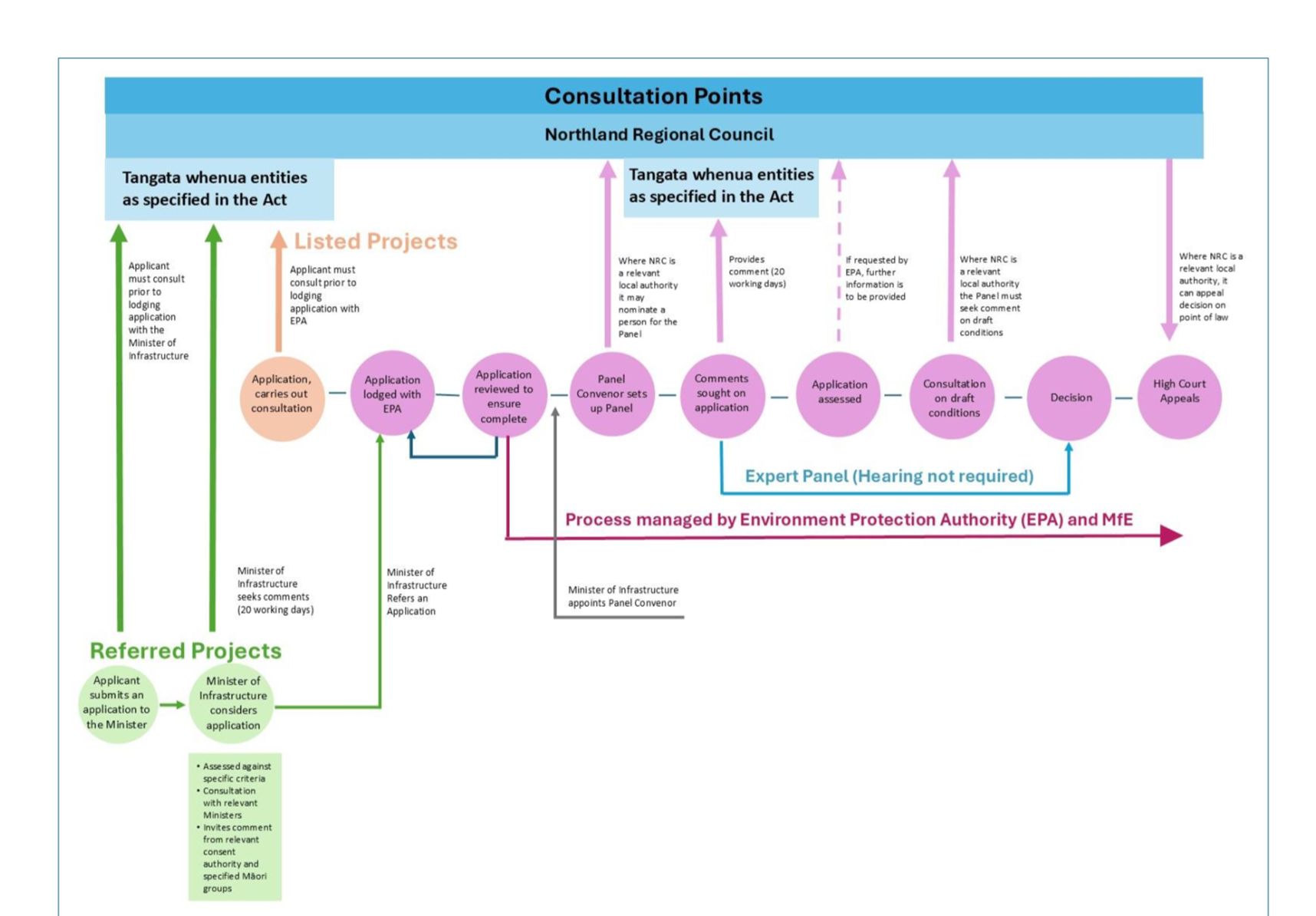
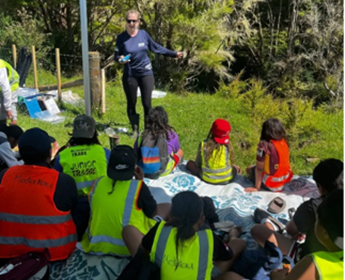
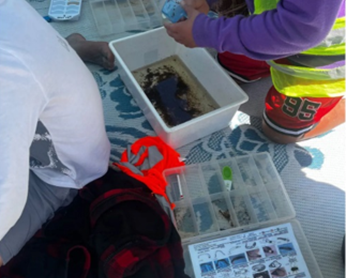







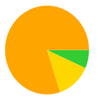





















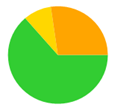

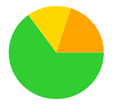

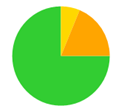
























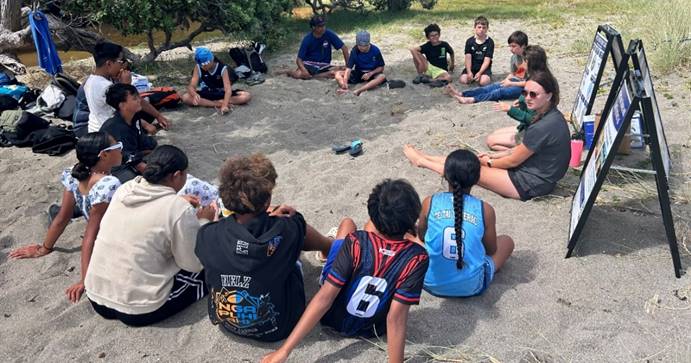
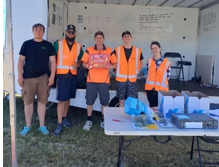
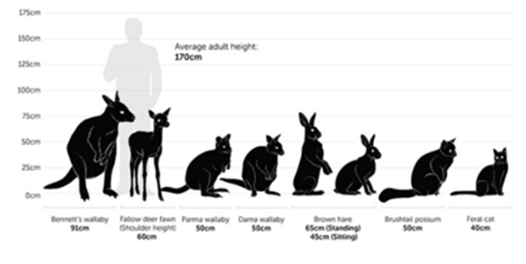
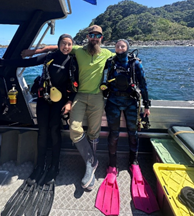
 Signing
the Mana Whakahono ā Rohe: Deputy Chair Northland Regional Council, Tui
Shortland, and Deputy Chair, Te Rūnanga o Ngāti Hine Pita Tipene.
Signing
the Mana Whakahono ā Rohe: Deputy Chair Northland Regional Council, Tui
Shortland, and Deputy Chair, Te Rūnanga o Ngāti Hine Pita Tipene.