|
Council Wednesday 25 March 2026 at 10.00am
|
|
|
|
|
|
Council Wednesday 25 March 2026 at 10.00am
|
|
|
|
|
25 March 2026
Northland Regional Council Agenda
Meeting to be held in the Council Chamber
36 Water Street, Whangārei
on Wednesday 25 March 2026, commencing at 10.00am
Recommendations contained in the council agenda are NOT council decisions. Please refer to council minutes for resolutions.
RĪMITI (Item) Page
1.0 Ngā Mahi Whakapai / Housekeeping
Key Health and Safety points to note:
· If the fire alarm goes off – exit down the stairwell to the assembly point which is the visitor carpark.
· Earthquakes – drop, cover and hold
· Visitors please make sure you have signed in at reception, and that you sign out when you leave. Please wear your name sticker.
· The toilets are on the opposite side of the stairwell.
Opinions expressed or statements made by individual persons during a meeting are not the opinions or statements of the Northland Regional Council. Council accepts no liability for any opinions or statements made during a meeting.
2.0 Karakia Timatanga – Tauāki ā roto / Opening karakia
3.0 Ngā WhakapĀhA / apologies
4.0 Ngā Whakapuakanga / DECLARATIONS OF CONFLICTS OF INTEREST
5.0 Ngā Whakaae Miniti me te Mahere Mahi / Council Minutes and Action Sheet
5.1 Confirmation of Minutes - 18 February 2026 6
5.2 Receipt of Action Sheet 16
6.0 Ngā Ripoata Putea / Financial Reports
6.1 Financial Report to February 2026 19
6.2 Regional Rates Collection - update to 31 December 2025 25
6.3 Withdrawal of the Planned 2025-26 Funding Contribution from the Managed Investment Fund Portfolio 27
7.0 Ngā Take / Decision Making Matters
7.1 Local Government reform programme 31
7.2 Approval of updated Delegation Manual 46
7.3 Adoption of the Statement of Proposal and Draft Dangerous Dams Policy 2026 for consultation 54
7.4 Regional Software Holdings Limited Statement Of Intent 69
7.5 Investment Committee Terms of Reference 114
8.0 Ngā Ripoata Mahi / Operational Reports
8.1 Chair's Report to Council 119
8.2 Chief Executive’s Report to Council 128
8.3 Legislative compliance half yearly report July - December 2025 160
9.0 Receipt of Committee Minutes and Working Party/Group Updates
9.1 Receipt of Committee Minutes 163
9.2 Working Party Updates Report 195
10.0 Kaupapa ā Roto / Business with the Public Excluded 199
10.1 Confirmation of Confidential Minutes - 18 February 2026
10.2 Receipt of Confidential Committee Minutes
10.3 Commercial Property Transactions
|
ACC - Accident Compensation Corporation ALGIM - Association of Local Government Information Management AMA - Aquaculture Management Area AMP - Asset Management Plan/Activity Management Plan AP - Annual Plan BCP – Business Continuity Planning CAPEX - Capital Expenditure (budget to purchase assets) CCO – Council Controlled Organisation CCTO – Council Controlled Trading Organisation CDEM - Civil Defence Emergency Management CEG - Co-ordinating Executive Group CEO - Chief Executive Officer CIMS - Co-ordinated Incident Management System (emergency management structure) CMA - Coastal Marine Area CPCA - Community Pest Control Areas DOC - Department of Conservation DP – District Plan ECAN - Environment Canterbury EECA - Energy Efficiency Conservation Authority EF - Environment Fund EMA - Employers and Manufacturers Association EOC - Emergency Operations Centre EPA - Environmental Protection Authority ETS - Emissions Trading Scheme FDE - Farm Dairy Effluent FNDC - Far North District Council FNHL - Far North Holdings Limited FPP - First Past the Post GIS - Geographic Information System HSWA - Health and Safety at Work Act 2015 IHEMP – Iwi/Hapū Environmental Management Plan ILGACE - Iwi and Local Government Chief Executives Forum IRIS - Integrated Regional Information System JREDC - Joint Regional Economic Development Committee KDC - Kaipara District Council KPI - Key Performance Indicator LAWA – Land, Air, Water Aotearoa LEA - Local Electoral Act 2001 LGA - Local Government Act 2002 LGNZ - Local Government New Zealand LGOIMA - Local Government Official Information & Meetings Act 1987 LIDAR – Light detection and ranging LTP - Long Term Plan LWDW – Local Waters Done Well MACC – Multi-Agency Co-ordination Centre MBIE – Ministry of Business, Innovation & Employment MFE - Ministry for the Environment MFL – Māori Freehold Land MHWS - Mean High Water Springs MMH - Marsden Maritime Holdings Limited MNZ - Maritime New Zealand MOU – Memorandum of Understanding MTAG - Māori Technical Advisory Group MWAR - Mana Whakahono Ā Rohe NCMC - National Crisis Management Centre NDHB - Northland District Health Board NEMA – National Emergency Management Agency NES - National Environmental Standards
|
NFT – Northland | Forward Together NGL – Northport Group Limited NGO - Non-Governmental Organisation NIF - Northland Intersectoral Forum NINC - Northland Inc. Limited NIWA - National Institute of Water and Atmosphere NPS - National Policy Statement NPS-FM - National Policy Statement for Freshwater Management NZCPS - New Zealand Coastal Policy Statement NZTA –New Zealand Transport Agency NZTE - New Zealand Trade and Enterprise NZWWA - New Zealand Water and Wastes Association OFI - Opportunity for Improvement OPEX – Operating Expenditures OSH - Occupational Safety & Health OTS – Office of Treaty Settlements PCBU - Person Conducting Business or Undertaking PPE - Personal Protective Equipment RAP - Response Action Plan RBI - Regional Broadband Initiative RFI - Request for Information RFP - Request for Proposal RLTP - Regional Land Transport Plan RMA - Resource Management Act 1991 RMG - Resource Managers Group (Regional Councils) RMZ - Riparian Management Zone ROI - Return on Investment RP – Regional Plan RPMP - Regional Pest Management Plan RPMS - Regional Pest Management Strategy RPS - Regional Policy Statement RPTP – Regional Public Transport Plan RRSAP – Regional Road Safety Action Plan RSG – Regional Sector Group RSHL - Regional Software Holdings Ltd RTC - Regional Transport Committee RTO - Regional Tourism Organisation SIG – Special Interest Group SIPO - Statement of Investment Policy and Objectives SITREP - Situation Report SOE - State of Environment (or) State Owned Enterprise SOI – Statement of Intent STV - Single Transferable Vote TAG - Technical Advisory Group Te Ruarangi – Te Taitokerau Māori & Council Working Party TKoT - Te Kahu o Taonui Tier 1 - Site level plan or response for an oil spill Tier 2 - Regional level plan or response to an oil spill Tier 3 - National level plan or response to an oil spill TLA - Territorial Local Authority – City & District Councils TMP - Treasury Management Plan TMP - Treasury Management Plan TOATB – Te Oneroa-Ā-Tohe Board TOR - Terms of Reference TPK - Te Puni Kōkiri (Ministry of Māori Development) TTNEAP – Tai Tokerau Northland Economic Action Plan TWWAG – Tangata Whenua Water Advisory Group UNISA - Upper North Island Strategic Alliance WDC - Whangarei District Council WSMP - Workplace Safety Management Practices |
|
25 March 2026
|
TITLE: |
Confirmation of Minutes - 18 February 2026 |
|
From: |
Meloney Tupou, Māori Governance and Engagement Support Admin |
|
Authorised by: |
Chris Taylor, Governance Specialist, on 10 March 2026 |
That the minutes of the council meeting held on 18 February 2026, be confirmed as a true and correct record and that these be duly authenticated with the Chair’s electronic signature.
Attachments/Ngā tapirihanga
Attachment 1:
Council Meeting Minutes - 18 February Meeting 2026 ⇩ 
25 March
2026
This page is a placeholder for a single page of a PDF attachment. It will be replaced by the actual PDF page when the PDF version of this document is generated.
Report: Confirmation of Minutes - 18 February 2026
Attachment: Council Meeting Minutes - 18 February Meeting 2026
Page: 1
This page is a placeholder for a single page of a PDF attachment. It will be replaced by the actual PDF page when the PDF version of this document is generated.
Report: Confirmation of Minutes - 18 February 2026
Attachment: Council Meeting Minutes - 18 February Meeting 2026
Page: 2
This page is a placeholder for a single page of a PDF attachment. It will be replaced by the actual PDF page when the PDF version of this document is generated.
Report: Confirmation of Minutes - 18 February 2026
Attachment: Council Meeting Minutes - 18 February Meeting 2026
Page: 3
This page is a placeholder for a single page of a PDF attachment. It will be replaced by the actual PDF page when the PDF version of this document is generated.
Report: Confirmation of Minutes - 18 February 2026
Attachment: Council Meeting Minutes - 18 February Meeting 2026
Page: 4
This page is a placeholder for a single page of a PDF attachment. It will be replaced by the actual PDF page when the PDF version of this document is generated.
Report: Confirmation of Minutes - 18 February 2026
Attachment: Council Meeting Minutes - 18 February Meeting 2026
Page: 5
This page is a placeholder for a single page of a PDF attachment. It will be replaced by the actual PDF page when the PDF version of this document is generated.
Report: Confirmation of Minutes - 18 February 2026
Attachment: Council Meeting Minutes - 18 February Meeting 2026
Page: 6
This page is a placeholder for a single page of a PDF attachment. It will be replaced by the actual PDF page when the PDF version of this document is generated.
Report: Confirmation of Minutes - 18 February 2026
Attachment: Council Meeting Minutes - 18 February Meeting 2026
Page: 7
This page is a placeholder for a single page of a PDF attachment. It will be replaced by the actual PDF page when the PDF version of this document is generated.
Report: Confirmation of Minutes - 18 February 2026
Attachment: Council Meeting Minutes - 18 February Meeting 2026
Page: 8
This page is a placeholder for a single page of a PDF attachment. It will be replaced by the actual PDF page when the PDF version of this document is generated.
Report: Confirmation of Minutes - 18 February 2026
Attachment: Council Meeting Minutes - 18 February Meeting 2026
Page: 9
25 March 2026
|
TITLE: |
Receipt of Action Sheet |
|
From: |
Chris Taylor, Governance Specialist |
|
Authorised by: |
Chris Taylor, Governance Specialist, on 17 March 2026 |
Whakarāpopototanga / Executive summary
The purpose of this report is to enable the meeting to receive the current action sheet.
That the action sheet be received.
Attachments/Ngā tapirihanga
Attachment 1:
Council Action Sheet - March 2026 ⇩
25 March
2026
This page is a placeholder for a single page of a PDF attachment. It will be replaced by the actual PDF page when the PDF version of this document is generated.
Report: Receipt of Action Sheet
Attachment: Council Action Sheet - March 2026
Page: 1
This page is a placeholder for a single page of a PDF attachment. It will be replaced by the actual PDF page when the PDF version of this document is generated.
Report: Receipt of Action Sheet
Attachment: Council Action Sheet - March 2026
Page: 2
25 March 2026
|
TITLE: |
Financial Report to February 2026 |
|
From: |
Taka Skipwith, Financial Accountant |
|
Authorised by: |
Bruce Howse, Pou Taumatua – Group Manager Corporate Services, on 19 March 2026 |
Whakarāpopototanga / Executive summary
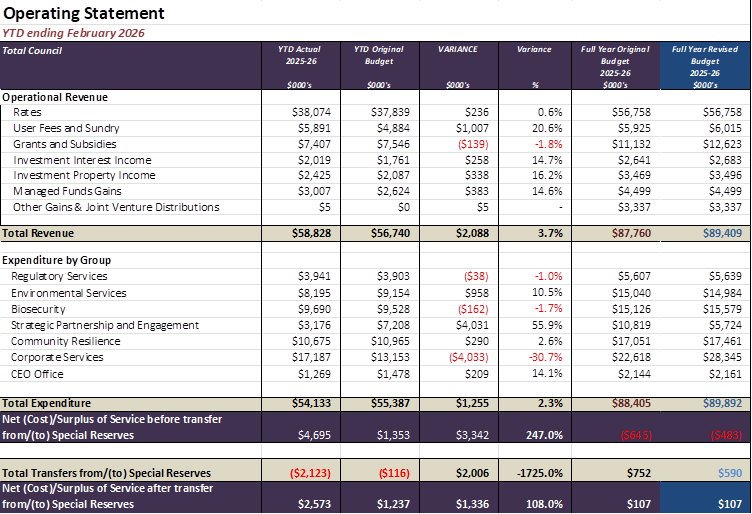
This report details the year to date (YTD) financial results for February 2026. The council has achieved a YTD surplus of $2.57m after transfers to and from reserves, which represents a favourable variance of $1.34m compared to the original budgeted of $1.24m. The favourable variance is mainly attributed to salary savings across council. All comparisons in this report are based on the original budget.
That the report ‘Financial Report to February 2026’ by Taka Skipwith, Financial Accountant and dated 4 March 2026, be received.
Background/Tuhinga
The operating surplus, before transfers to and from reserves, for the YTD period ending February 2026 is $4.70m, which exceeds the original budget of $1.35m, by $3.34m (refer to Table 1). The operating surplus after transfers to and from reserves is $2.57m, representing a favourable variance of $1.34m compared to the original budgeted of $1.24m.
Table 1
The contributing factors for the YTD favourable variance are.
YTD Operating Revenue (table 4) favourable variance of $2.09m is 3.7% of the budget and predominantly due to:
· Managed funds continue to outperform budget expectations, achieving 67% of the full year budget between July 2025 and January 2026.
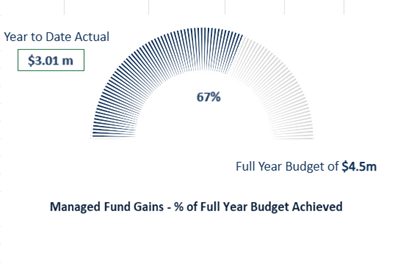
o Fund performance YTD is $3.01m against a YTD budget of $2.62m, resulting in a YTD favourable variance of $383k. (Refer to Table3)
o Gains of $1.17m have been allocated to reinvestment in council reserves, with a further $503k allocated to standard operations, CCO, community support and management fees.
· Higher than expected Investment interest income of $258k, from cash and term deposits.
· Commercial property investment income of $338k is attributable to higher-than-expected rental income, and higher than planned contributions for strategic review of $556k and cost recoveries of $388k.
YTD Operational Expenditure (table 5) favourable variance of $1.26m which is 2.3% of the budget, due to:
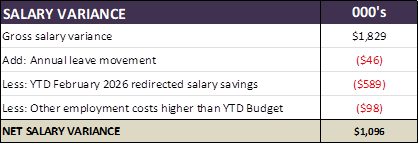
· Salary savings across all of council of $1.10m,
· Across council expenditure variances as detailed in Table 5.
Operational Expenditure approvals
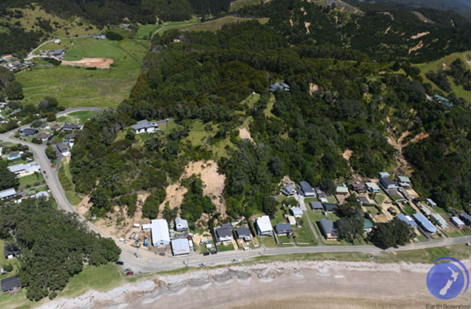
The Chair and Acting CE approved an emergency payment in accordance with the updated delegation’s manual, for $150,000 to contract a LIDAR survey of the east coast areas recently impacted by the severe weather event. The information will be used to provide an update on the current landslip risk so that communities can be informed. There are concerns regarding several areas where the landslip risk is unknown hence the urgency to this work. The LIDAR information will also support the development of a Northland susceptibility map that will be published on the NRC website in due course. The work is funded from resources remaining from the regional LIDAR collecting in 2018 and being held as revenue in advance to contribute to the regional LIDAR update due to start in the 2027/2028 financial year. The information collected has multiple functions and including the use for updating flood models.
Net Salary savings across all of council for the YTD is $1.10m, or 4.6% of the YTD budget for salaries and associated costs (refer to Table 2). Salary savings generated, strengthens council’s available working capital position for the remainder of the financial year.
Table 2
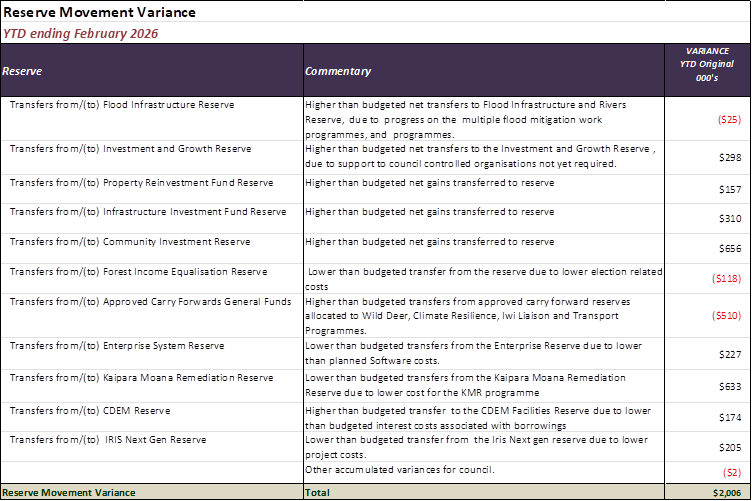
Reserve Movements (Table 6) variance of $2.01m arises from net transfers to reserves of $2.12m compared to a budgeted net transfer to reserves of $116k. The variance is due mainly to.
· Higher than budgeted transferred to the Property Reinvestment Reserve, Regional Project Reserve, the Economic Development Reserve.
· Lower than budgeted transfers from KMR reserves of $663k.
· Additional reserves movements listed in table 6.
Capital Expenditure
Capital expenditure YTD is $5.36m and is $335k lower than the corresponding budget of $5,70m at February. This is due to
· Flood infrastructure and river projects progressing ahead of budget by ($3.27m) funded in part by Crown Infrastructure Partnerships. Offset by
· Joint emergency co-ordination centre planning delayed, and therefore behind budget by $2.1m. Design phase is now in progress.
· Hannah Street Redevelopment behind budget of $819k due to delays associated with tenancy factors.
Table 3
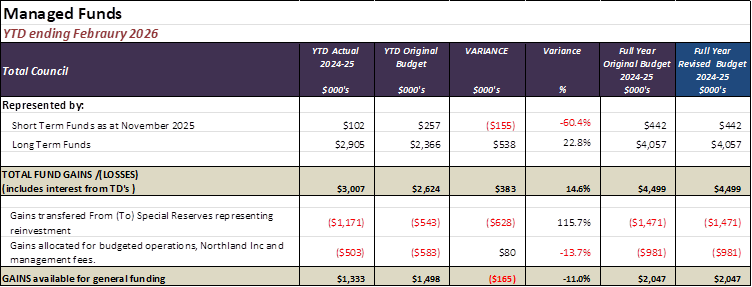
Table 4
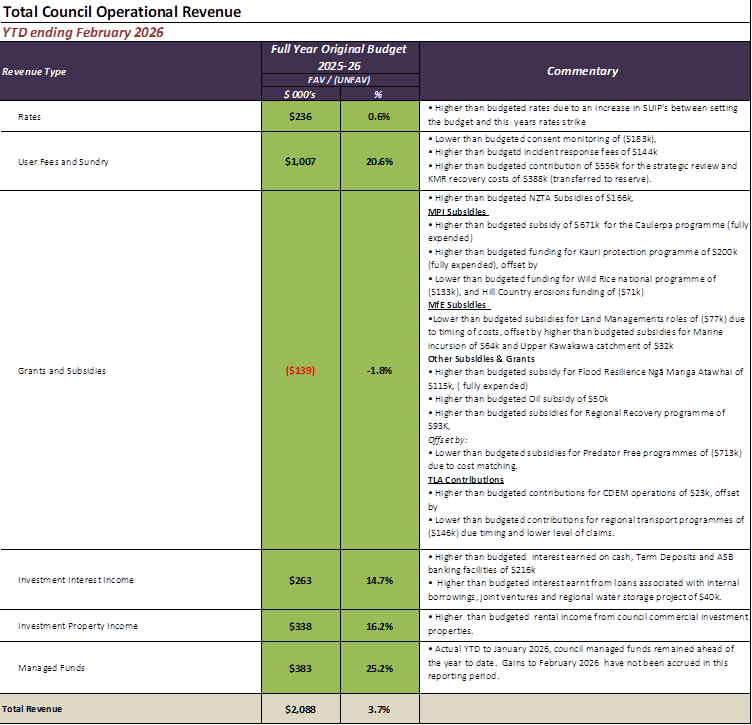
Table 5
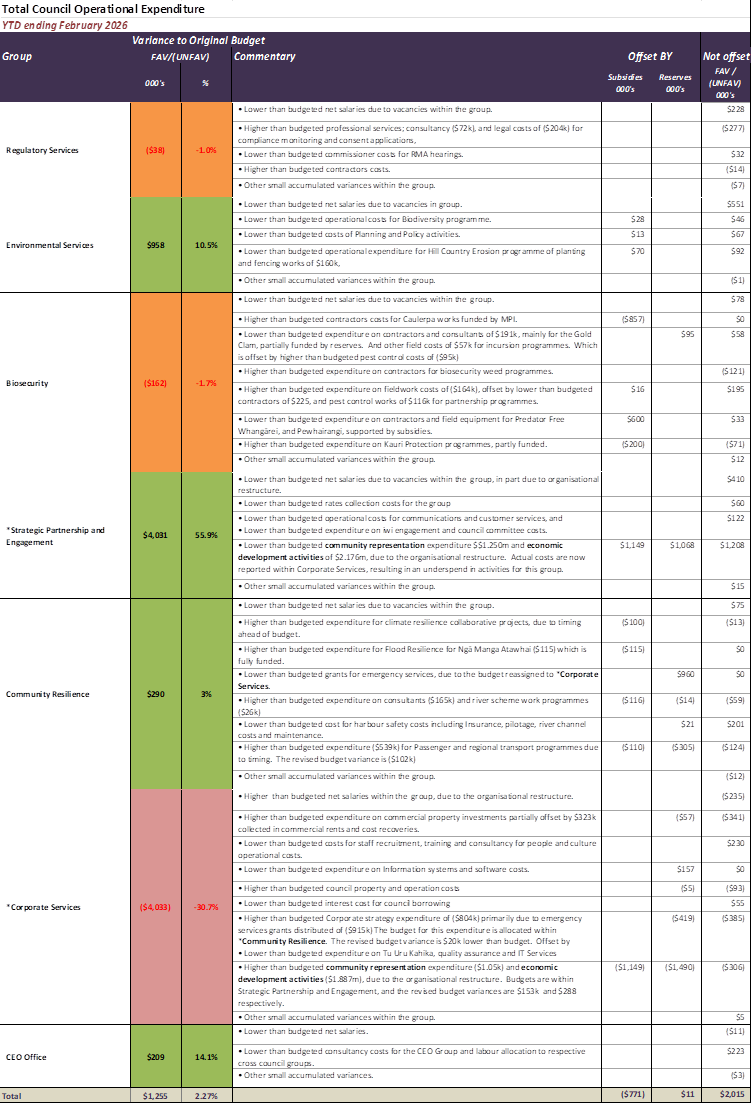
Impact of the restructure of economic development, community representation programmes and emergency services grants are.
*Corporate Services: Of the ($4.03m) unfavourable variance, ($3.79m) or (93%) is attributable to restructuring-related expenditure across group. Excluding the impact of the restructure the revised group variance would be ($284k) favourable.
*Strategic Partnership & Engagement: Of the $4.03m favourable variance, $3.43m (representing 85%) is attributable to restructuring-related expenditure across groups. Excluding the impact of the restructure the revised group variance would be $608k favourable.
Table 6
Attachments/Ngā tapirihanga
Nil
25 March 2026
|
TITLE: |
Regional Rates Collection - update to 31 December 2025 |
|
From: |
Simon Crabb, Finance Manager |
|
Authorised by Group Manager: |
Bruce Howse, Pou Taumatua – Group Manager Corporate Services, on 03 March 2026 |
Whakarāpopototanga / Executive summary
The three district councils administer the collection of the regional council rates on our behalf. The purpose of this report is to provide an update on the collection of this year’s current rates and the rate arrears owing to the regional council by each district council.
Table One below summarises the level of rates collected in the first two quarters of the 2025/26 financial year and the total outstanding rate balances as of 31 December 2025.
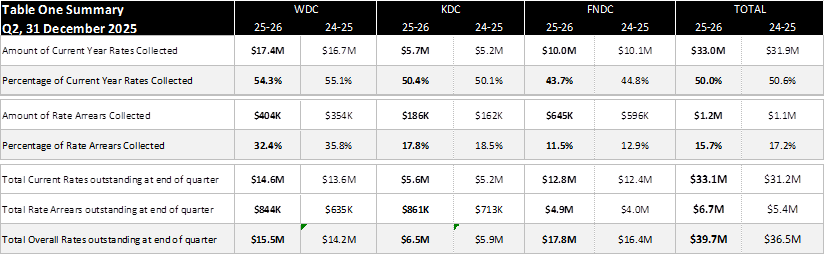
Overall, the three district councils collected a total of 50% of our annual rate strike in the six months to 31 December 2025. As a comparative, 50.6% was collected for the same period in the last financial year.
That the report ‘Regional Rates Collection - update to 31 December 2025’ by Simon Crabb, Finance Manager and dated 10 February 2026, be received.
Background/Tuhinga
Whangārei District Council (WDC)
The Whangārei District Council collected 54.3% of our annual rate strike to the end of December of this financial year (Last Year 2024/25 comparative: 55.1%).
32.4% ($404k) of the WDC outstanding rate arrears balance (2024/25: 35.8%; $354k) was also collected in the first six months of this financial year resulting in a closing rate arrears balance (excluding outstanding current year rates) still to be collected of $844k.
WDC reported:
“There were 320 dishonoured direct debit payments on 20 November. While a high number of debtors to follow up, this is down from almost 1,000 in August. By the end of November, almost a third had paid. The penalty on the 2nd instalment was added on 24 November, and letters/emails were sent to all ratepayers with arrears in the first week of December - this reduced the number of letter/emails sent out as many ratepayers had paid in the week between the penalty being added and the letter/email being sent. This approach assisted in managing the team’s workload and ability to respond to customers.
There are currently 174 files with DMC the Council’s debt collector. There were 10 files closed during the quarter with $43,500 recovered. There are also two litigated debts and one debt for which an intention to sell Abandoned land was advertised. The rating sale process has reached the final phases for another property which will be marketed soon. “
Alison Purchaux, Revenue Manager at Whangārei District Council, will attend the meeting to share her observations and insights on WDC’s rates collection and emerging trends.
Kaipara District Council (KDC)
At the end of December 2025, Kaipara District Council (KDC) collected 50.4% of our annual rate strike (2024/25: 50.1%).
17.8% ($186k) of the KDC outstanding rate arrears balance (2024/25: 18.5%; $162k) was also collected in the first six months of this financial year resulting in a closing rate arrears balance (excluding outstanding current year rates) still to be collected of $861k.
KDC reported:
“There are a number of hardship requests coming through and there is an increase in people struggling to meet the payment arrangements due to the increase in rates and the cost of living, redundancies etc. There are pockets of new owners who have bought properties and refuse to engage with us about their rates, and sovereign citizens are still about.”
Far North District Council (FNDC)
The Far North District Council has collected 43.7% of our annual rate strike to the end of December of this financial year, (2024/25: 44.8%).
11.5% ($645k) of the FNDC outstanding rate arrears balance has also been collected in the first six months of this financial year, (2024/25: 12.9%; $596k), resulting in a closing rate arrears balance (excluding outstanding current year rates) still to be collected of $4.9m.
FNDC reported:
“We have observed and continue to observe impact of prior year and current year cost-of-living increases and effects of the depressed employment conditions in the region. This is continuing to affect the collection of rates and payment percentage metrics.”
Attachments/Ngā tapirihanga
Nil
25 March 2026
|
TITLE: |
Withdrawal of the Planned 2025-26 Funding Contribution from the Managed Investment Fund Portfolio |
|
From: |
Simon Crabb, Finance Manager |
|
Authorised by Group Manager/s: |
Bruce Howse, Pou Taumatua – Group Manager Corporate Services, on 03 March 2026 |
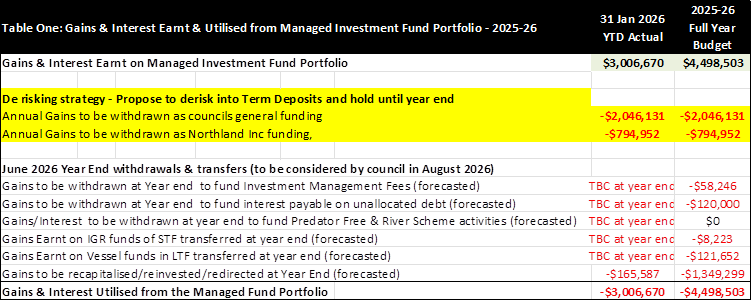
This report seeks council approval to withdraw $2.841m of gains and interest from the managed investment fund portfolio in March 2026. This withdrawal represents the planned 2025/26 annual general funding requirement and the Northland Inc funding contribution.
The proposed strategy, supported by Russell Investments, is designed to mitigate the risk that a market downturn erodes gains generated over the seven months to January 2026 and is also subject to Russell Investments confirming that sufficient gains and interest continue to exist at the end of March 2026 for the $2.841m to be withdrawn.
The withdrawn funds will be transferred into term deposits and held until year-end. At that time, council will determine the final application of these funds, taking into account council’s overall financial position.
This prudent approach is recommended by Russell Investments, particularly given the disestablishment of the short-term fund and the transition to a higher-growth asset allocation. As such, funding required in the next six to 12 months should be held in less volatile assets, such as term deposits.
1. That the report ‘Withdrawal of the Planned 2025-26 Funding Contribution from the Managed Investment Fund Portfolio’ by Simon Crabb, Finance Manager and dated 20 February 2026, be received.
2. That $2,841,083 is withdrawn in March 2026 from the investment funds recommended by Russell Investments and invested into term deposits maturing in August 2026
Options
|
No. |
Option |
Advantages |
Disadvantages |
|
1 |
Withdraw $2.841m of managed investment fund gains and interest earnt in the first seven months of the 2025-26 financial year and invest into fixed term deposits from March 2026 through to August 2026. |
Protect the gains generated over the past seven months and have the planned annual general funding requirement for council and Northland Inc secured in term deposits and available for council application at year end.
|
Earn a lower rate of return, associated with term deposits. |
|
2 |
Do not withdraw any gains from the managed investment fund portfolio in March 2026 |
Take advantage of a higher rate of return should the managed investment fund portfolio perform well in the remaining months of the 2025-26 financial year. |
Maintain an exposure to the risk of a market downturn eroding the managed investment fund gains that have already been generated over the past seven months, and the possibility that annual gains earnt on the managed investment fund portfolio are not sufficient to cover the required annual general funding contributions. |
The staff’s recommended option is 1.
Considerations
1. Alignment to council strategic direction - community outcomes
The matters covered in this report relate to the following community outcomes:
|
☐ Carbon neutral, resilient communities in a changing climate |
|
|
☐ Efficient, progressive and transparent council systems
|
|
Being a purely administrative matter, Climate and Environmental impacts and Community Views are not applicable.
2. Māori impact statement
This decision is expected to have no unique impact on Māori compared to the wider community however council acknowledges the mana of tangata whenua and remains committed to Te Tiriti o Waitangi principles.
3. Financial implications
A reduction in growth assets (equities) and income assets (bonds) at this stage of the year helps maintain the level of managed investment fund gains already earnt this financial year. The strategy proposed in this report is intended to defend against the negative impacts of any downturn occurring before 30 June 2026 by removing council’s operating funding requirement and the Northland Inc funding contribution from exposure to any volatility in the financial markets.
Holding funds in term deposits is a low risk - lower return investment option. The opportunity cost associated with a term deposit is the forgone gains that the investment could have earnt in the managed investment fund portfolio. As an indication, at the time of writing the one-year target return of the Long-term fund is 6% per annum, and a five-month term deposit with a NZ trading bank will return roughly 3.15% per annum equating to an opportunity cost of $34k over five months.
4. Implementation issues
At the time of writing there are no know implementation issues.
5. Significance and engagement
In relation to section 79 of the Local Government Act 2002, this decision is considered to be of low significance when assessed against council’s Significance and Engagement Policy because it is part of council’s day to day activities. This does not mean that this matter is not of significance to tangata whenua and/or individual communities, but that council is able to make decisions relating to this matter without undertaking further consultation or engagement.
6. Policy, risk management and legislative compliance
The activities detailed in this report are in accordance with council’s Treasury Risk Management Policy, and the 2025/26 Annual Plan – both of which were approved in accordance with council’s decision-making requirements of sections 76–82 of the Local Government Act 2002.
Background/Tuhinga
The proposed withdrawal of $2.841 million in gains from the managed investment fund portfolio will provide funding for council’s day-to-day operations and the grant contribution to Northland Inc, as outlined in the 2025/26 Annual Plan. This approach reduces reliance on rating revenue and helps ease the financial burden on the region’s ratepayers.
Historically, the annual general funding contribution has been withdrawn at the end of the financial year. However, as actual gains earned to 31 January 2026 ($3.007m) are tracking ahead of the corresponding year to date budget ($2.624m), it is proposed to bring forward the withdrawal of the full-year funding requirement into March 2026. This timing aims to mitigate the risk of a market downturn eroding the gains accumulated over the past seven months.
The gains will be withdrawn from the investment funds recommended by Russell Investments and placed into Term Deposits with maturity dates aligned to the August 2026 council meeting, at which point council can fully assess the need and final application of these funds.
Table One demonstrates the capacity to withdraw the annual funding requirement from the gains generated to January 2026.
Attachments/Ngā tapirihanga
Nil
25 March 2026
|
TITLE: |
Local Government reform programme |
|
From: |
Justin Murfitt, Strategic Policy Specialist and Stephanie Versteeg, Kaitohutohu Matua / Principal Advisor |
|
Authorised by Group Managers: |
Jonathan Gibbard, Tāhūhū Rangapū - Chief Executive Officer, on 19 March 2026 |
Executive summary/Whakarāpopototanga
In November 2025 the government released a discussion document setting out draft proposals for reform of local government with the aim of simplifying the system. The reform proposals provide for interim governance arrangements and a process for each region to develop a Regional Reorganisation Plan (RRP), which sets out bespoke local government arrangements in each region.
Following discussion at Northland Forward Together (December 2025), the Chief Executives Forum and the Mayoral Forum, as well as engagement with the Minister for Local Government, on 5 February 2026 Northland councils publicly confirmed a shared position that local government reform should be progressed through a “By Northland, For Northland” approach.
Proceeding with this approach allows us to proactively advance the future of regional governance in Northland, with the aim of delivering material benefit to services and outcomes achieved through local government.
This approach was further considered at the Mayoral Forum on 27 February 2026 where members agreed to take the proposal to establish a Local Government Reform programme to their respective councils for consideration.
This report recommends that council approve the following:
· Governance arrangements and programme structure for a Local Government Reform Programme.
· Draft Terms of Reference for the proposed Governance Steering Group and External Advisory Group to oversee a Local Government Reform Programme.
· A placeholder budget for a Local Government Reform Programme for the remainder of the 25/26 Financial Year and the 26/27 Financial Year.
· An indicative timeline that, subject to detailed planning, could allow for a new governance structure(s) to be in place ahead of the October 2028 local government elections.
1. That the report ‘Local Government reform programme ’ by Justin Murfitt, Strategic Policy Specialist and Stephanie Versteeg, Kaitohutohu Matua / Principal Advisor and dated 19 March 2026, be received.
2. That council approve the establishment of a staged programme for Local Government Reform as set out in this report.
3. That council approves the governance structure set out in this report, including the establishment of a Local Government Reform Steering Group and External Advisory Group.
4. That council endorse the Mayor of Whangārei District Council as Chair of the Local Government Reform Steering Group.
5. That council nominates the Chair and councillors Craw and Crawford as members of the Local Government Reform Steering Group.
6. That council approve the Draft Terms of Reference for the Local Government Reform Governance Steering Group (Attachment 1).
7. That council approve the Draft Terms of Reference for the Local Government Reform External Advisory Group (Attachment 2).
8. That council approve the indicative timeline set out in this report, which subject to detailed planning once the programme is established would enable a new governance structure(s) to be in place for the October 2028 local government election.
9. That council approve the allocation of $31,250, funded from salary savings, to meet the placeholder budget of $125,000 for the Local Government Reform Programme over the remainder of the 2025/26 Financial Year.
10. That council approve allocation of $250,000 to meet the placeholder budget of $1,000,000 in its 2026/27 Annual Plan, noting that this amount is indicative only and subject to further detailed planning and refinement.
11. That council agree to proceed with the proposed programme and to fund a third of the costs, as outlined in this report, rather than a quarter if only three Northland councils are participating.
12. That council agree that the programme approach needs to be reviewed if fewer than three Northland Councils agree to proceed with the programme as proposed.
Options
|
No. |
Option |
Advantages |
Disadvantages |
|
1 |
Council approve the Local Government reform programme and associated recommendations (relating to the programme structure, indicative timeline, provisional budget, terms of reference and nominates council steering group members) |
Council will have a proactive role in developing a Regional Reorganisation Plan in collaboration with other participating councils. A regional council perspective will add knowledge and expertise to the process. |
Costs and resourcing / staff and elected member time required.
|
|
2 |
Council does not approve the local government reform programme (and associated recommendations) |
No costs or demand on staff / councillor time or other council resource. |
The process will lack regional council perspective, knowledge and expertise Signals that Northland councils are not unified or aligned on reforms (contrary to previous public statements) The perception that council does not have an interest in improving local government system in Northland |
Staff recommend Option 1.
Considerations
1. Alignment to council strategic direction - community outcomes
The matters covered in this report relate to the following community outcomes:
|
1. ☐ Protected and flourishing native life |
☐ Healthy waters, land and air |
|
☐ Safe and resilient transport networks |
☐ A sustainable, innovative and equitable economy |
|
☐ Meaningful partnerships with tāngata whenua |
☐ Carbon neutral, resilient communities in a changing climate |
|
☒ Efficient, progressive and transparent council systems
|
|
2. Climate Impact
The decision to participate in and resource the local government reform programme will not have material impacts on council’s ability to respond to climate change issues. However, reorganisation of local government arrangements in Northland may improve efficiency and effectiveness of local government generally and therefore result in improved ability to respond to climate change risks.
3. Environmental Impact
The decision to participate in and resource the local government reform programme will not have material impacts on council’s ability to respond to environmental issues in the region. However, reorganisation of local government arrangements in Northland may improve efficiency and effectiveness of local government generally and therefore result in improved ability to respond to environmental issues.
4. Community views
Community views on local government arrangements and the need for change vary widely, however it is likely that there is support for reform in Northland communities given common concerns / issues – these include the cost of rates, the quality and timeliness of services delivered, uncertainty over roles and functions, and the ability to have a say on key decisions.
Community views on the optimal form and functions of local government in Northland will be sought and considered in the development of the Regional Reorganisation Plan. Council participation in the local government reform programme is likely to be supported – and conversely there is likely to be some community concern if council decided not to participate given the wide interest in the effective and efficient delivery of regional council functions.
5. Māori impact statement
Māori views on local government arrangements and the need for change are likely to vary, however it is likely that there is significant support for reform by Māori given common concerns / issues – these can be similar to those held by communities generally as outlined above, but honouring Te Tiriti, appropriate provision for engagement and representation and in particular, the role for Māori in any new local government system are particularly significant.
Māori views on the optimal form and functions of local government in Northland will be sought and considered in the development of the Regional Reorganisation Plan. Council participation in the local government reform programme is therefore likely to be generally supported by Māori – and conversely there is likely to be some concern if council decided not to participate given the knowledge and expertise council has access to and the experience and relationships that council has developed with Māori.
6. Financial implications
There are financial implications of the decision for council to participate in the local government reform programme. The intention is that programme costs are shared equally across all participating councils (both in terms of funding and staff /councillor time). Estimated budget for each council include $31,250 for the remainder of this financial year (for NRC, this is proposed to be funded from salary savings) and an undertaking to allocate a further provisional budget of $250,000 in the 2026/27 financial year (subject to Annual Plan decisions, and for NRC this is proposed to be funded from refinements within general funding of the Annual Plan budget which will be subject to future council approval). These are placeholder budgets and, should councils decide to proceed, a more detailed programme budget will be prepared in the next phase of the programme.
Longer-term programme costs and resourcing are difficult to forecast at this stage. Some further programme costs to enable the programme to gain Government decision on the final form of local government arrangements will be subject to LTP decisions. Beyond that, transition and implementation costs depend on the final form of local government arrangements once approved by Government. The costs (and benefits) of shifting to different forms of local government will be estimated as options are assessed and a Regional Reorganisation Plan is developed.
7. Implementation issues
Potential implementation issues associated with the programme include navigating a bespoke process for the region alongside the government-led approach, which is still under consideration with decisions expected in coming months. There is also the complexity and capacity demands on councils due to resource management reform occurring over a similar timeframe. The timeframe for developing and having the Regional Reorganisation Plan approved by government before the 2028 local government elections is likely to be extremely challenging. These issues can be mitigated by staging the programme based on key decision points, ensuring adequate resource is available and keeping governance and senior management ‘line of sight’ of both the resource management and local government reform programmes. Maintaining strong relations with key ministers and officials, and the establishment of an External Advisory Group with relevant expertise and knowledge will also help manage risks and ensure a robust outcome.
8. Significance and engagement
In relation to section 79 of the Local Government Act 2002, the decision to participate and contribute to the local government reform programme is considered of low significance when assessed against council’s significance and engagement policy. This is because council participating in the programme does not in itself have material implications for Northland communities – further, any proposals for regional reorganisation in Northland will be subject to engagement and consultation prior to finalising recommendations to the Minister / Local Government Commission. This does not mean that this matter is not of significance to tāngata whenua and/or individual communities, but that council is able to make decisions relating to this matter without undertaking further consultation or engagement.
9. Policy, risk management and legislative compliance
There is some risk that future change in legislation or policy direction may require alteration to the programme and / or its structure or process requirements. However, there are current reorganisation provisions in the Local Government Act 2002 that are likely to be a sound basis for progressing the reform programme. Staging the programme will enable readjustment to meet any new legislative requirements / policy if needed. The programme will also benefit from independent advice by the External Advisory Group and a representative from the Department of Internal Affairs on the Local Government Reform Steering Group to ensure a quality product. A more detailed table of risks is set out in the report, and if established the programme will establish robust risk management disciplines.
Background/Tuhinga
In November 2025 the government released a discussion document setting out draft proposals for reform of local government. The primary objective (as per the Regulatory Impact Statement) is to initiate a locally led process to simplify and streamline local government structures and service delivery, in a way that supports the implementation of resource management reforms.
The draft proposal was to remove regional councillors and establish a Combined Territories Board (CTB) of Mayors. There would potentially also be a role for a Crown Commissioner on the CTB. The CTB would, among other things, need to develop a Regional Reorganisation Plan (RRP) with a recommended delivery model for council services across the region within two years of being established.
Following discussion at Northland Forward Together (December 2025), the Chief Executives Forum and the Mayoral Forum, and engagement with the Minister for Local Government, on 5 February 2026 Northland councils publicly confirmed a shared position that local government reform should be progressed through a “By Northland, For Northland” approach.
The matter was further considered at the Mayoral Forum on 27 February 2026 where the establishment of a local government reform programme, including a recommended governance and programme structure, indicative project timeline and budget was endorsed for consideration by each council.
Why this is important and what NRC wants to achieve
It is critical that NRC bring a clear perspective on why this is important and what we want to achieve from local government reform. If the programme moves forward, then this will need to be developed at a programme level across councils.
A key framing of the proposed approach is that it is ‘By Northland, For Northland’ and proactively advancing the future of regional governance in Northland.
Further to this, the opportunity to provide better outcomes for Northland is the fundamental driver. Local government reform provides an opportunity to review existing local government arrangements with the aim of delivering better outcomes for Northland. Proposed objectives, which can be refined over time, include to:
· provide material benefit to services and outcomes delivered - including greater affordability, effectiveness and operational efficiency;
· improve local representation - fair and effective representation of communities of interest across all of Northland;
· ensure roles and delivery are at the right scale for efficient and effective system performance and outcomes;
· enable effective and visible regional leadership and governance for Northland; and
· provide financially sustainable delivery of quality services into the future.
Recommended staged programme for Northland Local Government Reform
It is recommended that the programme be staged based on key decision points to ensure that checks and balances are in place before progressing to next steps. Key decisions would be referred back to each council for consideration before progressing (e.g. approval to consult on a draft RRP and recommendations to the Local Government Commission / Minister). Timeframes are indicative, and subject to detailed programme planning in Stage 3.
Proposed stages and indicative timeframes are summarised below:
· Stage 1 (completed) - Early engagement, regional alignment, and council submissions on the draft reform proposals, including confirmation of a shared position that reform should be progressed through a “By Northland, For Northland” approach [December 2025 – February 2026).
· Stage 2 (in progress) - Establishing the governance and advisory arrangements, programme structure, indicative timeline and provisional budget [February – April 2026).
· Stage 3 – Implement and resource the programme structure, detailed project planning and resourcing, including approaches to iwi, hapū and community participation [April – June 2026].
· Stage 4 - Assessment of current state and options for future delivery models, including stocktake of services, functions and structures and options analysis [June – December 2026].
· Stage 5 - Preferred option and draft Regional Reorganisation Plan and supporting evidence (including representation review and assessment against legislative requirements) [December 2026 to February 2027].
· Stage 6 – Engagement and public consultation on draft RRP and representation review [February to May 2027].
· Stage 7 – Consider feedback and finalise and submit Northland’s recommended RRP (including supporting evidence) to Minister / Local Government Commission [June to September 2027].
· Stage 8 – Local Government Commission / Ministerial decision and (subject to approval) establish transition body [October 2027 – February 2028].
· Stage 9 - Establish governance and administrative arrangements to ensure a functioning local government entity/entities capable of meeting statutory, governance, and operational requirements is in place ahead of the election [February to October 2028].
· Stage 10 - Local Body Elections in Northland [September to Saturday 14 October 2028].
· Stage 11 – Full execution of the Transition Plan and Implementation Scheme [November 2028 onwards].
Recommended Governance structure and draft terms of reference
At the meeting of 27 February 2026, the Mayoral Forum considered and endorsed for consideration by each council the programme structure outlined below, and Draft Terms of Reference for the Local Government Reform Steering Group and Local Government Reform External Advisory Group.
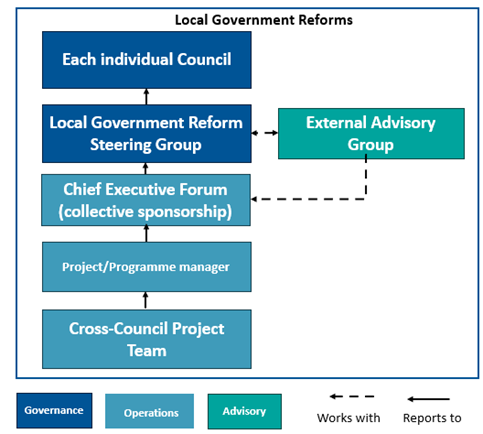
The recommended programme governance and operational structure are set out below.
Local Government Reform Steering Group
It is recommended that the programme be overseen by a Local Government Reform Steering Group made up of the Mayors and NRC Chair plus two elected members from each council, and one representative from the Department of Internal Affairs (a total of 13 members).
The core role of this group is to provide collaborative, strategic oversight and regional leadership. It is not proposed that this group has delegated decision-making powers but would make recommendations as required to participating councils on Regional Reorganisation Plans and next steps. It is proposed that the Mayor of Whangārei act as Chair of the Local Government Reform Steering Group. Draft Terms of Reference for the Local Government Reform Steering Group are set out in Attachment 1.
It is recommended that the Steering Group Terms of Reference now be approved.
At a council workshop on 11 March, it was proposed that Councillors Craw and Crawford be nominated to join the Chair and represent NRC on the Local Government Reform Steering Group.
Local Government Reform External Advisory Group
It is recommended that the programme be supported by an External Advisory Group (EAG) that would provide independent advice for the programme and support the Local Government Reform Steering Group to develop a robust proposal and evidence base for local government reorganization that meets central government and Northland’s objectives and quality standards.
It is proposed that four members be appointed through a transparent, merit-based process that ensures the right balance of independence, skills and expertise, and that the Mayor of Whangārei District Council be appointed as an observer to the group. It is not proposed that the EAG have delegated decision-making powers. Draft Terms of Reference for the External Advisory Group are set out in Attachment 2.
It is recommended that the EAG Terms of Reference now be approved.
Programme support
It is recommended that the programme be supported by a dedicated programme manager and cross-council project team, reporting to the Chief Executive’s Forum. The Chief Executive’s Forum will provide operational oversight, resourcing, and the link between governance and operations, and report to the Local Government Reform Steering Group. The programme manager would be appointed by the Chief Executive’s Forum and would provide project management and reporting functions. The cross-council project team would be made up of staff from each council (membership to be confirmed) and would implement the project plan and provide technical data and analysis. The appropriate balance between internal and external capacity to resource the programme will be determined during stage 3 (detailed programme planning).
Budget
A placeholder programme cost and resourcing has been estimated for the remainder of this financial year at a total of $125,000 ($31,250 from each council). For NRC, this contribution is proposed to be funded from salary savings. This will support set up of the EAG, and initial programme planning and analysis.
A placeholder budget of $1,000,000 has been provided for the 2026/27 Annual Plan ($250,000 from each council and for NRC this is proposed to be funded from refinements within general funding of the Annual Plan budget which will be subject to future council approval). These are placeholder budgets and should council decide to proceed a more detailed programme budget will be prepared during Stage 3.
Any further programme costs to enable the programme to gain Government decision on the final form of local government arrangements will be subject to LTP decisions. Beyond that, transition and implementation costs depend on the final form of local government arrangements once approved by Government. The costs (and benefits) of shifting to different forms of local government will be estimated as the options are assessed and the RRP is developed.
Risk management
A programme of this significance on the proposed timeframes is a significant undertaking for Northland Councils and presents a number of risks - as well as opportunities. The programme will establish robust risk management processes. An initial assessment of risks is presented below.
|
Risk Description |
Likelihood |
Impact |
Potential Mitigation/Control |
|
Central government decisions on LG reform (e.g. local government functions, and CTB establishment) could impact the programme |
High |
High |
- Regular engagement with key officials and Ministers - Initial stages of project are preparatory and advisory (no regrets) - Agile programme approach enables adaptation if necessary as national settings become clear. |
|
Delays establishing governance or work programme impact on timeline |
High |
High |
- Early testing and approval, clear milestones, regular reporting, |
|
Inconsistent council engagement or commitment |
High |
High |
- Agreed roles, responsibilities, and protocols endorsed by CE Forum, recognising capacity constraints |
|
Inadequate engagement of iwi and hapū |
High |
High |
- Stage 3 prioritises gaining agreement on approach to engagement |
|
Misalignment with new Resource Management (RM) system implementation (e.g. functions, resourcing) |
Medium |
High |
- Aligned reporting through CE Forum - Identify and manage interdependencies |
|
Process does not meet legislative requirements and is not approved |
Medium |
High |
- Align with legislative requirements - Ensure process is sufficient |
|
Rushed process does not bring community along |
High |
High |
- Early engagement plan - Thorough consultation that meets legislative requirements - Adequate resourcing of comms and engagement |
|
Capacity constraints across councils (including RM Reform and the implementation of LWDW) impact delivery |
High |
High |
- Early decision to set up project run with sufficient external capacity. - CE oversight of work programmes to manage dependencies and risks |
|
Programme delays mean that new governance is not in place ahead of the 2028 elections |
High |
High |
- Resource the project from the start - Immediate request to central government for funding support - Work closely with central government so approval process is resourced and not delayed. - Procure external and professional services as soon as possible. - Regular governance meetings and report backs to councils. - Consider case to advocate for a four-year term. |
|
Procedural / legal challenge risk increased due to pace of work |
Medium |
High |
- Early legal assurance and disciplined records management. - Ensure statutory processes are followed precisely. - Avoid substantive commitments ahead of triggers. - Embed quality assurance at each decision gate. |
Attachments/Ngā tapirihanga
Attachment 1: Draft Terms of Reference - Steering Group ⇩
Attachment 2: Draft Terms of Reference - External Advisory Group ⇩
25 March
2026
This page is a placeholder for a single page of a PDF attachment. It will be replaced by the actual PDF page when the PDF version of this document is generated.
Report: Local Government reform programme
Attachment: Draft Terms of Reference - Steering Group
Page: 1
This page is a placeholder for a single page of a PDF attachment. It will be replaced by the actual PDF page when the PDF version of this document is generated.
Report: Local Government reform programme
Attachment: Draft Terms of Reference - Steering Group
Page: 2
25 March
2026
This page is a placeholder for a single page of a PDF attachment. It will be replaced by the actual PDF page when the PDF version of this document is generated.
Report: Local Government reform programme
Attachment: Draft Terms of Reference - External Advisory Group
Page: 1
This page is a placeholder for a single page of a PDF attachment. It will be replaced by the actual PDF page when the PDF version of this document is generated.
Report: Local Government reform programme
Attachment: Draft Terms of Reference - External Advisory Group
Page: 2
This page is a placeholder for a single page of a PDF attachment. It will be replaced by the actual PDF page when the PDF version of this document is generated.
Report: Local Government reform programme
Attachment: Draft Terms of Reference - External Advisory Group
Page: 3
25 March 2026
|
TITLE: |
Approval of updated Delegation Manual |
|
From: |
Kyla Carlier, Corporate Strategy Manager |
|
Authorised by Group Manager: |
Bruce Howse, Pou Taumatua – Group Manager Corporate Services, on 04 March 2026 |
Executive summary/Whakarāpopototanga
This paper seeks council approval for a new process governing unbudgeted expenditure delegations, as recommended by resolution of council’s Audit and Risk Committee on 17 February 2025.
This change addresses a key gap identified during the Strategic Delivery Refresh programme and forms the first tranche of improvements to the NRC Delegation Manual. Additional enhancements to the Delegation Manual will follow in 2026/27 to improve clarity and efficiency across the manual, as resourcing allows.
1. That the report ‘Approval of updated Delegation Manual’ by Kyla Carlier, Corporate Strategy Manager and dated 23 December 2025, be received.
2. That council approve the inclusion of the proposed unbudgeted expenditure process, as per Attachment 1, in the NRC Delegation Manual.
Options
|
No. |
Option |
Advantages |
Disadvantages |
|
1 |
Approve inclusion of the proposed unbudgeted expenditure process in the Delegation Manual. |
The process and approval levels for spending unbudgeted expenditure will be clear, ensuring compliance with council’s Revenue and Financing Policy. Is recommended by council’s Audit and Risk Committee. |
None apparent. Minor administrative process to update the manual. |
|
2 |
Do not approve the inclusion of the proposed unbudgeted expenditure process in the Delegation Manual. |
No change required to manual. |
The process and approval levels for spending unbudgeted expenditure will remain unclear, potentially leading to confusion and the allocation of funds in a manner that is inconsistent with council’s Revenue and Financing Policy. |
The staff’s recommendation is Option 1 to approve the inclusion of the proposed unbudgeted expenditure process in the Delegation Manual.
Considerations
1. Alignment to council strategic direction - community outcomes
The matters covered in this report relate to the following community outcomes:
|
☐ Protected and flourishing native life |
☐ Healthy waters, land and air |
|
☐ Safe and resilient transport networks |
☐ A sustainable, innovative and equitable economy |
|
☐ Meaningful partnerships with tāngata whenua |
☐ Carbon neutral, resilient communities in a changing climate |
|
☒ Efficient, progressive and transparent council systems
|
|
2. Climate Impact
Updating the Delegation Manual with an improved process for the allocation of unbudgeted expenditure will enable smoother transition of funds to priority work programmes, and is not anticipated to have any impact on climate.
3. Environmental Impact
Updating the Delegation Manual with an improved process for the allocation of unbudgeted expenditure will enable smoother transition of funds to priority work programmes, and is not anticipated to have any environmental impact.
4. Community views
The Delegation Manual is an internal document, and community views are not considered a necessary part of considering its update.
5. Māori impact statement
The proposed updates to the Delegation Manual are largely administrative and are not considered to have any impact on Māori, over and above the impact on the wider community.
6. Financial implications
The proposed updates to the Delegations Manual will ensure a clearer and more transparent allocation of unbudgeted expenditure across council activities, and will ensure that rated funds are applied in accordance with the rating purpose statements set out in council’s Long Term Plan and council’s Revenue and Financing policy.
7. Implementation issues
No implementation issues are anticipated.
8. Significance and engagement
The decision to approve an update to the Delegations Manual to reflect an improved process for the allocation of unbudgeted expenditure does not trigger any further considerations under council’s Significance and Engagement Policy.
9. Policy, risk management and legislative compliance
Making the proposed updates to the Delegations Manual will have positive impacts in terms of policy, risk management and legislative compliance, with a more relevant and up-to-date Delegations Manual in place, and lower risk of non-compliance with council’s Revenue and Financing policy.
Background/Tuhinga
Council’s Delegations Manual records all current delegations made by council or the Chief Executive. The manual is a living document that is reviewed periodically, when legislative changes require amendments, or when updates are needed to reflect staffing and organisational structure.
The Chief Executive may authorise changes and updates to any Chief Executive delegations or matters that have been sub-delegated, except those prohibited by statute. This includes regularly reviewing and updating staff purchasing and credit card limits and administrative matters such as job title changes, staff changes, typographical corrections, and legislative amendments that do not affect the nature or scope of the power already delegated.
As part of the Project Delegation workstream of the Strategic Delivery Refresh programme, a review of the manual has been carried out and improvements identified. This includes structuring the manual for clarity, resolving bottlenecks in BAU council work created by the level of delegation, and ensuring a clear process is documented for the update of the manual.
The proposed improvements are intended to be delivered in two tranches, with an improved process for the application of unbudgeted expenditure being the first improvement of this tranche.
The current Delegation Manual does not provide clear guidance on managing unbudgeted expenditure, creating uncertainty and risk in decision-making.
The proposed change introduces a new section on budget re-alignment for inclusion in the Delegation Manual (see Attachment 1). This section establishes a more clearly defined process for these transactions with clear approval and reporting lines, and reviewed thresholds. It also provides further guidance and context on where decisions may be inconsistent with annual or long-term plans and therefore require greater consideration.
The section separates out circumstances where budget re-alignment is very clear cut and provides an explanation of the process as a whole and how it relates to the Revenue and Financing Policy.
The proposed addition was presented to council’s Audit and Risk Committee on 17 February, with the recommendation that the Audit and Risk Committee support its inclusion in the manual. The committee discussed the inclusion and supported the amendment as presented, by way of formal resolution.
If council approves the inclusion of this process, it will be incorporated into the Delegation Manual as of the date of this meeting. Other improvements identified under the Strategic Delivery Refresh programme will follow in 2026/27, focusing on broader delegation clarity and efficiency.
The proposed new process, and the current process to be replaced, are set out in the attached document.
Attachments/Ngā tapirihanga
Attachment 1:
Unbudgeted expenditure - updated process ⇩
25 March
2026
This page is a placeholder for a single page of a PDF attachment. It will be replaced by the actual PDF page when the PDF version of this document is generated.
Report: Approval of updated Delegation Manual
Attachment: Unbudgeted expenditure - updated process
Page: 1
This page is a placeholder for a single page of a PDF attachment. It will be replaced by the actual PDF page when the PDF version of this document is generated.
Report: Approval of updated Delegation Manual
Attachment: Unbudgeted expenditure - updated process
Page: 2
This page is a placeholder for a single page of a PDF attachment. It will be replaced by the actual PDF page when the PDF version of this document is generated.
Report: Approval of updated Delegation Manual
Attachment: Unbudgeted expenditure - updated process
Page: 3
This page is a placeholder for a single page of a PDF attachment. It will be replaced by the actual PDF page when the PDF version of this document is generated.
Report: Approval of updated Delegation Manual
Attachment: Unbudgeted expenditure - updated process
Page: 4
25 March 2026
|
TITLE: |
Adoption of the Statement of Proposal and Draft Dangerous Dams Policy 2026 for consultation |
|
From: |
Tami Woods, Policy and Planning Manager |
|
Authorised by Group Manager: |
Colin Dall, Pou Whakaritenga - Group Manager Regulatory Services, on 09 March 2026 |
Whakarāpopototanga | Executive Summary
The purpose of this agenda item is to:
· Present the Statement of Proposal and Draft Dangerous Dams Policy 2026 for adoption; and
· Seek approval to commence public consultation on the Draft Dangerous Dams Policy 2026 using the Special Consultative Procedure set out in section 83 of the Local Government Act 2002 (LGA).
1. That the report ‘Adoption of the Statement of Proposal and Draft Dangerous Dams Policy 2026 for consultation’ by Tami Woods, Policy and Planning Manager and dated 25 February 2026, be received.
2. That council adopts the Statement of Proposal and the Draft Policy on Dangerous Dams, Earthquake-Prone Dams and Flood-Prone Dams 2026 (Dangerous Dams Policy 2026) for the purpose of consultation pursuant to section 162 of the Building Act 2004 and in accordance with Section 83 of the Local Government Act 2002.
3. That council approves public consultation, using the Special Consultative Procedure set out in section 83 of the Local Government Act 2002, between 1 April and 8 May 2026.
4. That council delegates to the Group Manager –Regulatory Services the authority to make any necessary minor formatting typographical and administrative changes to the Statement of Proposal and Draft Policy prior to formal public consultation.
Options
|
No. |
Option |
Advantages |
Disadvantages |
|
1 |
Adopt the Draft Dangerous Dams Policy 2026 and associated Statement of Proposal for consultation. |
Aligns council’s Policy with legislation. Meets the requirement to review the Dangerous Dams Policy. Northland Dam owners will have clarity on the changes in their role and NRC functions. |
Resources will be required for the review, although these are not significant. |
|
2 |
Do not adopt the Draft Dangerous Dams Policy 2026 and associated Statement of Proposal for consultation. |
Avoids the requirement for immediate resources to review the Policy. |
The Policy is not aligned with current legislation. |
The staff’s recommended option is 1.
Considerations
1. Alignment to council strategic direction - community outcomes
The matters covered in this report relate to the following community outcomes:
☐ Protected and flourishing native life
☐ Safe and resilient transport networks
☐ Meaningful partnerships with tāngata whenua
☒ Efficient, progressive and transparent council systems
☐ Healthy waters, land and air
☐ A sustainable, innovative. and equitable economy
☐ Carbon neutral, resilient communities in a changing climate
2. Climate Impact
Reviewing and updating the Dangerous Dams Policy does not have implications for responding to climate change in the region.
3. Environmental Impact
Reviewing and updating the Dangerous Dams Policy contributes to continued positive environmental outcomes for Northland’s waterways and land by ensuring effective management and preparedness for potentially dangerous dams.
4. Community views
The Dangerous Dams Policy review aligns with and gives effect to central government legislation that was consulted on in July - August 2019. The Special Consultative Procedure allows the community to express views during the consultation period between 1 April and 8 May.
5. Māori impact statement
There are no known impacts specific to Māori that differ from those experienced by general dam owners.
6. Financial implications
Preparation of the policy and consultation costs are to be funded from existing budgets. No additional funding is required.
7. Implementation issues
The policy can be implemented without requiring additional staff resources.
8. Significance and engagement
Under section 79 of the Local Government Act 2002, this decision is of low significance when assessed against the council’s Significance and Engagement Policy. The review aligns with central government requirements, and consultation is a statutory requirement.
9. Policy, risk management and legislative compliance
The review of the Dangerous Dams Policy is consistent with legislative requirements. The review process and the policy are compliant with council’s Risk Management Policy.
Tuhinga | Background
A regional policy on dangerous dams, earthquake-prone dams, and flood-prone dams enables NRC to protect people, property and the environment from the impacts of dam failure.
Section 161 of the Building Act 2004 (Act) requires a regional authority to have a policy on dangerous, earthquake-prone and flood-prone dams.
The Dangerous Dams Policy:
Ÿ Provides a framework for regional councils to manage dangerous, earthquake-prone and flood-prone dams under Sections 161 and 162 of the Building Act 2004;
Ÿ Sets priorities for risk management, consultation with dam owners and enforcement options; and
Ÿ Ensures national consistency and alignment with the Building (Dam Safety) Regulations 2022 (the Regulations).
The current 2011 NRC Dangerous Dams Policy needs to be updated so that it aligns with the new dam safety requirements created by central government (MBIE). Those new requirements include the Building Dam Safety Regulations 2022 and 2024 (the Regulations).
The 2011 Policy is also due a prescribed five-yearly review under the Building Act 2004.
Changes to the Dangerous Dams Policy:
The proposed Dangerous Dams Policy 2026 (Attachment 2) puts primary responsibility on the owner to assess, mitigate and report the risk associated with the dam through a recognised engineer in line with changes in the Building Act 2004 and Dams Safety Regulations 2022 since 2011.
The key additions are:
Ÿ The introduction of “classifiable dams” and definition for classifying dangerous dams; and
Ÿ The introduction of Potential Impact Classification, the Dam Safety Assurance Programme and relevant procedures as new tools for managing dangerous dams.
Ÿ For dam risk assessment, the old NRC 2011 Policy has a risk indicator tool. This has been removed as the risk factors are now prescribed in Schedule 2 of the Regulations and must be assessed by a recognised engineer employed by the owner.
Consultation and Adoption Process on proposed Dangerous Dams Policy 2026
Consultation will be undertaken in line with the Local Government Act Section 83 special consultative process.
Feedback will be invited via an online form, email, hardcopy, and verbally by arrangement. It is not proposed that hearings be held as part of this process, but there is an opportunity for members of the community to talk to councillors should they wish, by appointment.
Council deliberations are proposed to occur as part of the 23 June 2026 council meeting.
It is proposed that final adoption of the Dangerous Dam Policy 2026 also takes place at the council meeting on 23 June 2026.
Attachments/Ngā tapirihanga
Attachment 1: Statement of Proposal ⇩
Attachment 2: Draft Dangerous Dams Policy ⇩
25 March
2026
This page is a placeholder for a single page of a PDF attachment. It will be replaced by the actual PDF page when the PDF version of this document is generated.
Report: Adoption of the Statement of Proposal and Draft Dangerous Dams Policy 2026 for consultation
Attachment: Statement of Proposal
Page: 1
This page is a placeholder for a single page of a PDF attachment. It will be replaced by the actual PDF page when the PDF version of this document is generated.
Report: Adoption of the Statement of Proposal and Draft Dangerous Dams Policy 2026 for consultation
Attachment: Statement of Proposal
Page: 2
This page is a placeholder for a single page of a PDF attachment. It will be replaced by the actual PDF page when the PDF version of this document is generated.
Report: Adoption of the Statement of Proposal and Draft Dangerous Dams Policy 2026 for consultation
Attachment: Statement of Proposal
Page: 3
This page is a placeholder for a single page of a PDF attachment. It will be replaced by the actual PDF page when the PDF version of this document is generated.
Report: Adoption of the Statement of Proposal and Draft Dangerous Dams Policy 2026 for consultation
Attachment: Statement of Proposal
Page: 4
This page is a placeholder for a single page of a PDF attachment. It will be replaced by the actual PDF page when the PDF version of this document is generated.
Report: Adoption of the Statement of Proposal and Draft Dangerous Dams Policy 2026 for consultation
Attachment: Statement of Proposal
Page: 5
25 March
2026
This page is a placeholder for a single page of a PDF attachment. It will be replaced by the actual PDF page when the PDF version of this document is generated.
Report: Adoption of the Statement of Proposal and Draft Dangerous Dams Policy 2026 for consultation
Attachment: Draft Dangerous Dams Policy
Page: 1
This page is a placeholder for a single page of a PDF attachment. It will be replaced by the actual PDF page when the PDF version of this document is generated.
Report: Adoption of the Statement of Proposal and Draft Dangerous Dams Policy 2026 for consultation
Attachment: Draft Dangerous Dams Policy
Page: 2
This page is a placeholder for a single page of a PDF attachment. It will be replaced by the actual PDF page when the PDF version of this document is generated.
Report: Adoption of the Statement of Proposal and Draft Dangerous Dams Policy 2026 for consultation
Attachment: Draft Dangerous Dams Policy
Page: 3
This page is a placeholder for a single page of a PDF attachment. It will be replaced by the actual PDF page when the PDF version of this document is generated.
Report: Adoption of the Statement of Proposal and Draft Dangerous Dams Policy 2026 for consultation
Attachment: Draft Dangerous Dams Policy
Page: 4
This page is a placeholder for a single page of a PDF attachment. It will be replaced by the actual PDF page when the PDF version of this document is generated.
Report: Adoption of the Statement of Proposal and Draft Dangerous Dams Policy 2026 for consultation
Attachment: Draft Dangerous Dams Policy
Page: 5
This page is a placeholder for a single page of a PDF attachment. It will be replaced by the actual PDF page when the PDF version of this document is generated.
Report: Adoption of the Statement of Proposal and Draft Dangerous Dams Policy 2026 for consultation
Attachment: Draft Dangerous Dams Policy
Page: 6
25 March 2026
|
TITLE: |
Regional Software Holdings Limited Statement Of Intent |
|
From: |
Bruce Howse, Pou Taumatua – Group Manager Corporate Services |
|
Authorised by Group Manager: |
Bruce Howse, Pou Taumatua – Group Manager Corporate Services, on 27 February 2026 |
Executive summary/Whakarāpopototanga
The Draft Regional Software Holdings Limited (RSHL) Statement of Intent (SOI) 2026-2027 is included as Attachment 1 for council endorsement.
1. That the report ‘Regional Software Holdings Limited Statement Of Intent’ by Bruce Howse, Pou Taumatua – Group Manager Corporate Services and dated 27 February 2026, be received.
2. That council endorse the Draft RSHL SOI 2026-2027 (Attachment 1).
Options
|
No. |
Option |
Advantages |
Disadvantages |
|
1 |
Council endorse the RSHL Statement of Intent. |
Compliant with legislative requirements. The RSHL SOI is endorsed by council. Council’s investment is managed appropriately. |
No material disadvantage. |
|
2 |
Council does not endorse the RSHL Statement of Intent. |
No material advantage. |
Not compliant with legislative requirements. Council’s shareholding may not be managed appropriately if the RSHL SOI is not endorsed by council and adopted by RSHL. |
The staff’s recommended option is option 1.
Considerations
Given this is an administrative matter, Climate Impacts, Environmental Impacts, Community Views, Māori Impact Statement, Financial implications and Implementation issues are not applicable.
1. Significance and engagement
The decision to endorse the Draft RSHL SOI 2026-2027 does not trigger any further considerations under council’s Significance and Engagement Policy as this is part of council’s day to day activities.
2. Policy, risk management and legislative compliance
This decision is consistent with legislative requirements.
Background/Tuhinga
RSHL is a Council Controlled Organisation (CCO) that provides shared service support and collaboration to deliver programmes of work to the regional sector. NRC is a shareholder of RSHL.
In accordance with section 64 of the Local Government Act 2002, every CCO must prepare and adopt a SOI. The CCO board must consider any comments on the draft statement of intent that are made by the shareholders on or before 1 May in the year preceding the year to which the draft statement relates.
The Draft SOI is included as Attachment 1.
A cover letter from RSHL is included as Attachment 2 and summarises the key elements of the Draft SOI, including:
· Revised purpose and objectives:
o Our Purpose
§ To provide high-quality shared services for local government (and associated agencies) at a national scale to deliver value to shareholders customers and their communities.
o Primary objectives
§ Ensure the local government sector is better prepared to respond to current and future challenges.
§ Achieve a better return on investment with a focus on quality of outcome and realising the value proposition for the sector.
§ Achieve consistent good practise process across the sector and within councils.
o Supporting objectives
§ Increase credibility of the sector as a trusted deliverer with a unified and consistent sector profile.
§ Improve key staff attraction and retention.
· Board composition, noting the recommendation to appoint an additional Independent Director and that an Independent Chair has been appointed (previously signalled in the 2025/26 SOI).
· Summary of the five activities of the budget contained in the Draft SOI, these being:
o IRIS Next Generation.
o IRIS Classic.
o Shared Services
o Te Uru Kahika Support Services.
o Public Transport Ticketing Programme.
o Corporate
Staff support the content and direction of the Draft SOI and recommend council endorse the Draft SOI.
Attachments/Ngā tapirihanga
Attachment 1: Cover Letter for Draft SOI ⇩
Attachment 2: RSHL DRAFT Statement of Intent 2026-27 ⇩
25 March
2026
This page is a placeholder for a single page of a PDF attachment. It will be replaced by the actual PDF page when the PDF version of this document is generated.
Report: Regional Software Holdings Limited Statement Of Intent
Attachment: Cover Letter for Draft SOI
Page: 1
This page is a placeholder for a single page of a PDF attachment. It will be replaced by the actual PDF page when the PDF version of this document is generated.
Report: Regional Software Holdings Limited Statement Of Intent
Attachment: Cover Letter for Draft SOI
Page: 2
This page is a placeholder for a single page of a PDF attachment. It will be replaced by the actual PDF page when the PDF version of this document is generated.
Report: Regional Software Holdings Limited Statement Of Intent
Attachment: Cover Letter for Draft SOI
Page: 3
This page is a placeholder for a single page of a PDF attachment. It will be replaced by the actual PDF page when the PDF version of this document is generated.
Report: Regional Software Holdings Limited Statement Of Intent
Attachment: Cover Letter for Draft SOI
Page: 4
25 March
2026
This page is a placeholder for a single page of a PDF attachment. It will be replaced by the actual PDF page when the PDF version of this document is generated.
Report: Regional Software Holdings Limited Statement Of Intent
Attachment: RSHL DRAFT Statement of Intent 2026-27
Page: 1
This page is a placeholder for a single page of a PDF attachment. It will be replaced by the actual PDF page when the PDF version of this document is generated.
Report: Regional Software Holdings Limited Statement Of Intent
Attachment: RSHL DRAFT Statement of Intent 2026-27
Page: 2
This page is a placeholder for a single page of a PDF attachment. It will be replaced by the actual PDF page when the PDF version of this document is generated.
Report: Regional Software Holdings Limited Statement Of Intent
Attachment: RSHL DRAFT Statement of Intent 2026-27
Page: 3
This page is a placeholder for a single page of a PDF attachment. It will be replaced by the actual PDF page when the PDF version of this document is generated.
Report: Regional Software Holdings Limited Statement Of Intent
Attachment: RSHL DRAFT Statement of Intent 2026-27
Page: 4
This page is a placeholder for a single page of a PDF attachment. It will be replaced by the actual PDF page when the PDF version of this document is generated.
Report: Regional Software Holdings Limited Statement Of Intent
Attachment: RSHL DRAFT Statement of Intent 2026-27
Page: 5
This page is a placeholder for a single page of a PDF attachment. It will be replaced by the actual PDF page when the PDF version of this document is generated.
Report: Regional Software Holdings Limited Statement Of Intent
Attachment: RSHL DRAFT Statement of Intent 2026-27
Page: 6
This page is a placeholder for a single page of a PDF attachment. It will be replaced by the actual PDF page when the PDF version of this document is generated.
Report: Regional Software Holdings Limited Statement Of Intent
Attachment: RSHL DRAFT Statement of Intent 2026-27
Page: 7
This page is a placeholder for a single page of a PDF attachment. It will be replaced by the actual PDF page when the PDF version of this document is generated.
Report: Regional Software Holdings Limited Statement Of Intent
Attachment: RSHL DRAFT Statement of Intent 2026-27
Page: 8
This page is a placeholder for a single page of a PDF attachment. It will be replaced by the actual PDF page when the PDF version of this document is generated.
Report: Regional Software Holdings Limited Statement Of Intent
Attachment: RSHL DRAFT Statement of Intent 2026-27
Page: 9
This page is a placeholder for a single page of a PDF attachment. It will be replaced by the actual PDF page when the PDF version of this document is generated.
Report: Regional Software Holdings Limited Statement Of Intent
Attachment: RSHL DRAFT Statement of Intent 2026-27
Page: 10
This page is a placeholder for a single page of a PDF attachment. It will be replaced by the actual PDF page when the PDF version of this document is generated.
Report: Regional Software Holdings Limited Statement Of Intent
Attachment: RSHL DRAFT Statement of Intent 2026-27
Page: 11
This page is a placeholder for a single page of a PDF attachment. It will be replaced by the actual PDF page when the PDF version of this document is generated.
Report: Regional Software Holdings Limited Statement Of Intent
Attachment: RSHL DRAFT Statement of Intent 2026-27
Page: 12
This page is a placeholder for a single page of a PDF attachment. It will be replaced by the actual PDF page when the PDF version of this document is generated.
Report: Regional Software Holdings Limited Statement Of Intent
Attachment: RSHL DRAFT Statement of Intent 2026-27
Page: 13
This page is a placeholder for a single page of a PDF attachment. It will be replaced by the actual PDF page when the PDF version of this document is generated.
Report: Regional Software Holdings Limited Statement Of Intent
Attachment: RSHL DRAFT Statement of Intent 2026-27
Page: 14
This page is a placeholder for a single page of a PDF attachment. It will be replaced by the actual PDF page when the PDF version of this document is generated.
Report: Regional Software Holdings Limited Statement Of Intent
Attachment: RSHL DRAFT Statement of Intent 2026-27
Page: 15
This page is a placeholder for a single page of a PDF attachment. It will be replaced by the actual PDF page when the PDF version of this document is generated.
Report: Regional Software Holdings Limited Statement Of Intent
Attachment: RSHL DRAFT Statement of Intent 2026-27
Page: 16
This page is a placeholder for a single page of a PDF attachment. It will be replaced by the actual PDF page when the PDF version of this document is generated.
Report: Regional Software Holdings Limited Statement Of Intent
Attachment: RSHL DRAFT Statement of Intent 2026-27
Page: 17
This page is a placeholder for a single page of a PDF attachment. It will be replaced by the actual PDF page when the PDF version of this document is generated.
Report: Regional Software Holdings Limited Statement Of Intent
Attachment: RSHL DRAFT Statement of Intent 2026-27
Page: 18
This page is a placeholder for a single page of a PDF attachment. It will be replaced by the actual PDF page when the PDF version of this document is generated.
Report: Regional Software Holdings Limited Statement Of Intent
Attachment: RSHL DRAFT Statement of Intent 2026-27
Page: 19
This page is a placeholder for a single page of a PDF attachment. It will be replaced by the actual PDF page when the PDF version of this document is generated.
Report: Regional Software Holdings Limited Statement Of Intent
Attachment: RSHL DRAFT Statement of Intent 2026-27
Page: 20
This page is a placeholder for a single page of a PDF attachment. It will be replaced by the actual PDF page when the PDF version of this document is generated.
Report: Regional Software Holdings Limited Statement Of Intent
Attachment: RSHL DRAFT Statement of Intent 2026-27
Page: 21
This page is a placeholder for a single page of a PDF attachment. It will be replaced by the actual PDF page when the PDF version of this document is generated.
Report: Regional Software Holdings Limited Statement Of Intent
Attachment: RSHL DRAFT Statement of Intent 2026-27
Page: 22
This page is a placeholder for a single page of a PDF attachment. It will be replaced by the actual PDF page when the PDF version of this document is generated.
Report: Regional Software Holdings Limited Statement Of Intent
Attachment: RSHL DRAFT Statement of Intent 2026-27
Page: 23
This page is a placeholder for a single page of a PDF attachment. It will be replaced by the actual PDF page when the PDF version of this document is generated.
Report: Regional Software Holdings Limited Statement Of Intent
Attachment: RSHL DRAFT Statement of Intent 2026-27
Page: 24
This page is a placeholder for a single page of a PDF attachment. It will be replaced by the actual PDF page when the PDF version of this document is generated.
Report: Regional Software Holdings Limited Statement Of Intent
Attachment: RSHL DRAFT Statement of Intent 2026-27
Page: 25
This page is a placeholder for a single page of a PDF attachment. It will be replaced by the actual PDF page when the PDF version of this document is generated.
Report: Regional Software Holdings Limited Statement Of Intent
Attachment: RSHL DRAFT Statement of Intent 2026-27
Page: 26
This page is a placeholder for a single page of a PDF attachment. It will be replaced by the actual PDF page when the PDF version of this document is generated.
Report: Regional Software Holdings Limited Statement Of Intent
Attachment: RSHL DRAFT Statement of Intent 2026-27
Page: 27
This page is a placeholder for a single page of a PDF attachment. It will be replaced by the actual PDF page when the PDF version of this document is generated.
Report: Regional Software Holdings Limited Statement Of Intent
Attachment: RSHL DRAFT Statement of Intent 2026-27
Page: 28
This page is a placeholder for a single page of a PDF attachment. It will be replaced by the actual PDF page when the PDF version of this document is generated.
Report: Regional Software Holdings Limited Statement Of Intent
Attachment: RSHL DRAFT Statement of Intent 2026-27
Page: 29
This page is a placeholder for a single page of a PDF attachment. It will be replaced by the actual PDF page when the PDF version of this document is generated.
Report: Regional Software Holdings Limited Statement Of Intent
Attachment: RSHL DRAFT Statement of Intent 2026-27
Page: 30
This page is a placeholder for a single page of a PDF attachment. It will be replaced by the actual PDF page when the PDF version of this document is generated.
Report: Regional Software Holdings Limited Statement Of Intent
Attachment: RSHL DRAFT Statement of Intent 2026-27
Page: 31
This page is a placeholder for a single page of a PDF attachment. It will be replaced by the actual PDF page when the PDF version of this document is generated.
Report: Regional Software Holdings Limited Statement Of Intent
Attachment: RSHL DRAFT Statement of Intent 2026-27
Page: 32
This page is a placeholder for a single page of a PDF attachment. It will be replaced by the actual PDF page when the PDF version of this document is generated.
Report: Regional Software Holdings Limited Statement Of Intent
Attachment: RSHL DRAFT Statement of Intent 2026-27
Page: 33
This page is a placeholder for a single page of a PDF attachment. It will be replaced by the actual PDF page when the PDF version of this document is generated.
Report: Regional Software Holdings Limited Statement Of Intent
Attachment: RSHL DRAFT Statement of Intent 2026-27
Page: 34
This page is a placeholder for a single page of a PDF attachment. It will be replaced by the actual PDF page when the PDF version of this document is generated.
Report: Regional Software Holdings Limited Statement Of Intent
Attachment: RSHL DRAFT Statement of Intent 2026-27
Page: 35
This page is a placeholder for a single page of a PDF attachment. It will be replaced by the actual PDF page when the PDF version of this document is generated.
Report: Regional Software Holdings Limited Statement Of Intent
Attachment: RSHL DRAFT Statement of Intent 2026-27
Page: 36
This page is a placeholder for a single page of a PDF attachment. It will be replaced by the actual PDF page when the PDF version of this document is generated.
Report: Regional Software Holdings Limited Statement Of Intent
Attachment: RSHL DRAFT Statement of Intent 2026-27
Page: 37
This page is a placeholder for a single page of a PDF attachment. It will be replaced by the actual PDF page when the PDF version of this document is generated.
Report: Regional Software Holdings Limited Statement Of Intent
Attachment: RSHL DRAFT Statement of Intent 2026-27
Page: 38
25 March 2026
|
TITLE: |
Investment Committee Terms of Reference |
|
From: |
Chris Taylor, Governance Specialist |
|
Authorised by: |
Bruce Howse, Pou Taumatua – Group Manager Corporate Services, on 10 March 2026 |
Executive summary/Whakarāpopototanga
The suite of council’s governance bodies’ Terms of Reference (TOR) were formally approved on 25 November 2025. Approval was subject to the specific requirement that the TOR be reviewed by the respective governance bodies at their first meeting and any agreed amendments be brought back to respective councils for ratification.
The Investment Committee reviewed its TOR at its inaugural meeting on 3 March 2026. The relevant extract from the committee’s minutes which details the recommended amendments is as follows:
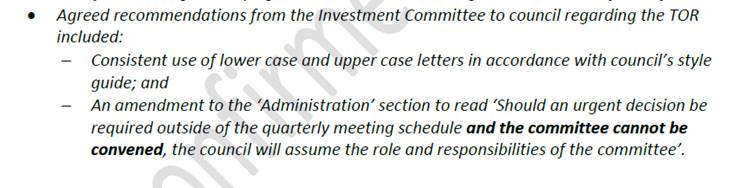
This report formally presents the recommended amendments to the Investment Committee TOR (included as ‘track changes’ in Attachment One) for council’s consideration .
1. That the report ‘Investment Committee Terms of Reference’ by Chris Taylor, Governance Specialist and dated 10 March 2026, be received.
2. That council approves the recommended amendments to the Investment Committee’s Terms of Reference (included in Attachment One).
Options:
|
No. |
Option |
Advantages |
Disadvantages |
|
1 |
Approve the amendments to the Investment Committee TOR. |
· The TOR reflect the manner in which the Investment Committee wishes to operate. · The TOR are correctly formatted in accordance with council’s style guide. |
None - apparent |
|
2 |
Do not approve the amendments to the Investment Committee TOR. |
None - apparent |
· The TOR do not reflect the manner in which the Investment Committee wishes to operate. · The TOR have inconsistent formatting that is not in accordance with council’s style guide. |
The staff’s recommended option is Option 1.
Considerations
Being a purely administrative matter, climate impact, environmental impact, community views and Māori impact statement are not applicable.
1. Alignment to council strategic direction - community outcomes
The matters covered in this report relate to the following community outcomes:
|
☐ Protected and flourishing native life |
☐ Healthy waters, land and air |
|
☐ Safe and resilient transport networks |
☐ A sustainable, innovative and equitable economy |
|
☐ Meaningful partnerships with tāngata whenua |
☐ Carbon neutral, resilient communities in a changing climate |
|
☐ Efficient, progressive and transparent council systems |
|
2. Financial implications
There are no financial implications identified.
3. Implementation issues
There are no implementation issues identified.
4. Significance and engagement
In relation to section 79 of the Local Government Act 2002, this decision is considered to be of low significance when assessed against council’s significance and engagement policy because it has previously been consulted on and provided for in council’s Long-Term Plan and/or is part of council’s day to day activities. This does not mean that this matter is not of significance to tangata whenua and/or individual communities, but that council is able to make decisions relating to this matter without undertaking further consultation or engagement.
5. Policy, risk management and legislative compliance
This report reflects cl.30 (3) & (4), Schedule 7,Local Government Act 2202 which states that a committee, subcommittee or other subordinate decision-making body is subject in all things to the control of the council and must carry out all general and special directions given to them by the council.
This direction is set in the Terms of Reference.
Background/Tuhinga
Nil
Attachments/Ngā tapirihanga
Attachment 1: Proposed amendments to the Investment Committee Terms
of Reference ⇩
25 March
2026
This page is a placeholder for a single page of a PDF attachment. It will be replaced by the actual PDF page when the PDF version of this document is generated.
Report: Investment Committee Terms of Reference
Attachment: Proposed amendments to the Investment Committee Terms of Reference
Page: 1
This page is a placeholder for a single page of a PDF attachment. It will be replaced by the actual PDF page when the PDF version of this document is generated.
Report: Investment Committee Terms of Reference
Attachment: Proposed amendments to the Investment Committee Terms of Reference
Page: 2
25 March 2026
|
TITLE: |
Chair's Report to Council |
|
From: |
Rae Hetaraka, Executive Assistant to the Chair |
|
Authorised by Group Manager/s: |
Pita Tipene, Chair of council, on 17 March 2026 |
Purpose of Report
This report is to receive information from the Chair on strategic issues, meetings/events attended, and correspondence sent for the month of February 2026.
That the report ‘Chair's Report to Council’ by Rae Hetaraka, Executive Assistant to the Chair and dated 27 February 2026, be received.
Meetings/events attended
During this period, I attended the following meetings/events/functions:
1. Mangungu – Signing of Te Tiriti o Waitangi
· I attended the commemorations of the biggest signing of Te Tiriti o Waitangi that happened on February 12th, 1840.
· There was a large crowd there for the 181st Commemorations where 65 rangatira signed (45 signed at Waitangi on February 6th)

2. Meeting with Minister Shane Jones
Geoff Crawford, Jono Gibbard and I met with Shane Jones (and his wife Dot as well as Jo Littin of Kanoa) on Friday 20th February at our Whangarei office. We were joined by Steph Versteeg and Kaeden Leonard.
We traversed these topics:
· requested support for the draft CVP proposal through Ministerial and Cabinet processes
· highlighted the many synergistic development opportunities at Marsden Point, and their significant potential to contribute to the Northland economy. As a next step, we agreed to jointly organise a face-to-face briefing on development opportunities at Marsden Point.
· Other regional economic development opportunities for Northland including:
o construction of a commercial-scale Recirculating Aquaculture System, designed to produce 3,000 tonnes of Haku (yellowtail kingfish) per annum being a key opportunity near Marsden Point.
o Further investment in the Kāihu Valley Trail is required to strengthen connectivity within Northland’s wider cycle tourism network and complete the connection between Dargaville and Donnelly’s Crossing.
o Water storage is a key element in unlocking further economic growth and improving the resilience of vulnerable community supplies.
o a proposal for Te Make reservoir has been submitted to the Regional Infrastructure Fund. This collaboration with Ngāi Takoto, TTTWT, Te Rarawa and the Far North District Council would further improve Northland’s resilience.
o The proposal to invest in upgrading Northland’s electricity network is another key opportunity to enhance Northland’s energy resilience and economic potential, by enabling increased capacity for transmission, distribution and renewable generation.

That same afternoon, I joined Shane Jones onstage at the Kerikeri Market where the local community are seeking to purchase the complex from its current owners.

3. The ‘Big Dig’ at Mangawhai
On Saturday 21st February, I travelled with Jono Gibbard to join John Hunt at the Mangawhai museum and the Kaupapa known as the ‘Big Dig.’
In 1991, following Cyclone Bola that hit our nation in 1988, the Mangawhai Harbour had been blocked with a solid wall of sand.
As a result the inner harbour became stagnant, foul and a stench.
So the community mobilised and over 40 large earth-moving machines worked to move the sand and release the water.
Some of the originals of that team told me that fish like kahawai immediately began swimming upstream through the breach created.
One of the originals of the Big Dig, Richard Bull was one who described himself as one of the rebels because they worked against official advice.
I was there at the 35th anniversary representing the ‘bureaucracy’ who had a different perspective back in 1991.
Nonetheless, here in 2026, we must all work together because the Mangawhai Harbour needs constant attention and care, so we as NRC were there to help achieve that.
As I said when I stood to speak, ‘the health of the community is a reflection of the health of the harbour!’
I acknowledged and thanked the community and the leaders of this kaupapa and especially the Mangawhai Harbour Restoration Society led by chair Peter Wethey, for their passion, leadership, unity and action.
All communities in Taitokerau identify with their local surroundings and solutions to local issues are found and led through local leadership.
A real bonus was to be given a guided tour of the Mangawhai museum where our guides highlighted the Climate Resilience Exhibition sponsored by the Northland Regional Council.
4. Kaipara Moana Remediation
I attended the Kaipara Moana Remediation Committee meeting in Wellsford on Monday 23rd February.
As you well know, the kaupapa is to protect and restore the mauri of Kaipara Moana. John Blackwell and Jack Craw are our representatives with myself as the third member.
The Kaipara is the largest natural harbour in the Southern Hemisphere.
Its catchment is huge, (600,000 hectares) going right to Motatau maunga, Ruapekapeka and right over to almost Helena Bay on the east coast whilst draining out on the West Coast.
Reducing sediment is the focus.
It was my first meeting and I really appreciate having Tame Te Rangi as the chair and others like Georgina Connelly and Tracy Davis on the committee.


5. Connecting North Symposium held at the Waitangi Treaty Grounds on Feb 24th
The stated purpose of the hui was to shape a clear and compelling story about what Taitokerau offers as a place to do business.
The forum was facilitated by Leah McKerrow, CE of North Chamber and there was a full house of attendees drawn from Northland Businesses.
I was asked to address the forum and I emphasised Te Kara, He Whakaputanga and Te Tiriti o Waitangi-kaupapa that dominated many of our Māori people’s psyche and aspirations. Moreover I spoke about ‘mahi rangatira’ and what many of our Māori people sought in kaupapa that motivated them.
While we have much opportunity as the ‘top’ region, understanding our Māori communities was key and thereby enabling them was my challenge to the forum.
Three documents were put forward as the foundation for the business story.
· Te Rerenga sets the long-term vision and values for Taitokerau Northland’s wellbeing economy.
· Northland Regional Deal Proposal translates that vision into a delivery and investment partnership with central government.
· Look North (NZIER) provides the economic evidence and national case for why investing in Northland matters for Auckland and New Zealand.
Together, they answered three critical questions:
· Why are we doing this? (Te Rerenga)
· How will we deliver it? (Regional Deal)
· Why should the rest of New Zealand care? (Look North)

6. Local Government NZ
I attended the Local Government NZ forum on Thursday 26th February at the Banquet Hall, Parliament.
I was impressed by the purposeful leadership by Rehete Stoltz as president, accompanied by her executive.
The programme included the following:
· The Deputy Prime Minister, David Seymour shared his views on the government’s work programme and on ways the government is looking to reduce red tape for councils, focusing on the Regulatory Standards Act.
· Emergency management update : Minister Mark Mitchell addressed the forum following the recent tragedy in Mount Maunganui and other severe weather events around the country in January.
· A panel consisting of Greg Severinsen, Sandra Faulkner and Vincent Holloway spoke about Regulatory takings under new Resource Management system. This panel explored various perspectives on the opportunities and pitfalls of the government’s regulatory takings proposal, which it plans to introduce as part of resource management reforms.
· Opposition’s perspective: Damien O’Connor drawing on decades of experience working with councils shared his perspective on the scale of unprecedented change facing councils today.
· The Commerce Commission’s role in local government: The Commerce Commission’s role is growing as part of the Government’s reform programme. This session explained how economic regulation already supports the water system and what the proposed oversight of development levies means for councils. We also heard about the benefits of economic regulation and how this will support local government to deliver for communities and in the long-term interest of consumers.
· Simon Upton spoke about delivering better environmental outcomes through Simplifying Local Government. The Parliamentary Commissioner for the Environment spoke about his submission on the Government’s draft proposal on Simplifying Local Government.
· Panel - Navigating rates capping : We heard from Nick Brunsdon (principal economist and lead demographer at Infometrics), Matt Prosser (Wellington City Council, CEO), and Richard Saunders (Otago Regional Council CEO) speaking about how they are navigating rates capping.
· Understanding the political operating environment : This panel explores election dynamics, ministerial performance, and where local government issues are likely to sit as the campaign takes shape. Audience Q&A is encouraged! Panel: Tracey Martin / Former Minister, New Zealand First David Farrar / Writer, Kiwiblog and Pollster, Curia Tai Ahu / Co President, Te Hunga Roia, Māori Law Society.
· Keynote speech by Paul Snelgrove: Owning the change and highlighting lessons from the Tranzit story. The Tranzit Group is the last family-owned bus company in the country and celebrated 100 years last year. Paul shared their journey, his reflections on the opportunities for councils as reforms take place and what sorts of leadership will matter most in the process.


7. Reconnecting Northland
On Monday 2nd March, I met with Eamon Nathan and Liz Oliver of Reconnecting Northland in Kawakawa.
They told me how they wanted to link their work to what Northland Regional Council were doing. They had tried several times in the recent past to link up but nothing eventuated.
8. Sea Cleaners
On Monday 2nd March, I met with Hayden Smith of SeaCleaners in Kawakawa. Hayden is seeking continued support for SeaCleaners.
9. Institute of Directors (IoD) Auckland Branch
On Thursday 5th March, I spoke to a large gathering of the Institute of Directors (IoD) Auckland Branch at the Ōrākei Marae in Auckland. I had received an invitation from Marama Royal, Chair of Ngati Whatua-Orakei to be a panellist on the Independent Directors in Iwi Governance Panel. Other panellists were Lisa Tumahai (former chair of Ngai Tahu) and Nanaia Mahuta.
It was great to meet the likes of Greg Barclay a director on the NZRFU Board and Dame Jo Brosnahan who was once CEO of the Northland Regional Council amongst a host of others.


10. Mayoral Forum
On Friday 6th March, I attended the Mayoral Forum held at the Whangarei District Council Chambers.
On the agenda was the formal signing of the Triennial Agreement.
Other key agenda items included:
· Introduction by new Regional Commissioner and Public Service Commissioner
· Waitangi Commemorations Debrief
· Dog Control Act 1996
· Draft Northland Mayoral Forum - Terms of Reference
· Northland Forward Together Draft Work Programme: 2025 - 2028 triennium
· Northland Mayoral - Northland | Forward Together - Te Taitokerau Kokiri Ngatahi
· Submissions - Local Government Simplification
· Resource Management Reforms
· Regional collaboration on NRC strategic direction and LTP workshops
· The Mayor appreciated NRC’s efforts to include DC in our strategic discussions and commented that NRC was “walking the talk” and demonstrating true leadership within the LG reform context.
Signing of the Triennial Agreement
11. Valedictory Speech – Peeni Henare

 On Wednesday 11th March, I attended the valedictory speech
by Member of Parliament, Peeni Henare who will now leave parliament. Peeni
Henare is my nephew and so I attended to give him support. While this
wasn’t a Northland Regional Council sponsored trip, any time one enters
parliament, things become political and of course I was able to talk with the
likes of Andrew Little, Mayor of Wellington, Minister Paul Goldsmith, Minister
of Justice including many others.
On Wednesday 11th March, I attended the valedictory speech
by Member of Parliament, Peeni Henare who will now leave parliament. Peeni
Henare is my nephew and so I attended to give him support. While this
wasn’t a Northland Regional Council sponsored trip, any time one enters
parliament, things become political and of course I was able to talk with the
likes of Andrew Little, Mayor of Wellington, Minister Paul Goldsmith, Minister
of Justice including many others.
12. Ngati Hine Forestry Trust – Kiwifruit Harvest karakia
On Friday 13th March, the Ngati Hine Forestry Trust held its annual Kiwifruit harvest karakia at one of its six kiwifruit orchards in Kerikeri.
The karakia, heralds the start of the annual harvest season with Northland traditionally starting the harvest earlier than other regions.
Ngati Hine Forestry Trust is pushing Zespri to have a national karakia to kick off the annual harvest season.
There was a strong turn-out from Local Government, Māori Hapu, Iwi and Māori Farm trusts, NGO leaders and local MP’s Grant McCallum and Huhana Lyndon.
Ngati Hine Forestry Trust works closely with Seeka who owns the packhouse in Kerikeri and Zespri who markets and sells our produce through a single desk.
At the same time, the Ngati Hine Forestry Trust has been nominated for the National Ahuwhenua Excellence on Horticulture awards with the award ceremony being held at McKay stadium on June 5th.
The awards have brought much more attention to Northland our primary industries given that government is the main sponsor.
Acknowledgments to Geoff Crawford who is the chair of the JREDC, offered to speak and highlight key priorities for Northland to drive action. This is the very leadership that we need to move forward with purpose.
Geoff was joined by other speakers including Suzanne Duncan (chair of Northland Inc) and Talia Rikihana of Whariki (Māori Business Network).
I really appreciated having councillors John Hunt and Arama Morunga there to tautoko Geoff in the first instance as I was, of our NRC team led by Darryl Jones and including Codie McIntyre, Sam Johnson, Matt Johnson and others who supported the kaupapa.


Correspondence
During February I sent out the following correspondence:
|
Date |
Addressed To |
Subject |
|
20260226 |
Hon Minister Shane Jones |
Follow up from meeting with Northland Regional Council |
Attachments/Ngā tapirihanga
Nil
25 March 2026
|
TITLE: |
Chief Executive’s Report to Council |
|
From: |
Jonathan Gibbard, Tāhūhū Rangapū - Chief Executive Officer |
|
Authorised by Group Manager/s: |
Jonathan Gibbard, Tāhūhū Rangapū - Chief Executive Officer, on 11 March 2026 |
That the report ‘Chief Executive’s Report to Council’ by Jonathan Gibbard, Tāhūhū Rangapū - Chief Executive Officer and dated 2 March 2026, be received.
8.2.1 Highlights
Waitangi Commemorations 2026
Council significantly increased its visibility and engagement at Waitangi this year. Our involvement focused on raising awareness of council’s Te Tiriti obligations, demonstrating unity with iwi and hapū, and providing opportunities for public engagement through our stand, partner sites and online channels. The event delivered strong digital reach (181,000+ impressions, 20,000 engagements) and approximately 350–400 direct interactions at the council stall. Feedback reflected growing recognition of council’s Te Tiriti commitments and the value of our presence alongside iwi/hapū partners.
Waitangi Commemorations content was by far the best performing of our digital content this month, including reels of Te Raki councillor and NRC Chair, followed by a wrap-up post of day 3 Waitangi Commemorations.
|
|
Council representatives participated across a wide range of Waitangi Week events, reinforcing our partnerships with iwi, hapū and our communities. The week opened with a pōwhiri at Te Tii Marae hosted by Ngāti Rāhiri and Ngāti Kawa. Councillors, ELT and kaimahi attended events including the pōwhiri for parliamentarians at the Treaty Grounds, the launch of Te Ara Mātauranga o Te Kauri, and the reopening of Haruru Falls Road, all highlighting the value of working together to support resilient communities. NRC representatives also took part in the Taiātea – Gathering of Oceans symposium facilitated by Ngāti Kuri.
|
|
|
|
NRC Chief Executive Officer and Nyze Manuel, Co-Chair of Te Ruarangi |
Taitokerau Māori Elected Members supported by kaimahi, led by Cr Morunga, as the Taitokerau representative on Te Maruata |
NIFF Programme
Mangamuka Marae flood protection works are now practically complete. The deflection bund that was over-wintered and has now been rebuilt at the upstream extent, achieving excellent compaction and final profiling to match the downstream extent. Regrassing and fencing is being installed to complete this job.
|
|
|
Bench and Iwitaua Bridge |
|
|
|
Deflection Bund at Mangamuka Marae |
Economic Development and Northland Inc
An impact report on the Investment and Growth Reserve (IGR) was completed by Northland Inc with input from all four shareholder councils. The report reviewed Project Development and Enabling Investment allocations, as well as the performance of Northland Inc activities funded through annual operational funding. Since 2013/14, a total of $8.6 million in Enabling Investment has been allocated across 13 projects which, when combined with other funding sources, represent total investment of more than $55.5 million. The full report and summary are available online. An update on council’s current and potential investments from the Regional Projects Reserve (RPR) was also prepared for the Investment Committee. In parallel, work has continued with Te Tai Tokerau Water Trust, Northland Inc, Horticulture NZ, Te Uri o Hau, and Plant & Food Research (Bioeconomy Science Institute) to explore research and co‑funding opportunities to support the commercial uptake of water from the Kaipara Water Company.
Northland Inc also worked in partnership with regional agencies and leaders in response to the January 2026 weather events, advocating for the region through national forums including the Visitor Sector Emergency Advisory Group and providing direct feedback to MSD and MBIE. Through partner networks including NorthChamber and Whāriki, feedback was gathered from regional businesses on the economic impacts of the weather event and shared with relevant forums, including the Small Business Advisory Group meeting attended by Chief Executive Paul Linton with Minister Penk on 24 February. To support recovery and ongoing visitation, the Destination Management and Marketing team brought forward its Autumn marketing campaign to reassure potential visitors that the region was open ahead of Waitangi Day, Easter, and the April school holidays. Northland Inc also engaged directly with Minister Willis during her visit to Northland, including a visit to Maungatāpere Berries, with discussions focused on horticulture opportunities for the region. In addition, the Business, Growth and Innovation (BIG) team hosted an event with MBIE on accessing the Research and Development Tax Incentive, supported the rollout of the MBIE AI Automation Pilot in Northland, and continued delivery of business capability workshops through the Regional Business Partner Network.
Climate
Early engagement on the development of Community Adaptation Planning project for the Herekino, Whangapaē and Hokianga catchments got underway in late February.
The engagement involved a haerenga to meet with local community groups and tangata whenua. The project team, made up of FNDC, NRC and consultant team (Isthmus, Tonkin & Taylor, AKAU), introduced the project goals with an early look at the natural hazard risks.
They listened to feedback from locals on a range of topics; from the role of councils in communities, previous council projects and concerns, opportunities to improve council-community working, how to realise community values, and how to understand council levels of service.
These broad discussions signalled the beginning of an adaptation conversation with communities about values, risks and opportunities for the future given our changing climate.
|
|
|
|
|
|
8.2.2 PROTECTED AND FLOURISHING NATIVE LIFE
Freshwater Pest Fish
Staff have been working alongside Patuharakeke kaimahi to eradicate a long‑established (15‑year) koi carp population from Mountfield Dam in Ruakākā. The work requires native fish to be safely relocated prior to draining the dam. To date, the team has installed exclusion screens, undertaken staged netting with daily trap checks, and carefully identified and managed all captured species—returning native fish downstream and humanely euthanising pest fish. Construction of the gravity‑fed siphon system required for the drainage phase is now underway and will be tested in the coming weeks.
|
|
|
Left: The team setting up for survey and netting placement. (Centre and Right): Patuharakeke kaimahi measuring shortfin eels and recording data for reporting (MPI) |
|
|
|
Left: Non-native gambusia captured in Mountfield Dam (right) native shortfin eels (centre) captured for downstream release (right) prior to the dam being dewatered. |
 The team also attended the Northland Field Days (26–28 March),
engaging with the public on the impacts of aquatic animal pests, supporting
species identification, and promoting practical freshwater biosecurity actions.
Crowd favourite “Snappy” the turtle returned this year, joined by a
new goldfish companion. Together they helped demonstrate the importance of
responsible pet ownership and how easy it is to ensure effective freshwater
biosecurity hygiene practices are to follow.
The team also attended the Northland Field Days (26–28 March),
engaging with the public on the impacts of aquatic animal pests, supporting
species identification, and promoting practical freshwater biosecurity actions.
Crowd favourite “Snappy” the turtle returned this year, joined by a
new goldfish companion. Together they helped demonstrate the importance of
responsible pet ownership and how easy it is to ensure effective freshwater
biosecurity hygiene practices are to follow.
|
|
Part of the NRC CCD and freshwater biosecurity display, featuring Snappy the turtle and a goldfish companion. |
Marine Protection - Rāhui Tapu
With an increased number of visitors expected over the summer period, staff undertook proactive engagement with Northland and Auckland marinas prior to Christmas. Posters and informational pamphlets were distributed for marinas to share with members and visitors planning to travel to Northland. Locally, additional posters were placed to remind the community of the no‑take rules within the Rāhui Tapu areas. New signage has also been installed at Maunganui Bay and Oke Bay in the Rākaumangamanga Rāhui Tapu to better communicate the rules to boaties on the water.
|
|
NRC's Rāhui Tapu compliance officer undertaking surveillance in the Rākaumangamanga Rāhui Tapu at dusk. |
Despite variable weather conditions impacting boating activity over December and January, Rāhui Tapu compliance surveillance continued throughout the period. A total of 35 surveillance trips were completed, during which staff approached 152 vessels to provide education on the no‑take rules and seven notices were issued in response to observed fishing activity. In early February, Council also undertook its first night-time surveillance operation and responded to two reports from the public of fishing activity in the Rākaumangamanga Rāhui Tapu. Night surveillance will occur intermittently over the coming weeks to support compliance efforts and the public can continue to report fishing activity through council’s Environmental Hotline 0800 504 639.
|
|
Kōura/red rock lobster being measured during Rāhui Tapu survey (courtesy of University of Auckland and Te Uri o Hikihiki hapū) |
Baseline ecological monitoring of key indicator species, snapper/tāmure and crayfish/kōura, was completed last year. Survey results for snapper/tāmure indicate differences in both size and abundance between protected and non‑protected areas, suggesting early signs of a protection effect. Results for crayfish/kōura are less conclusive at this stage. At Rākaumangamanga, observed densities of kōura/red rock lobster and packhorse crayfish were low, indicating a possible population decline. While densities at Mimiwhangata were higher overall, it is too early to confirm a clear protection effect. Ongoing monitoring will be required to build a better understanding of kōura population trends within these Rāhui Tapu areas.
Predator Free Whangārei
Staff have had a busy period over the last month defined by high live capture results and very changeable weather ranging from heat and high humidity to intense rain events.
The second bi-annual 5-minute bird count was completed for Kauri Mountain supporting the baseline creation of outcome monitoring for this area (results below). While not hearing or seeing riflemen this time, bell bird and many others were present again. Over time, this information will strengthen our understanding of bird species presence, relative abundance and seasonal variations with an opportunity to link these results to an expected increase in forest health following the removal of possums and the suppression of rats and stoats.
Scat-mapping by our internal certified possum detection dog (CPDD) team supported contractors on whenua māori at Pataua South. After months of intense operations and no recent detections, we aimed to assist in determining if the area was possum-free. A positive scat detection by our team prompted the installation of traps in a specific area resulting in the capture of a lone animal. PFW supplied a follow-up with a thermal drone contractor however no other cats or possums were detected.
|
|
|
Results of 5-minute Bird Count for Kauri Mountain |
Manchurian wild rice programme update
Council continues to deliver the Manchurian Wild Rice National Interest Pest Response Programme in Northland on behalf of the Ministry for Primary Industries. This funding and delivery partnership has been underway for over 20 years. As a Progressive Containment programme, the goal is to eradicate all Manchurian wild rice infestations outside of the high-density infestation zone centred around the Wairoa river (where it was first introduced into Northland in the early 1900s). Because of the extremely hardy rhizomes, it takes multiple years of repeated treatments to eliminate Manchurian wild rice, and a further 10 years of monitoring to declare a site eradicated. To date 32 sites have been declared eradicated and another 37 are at monitoring status. A further 215 sites are part of the ongoing treatment programme. Inspections and control work is usually undertaken over two control rounds; round one control work is still being undertaken and is scheduled for completion in mid-March. This round began in early spring but contractor issues meant a portion of the work had to be reallocated. Round two control work is scheduled to begin in April.
Staff have also been trialling methods to improve agrichemical treatment and investigating alternative control methods. Excavator trials undertaken in the last two years, where plants and rhizomes were physically dug up and removed, have proved very effective at small scale sites with the subsequent monitoring showing very little to no re-growth. This suggests this approach could be used to significantly reduce the time and effort required to progress a site from treatment to monitoring status. The most significant barrier to this approach is secure disposal of the hard-to-kill rhizomes; staff have been working closely with MPI and contractors to identify suitable drying and disposal processes and facilities to make larger scale site excavation possible.
Drone treatment has also been trialled and found to be relatively effective for difficult to access sites, and staff are now working through ways to reduce standing dead material following control to enable a second effective drone treatment of the re-growth. For difficult to access sites physical knock down of the standing dead material is not possible and plans for controlled burns are being scoped and developed for this.
Lake monitoring
Eight lakes were surveyed during the annual lakes ecological survey week. Highlights included improved water clarity in Lake Kanono and Mokeno, and no hornwort present in Lake Egg. Lake ecological reports will be written and uploaded to the NRC website by the end of the financial year.
|
|
|
Divers head out to complete LakeSPI (submerged plant index) on Lake Mokeno, Poutō Peninsula. |
In February coastal dune monitoring was done at three sites:
· Glinks Gully, where four dune transects have been set up and measured this year with Glinks Gully Protection Society, who will be continuing the monitoring. Two tracking tunnels were placed on each transect. Ink cards from the tunnels put out in January showed clear skink prints confirmed to be tātahi skink which have been found at the site previously by residents.
· Pātaua North where six transects are measured annually by NRC and Tahi staff to track the weed control and planting work being done at the site by Tahi. Vegetation cover on one of the transects was 97% compared to 61% in December 2022.
· Waipu Cove Refuge with Excellere College and Renew School and Enviroschools and Biodiversity staff. Each year students measure the transects and analyse the data. CoastCare staff visited both schools before hand in preparation for the field work.
|
|
|
|
Skink prints from tracking tunnels at Glinks |
5 minute bird count at Waipū Cove |
8.2.3 HEALTHY WATERS, LAND AND AIR
|
Department |
Description |
Status |
|
Consent decision appeal |
New groundwater take at Tautoro (south of Kaikohe) for irrigation of a proposed avocado orchard |
One appeal was received from Te Riingi Marae. Environment Court assisted mediation was held on 21 October 2025. A mediation agreement was signed which has several tasks for parties to complete by agreed deadlines, with an update to the Court on progress being required 28 November 2025. The Court has approved an extension until 30 March 2026 when parties are to file and serve a further reporting memorandum. |
Consents Update
During February 2026, a total of 87 Decisions were issued. These decisions comprised:
|
Ÿ Coastal Permits |
18 |
|
Ÿ Land Discharge Permits |
2 |
|
Ÿ Water Discharge Permits |
7 |
|
Ÿ Land Use Consents |
42 |
|
Ÿ Water Permits |
3 |
|
Ÿ Water Takes |
9 |
|
Ÿ Bore Consents |
6 |
Twenty-six applications were received in February 2026.
Of the 101 applications in progress at the end of February 2026:
Ÿ 26 were received more than 12 months ago;
Ÿ 27 were received between 6 and 12 months ago (most awaiting further information from the applicant);
Ÿ 48 less than 6 months.
Appointment of Hearing Commissioners
§ No commissioners were appointed in February 2026.
Consents Decisions and Progress on Notified Applications in Process, Objections and Appeals
The current level of notified application processing activities at the end of February 2026 is (by number):
|
Ÿ Applications Publicly/Limited Notified During Previous Month |
1 |
|
Ÿ Progress on Applications Previously Notified |
5 |
|
Ÿ Appeals/Objections |
1 |
Compliance Monitoring
The results of compliance monitoring for February 2026 (and year-to- date figures) are summarised in the following table and discussed below.
|
Classification |
Total |
Full compliance |
Low risk non-compliance |
Moderate non-compliance |
Significant non-compliance |
|
Air Discharge |
14 |
14 |
0 |
0 |
0 |
|
Bore Consent |
2 |
1 |
1 |
0 |
0 |
|
Coastal Discharge |
5 |
5 |
0 |
0 |
0 |
|
Coastal Permit |
19 |
17 |
2 |
0 |
0 |
|
Land Discharge |
29 |
23 |
4 |
2 |
0 |
|
Land Use Consent |
32 |
26 |
3 |
3 |
0 |
|
Water Discharge |
22 |
12 |
4 |
6 |
0 |
|
Water Permit |
2 |
2 |
0 |
0 |
0 |
|
Water Take |
69 |
53 |
15 |
1 |
0 |
|
Total |
194 |
153 |
29 |
12 |
0 |
|
Percentage |
|
78.9% |
14.9% |
6.2% |
0% |
|
Year to date |
3494 |
2642 |
386 |
395 |
71 |
|
Percentage |
|
75.6% |
11.1% |
11.3% |
2.0% |
Municipal wastewater treatment plant compliance/enforcement
|
WWTP/Consent Status |
Compliance for last 12 months |
Compliance for last 3 months |
Enforcement Action/Response |
||||||
|
Kaiwaka Expires 2049 |
|
|
Under AN (issued in August 2025) Significant and moderate non-compliance for wetland overflowing and short circuiting. Most recent results compliant. |
||||||
|
Hikurangi Expired June 2025 (replacement consent application being processed) |
|
|
Under AN TSS, BOD5 and E. coli results above RC limits for 90th percentile. Results are showing improvement following recent upgrades. |
||||||
|
Paihia Expires 2034 |
|
|
Under AN Moderate non-compliances due to ammoniacal nitrogen exceeding RC limits for 90th percentile. Some results missing and meter not working. |
||||||
|
Whatuwhiwhi Expires November 2025 (replacement consent application being processed) |
|
|
Moderate non-compliances for TSS exceeding RC limits. Self-monitoring not being undertaken in accordance with consent requirements. CH exploring options for plant upgrade alongside consent renewal. |
||||||
|
Taipā Expires 2029 |
|
|
Moderate non-compliances for FC exceeding 85th percentile and TN exceeding RC limits. Electrocoagulation trial being set up. CH committed to land-based discharge by 2027. |
||||||
|
Rāwene Expired 2023 (replacement consent being processed) |
|
|
TSS and FC exceeded 90th percentile consent limits. Total ammoniacal nitrogen exceeded median consent limit. CH working on remedial plan. |
||||||
|
Opononi & Ōmāpere Expires 2027 |
|
|
Under ANs Moderate non-compliances for BOD, ammoniacal nitrogen, E. coli, and TSS. Baffle curtains recently installed and further remediation measure planned. Further monitoring required to determine effectiveness. |
||||||
|
Hihi Expired 2022 (replacement consent being processed) |
|
|
Ammoniacal nitrogen and E. coli exceeding RC limits. Some self- monitoring results still missing. |
||||||
|
Kohukohu Expires 2026 |
|
|
Under AN Self-monitoring not being undertaken correctly. FC and ammoniacal nitrogen exceed consent limits. Discharge volumes have also exceeded RC limits occasionally. Some remedial actions have been undertaken. |
||||||
|
Russell Expired 30 April 2024 (replacement consent being processed) |
|
|
Under AN Reporting requirements outstanding and volume of leachate discharged to plant exceeded consent limits. CH investigating leachate rates and mitigation strategies. Awaiting further updates. |
||||||
|
Ahipara Expires 2033 |
|
|
Under ANs (reissued in September 2022). Median being exceeded for FC limits. |
||||||
|
Kaitāia Expired 2021 (decision on replacement consent due soon) |
|
|
Under AN (for reticulation overflows). Ongoing works on reticulation system. Some sample results missing. RC limits exceeded for percentiles of F-specific bacteriophage. Desludging of ponds in progress. |
||||||
|
Kaikohe Expired 2021 (replacement consent being processed but also listed Fast-track proposal) |
|
|
Under AN Self-monitoring data missing or not reported correctly. E. coli exceeded median limit. |
||||||
|
Ruakākā Expires 2046 |
|
|
None currently. |
||||||
|
Kawakawa Expires 2036 |
|
|
E. coli spikes on two occasions have caused exceedance in percentile limits. Cause of spikes fixed and E. coli levels have returned to normal. BOD and TSS have exceeded 90th percentile limits due to spike in November 2025. |
||||||
|
Ngunguru Expires 2035 |
|
|
None currently.
|
||||||
|
Tutukaka Expires 2054 |
|
|
None currently. |
||||||
|
Kaeo Expired 2022 (replacement consent being processed) |
|
|
Several water quality parameters exceeded consent limits (temperature and microcystis cell count). |
||||||
|
Waipū Expires 2030 |
|
|
Discharge volume exceeded consent limit on multiple occasions. CH undertaking remedial action. The purpose of the latest site inspection was to check if a specific activity authorised by the consent had been implemented. The activity had not been implemented but as the activity was not mandatory, the associated consent conditions were deemed to be “not exercised” – denoted by the grey shading. |
||||||
|
Te Kopuru Expires 2044 |
|
|
Low risk non-compliance for discharge flow meter not working. |
||||||
|
Whangārei City Expires 2045 |
|
|
Under AN for odour from plant. Additional odour controls being implemented. No issues currently at the plant. Reticulation issues relating to the Whangarei Heads line and pump stations is being managed. Investigations for long term remediation are underway. Further information is available on WDC website. |
||||||
|
Rangiputa Expires 2032 |
|
|
None currently. |
||||||
|
Dargaville Expires 2043 |
|
|
Under ANs Required report received late. |
||||||
|
Maungaturoto Expires 2032 |
|
|
Under AN; IN issued September 2024 No issues currently. |
||||||
|
Kerikeri Expires 2036 |
|
|
None currently. |
||||||
|
Mangawhai Expires 2042 |
|
|
Under ANs Enforcement relates to odour. None currently. |
||||||
|
Okakura Expires 2025 |
|
|
None currently. |
||||||
|
Portland Expires 2054 |
|
|
None currently. |
||||||
|
Glinks Gully Expires 2034 |
|
|
None currently. |
||||||
|
Waiotira Expires 2030 |
|
|
None currently. |
||||||
|
Compliance Status |
|
|
|||||||
|
Not exercised in the period |
|
|
|||||||
|
Full compliance |
|
|
|||||||
|
Low risk non-compliance |
|
|
|||||||
|
Moderate non-compliance |
|
|
|||||||
|
Significant non-compliance |
|
|
|||||||
Court Cases Update
|
Litigation |
Next Court Event/Action |
|
Enforcement Order and Prosecution Environment Court Earthworks and vegetation removal in a wetland |
NRC has approved the Remediation and Mitigation Plan which was a requirement of the Enforcement Orders (issued on 20 January 2025). Some requirements of the Enforcement Orders have not been met by the defendant. Charges for prosecution served on defendants on 25 July 2025. Outcome of the pre-trial hearing held on 1 December 2025 found the defendants are eligible for jury trial. Awaiting further direction from the court. |
|
Interim Enforcement Orders Environment Court Discharge to air from the manufacturing of Asphalt and open burning |
On 23 June 2025, the parties filed and served a joint memorandum advising that the respondents plan to dismantle and remove the asphalt plant from the site permanently and are no longer pursuing a resource consent for bitumen batching activities on the site. The respondents requested additional time to complete the dismantling process. A joint memorandum was filed on 27 February 2026. Parties agreed to leave the undertaking in place until either a RC for the plant operation is granted or the plant is dismantled. |
|
Abatement notice appeal Operation of pyrolysis plant without resource consent |
Three parties issued abatement notices in November 2025 appealed the notices. A joint memorandum was agreed to and filed in court on 30 January 2026 seeking an extension to the proceedings as the parties have been engaging in constructive resolution discussions to try to resolve the matter without the need for Court intervention. An extension was granted until 5 February which has been further extended to 12 March 2026 after the council and the three parties filed an update memo. |
|
Interim Injunction (Civil Matter) Māori Land Court Encroachment and damage of Māori land by neighbour’s earthworks |
The Māori Land Court requested the NRC to participate in the proceedings as a Third Party. There was not enough time at the initial hearing of the matter for the presiding judge to rule on the matter. However, he granted an interim injunction restricting the neighbour’s earthworks in the vicinity of the contested land boundary and gave directions regarding further evidence filing. The parties have exchanged their further evidence for the further hearing of the matter which is scheduled for 27 March 2026. |
Kaipara Moana Remediation
· Key Performance Indicators
The information shown below reflects the formal KMR Key Performance Indicators, as required under the Deed of Funding with the Crown. We will continue to report monthly on these indicators, which are common across all Jobs for Nature investments.
As at end February 2026 KMR has delivered the following results on the ground:
Nature & Resilience
· 2.92 million plants in the ground or contracted to plant
· 1,810 hectares planted or contracted, or regenerating into native forest
· 1,153 km of fencing completed or contracted – the same distance as to Hamilton and back.
· Over 153,000 hectares managed under KMR plans
Jobs & Skills
· $30.7 million invested in restoration projects
· 53 local businesses and nurseries accredited to supply KMR
· Over 447,000 hours of new work created – a year’s work for over 287 people (*end December)
· 262 people trained and mentored, many from local iwi/hapū, to advise on project design and delivery (*end December)
(*Data collated at each quarter end)
Participation
· 1,478 landowners have expressed interest in KMR
· 957 plans have been completed with landowners
· 131 more plans are in development
· 135 group-led projects led by hapū, marae, community groups, catchment groups and other collectives.
· Impact monitoring and reporting
1. Our exciting news inching into the first week of March, is that KMR’s environmental efforts have been recognised in The Aotearoa Circle’s just-launched Natural Infrastructure Plan at Parliament on March 4. KMR’s collaboration with Beca and The Aotearoa Circle began in 2025, and we are of course very excited to see the Plan now launched and honoured to be a part of it.
The plan calls for Aotearoa New Zealand to recognise wetlands, forests, dunes, waterways, and soils as core national infrastructure that strengthens the country’s long‑term resilience
Genevieve Smith, Principal Sustainability and Climate at Beca, who led the case study element of the Natural Infrastructure Plan, says the KMR programme is a clear example of how investing in natural infrastructure delivers multiple strong benefits.
2. Following on from last month, we are pleased to report that NZ Landcare Trust is holding a Northland Catchment Groups Forum/Hui 26th March, where KMR will be participants to the kōrero, and will present our model of co-governance. Alongside this Northland initiative, KMR are engaging with MPI to gain some clarity about the current landscape and future directions for farmer-led catchment groups.
· Included in Outcomes monitoring and reporting
1. In KMR’s second year of monitoring, 23 projects across 22 landowners had their planting monitored by survival and spacing. Whilst we were pleased to evidence that overall survival rates were good, this round of monitoring provided new learnings and opportunities for KMR to anticipate potential plant survival risks and provide support to landowners. New initiatives include preparing landowners to mitigate the impacts of extreme weather events and maintain morale, and to improve plant survival rates and ROI for organic or hand-release sites.
2. Northland based Field Days and Ag Days events have been a focus for KMR this month, with 22 new EOIs generated to date. Our presence at community events has been greatly appreciated by our existing landowners where they may come and talk about their projects, seek advice, and meet up with others connected with KMR. Contact with potential future business partners in an informal setting is proving to be additional gain for KMR looking forward, and very much validates the resource investment.
3. KMR has begun a series of collaborative open day events with our accredited nurseries, as one of our comms strategies to promote winter planting for 2026. Working with one Auckland and one Northland based nursery during February, we re-connected with some of our existing Landowners and groups to discuss additional projects and generated 5 new landowner EOIs. We will be continuing further nursery-hosted events over the coming month.
8.2.4 SAFE AND RESILIENT TRANSPORT NETWORKS
Maritime
20 maritime incidents were reported in February, the majority involved vessels speeding or abandoned/derelict vessels. 11 Cruise ships and 1 superyacht visited the Bay of Islands. Maintenance was carried out to aids in navigation in Whangārei, Bay of Islands, Doubtless Bay and the Far North Coast with 9 batteries replaced, 1 new install, 1 full replacement and 1 full service.
For Waitangi Day, the maritime team supported the implementation of a special reserved area which was created for the visiting Waka to manoeuvre. The area off Te Ti Bay was marked off with buoys and patrolled by the team to ensure other vessels did not anchor in this area with positive results.
A vessel sank after running aground on rocks in the vicinity of Opito Bay, the team deployed a boom to contain oil and debris until the vessel could be refloated by divers and salvaged.
|
|
|
Boom containing oil and debris from sunken vessel at Opito Bay |
|
|
|
Divers refloat sunken vessel at Opito Bay |
Transport
Transport Planning
Draft Regional Land Transport Strategy 2027/2033 (RLTP)
A presentation on the Land Transport Management Act 2003 requirements regarding the process to be followed in the compilation of the RLTP was given to the Regional Transport Committee at their February 2026 Meeting.
Further progress will be dependent on the release of the Draft Government Policy Statement on Land Transport and receipt of NZTA‘s funding information requirements and timelines to be met.
Transport Operations
Hokianga Link – Contract Termination, Interim Provision, and Tender Process
The previous operator of the Hokianga Link service provided one month’s formal notice to terminate their contract on 28 February. Following this, NRC received expressions of interest from three parties wishing to take over the service. In accordance with NZTA Waka Kotahi funding requirements, NRC will undertake a Closed Contest tender process to procure a new long‑term provider. A Request for Quotes has been published on GETS.
To ensure continuity of service during the procurement process, Kaikohe Bus Company has been contracted to operate the Hokianga Link from 1 March to 31 May 2026. The successful tenderer will deliver the Hokianga Link service under a nine‑year contract, commencing 1 June 2026.
WDC–NRC Public Transport Meeting – 10 February
A joint meeting between WDC and NRC was held on 10 February to review key public transport matters in Whangārei. Discussion covered the operation of the T2 lanes and noted continued growth in passenger numbers on the Hikurangi Link. The meeting also discussed upcoming changes to the Total Mobility Scheme from 1 July, including reduced fare caps and a shift in the subsidy rate from 75% to 65%.
SchoolLink Services – Driver Shortage
During March 2026, SchoolLink services were affected by a shortage of drivers. With limited relief drivers available, some services had to be combined at short notice to maintain coverage. This is an ongoing issue which highlights the need for council and operators to continue to work together to try and resolve.
Total Mobility Schemes
Total Mobility Scheme – National Workshop 12 February 2026
On Tuesday, 12 February 2026, staff facilitated a national workshop, convened by the Ministry of Transport, to discuss the Government’s upcoming changes to the Total Mobility Scheme. The Government has confirmed a reduction in the subsidy rate from 75% to 65% from 1 July 2026, along with lower fare caps. The workshop focused on the remaining proposed changes, including improving assessment consistency and increasing wheelchair‑accessible transport options. Public consultation on these issues is open until 22 March 2026, with users and support organisations encouraged to provide feedback through the Ministry of Transport’s discussion document. https://www.transport.govt.nz/area-of-interest/strategy-and-direction/review-of-the-total-mobility-scheme
Total Mobility Scheme Trips for February 2026
Total mobility Trips and client travel for January 2026:
· Whangarei – 1,971 clients undertaking 3,743 trips
· Far North – 474 clients undertaking 288 trips
8.2.5 A SUSTAINABLE, INNOVATIVE AND EQUITABLE ECONOMY
Climate
Electrify Te Taitokerau at Field Days
Staff attended the Northland Field Days alongside Electrify Te Taitokerau, a local advocacy group affiliated with Rewiring Aotearoa that promotes the benefits of electrifying our energy system to lower energy costs and improve resilience.
Staff developed practical resources highlighting the benefits of on-farm solar and received strong interest from farmers actively considering solar installations. Staff also shared information on household electrification as a way to reduce power bills and showcased an EV on-site, answering a wide range of questions and helping demystify electric vehicle technology.
The event provided a valuable opportunity to connect with solar installers operating in the region, as well as Fonterra, to better understand current efforts to reduce agricultural emissions.
Following the Field Days, staff are working with Northland Inc and Energy Efficiency and Conservation Authority (EECA) to develop tailored guidance for Northland farmers, supporting greater uptake of on-farm solar to lower operating costs and strengthen farm resilience.
Site Tour: Channel Infrastructure Energy Precinct
Staff toured the Channel Infrastructure Energy Precinct. It was particularly interesting hearing their perspective on the energy transition, including their plans to transition away from diesel and petrol imports as the private vehicle fleet electrifies, reducing demand, and to scale up sustainable aviation fuel storage as demand and availability increases.
Regional Economic Development
The Joint Regional Economic Development Committee (JREDC) met on Friday 6 March. This included working with other shareholder councils and Northland Inc on performance reporting and appointment of directors, and coordination of speakers including Kānoa, Lake Ōmāpere Trust and Infometrics.
The Northland Infrastructure Plan continues to be developed by Beca in consultation with a project team involving staff from all four councils. Work in February included a review by council staff of a draft that incorporated feedback from the elected members provided at the Northland Forward Together Strategic Planning Workshop, the Regional Transport Committee, and the release of the National Infrastructure Plan. An updated draft will be provided to the next meeting of JREDC on 24 April 2026.
Economic Information
A presentation on getting the most from economic indicators was made to the Northland Funding Forum organised by MSD. The presentation drew attention to the depth and breadth of information on the Northland economy that is available on the Regional Economic Profile produced by Infometrics and available online at https://regions.infometrics.co.nz/northland-region.
Financial Performance Overview
The Council remains financially stable for the current reporting period, with overall performance continuing to track largely in line with the Annual Budget after adjusting for net salary savings.
Manager reviews were undertaken using the February financial results to enable early identification of any potential cashflow or service‑delivery pressures. Managers were reminded that actual expenditure must remain aligned with their approved budgets for the remaining months of the financial year. No material financial risks were identified through these manager reviews.
The ongoing conflict in Iran presents an external financial risk due to the heightened volatility in global energy markets and disruptions to major oil supply routes which is creating volatility in the global financial markets. Should the budgeted gains required from Councils managed investment fund not eventuate because of this global uncertainty, sufficient funding is held in term deposits within the Opex Reserve to provide resilience and ensure cashflow continuity if required.
Fraud, Corruption and Dishonesty Statement
There are no new fraud investigations to report or any new incidents or suspected incidents of fraud at this time.
Local Government (Infrastructure Funding) Amendment Bill
The government has proposed changes to the Local Government (Infrastructure Funding) Act. Changes are intended to make it easier to fund and finance critical infrastructure (such as water, transport, and roads) for housing and urban development.
The current Local Government (Infrastructure Funding) Act includes a process for a separate legal entity (a Special Purpose Vehicle, or SPV) to borrow money to build the infrastructure. Properties that benefit from it pay it back over time through a levy. Infrastructure can therefore be delivered without the debt sitting on territorial authorities’ books and without relying on council rates or central government capital.
Submissions closed on the 20 February, with sector submissions both from Te Uru Kahika (TUK) and Taituarā (LG) representing regional council interests.
Both sector submissions expressed concern that the draft legislative changes were too narrow in scope, risks undermining climate resilience, and do not support equitable growth funding for regional communities.
Māngungu me Te Rā o Pōmare - Te rā whakamaumahara i te waitohunga o Te Tiriti o Waitangi
|
Council was represented at the Māngungu Tiriti commemoration, where Chair Pita Tipene spoke on the taumata, acknowledging the significance of the site and the commitments made there in 1840. Te Rā o Pōmare was also marked, recognising the wider historical context of Tiriti signings across Te Taitokerau.
|
|
Strengthening Resilience through Te Tiriti led Practice
As part of Te Ruarangi – Te Taitokerau Resilience Action Plan, kaimahi engaged with regional partners and funders during Waitangi Week on climate impacts and decision‑making grounded in Te Tiriti and He Whakaputanga. These engagements support stronger, more inclusive regional resilience planning.
|
|
|
Whanaungatanga with the Clare Foundation and wāhine across Taitokerau. |
Te Whāriki
|
Te Whāriki has commenced its 2026 work programme, with a focus on strengthening kaimahi capability in Te Reo Māori, Tikanga Māori and Te Tiriti o Waitangi. A refreshed delivery approach is being developed for rollout this year. |
|
Rae ki te Rae Whakaaro - Marae Recovery Hubs
Our team have been working hard in the community to help with the collective recovery by wrapping a korowai of care around the response approach. We call this model the Rae ki te Rae Whakaaro.
|
The model builds on two years of preparedness work where our CDEM team supported marae across Te Taitokerau to develop emergency plans and act as community hubs during the first 72 hours of an event. Its effectiveness was demonstrated during the January 2026 Whangaruru floods, when ten Ngātiwai marae activated early and provided immediate support to their communities before external agencies could reach the area. |
Ōtetao Reti Marae |
|
Following this, our Civil Defence and Te Tiriti Partnerships teams used the Rae ki te Rae Whakaaro framework to guide recovery efforts, ensuring consistent communication, timely identification of community needs, and coordinated delivery of support. This approach is helping shape how we work alongside marae in future recovery situations. |
|
A hui was held at Lake Waiparera in partnership with NgaiTakoto and Waiharara School. Discussion was held on the health of the lake and what the community would like to do to make improvements. Ideas will be followed up and actioned through the Dune Lakes Kaitiaki Partnership Programme in the coming years.
|
|
|
Tangata whenua, local landowners and Waiharara School members holding a hui at Waiparera. |
8.2.7 carbon neutral, resilient communities in a changing climate
Natural Hazards
Plan for LIDAR and subsequent landslide mapping
The intensely heavy rainfall of the 16 January triggered a number of rainfall induced landslides around Ōakura, Whangaruru Harbour and eastern coastline between Whangarei Heads and Cape Brett. In late January a landslide reconnaissance flight by GNS Science identified the area of landslides triggered by this event and noted that is some catchments there had been significant landslides, some extending well under forest canopy cover. Analysis by an Auckland Council Geotechnical Engineer identified those landslides that could present an immediate threat to life, and those sites have been visited in person by Geotechnical Engineers.
To better understand the impacts of this storm on the land, NRC is partnering with Earth Sciences New Zealand (ESNZ) to map the landslides triggered by this rainfall event. In order to gather the data to allow accurate mapping we first need to collect aerial photography and LiDAR of the impacted area. We have contracted Aerial Survey to undertake the collection of this information as soon as weather permits.
Mapping the landslides will be the first step in enabling us to model the hazard and support future landslide forecasts. It also supports the work of the Land Management Team and Whangarei District Council. The landslide maps will be included in Land Information Memorandum of properties in the mapped area.
Increasing numbers of high intensity rainfall fall events are likely to cause more landslides which may require aerial photography or LiDAR to map and understand the hazard. ESNZ continues to investigate whether landslides can be mapped effectively using AI and or satellite imagery, an option that may be timelier and more cost effective in the future. Natural Hazards, CDEM and Science teams are working together on a triggers and processes for future events so that any data required can be collected as soon as possible after an event.
|
|
|
Aerial reconnaissance photo of the landslide impacts in Ōakura, January 2026 (image credit Earth Sciences NZ) |
Whangarei Urban Flood Strategy
The consultants on the Whangarei Urban Flood Strategy have begun to identify and model possible mitigation options, looking at how they interact and the costs vs benefits. The project team will be briefing councils in April with a joint workshop starting in May.
Rivers and Natural Hazard Enquiries
In February, the team received 25 enquiries, most of which requested flood level data. The team are working on internal processes and systems to enable the public to find this information themselves freeing up staff time.
|
|
Rivers
Otiria Swale
A formal blessing for the work was held on 26th February and was well attended by the local community. Additional asbestos was discovered at the site and is programmed to be removed by mid-March. An amendment was made to the construction programme to enable this work to progress in isolation from the main excavation work, which will reduce the impact on completion deadline.
Kaeo Stage 2 Flood Infrastructure Project
Earthworks continue to progress well. Stage 1 of the deflection bank has reached design level and will undergo final trimming and topsoiling this week. Excavation of the remaining section of the new Kaeo River channel is advancing, with approximately one week of work left to complete Stage 1. This will be followed by placement of rock in the channel base and topsoiling of the batters for grass stabilisation.
Upon completion, the project will move into Phase 2: diverting the river into the new channel and infilling part of the old channel to join the new deflection bank with the existing structure. This phase is expected to commence in late April 2026.
A significant number of archaeological finds have been uncovered and are being managed appropriately by the site archaeologist in partnership with local hapū and iwi. The clay win area is being backfilled using material from the new channel and is being shaped into a constructed wetland, guided by the project ecologist.
|
|
|
Drone image of current construction site |
Awanui Scheme Upgrade
Tranche 2 – Lower Whangatane Spillway Setback, landowner negotiations, geotechnical and initial layout underway. Modelling indicates a 500 mm drop in flood level by setting back the stopbank. Funding agreement with Kanoa is being finalised. Enabling works are underway on the 1st of 3 phases. The team are removing unsuitable soil and using excess material from Tranche 1 to form a working track.
LTP Business Case
Awanui Lower Stopbank Assessment and Options:
Many of the Lower Awanui Coastal Stopbanks are of unknown height, strength and are difficult to reach. They have been overtopped in recent storm surge and king tide events.
Staff have developed a set of conceptual ideas to increase the flood protection of coastal banks by using a setback of the banks, taking advantage of higher more stable ground and shortening the total length of banks to maintain. This concept was presented to the Awanui Flood Scheme Working Group meeting on 5th March 2026. Staff have since engaged and scoped hydraulic modelling for the stopbank set-back options, engaged survey to confirm stopbank height and will undertake conditional survey to try to get a better understanding of the existing condition of these coastal banks. Staff are also work with The Nature Conservancy (TNC) regarding a joint modelling exercise for the coastal stopbank setback proposal. TNC have funds for modelling and if the modelling shows favourable environmental benefits, TNC may fund other work.
Kerikeri Flood Mitigation Options:
Staff have engaged a hydraulic modelling consultant and scoped the options including Cross-Catchment flows, targeted channel improvement and K3A detention dam. Staff have met with the 2 x landowners that the Dam footprint is located. NRC will be using the Public Works Act to enable Geotech testing.
Tauranga Bay Flood Mitigation:
Staff picked up flood levels after the 22 Jan rain event. This proved useful to understand the flood gradient and also overland flow paths. Staff have contracted the peer review of the existing preliminary design. Staff have been invited to present the concept design at the Tauranga Bay Community Association AGM at Easter.
Dargaville Flood Risk Assessment and Options:
Staff have engaged a hydraulic modelling consultant to progress this work. We have scoped to understand the existing Level Of Service (LOS) with next steps to include options to increase the LOS and Rough Order Costs (ROC). NRC and KDC staff are working jointly on this proposal.
18 Jan 2026 Flood Event
Two Hydrologist from Earth Sciences New Zealand formally NIWA, assisted Staff with surveying 90 + flood levels after the event. This is valuable data that will be used for future calibration and verification of flood modelling and for “sanity checks” of flood levels. They picked up the data over a 3 days at no cost to NRC.
Civil Defence Emergency Management
Weather Impacts and Ongoing Recovery
Northland CDEM Group office’s focus through February remained on recovery and sustained operational support following the significant January 2026 severe weather events. While no major new emergencies occurred in February, the cumulative impacts of January’s weather systems continued to generate complex recovery needs, mainly in the Whangārei District.
Emergency Coordination Centre (ECC) support remained active during the early part of the month to assist the Whangārei District Council Emergency Operations Centre (EOC), which transitioned to recovery on 3 February.
Internal operational debriefs are underway across all teams, with phased processes to accommodate staff still heavily committed to recovery operations.
The National Emergency Management Agency (NEMA) sought assurance from all CDEM Groups regarding landslide risk assessments following January’s severe weather. Northland provided a formal response confirming that immediate life-safety assessments were completed promptly, urgent risks were addressed, and ongoing hazard monitoring is in place. A short‑term coordination group is being established to link technical specialists, councils, and community representatives to improve the consistency, speed and quality of landslip information across the region.
Operational Activities
Throughout February, the Northland CDEM Group Office continued implementation of the 2025–2026 work programme. Key activity areas include:
Community engagement and planning:
Emergency Management Specialists engaged with six new marae groups and one new community group between December–February, reflecting ongoing demand for preparedness support. There are now 81 completed Community Response and Marae Preparedness Plans across Te Taitokerau, with 13 plans identified for review to incorporate updated hazard data, particularly tsunami evacuation zones.
EOC/ECC Readiness and Staff Development:
District councils continued rolling training and exercising programmes to strengthen readiness. This included EOC set‑up exercises (FNDC), function‑lead and CIMS development (WDC), and Starlink deployment practice (KDC). Five regional CIMS/function training blocks have been scheduled for 2026, although a forecast training funding shortfall of approximately $29,000 remains a key risk.
Infrastructure and Lifeline Resilience:
The Northland Lifelines Group continued progressing infrastructure resilience initiatives, including updated flood modelling, roading and bridge repairs, and utility network upgrades. Work also advanced on the regional early flood-warning system and the Whangārei Urban Flood Strategy.
Tsunami Siren Network Upgrades:
Installation and mains connection works continued through February/March, with resource consenting issues for Waitangi and Arawhiti now resolved. An audit of the new siren systems will be undertaken by Malte to confirm future maintenance and support requirements, following the acquisition of HSS by Hörmann Warning Systems GmbH.
Capability Development
Common Operating Platform (COP):
Desktop testing is underway on the platform, with a targeted ECC go‑live in March. Work continues on integrating data feeds, with
development of external functionality for partner agencies planned for
subsequent phases.
8.2.8 efficient, progressive and transparent council systems
People & Culture
People and Culture activity for the last quarter was steady, with FTE fluctuating slightly due to seasonal intern placements and turnover rising to 12.5%. Recruitment remained busy with multiple parental leave roles, 15 recommendation memos, and 12 new requisitions, alongside two promotions, one secondment, two transfers, and seven departures. Training delivered DEIB, unconscious bias, resilience, stress management, management pathway modules, and Mental Health 101, with Conflict of Interest courses also underway. Strategic work progressed across the refreshed Performance Criteria Framework, organisational values review, Flexi Plus trial, Modern Workspaces updates, and ELMO implementation.
Health and safety performance is consistent, with incident reporting providing visibility of organisational trends and supporting a maturing safety culture. Additional emphasis is being placed on ‘Work as Done’ audits to ensure that assumptions match reality of how work is done on-site.
Health and Safety at Work Amendment Bill - The Government’s proposed reforms to Health and Safety aim to refocus the system on preventing serious harm by prioritising critical risks and reducing unnecessary compliance requirements for businesses, particularly small and low‑risk operators. While most changes, such as reduced obligations for small, low‑risk businesses and streamlined notification rules will not apply to NRC due to our size (greater than 20 employees), they may influence how we engage with contractors that fall into these categories. The reforms also clarify the distinction between governance and operational responsibilities and strengthen Approved Codes of Practice, providing increased certainty about compliance expectations.
Council Property
· The Whangarei HQ Office lift replacement project is on schedule with lift commissioning late March 2026 and lift services resuming after WDC inspection and consenting early April 2026.
· Developed and detailed design has begun for the Multi-Agency Emergency Coordination Centre (MACC), this will continue for several months to a point that resource and building consents can be applied for and issued later in the calendar year.
Information Services and Technology
Operations
· The laptop and mobile phone refresh programme is progressing well and remains on track for completion by the end of April 2026. GIS system integration updates are currently under review, with completion and issue resolution targeted for the end of March 2026. Recruitment is underway for the vacant Application Support Analyst role.
· Transition to new Security Operations Centre is complete. Work to rationalise security products continues and system polices covering geo-blocking have been reviewed to manage current global threats.
Data and Information
· The initial Data Strategy has been drafted and is now being prepared for internal review. GIS is currently focused on resolving Maritime-related tickets, addressing IRIS data‑transfer issues, and progressing the integration design for the new Asset Management System. Archiving of physical records continues in support of the Modern Workspaces project.
Projects
Project Axis - Implementation of new Asset Management and Human resources systems.
· Assets - progress is positive with the decision made to pivot to the Univerus legacy platform, with maps now operational and Work Requests configuration underway. Master data for Maritime, Hydrology and Information Technology asset registers is well underway.
· Human Resource Information System (HRIS) - progress remains high with timelines on track. Current focus is on configuring the Learning and Development module ready for launch in April.
IRIS Next Generation
A collaborative initiative involving ten regional councils working with Regional Software Holdings Limited and Datacom to deliver a modern software platform to councils. The software facilitates a wide range of activities, including Customer and Community Engagement, Environmental Stewardship, and Regulatory functions, and incorporates both an online customer portal and a mobile application for field staff.
· Sector Programme- The planned Otago Regional Council design workshops for the Pilot are currently on hold until the software is fully functional and outstanding system issues are resolved. Any potential delays to the timeline are yet to be confirmed, and the programme‑wide impacts are still being assessed. NRC continues to support the ORC Pilot by contributing expertise to progress work that can continue during this pause.
· NRC Project - Work continues to focus on understanding how the current Classic IRIS system is used, enabling a comprehensive current‑state view of system business functions. This will help determine consistency, extent of use, and examples of good practice. Where opportunities arise, early transition planning is being explored to reduce effort and complexity ahead of NRC’s implementation date. The current‑state assessment will also be compared to the future‑state design to inform the scope of change required.
Corporate Strategy and governance
Staff have been progressing a number of projects and working to support mahi across the organisation:
· Council's programme and project system 'WayPoint' has been used to support the activity reviews being carried out as part of the Long Term Plan development process. Over 450 projects and programmes have been entered into the system which also supports risk and KPI reporting, allowing linkages to be created between activities, programmes, projects, reporting, service provision, and risk.
· The governance team have been facilitating a review of sector‑wide LG membership organisations and supporting the review of terms of reference for the CE and Mayoral forums, and the Triennial Agreement.
· Council’s in-house legal counsel has been in demand, providing comprehensive legal reviews of contracts and offering expert advice on complex matters, which in the past month has included flood works, transport contracts, CDEM and Caulerpa.
· Drafting of the zero-percent increase Annual Plan 2026/27 is well underway, aiming for adoption in May this year.
· Councils User Fees and Charges for 2026/27 is out for consultation, with the submission period open until 2 April.
· An extensive series of Council workshops has commenced as part of development of the Long Term Plan 2027-2037. This includes a collaborative approach to development of a new strategic direction, review of council activities and performance. Planning remains agile and able to be adapted as required as LG reform progresses. The process of development will extend throughout this year with key strategies, policies, performance framework, and full draft financial statements and rating forecasts for ten years developed. A plan for engagement with hapū and iwi is being developed.
· A programme of review of council's internal corporate policies continues, with the Acceptable Use Policy approaching completion.
· Improvement programmes including risk framework review, contract management improvement and support, LGOIMA improvement, internal audit and quality management are continuing as resourcing allows. A review of council's process management software is being carried out by the team.
Local Government Official Information Requests
|
|
In February 2026 we received 27 LGOIMA requests, 4 less than February 2025. Across the past three full years, totals rose from 310 in 2023 to 368 in 2024 and then held steady at 368 in 2025.
|
|
|
All LGOIMA requests for February 2026 were responded to within the required timeframe. |
Community Engagement
Media and reputation
Five media releases were issued during February to local and national outlets, all receiving full pickup. Additional activity included two media briefs and substantive responses to nine media enquiries.
Media monitoring recorded 56 mentions, covering a wide range of council functions. The main drivers of attention were the teacher misconduct case involving a former staff member and ongoing commentary around local government reform and Northland councils’ joint regional vision.
Digital engagement
Engagement across NRC’s digital channels increased significantly this month. Overall impressions rose by more than 300%, with engagements up over 600% and audience growth of 3.2%. This uplift was driven primarily by Waitangi commemorations content, which received strong positive feedback and provided a platform to reinforce Tāiki ē and council’s Te Tiriti partnership approach.
Across platforms, Facebook continued to deliver the widest reach, while LinkedIn maintained the strongest engagement rate per impression.
Website traffic remained steady, with the Environmental Data Hub, Ngā Purākau stories and Madagascar ragwort information among the most visited pages.
Taumata Taiohi, the Education team’s quarterly eNewsletter, was distributed to 326 subscribers and achieved a 44% open rate.
Digital engagement snapshot
|
Metric |
Feb 2026 |
Change to last period |
|
Total audience (social) |
24,565 |
+3.2% audience growth |
|
Net audience growth (social) |
764 |
↑ 154.7% |
|
Published posts |
122 |
26 in January |
|
Impressions (social) |
570,781 |
↑ 322.6% (from 135,068) |
|
Engagements (social) |
35,959 |
↑ 614.9% (from 5,030) |
|
Engagement rate (per impression) |
6.3% |
Up from 3.6% (+73%) |
|
Video views |
117,061 |
↑ 192.4% (from 40,032) |
|
Website visits (nrc.govt.nz) |
55,783 |
−30.0% (from 79,654) |
|
Top website pages (by views) |
1. Environmental Data Hub — 4,338 2. Ngā Purākau — 2,788 3. Madagascar ragwort — 2,508 |
|
|
eNews subscribers (cumulative) |
6,250 |
Up from 4,208 |
|
Subscribed web alerts (cumulative) |
1,869 |
+31 (from 1,838) |
Education and youth engagement
The Education team delivered Stream Health Monitoring Assessment Kit (SHMAK) training to teachers at St Francis Xavier Catholic School and all science classes at Kerikeri High School, enabling them to on-teach 500 students to participate in freshwater monitoring activities and raising the awareness and knowledge of Taitokerau water quality.
|
|
|
|
Teachers from St Francis Xavier Catholic School learn how to use their SHMAK kit. |
Kerikeri High School students water quality testing. |
Seaweek activity across Whangārei Primary, Totara North, Excellere and Renew Schools focused on marine biosecurity, shoreline surveys and coastal transects.
|
|
|
|
Whangārei Primary School students identify native and pest marine species. |
The Marine Metre Squared initiative collects biodiversity, distribution and abundance data of seashore species. |
The team supported 56 Enviroschools communities, with a focus on awa restoration, pest control and native seed collection. The team have also developed an Invasive freshwater clam education programme that is being rolled out to Taitokerau schools
Community events
NRC maintained a strong, coordinated presence at the February A&P shows in Kaitaia, Broadwood and Paparoa, engaging with approximately 500 attendees on land management, biosecurity and environmental matters.
Northland Field Days:
Council had another highly successful Northland Field Days, with an estimated 1,800 people visiting the NRC site across the three days. Displays on Madagascar ragwort, wetlands and freshwater pests attracted strong interest, with over 55 enquiries recorded for follow up. Online content linked to Field Days received 42,700 impressions and an 8.5% engagement rate.
|
|
|
|
Staff from across council supported engagement at Northland Field Days |
Goat pies were this year’s wild food giveaway and a great draw card for staff to engage with the public |
Campaigns and business support
The Community Engagement team supported several major campaigns and projects this month:
· Madagascar Ragwort: A large-scale awareness campaign (digital, print, signage and event display) launched in partnership with MPI and Biosecurity New Zealand. Early indicators show strong farmer reach and conversation-starter value at Field Days.
· Moth Plant Competition: The inaugural competition launched with strong uptake - 46 registrations in the first week and significant early reporting of seedlings and pods removed. More information is available here: http://www.nrc.govt.nz/mothplantcomp
· Good to Go Hub: our annual summer campaign delivered over 1.5 million impressions, 1,860 clicks, and 2,292 website sessions exceeding expectations and directing visitors to safety and biosecurity information for Northland’s waterways, using targeted advertising to reach visitors and locals most likely to engage in water-based activities.
· Caulerpa Awareness: campaign helped familiarise communities and visitors about the affected areas and encourage people to check the rules before undertaking recreational water activities. Targeted marine-user advertising delivered 542,000+ impressions, 973 website sessions and 90% more reach than forecast.
· Freshwater Invasive Clam: an awareness campaign to highlight the risks of invasive freshwater clams and behavioural and visitor targeting across Northland and Kai Iwi Lakes reached nearly one million impressions, 1,317 clicks, and 1,643 website sessions.
· Land: Promotion for the poplar and willow erosion control season commenced and will continue through April.
· Science: Work is underway with the Coastal Science team to refresh web content and make science outputs more accessible to the community.
· Transport: Messaging was provided for Waitangi Day service closures, the Hikurangi service and SuperGold information.
Attachments/Ngā tapirihanga
Nil
25 March 2026
|
TITLE: |
Legislative compliance half yearly report July - December 2025 |
|
From: |
Mandy Tepania, Audit and Assurance Lead |
|
Authorised by Group Manager: |
Bruce Howse, Pou Taumatua – Group Manager Corporate Services, on 19 March 2026 |
Whakarāpopototanga / Executive summary
This report presents the findings of council’s legislative compliance programme for the six-month period 1 July 2025 – 31 December 2025.
That the report ‘Legislative compliance half yearly report July - December 2025’ by Mandy Tepania, Audit and Assurance Lead and dated 9 March 2026, be received.
Background/Tuhinga
The Office of the Auditor-General encourages local authorities to apply a systematic process to managing the legal risks that might arise in relation to the functions and activities that they are responsible for.
Council’s current legislative compliance framework provides assurance for compliance with legislation that is fundamental to the council’s operations and/or poses significant potential risk (core legislation).
Core legislation was determined in conjunction with council’s auditors and is reviewed every six months as part of the compliance process. Core legislation includes:
· Council's own rules, policies and bylaws
· The Local Government Act 2002
· The Local Government (Financial Reporting and Prudence) Regulations 2014
· The Non-Financial Performance Measures Rules 2013
· The local Government Borrowing Act 2011
· The Local Government (Rating) Act 2002
· The Local Government Official Information and Meetings Act 1987
· Local Government (Pecuniary Interests Register) Amendment Act 2022
· The Local Authorities (Member’s Interests) Act 1968
· The Resource Management Act 1991
· The Fast Track Approvals Act 2024
· The Health and Safety at Work Act 2015
· The Holidays Act 2003
· The Employment Relations Act 2000
· The Biosecurity Act 1993
· The Building Act 2004
· The Civil Defence and Emergency Management Act 2002
· The Land Transport Act 1998
· The Maritime Transport Act 1994
· The Fire and Emergency New Zealand Act 2017
· The Privacy Act 2020
· The Public Records Act 2005
· The Goods and Services Tax Act 1985
· The Residential Tenancies Act 1956
· The following settlement acts:
· Ngāti Kuri Claims Settlement Act 2015;
· Te Aupōuri Claims Settlement Act 2015;
· Ngāi Takoto Claims Settlement Act 2015;
· Te Rarawa Claims Settlement Act 2015;
· Te Hiku Omnibus Settlement Acts.
· Ngāti Kahu Accumulated Rentals Trust Act, 2015
There are several other pieces of legislation that also have relevance to council operations, but compliance is managed via other internal processes and procedures and not reported here.
Legislative compliance reporting is completed six-monthly by group managers. Reporting requires group managers to confirm compliance (or otherwise) with the relevant legislation and identify action that has been carried out to ensure that council is aware of any new legislation or regulations. Group managers must sign a declaration confirming their level of compliance.
Group managers stay informed of legislative amendments via legal compliance software ‘Complywith’, Te Haeata Portal (a treaty settlement commitment database), Local Government Listserv email distribution, national steering groups, parliamentary alerts, legal advice, advisors, and audit processes.
Reporting has been completed for the six-month period 1 July – 31 December 2025, and the results are reported here by exception.
Addition to core legislation
The Regulatory Services Group indicated in this reporting period the new Resource Management (Consenting and Other System Changes) Amendment Act 2025 as being core legislation as it places obligations on the Northland Regional Council as a local authority and a consent authority. The Resource Management (Consenting and Other System Changes) Amendment Act 2025 will be included in this reporting period, and the legislative compliance policy will be updated to reflect this in due course.
Following the signing in August 2025, Te Pire Whakahoki i a Kororipo Pā / Kororipo Pā Vesting Bill was introduced to Parliament and received unanimous support at its first reading in September 2025. This bill is currently before Parliament and will need to be considered in the next six-monthly report. The Deed for this settlement was signed between the Crown and the trustees of Te Rūnanga o Ngāti Rēhia Trust.
Reporting
Reporting over this last period indicated that compliance was achieved with all of council’s core legislation, with exception to the following:
· An efficiency and effectiveness review of the Regional Plan, as required under section 35 of the Resource Management Act 1991, is overdue. The review is currently on hold due to resourcing constraints, the strategic uncertainty created by resource management reform, and the fact that our previous interpretation of section 35 requirements differed from interpretation that have been brought about through the judiciary. In addition, the Government’s ‘plan stop’ means that undertaking a full efficiency and effectiveness review now would divert limited resources toward work that won’t be able to be actioned until the new system is in place.
Attachments/Ngā tapirihanga
Nil
25 March 2026
|
TITLE: |
Receipt of Committee Minutes |
|
From: |
Chris Taylor, Governance Specialist |
|
Authorised by: |
Chris Taylor, Governance Specialist, on 10 March 2026 |
That the unconfirmed minutes of the:
· Regional Transport Committee – 9 December 2025
· Regional Transport Committee – 10 February 2026
· Infrastructure Committee – 17 February 2026
· Audit and Risk Committee – 17 February 2026
· Kaipara Moana Remediation Joint Committee – 23 February 2026
· Investment Committee – 3 March 2026
be received.
Attachments/Ngā tapirihanga
Attachment 1:
Regional Transport Committee Minutes - 9 December 2025 ⇩
Attachment 2:
Regional Transport Committee Minutes - 10 February 2026 ⇩
Attachment 3:
Infrastructure Committee Minutes - 17 February 2026 ⇩
Attachment 4:
Audit and Risk Committee Minutes - 17 February 2026 ⇩
Attachment 5:
Kaipara Moana Remediation Joint Committee Minutes - 23 February 2026 ⇩
Attachment 6:
Investment Committee Minutes - 3 March 2026 ⇩
25 March
2026
This page is a placeholder for a single page of a PDF attachment. It will be replaced by the actual PDF page when the PDF version of this document is generated.
Report: Receipt of Committee Minutes
Attachment: Regional Transport Committee Minutes - 9 December 2025
Page: 1
This page is a placeholder for a single page of a PDF attachment. It will be replaced by the actual PDF page when the PDF version of this document is generated.
Report: Receipt of Committee Minutes
Attachment: Regional Transport Committee Minutes - 9 December 2025
Page: 2
This page is a placeholder for a single page of a PDF attachment. It will be replaced by the actual PDF page when the PDF version of this document is generated.
Report: Receipt of Committee Minutes
Attachment: Regional Transport Committee Minutes - 9 December 2025
Page: 3
This page is a placeholder for a single page of a PDF attachment. It will be replaced by the actual PDF page when the PDF version of this document is generated.
Report: Receipt of Committee Minutes
Attachment: Regional Transport Committee Minutes - 9 December 2025
Page: 4
This page is a placeholder for a single page of a PDF attachment. It will be replaced by the actual PDF page when the PDF version of this document is generated.
Report: Receipt of Committee Minutes
Attachment: Regional Transport Committee Minutes - 9 December 2025
Page: 5
This page is a placeholder for a single page of a PDF attachment. It will be replaced by the actual PDF page when the PDF version of this document is generated.
Report: Receipt of Committee Minutes
Attachment: Regional Transport Committee Minutes - 9 December 2025
Page: 6
This page is a placeholder for a single page of a PDF attachment. It will be replaced by the actual PDF page when the PDF version of this document is generated.
Report: Receipt of Committee Minutes
Attachment: Regional Transport Committee Minutes - 9 December 2025
Page: 7
25 March
2026
This page is a placeholder for a single page of a PDF attachment. It will be replaced by the actual PDF page when the PDF version of this document is generated.
Report: Receipt of Committee Minutes
Attachment: Regional Transport Committee Minutes - 10 February 2026
Page: 1
This page is a placeholder for a single page of a PDF attachment. It will be replaced by the actual PDF page when the PDF version of this document is generated.
Report: Receipt of Committee Minutes
Attachment: Regional Transport Committee Minutes - 10 February 2026
Page: 2
This page is a placeholder for a single page of a PDF attachment. It will be replaced by the actual PDF page when the PDF version of this document is generated.
Report: Receipt of Committee Minutes
Attachment: Regional Transport Committee Minutes - 10 February 2026
Page: 3
This page is a placeholder for a single page of a PDF attachment. It will be replaced by the actual PDF page when the PDF version of this document is generated.
Report: Receipt of Committee Minutes
Attachment: Regional Transport Committee Minutes - 10 February 2026
Page: 4
This page is a placeholder for a single page of a PDF attachment. It will be replaced by the actual PDF page when the PDF version of this document is generated.
Report: Receipt of Committee Minutes
Attachment: Regional Transport Committee Minutes - 10 February 2026
Page: 5
25 March
2026
This page is a placeholder for a single page of a PDF attachment. It will be replaced by the actual PDF page when the PDF version of this document is generated.
Report: Receipt of Committee Minutes
Attachment: Infrastructure Committee Minutes - 17 February 2026
Page: 1
This page is a placeholder for a single page of a PDF attachment. It will be replaced by the actual PDF page when the PDF version of this document is generated.
Report: Receipt of Committee Minutes
Attachment: Infrastructure Committee Minutes - 17 February 2026
Page: 2
This page is a placeholder for a single page of a PDF attachment. It will be replaced by the actual PDF page when the PDF version of this document is generated.
Report: Receipt of Committee Minutes
Attachment: Infrastructure Committee Minutes - 17 February 2026
Page: 3
This page is a placeholder for a single page of a PDF attachment. It will be replaced by the actual PDF page when the PDF version of this document is generated.
Report: Receipt of Committee Minutes
Attachment: Infrastructure Committee Minutes - 17 February 2026
Page: 4
25 March
2026
This page is a placeholder for a single page of a PDF attachment. It will be replaced by the actual PDF page when the PDF version of this document is generated.
Report: Receipt of Committee Minutes
Attachment: Audit and Risk Committee Minutes - 17 February 2026
Page: 1
This page is a placeholder for a single page of a PDF attachment. It will be replaced by the actual PDF page when the PDF version of this document is generated.
Report: Receipt of Committee Minutes
Attachment: Audit and Risk Committee Minutes - 17 February 2026
Page: 2
This page is a placeholder for a single page of a PDF attachment. It will be replaced by the actual PDF page when the PDF version of this document is generated.
Report: Receipt of Committee Minutes
Attachment: Audit and Risk Committee Minutes - 17 February 2026
Page: 3
This page is a placeholder for a single page of a PDF attachment. It will be replaced by the actual PDF page when the PDF version of this document is generated.
Report: Receipt of Committee Minutes
Attachment: Audit and Risk Committee Minutes - 17 February 2026
Page: 4
This page is a placeholder for a single page of a PDF attachment. It will be replaced by the actual PDF page when the PDF version of this document is generated.
Report: Receipt of Committee Minutes
Attachment: Audit and Risk Committee Minutes - 17 February 2026
Page: 5
25 March
2026
This page is a placeholder for a single page of a PDF attachment. It will be replaced by the actual PDF page when the PDF version of this document is generated.
Report: Receipt of Committee Minutes
Attachment: Kaipara Moana Remediation Joint Committee Minutes - 23 February 2026
Page: 1
This page is a placeholder for a single page of a PDF attachment. It will be replaced by the actual PDF page when the PDF version of this document is generated.
Report: Receipt of Committee Minutes
Attachment: Kaipara Moana Remediation Joint Committee Minutes - 23 February 2026
Page: 2
This page is a placeholder for a single page of a PDF attachment. It will be replaced by the actual PDF page when the PDF version of this document is generated.
Report: Receipt of Committee Minutes
Attachment: Kaipara Moana Remediation Joint Committee Minutes - 23 February 2026
Page: 3
This page is a placeholder for a single page of a PDF attachment. It will be replaced by the actual PDF page when the PDF version of this document is generated.
Report: Receipt of Committee Minutes
Attachment: Kaipara Moana Remediation Joint Committee Minutes - 23 February 2026
Page: 4
This page is a placeholder for a single page of a PDF attachment. It will be replaced by the actual PDF page when the PDF version of this document is generated.
Report: Receipt of Committee Minutes
Attachment: Kaipara Moana Remediation Joint Committee Minutes - 23 February 2026
Page: 5
This page is a placeholder for a single page of a PDF attachment. It will be replaced by the actual PDF page when the PDF version of this document is generated.
Report: Receipt of Committee Minutes
Attachment: Kaipara Moana Remediation Joint Committee Minutes - 23 February 2026
Page: 6
25 March
2026
This page is a placeholder for a single page of a PDF attachment. It will be replaced by the actual PDF page when the PDF version of this document is generated.
Report: Receipt of Committee Minutes
Attachment: Investment Committee Minutes - 3 March 2026
Page: 1
This page is a placeholder for a single page of a PDF attachment. It will be replaced by the actual PDF page when the PDF version of this document is generated.
Report: Receipt of Committee Minutes
Attachment: Investment Committee Minutes - 3 March 2026
Page: 2
This page is a placeholder for a single page of a PDF attachment. It will be replaced by the actual PDF page when the PDF version of this document is generated.
Report: Receipt of Committee Minutes
Attachment: Investment Committee Minutes - 3 March 2026
Page: 3
This page is a placeholder for a single page of a PDF attachment. It will be replaced by the actual PDF page when the PDF version of this document is generated.
Report: Receipt of Committee Minutes
Attachment: Investment Committee Minutes - 3 March 2026
Page: 4
25 March 2026
|
TITLE: |
Working Party Updates Report |
|
From: |
Meloney Tupou, Māori Governance and Engagement Support Admin |
|
Authorised by Group Manager/s: |
Auriole Ruka, Pou Manawhakahaere - Strategic Partnerships and Engagement, on date 18 March 2026 |
That the report ‘Working Party Updates Report’ be received.
Kāeo River - Whangaroa Catchment Working Group (Cr Colin Kitchen)
The Kāeo River – Whangaroa Catchment Working Group met on 4 February 2026. The topics for discussion included:
· Terms of Reference
· Recent heavy rain events
· Kaeo Stage 2 update
· Tauranga Bay Business Case
Following discussion, the Kāeo – Whangaroa Catchment Working Group provided advice on the following next steps:
· NRC Rivers manager to obtain the rainfall measurement for other areas not shared in the slides
· NRC Project Manager to provide the fire station gauge slide
· NRC Rivers Manager to ask the NRC hydrology team to pull data from the rain radar for the days before and after the Jan weather event
· NRC Rivers Manager to send a link to the NRC web page or data hub with flood modelling, environmental statements, and risk assessments to interested parties.
Whangarei Public Transport Working Party (Cr Amy MacDonald)
The Whangarei Public Transport Working Party met on 10 February 2026. The topics for discussion included:
· Terms of Reference
· Operational Report
Following discussion, the Whangarei Public Transport Working Party provided advice on the following next steps:
· NRC Transport team to monitor bus patronage on the T2 lane route and provide information at future meetings to inform decisions on increasing bus service frequency on this route.
· The chair to meet with WDC Deputy Mayor to discuss the appetite for public transport improvements, the future of T2 lanes, and opportunities such as park and ride.
· NRC Transport Manager to check and confirm whether the transport rate is collected district-wide or only for the urban area, and report findings to the working party by email
Te Ruarangi (Co-Chairs Cr Arama Morunga and Nyze Manuel, Te Rūnanga o Whaingaroa)
Te Ruarangi Working Party (Te Ruarangi) met on 19 February 2026. The topics for discussion included:
· Tāiki ē: Report on Priority Actions; Strategic Review
· Local Government and Resource Management Reforms
· Stage Two Treaty Health Check Recommendations and Implementation
· Wānanga Waiora 2026 - Strengthening Kaitiaki Networks
· Climate Adaptation Work Programme and Climate Summit
Following discussion, Te Ruarangi provided advice on the following next steps:
· That briefings be provided to future meetings on: procurement settings and pathways for iwi/hapū to access council contracts; the 2026 programme for resource management training and education components of Wānanga Waiora; advice on what Mana Whakahono ā Rohe (MWaR) “initiation” looks like in practice and how NRC will enable/support iwi/hapū to commence MWaR processes; refresher on Transfer of Powers.
· That staff support Māori Technical Advisory Group (MTAG) to report back at the next meeting with recommendations on options to:
a) Ensure involvement of iwi/hapū as the councils work together to deliver both local government and resource management reform; and
b) Advance council’s commitment to undertake joint advocacy to central government on new legislation and other initiatives that are of mutual interest to council and iwi and hapū.
· That a review of Tāiki ē by the existing Terms of Reference Review Group (Review Group) be undertaken to ensure Tāiki ē continues to align with the Long-Term Plan, Terms of Reference review, and Te Tiriti Health Check recommendations, and that the review be brought back to Te Ruarangi for endorsement.
· That staff work with MTAG to develop an implementation plan for the Stage Two Treaty Health Check recommendations and bring back to Te Ruarangi for members consideration.
· That a programme and outline for the three-day Wānanga Waiora, inclusive of the proposed Climate Summit, be developed with MTAG and brought for endorsement to the March Te Ruarangi meeting.
· That advice on a dedicated Tangata Whenua-led Climate Resilience Programme as part of council’s planning for the next Long-Term Plan be brought to Te Ruarangi.
Natural Resources Working Party (Cr Geoff Crawford)
The Natural Resources Working Party met on 25 February 2026. The topics for discussion included:
· Taumārere Business Case - next steps
· Strategic review of Northland Regional Council’s Natural Resources Unit
· Land Management Work Programme
· January Weather Event
Following discussion, the Natural Resources Working Party provided advice on the following next steps:
· The Working Party received a briefing and acknowledged the business case as a significant partnership between Council and Ngāti Hine, with clarity provided that Ngāti Hine Rūnanga is the key partner.
· The Chair sought transparency on total NRC costs to date and questioned whether the rationale is sufficiently strong. Staff confirmed the purpose—reducing sedimentation in the Bay of Islands—and noted key learnings from KMR, with Ngāti Hine expected to lead locally.
· Members highlighted the need for broader engagement with other landowners and farmers in the surrounding area, despite Ngāti Hine’s land ownership.
· Secured funding would provide major benefits for Northland, support future LTP opportunities, and requires deeper engagement with FNDC and other councils who recognise the Bay of Islands’ economic importance.
· The group emphasised the need for economic impact data, agreed the business case could serve as a broader case study, and the Chair suggested a field visit for Councillor Morunga to understand the tool in practice.
· Acknowledgements were given to Chantez Connor Kingi, Kai Whiri Iwituna for her contribution and support during the event.
· Karla was acknowledged for her role in the helicopter operations, with appreciation expressed to the wider team for drawing on specialist expertise and the knowledge held by kaimahi familiar with the area.
· It was noted that delays in capturing intelligence during an event can negatively impact funding and overall response effectiveness.
· The group identified a gap between science and resilience functions when responding to an event.
· Blind spots in the mahi and recovery process were noted, including that risk to life was not explicitly covered within NRC’s BAU framework. Despite this, staff stepped beyond their usual responsibilities to ensure communities were heard.
Biosecurity and Biodiversity Working Party (Cr Jack Crawford)
The Biosecurity and Biodiversity Working Party met on 25 February 2026. The topics for discussion included:
· Myrtle Rust
· Regional Pest Management Strategy
· Biodiversity Update
· Wild Deer
· Gold Clam
· Caulerpa
Following discussion, the Biosecurity and Biodiversity Working Party provided advice on the following next steps:
· Biosecurity staff to work with Jaycee Tipene-Thomas and Nyze Manuel to organise a hui on developing a collective approach to Kauri Protection in Te Taitokerau and the predicted (financial) needs of the collective – date to be confirmed but as soon as possible.
· Staff will provide further updates to the Working Party at a future date.
· The Working Party supported the Biosecurity New Zealand (BNZ) proposal to prohibit ballasted watercraft from Taharoa unless they have a specific permit and require all other craft to be treated at an approved wash-down facility.
· The Working Party indicated their support for the BNZ rule that all other equipment used in the water at Lake Taharoa meeting Check, Clean, Dry protocols.
· The Working Party indicated their support for multiple wash stations to be progressed as part of a CAN rule.
· The Working Party agreed to option 2 as the preferred option – Designated Wash-Down Stations.
· Staff to report back to the next Working Party meeting on a plan to engage summer students and undertake survey for the Mytrle rust disease and to raise awareness.
Council Meeting ITEM: 10.0
25 March 2026
|
TITLE: |
Whakarāpopototanga / Executive Summary
The purpose of this report is to recommend that the public be excluded from the proceedings of this meeting to consider the confidential matters detailed below for the reasons given.
1. That the public be excluded from the proceedings of this meeting to consider confidential matters.
2. That the general subject of the matters to be considered whilst the public is excluded, the reasons for passing this resolution in relation to this matter, and the specific grounds under the Local Government Official Information and Meetings Act 1987 for the passing of this resolution, are as follows:
|
Item No. |
Item Issue |
Reasons/Grounds |
|
10.1 |
Confirmation of Confidential Minutes - 18 February 2026 |
The public conduct of the proceedings would be likely to result in disclosure of information, as stated in the open section of the meeting -. |
|
10.2 |
Receipt of Confidential Committee Minutes |
The public conduct of the proceedings would be likely to result in disclosure of information, as stated in the open section of the meeting -. |
|
10.3 |
Commercial Property Transactions |
The public conduct of the proceedings would be likely to result in disclosure of information, the withholding of which is necessary to protect information where the making available of the information would be likely unreasonably to prejudice the commercial position of the person who supplied or who is the subject of the information s7(2)(b)(ii), the withholding of which is necessary to enable council to carry out, without prejudice or disadvantage, commercial activities s7(2)(h) and the withholding of which is necessary to enable council to carry on, without prejudice or disadvantage, negotiations (including commercial and industrial negotiations) s7(2)(i).
|
3. That the Independent Advisors be permitted to stay during business with the public excluded.
Considerations
1. Significance and Engagement
This is a procedural matter required by law. Hence when assessed against council policy is deemed to be of low significance.
2. Policy and Legislative Compliance
The report complies with the provisions to exclude the public from the whole or any part of the proceedings of any meeting as detailed in sections 47 and 48 of the Local Government Official Information Act 1987.
3. Other Considerations
Being a purely administrative matter; Climate Impact, Environmental Impact, Community Views, Māori Impact Statement, Financial Implications, and Implementation Issues are not applicable.